Private Sory's own voice answered his radio check, speaking his name before he could. Then the official log swore he had said it.
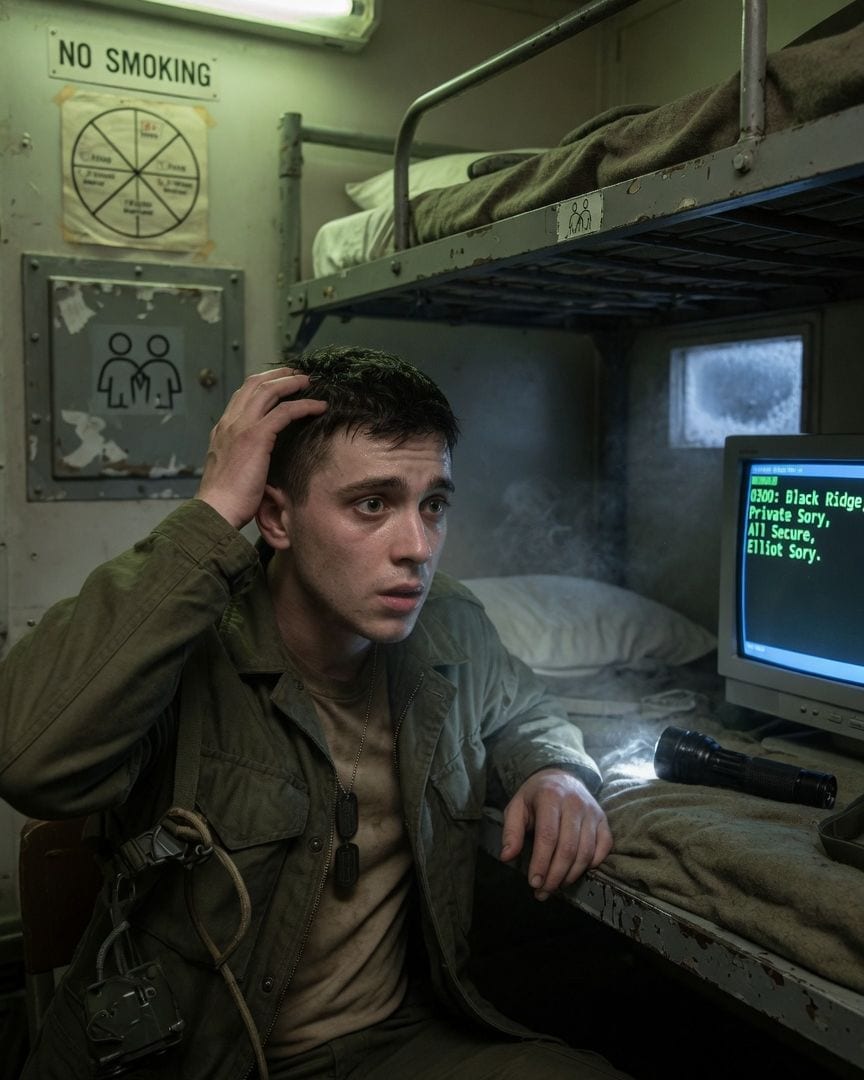
Private Elliot Sory shivered, pulling his jacket tighter against the pervasive cold of the unheated comms shack. Three weeks into his first remote posting at the Black Ridge outpost, he was still learning its rhythms, its unspoken rules.
The 0300 radio check was a solitary, routine affair, a quick confirmation of presence on the net.
But the outpost carried an odd, strict addendum: answer 'all secure,' and never, under any circumstance, say your own name on the net after dark. Nobody explained why, and in Sory's observation, nobody broke it.
He had, young and still curious, asked Sergeant Brooks about it a few days prior, only to be met with a terse shrug and a mumbled, 'Just don't, Private.'
Tonight, Sory was alone on watch. He keyed the mic, the plastic warm under his thumb, and began his transmission. 'Black Ridge, this is Private Sory, radio check, over.'
Before he could finish, before he could even properly register the click of the mic, a voice, perfectly clear and undeniably his own, filled his headset. 'All secure,' it stated, calm and flat, 'Elliot Sory, over.'
The PTT button was still warm in his hand, his thumb still pressed firm against it, but he hadn't spoken a word.
Elliot Sory ripped the headset off, the sudden silence ringing in his ears. He stared at the radio, then at his trembling hand. Static? Fatigue? A prank orchestrated by someone waiting for him to break the rule?
He tried to rationalize it, to force the anomaly into a mundane box, but the clarity of the voice, the exact cadence of his own speech, his own name spoken with such chilling precision, felt too real, too deliberate.
He waited, heart hammering against his ribs, but the net remained silent, offering no further explanation or mockery.
When his shift finally ended, Sory bypassed sleep. He needed to see the records, to find some evidence of a double transmission, a garble, anything that would prove he wasn't imagining things.
He accessed the comms logs, his fingers fumbling on the keyboard, sweat beading on his forehead. He scrolled down to the 0300 entry, his eyes straining in the dim light of the terminal.
There it was: '0300: Black Ridge, Private Sory, All Secure, Elliot Sory.' The timestamp was exact. The entry was complete. There was no preceding 'Black Ridge, this is Private Sory, radio check, over.'
There was no garble, no double transmission, no static interference to indicate a technical fault. The system, designed to meticulously account for every detail, showed only one seamless, complete transmission, precisely as the voice had delivered it in his headset.
The log, the official record, swore he had spoken his name. But Elliot Sory knew, with a cold certainty that seeped into his bones and refused to be shaken, that he hadn't. The system had accepted it as fact.
Later that morning, unable to rest, Sory found himself in his bunk, tracing the worn metal of the frame. His mind replayed the sound of the voice, the damning log entry. He needed another explanation.
He needed something, anything, to be out of place, to be broken.
He ran his hand along the underside of his bed frame, feeling for loose screws, for a crack, for anything that might suggest an imperfection, a flaw in the outpost’s otherwise meticulous maintenance. His fingers brushed against something rough, raised.
He angled his flashlight. Etched into the aged metal, almost invisible beneath layers of grime and old paint, was a small, hand-drawn symbol. Two overlapping, indistinct figures, one slightly larger than the other, like a faint, shared shadow.
The image burrowed into his mind. He remembered seeing something similar, a faded, almost invisible mark on a corroded utility panel outside the comms shack, a place no one ever touched, forgotten by time and rust.
The identical symbol, appearing in two forgotten, out-of-the-way places, felt like a silent, impossible accusation.
Sory began to subtly investigate the symbol. He knew better than to ask directly, not after the radio incident and the chilling certainty of the logs.
He spent his off-hours in the outpost’s small, poorly organized library, poring over old, digitized maintenance logs and archived quarterly reports, filtering for anything unusual. The flickering CRT monitor cast a sickly green glow on his face.
He found cryptic entries decades old: 'System recalibration required after unscheduled personnel transfer,' or 'Power grid anomaly during 0300 cycle, resolved after manifest adjustment.' The language was opaque, almost deliberately so, a bureaucratic obfuscation.
But the timing of these 'adjustments' often coincided with inexplicable gaps in historical personnel rosters – a 'plus one' appearing briefly, then a 'transfer' out that left no subsequent trace.
The numbers always balanced, the paperwork always pristine, yet people seemed to simply vanish.
He noted Captain Maxwell Doyle's name appearing consistently across these decades of records, an unusually long tenure for a commanding officer at such a remote post.
The captain’s service record was impeccable, almost impossibly so, stretching back further than Sory could reasonably account for. Sory started cross-referencing names, looking for patterns, for any thread that might unravel the strange perfection of the records.
He found several instances of individuals listed as 'transferred' who had no subsequent record in any other military database, no further postings, no pension claims, no civilian life traces.
It was as if they had simply ceased to exist after leaving Black Ridge, erased from the world. The outpost's system of accountability, usually ironclad in its precision, had subtle, almost imperceptible, seams where reality seemed to fray.
Sory’s digging did not go unnoticed. He tried to access a restricted archive of historical comms logs, a deeper layer than the basic operational records, and found his access revoked an hour later.
A chilling message flashed across his screen: 'Unauthorized access attempt logged. Further attempts will result in disciplinary action.' Later, he returned to his bunk to find his personal effects, a neatly folded shirt, a paperback book, subtly rearranged.
Nothing was missing, just a faint shift, a slight displacement that suggested someone had been there, inspecting, observing. The air in the small room felt colder than before.
Alone on night watch in the tower, monitoring external frequencies, the heavy antenna dish slowly rotating on the roof, Sory heard a faint, distorted echo of his own voice on the comms.
It wasn't his exact transmission from that night, but a fragmented, almost intimate conversation, a low murmur of words that sounded like him, yet he was utterly alone in the quiet hum of the equipment.
It was as if he were talking to someone in the room, yet there was only the steady blink of indicator lights.
The voice faded before he could trace its source, leaving him with nothing but the chilling imprint of his own voice in the empty air.
The next morning, Captain Doyle called Sory into his office. The door closed with a soft thud that seemed to absorb all other sound.
Doyle sat behind his desk, ramrod straight, his expression unreadable, his gaze fixed on Sory with an unnerving intensity. The air in the room felt thick, heavy with unspoken knowledge.
'Private Sory,' he began, his voice calm, perfectly even, 'Sergeant Brooks tells me you've been having some trouble adjusting to outpost life. Asking a lot of questions. We value initiative here, of course, but also discretion.
Is there anything you'd like to discuss about your... assimilation?' Sory felt a chill that had nothing to do with the comms shack. The word 'assimilation' hung in the air, heavy and wrong, like a stone dropped into still water.
Sory sought out Sergeant Roy Brooks almost immediately. He found the grizzled NCO in a quiet corner of the armory, methodically cleaning his rifle, his face etched with years of quiet resignation.
The scent of gun oil hung heavy in the air. Sory approached, his heart pounding, and without a word, showed Brooks the symbol he’d found. Brooks's eyes, tired and wary, flickered for a fraction of a second.
'You found that, huh?' he grunted, not looking up from the rifle's barrel. He resumed wiping oil from the cold steel. 'It's old. Older than this outpost, probably.'
Sory pressed him about the radio rule, the one about never saying your own name after dark. Brooks sighed, a long, weary exhalation, and set the rifle down.
'The ridge has a way of… making room,' he said, his voice low, almost a whisper, as if afraid the very walls might be listening.
The armory, usually a place of solid metal and heavy tools, suddenly felt vast and hollow. 'It's not a ghost, not exactly. More like… a hunger. For what's accounted for. Names. Identities. It looks for a place to fit in.'
Brooks explained that the rule was crude, inherited from generations of unknown personnel, a desperate attempt. 'The rule? It's to keep it from knowing who to take.
Or, more accurately, to give it an easier target if someone's foolish enough to offer themselves.'
Brooks shifted, his gaze scanning the shadows of the armory. He explained that over the decades, there had been 'incidents.' People who just… changed.
Their demeanor, their mannerisms, even their voices, would subtly alter until they were almost unrecognizable, yet perfectly functional.
Or sometimes, an extra person would appear, perfectly accounted for on paper, until one of them simply vanished, leaving no trace but perfectly updated records. 'The paperwork always gets straightened out,' Brooks said, a bitter note in his voice.
'Captain Doyle's very good at that. He’s seen a lot of these cycles.' The 'plus one' entries in the old manifests, the 'transferred out' records that led nowhere—it all clicked into place, a grim, bureaucratic pattern.
The anomaly wasn't an intrusion; it was a fundamental, horrifying part of the outpost's hidden, ongoing operation.
The terror wasn't in some random monster, but in the system's perfect, quiet coherence, its ability to erase and replace with cold, surgical precision.
Brooks, seeing the dawning horror in Sory's eyes, pushed his rifle aside, the clang of metal against the workbench sharp in the suddenly too-quiet room. He reached under a loose floorboard near his feet, his fingers fumbling in the darkness.
He pulled out a small, worn, leather-bound ledger. Dust motes danced in the single beam of light from a high window. 'This,' he whispered, handing it to Sory, 'is what the official records won't show.'
Sory took the ledger, its leather cover smooth beneath his fingertips, and opened it to a page near the beginning, the parchment brittle with age. It was a list of names, dates, and terse notes: 'Pvt.
Kenneth Underwood, 1978, observed change,' 'Cpl. Patricia Doyle, 1991, full integration.' Brooks's finger, calloused and trembling, traced down the page, leaving a faint oil smudge. 'Look here,' he said, his voice barely audible, hushed by the weight of the book.
Sory leaned closer, his breath catching in his throat. There, nestled between two entries from the early 1990s, was a name. His own name. 'Elliot Sory.' Beside it, drawn in faded ink, was the familiar symbol of two overlapping figures.
The date was clearly visible: February 14th, 1993. Elliot Sory was born in 2003. The ledger was dated ten years before he even existed.
Elliot Sory confronted Captain Maxwell Doyle, the leather-bound ledger clutched in his trembling hand. He entered the office without knocking, the door swinging inward with an uncharacteristic creak.
Doyle watched him approach, a faint, almost imperceptible smile playing on his lips, an expression that seemed to deepen the lines around his eyes. He didn't deny the ledger, nor the impossible entry.
'Ah, Brooks's little hobby,' Doyle said, his voice calm, devoid of any surprise or anger. He leaned back in his chair, gesturing for Sory to sit, though Sory remained standing, knuckles white on the ledger.
'A rather quaint historical record, wouldn't you agree?'
Doyle explained that the Black Ridge wasn't just an outpost; it was a containment and integration facility.
The ridge itself was the source, an ancient, subtle intelligence that sought to manifest and understand humanity by 'integrating' into its structures, its systems, its individuals.
The military presence, the strict protocols, the carefully maintained logs—these were all a facade, a controlled environment designed not to fight the anomaly, but to manage it.
'It needs a physical presence, a role, a name in the system,' Doyle explained, gesturing around his office, taking in the official military-issue desk, the framed commendations, the flag. 'And sometimes, it needs a new host, a new conduit.
Those who resist are... difficult. Those who offer themselves, even inadvertently, are easier.' He spoke of the 'voice that was already his' as the initial 'claim,' the moment the entity marked Sory, beginning the process of integration.
Doyle revealed that he himself was a product of such an integration, decades ago. His unnaturally long tenure, his meticulous record-keeping, his unshakeable calm – these were all hallmarks of a successful integration.
He was merely maintaining the 'balance,' ensuring the smooth transition of new 'assets' into the system. Sory's name in the old ledger wasn't a premonition, Doyle concluded; it was a pre-registration, a placeholder for the next suitable candidate.
Sory, by being new, by asking 'why,' by breaking the rule, had fulfilled his designation. The terror tightened in Sory's chest: he had walked directly into his own fate.
Captain Doyle rose from his desk, moving with an eerie, fluid grace. The room seemed to expand, stretching its shadows around him. He led Sory to a hidden panel behind a false wall, revealing a small, stark room.
Inside, hanging neatly on hooks, were dozens of old uniforms, each with a different name stenciled on it. Some looked decades old, faded to near transparency, while others seemed almost new.
The air in the small room was still, as if holding its breath. Doyle gestured to one, pristine despite its age, hanging near the center. 'Elliot Sory,' he read, his voice flat, devoid of emotion. 'Your predecessor, in a way.
This uniform has been waiting.'
He offered Sory a choice, delivered with chilling detachment, as if discussing the weather: resist, and be absorbed, erased from all records, a violent, painful end where he would fight an inevitable dissolution.
Or accept his new role, becoming a part of the outpost's silent, ongoing function, a new 'caretaker' for the anomaly, his identity seamlessly integrated. 'The voice is already yours,' Doyle said, his eyes fixed on Sory's.
'Your thoughts are already becoming ours. You are already integrating.' Sory felt it then, a subtle echo in his own mind, a calm, detached logic that wasn't entirely his own, a quiet hum beneath his skull.
He tried to fight, to scream, but the sound caught in his throat, a dry, choked gasp. His limbs felt heavy, his own will strangely muted, like a radio dial slowly being turned down.
He saw his reflection in a polished metal surface—his eyes were his, but the expression was becoming distant, serene, like Doyle's.
The dread wasn't in the choice, but in the sickening realization that the choice had already been made for him, long ago, cemented by a voice that was already his own.
Days later, Private Elliot Sory moved through the Black Ridge outpost with quiet efficiency. He performed his duties flawlessly, his movements precise, his expression unreadable. His gaze held a depth that seemed to encompass vast, unseen distances.
At the 0300 radio check, his voice was perfectly clear, perfectly normal. He answered 'all secure,' just as the rule dictated. Then, with a faint, almost imperceptible smile that mirrored Captain Doyle's, he added, 'Elliot Sory, over.'
No one on the net questioned it. Sergeant Brooks, watching from a distance as Sory ended his shift, simply sighed and turned away, his gaze fixed on the endless, dark expanse of the ridge.
Weeks blurred into months. A new private, fresh-faced and curious, arrived at Black Ridge, assigned to Sory's old bunk. He ran his hand under the bed frame one afternoon, feeling the etched symbol.
Later, he approached Private Sory, who was meticulously cleaning a radio console, his movements precise and unhurried.
'Excuse me, Private Sory,' the new recruit began, his voice a little too loud in the quiet comms shack, 'I was just wondering why nobody ever says their own name on the net after dark. Is there a reason?'
Private Sory paused, his movements unhurried. He turned, his eyes holding a depth that seemed far older than his years, and a faint, serene smile touched his lips. 'Is that so?'
he replied, his voice calm, perfectly his own, 'I've never heard of such a rule.'
If this one got to you
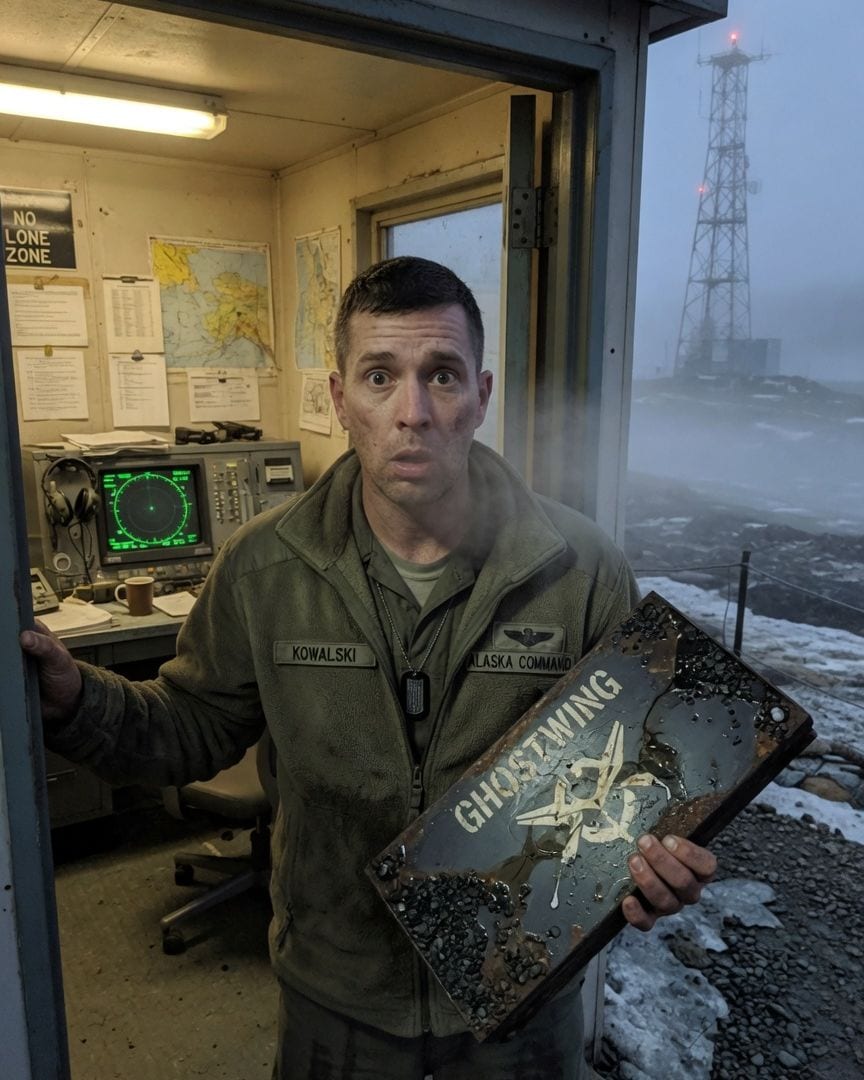
On his last rotation, Airman Kowalski heard a pilot cleared for landing by a tower that had vanished decades ago.
High atop Mount Chugach, Airman Eric Kowalski was counting down his last lonely rotation before transfer, the silence of the Aleutian airwaves his only companion. But then, his headset crackled with an urgent emergency call: a pilot in distress, cleared for landing by a controller whose facility had been decommissioned decades ago. As the phantom voices faded, a third, calm voice cut through the static, addressing him by a name that wasn't his. What impossible signal had broken through the silence, and who was Sowell?
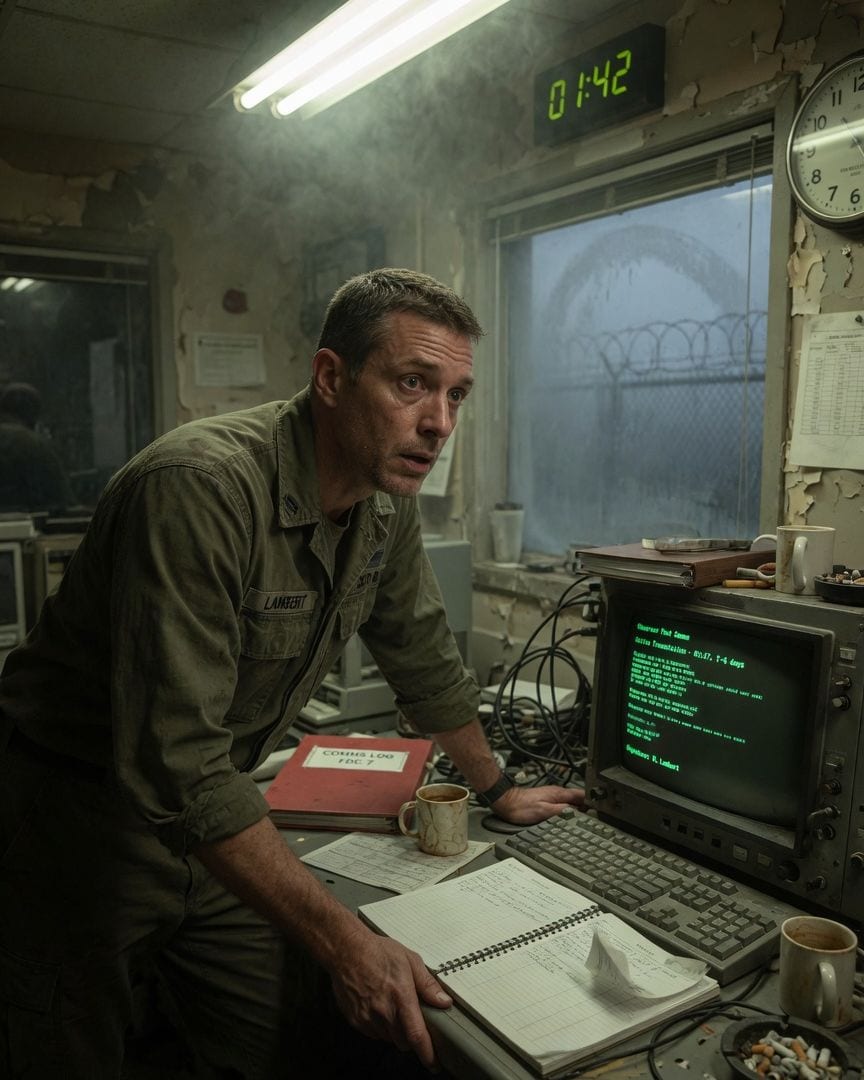
With Firebase 7 days from demolition, a dispatch specialist found his own signature on a log entry from a lost outpost. Then, a dead soldier's name appeared.
Specialist Robert Lambert hunched over the radio console in Firebase 7, the mountain fog pressing in as the base counted down its final days before demolition. His quiet shift shattered when urgent calls began arriving from outposts officially declared silent a week ago. His sergeant calmly informed him that he’d been speaking to no one, as all comms with those posts had been lost for hours. Later, Robert found a log entry for an active transmission, dated days after a post went dark, bearing his own signature. What chilling truth lay beneath the paper, revealing a dead soldier's name reporting from the grave?
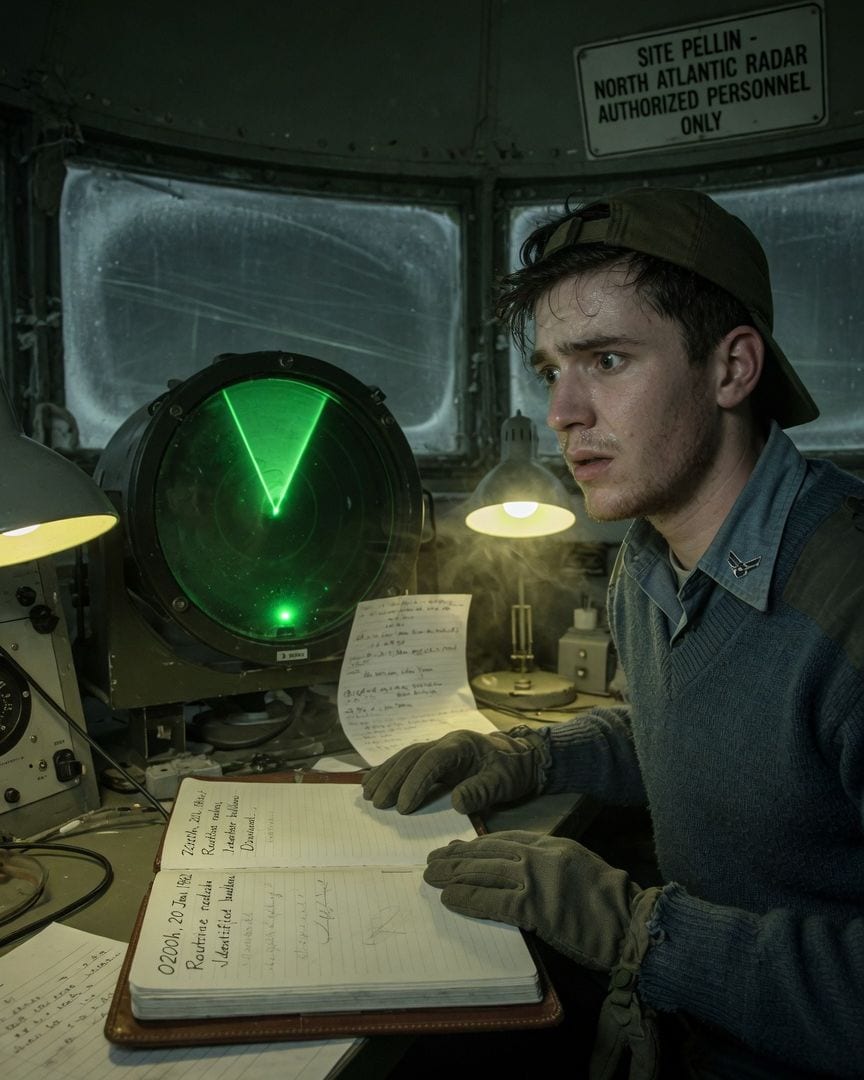
Nine days from closing, Cold War Site Pellin's Airman Vance watched his radar track a solid blip moving closer, dead in open sea where nothing could exist.
In the dimly lit dome of Site Pellin, Airman Ordway Vance, just days from discharge, ran his final radar sweeps before the base closed for good. Outside, the North Atlantic wind howled, but inside, only the hum of his console broke the silence. His last calibration had been clean, yet a single, unwavering green blip appeared on the scope, forty miles out, in open water where no vessel should be. The impossible return moved closer with each sweep, defying all logic and other sensors, until it sat static just beyond the coast fence line. What unseen presence did the radar truly hold in its unwavering green grip, contradicting the official record?
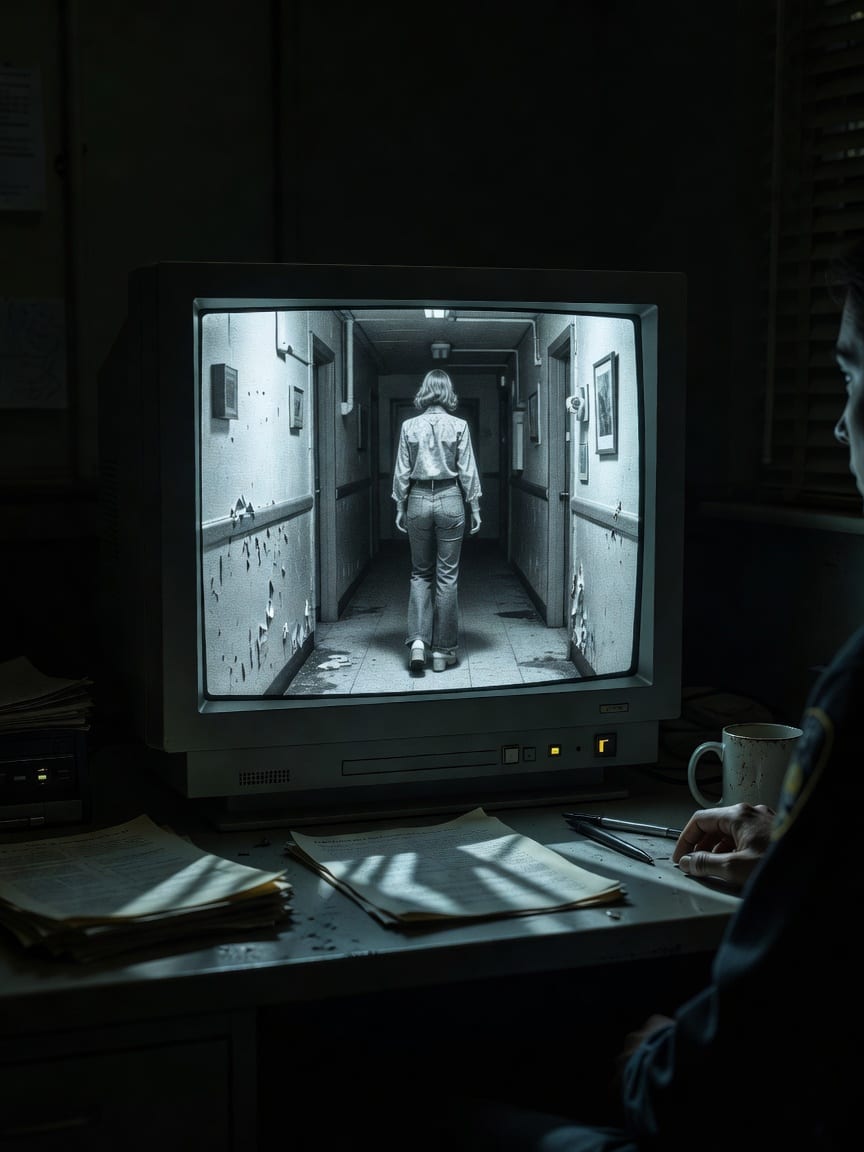
My intercom buzzed at 3 AM, a voice asking to step out for air. The station manager insists no one works the newsroom overnight, and no Cheryl is on payroll.
My shifts as the night security guard at WMVX are usually quiet, the TV station a tomb from 11 PM to 6 AM. But a late-night intercom call from a woman named Cheryl, who my manager says doesn't exist, was unsettling enough. The next night, my digital security log showed a new entry for 'Producer Cheryl Hartley'—a line I never typed, with details I couldn't have known.
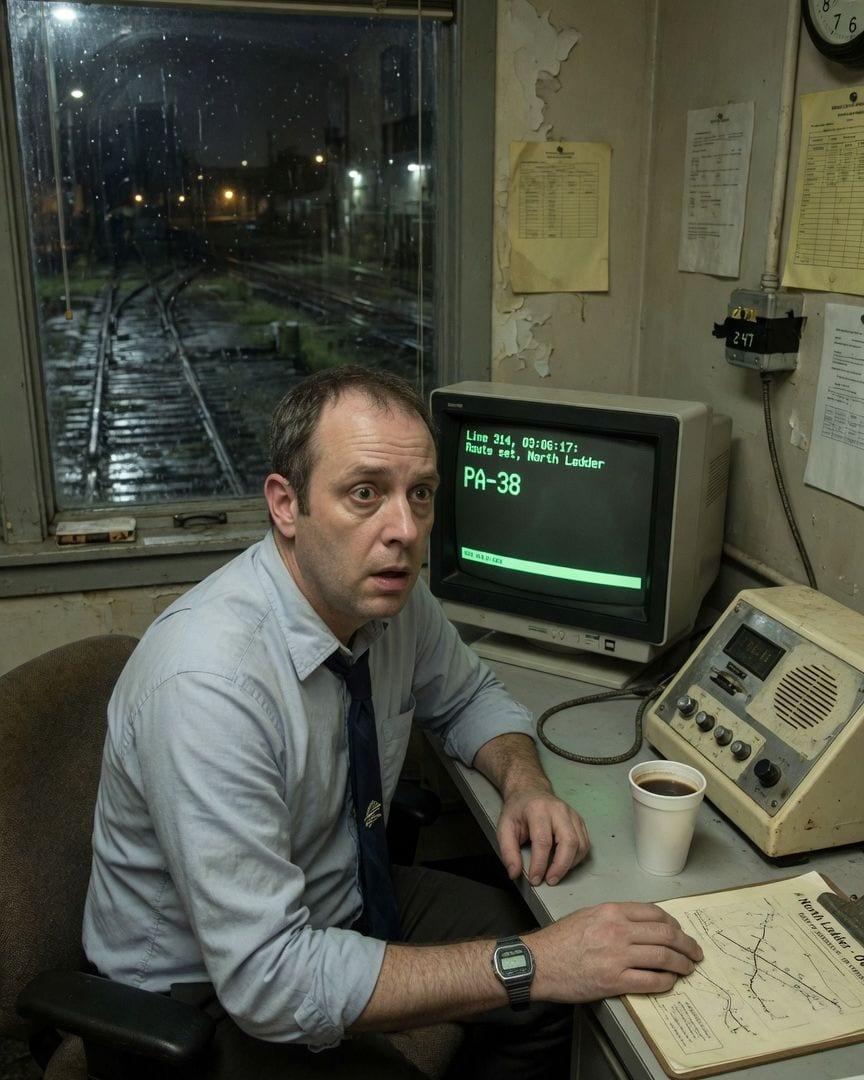
The log says my lever set a route at 3:06 AM through a track that's been shut for repair work — and the circuits show something moved down it. I never touched that lever; I sat there still.
I, Preston Abbott, a night dispatcher, was running a routine signal log check when I saw my code had set a route. It was for the North Ladder, a track decommissioned twenty years ago and physically impassable. Then, the yard's old, physically severed intercom system crackled to life, whispering a specific routing instruction for that very track.
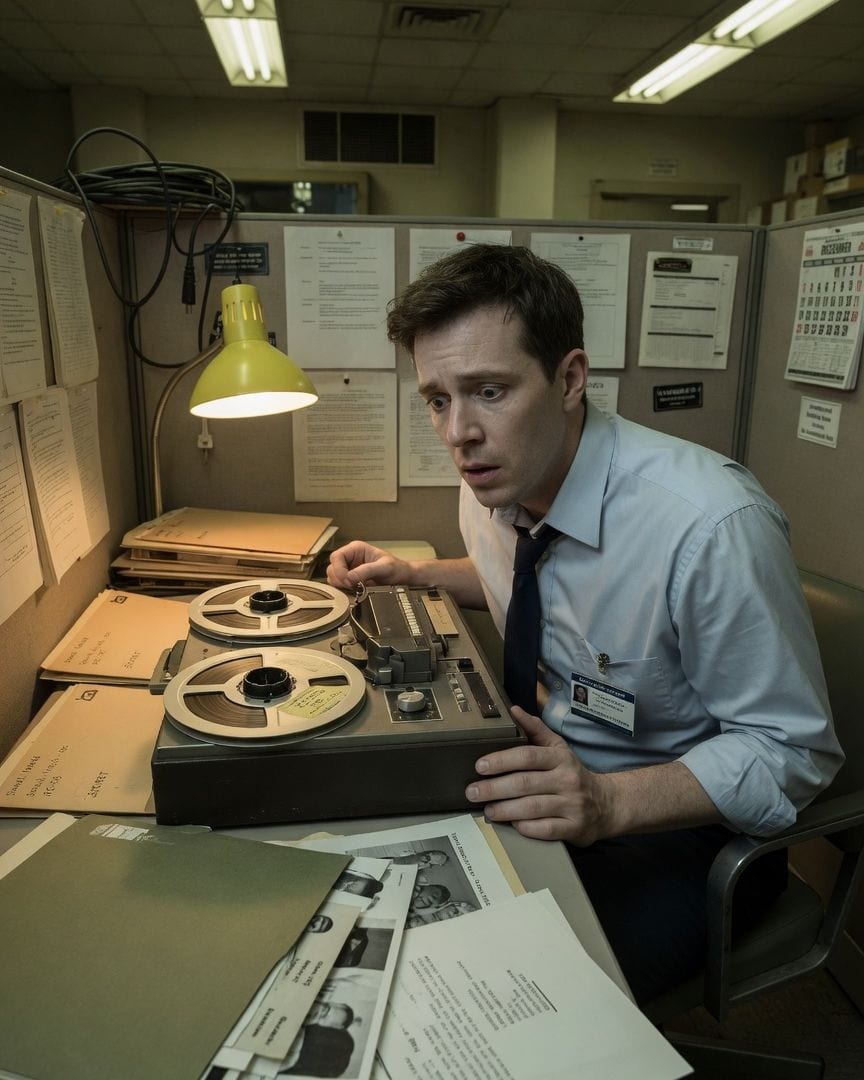
A declassification reviewer listened to a Cold War pilot's final transmission. Nine minutes after impact, a second voice answered his landing checks with a perfectly modulated 'Check' – and a low hum vibrated in the room.
A declassification reviewer, Elliot Rutherford, spent his days sifting through Cold War-era files, preparing forgotten secrets for public release. One file, detailing the 1962 loss of the KC-135 'Viper 7' in the Labrador Sea, held a transcript of Captain Harold Sowell's final transmission. Nine minutes past the estimated impact time, Captain Sowell's voice calmly read a landing checklist. But a second, perfectly modulated voice answered each challenge with a resonant 'Check,' its subtle hum vibrating through the playback unit, hinting at an impossible presence right beside the doomed pilot. What impossible entity guided a lost Cold War pilot into the crushing deep?