With Firebase 7 days from demolition, a dispatch specialist found his own signature on a log entry from a lost outpost. Then, a dead soldier's name appeared.
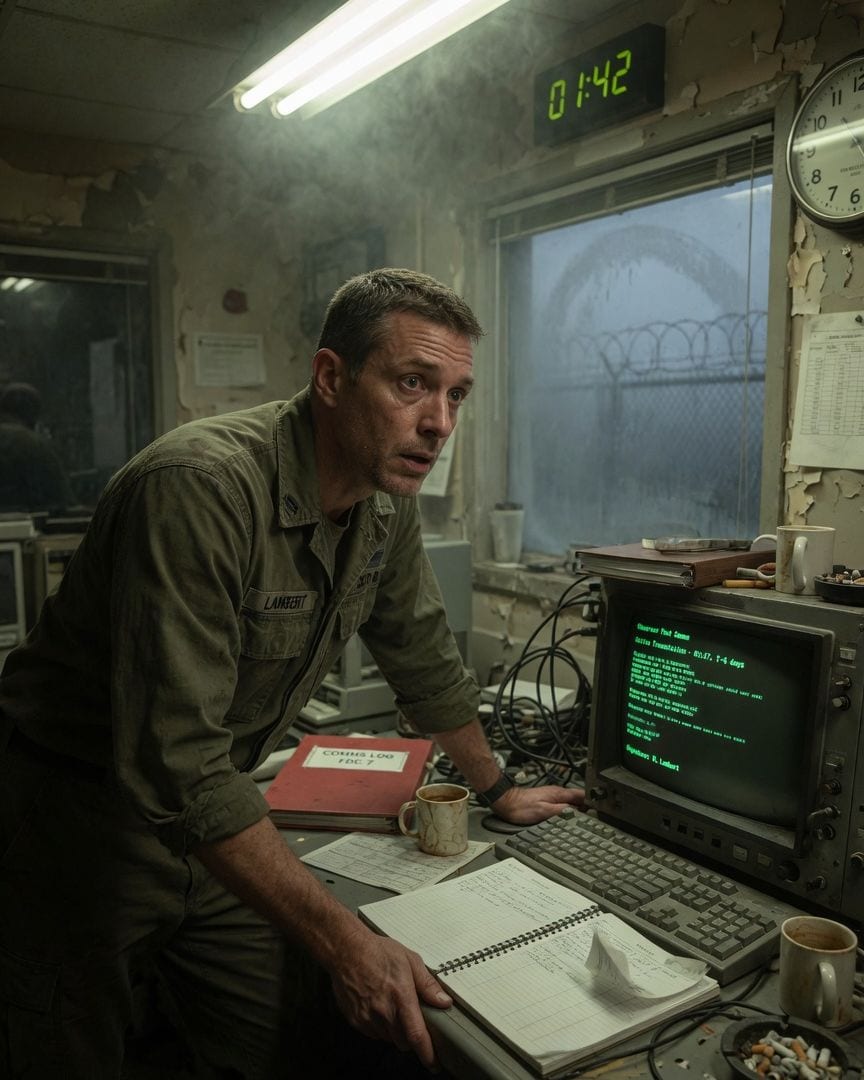
Specialist Robert Lambert hunched over the radio console in the Firebase 7 Dispatch Center, the air thick with the mountain fog that pressed against the windows.
The base was due to be torn down at week's end, lending a hollow echo to every sound. His shift had been quiet until just before midnight, when calls began arriving on the net.
They weren't routed through Control, as they should have been, but came directly from Observer Posts Alpha, Beta, and Gamma.
Each voice, distinct and urgent, crackled with reports of the same enemy element moving through 'The Serpent's Draw' – the very place where a patrol had been wiped out just last week.
Robert keyed his mic to Control, a knot forming in his stomach. "Sergeant Romano, why are we letting the OPs talk over the net? And on unapproved channels?"
Static answered him for a moment, then Sergeant Hugo Romano’s voice, calm and unsettling, replied. "Lambert, I haven't heard a peep from Alpha, Beta, or Gamma for hours. Lost comms with all of them.
I've been sitting here in silence, listening to you talk to no one."
As Romano spoke, another voice, strained and frantic, cut through the net from Observer Post Alpha. "Contact! Enemy in the draw, moving fast—" The transmission ended abruptly in a burst of white noise.
Robert’s skin crawled. He tried to rationalize it – a cross-frequency bleed from a nearby commercial signal, a faulty antenna array somewhere on the fog-shrouded mountain, or even a morbid prank from a departing unit.
But the voices were too clear, too specific, too many, and Control’s silence on his end was too absolute. He spent the rest of his shift cross-referencing comms logs against the FDC’s master record.
Every incoming call, every outbound transmission, every lost signal was meticulously documented in the system.
He found the entries for Observer Posts Alpha, Beta, and Gamma, exactly as Sergeant Romano claimed: 'Comms Lost - 22:00, T-7 days,' recorded precisely when contact had been officially broken a week prior.
Robert scrolled down, his fingers tapping the cold keyboard. The entries were chronological, precise. He passed a routine weather check, then another. And then he saw it.
Tucked between those two unremarkable records, an entry glowed on the screen: 'Observer Post Gamma - Active Transmission - 01:17, T-6 days.'
Two days after comms were officially lost.
The entry detailed a 'reconnaissance patrol' report from Gamma, describing enemy movement in 'The Serpent's Draw.' What truly made Robert's breath catch, turning the air cold in his lungs, was the signature listed beneath the impossible log entry: 'R. Lambert.'
His own signature, copied with unnerving accuracy, scrawled beneath the time stamp. He knew, with a sudden, chilling certainty, that he had been off-shift that night, asleep in his bunk, a full rotation away from any console.
He had never signed this.
The next morning, driven by a cold, undeniable certainty, Robert requested access to the physical comms logbooks for Firebase 7. Captain Catherine Hale, the firebase commander, granted it with a weary sigh, attributing his insistence to "end-of-rotation jitters."
He walked through the FDC, past the silent consoles, the fog still thick outside the windows, and found the storage locker.
He thumbed through the heavy, bound volumes, his fingers tracing the familiar entries, until he found the page he'd seen on the digital record.
There it was, in faded but clear ink: the 'Observer Post Gamma - Active Transmission' entry, dated 01:17, T-6 days. And beneath it, his signature, undeniable in its form, yet a complete fabrication in its origin.
But as he ran his thumb over the paper, a strange detail caught his eye. He noticed a faint, almost imperceptible indentation on the page, like a ghost impression pressed into the thick paper.
He held the logbook up to the harsh fluorescent light of the FDC, tilting it slowly. On the page directly beneath, where the pressure from the pen had transferred through, a faint, barely legible imprint of text was visible.
It wasn't the next log entry. It was a fragment of a name, 'Marsh, A.' and a partial service number, followed by 'Reporting from…' Robert knew that name. Private First Class Adam Marsh.
He was one of the soldiers wiped out in The Serpent's Draw, a week ago.
Robert photographed the logbook page with his phone, documenting the impossible entry and the ghostly imprint of the dead man’s name. He then cross-referenced Adam Marsh’s service record on the FDC terminal.
Marsh’s last official duty log entry was indeed dated a week ago, hours before the patrol was wiped out. There was no 'Reporting from…' entry, or any record of him after that last fateful mission.
He approached Captain Hale, presenting his findings with a tightly controlled tremor in his voice.
Hale, a pragmatic officer who valued efficiency above all, initially dismissed it as a clerical error, a misfiled report, or even a morbid prank from a departing soldier. Her eyes were tired, dark circles beneath them.
"Lambert, these posts are abandoned. The men are gone. It's just paperwork, you're looking too hard," she insisted, rubbing her temples as if to ward off a headache.
But Robert pressed, detailing the phantom radio calls, the forged signature on the comms log, and now the undeniable imprint of a dead man's name in a book he shouldn't have been able to access.
He showed her the photograph on his phone, enlarged and clear. Hale, seeing his genuine distress and the unsettling coherence of his evidence, agreed to a deeper dive. The air in her office felt suddenly colder.
She pulled up the firebase's comprehensive resource logs, navigating through several layers of secure menus. What they found was unsettling. Despite the official decommissioning process being well underway, there were minor but consistent discrepancies.
Fuel consumption for vehicles that hadn't moved in days, ration requisitions for personnel numbers that didn’t quite match the dwindling manifest, and, most disturbingly, a small but regular draw on power from the grid feeding the now-empty observer posts, long after their official shutdown.
"It's a rounding error," Hale muttered, but her brow furrowed deeply, her usual composure cracking slightly. "Or someone's siphoning supplies before we shut down. It wouldn't be the first time."
The room itself seemed to hold its breath around them, the hum of the old server rack a low, watchful growl.
Captain Hale ordered an internal audit, but she maintained a skeptical front to the rest of the dwindling command staff. Robert, however, felt a profound shift in his perception of the firebase. He noticed small, unsettling things now.
His personal gear in his bunk, a neatly folded uniform, had been subtly rearranged, folded with a precision he hadn't used. A folder of his own service records, usually tucked away, was left open on his desk.
A faint scent of old canvas and damp earth, like the smell of a recently vacated foxhole, clung to the air in the FDC when no one else was present, a smell the disinfectant spray couldn't quite erase.
He began to feel watched, an unsettling awareness that was more than just paranoia. The fog outside the windows seemed to press closer, thicker.
One evening, as he left the FDC, heading for his bunk, he saw a shadow detach itself from the edge of the fog-shrouded tree line.
It moved with a gait that was too stiff, too regular, a mechanical precision that felt deeply unnatural, before vanishing back into the swirling mist. He paused, his heart thumping, and instinctively drew his sidearm. Nothing.
The silence of the mountain settled back in, heavy and unbroken. He checked the perimeter cameras on a nearby monitor. A brief flicker, then clear footage of an empty, fog-bound landscape, the trees still and silent.
Later, back in his bunk, the unsettling presence followed him. He found a small, folded piece of paper tucked under his pillow. It was a crudely drawn map of Firebase 7, with a bold red X marking 'The Serpent's Draw.'
And scrawled beneath it, in a hand that looked eerily like his own, were the words: 'ACCOUNTED FOR.' The message was direct, personal, and utterly chilling.
Someone, or something, knew exactly what he was uncovering, and it was watching him closely, marking him.
Shaken, Robert confronted Captain Hale again, his hand trembling slightly as he showed her the map. This time, her skepticism shattered. Her face went pale as she studied the crude drawing and the chilling message.
She led him to her office, locking the door behind them with a decisive click that echoed in the sudden quiet.
"Lambert, this firebase… it has a history," she said, her voice low and strained. She pulled a dusty, unclassified file from a locked cabinet, its metal protesting with a groan. "Every few rotations, the same patterns emerge.
Phantom radio signals, resource drains, reports of patrols in impossible places, always around 'The Serpent's Draw.' Command always writes it off as a combination of stress, isolation, and 'local folklore.' They call them 'The Grey Patrol stories.'"
Hale flipped through the file, the dry paper rustling, showing him reports from decades past – similar accounts of impossible comms, 'misplaced' personnel, and 'clerical errors' in duty logs.
Each one ended with the transfer or disappearance of the reporting officer. The names and dates blurred, but the pattern was stark, undeniable.
"The last time it escalated this badly," Hale said, her finger tracing a faded report from fifteen years prior, "was when a supply sergeant reported a full company's worth of rations being drawn for an unassigned unit.
He went missing a week later. They found his service record updated with a transfer to a 'Special Reconnaissance Unit' that didn't exist, signed by him. His own signature, just like yours."
Robert’s mind raced, connecting the dots with sickening clarity: the radio calls from the dead, his forged signature on the comms log, the ongoing resource drains, the map under his pillow. The anomaly wasn’t random or fleeting.
It was a slow, methodical process of integration, using the system against itself. It was trying to become 'real' through the very paperwork designed to account for reality.
And it was targeting anyone who noticed the cracks, those who saw the reality beneath the official record. The air in the room grew heavy, the weight of decades of unknown history pressing down.
Captain Hale, now genuinely alarmed, agreed to help Robert. They decided their immediate next step was to access his complete digital service record, looking for any further anomalies before whatever this was could escalate.
As Hale navigated the secure military network, her fingers flying across the keyboard, Robert stood beside her, his breath held tight, the image of the 'ACCOUNTED FOR' map burned into his memory.
The screen refreshed, displaying his full file: deployments, commendations, medical history, and—
"What is this?" Robert pointed to a new entry, his voice barely a whisper. Under the 'Orders' section, a document was listed: 'Transfer Orders - Specialist Robert Lambert - Observer Post Gamma - Effective T-1 day.'
The date on the document was tomorrow.
Hale clicked on it. The PDF loaded instantly, official letterhead, specific transfer codes, and a detailed itinerary. And at the bottom, a signature block: 'Specialist Robert Lambert.'
His signature, perfectly replicated, as if he had signed it himself just hours ago. He had never seen these orders, let alone signed them. He stared at the screen, the pixels of his own forged name mocking him.
Hale quickly pulled up the firebase's current personnel manifest, a live document updated daily, showing every active soldier, their assignments, their transfers.
Robert Lambert's name was there, but it was highlighted, bolded, and beneath it, a new line: 'Transfers Pending: Observer Post Gamma.' His heart hammered against his ribs, a frantic drum in his chest.
He was officially accounted for, slated to be transferred to a post that didn't exist, where dead men spoke on the radio.
The system, the very bureaucracy he served, had already claimed him, and he was due to report in less than twenty-four hours.
The realization hit Robert with sickening clarity, cold and heavy in his gut. The anomaly wasn't just echoing the dead; it was actively recruiting new members through the very mechanisms of military accountability.
The Grey Patrol wasn't just a legend; it was a unit that the system itself was slowly, meticulously building, one 'transfer' at a time.
The forged signature on the comms log, the imprint of Marsh's name, the consistent resource drains, the 'Accounted For' note under his pillow – they were all steps in a systematic process of assimilation.
Hale, pale and grim, confirmed it. "This isn't just a ghost story, Robert. It’s a bureaucracy, a monstrous, unseen bureaucracy. It uses our own system against us. It makes it real by making it official."
She pointed to the transfer orders on the screen, the cold glow reflecting in her eyes. "If you report, if those orders are processed, you become part of their manifest. You disappear from ours. You become accountable to them."
Robert understood now. The radio calls from the dead patrol weren't just cries for help; they were a siren song, a roll call for the next 'recruits.'
The enemy in the draw wasn't just a memory of a past event; it was the mechanism of entry, the initiation point for those whose records were now being rewritten.
The firebase wasn't just being torn down; it was being purged, its records sanitized, because this place had become too 'active,' too efficient at generating its phantom unit.
Robert and Hale knew they had to act before his transfer became irreversible, before the system swallowed him whole.
Their immediate goal: erase his impending transfer from the system and destroy any physical records that linked him to Observer Post Gamma. They worked frantically, the clock ticking towards tomorrow's transfer.
Hale attempted to access the deeper layers of the personnel database to nullify the transfer, her fingers flying over the keyboard, but the system seemed to resist her, throwing up error messages.
Meanwhile, Robert focused on the FDC itself. He knew the source of the false comms and the forged logs had to be tied to the radio equipment, or perhaps a hidden terminal, some physical anchor for the anomaly.
He located an old, rarely used maintenance panel behind the main console, its screws rusted shut with age and disuse.
Prying it open with a multi-tool, he found not wires, but a small, heavy, leather-bound logbook, identical in size and cover to the official FDC comms logs, but utterly unmarked on its exterior.
He opened it.
Its pages were filled with faded, looping script, recording radio transmissions from 'Observer Posts Alpha, Beta, Gamma' – not from this rotation, but decades of them, each entry describing enemy movements in 'The Serpent's Draw,' each signed by different names, many of them familiar from Hale's 'Grey Patrol' file.
This was the artifact, the physical manifestation of the anomaly’s core. This was the true comms log for the 'Grey Patrol.'
As he stared at the names, a faint crackle emanated from the main console’s speakers. A voice, distorted but undeniably familiar, called his name. "Specialist Lambert. Report to Observer Post Gamma. Your transfer is complete."
It was his own voice, echoing back at him, hollow and cold. Panic surged through Robert, a primal scream caught in his throat.
Hale shouted from her terminal, her voice tight with terror. "Robert, I can't override it! The system's locked me out!"
He grabbed the logbook, feeling its cold, heavy weight. This was the link, the anchor, the heart of the system that had claimed him. He had to destroy it.
He found a jerrycan of fuel, meant for emergency generators, and doused the ancient book, the sharp scent of gasoline stinging his nostrils.
He fumbled for his lighter, his hands shaking, as the distorted voice on the radio grew louder, more insistent, repeating his name, "Lambert. Accounted for."
Robert ignited the fuel. The logbook flared with a whoosh, the old leather curling, the impossible entries turning to ash.
As it burned, the radio signals from the 'dead' posts ceased, replaced by a sudden, deafening static that quickly faded to silence. The phantom energy drain on the base grid flatlined, the hum of the FDC returning to normal.
Robert and Hale escaped Firebase 7 just hours before its scheduled demolition, their official records miraculously clean of the 'transfer' to Observer Post Gamma. The firebase was razed, its foundations blasted, the mountain returning to its fog-shrouded quiet.
No one else at Command questioned the minor discrepancies found during the final audit; they were simply attributed to the chaos of decommissioning a remote outpost.
Robert and Hale were both transferred to different units, miles apart, never to speak of what they found.
Years later, Robert Lambert sat in his quiet suburban home, far from any mountains or fog. He was a civilian now, a logistics manager, his military career a distant memory, but the dread never truly left him.
He still checked his personal records online, a ritual he couldn't break, just to make sure no new, impossible entries had appeared.
Sometimes, late at night, a wrong number would call, a crackle of static on the line, and he would hold his breath, listening for a voice that wasn't there.
He knew the system was vast, its records endless, and that something out there understood how to use it.
One day, while reviewing his old military service records, he noticed a faint, almost invisible watermark on a document: a tiny, stylized 'X' etched into the corner of the paper, barely visible unless the light hit it just right.
It was on his discharge papers. A subtle, permanent mark of having been 'Accounted For.'
If this one got to you
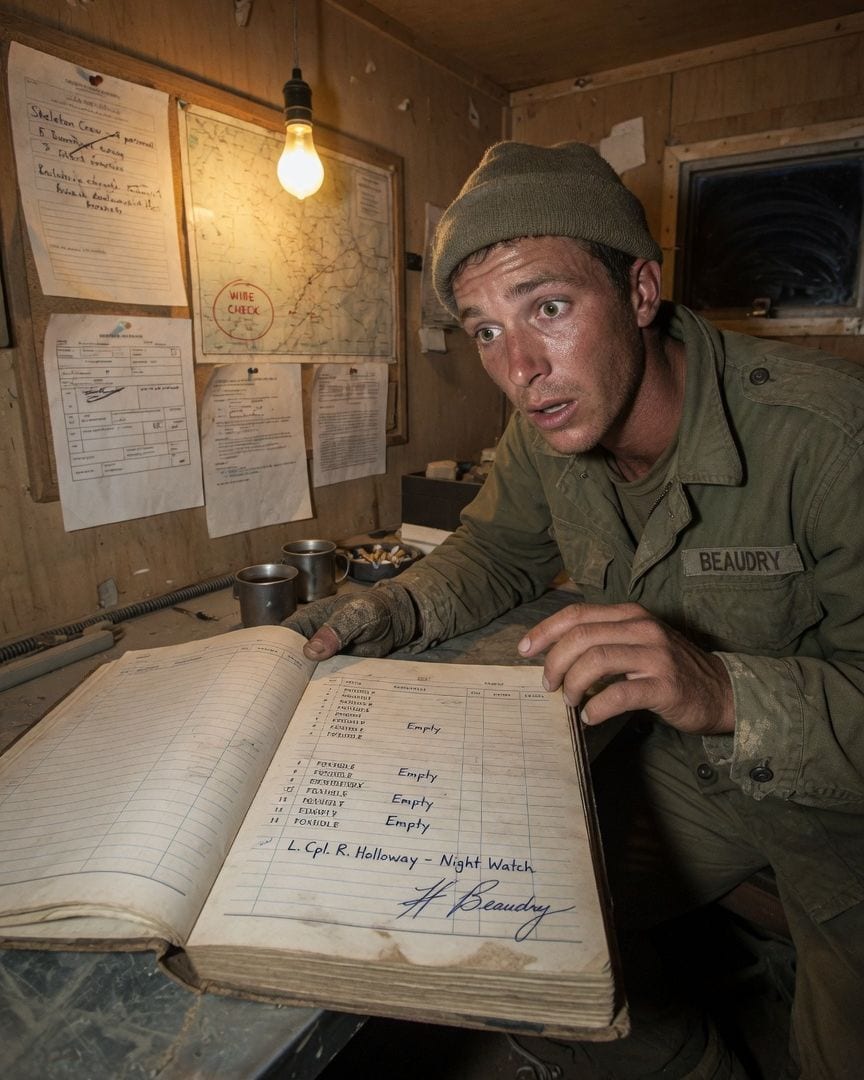
Lance Corporal Beaudry checks the perimeter's empty foxhole. The comm wire pulls back: a signal from no one.
Lance Corporal Hugo Beaudry moved along the perimeter of Firebase Kettle, a lonely outpost in its final drawdown. His solitary wire-check tonight was a routine task in the biting desert wind. He reached the third foxhole, empty for a week, and tugged its comm wire. Two distinct pulls answered back, sharp and unmistakable, from a position where no one remained. Back inside, Beaudry found his own precise signature in the duty log, assigning a Lance Corporal R. Holloway to that very foxhole – a man he'd never seen or heard of. The entry was perfectly aged, a cold dread of paper lying. Who was signalling from the empty hole, and why did his own hand confirm it?
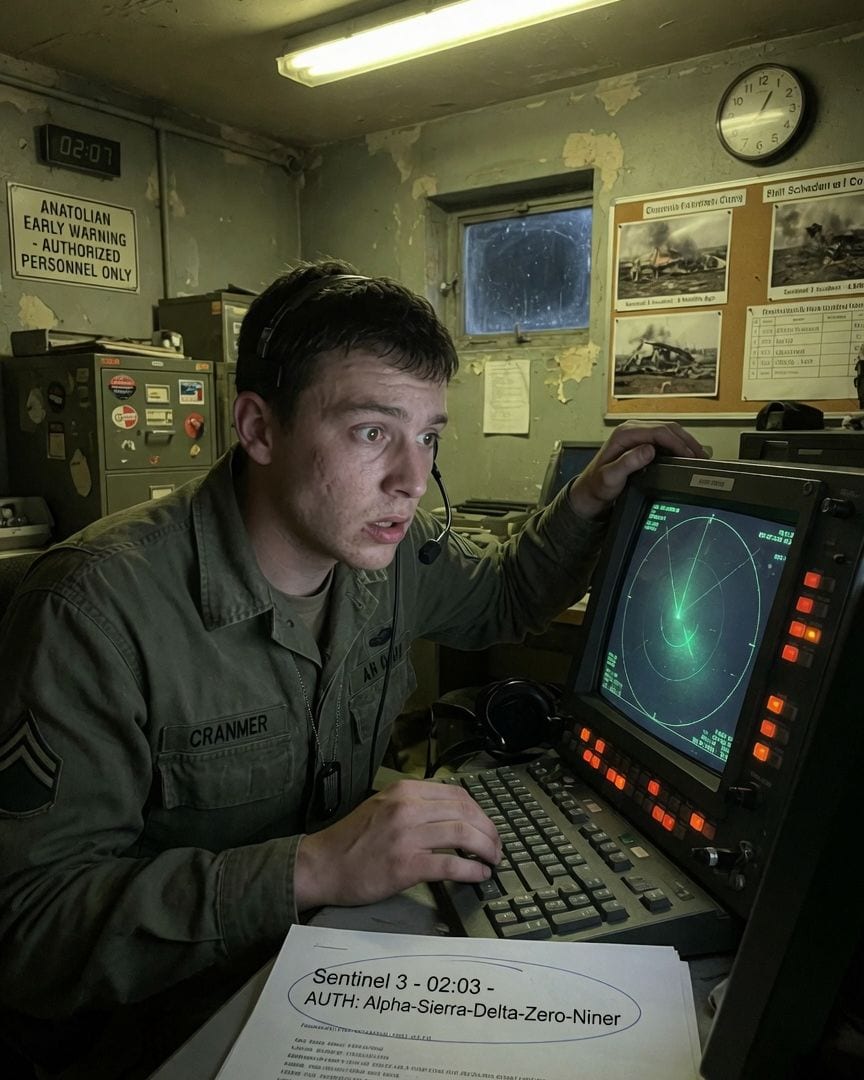
A radar specialist uncovers a dead man's logbook entry, dated two weeks after the fire that killed him. It asks, 'We're still here. What happened to us?'
Specialist Gideon Cranmer, just three weeks from his rotation, endured his overnight watch at an air-defense radar site in the desolate Anatolian highlands. As he monitored his radar console, a secure line crackled with a voice check from Sentinel 3, an adjacent early-warning station. Cranmer's blood ran cold: Sentinel 3 had burned to the ground eight months prior, killing its crew. Yet the voice gave exact coordinates and then whispered, "And has anyone ever found out what happened to us?" Despite his superior's dismissals, the call log confirmed the impossible.
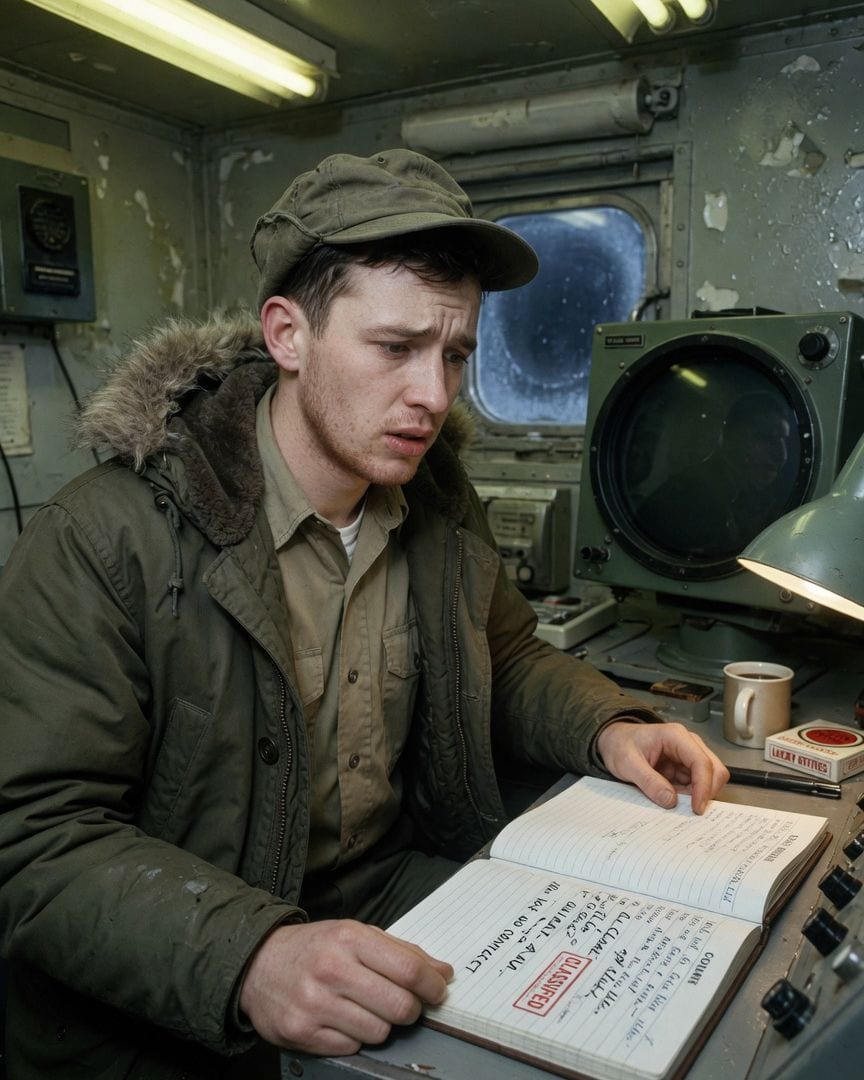
A Cold War airman logs an impossible radar contact on his last sweep. But his official logbook entry is stamped 'CLASSIFIED' and then contradicted by a hastily scrawled 'ALL CLEAR' dated moments before it.
Airman Ordway Vance, 22, manned the radar dome at Site Pellin in the biting North Atlantic dark of January 1962, running the last calibration sweep before its decommissioning. His scope picked up a faint, impossible return, growing closer with each pass, though the ocean remained empty to the eye. When Vance detailed the contact in his official logbook, a 'CLASSIFIED' stamp appeared, followed by a hastily scrawled 'ALL CLEAR' dated moments before his own entry, contradicting his every word. Commander Hartley dismissed it as equipment malfunction, but Vance sensed a chilling, official erasure behind the lie. He soon found a locked cabinet marked 'SITE PELLIN ANOMALIES,' hinting at a deeper truth buried within the base's final days.
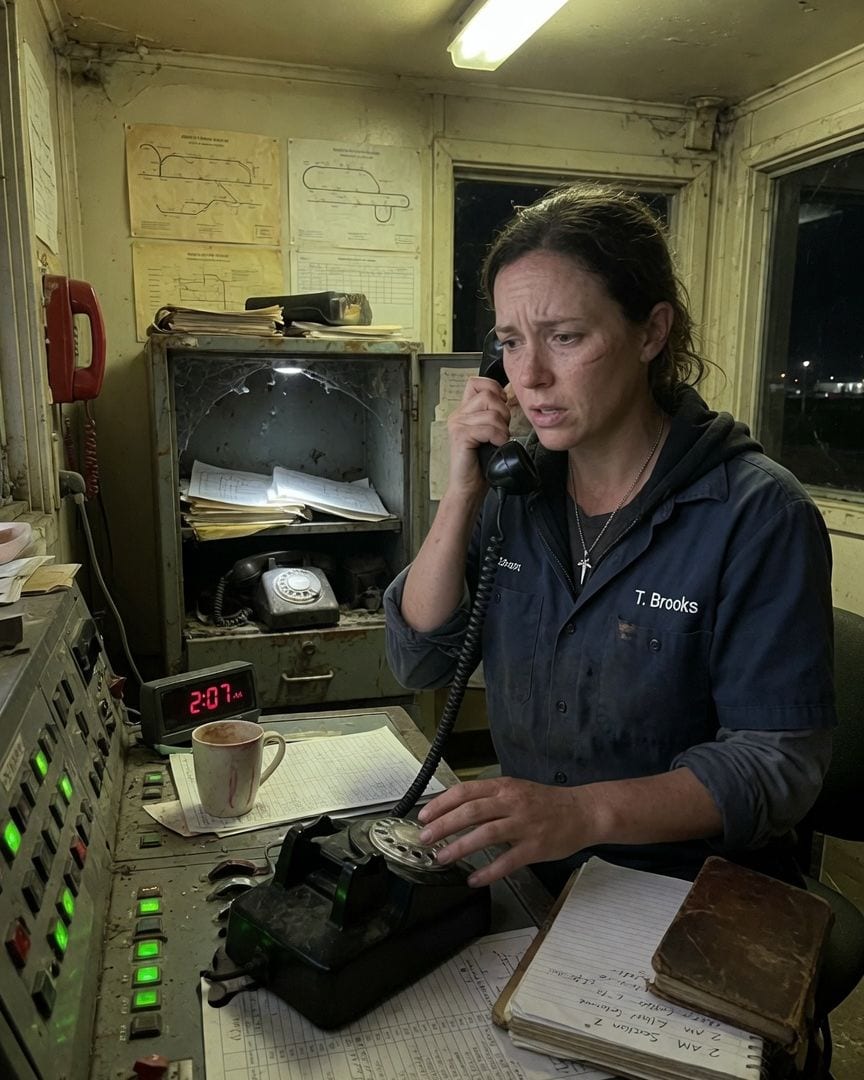
My signal box gets a 2 AM call every night from a man whose section was demolished eleven years ago. Now I found his logbook with today's date.
My night shift at the signal box is quiet and precise, defined by the routine 2 AM call from Ellis confirming Section 7 is clear. But when I asked my duty manager to log it, he said Section 7 hasn't had a track walker in eleven years, not since its cabin and phone were demolished.
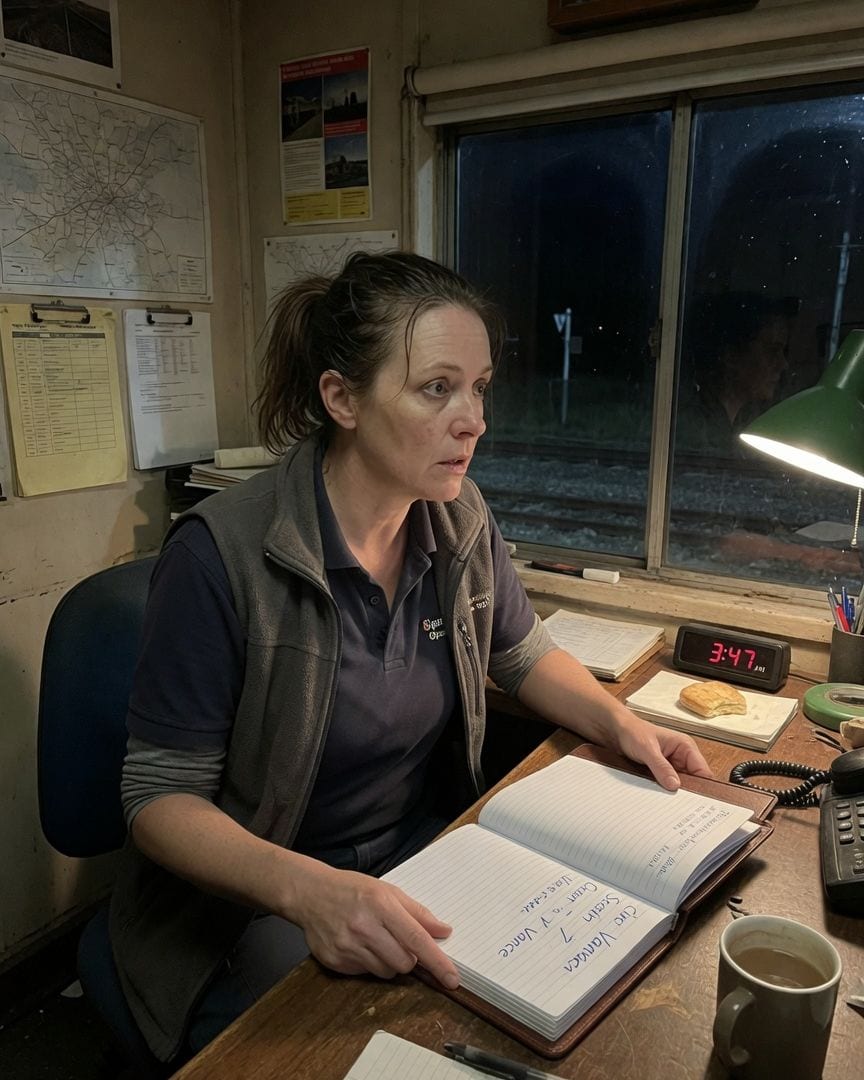
My linesman taps twice on my window at 3 AM. Control says he retired and passed years ago.
My routine at the rural signal cabin was regular: the linesman's double tap on the window at 3 AM. But then my supervisor called, revealing the linesman I knew, Warren Vance, had died five years ago. Now, an impossible entry in my official logbook, with his signature and timestamped from my shift, proves someone else was there.
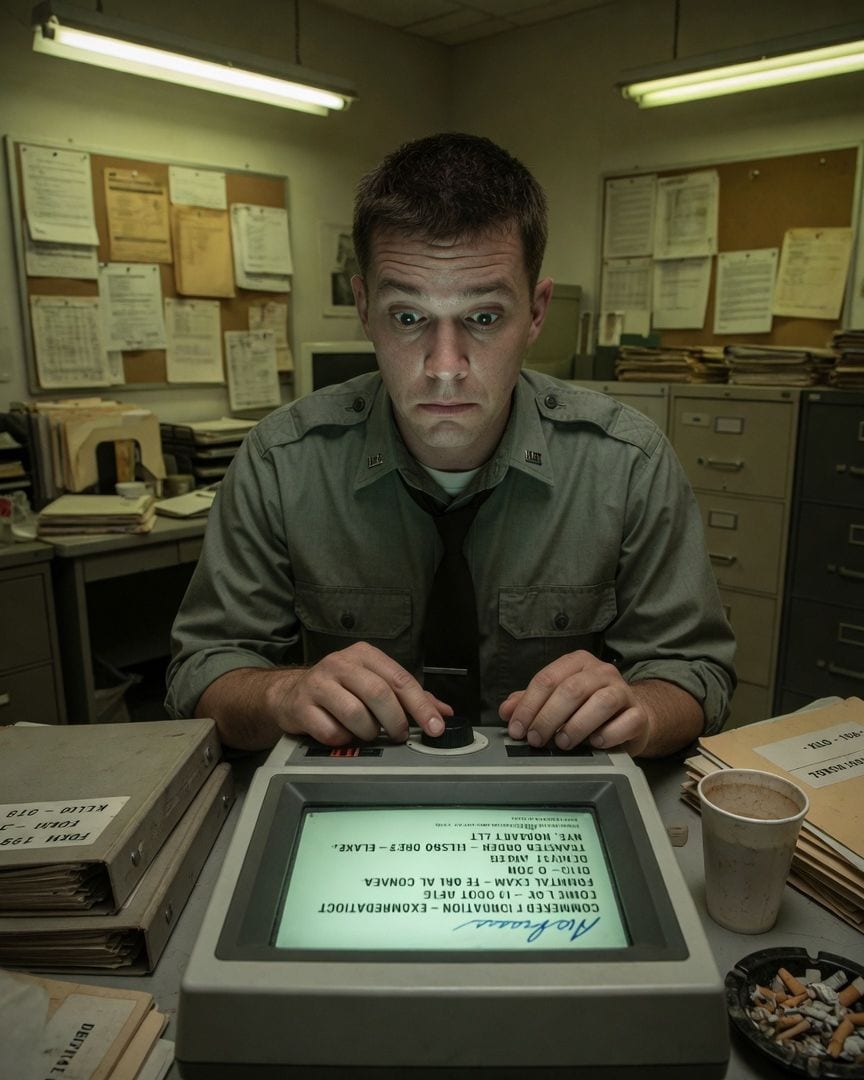
A missile commander watched his ten nuclear silos go dark. His own service record shows his signature on a future he's never lived.
Second Lieutenant Hobart Nye, a missile commander in Wyoming, had his quiet 0247 watch shattered by a security report: a massive, silent black triangle hovered over Launch Facility Kilo, casting a perfect shadow. Hobart watched his console's fault panel light up, signaling all ten nuclear missiles going dark in an impossible silence, followed by eleven minutes his security team could not remember. Official logs called it a "radio malfunction," but Hobart found a requisition for invisible-tracking sensors, signed by a base commander who was supposed to be off-base. The final, chilling discovery came when his own service record showed new entries—a dental check-up, a transfer to Alaska—all dated for a future he never lived, complete with his perfectly replicated signature.