A deep-sea diver finds fresh paint on a sunken ship’s hull. It’s his dead grandfather’s distinct hand.
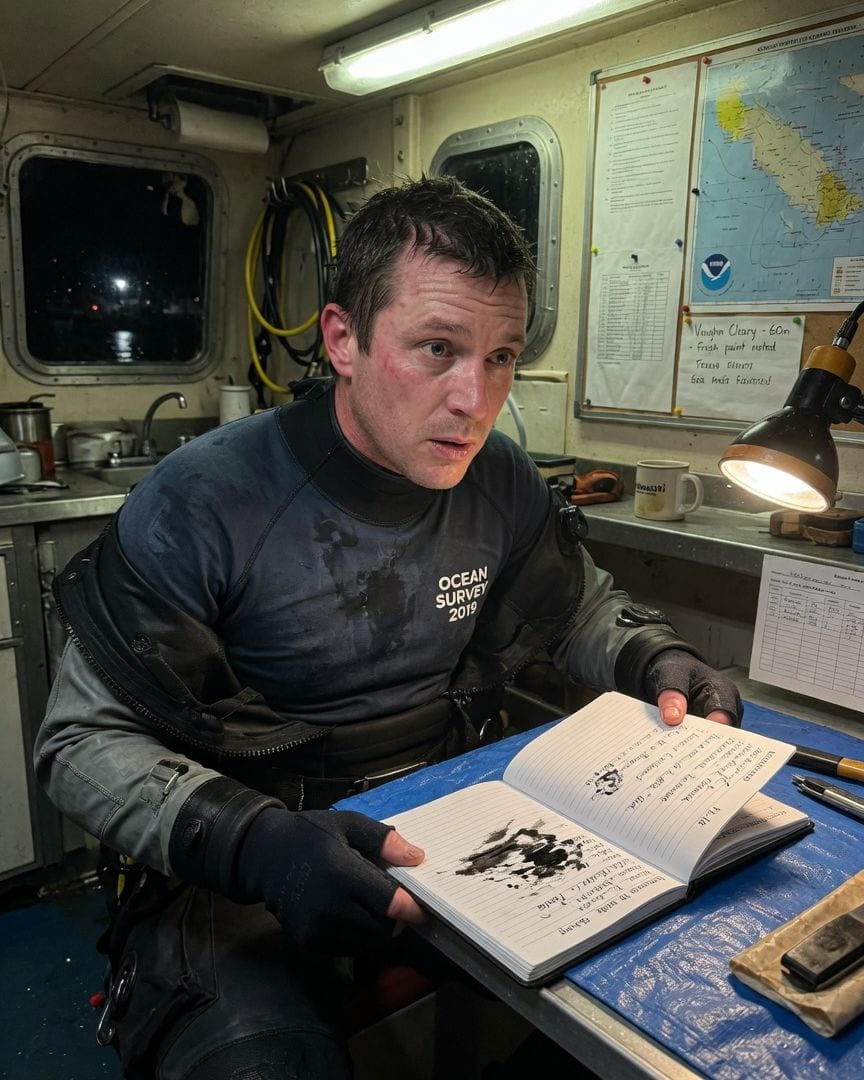
The deep ocean pressed in, a cold, indifferent blackness Teague Orrin knew intimately. His dive light cut through the gloom, a stark beam against the abyssal curtain. Sixty meters down, the transport ship Vaughn Cleary materialized, a silent, hulking shadow.
He was here for his grandfather, Howard, pulled off her crew list two days before she sailed, never speaking of it again. Teague felt the weight of that silence, a cold counterpoint to the ocean’s pressure.
His light swept across the hull, searching for the name, for any sign of the past. And then he saw them. The hull letters, 'VAUGHN CLEARY,' shimmered in the beam, impossibly bright.
Fresh white paint, brush strokes still visible, a faint run near the 'R.' It was laid over marine growth the survey had photographed bare three weeks before.
His grandfather had been dead for nine years, but Teague knew the distinct, slightly heavy hand that had painted those letters. It was Howard’s.
Teague surfaced, shivering despite the drysuit, the image of the fresh paint seared behind his eyes. He reported it to the dive lead, a grizzled Navy veteran named Eric Kowalski.
Kowalski listened, then grunted, blaming 'nitrogen narcosis,' a faulty light, or simply 'weird deep-sea optics.' Teague pushed back, methodical and precise.
He described the brushstrokes, the run in the paint, the way it sat over the growth, the undeniable familiarity of the hand. Kowalski, though skeptical, saw the conviction in Teague’s eyes.
'Alright, Orrin,' he conceded, 'go take another look, but log it properly this time. Maybe it's some kind of deep-sea bioluminescence trick.' Teague didn't believe it for a second.
He volunteered for the next dive, his unease a cold knot in his stomach. This time, he was less interested in the hull's exterior. He navigated through the wreckage, seeking an entry point.
He found a miraculously intact section, the captain’s quarters, sealed by a heavy, dogged hatch. Inside, surprisingly clear of silt, sat a small, bolted-down safe. He worked methodically, using his tools to pry it open. The interior was dry.
And inside, wrapped in oilskin, was a logbook. Its leather cover was still supple, the brass clasps untarnished. He carefully removed it, the weight in his gloved hands feeling impossibly light, yet heavy with unspoken history.
This wasn't just a record of the past; it felt... active.
Back on the surface, the logbook was laid out on a clean tarp in the dive tender’s galley. The team gathered, a mix of curiosity and skepticism. Teague, his hands steady, peeled back the oilskin.
The pages were remarkably preserved, the ink sharp. He turned past the initial entries, detailing the Vaughn Cleary’s final voyage, past the grim account of her sinking. Then, the dates shifted. Entries began appearing after the ship was lost.
Routine maintenance logs, supply manifests, crew assignments. The handwriting was neat, official, but the ink looked… fresh. He ran a finger over a particularly crisp entry, a list of names. The ink barely smudged. He looked at the date.
It was today’s date, and the ink was still not fully set.
The discovery of the logbook sent a ripple through the small team, then through the naval records office. Experts examined it, confirming the paper and ink were period-appropriate for the Vaughn Cleary’s era, yet the later entries defied all logic.
The ink was chemically indistinguishable from fresh ink, the paper showed no water damage. The official conclusion was a sophisticated hoax, but no one could explain how it was planted at 60 meters, or why.
Teague, however, knew it wasn't a hoax. He packed his bags and headed to the National Archives in Washington, D.C., driven by a cold certainty that his grandfather's silence and the impossibly fresh paint were connected.
He requested every declassified file on the Vaughn Cleary incident, and anything related to Howard Orrin's service. Days blurred into weeks. He pored over manifests, incident reports, commendations.
He found inconsistencies: a discrepancy in the final cargo manifest, a notation about 'expedited personnel transfer' for his grandfather that lacked proper authorization codes, and a series of redacted reports labeled 'Project Chimera,' which always seemed to appear around the Vaughn Cleary’s operational dates.
The official narratives always ended with the ship’s sinking. But the redacted files hinted at something else, a quiet, ongoing investigation that seemed to have no conclusion. He requested the original, unredacted files, citing FOIA.
The request was met with polite stonewalling. He persisted, a methodical, relentless investigator. He noticed that the official documents describing the 'loss' of the Vaughn Cleary always used a specific, almost clinical phrase: 'contained and filed.'
It struck him as odd, too formal for a maritime tragedy. It was a phrase that echoed the cold bureaucracy of 'buried record,' a chilling resonance that deepened his unease.
As Teague delved deeper into the archives, the polite stonewalling turned subtly menacing. Files he had accessed the day before were suddenly marked 'unavailable.'
His requests for specific documents were met with blank stares from clerks who insisted they'd never seen them. He started noticing the same woman, a quiet, severe-looking archivist named Rosemary Lockwood, always in his periphery.
She was never overtly hostile, just… present. One afternoon, as he left the archives, his phone rang. The number was blocked. A synthesized voice spoke, clear and calm. 'Some records are meant to stay closed, Mr. Orrin.
For your own benefit.' The line went dead. Teague felt a prickle of cold sweat. They knew. They knew what he was looking for. The next day, he found a small, unmarked envelope tucked into his research cubicle.
Inside was a single, faded photograph of his grandfather, Howard Orrin, taken perhaps a week before the Vaughn Cleary sailed. Howard looked younger, but his eyes held a haunted quality Teague had never seen in family photos.
On the back, scrawled in a familiar, slightly heavy hand, were two words: 'Don't Open.' It was his grandfather's handwriting, identical to the paint on the hull. Teague’s heart hammered.
This wasn't a warning from the archives; it was a message from the thing itself, using his grandfather's hand, echoing the paint. He looked up, scanning the aisles of towering shelves.
Rosemary Lockwood stood at the end of a row, watching him. Her expression was unreadable, but her presence was a cold, undeniable weight. He felt like prey.
Teague confronted Rosemary Lockwood in her office, the faded photograph of his grandfather clutched in his hand. 'Who sent this?' he demanded, placing it on her desk. She didn't flinch. Her gaze was steady, her voice low and even.
'It's a warning, Mr. Orrin. From the source.' Teague stared, incredulous. 'The source? What is this? What does 'contained and filed' mean?' Rosemary sighed, a deep, weary sound. 'It means exactly what it says.
The Vaughn Cleary wasn't just a transport ship. It was… a facility. A processing unit for what we call 'The Filing.'' Teague felt a chill deeper than any ocean depth. 'The Filing? What are you talking about?'
Rosemary leaned forward, her voice dropping to a whisper. 'It's an institution, or perhaps an entity that uses institutions. It collects. Certain individuals, certain events, they fit a pattern. They are… converted. Into information. Into records.
That's what the Vaughn Cleary did.' 'My grandfather,' Teague breathed. 'He was on the crew list. He was pulled off.' Rosemary nodded. 'Howard Orrin was designated for filing. He was one of the few who slipped through.
Someone on the inside, a sympathizer, altered his record at the last minute. But not before he was… marked.' 'Marked?' Teague remembered the fresh paint, his grandfather's hand. 'The paint on the hull?' Rosemary confirmed, 'It's a signature. A mark.
When a 'file' is initiated, or reactivated, it leaves a trace. Often, it mimics the handwriting of the last human designated for that particular 'filing.' Your grandfather’s hand. Because he was the one who got away.'
The logbook, the impossible dates, the fresh ink – it all clicked. The logbook wasn’t a historical artifact; it was an active ledger. 'The dates in the logbook… they're current because it's still happening, isn't it?'
Teague asked, his voice barely a whisper. Rosemary's eyes held his. 'Always. The Filing is patient. And it never forgets a designation. Or a debt.'
Rosemary pushed a faded, heavily redacted printout across the table. 'This is an appendix to the original Vaughn Cleary incident report. It's highly classified. It lists… future acquisitions. Designated subjects.' Teague's hands trembled as he took the document.
The paper was brittle, the ink faded in places, but the chilling precision of the entries was clear. Names, dates, coordinates. He scanned the columns, his breath catching in his throat.
He saw his grandfather’s name listed, with an old, crossed-out date. Then, further down the list, his eyes snagged on a familiar surname. His own. 'Orrin, T. A.,' it read, followed by a series of alphanumeric codes.
The next column, titled 'Designation,' listed 'Recovery Team / Acquisition Target.' And in the final column, 'Activation Date,' was a sequence of numbers that matched his own birth date.
The date his grandfather had passed, nine years ago, suddenly resonated with a terrible new meaning. He wasn't just investigating a buried record. He was already part of it. The file had been open on him for decades.
His dive, his search for answers, hadn't been an act of discovery; it had been an act of… activation. He looked up at Rosemary, his face a mask of dawning horror.
She met his gaze, her eyes filled with a profound, shared dread. 'You were never looking for the file, Mr. Orrin,' she said, her voice barely audible. 'The file was looking for you.'
Rosemary explained the full, horrifying scope of 'The Filing.' It wasn't an organization with agents and offices in the conventional sense. It was a pervasive, almost elemental force that manifested through human institutions, particularly those dealing with records and disappearances.
The Vaughn Cleary was one of its oldest 'doors,' activated periodically when certain conditions were met—like a descendant of a 'designated subject' seeking answers, or a specific anomaly being observed.
'Your grandfather,' she said, 'was pulled off the ship by a network of people who understood what 'The Filing' was. They couldn't stop it entirely, but they could delay it, divert it.
They marked him, yes, so 'The Filing' would know he was still due. But they saved him from being processed.'
The fresh paint on the hull, the handwriting—it was 'The Filing's' way of acknowledging his grandfather's original designation, a signature claiming what it still considered its own.
And by recognizing that handwriting, by seeking the truth, Teague had inadvertently confirmed his own 'activation.' The logbook wasn't a ship's record; it was a 'Filing' ledger, documenting its 'acquisitions' and 'designations.'
The entries after the sinking weren't a paradox; they were simply the ongoing operations of 'The Filing' through its 'door.'
The 'Recovery Team' designation for Teague wasn't a military unit; it was a classification for subjects who would eventually be 'recovered' by 'The Filing' itself. 'It doesn't k*ll, Mr. Orrin,' Rosemary whispered, 'not in the way you understand. It transforms.
It files. You become a record. An entry. A data point in a vast, cold archive that stretches beyond human comprehension.' The horror wasn't in a monster, but in the insidious, bureaucratic coherence of it all. Everything fit.
Every impossible detail, every chilling coincidence, every unanswered question. It all made perfect, terrifying sense.
Teague tried to process it, but the weight of the truth was crushing. He had to warn someone. He had to expose it. He stood up, determined, but Rosemary put a hand on his arm. 'It's too late, Mr. Orrin.
You're already activated. They know.' Just then, the office door opened. Two men in plain, dark suits stood there, silent and unsmiling. They weren't military, weren't police. Their presence was simply… official.
They carried no weapons, but their eyes held an unnerving calm. 'Mr. Orrin,' one of them said, his voice flat. 'We've been expecting you.' Teague looked at Rosemary. Her face was resigned.
He knew then that she wasn't an agent of 'The Filing,' but another 'sympathizer,' trapped in its machinery, able only to offer warnings. He backed away slowly, his mind racing for an escape, but the small office offered none.
The men moved with an unsettling, practiced efficiency, blocking his path. He felt no anger, no fear, only a profound, cold understanding. He was not being arrested. He was being processed.
The truth was understood, and it could not be undone. He was simply left knowing, and the knowing was the ending.
He saw the faint, familiar curve of the 'R' in the fresh paint on the hull in his mind's eye, a signature claiming him.
He saw his grandfather's haunted eyes in the faded photograph, a silent warning from a man who had known too much. The men closed in, their movements fluid, unhurried. Teague felt a hand close gently, firmly, on his shoulder.
There was no struggle, no violence. Only a quiet, inevitable surrender to the machine. He was being filed.
The official report stated that Aviation Boatswain's Mate Teague Orrin disappeared during a follow-up dive to the Vaughn Cleary. A search yielded no results. His personal effects were cataloged and returned to next of kin.
The files related to the Vaughn Cleary incident, and all associated 'Project Chimera' documents, were immediately re-sealed, marked 'Top Secret - Permanent Classification.'
A new entry was quietly added to the physical logbook recovered from the wreck, under today's date: 'Orrin, T. A. - File Closed.' The system moved with its usual, patient efficiency, absorbing another data point.
The world went on, oblivious to the quiet, bureaucratic horror that continued to operate beneath its surface, filing away the lost, one by one.
Rosemary Lockwood sat at her desk in the archives, a newly stamped 'Top Secret' file on her blotter. The last entry was 'Orrin, T. A. - File Closed.' She gazed at the blank page following it.
A faint, familiar curve of an 'R' began to form, then a 'V,' in a slightly heavy hand. The file was still being signed.
If this one got to you
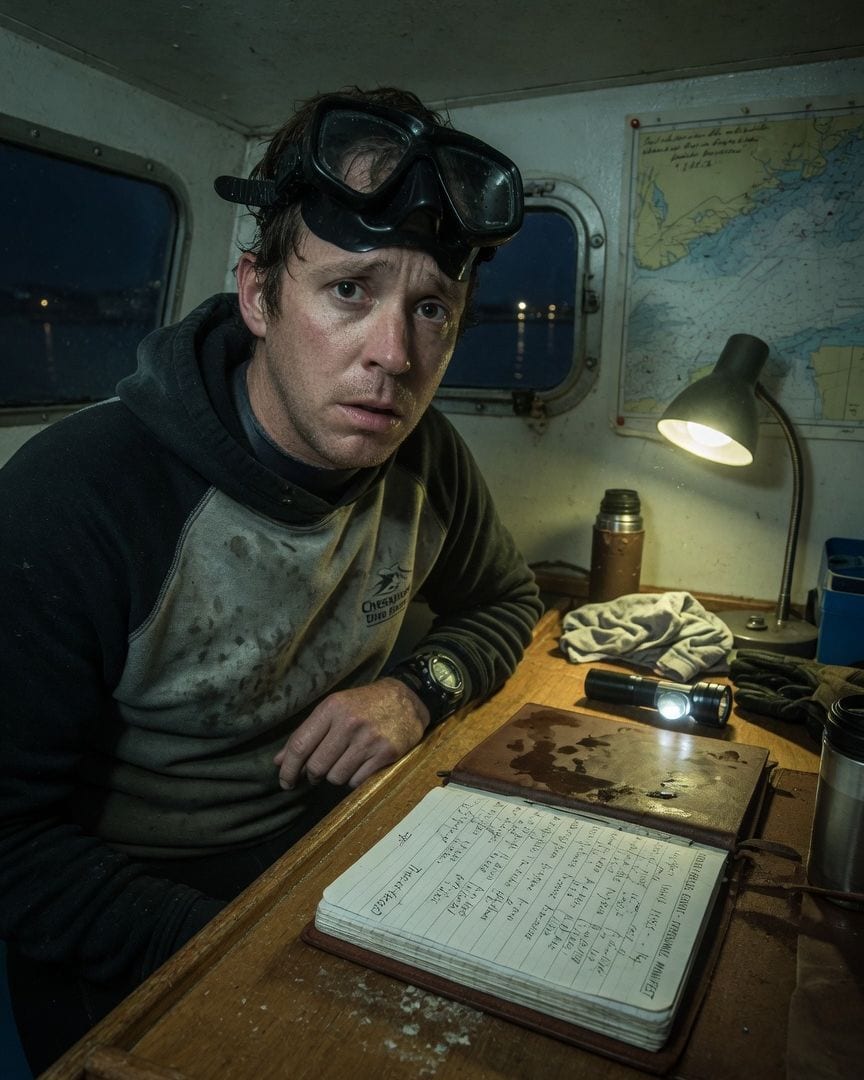
A diver on his last quest to his mother's lost ship found the crew listed in a hidden logbook as 'Transferred.'
Corey Nascimbene embarked on his last dive of the season, a personal quest to the sunken tug Harrow Belle, the ship his mother watched vanish decades ago. Descending into the cold Chesapeake gloom, he discovered a galley perfectly preserved, save for an impossibly folded, stark white napkin lying pristine on the muddy deck. Driven by unease, Corey later found a hidden, welded compartment in the engine room, containing a heavy, sealed logbook. Its personnel manifest listed the entire crew, not as lost, but with a single, unsettling word: 'Transferred.'
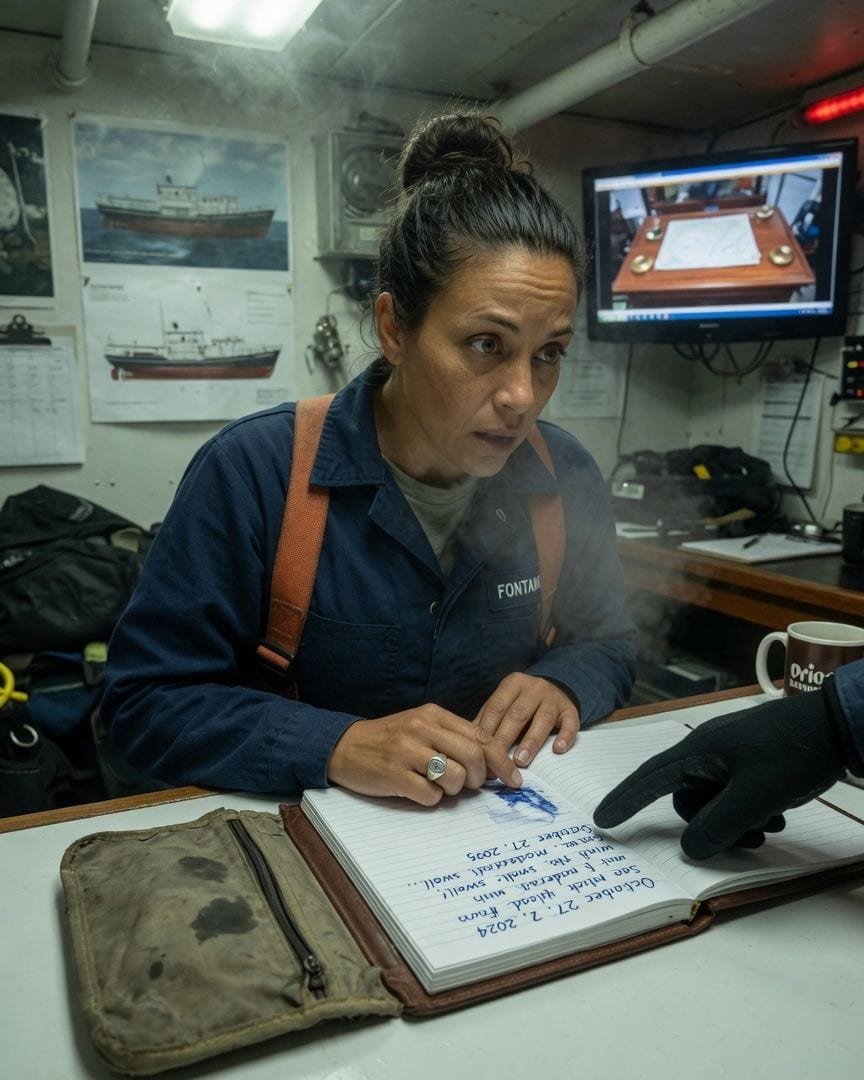
A Cold War survey ship's logbook holds an entry dated for today, its ink still wet.
Navy salvage officer Vivian Fontaine led the deep-sea recovery of the Hollis Wren, a survey ship lost forty years ago, finding it remarkably intact on the seabed. But inside, a nautical chart depicted new structures built decades after the ship vanished, and its hull was unnervingly clean of the expected forty years of growth. The true shock came in the captain's cabin: a sealed logbook with an entry dated October 27, 2024—today’s date—its deep blue ink still glistening wet, detailing current conditions at their exact coordinates. How could a ship lost so long ago carry a logbook written moments before its discovery?
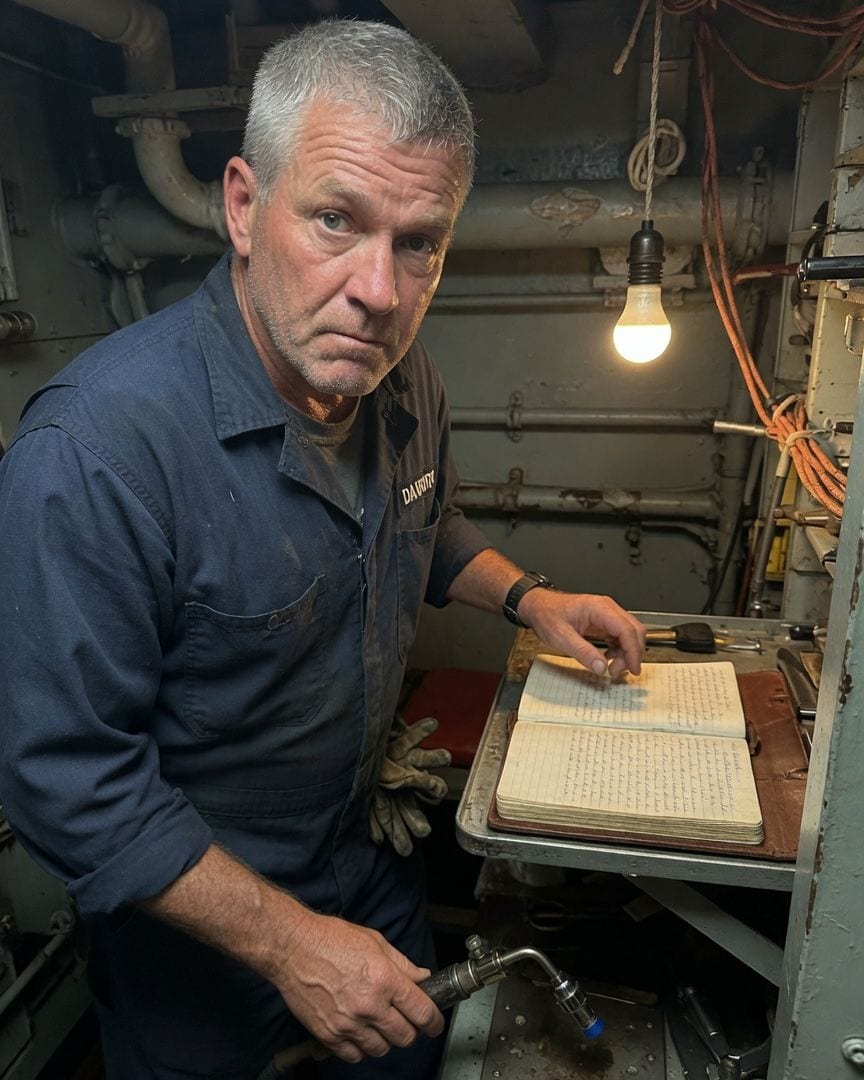
A week from shore duty, Chief Danforth cut a hatch where his ship's plans showed solid steel. An hour later, the wall was seamless, but the Cold War logbook from inside appeared under his mattress.
Chief Petty Officer Raymond Danforth, just a week from ending three decades of service, was intimately familiar with every pipe and plate of the guided-missile destroyer Weatherall. During a mid-cruise overhaul, his gloved hand found a sealed hatch where schematics promised only a solid bulkhead. He cut through the impossible seam to reveal a small, dry compartment, softly lit, containing a logbook filled with an unsettlingly familiar hand. When he returned an hour later with a witness, the hatch was gone, the wall seamless. Later that night, the same logbook appeared beneath his mattress, its pages revealing an entry: 'Petty Officer Howard Montgomery, missing, 1972.' How could a compartment vanish, yet leave its secrets behind?
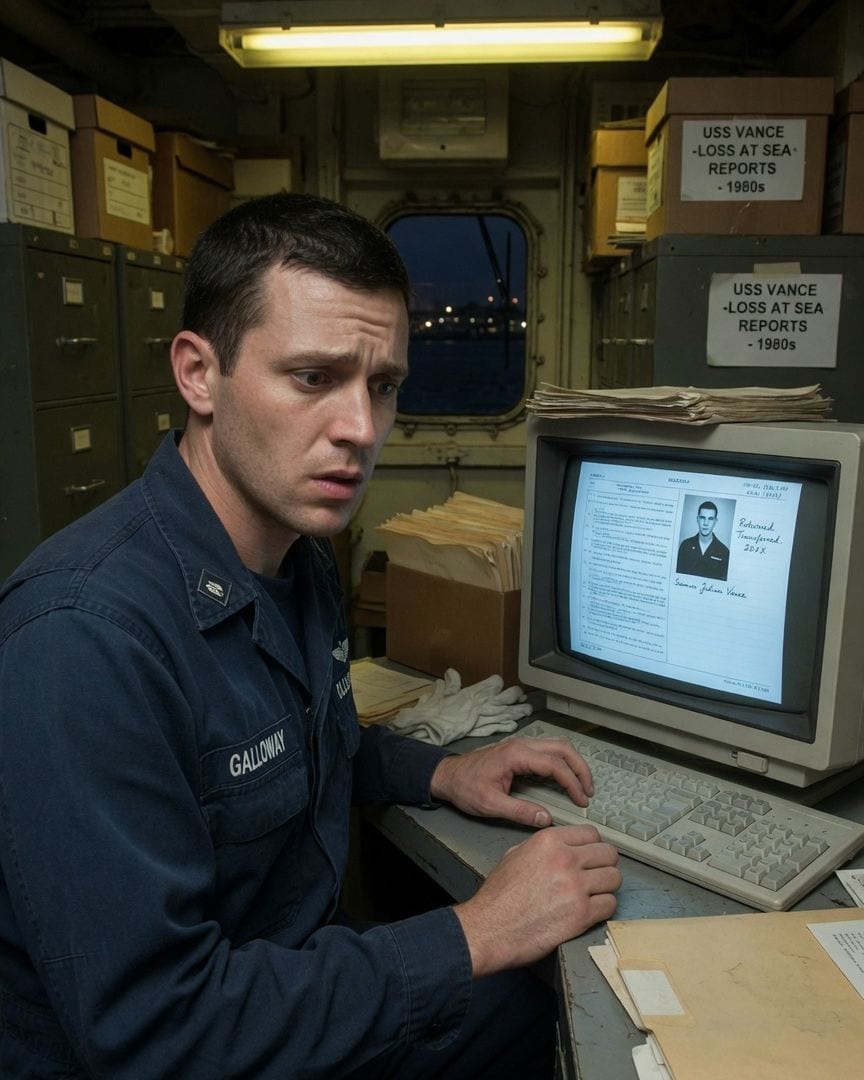
Petty Officer Galloway logged a sailor onto his ship. The man died at sea 40 years ago.
Petty Officer Joel Galloway scanned a sailor's ID on the USS Vance quarterdeck. The man's name, 'Seaman Julian Vance,' and his out-of-date uniform pricked at Galloway's memory. Later, the ship's berthing count came back one over, with an extra entry in the system but no physical body.
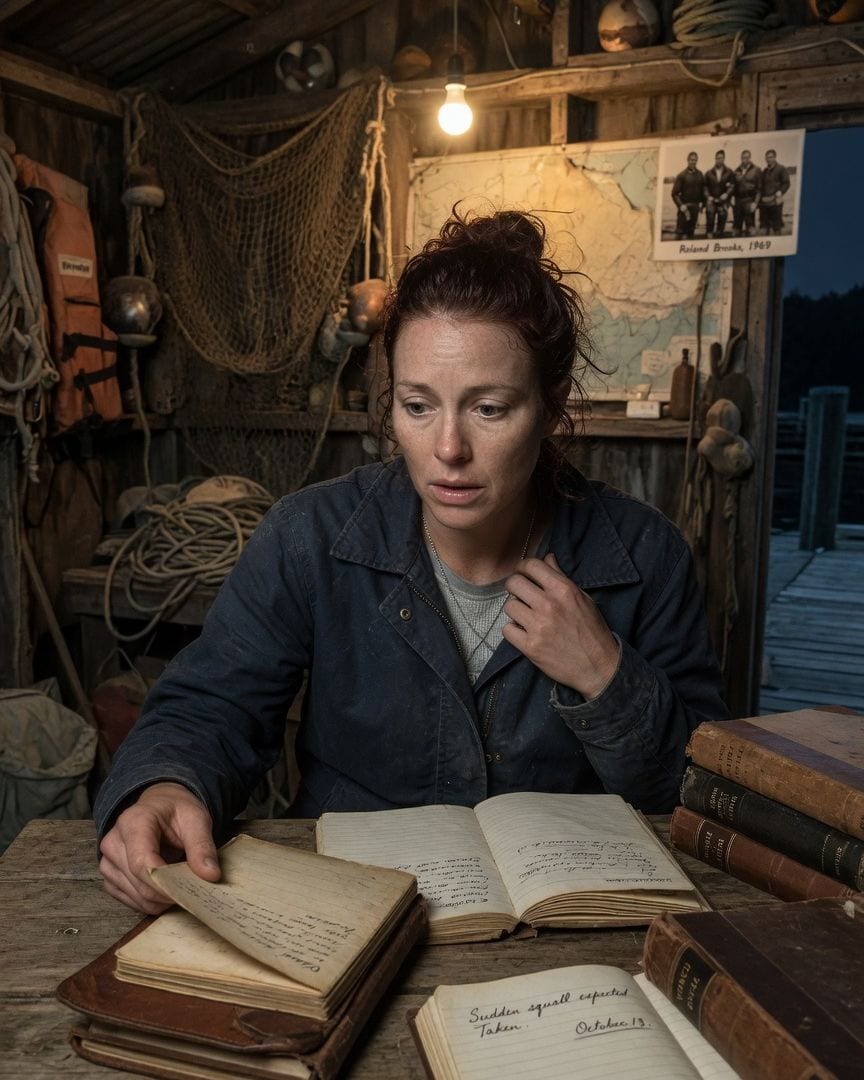
Tomorrow's gale was already written in the skipper's logbook — in his dead father's handwriting. His father drowned off that boat in 1969, and I'd whistled aboard.
My new deckhand job on the fishing boat was simple, until I saw Skipper Henry’s logbook. For *tomorrow’s* date, his dead father’s unmistakable handwriting had already scrawled “Gale Warning. Heavy Seas.” and “Payment Due.” The man drowned decades ago, and the entry leaves me cold.
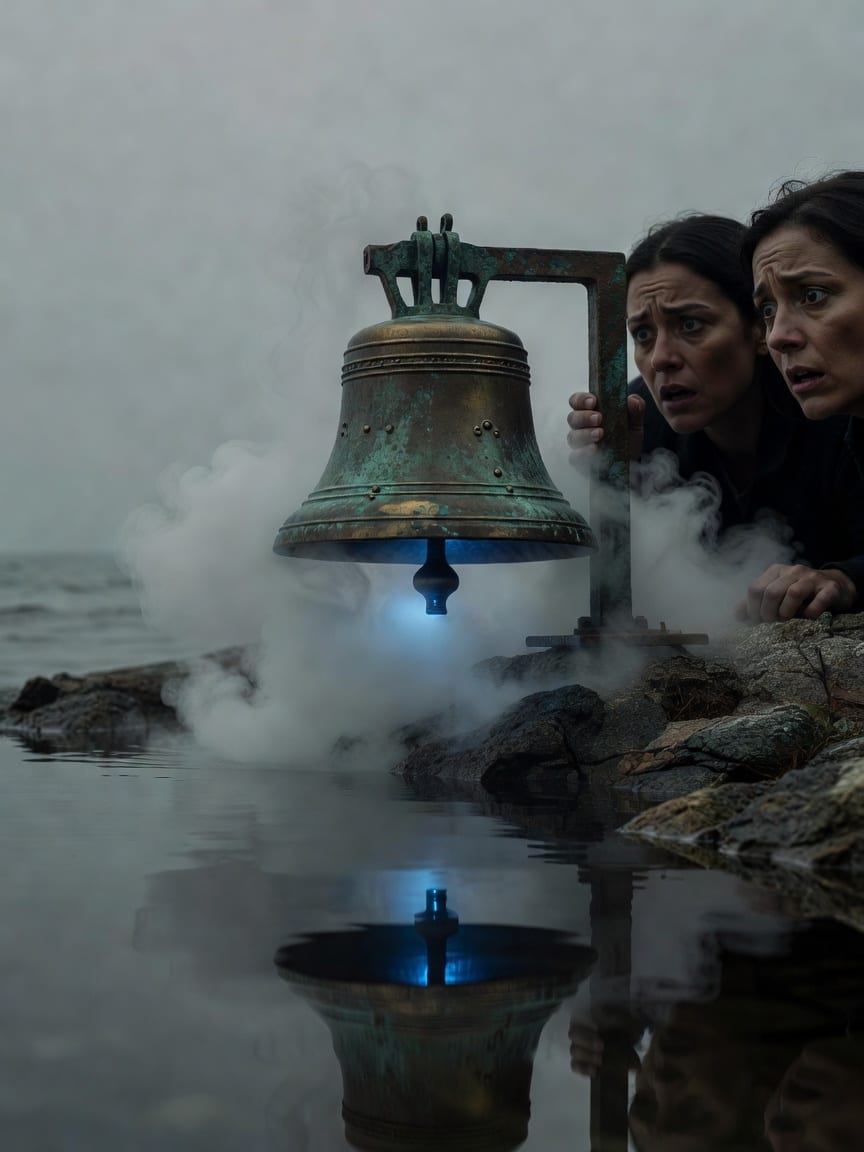
The fog bell on the point rings itself on still nights. The framed log at the yacht club lists eleven calm evenings it rang – each entry beside a boat that never came home.
Moving to a quiet coastal town, I found myself drawn to an old logbook at the yacht club. It recorded the fog bell ringing on flat-calm nights, each instance tied to a boat that simply vanished. Then, I found my own boat's name, 'The Osprey,' penciled at the bottom, marked with an unfinished, cryptic symbol.