A Cold War survey ship's logbook holds an entry dated for today, its ink still wet.
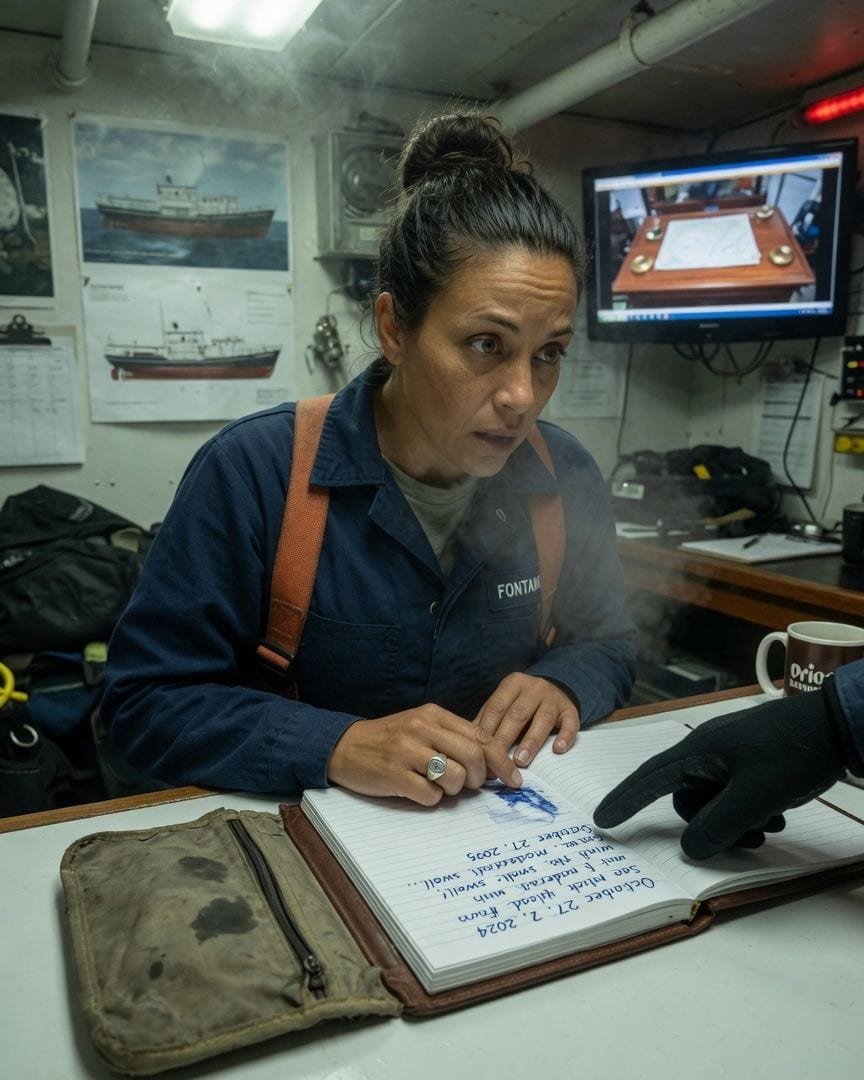
Forty years after its disappearance, the survey ship Hollis Wren was found. Navy salvage officer Vivian Fontaine, 40, watched the sonar feed from the survey vessel Orion as the deep-sea ROV approached the wreck.
The Hollis Wren lay upright on the seabed, remarkably intact, as if she had settled gently into her final resting place just yesterday.
Her hull was clean of the expected forty years of growth, a detail Vivian filed away, trying to rationalize it as a unique current pattern, perhaps an unusually cold gyre.
The ROV's floodlights penetrated the gloom, revealing the ship's name, still crisp on the bow. Inside, the ROV navigated through the surprisingly preserved interior. In the wardroom, the scene was eerily undisturbed.
A polished mahogany table held four brass paperweights, anchoring a large nautical chart. The image, transmitted to Nan Alcorn, 80, the widow of the Hollis Wren's captain, Albert Sheppard, showed a familiar coastline.
But Vivian, reviewing the raw data from the Orion's bridge, saw the impossible: the chart depicted a reclaimed harbor and a new breakwater, structures that hadn't existed until twenty-two years after the Hollis Wren was officially lost.
Somebody aboard had been keeping their charts corrected.
Vivian immediately ordered a manned dive, despite the depth. Senior diver Daniel Vance, 45, led the team, carefully entering the Hollis Wren through a breach near the stern.
The air inside the wreck was cold, still, and carried a faint scent of ozone mixed with salt. The team moved through the ship, finding cabins eerily preserved, personal effects untouched.
The hatches were dogged from the inside, confirming no external breach had flooded the vessel. It was as if the crew had simply... walked away.
In the captain's cabin, a small, brass-bound logbook rested on a desk, sealed in a waterproof canvas pouch. Daniel carefully retrieved it.
Back on the Orion, in the sterile light of the lab, Vivian laid the pouch on a clean table. She tried to think of a rational explanation for the chart. Perhaps a prank by a previous deep-sea expedition?
But the wreck was in a restricted zone, rarely surveyed, and the depth alone made such an elaborate setup implausible. Her mind grasped at currents, misidentification, anything but what her eyes had shown her.
The logbook, however, was a different matter. Its very presence, sealed and preserved, was a miracle that defied the known physics of deep-sea degradation. With a precise motion, Vivian cut the canvas stitching.
The leather-bound book felt cool and heavy in her hands. As she gently opened it, the first page was a standard title page, 'Hollis Wren - Official Log.'
She turned to the entries, expecting to find the last record of a ship in distress, a final, desperate account of her captain. Instead, the first entry she saw was dated not forty years ago, but today.
Daniel Vance leaned closer, his brow furrowed. 'Commander, look at that date,' he murmured, pointing with a gloved finger. Vivian's eyes, already fixed on the page, widened. October 27, 2024. Her breath hitched. That was the current date.
Below it, in what was unmistakably Captain Albert Sheppard’s meticulous hand, was an entry detailing current weather conditions, sea state, and a 'successful data upload' from their exact current grid coordinates. The ink, a deep, rich blue, looked unsettlingly fresh.
It glistened under the lab lights, still slightly wet, as if written moments before.
Vivian initiated a battery of tests on the logbook. Ink analysis confirmed it was period-appropriate naval ink, yet somehow the pigment was uncannily fresh in the recent entries.
The spectrometer readings for the moisture content were off the charts, suggesting the ink had bonded with the paper only hours before, not decades.
The paper itself, while aged in the earlier sections, showed no signs of water damage or degradation in the latter pages, as if those sections had never been submerged.
Handwriting experts, brought in via secure satellite link, meticulously compared the new entries to known samples of Captain Sheppard's hand, retrieved from archived Navy files. Their conclusion was unanimous.
'It's a perfect match, Commander,' the lead analyst stated, his voice tight with professional disbelief, 'down to the smallest flourish on the 'S' in Sheppard. The consistency is absolute. But the dates... it's impossible.'
Vivian felt a cold dread settle deep in her gut. She cross-referenced the logbook's 'data upload' coordinates with Navy records of other 'lost at sea' incidents in the Timor Sea and surrounding waters over the past forty years.
To her shock, she found a subtle, recurring pattern: several other vessels, officially listed as lost, had vanished within or near these exact 'upload' grid zones, often with peculiar circumstances – intact wrecks, unusual lack of distress signals, or subsequent sightings that were quickly dismissed as misidentification.
The pattern was too precise to be coincidence, a slow, patient accumulation of 'losses' over decades, all pointing back to these specific, impossible coordinates.
She tried to dismiss it, to find a mundane explanation for the repeating anomalies, a systemic record-keeping error, a statistical fluke, but each attempt failed. The data was too clean, too consistent, too meticulously recorded by the Hollis Wren itself.
Vivian's quiet investigation didn't go unnoticed. Her requests for deeper dives into archived 'lost at sea' files, particularly those with unusual characteristics, met with polite but firm resistance. Digital walls rose around her, subtly but effectively.
Her access to secure Navy databases began to experience 'technical glitches,' conveniently blocking her from the specific records she needed, often just as her cursor hovered over a critical file. One evening, a secure, encrypted message landed in her inbox.
It was from a retired Admiral, Bernard Lawson, 85, a figure once connected to the original Hollis Wren inquiry. The message was brief, a single line of text: 'Some things are better left undisturbed, Commander. The sea has its secrets.
Don't go looking for answers where none are meant to be found.' The implied threat was palpable, a cold breath across the miles. Vivian felt a prickle of unease.
She found herself checking her reflections in the Orion's portholes, a subtle paranoia taking root.
Back in her private office, she noticed a faint, almost imperceptible hum coming from her secure work terminal, even when it was in standby, a low, resonant thrum that seemed to vibrate in her teeth.
A few days later, a junior technician, running routine diagnostics, found a deeply embedded, highly sophisticated piece of surveillance software on her main workstation. It wasn't malicious, he reported, but it was sending encrypted data packets to an untraceable server.
'It's like someone wanted to know what you were looking at, Commander,' he'd said, his voice hushed, looking over his shoulder.
The hum in her office grew louder in her ears, a constant, low thrum against the ship's engines, a presence she couldn't shake.
Vivian secured a private meeting with Admiral Lawson, flying back to the mainland under a veil of official secrecy.
She laid out her evidence: the impossible chart, the current logbook entries, the recurring 'lost at sea' patterns linked to the Hollis Wren's 'upload' coordinates, and the surveillance on her own terminal.
Lawson listened, his face impassive, occasionally tapping a finger on the polished wood of his desk, the sound loud in the quiet room.
He initially dismissed it all as 'anomalous data, easily misinterpreted,' or 'the unfortunate side effect of deep-sea pressure on old electronics.'
But Vivian pressed, presenting the forensic handwriting analysis, the ink reports, the undeniable match of Captain Sheppard's hand to twenty-first-century entries. She detailed the specific dates, the precise coordinates.
She showed him a printout of the satellite-linked expert's report, its language unequivocal. Finally, Lawson’s composure cracked. He sighed, a long, weary sound, and leaned forward, his eyes suddenly old and haunted.
'Commander Fontaine,' he said, his voice barely a whisper, 'there are things the Navy has known for a very long time that the public can never know. The Hollis Wren was not lost in the way you understand 'lost.'
It was… filed.' He revealed the existence of 'Project Nautilus,' a clandestine, decades-old program established to monitor and, if possible, understand inexplicable naval anomalies. 'The Hollis Wren,' he continued, his gaze distant, 'is one of a handful of 'returns.'
Vessels that periodically reappear, sometimes for days, sometimes for weeks, before vanishing again. They are always intact, often updated, and always… different. We’ve been observing the Hollis Wren’s periodic resurfacing for forty years.'
He claimed the Navy's role was purely for containment and threat assessment, to prevent panic, to understand an unknown phenomenon, to keep humanity safe.
He did not, however, offer any explanation for why the ship returned, or who was doing the 'filing.'
Lawson, his facade finally crumbling, admitted the Navy wasn't just observing. 'We're trying to understand their selection criteria,' he stammered, catching himself too late, a flicker of true fear in his eyes. 'Why these ships? Why these individuals?'
He pushed a thick, yellowed folder across the table, heavily redacted but stamped 'Project Nautilus - Declassified (Limited Access).' The edges of the paper were brittle with age. 'This is the original file from the Hollis Wren incident.
It's all we have.' Vivian opened it, her hands trembling slightly, the cheap paper rustling like dry leaves.
She scanned page after page of official reports, witness testimonies, and scientific analyses, all heavily blacked out, like dark holes punched through the truth.
Deep within, on a page titled 'Personnel of Interest - Nautilus Program,' she found a list of names, birth dates, and brief descriptions. Her eyes snagged on one entry: 'Fontaine, V. (Born: 1984) - Subject of interest, observation recommended.
Current status: Active.' Vivian's own birth year. Her own initial. Her own name. She looked up, her gaze unfocused, as the faint, almost imperceptible ping from her ship's sonar console, miles away, echoed in her mind.
On the digital chart projected on the wall of her office, a ghost image she had left running, the ship's current position flashed—the exact grid coordinate mentioned in the Hollis Wren's impossible logbook entry from the previous day, and the same 'data collection point' listed in the old memo, now searing into her mind.
The full truth crashed down on Vivian with the force of a tidal wave. The Navy wasn't just observing; they were facilitating, covering up, and, in some sinister way, collaborating.
'Project Nautilus' wasn't about containment; it was about understanding and perhaps even managing a relationship with an unknown intelligence. The 'returns' weren't random anomalies; they were part of an ongoing, systematic process.
The Hollis Wren was a sophisticated, sentient probe, periodically resurfacing to update its data, its crew preserved within it as living records, or perhaps even hosts.
The 'personnel of interest' listed in the memo, including herself, were not accidental discoveries but pre-selected targets.
They were chosen for certain traits, for their proximity to the 'returns,' or for some other, unfathomable purpose, marked for future 'integration' or 'observation' into the entity's grand, silent survey.
The Navy had known for forty years that Albert Sheppard and his crew were not lost but 'filed,' their lives continuing in an impossible, horrifying stasis.
The 'data uploads' were the ship's way of transmitting its findings, its impossible charts, its current logs, back to whatever intelligence controlled it.
The secrecy machine, the institution itself, was not fighting the unknown; it was managing it, and its records were not just proof, but a chilling ledger of complicity.
Vivian raced back to the Orion, a desperate plan forming in her mind: expose it all. To her team, to the world, before it was too late.
She burst into the wardroom, expecting to find Daniel Vance and the rest of her dive team discussing their next move, perhaps even in a state of similar dread, horrified by what she had just uncovered.
Instead, they were already there, gathered around the chart table, where the original, impossible chart from the Hollis Wren now lay.
The room was quiet, too quiet, the drone of the Orion's engines a dull counterpoint to the thrumming silence of the people within. Daniel looked up, his face calm, a faint, wrong smile playing on his lips.
His eyes, usually sharp and inquisitive, held a placid, distant quality. He gestured to a newly placed, weighted marker on the chart. It wasn't one of their standard markers, the yellow plastic ones with magnetic bases.
It was old, brass, identical to the ones found in the Hollis Wren's wardroom, polished to a dull gleam. It rested precisely over Vivian’s current position, the Orion's location.
'The next phase of the survey is ready, Commander,' Daniel said, his voice flat, devoid of emotion, a peculiar echo in the room.
Behind him, the other divers stood equally still, their gazes fixed on Vivian, their faces unreadable, like figures carved from wood.
She realized with a sickening lurch that they were either compromised or had been part of this, perhaps unknowingly, all along. The 'selection criteria' was already here, on her own ship, in her own team.
Days later, the Orion's re-survey expedition was abruptly called off, citing 'unforeseen technical difficulties' and 'unstable deep-sea currents.'
The Hollis Wren was re-sealed, its location classified, marked for future deep-ocean disposal by a specialized, unnamed naval unit, its secrets sinking back into the depths.
Vivian Fontaine was reassigned, not discharged, but to a remote, desk-bound position in an obscure, heavily guarded naval records department, her detailed reports on the Hollis Wren quietly buried in a sub-section titled 'Anomalous Deep-Sea Phenomena - Unresolved.'
Her access to current operations was rescinded, her calls unanswered. The Navy's secrecy machine had closed around her, patient and absolute, swallowing her whole.
Vivian sat in her new office, a windowless room lined with dusty, archived files that stretched back decades, the air thick with the smell of old paper and forgotten truths.
She received a small, unexpected package: a framed photograph from Nan Alcorn, a thank you for 'finally finding the Hollis Wren.'
It was a picture of the wardroom, the impossible chart clearly visible on the table, the brass weights holding it down. But in the background, just out of focus, a figure stood by a porthole.
It was Albert Sheppard, Captain of the Hollis Wren, looking out into the murky blue.
As Vivian stared, the figure seemed to turn its head slightly, as if sensing the camera, its eyes appearing to meet hers across forty years and a thousand fathoms, a silent, knowing acknowledgment.
Vivian looked at the photo, then at her own hands, a strange, hollow calm settling over her. She picked up a pen.
Weeks later, a junior clerk in the naval records department noticed Vivian Fontaine. She was meticulously correcting old, long-archived charts, updating coastlines and marking new features, using a precise, steady hand, her faint, knowing smile never quite reaching her eyes.
If this one got to you
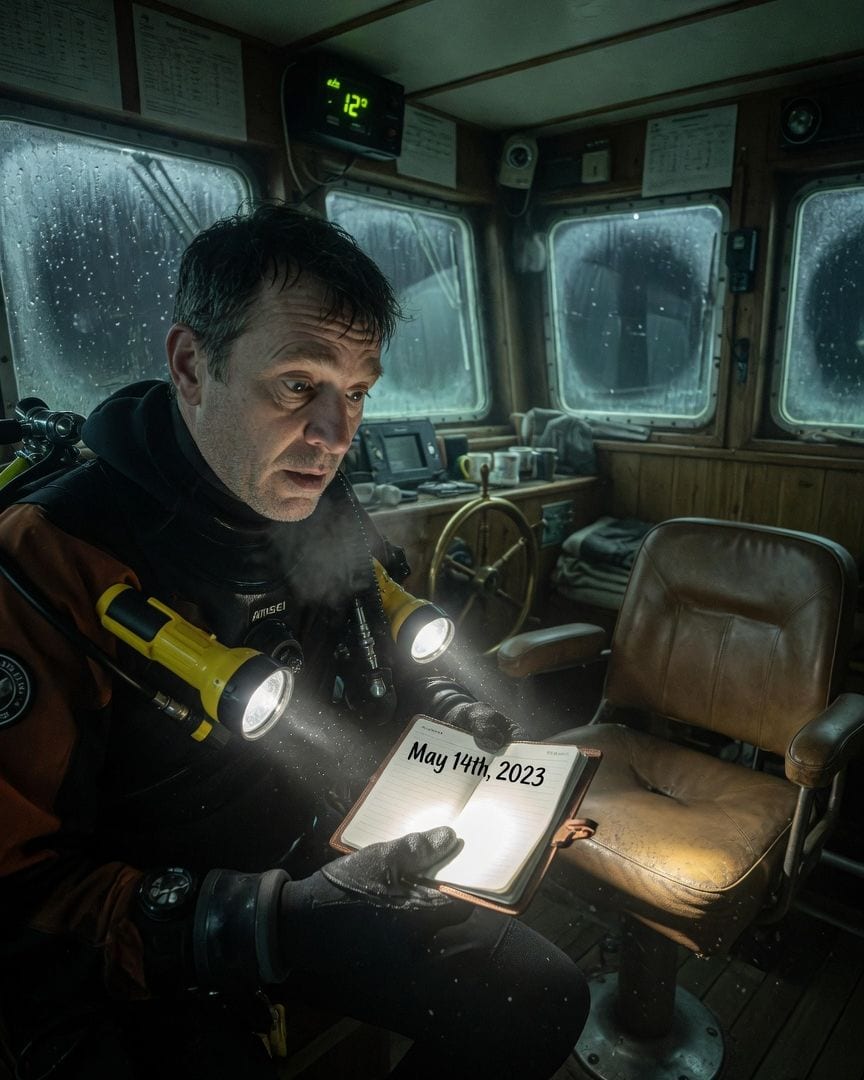
A dive supervisor exploring a Cold War sealer found its logbook on a wheelhouse shelf, with an entry dated this morning.
Dive supervisor Hugo Amsel felt the familiar cold of the Bering Sea as his submersible approached the 'Wynn Portal,' a sealer vanished without a trace in 1991. The wreck sat eerily intact, its wheelhouse windows impossibly clear, and the helm locked hard to starboard. But then the rudder angle indicator twitched, moving two degrees, a ghost still at the wheel. After breaching the sealed hull, Hugo and his lead diver found the ship's interior pristine, frozen in time. In the wheelhouse, on a shelf next to the chart table, lay the logbook. Its final entry, written in Captain Larsen’s hand, was dated 'May 14th, 2023' – today. The ink was still unsettlingly fresh, leaving Hugo to stare at the impossible date and the empty captain's chair.
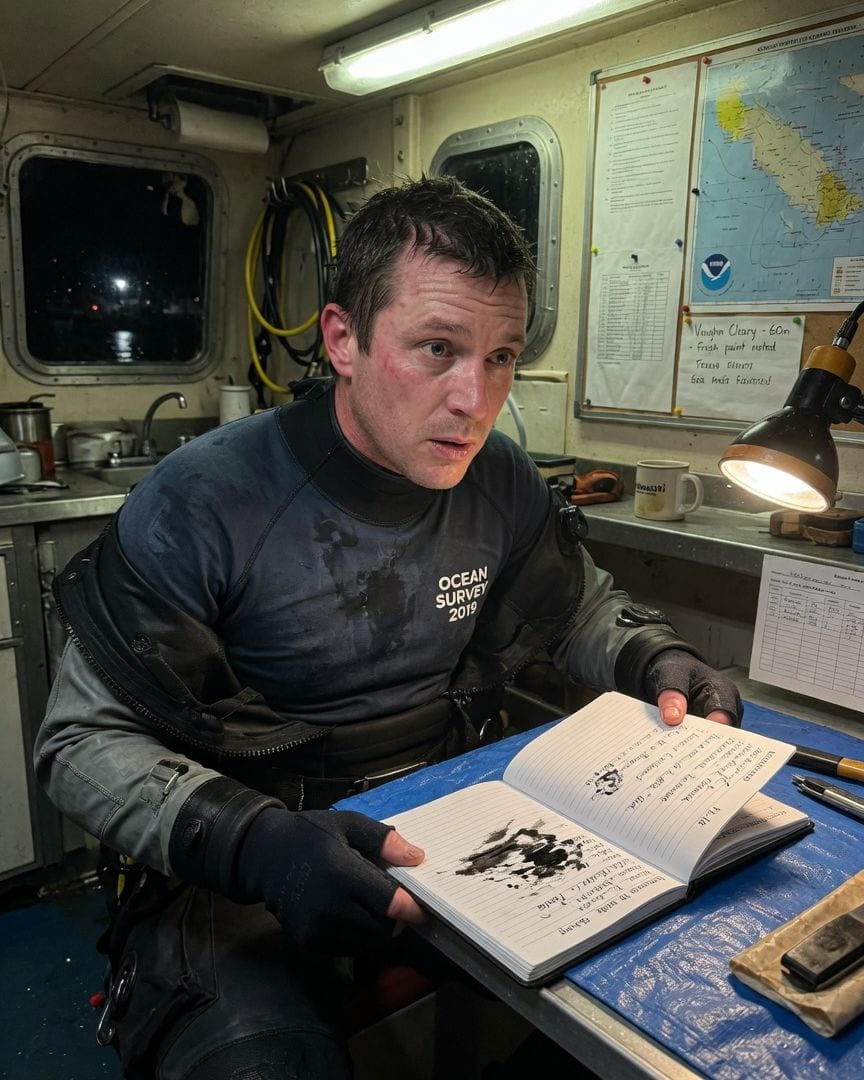
A deep-sea diver finds fresh paint on a sunken ship’s hull. It’s his dead grandfather’s distinct hand.
Deep-sea diver Teague Orrin knew the ocean's cold, indifferent blackness intimately as he descended sixty meters to the transport ship Vaughn Cleary. He was there to uncover the mystery surrounding his grandfather, Howard, pulled from her crew list days before she sailed, never speaking of it again. Teague's light swept the hull, revealing impossibly bright, fresh white paint over marine growth, bearing his dead grandfather's distinct hand. Dismissing skepticism, he returned to the wreck, discovering a miraculously intact captain's quarters and a bolted-down safe. Inside, a logbook awaited, its pages remarkably preserved, holding entries that continued *after* the ship was lost, with today's date still wet on the ink.
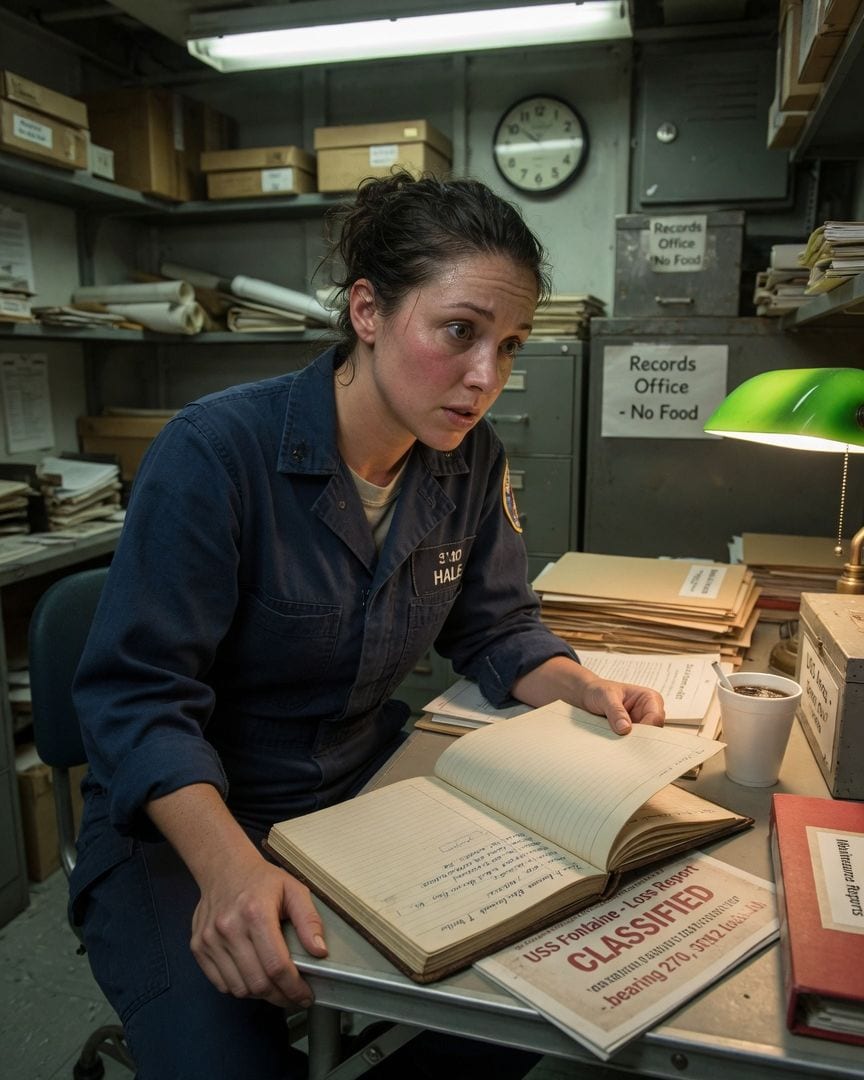
Petty Officer Hale needs a spotless record for her transfer. But the USS Ares sonar logs show an identical, impossible contact, logged to the minute, years apart, and tied to a classified loss report.
Petty Officer Sarah Hale needed a spotless record for her coveted shore duty transfer, a posting she'd worked five years to secure. Alone in the USS Ares sonar shack, three days out from San Diego, her midwatch was broken by an impossible contact: a close, slow echo holding perfect pace, invisible to radar, then vanishing. Her heart hammered, not from fear, but from the data's impossibility. When she found an identical entry in her own log from just one week prior, the cold dread tightened its grip. But the true chill settled when she unearthed decades of similar records, signed by other sonar officers, all showing the same impossible contact at 0212, off the port beam, for nineteen minutes, on the same ship, stretching back years—a persistent echo tied to a classified loss report.
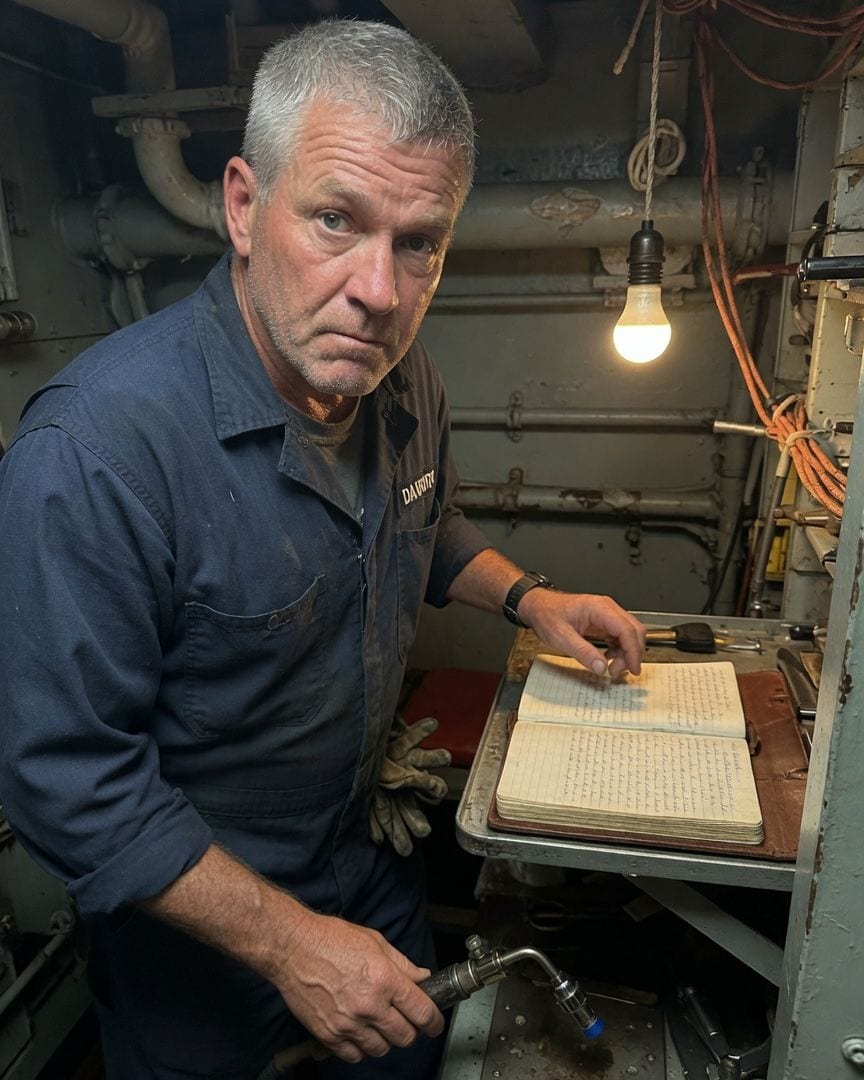
A week from shore duty, Chief Danforth cut a hatch where his ship's plans showed solid steel. An hour later, the wall was seamless, but the Cold War logbook from inside appeared under his mattress.
Chief Petty Officer Raymond Danforth, just a week from ending three decades of service, was intimately familiar with every pipe and plate of the guided-missile destroyer Weatherall. During a mid-cruise overhaul, his gloved hand found a sealed hatch where schematics promised only a solid bulkhead. He cut through the impossible seam to reveal a small, dry compartment, softly lit, containing a logbook filled with an unsettlingly familiar hand. When he returned an hour later with a witness, the hatch was gone, the wall seamless. Later that night, the same logbook appeared beneath his mattress, its pages revealing an entry: 'Petty Officer Howard Montgomery, missing, 1972.' How could a compartment vanish, yet leave its secrets behind?
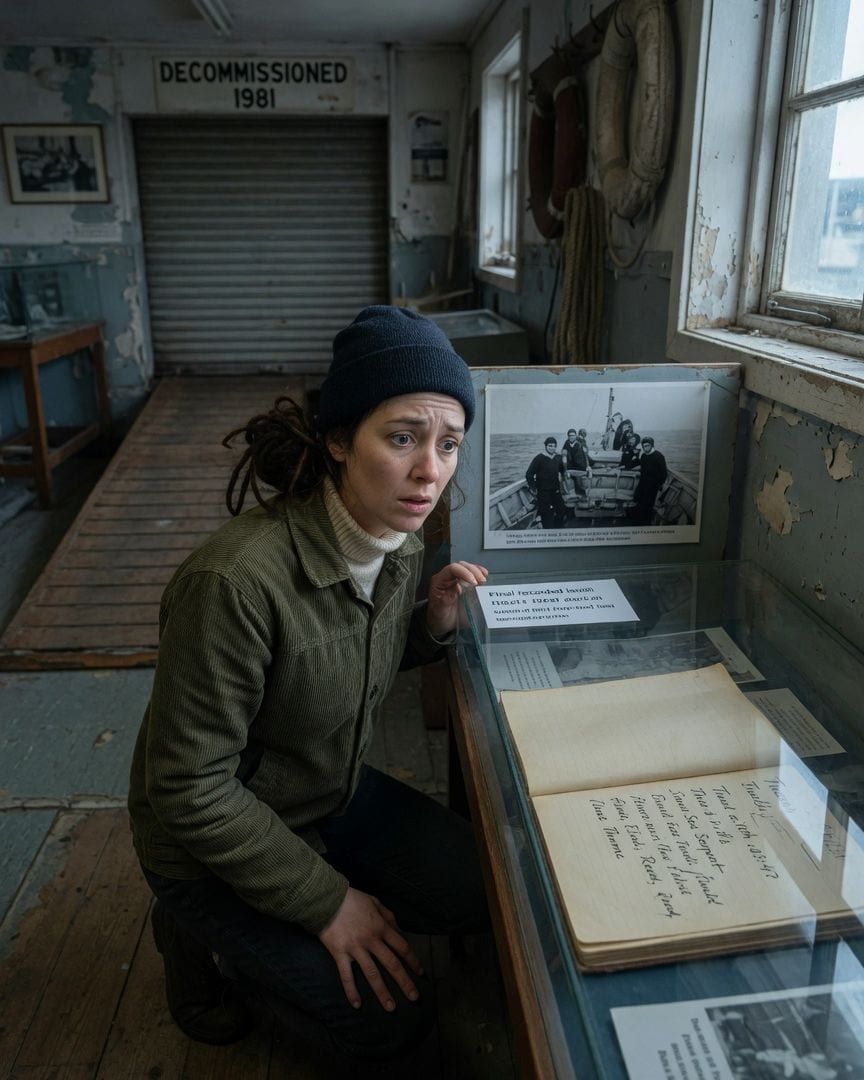
The museum's logbook recorded a rescue two days ago. Its 'souls saved' were buried in 1888.
As the new curator of the Runnock Maritime Museum, my assignment was to refresh the exhibits of its 1981-decommissioned station. Yet, a fresh logbook entry, dated just two days ago, noted a recent rescue. The vessel named, 'The Sea Serpent,' was listed in the archives as lost with all hands in 1888.
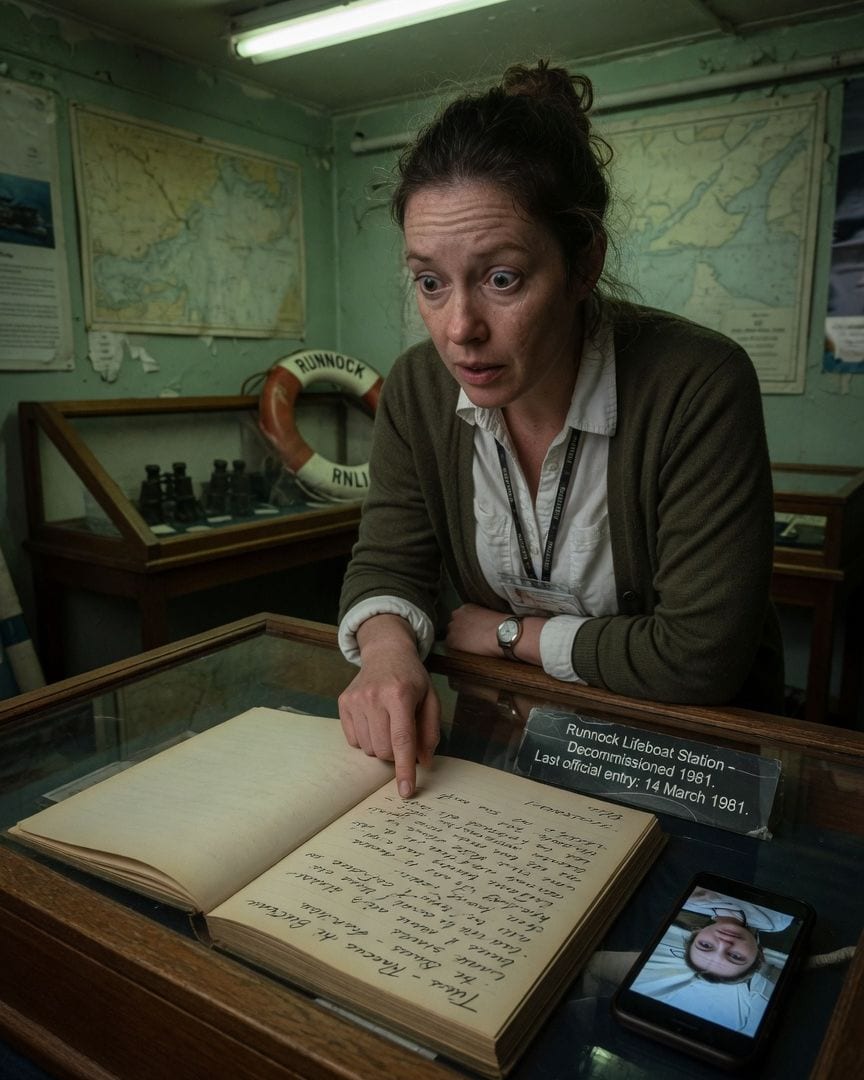
The Runnock lifeboat museum's old logbook adds new entries weekly – ships lost in the 1800s, saved Tuesday.
As the new archivist for Runnock Maritime Museum, I found an old logbook from a decommissioned lifeboat station. Its last entry, dated just Tuesday, listed a schooner lost in 1888 as 'saved with all hands,' penned in unsettlingly fresh ink. But then I found a man reported missing last month, also listed as 'saved' from that 1888 disaster.