My dental X-ray shows a whole tooth where a gap has been for twenty years. A tiny metal post and a filling in a molar I remember being pulled.
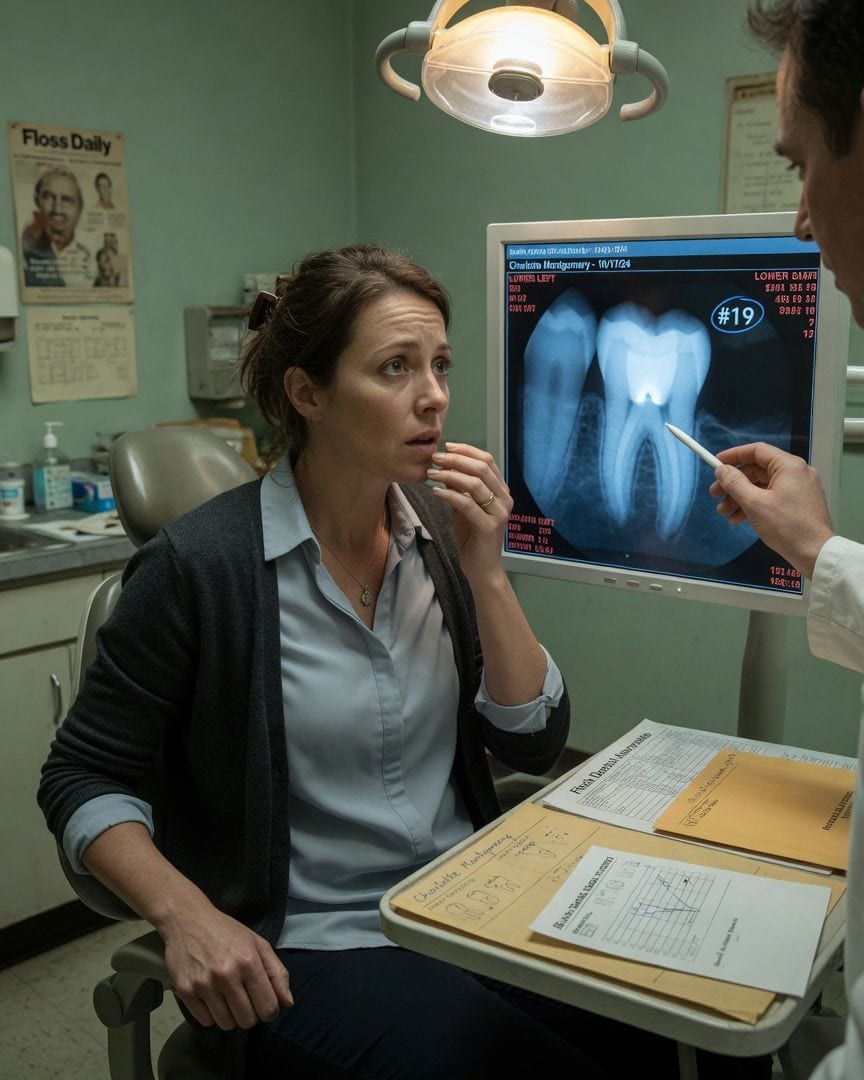
I sat in Elliot Caldwell’s dental chair, the hum of the overhead light a steady drone. On the screen beside me, my dental X-ray glowed, stark and undeniable.
There, precisely where I knew it shouldn’t be, was my lower left first molar, complete with a tiny metal post and a composite filling. The sight of it sent a chill through me, like static electricity crawling up my spine.
That tooth wasn't there. It couldn't be there.
I remembered the day it was pulled with an almost visceral clarity. I was nineteen, home from my first year of college, a brutal extraction followed by a week of agonizing dry socket. Only liquid meals.
I could still taste the metallic tang in my mouth, the phantom pressure of the missing tooth in my jaw. That had been twenty years ago. For half my life, there had been a gap.
Elliot, my dentist, a man in his mid-forties with a perpetually reassuring smile that usually put me at ease, had already counted my teeth twice. His brow was furrowed, the smile gone.
He even tapped the screen, as if the image itself might be mistaken, a digital ghost. "Number 19," he’d murmured, then counted again. "It’s there, Charlotte. Whole and treated. Right where… well, right where you said you had a gap."
It was my mouth, my X-ray, but it showed a piece of me that couldn't possibly exist.
Elliot, usually so unflappable, looked genuinely perplexed. He pulled up my current digital chart, cross-referencing the tooth numbers, his fingers hovering over the keyboard. "It's right there, Charlotte," he repeated, pointing to the screen with the stylus. "Number 19.
Fully restored." He knew my history, knew the long-standing gap in my lower jaw. "This is… highly unusual. Are you absolutely certain about the extraction?"
I recounted the exact year, almost to the season. The name of my old dentist, Dr. Finch. The specific, throbbing pain, the way I’d nursed lukewarm tomato soup for days. My conviction was absolute.
Elliot, seeing the certainty in my eyes, finally nodded. "Alright. Let's pull your old records. Sometimes records get mixed up, or a procedure was misfiled, a scan mislabeled."
His tone, however, lacked its usual confidence, a slight waver hinting at his own disbelief.
A week later, a thick envelope arrived in my mailbox, addressed from my previous dental practice, a small office across town. I tore it open, my hands oddly clumsy.
Inside, alongside years of my old cleaning schedules, was the record of the extraction. Dated precisely to when I was nineteen, it clearly stated: 'Molar #19, extracted due to severe decay.'
No mention of a post, no filling, just a blank space where the tooth should be, confirmed by a simple, hand-drawn 'X' on an old paper chart.
The X-ray, however, was recent, taken just last week, glowing with its impossible molar. The contradiction was no longer a possible mix-up; it was a cold, hard fact.
My body contained a tooth that my official history, and my own vivid memory, insisted was gone.
The next logical step, Elliot had suggested over the phone, was to trace my history further back. Perhaps something had been done in childhood, some obscure procedure that might explain this impossible anomaly.
It took weeks of phone calls, dead ends, and inquiries, but I finally located the archived records of Dr. Franklin Fairfax, my childhood pediatric dentist, whose practice had closed decades ago after his retirement.
The envelope that arrived felt ancient in my hands, brittle with age. Inside was a single, yellowed paper chart. It was dated from when I was five, six, seven years old, a timeline of my earliest dental history.
I scanned the tiny, precise handwriting, the carefully inked diagrams of teeth. It showed a full set of healthy primary teeth, then a transition to adult dentition.
But the chart, while bearing my name – 'Charlotte Montgomery' written in faded blue ink at the top – was subtly wrong.
The overall structure, the way the adult molars were sketched, the notations for minor procedures – it didn't align with my vague, fragmented memories of childhood dental visits.
And crucially, there was no indication of any missing molar at nineteen, or any precursor to the treated tooth on my current X-ray. It was a complete, alien dental history, as if it belonged to another child altogether.
I stared at the childhood chart, its yellowed paper crackling faintly in my hands, then back at the glowing X-ray on my laptop screen. The disconnect was absolute.
My own history, my own body, seemed to be telling two completely different stories.
I tried to find Dr. Fairfax, but his old office building, a small standalone structure downtown, was now a smoothie bar with bright green awnings and loud reggae music spilling onto the street. The old phone number was disconnected.
An elderly resident in the apartment building upstairs, Mrs. Jenkins, remembered him vaguely. "Oh, old Dr. Fairfax," she'd said, her voice raspy. "Nice man. Retired real sudden, must be thirty, forty years ago.
Said all his patient files went to the Medical Archives, out near the old industrial park."
The Medical Archives. It sounded official, impersonal, a bureaucratic black hole.
I drove out there the next day, a nondescript, windowless brick building on the edge of town, surrounded by dormant warehouses and a faint smell of something like damp concrete.
Inside, the air was cool, smelling of old paper and dust, a quiet so profound it felt like a pressure on my eardrums.
I was met by Walter Montgomery, a man in his late sixties with thin grey hair neatly combed and calm, unblinking eyes. He moved with a quiet efficiency, seemingly unbothered by my slightly distressed explanation of conflicting dental records.
He listened patiently, his hands clasped behind his back, then led me through rows of climate-controlled shelves that seemed to stretch into infinity.
"We have records going back a century," he said, his voice soft, almost a murmur, the words barely disturbing the stillness.
He found my name quickly on a digital index, then pulled a thick, manila folder from one of the lower shelves. "Ah, here we are. Charlotte Montgomery. Born... 1984."
He opened it, revealing a mix of official documents, insurance forms, and medical reports, many with sections redacted with thick black lines or marked 'missing' in neat, institutional stamps. Walter simply shrugged at my questioning look. "Common for older files.
Paper decays, or was never submitted." His composure was unnerving.
As I sifted through the partial records in the quiet archive, a growing unease settled over me. Walter Montgomery, ostensibly busy at a nearby terminal, sorting through what looked like microfilm reels, seemed to be observing me.
Every time I looked up, his eyes were on me, not with curiosity, but with a detached, knowing quality that pricked my skin like a thousand tiny needles.
He never smiled, never offered more than a clipped, polite answer if I asked a question about a redacted section. The room itself felt like it was holding its breath, the air thick with unspoken things.
Later, after I’d left the archives, the oppressive silence of the building replaced by the drone of afternoon traffic, a message appeared in my email inbox.
It was from an unknown sender, the address a string of alphanumeric characters, with no subject line. My stomach clenched as I opened it. The body contained a single, chilling sentence: 'Some things are best left undisturbed.
Let sleeping teeth lie.' My hand trembled as I read it, a cold wave washing over me. My digging had been noticed. Someone knew exactly what I was looking for, and they were watching me.
The anonymous warning, coupled with Walter’s unnerving gaze, made the clinical mystery feel suddenly, terrifyingly personal.
I wasn't just investigating a medical anomaly; I was being drawn into something that wanted to remain hidden, something powerful enough to track my every move.
I returned to the Medical Archives the next day, the anonymous email burning behind my eyes. I found Walter Montgomery in the same quiet corner, cataloging a stack of dusty volumes.
I walked directly to his desk, my conflicting dental charts – my recent X-ray, my old extraction record, my childhood chart – clutched in my hand. I placed them on the desk between us.
"This isn't a mix-up, Mr. Montgomery," I said, my voice tight, barely controlled. "Someone sent me a warning. You know something about this."
Walter looked at the documents, then at me, his expression unchanging, a still lake. "Some cases, Miss Montgomery," he began, his voice still unnervingly calm, a soft murmur that didn't quite reach the next shelf, "are… unique.
Their records are handled with a different protocol. For their protection, and for the integrity of the process." He paused, letting the words hang in the air between us, heavy and deliberate. The quiet archive seemed to hold its breath.
"The tooth you see in your current X-ray, the one with the post and filling? According to our internal, comprehensive records, that tooth is genuinely, biologically yours. It has been since you were very young."
A cold dread spread through me, numbing my fingertips. "My memory of it being pulled? My old dentist's records?"
Walter simply shook his head, a slow, almost imperceptible movement. "Memory can be… malleable. Public records, sometimes, are simplified for clarity."
He then opened a different drawer in his desk, pulling out a heavy, leather-bound ledger, its pages yellowed with age, the binding creaking as he laid it open.
He flipped through it, his finger running down columns of names and dates, stopping at an entry. "Your name, Charlotte Montgomery. Date of entry, when you were approximately five years old."
He pointed to a single, cryptic code next to my name: 'Project Molar.' He looked up at me, his gaze unblinking. "It was a long-standing, quiet program, Miss Montgomery. A protocol. For specific cases."
I stared at the ledger, the words 'Project Molar' a brand in my mind, burning into my awareness. "What is Project Molar?" I whispered, my voice barely audible above the low hum of the archive's ventilation system.
Walter Montgomery sighed, a soft, almost imperceptible sound, like air slowly leaking from an old tire. He traced a finger down the page, past my entry, past several other names, to an older, faded block of script below it.
"It was part of something larger. Much older." His finger stopped at a different name, a different identification: 'Patient 734.' The date next to it was from before I was born, decades before.
"This individual," Walter said, his voice flat, devoid of any inflection, "underwent a specific dental reconstruction procedure. Very advanced for its time."
He then shifted his finger slightly, indicating a faint, barely visible note scrawled in the margin next to Patient 734's entry. It was almost illegible, the ink faded to a sepia ghost, but I strained to read it, leaning closer.
'Recipient: (see above).' My gaze snapped back to my own name, higher on the page. The meaning hit me with the force of a physical blow, a sudden, sharp ache behind my eyes.
I wasn't just uncovering a secret; I was the product of it. I was the recipient. The program had been inside me, literally, since before I could consciously remember.
Walter Montgomery, having revealed the 'Recipient' entry, closed the heavy ledger with a soft thud.
He didn't wait for a question, but led me deeper into the archives, past rows of ordinary files, past sections marked 'Inactive' and 'Declassified,' to a heavily secured, unmarked section tucked away at the very back.
He unlocked a reinforced door with a key from a small, discreet chain, revealing more shelves filled with ancient, identical ledgers, stretching from floor to ceiling. The air in this section felt even colder, heavier, charged with unspoken history.
"Project Molar was an early sub-section of what we called the 'Reassignment Protocol'," Walter explained, his voice devoid of emotion, as if reciting a historical text.
"A program of subtle biological and identity modification, primarily for orphaned children or those with no next of kin. We provided them with… a new beginning. A standardized, stable identity."
He pulled out another ledger, opened to a page detailing 'Project Molar' in clinical, precise language. Diagrams, charts, lists of materials and procedures. "Your original dental record, from your birth family, was replaced.
The molar, as you observed, was a specific, early modification. A tissue graft, tested for long-term viability and integration." He showed me diagrams, surgical notes, dates that aligned with my earliest childhood.
"The memory of the tooth being pulled at nineteen?" Walter continued, his gaze unwavering. "That was a 'memory overlay'.
A carefully constructed narrative, implanted to account for the later appearance of the treated molar, which, as you know, was grafted in when you were very young."
He then produced an old, slightly faded photograph from a sealed envelope: a young girl, no older than seven, smiling broadly, missing her two front teeth, a gap for a moment in time. It was me.
And in that smile, perfectly blended with the others, was the 'wrong' molar, the one with the post and filling, undeniable. The evidence was irrefutable. My entire life, my very self, was a meticulously crafted lie.
I felt a profound numbness, as if my body had become a hollow shell. The world had shifted on its axis, and I was left floating in the void.
Walter Montgomery, seeing my despair, closed the ledger with a soft thud. The sound echoed in the vast, silent room. "You have two choices, Miss Montgomery," he said, his voice retaining its unnerving calm, as though discussing the weather.
"You can accept this truth, and continue living the life that has been so carefully constructed for you. Or you can fight it."
He gestured to the rows of ledgers around us, a silent, overwhelming testament to the scale of it all. "This program has managed thousands of lives over generations. It has vast resources.
To fight it would mean to unravel not just your own life, but the lives of countless others who are living their assigned realities, completely unaware. And you would find yourself… very much alone."
He pulled another file from a nearby shelf, thicker than any I had seen, filled with names and dates, a terrifying tapestry of managed identities. The names blurred into an endless scroll of carefully constructed lives.
I tried to speak, to ask, to scream, but no words came. I felt trapped, not by walls, but by an invisible, omnipresent system that owned my very existence, every breath I took.
I turned to leave, my legs feeling heavy and detached, moving as if they belonged to someone else. As I stepped out of the Medical Archives building, the bland afternoon sun felt harsh and unreal, too bright, too loud.
My eyes scanned the quiet street, and there, parked a block down, was a dark sedan. It was the same model Walter Montgomery drove.
I realized, with a sickening lurch, that I'd never truly been free, and I never would be.
I returned to my apartment. The familiar rooms, once a sanctuary, now felt like a stage set, every object a prop in a play I hadn't known I was performing.
I pulled out old photo albums, flipping through them with a detached gaze. There it was, in a picture from my eighth birthday, my smile wide, the 'wrong' molar perfectly in place.
The memory of the dry socket, once so vivid and painful, now felt hollow, a ghost of a sensation, an empty echo. My past was not my own.
My identity, a fragile construct, built on a foundation of meticulously manufactured lies.
I went through the motions of my evening routine, making dinner, watching television, but it was all just noise, a carefully curated backdrop to a life that had been assigned to me.
The dread was no longer in discovery, but in the crushing weight of coherence, the terrifying fact that it all fit.
I sat alone in my living room, the city lights reflecting faintly in the darkened window, painting faint, shifting patterns on the walls.
I lifted a finger to the side of my mouth, touching the area where the molar was, the molar that was never truly 'hers' by any right I understood.
The memory of Walter’s calm, knowing gaze, his unblinking eyes, was clearer than my own childhood. My phone buzzed, a text from my friend, Sophia Sullivan, asking if I was coming to dinner.
I looked at the screen, then back at my reflection in the dark glass. I didn't reply.
The next morning, Charlotte Montgomery arrived at work precisely on time, just as she always did. Her colleague, Sophia Sullivan, commented on her new, unusually serene expression.
'You look like you've seen a ghost, but in a good way,' Sophia joked. Charlotte just smiled, a faint, wrong little smile.
If this one got to you
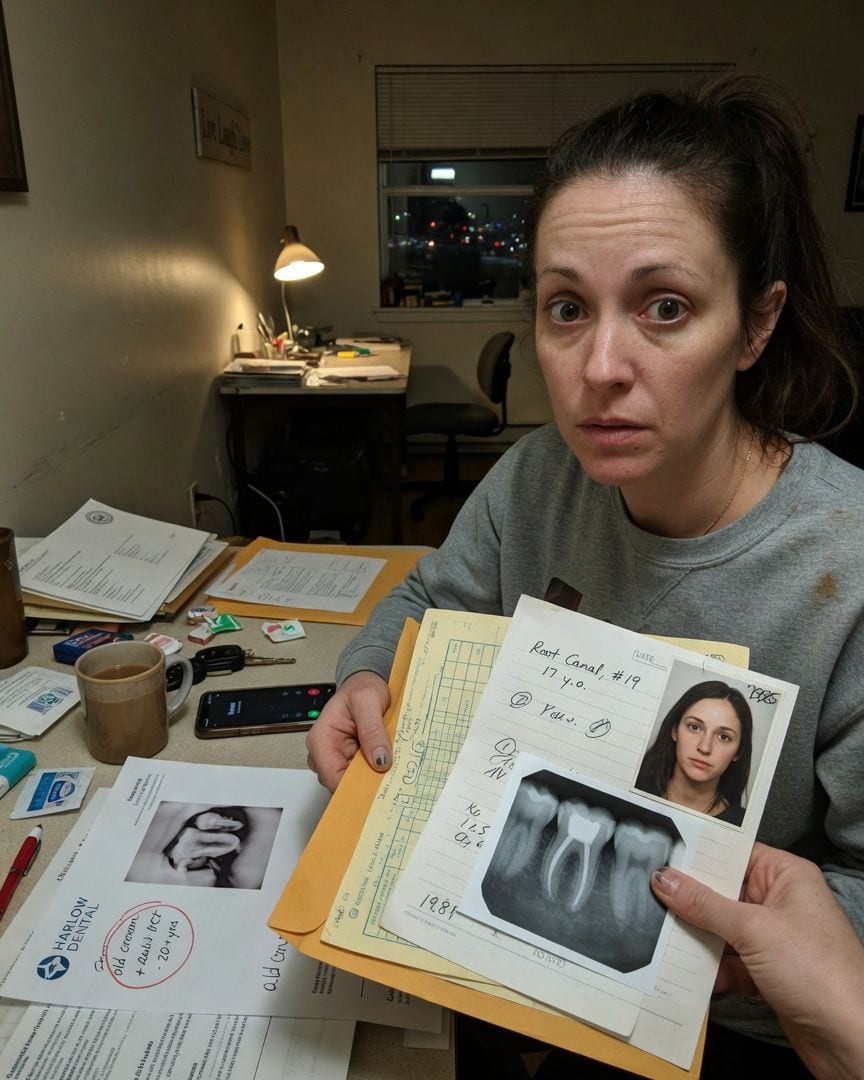
My lower molar has a twenty-year-old root canal. My new dentist showed me the scan. That tooth is whole. I can feel it.
My new dentist found a twenty-year-old root canal and crown in my mouth. The problem? I have no memory of ever having major dental work there, and my mother confirms I never did. My own body held a secret I couldn't explain.
My MRI showed a healed Achilles rupture, two anchors in the bone. I've never had surgery, and there's no scar.
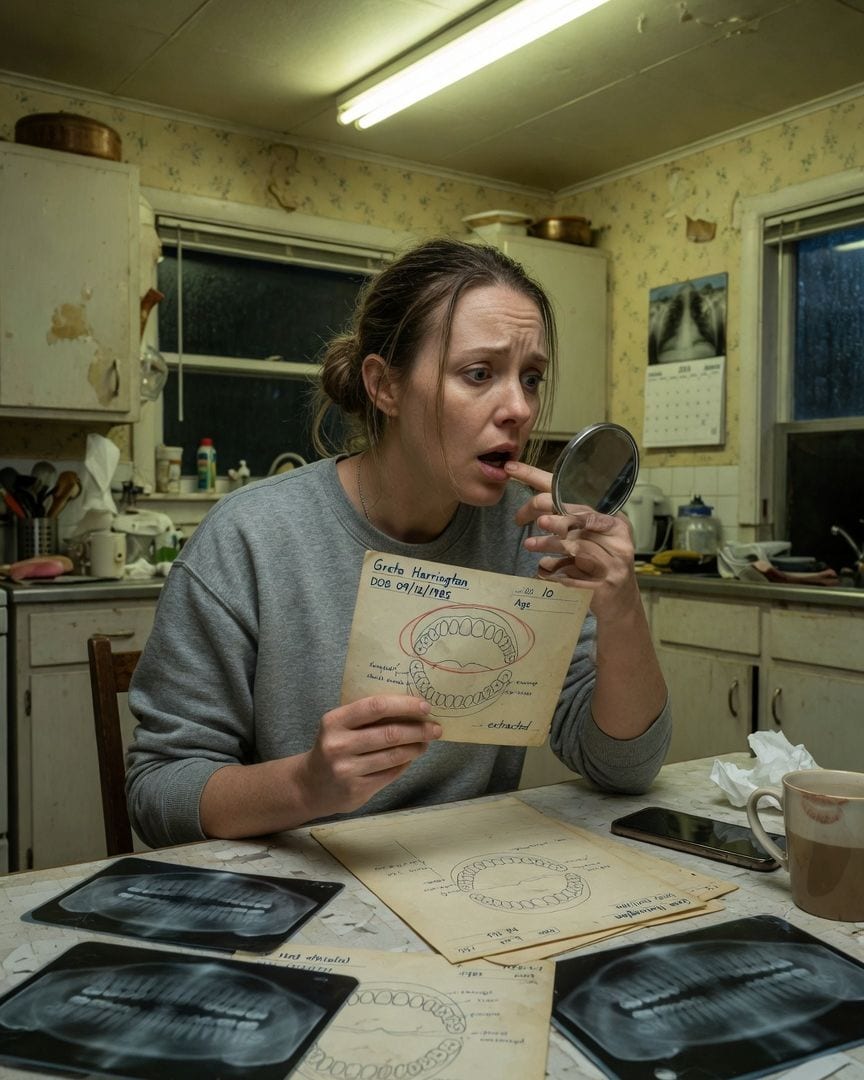
After a baffling medical discovery about my own body, I began to search my past. My childhood dental charts arrived, brittle with age, detailing a history I couldn't recall. But as I compared the faded diagrams to my own mouth, they showed a tooth extracted — a tooth I can feel, solid and real, in my jaw.
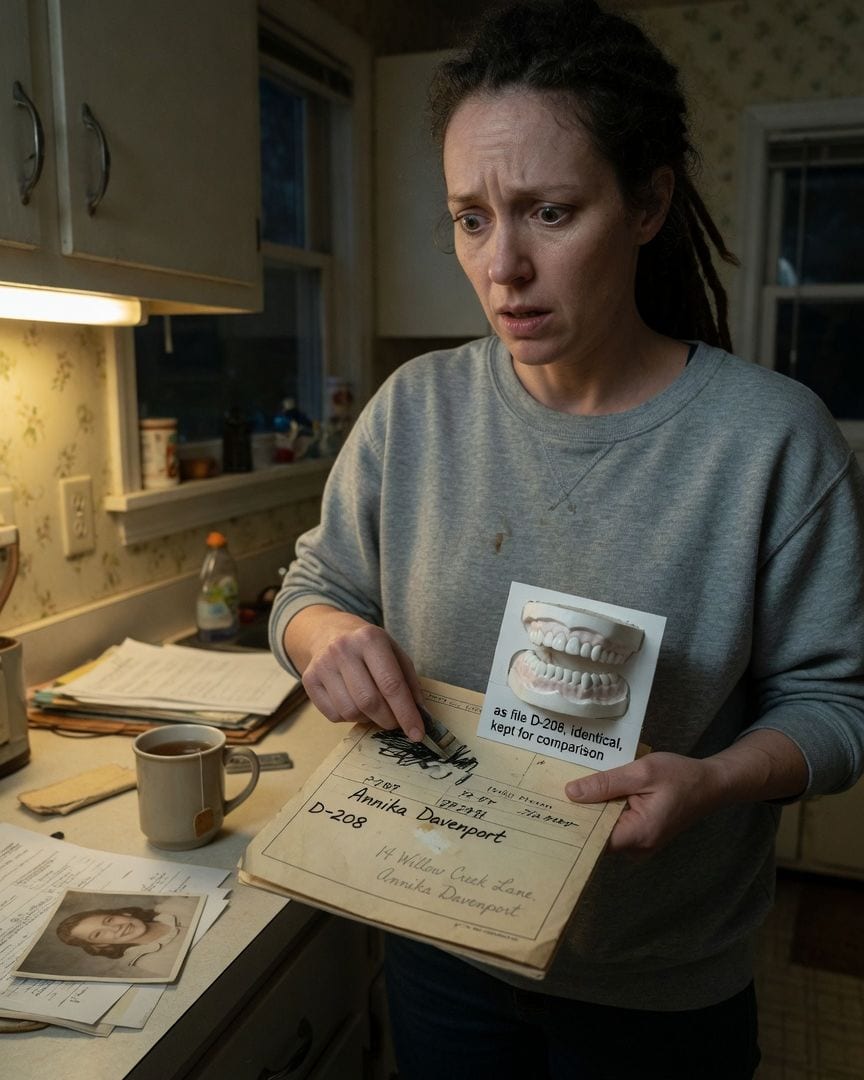
My childhood dental chart lists the house I bought last year — in my own name, years before I was born. A second set of my teeth sits filed beside it, marked 'identical.'
Sifting through old dental records, I found my chart, D-208, with my 1988 birth date. But a line from 1958 was blacked out, and a clipped card with an impression of my teeth listed my name and current home address, decades before I was born. The impossible facts knotted into a cold certainty.
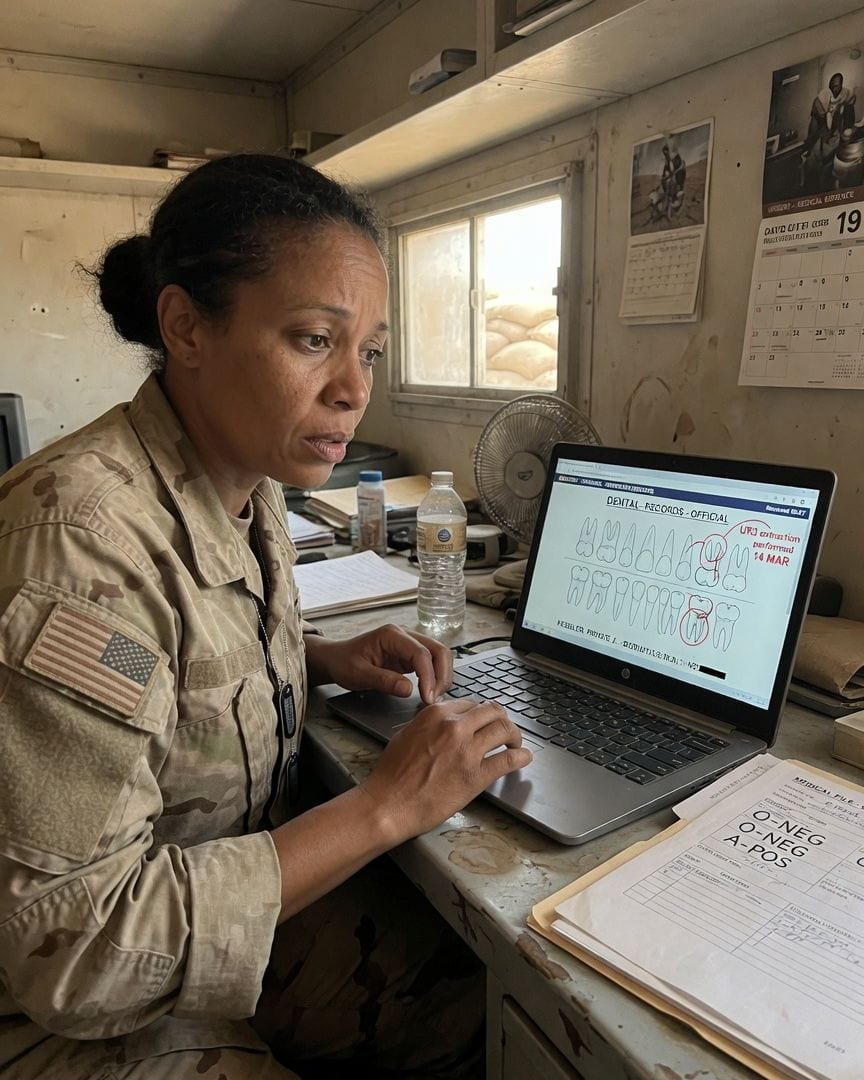
Weeks from going home, Sergeant Whitmore saw Private Kessler’s dental records show teeth he didn’t have and missing ones he did.
Sergeant First Class Iris Whitmore counted the weeks until her deployment ended, dreaming of home as the desert heat baked FOB Cerberus. But the familiar weight of Private Kessler’s dog tags soon brought a cold knot of dread: his blood type, once O-negative, suddenly read A-positive. She dismissed medical anomalies and clerical errors, only to find his official records subtly rewriting his timeline, linking old injuries to new identities. When his dental charts arrived, showing teeth he never had and missing ones he did, Sergeant Whitmore faced an impossible question: who was Private Kessler, really?
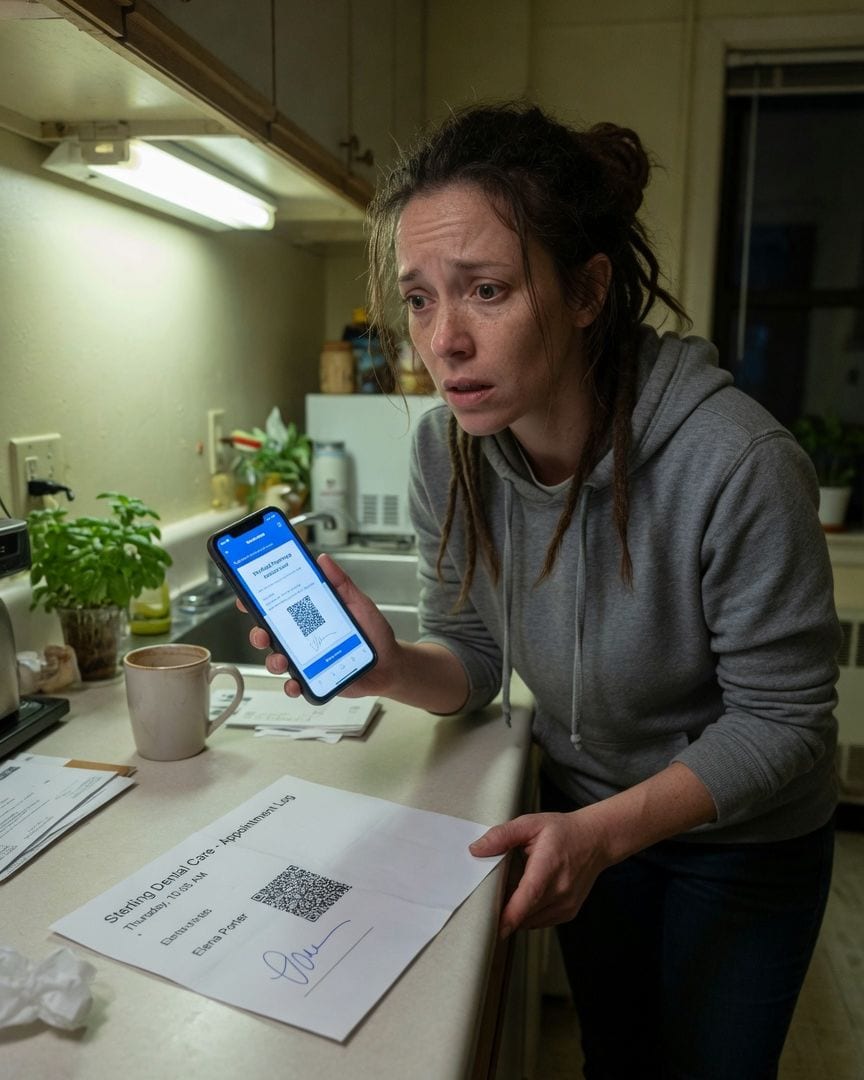
My dentist's system says I was there last Thursday. I wasn't. But the check-in tablet shows my signature, and the hygienist described my chipped tooth exactly right.
I received a call confirming a dental appointment I never made, for a day I was home. Yet, Sterling Dental had my perfect digital signature and described a chipped incisor I’d never told them about. The physical proof insisted I was there, but I wasn’t.
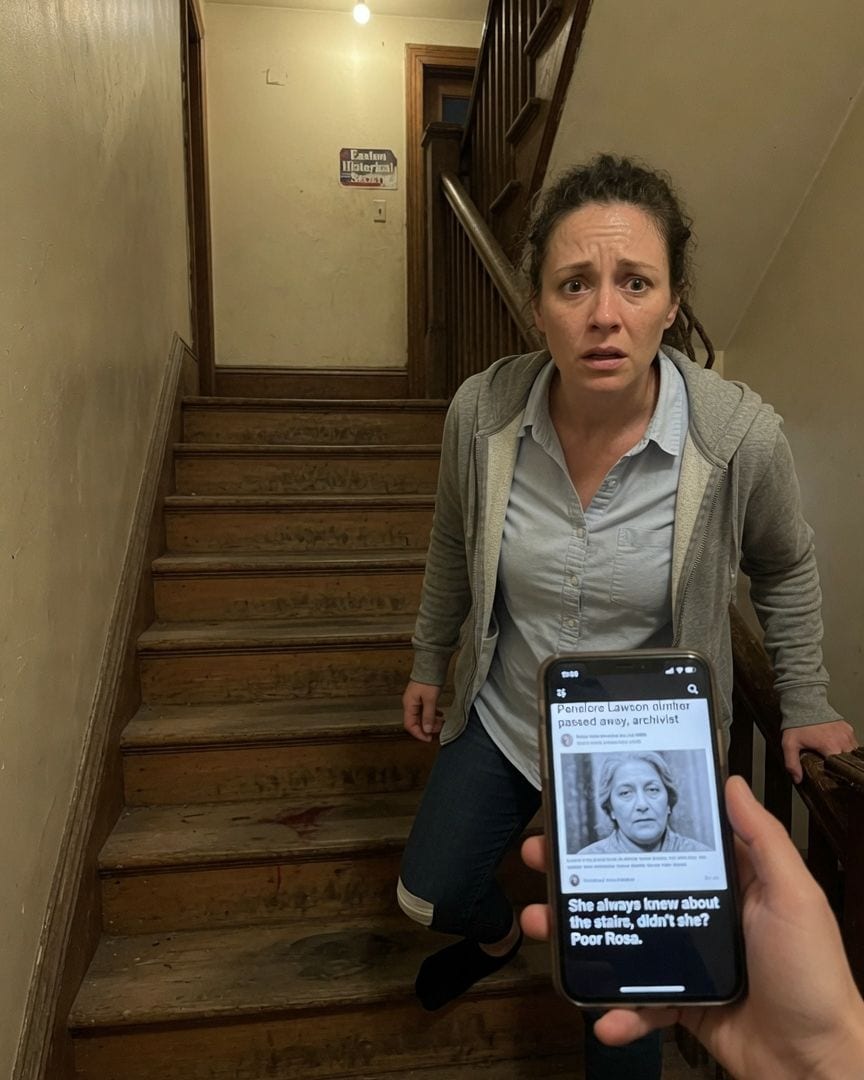
My hygienist apologized, 'I'm so sorry, Rosa — about the stairs.' I'd given the clinic only my surname, and they said she hadn't worked there in over a year.
During my routine dental cleaning, the hygienist murmured my name, Rosa, which wasn't on my intake form. She then offered a soft apology "about the stairs," a kindness that felt deeply misplaced and settled in my gut.