My MRI showed a healed Achilles rupture, two anchors in the bone. I've never had surgery, and there's no scar.
The ache in my right heel had been nagging me for months. A dull throb that flared with every step, every incline. I’d finally given in and booked an appointment.
Dr. Gordon Rutherford, the orthopedic consultant, was a man in his late fifties with kind eyes and a habit of tapping his pen against his chin. He’d ordered an MRI.
“Well, Ms. Harrington,” he’d said, swiveling his monitor to face me, the scan glowing a ghostly white and grey, “it’s certainly clear what’s causing the discomfort.”
He zoomed in on a specific section of my heel, a tangle of white fibres and what looked like tiny, bright flecks. “You’ve got a fully healed Achilles rupture here. Quite a clean repair, actually. See these?”
He pointed to two distinct, bright points embedded in the bone. “Suture anchors. They hold the tendon in place as it mends. This repair has held for years.”
He leaned back, his gaze steady on me. “Can you recall when you might have had surgery for this? It’s a significant procedure. Most people remember.”
I’m 38. I have never ruptured my Achilles tendon. Not even a sprain that needed more than RICE. My mind raced, searching for any memory, any incident, a vague hospital stay, a childhood accident. Nothing. And there was no scar.
I looked down at my right ankle, instinctively tracing the skin up the back of my heel with my thumb. Smooth. Unblemished. Not even a faint line, the kind that fades over decades. Just my skin.
I told Dr. Rutherford this, calmly. “I’ve never had surgery on my Achilles. There’s no scar. I would know.”
He just nodded, his expression unreadable, and suggested a second opinion. The X-ray was mine, the repair was mine, and it was undeniably, irrevocably, years old.
The fluorescent lights of his office seemed to hum a little louder then, a high-pitched whine that settled at the back of my skull.
The second opinion confirmed it. Dr. Anya Sharma, a younger, equally perplexed specialist, pointed to the faint calcification around the anchors, the way the tendon fibres had knitted together, almost invisibly.
“Textbook healing,” she’d said, her brow furrowed, “but definitely not recent. The bone remodelling suggests a repair that’s easily ten, maybe fifteen years old. Are you absolutely certain you don’t have any forgotten medical history?
Perhaps a surgery you were too young to remember, or one your parents didn’t fully explain?”
It seemed impossible. My parents were meticulous, almost to a fault. They remembered every childhood scrape, every ear infection. But the seed was planted. A surgery I didn’t remember. A part of my physical history that was alien to me.
I started with my dental records, thinking if there was any discrepancy, it might show up there first. Teeth are permanent, a fixed map of a person’s history.
I called my childhood dentist’s old office, now a modern clinic, and requested my charts. They arrived a week later, a thick manila envelope of X-rays and notes from when I was six, then ten, then fifteen.
The paper was brittle, the ink faded in places, smelling faintly of ancient paper and something metallic.
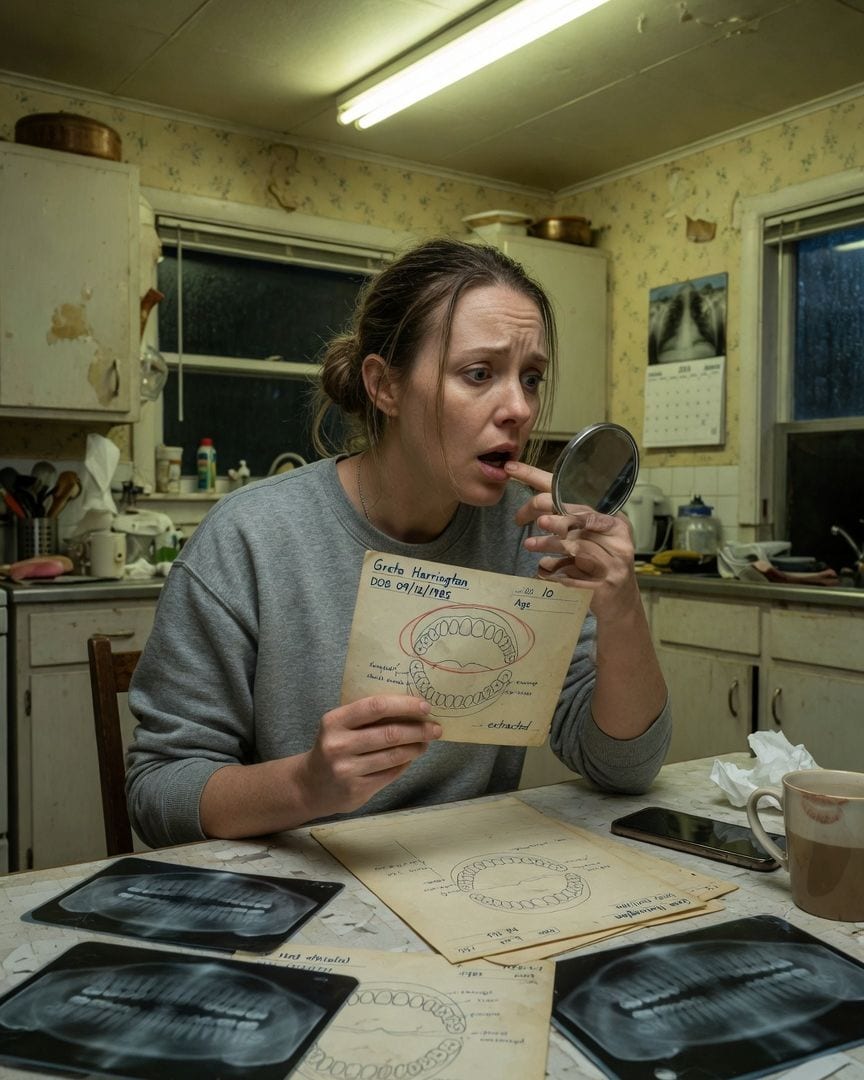
I spread them out on my kitchen table, pulling out my own mirror to compare. My current teeth are perfectly straight, a few fillings, nothing remarkable. I found the chart from when I was ten.
My name, Greta Harrington, clearly printed. My birthdate. And a diagram of my mouth. I traced the diagram with my finger, then my own teeth. My molars, my incisors, all present and accounted for.
But the diagram… the diagram showed a missing lower left canine. A gap. A space where a tooth should be. A space I didn’t have. I ran my tongue over my own lower left canine. Solid. Real. Present.
I checked the dates. The chart was definitely mine. The name, the birthdate, the address. Everything matched. Except for the physical reality of my mouth. I found another chart, from age six, then another at fifteen.
Each showed the same missing canine, sometimes marked with a faint 'extracted' note, sometimes just a blank space. It wasn't a mistake on one chart; it was a consistent, documented absence.
I pressed my fingers to my jaw, feeling the solid bone of the tooth that shouldn't be there, then stared back at the faded ink of my own childhood dental chart, holding it next to a mirror image of my current teeth, the undeniable discrepancies between them a cold, physical impossibility laid bare.
The dental records became an obsession. I called the new clinic. They confirmed the records were authentic, digitized from the original paper files. The dentist who’d made them, Dr. Evelyn Porter, had retired decades ago and passed away years later.
No one else could explain it. The young receptionist on the phone sounded apologetic, but firm: “Those are your records, Ms. Harrington. They’re historical.”
I tried to find any other medical anomalies in my past, anything that might correlate with a missing tooth or an Achilles repair. Nothing. My medical history was remarkably dull.
The only common thread was that both records—the MRI and the dental charts—were official, documented facts about my body that contradicted my lived experience.
The world felt slightly out of focus, as if someone had subtly shifted the ground beneath my feet.
I remembered the old clinic name on the dental chart: 'Harrington & Sons Medical Registry.' It was a very old name, almost a historical footnote in the city directories.
A quick search led me to an archived building downtown, now simply called the 'Historical Medical Archives,' run by a single, quiet man named Raymond Hawkins.
The building itself felt ancient, a grey stone structure tucked between modern glass towers. The air inside was thick with the smell of old paper and dust, a scent so potent it tasted metallic on my tongue.
Hawkins was a small, neat man in his late sixties, with spectacles perched on his nose, making him look like a character from a forgotten library.
He sat behind a large, dark wooden desk, surrounded by towering walls of metal filing cabinets that seemed to reach the low, recessed ceiling.
He listened to my story of the Achilles and the impossible tooth with unnerving calm. He didn't interrupt, didn't question.
His eyes, behind the thick lenses, seemed to take in every detail, as if he'd heard it all before, or was simply cataloging a new entry in an invisible mental ledger.
He simply nodded when I finished, the only sound the faint hum of an ancient ceiling fan slowly churning the heavy air.
“A body that doesn’t fit its record,” he murmured, almost to himself, his voice soft, dry as old parchment.
He stood, walked to a section of the wall where the cabinets were particularly tall, and pulled out a single, unmarked drawer with a soft, metallic screech. The sound echoed in the quiet room.
“You’re looking for a specific kind of discrepancy, aren't you, Ms. Harrington?”
Hawkins returned to his desk and slid a slim, leather-bound volume across the polished dark wood. It looked like an antique ledger, its pages yellowed and brittle at the edges, the binding worn smooth from countless openings.
“This isn’t official,” he said, his voice flat, his gaze resting on the ledger, not on me. “But it might offer context. A… personal collection.”
He opened it to a random page, filled with tight, spidery handwriting and columns of dates and codes. My name wasn't there.
He didn't point to anything specific, just let me examine the page, then closed it with a whisper of old paper.
“Some things,” he continued, without looking at me, his fingers tracing the worn cover of the ledger, “have a longer history than we perceive. The body is a remarkable vessel, capable of holding more than one story.”
His calmness was more unsettling than any fear or resistance. He wasn't trying to hide anything, yet he revealed nothing directly. He simply observed me, his head tilted slightly, like a collector examining a curious specimen.
“The Achilles, the dental records… they are consistent with a certain… protocol. One that began many decades ago, long before you or I were born.” He looked at me then, a faint, almost imperceptible smile touching his lips.
The smile didn't reach his eyes; it was a practiced, knowing expression. “You’re not the first to notice. And you won’t be the last. The records are all here, if you know how to read them.
Look for the 'Host Integration Protocols' in the archived medical journals of the early 20th century. Specifically, volumes from the 'Whitfield Institute of Applied Biology.' They were pioneers.”
He closed the ledger and gently pushed it back towards himself, as if protecting a fragile secret.
He was not helping me, he was guiding me, as if testing my resolve, watching to see if I would follow the thread he’d dangled. I felt a cold prickle on my skin. He knew. He knew everything.
And he was utterly unbothered by it.
I left Hawkins’s office with a new lead and a profound sense of unease. The Whitfield Institute. The name echoed in my mind. I found their archives online, a treasure trove of digitized medical journals from the early 20th century.
The screen glowed late into the night, illuminating my kitchen table, now buried under a new kind of impossible evidence.
It took days of sifting through dense, archaic language, of reading clinical articles on genetics and obscure biological theories, until I found it: a series of articles, starting in the 1930s, titled 'Host Integration Protocols: Studies in Somatic Continuity.'
The language was clinical, detached, almost academic in its cold precision, but the implications were horrifying.
They described experiments in 'transferring somatic memory' and 'integrating pre-existing physical histories' into new biological vessels. The goal, stated plainly, was to ensure the 'continuity of specific biological lines' or 'presences' through successive bodies.
They detailed procedures for 'grafting' or 'imprinting' physical traits and even past injuries onto a new host, ensuring that the physical history of the 'occupant' was maintained.
The Achilles repair, the missing tooth – these weren't my memories, they were residual physical markers of a previous 'occupant' that my body had been designed to carry forward. My own body was not entirely mine.
It was a vessel, a continuation.
The articles spoke of 'pre-emptive modifications' for certain vessels, explaining why the missing tooth was present in my childhood charts, even if I had never experienced the extraction myself. It was planned, integrated.
The Achilles repair was a later 'integration' from the prior host's life, a physical detail copied and embedded within my own tissue. Everything clicked into place with a sickening coherence.
My MRI, my dental charts, Hawkins’s calm demeanor – it all made a terrible kind of sense. The chill that ran down my spine wasn’t from the drafty room; it was the cold shock of understanding.
My body was a living archive, a physical legacy for someone else. But who? And how many others? The room seemed to press in on me, the silence suddenly heavy, accusatory.
The journal articles confirmed the 'what,' but not the 'why' or the 'who.' I returned to Raymond Hawkins, the heavy printouts clutched in my hand, the pages crinkling with every tremor in my grip. He was expecting me.
The door to his archive office was slightly ajar, as if he knew I’d be back. He didn’t ask what I’d found, just gestured to the worn visitor’s chair opposite his desk.
“So you’ve read the protocols,” he said, his voice as even as ever, as if we were discussing the weather. “You understand the scope?”
I asked him about the missing tooth, the Achilles. He confirmed they were indeed 'integrated historical markers,' physical echoes from a previous tenant in the somatic line.
I demanded to know if this was still happening, if I was an isolated case, a glitch in a long-abandoned experiment. He smiled, a thin, knowing curve of his lips, unsettlingly devoid of warmth.
“Ms. Harrington, the Institute has a very long memory. And its work is… continuous.”
He then stood, walked to a locked cabinet behind his desk, older and more imposing than the others, and pulled out a much older, heavier ledger than the one he’d shown me before.
It was bound in dark, worn leather, its corners scuffed down to the wood, radiating an aura of immense age and weight. This one was clearly an official record, not a personal collection.
He laid it open on the desk between us, revealing pages filled with precise, almost calligraphic script, columns of dates, names, and complex alphanumeric codes.
The air in the room grew noticeably colder, a silent shift that made the hairs on my arms stand up.
He ran his finger down a column, past dozens of entries, each a case, a 'host integration.' The dates spanned back over seventy years, some from before World War II. He paused, his finger resting on a line.
My eyes followed. A name, slightly different from mine, but undeniably close, a variant, followed by a date – December 14th, 1937 – decades before my birth. Below it, a series of codes.
And below that, a designation: 'Harrington, Greta – Host Integration Protocol, Stage 3.'
Raymond Hawkins's finger traces a line in the heavy, leather-bound ledger, moving past dozens of entries before landing on a name similar to Greta's, listed next to a date from decades before she was born, under a clinical designation that chills her to the bone.
Hawkins looked up, his gaze steady, unwavering, devoid of any judgment or emotion. “This ledger,” he explained, his voice hushed, as if speaking of sacred text, “is the master record. It details the lineage, the successions.
The 'Host Integration Protocol' isn’t about replacing a person, Ms. Harrington. It’s about continuity. Certain individuals, certain 'presences,' are deemed essential. Their contributions, their very essence, are too valuable to lose to a single lifespan.
Your body, the current iteration, is a carefully prepared vessel. The Achilles repair, the dental structure – these were physical echoes, markers of the previous host, integrated to maintain the somatic continuity of the core presence.
You are, in essence, a living archive, a continuation. The 'previous tenant' lived a full life, passed on, and their physical history, their very genetic memory, was carefully transferred, reinforced in the next designated host. You are that host.
The original Dr. Whitfield believed that consciousness was not singular, but a layered experience, and that certain layers could be preserved, passed down. This protocol has been refined over generations. Your parents, your grandparents, they were aware.
It’s a family legacy, Ms. Harrington. A specific bloodline chosen for its… receptivity.” He closed the ledger with a soft thud, the sound echoing in the sudden, profound silence. “You are not unique.
You are part of a long and successful program.”
The revelation settled over me like a shroud. A family legacy. My own parents, complicit. The thought was a raw wound, fresh and burning. I demanded to see the full, official records, not just Hawkins's cryptic ledger.
He directed me to Dr. Malcolm Whitfield, the current head of the Institute, a man in his late eighties who was, remarkably, the grandson of the original Dr. Whitfield.
His office was minimalist, sterile, overlooking the city from a high floor, the muted hum of traffic a distant drone. Dr. Whitfield was as calm and unbothered as Hawkins, perhaps even more so.
He listened to my agitated questions, his ancient eyes holding no judgment, only a deep, unsettling understanding that made me feel transparent, seen through.
“Greta,” he said, his voice soft but firm, a cultivated whisper, “you are a magnificent success. The protocol ensures the continuation of vital consciousness. You are a vessel, yes, but a chosen one, carrying forward a legacy of immense importance.”
He spoke of 'the Presence' residing within me, of its long history, its contributions to science, to art, to philosophy, stretching back through generations of 'vessels.' He offered me a thick, sealed file. “This is your complete record. Everything.
From the initial genetic profiling of your lineage, the preparations, the 'integrations,' to your current status. It’s all there, in black and white. It shows how many decades we have known, how meticulously this has been managed.”
I took the file, my hands trembling. It was heavy, a lifetime of clinical observations and chilling detail.
I could feel the weight of decades of institutional knowledge, of a truth that had been woven into the very fabric of my being before I was even born.
The file was labeled: 'Harrington, Greta: Host Integration Protocol – Current Vessel Status Report (Subject: A-72-B).' The 'A-72-B' designation, I realized, was the 'Presence' living within me, the seventy-second iteration of its existence.
It was all there, the entire, clinical, horrifying truth, stated plainly, in black and white. The city outside, so vast and bustling, suddenly seemed small, contained, as if I had merely stepped behind the curtain of its ordinary facade.
I left the Whitfield Institute with the file, the city lights blurring around me, a cold wind cutting through my coat. The world hadn't changed, but I had. Every step I took, every breath, felt alien.
My body, once a familiar home, was now a shared space, a meticulously constructed vessel.
My parents, when I confronted them, confirmed it all with quiet, resigned faces, speaking of 'duty' and 'honor,' of a 'great responsibility' passed down through our line. They had been chosen, too, to facilitate the next stage.
The truth was not a monster, but a clinical, generations-long project, and I was its latest, living success.
The ache in my heel, the missing tooth in the old charts – they were just footnotes in a much larger, terrifying story written into my very bones.
The file sits on my desk, untouched. I haven't opened it since I left the Institute. I don't need to. The knowledge is in my blood, in my bones, in the healed Achilles that isn't mine.
I look in the mirror now, and I see Greta Harrington, but I also see the faint echo of someone else, a long, unbroken lineage.
Sometimes, when I’m alone, I find myself humming a tune I’ve never heard before, or reaching for a book I don’t own, my fingers tracing titles that feel both new and deeply familiar. I just let it happen.
It’s quieter this way. I no longer question the body that doesn't fit, because I know it fits perfectly. It always has.
My neighbor, Sophia Sheppard, waved to Greta as she watered her porch plants. “Everything alright, Greta? You seem… a little different lately.” Greta smiled, a faint, slow smile that didn't quite reach her eyes. “Oh, perfectly alright, Sophia.
Never been better.”
If this one got to you
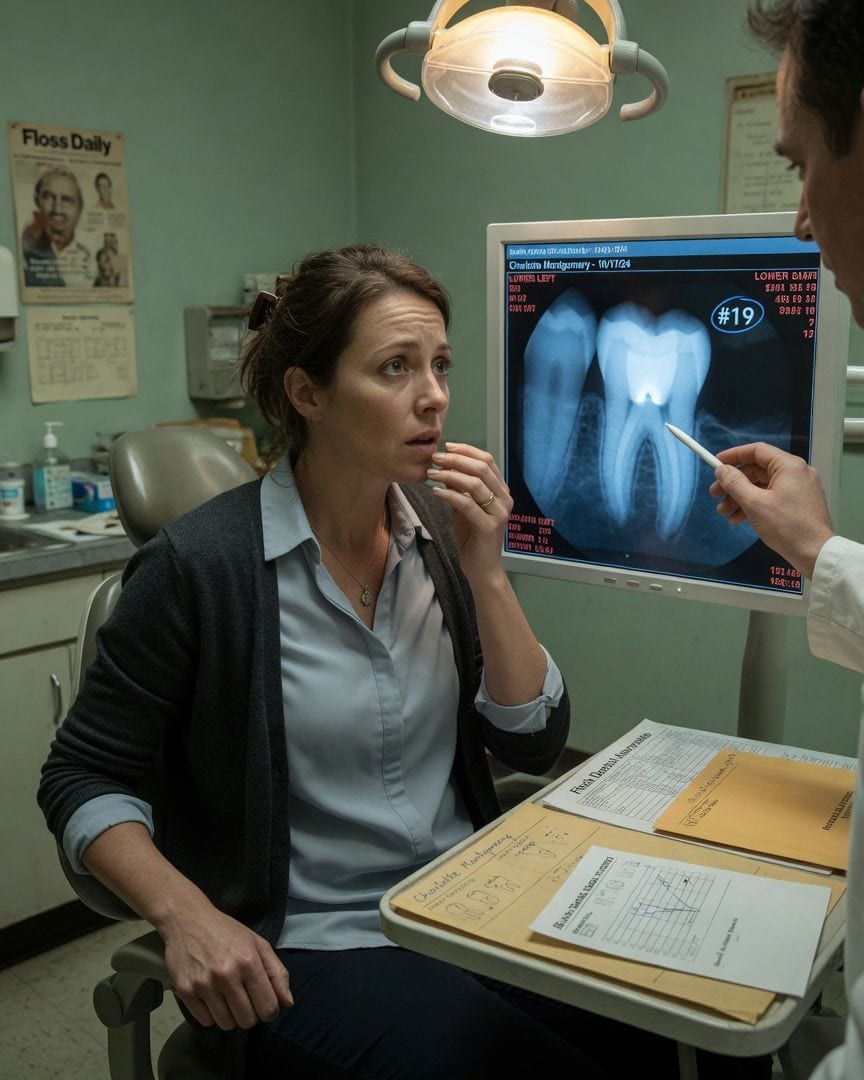
My dental X-ray shows a whole tooth where a gap has been for twenty years. A tiny metal post and a filling in a molar I remember being pulled.
Sitting in my dentist’s chair, I saw my X-ray light up with a chilling impossibility. My lower left molar, fully restored with a metal post and filling, was clearly visible. But I knew that tooth couldn't be there; it had been brutally extracted twenty years ago, leaving a gap for half my life.
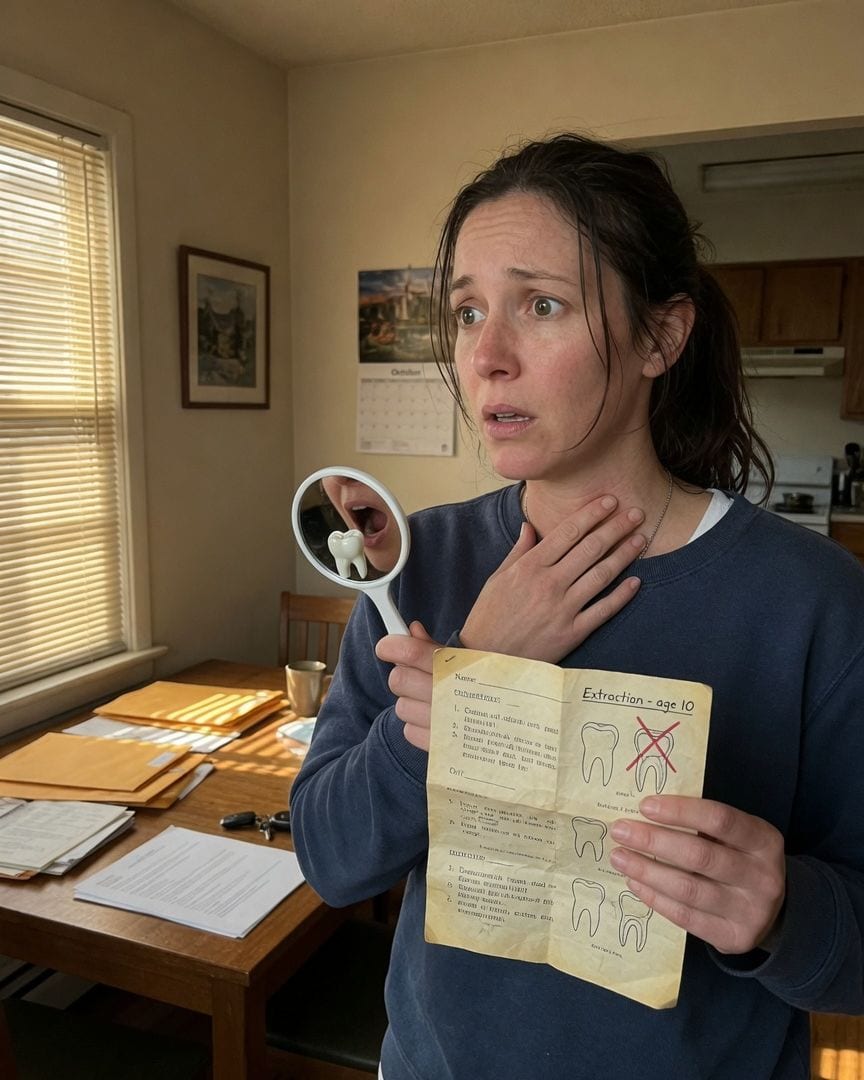
My MRI scan shows metal rods fused into my neck vertebrae. I've never had spinal surgery. The clinic doctor personally called, asking which hospital placed them.
I booked a full-body MRI for my 34th birthday, expecting a clean bill of health. Instead, the scan revealed a perfectly healed surgical fusion in my neck, complete with tiny rods and screws. I have no memory of any such surgery, no scar, and nothing in my medical history.
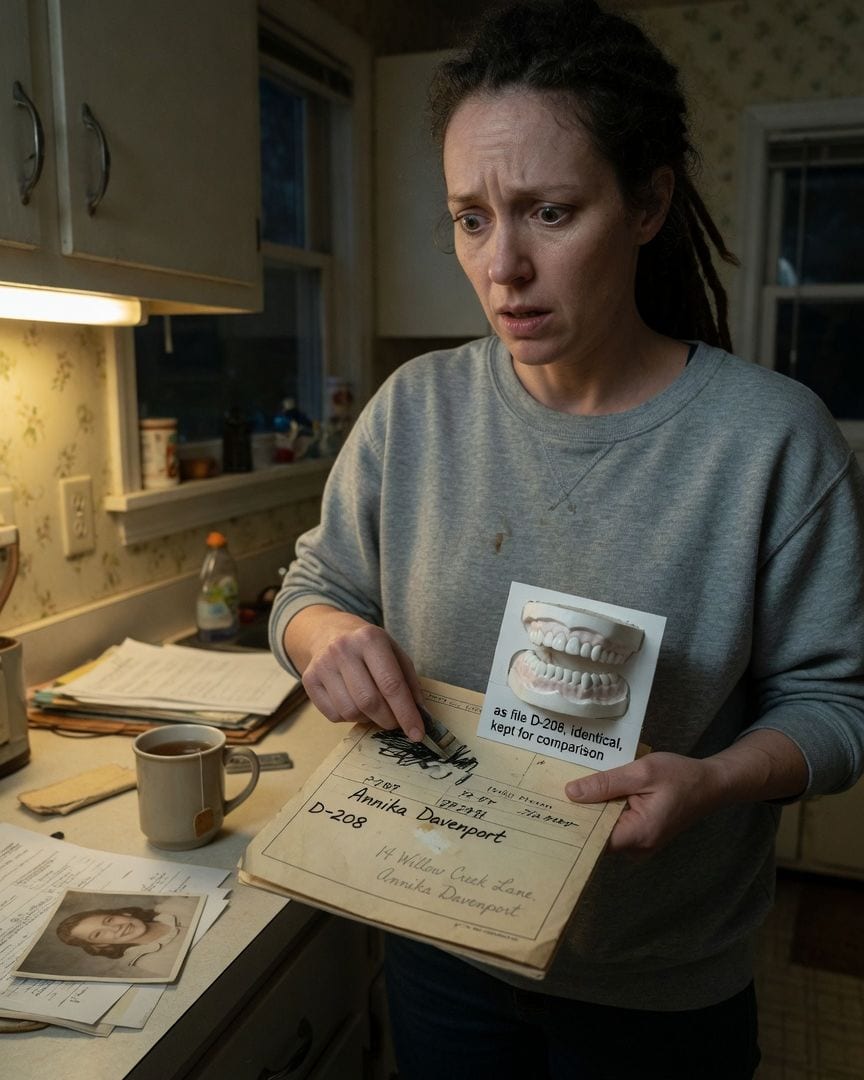
My childhood dental chart lists the house I bought last year — in my own name, years before I was born. A second set of my teeth sits filed beside it, marked 'identical.'
Sifting through old dental records, I found my chart, D-208, with my 1988 birth date. But a line from 1958 was blacked out, and a clipped card with an impression of my teeth listed my name and current home address, decades before I was born. The impossible facts knotted into a cold certainty.
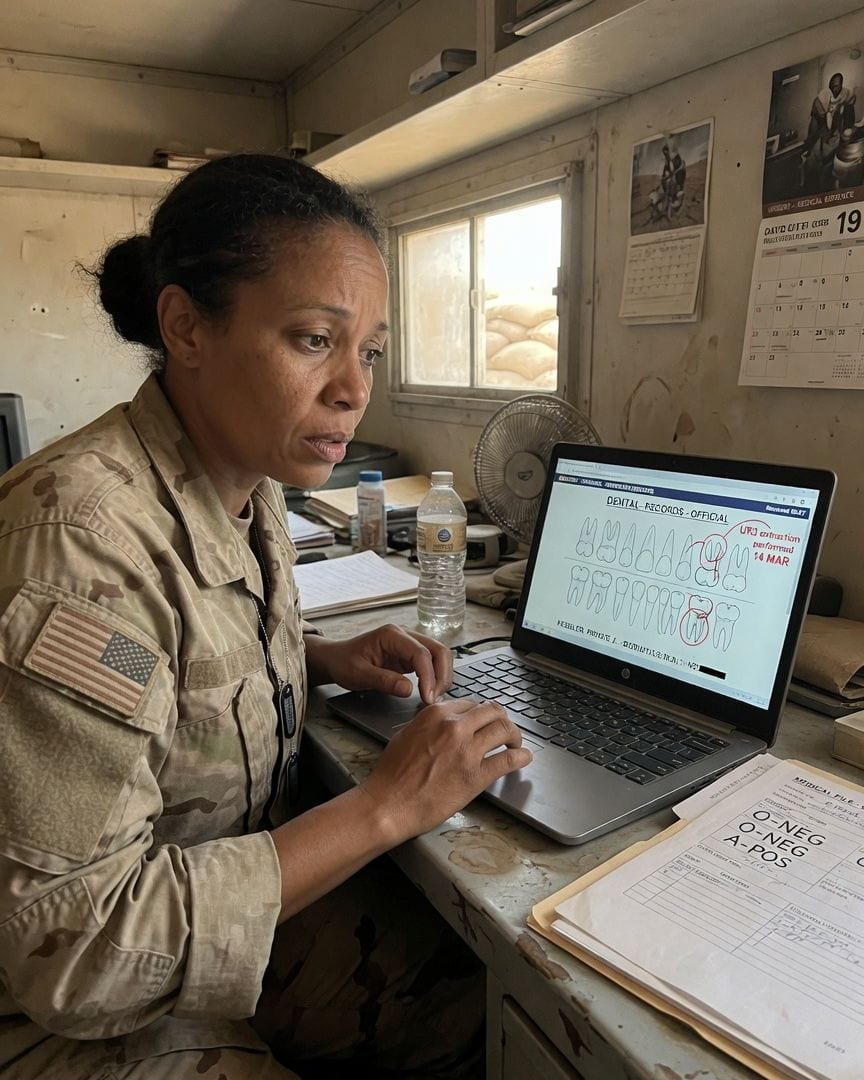
Weeks from going home, Sergeant Whitmore saw Private Kessler’s dental records show teeth he didn’t have and missing ones he did.
Sergeant First Class Iris Whitmore counted the weeks until her deployment ended, dreaming of home as the desert heat baked FOB Cerberus. But the familiar weight of Private Kessler’s dog tags soon brought a cold knot of dread: his blood type, once O-negative, suddenly read A-positive. She dismissed medical anomalies and clerical errors, only to find his official records subtly rewriting his timeline, linking old injuries to new identities. When his dental charts arrived, showing teeth he never had and missing ones he did, Sergeant Whitmore faced an impossible question: who was Private Kessler, really?
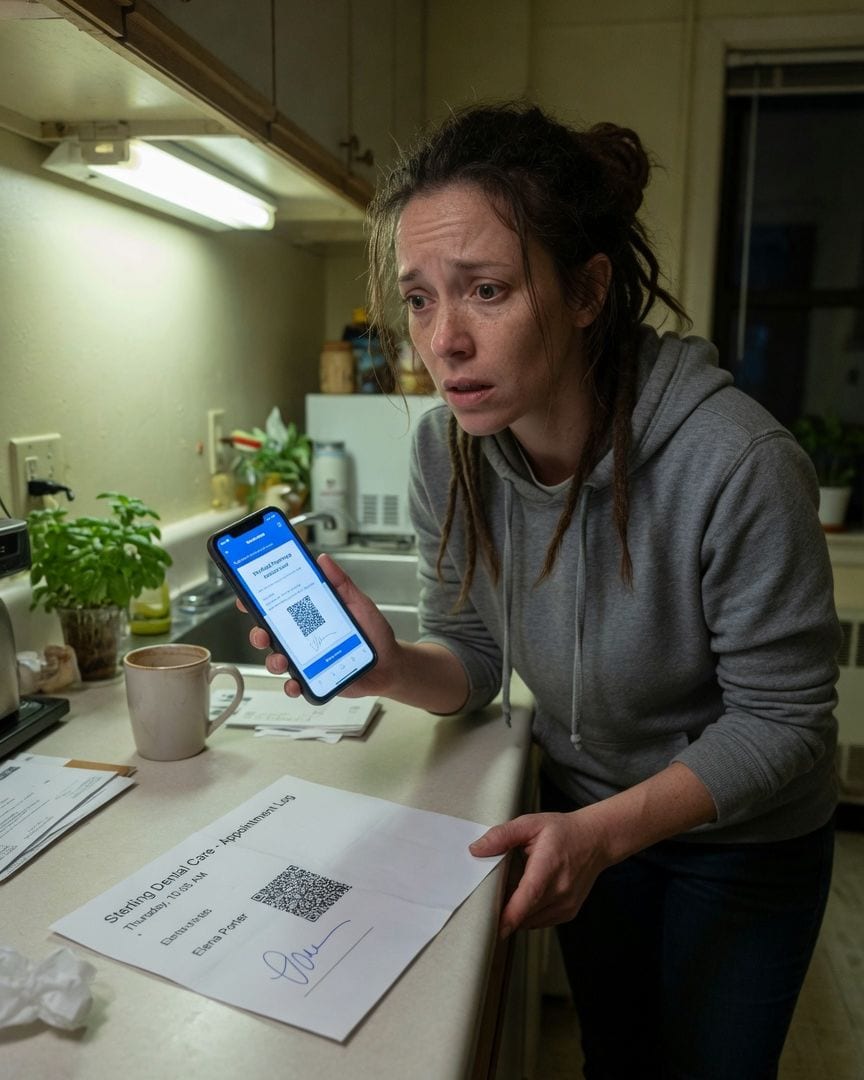
My dentist's system says I was there last Thursday. I wasn't. But the check-in tablet shows my signature, and the hygienist described my chipped tooth exactly right.
I received a call confirming a dental appointment I never made, for a day I was home. Yet, Sterling Dental had my perfect digital signature and described a chipped incisor I’d never told them about. The physical proof insisted I was there, but I wasn’t.
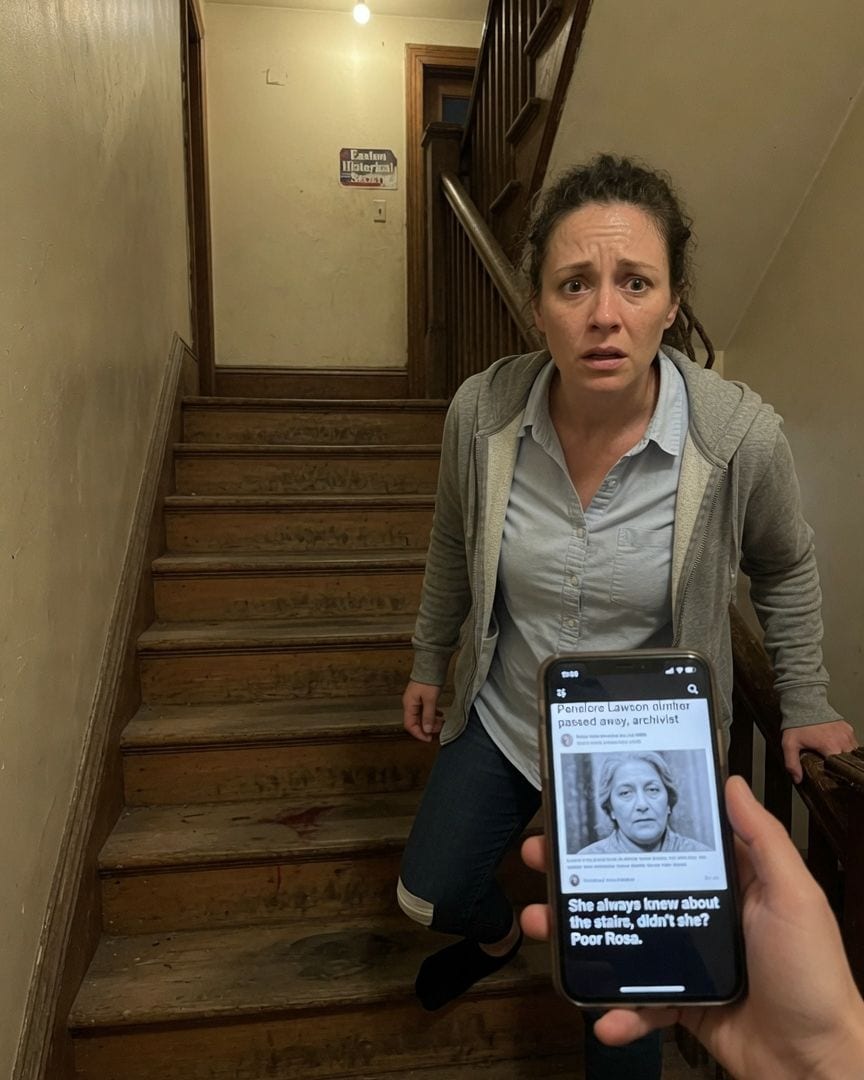
My hygienist apologized, 'I'm so sorry, Rosa — about the stairs.' I'd given the clinic only my surname, and they said she hadn't worked there in over a year.
During my routine dental cleaning, the hygienist murmured my name, Rosa, which wasn't on my intake form. She then offered a soft apology "about the stairs," a kindness that felt deeply misplaced and settled in my gut.