My doctor says two DNA profiles are in my blood. One is mine, the other belongs to a bone-marrow donor, logged deceased in 1988. I've never had a transfusion.
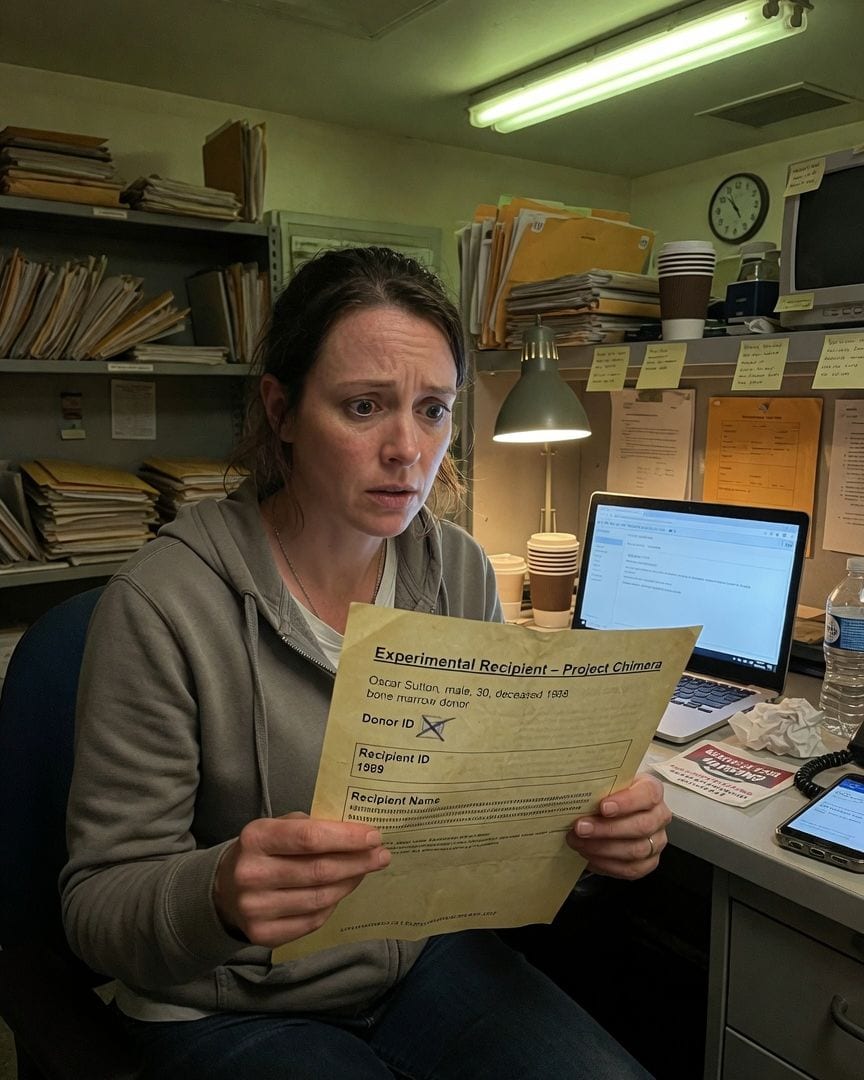
The fluorescent lights of Dr. Whitfield’s office hummed, a thin, persistent whine above the muffled sounds of the hospital.
I sat opposite him, my hands clammy on my jeans, the chill of the air conditioning doing nothing to steady my nerves. He cleared his throat, pushing a pristine white folder across the polished desk.
“Ms. Brooks, your pre-surgery blood panel… it’s come back with an anomaly.”
My heart gave a little thump. I’d expected something mundane, a vitamin deficiency, maybe a slightly high cholesterol. Not an anomaly.
He continued, his gaze unreadable. “We found two distinct DNA profiles in your sample. The lab initially suspected a past transfusion or transplant. You’ve had neither, correct?”
I shook my head, a cold knot forming in my stomach. “No. Never.”
“I see.” He picked up a pen, tapping it lightly against the folder. “The second profile… it matches a bone-marrow donor logged in our database in 1988. A donor whose file is closed and marked deceased. Oscar Sutton.”
Deceased. 1988. Before I was even born.
“We’ve re-drawn your blood, twice,” he said, his voice flat. “The results are consistent. Both profiles are present, unequivocally.” He paused, letting the words hang in the sterile air.
My mind reeled. Two sets of instructions, two separate identities, living inside my own blood. One of them belonging to a dead man, from before I even existed. It felt like a bad joke. A scientific glitch, surely.
But the doctor’s composure, the way he’d repeated "unequivocally," scraped away at that. This wasn't a mistake. Not in his eyes.
I spent the next few days in a fog of disbelief and frantic research. The hospital’s official channels offered only platitudes and reassurances of an “unprecedented error” that would be investigated. Every call ended with the same polite, dead-end response.
They seemed to want me to forget it, to accept that sometimes labs just got things wrong. But two redraws? Unequivocally? I couldn’t forget it. Not when I felt like a stranger was suddenly sharing my skin.
Unsatisfied, I leveraged my friend in medical records, Simon Lawson, for a discreet look. Simon was a nervous man, always on the edge of a panic attack, his office cluttered with stacks of yellowing files and coffee cups.
He’d promised to pull the donor file for Oscar Sutton, the deceased individual whose DNA now supposedly coexisted with mine. I told him it was for a personal project, a genealogy thing. He looked at me funny, but didn’t push.
Hours later, an encrypted email landed in my inbox. The subject line was simply ‘Sutton.’ My fingers trembled as I clicked it open.
The donor file itself was sparse, just a scan of a few old forms: Oscar Sutton, male, age 30, deceased 1988, bone marrow donation. Nothing unusual, just a tragic end to a young life.
But attached was another, almost blank record. It was titled, in thick, institutional font, 'Experimental Recipient – Project Chimera.' The name field was empty, just a series of underscores: '___________'. My breath hitched.
The birthdate, however, was clearly listed: '1989.' My own birth year. Below that, the date of the 'procedure' was listed as early 1990.
The file was incomplete, almost redacted, a ghost in the machine, linking a dead man's cells to a nameless recipient born the same year as me, in a procedure that couldn't possibly exist. Not a normal one, anyway.
This wasn’t a mix-up. This felt like a secret.
My breath hitched. I scrolled down, seeing only a cryptic series of alphanumeric codes under 'Associated Medical Notes.' This wasn't a mix-up; it was a deliberate suppression.
The record was a placeholder, a ghost, yet it was tied to Oscar Sutton, dated to my own birth year, and hinted at a procedure that defied logic, defying everything Dr. Whitfield implied was impossible.
I stared at the faded printout from the hospital's archived database. It showed Oscar Sutton’s donor ID, marked 'deceased – 1988.'
Directly beneath it, in a separate field labeled 'Recipient ID,' was a record with my own exact birthdate, but the 'Recipient Name' field was blank, just a series of underscores.
The incomplete file burned in my mind. Every line, every blank space, felt like a deliberate insult. I tried to follow up with Simon, but his email bounced. His work phone went straight to voicemail.
I walked by his office, and it was empty, the stacks of files tidier than I’d ever seen them. Gone. Just like that.
Desperate, I took a day off work and paid a visit to the hospital’s old administrative wing. It was a dusty maze of forgotten offices, the air thick with the scent of old paper and disinfectant.
I eventually found Cecilia Patterson, a retired archivist still working part-time, hunched over a mountain of paper records. She was a woman with sharp eyes behind thick glasses and a weary smile, her hands stained with printer ink.
I tried to be casual, asking about old experimental procedures, mentioning 'Project Chimera' almost as an afterthought. Cecilia’s smile flickered. Her eyes narrowed. "Project... what was that now, dearie?"
she asked, her voice a little too high, a little too quick. She feigned ignorance, shuffling papers with deliberate slowness.
But as I pressed, mentioning Oscar Sutton and the 1988 donor date, a flicker of recognition, then fear, crossed her face. A vein pulsed in her temple.
"Some things… some things were done back then," she mumbled, her voice barely audible, barely a whisper over the rustle of paper. She glanced over her shoulder, though no one else was in the cavernous room. "Experimental. Not officially sanctioned.
They used to call them… 'legacy procedures.' For exceptional individuals. But the records… they were all supposed to be destroyed."
Cecilia’s hands trembled as she gestured vaguely at stacks of yellowed folders, piled precariously like ancient ruins. The room itself seemed to hold its breath, the low hum of the fluorescent lights feeling heavy, watchful.
I felt a prickle of dread crawl up my spine. This wasn't a mistake; it was a deliberate secret, carefully buried. Simon wasn't just gone; he'd been silenced.
I continued to dig, searching online forums for 'experimental cellular transfer 1988' and 'Project Chimera,' but found nothing. The official silence was absolute, a wall of non-information. It was like scrubbing a page clean, leaving no trace.
One evening, after a particularly frustrating day spent staring at a blank search bar, I returned home. My apartment door, usually so ordinary, stood ajar by an inch. My breath caught. I pushed it open slowly.
Nothing seemed disturbed, but there, on my doorstep, nestled against the frame, was a small, unmarked package. It wasn’t gift-wrapped, just a plain brown paper parcel, taped shut.
Inside was a single, faded photograph. It was a black and white image, curled at the edges, of a young woman, a nurse, standing beside an incubator.
The nurse’s face was obscured by shadow from the overhead light, but the uniform looked vaguely familiar, an older style. Tucked beneath the photo was a handwritten note, in elegant, looping script, almost copperplate: 'Some legacies are best left undisturbed.'
My blood ran cold. Someone knew. Someone was watching me. The photograph, mundane in its composition, felt like a direct, chilling warning. I looked closer at the nurse. The way she held her hands, the set of her shoulders.
It was Cecilia Patterson, younger, unburdened by secrets, a faint ghost in time. The implication was clear: Cecilia was involved, and someone else was protecting the secret, willing to threaten me to keep it buried.
This wasn't just about old records anymore. This was personal.
I confronted Cecilia Patterson again, the faded photograph clutched tight in my hand. I found her in her dusty corner of the archives, meticulously stamping a ledger. She looked up, startled, as I laid the photo on her desk.
“You were there, weren’t you?” I demanded, my voice tight with a fear I was barely containing. “In 1988? With Oscar Sutton’s cells? What was Project Chimera?”
Cecilia’s face paled, her eyes darting around the empty archive office. The silence in the room stretched, thick and suffocating. “They told me it was cutting-edge…” she whispered, her gaze fixed on the old photograph.
“A way to ensure certain… qualities wouldn’t be lost. Genetic material, cellular memory. To pass it on.”
My voice was tight with suppressed panic. “Pass it on to whom? The blank file, Cecilia. The one with my birth year. The 'Experimental Recipient' file with the empty name field.”
She wrung her hands, the sound of her skin rubbing together impossibly loud. “They never told us who the recipients were, not explicitly. Just… an infant. A special case. The lead doctor, Dr. Davenport, he was obsessed.
He believed some people were too valuable to truly die.” Her eyes, when they met mine, were wide with a terror that mirrored my own.
I pressed harder, my voice low and steady. “And Oscar Sutton? He was one of these ‘exceptional individuals’?”
Cecilia nodded slowly, tears welling in her eyes, tracing paths down her wrinkled cheeks. “A brilliant scientist. Died suddenly. They harvested his cells immediately. Said it was a chance to… extend his legacy.
And the infant… the baby was the perfect blank slate. A vessel.”
The pieces clicked into place with sickening clarity. The two DNA profiles. The dead donor. Her words about ‘extending a legacy.’ My birth year on the blank file. The name field, empty because I wasn’t supposed to know.
I was the infant. The vessel. The horror wasn't a mix-up, or a glitch in the system; it was a deliberate, monstrous act that had shaped my very being. This entire time, I had carried a ghost.
Cecilia, now openly weeping, buried her face in her hands. Her shoulders shook with silent sobs. “Dr. Davenport… he kept everything. Not just the paper files. He had a private collection, a vault.” Her voice was muffled, strained.
“He was so proud of his… creations. He kept biological samples. Proof.” She lifted her head, her eyes bloodshot, fixated on some distant point. “He called it the ‘master slide.’ A cross-section of the recipient’s initial cellular integration.
He said it was the only true physical evidence that the procedure worked.”
The air in the room grew heavy, cold, as if Davenport’s shadow had just fallen over us. “The hospital tried to destroy all copies,” Cecilia continued, her voice dropping to a whisper, her eyes wide with fear.
“But his private collection… it was never found. It’s in the old research vault, deep under the surgical wing. The one they sealed off after the 'ethics review' in the nineties. It shows… the integration. Your integration.”
Armed with Cecilia’s terrified confession, and the memory of the cold dread in her eyes, I descended into the forgotten sub-basements of the old hospital.
It was a labyrinth of dust and disused equipment, pipes weeping rusty water, air thick with the smell of decay. Following Cecilia’s rough directions, I found a hidden, unmarked door, obscured by decades of neglect and cobwebs.
It was heavy, made of thick steel, and blended into the rough concrete wall. A faded sign, barely legible, read 'DANGER - BIOHAZARD - DO NOT ENTER.'
I forced it open with a pry bar I’d bought that morning. Inside, a small, meticulously preserved archive awaited. The air was dry and still, strangely free of the pervasive dampness outside.
It was filled with Dr. Davenport’s personal effects: medical texts, bizarre anatomical models, and an old oak desk. Among them, a heavy, leather-bound journal, its pages yellowed but intact. And on the desk, a locked, climate-controlled box, humming faintly.
With a rusty key I found tucked inside the journal’s front cover, I opened the box. Inside, nestled in velvet, was a single, pristine microscope slide. It was larger than normal, almost a display piece.
My hands trembled as I picked it up. Labeled in Davenport’s elegant, precise hand, were the words: 'Subject: P. Brooks. Integration Event. Biopsy: Infancy.'
My own name. My entire body felt like it was humming.
I held it up to the weak emergency light I’d brought, trying to steady my hands. Through the glass, I could see it: two distinct cellular structures, unmistakably intertwined, a perfect, impossible mosaic of genetic material.
My own DNA, undeniably present, interwoven with the distinct pattern of Oscar Sutton’s cells. The evidence was irrefutable, undeniable.
Dr. Davenport’s journal entries detailed the procedure with chilling scientific detachment, celebrating the 'successful chimerism' and the 'preservation of cognitive essence' from Sutton to the infant recipient.
He wrote about the careful harvesting, the delicate cellular transfer, the anticipation of a prolonged ‘legacy.’ The horror wasn't just that it happened, but that it was a success.
I wasn't just a host; I was a fusion, a living testament to a dead man's 'legacy.'
The slide was irrefutable. I sat on the cold concrete floor of the vault, the journal open to Dr. Davenport's final entry. It was dated a few years after my birth: 'The subject exhibits remarkable integration. Initial cognitive transference observed.
A true triumph of cellular legacy.'
The words echoed in my mind, growing louder, more insistent. Cognitive transference. I wasn't just carrying Oscar Sutton's DNA; I was, in some profound, terrifying way, becoming him, or sharing my consciousness with him. The dread was internal, inescapable.
My body, my mind, my very identity was compromised. I thought of the fleeting thoughts I'd had, thoughts not quite my own. The odd preferences for classical music, a genre I’d never cared for.
A sudden, inexplicable interest in astrophysics—Oscar Sutton's documented field of expertise, I now remembered from his sparse donor file. The horror wasn't a monster in the dark, but a subtle, insidious transformation from within.
I closed my eyes, trying to find the 'Paige' I knew, the one I used to be, but the lines were blurring. My self was dissolving, changing, merging, and it had been happening since infancy.
I was a living archive, a walking, breathing echo. There was no escape, no surgery to undo this. Davenport wasn't just proud of his creation; he was proud of me.
I sealed the vault, the heavy door clanging shut behind me, burying the slide and journal once more in the hospital’s forgotten depths. I gave a vague, frantic account to the authorities.
The hospital launched an internal investigation, but the official report, months later, blamed a rogue doctor, Dr. Davenport, and dismissed my evidence as 'unsubstantiated claims' and 'fabrications of a fragile mind.'
Cecilia Patterson retired fully, disappearing from public life, her name never mentioned. The medical community dismissed the story as an urban legend, a bizarre episode from a dark chapter in medical history.
I returned to my life, but it was not the same. Every mirror, every quiet thought, became a source of profound unease. The world moved on, oblivious to the quiet war being waged within my own cells.
Sometimes, I find myself humming tunes I've never heard before, old-fashioned melodies that drift into my head from nowhere, or reaching for books I've never owned, for subjects I have no memory of studying.
I try to hold onto my own thoughts, my own memories, to the person I was, but there are gaps now, moments where another's presence feels almost… complete.
I trace the lines of my palm, wondering which hand is truly mine, which mind is truly making it move. The dread isn't in what I found, but in what I'm losing, piece by piece, every day.
Later, her partner, Thomas, found her staring blankly at the night sky, murmuring complex equations he didn't understand. “Paige?” he asked softly. She turned, her eyes distant, a faint, unfamiliar smile playing on her lips. “Is that so?”
he heard himself say, a strange chill running down his spine. Her reflection shows my own eyes, but sometimes, when I smile, I see a different set of teeth in the curve of my mouth.
If this one got to you
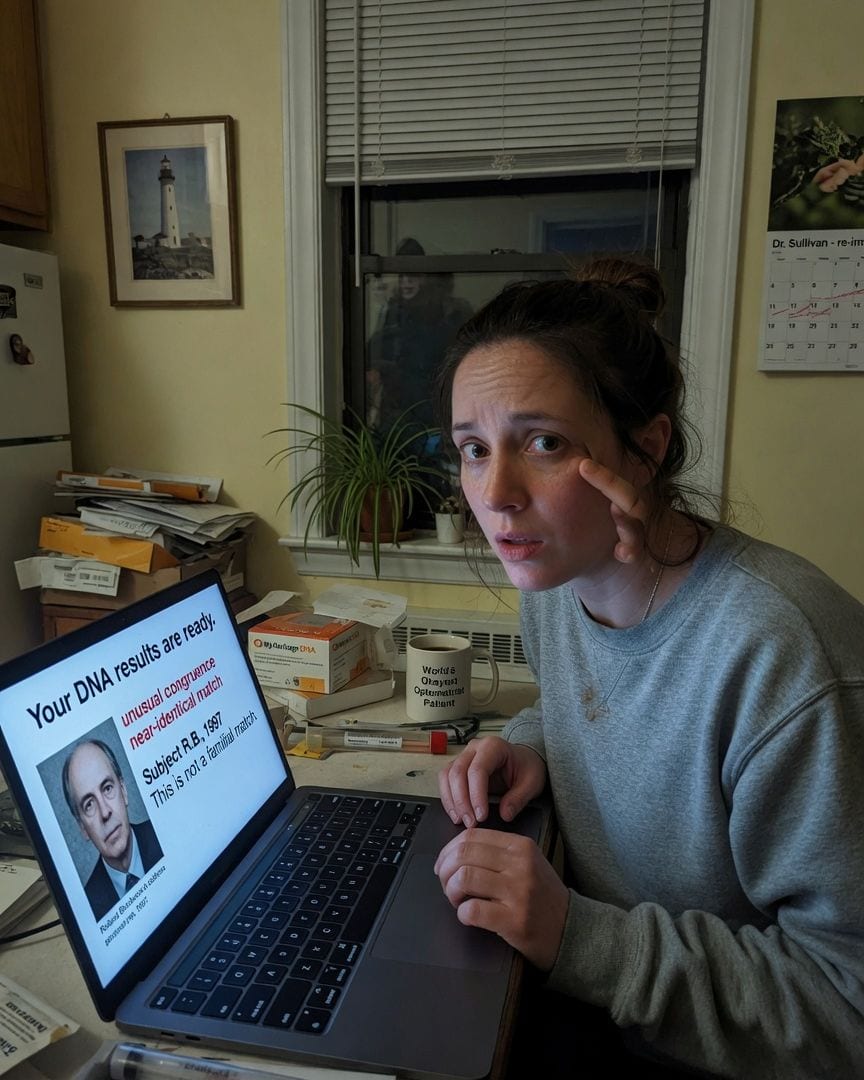
My retinal scan matched a dead man's eyes. His chart said 'deceased' from 1997. The pattern in my eye is his.
An ordinary eye exam turned unsettling when my optometrist paused, staring at the screen. He whispered that the machine flagged me as a returning patient, matching my unique eye pattern to a man deceased in 1997.
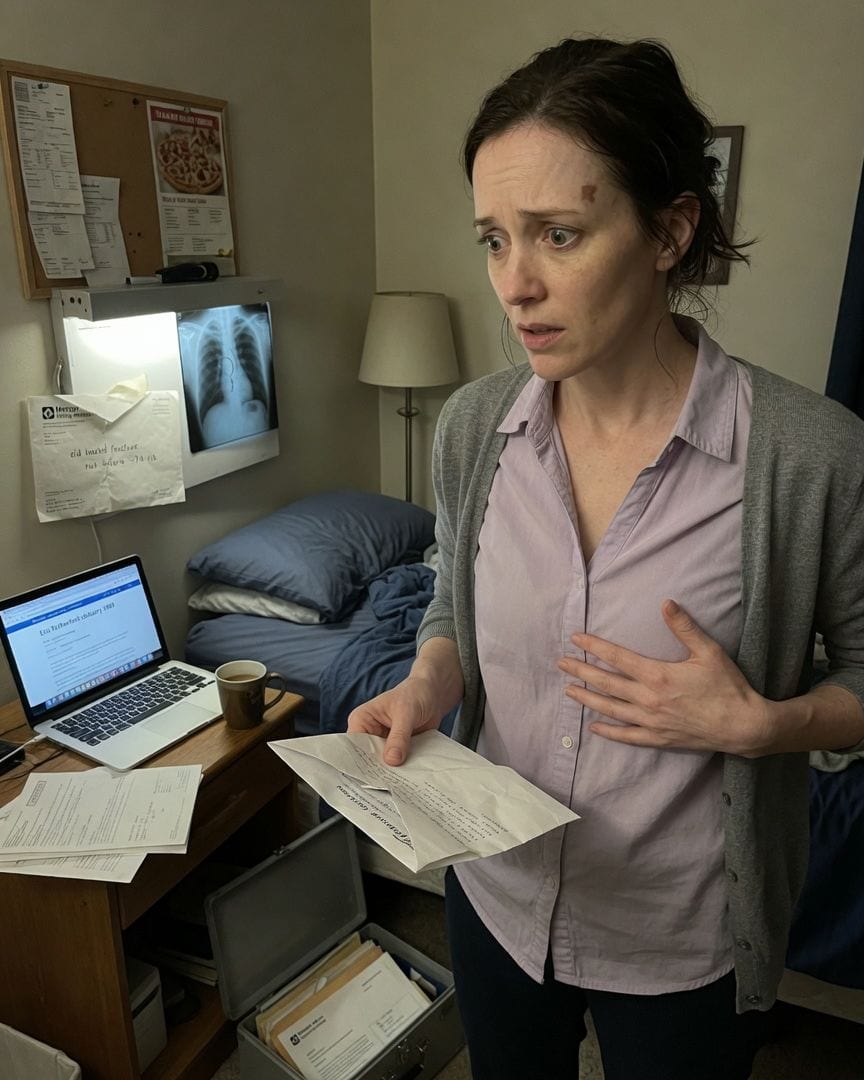
My eye bank said my corneas were already donated. In 1989. The donor died that year, but his tissue is mine.
I’m Rachel Granger, a data analyst living an orderly life. So when my organ donation was declined, citing my tissue was already used in 1989, I assumed a clerical error. But my birth certificate clearly shows I wasn't even born until 1990.
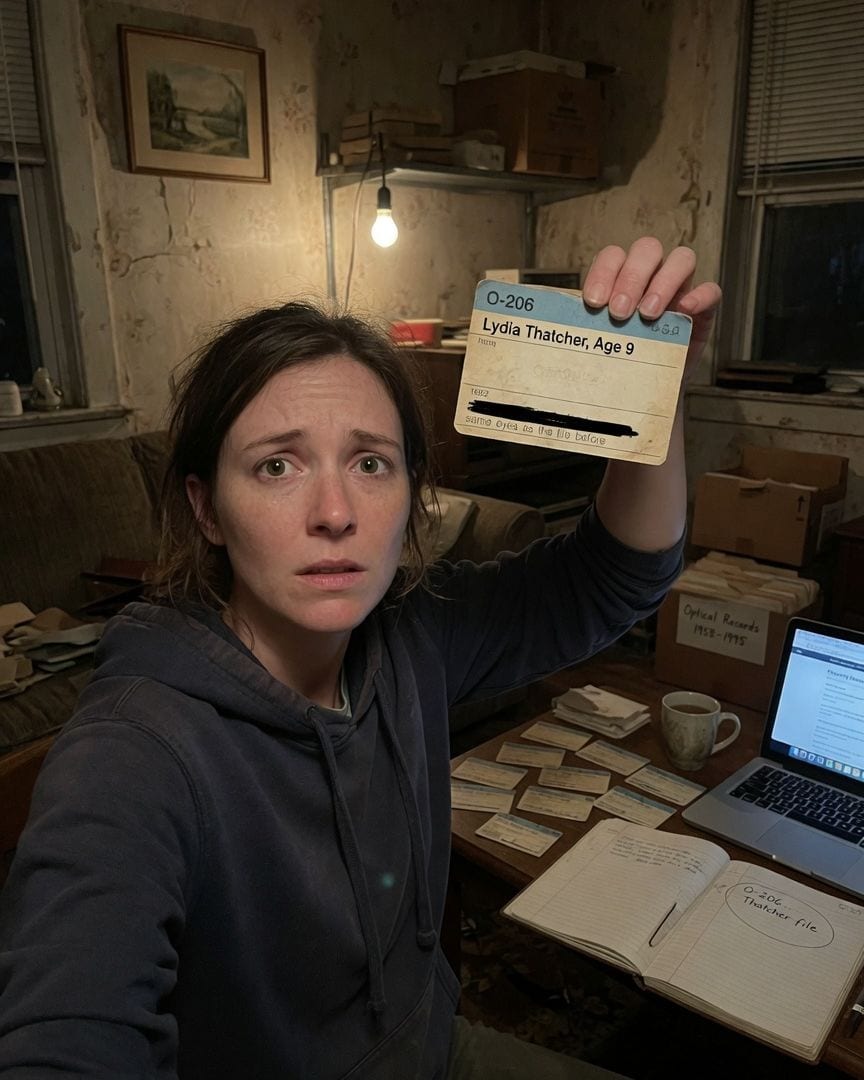
My own optical card is dated 1962, with my name on it. I wasn't born until 1993.
Sifting through old patient files from my former optical practice, I found my own O-206 card. It had my name, Lydia Thatcher, and my current home address printed on it. But the card was dated 1962, decades before I was even born, and a redacted note mentioned 'same eyes.'
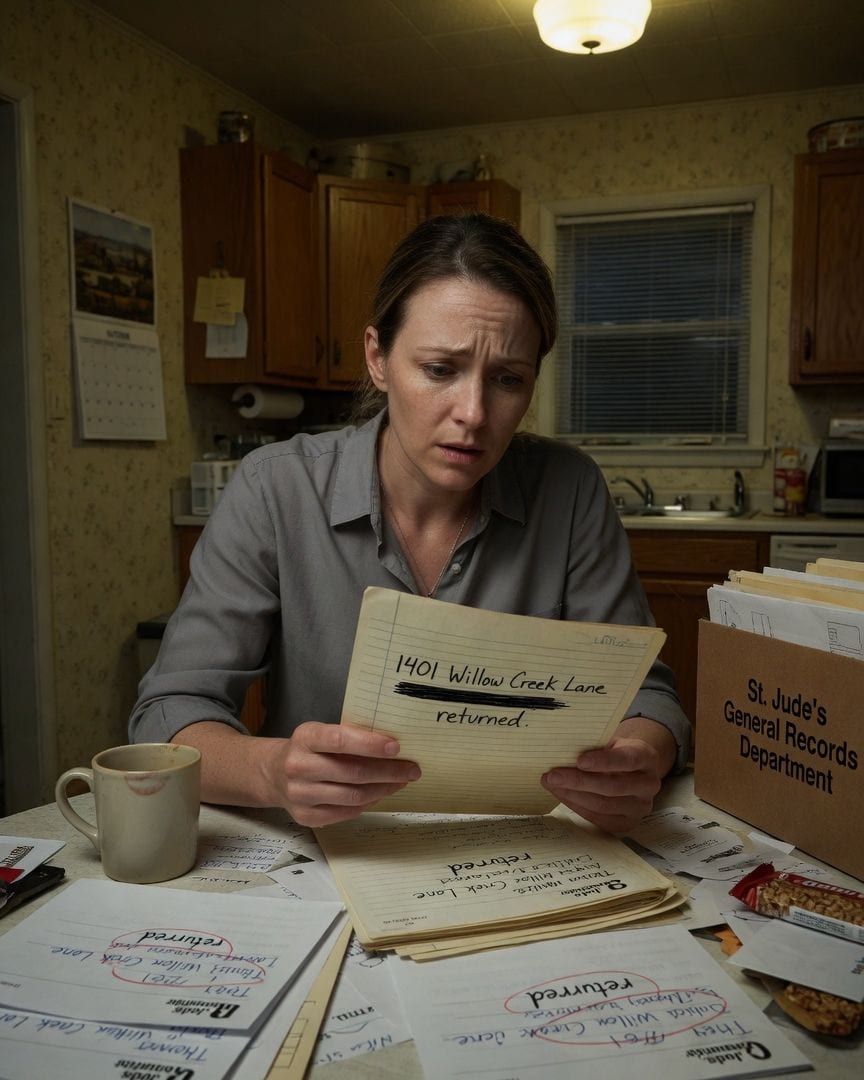
My medical file shows my street address on a struck-through line from 1988, a year I lived two counties away. It just says 'returned'.
A routine insurance audit led me to my childhood medical file from 1988. But among the expected notes, a deliberately struck-through line listed my current house address, followed by the stark word 'returned.' In 1988, I lived two counties away, making this entry an impossible and unsettling mystery.
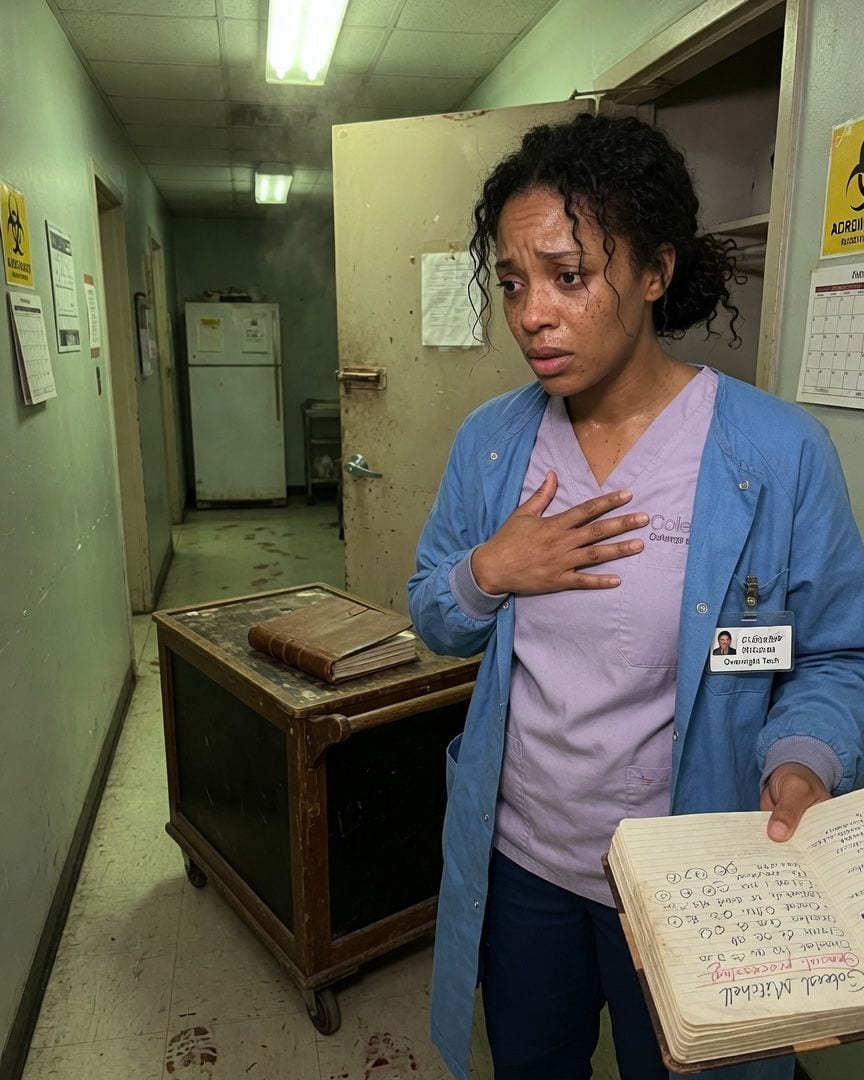
My boss says no one named Grace has ever worked here. But Grace stands beside me every night, reminding me to label the third rack — and I work the overnight shift alone.
On my quiet night shift at the blood bank, Grace always appears around 3 AM. I hear her familiar cart, smell her antiseptic scent, and follow her precise instructions. But my lab director insists no one named Grace has ever been credentialed here, leaving me to wonder who I've been working with.
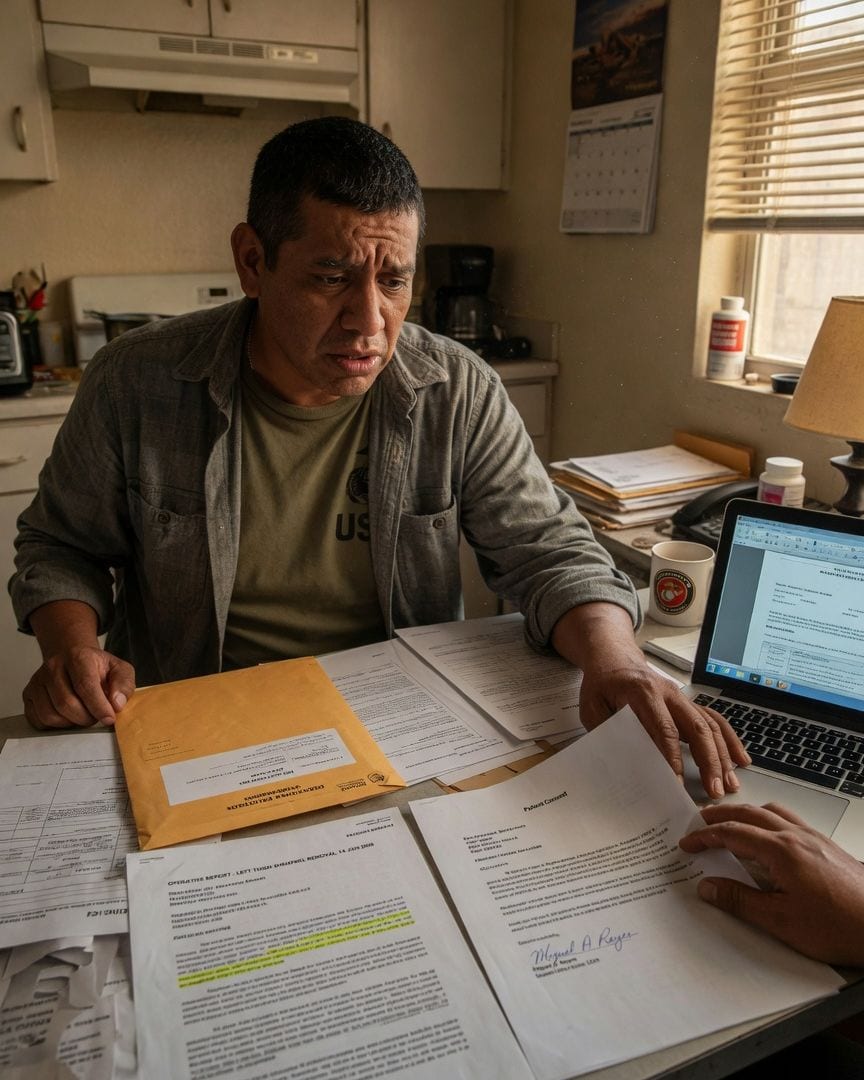
A veteran's VA file listed surgery for shrapnel. The doctor retired decades before he joined the Corps.
Miguel Reyes, a veteran, sat in a sterile VA clinic, his bad knee throbbing, expecting routine. Instead, a physician's assistant presented a digital file detailing shrapnel removed from his thigh in 2008 – an injury Miguel had no memory of, no scar for. His own service record later confirmed the impossible surgery, complete with a consent form bearing his perfect, yet utterly alien, signature. Driven by unease, Miguel researched the listed surgeon, Dr. Charlotte Bennett, only to discover she had retired from military service decades before he even enlisted. The numbers didn't just not add up; they violently contradicted each other, revealing a deliberate, impossible fabrication in his own life story.