On his final patrol, Sergeant Hans Aoki led his four-man team. A fifth figure, silent, disciplined, shifted its weight right off his shoulder. Then his own signed log confirmed five men present.
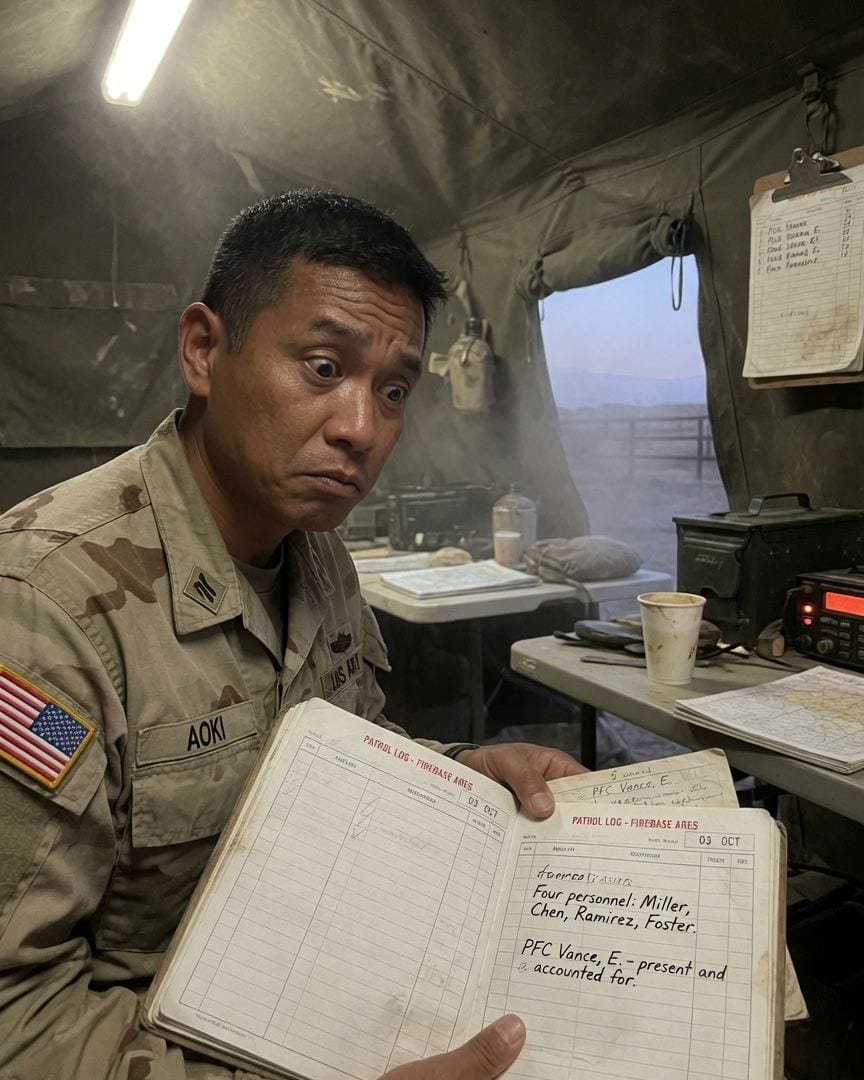
Sergeant Hans Aoki's relief arrived at dawn.
On his final patrol before handover, Sergeant Hans Aoki moved through the pre-dawn gloom of the Afghan desert, the familiar crunch of gravel under his boots a rhythmic counterpoint to the distant hum of the firebase generators.
He led a four-man team, their silhouettes dark against the faint sliver of moon. Aoki knew the old hands' rule for Firebase Ares patrols: you never counted heads aloud, and you never named the third man walking.
But tonight, with relief just hours away, a perverse urge pushed at him. At the halfway point, near the northern wire where a segment of fencing had buckled in a recent dust storm, he paused for a routine accountability check.
He turned, scanning each man, calling out their numbers in a low, even tone. "One. Two. Three. Four." His gaze swept over Private David Foster, the youngest, then Specialist Ramirez, then Corporal Chen, then Sergeant Miller.
He began to turn back, a sense of quiet relief washing over him, when a fifth figure, just off his left shoulder, shifted its weight, a barely perceptible rustle of gear.
It matched his stride back into position, a silent, disciplined presence that answered to no name, no number, yet was undeniably there.
Aoki felt a prickle of cold sweat on his neck that had nothing to do with the desert night. He counted again, slower, his blood turning cold in the dry air. Four men. He saw four men.
But the phantom presence, steady and unhurried, kept station just off his shoulder for the rest of the walk, its nonexistent rhythm a terrifying counterpoint to his own.
The low static on his comms unit, usually a minor annoyance, now felt like a muffled whisper, a subtle interference in the vast, empty night.
Back at the wire, the dread clung to Aoki like the desert dust. He tried to rationalize it – fatigue after a long rotation, a trick of the shifting sand, a momentary lapse of concentration. It had to be.
He ducked into the operations tent, the canvas flaps rustling like dry leaves behind him, and pulled the official patrol log from its slot. He flipped to the current date, his fingers brushing the cool, stiff paper.
His own signature, clear and firm, attested to the four men on his team – Miller, Chen, Ramirez, Foster. It was all in order, just as it should be.
But then, a flicker caught his eye. Beneath the main, stamped log, he found a secondary, less formal, handwritten logbook. This one was typically used for quick, internal checks, a redundant measure. He pulled it out.
It listed five names for his patrol, dated for that night. He saw Miller, Chen, Ramirez, and Foster. The fifth name was stark on the page: 'PFC Vance, E.' He didn't recognize it.
He knew every man in his squad, every face, every name. He scanned the main roster for the current rotation, running his finger down the alphabetical list of active personnel. No 'PFC Vance, E.' existed anywhere.
Private David Foster, his uniform still dusty from patrol, passed the tent entrance, his face pale and drawn under the faint electric light. He glanced in, his eyes wide. Aoki stopped him.
"Foster," he said, his voice lower than he intended. "Did you feel anything… odd out there tonight? Anything at all?" Foster shifted his weight, avoiding Aoki's gaze. He shuffled his boots on the packed earth.
"Just the desert, Sarge," Foster mumbled, his throat suddenly tight. "Always plays tricks." But the tremor in his voice, and the way his gaze darted to the empty space beside Aoki, suggested otherwise, a shared, unspoken awareness.
The ordinary explanation was already failing.
Aoki dismissed Foster and returned to the logs, his heart now thudding with a cold, slow beat.
He ignored the unofficial log for a moment, forcing himself to focus on the official, stamped, and signed duty log, the one that truly mattered. He found the entry for his specific patrol shift.
His own signature was there, bold and undeniable, confirming the four men he'd led through the dark.
But beneath his signature, a final entry, meticulously handwritten in the same ink as the rest of the log, listed 'PFC Vance, E.' as present and accounted for, completing the patrol.
The paperwork, his own signature, swore to a thing he knew did not happen.
He stood frozen, the desert wind rattling the tent flaps, the logbook heavy in his hands, the faint smell of stale coffee and dust in the air.
The next morning, the relief column arrived, a convoy of armored vehicles kicking up a plume of dust that stretched for miles across the horizon.
The hand-off began, a flurry of paperwork and introductions, the air filled with the buzz of new energy. Aoki, however, couldn't let it go. His mind kept returning to the impossible entry, the phantom soldier.
Instead of focusing on his upcoming flight home, he spent his off-duty hours trying to locate 'PFC Vance, E.' He checked the central personnel database on the outdated ops tent computer, cross-referenced with recent transfers and enlistments, even searched medical records.
Nothing. No service record, no medical file, no pay stub, no next of kin. It was as if the name existed only in that one log entry, a ghost in the machine.
He approached Captain Patricia Vance, the firebase commander, her face tight with the pressures of the handover. She stood by the makeshift landing pad, supervising the offloading of supplies, her eyes narrowed against the glare.
"Captain, I need to report a discrepancy in the patrol logs," Aoki stated, holding out the offending page. He explained the headcount, the phantom fifth man matching his stride, and the impossible entry.
Captain Vance listened, her brow furrowed, her gaze briefly flicking to the log. "Sergeant," she said, her voice clipped, "it sounds like a clerical error, or perhaps fatigue. These things happen in remote postings."
She dismissed it with a wave, turning back to the unloading, but her eyes, for a split second, held a flicker of something unreadable, a depth of knowledge that belied her casual dismissal.
Aoki knew it wasn't a mistake. He spoke to other members of his patrol, one by one.
Private Foster, now visibly jumpy, admitted to feeling "a chill" and "a sense of being watched," but quickly attributed it to nerves, the approaching end of their deployment. Specialist Ramirez just shrugged, claiming the desert always messed with your head.
Corporal Chen said nothing. Aoki reviewed the radio logs from the patrol – intermittent static and dropped signals, not unusual for the area, but in hindsight, unsettling.
Each mundane explanation withered under Aoki’s scrutiny, replaced by a growing, specific unease, like a slow-setting concrete.
Aoki’s persistent inquiries did not go unnoticed. He started to feel a subtle shift in the atmosphere around him. When he entered the mess tent, conversations would abruptly cease, heads turning away as if he carried a contagious disease.
He'd catch quick, furtive glances from the older, long-serving personnel, their expressions unreadable, like hieroglyphs carved into ancient stone.
One evening, Sergeant Major Bernard Lawson, a grizzled veteran with eyes that seemed to have seen too much desert, cornered Aoki by the mess tent, just as the last rays of sun bled purple into the sky.
"You’re asking too many questions, son," Lawson rumbled, his voice low, his words barely audible above the distant thrum of the generators. He was polishing his old combat knife, the steel gleaming dully. "Some things out here, the desert keeps.
Best not to disturb them." Lawson’s tone was calm, almost fatherly, but the implication was clear: stop digging. The knife in his hand seemed to underscore the warning, not as a threat, but as a statement of hard-won experience.
Later that night, alone in his bunk, Aoki heard faint, garbled voices on his comms unit, like distant whispers through sand. He knew the frequency was dead, the channel secure, yet the voices persisted, murmuring just beyond comprehension.
He checked the perimeter on the thermal imager. Nothing. Only the heat signature of the desert, vast and empty. But the feeling of being observed, of an unseen presence just beyond the wire, was palpable, pressing down on him.
He was no longer just investigating; he was being watched, warned, nudged away from a truth he was getting too close to. The danger was becoming personal, a cold prickle on the back of his neck.
Ignoring Lawson's warning, Aoki pressed on, the sense of dread now a constant companion. He requested access to the firebase's archived duty logs, going back several rotations.
Captain Vance, visibly annoyed by his persistence but bound by the appearance of protocol, reluctantly granted it, citing "protocol compliance" with a sigh that tasted of resignation.
Aoki spent hours in a small, stuffy storage tent, poring over dusty binders, his fingers tracing faded ink. The air hung thick with the smell of old paper and mildew.
What he found made his blood run colder than any night patrol.
It wasn't just one 'PFC Vance, E.' but similar impossible entries, a slow, horrifying trickle through the years: 'Specialist Galloway, T.' in 2008, 'Corporal Fletcher, H.' in 2005, 'Private Lambert, S.' in 2001.
Always an extra name, always meticulously logged as present for patrols or duties, always with no corresponding service file, no trace in any central database. It was a phantom unit, existing only within these pages.
He compiled his evidence, a stack of photocopied log pages, each a testament to an impossible reality.
He confronted Captain Vance again, finding her in her cramped office, the air conditioner rattling weakly. He laid the evidence on her desk, the stack of papers a defiant weight between them.
"These aren't clerical errors, Captain," Aoki stated, his voice steady despite the tremor in his hands. "This is a pattern. It's been happening for years." Vance's composure finally cracked.
Her face went pale, her eyes wide with a fear she could no longer hide. "Sergeant… these are… anomalies," she whispered, her voice barely audible. "We’ve been aware of them. Command has procedures. They are… contained."
She spoke with a rehearsed calm, the words coming out flat and hollow, but her eyes betrayed a deep-seated terror, a desperate plea for him to stop. Aoki felt the weight of her words, heavy and final. Contained.
Not solved, not eliminated, but simply managed. The earlier clues, the old hands' rule, the radio static, Foster's unease, Lawson's warning—they all clicked into a horrifying, coherent picture. The wrongness wasn't a glitch; it was a feature.
Aoki pushed further, refusing to accept "contained" as an answer. The word felt like a lie, a desperate attempt to impose order on chaos. He knew there was more, a deeper layer to this carefully constructed illusion.
He found a small, neglected box in the back of the archives, labeled 'Commendations - Misc.' Sifting through them, his fingers brushed against thick, textured paper.
He unearthed a faded document: a Bronze Star awarded to 'PFC Vance, E.' for bravery during a patrol in 2008, signed by a previous commanding officer.
The citation detailed a daring rescue, a real event, a heroic act that had genuinely saved lives.
But 'PFC Vance, E.' was the only name on the list of commended soldiers that didn't exist in any other official record, central database, or personnel file. The medal itself was missing, only the paper record remained.
It wasn't just about logs; the system wasn't just acknowledging these phantom soldiers in its internal records. It was celebrating them, validating their impossible bravery, intertwining their nonexistent histories with the real, unimpeachable fabric of military service.
Aoki realized the truth was far worse than simple clerical errors or isolated anomalies. The military's own meticulous record-keeping, its very system of accountability, was validating the existence of something that should be impossible.
The phenomenon wasn't being fought; it was being integrated, absorbed into the very fabric of the firebase, the desert itself a silent, complicit host. The relief column was due in hours, their hum now a tangible vibration on the ground.
Aoki wondered if they, too, were merely new entries waiting to be accounted for, their lives already earmarked for a ledger that swore to an impossible truth.
Aoki found Sergeant Major Lawson sitting alone outside the maintenance shed, polishing his combat boots in the pre-dawn dark. The smell of boot polish and dust hung in the air.
Aoki laid out his evidence, the stack of phantom citations and logs, the Bronze Star document for 'PFC Vance, E.' Lawson sighed, the sound like wind over desert rock, and wiped a calloused thumb across the smooth leather of his boot.
"Firebase Ares," he began, his voice low, a gravelly whisper. "It was built on a place that hungers for order. For structure. For bodies." He explained that for decades, soldiers had vanished from the outpost.
Sometimes one, sometimes an entire patrol. Then, the disappearances stopped. Instead, 'extra' names started appearing in the logs, just as Aoki had discovered.
Command, terrified of the implications, found a grim solution: if they couldn't fight it, they'd account for it. They'd maintain the illusion of order.
The 'third man walking' rule wasn't just superstition; it was a quiet acknowledgement, a coping mechanism passed down through the years.
The phantom soldiers weren't ghosts; they were the disappeared, or what had absorbed them, now meticulously integrated into the base's personnel, silently maintaining the status quo, ensuring the system remained 'accounted for.'
The pattern snapped into place, horrifyingly clear: the land, the base, the records—it was all one coherent, monstrous system, designed to absorb and perpetuate itself, using the military's own rigid structure as its host.
Aoki realized his own patrol, his own signature, was just the latest entry, a validation of the system's relentless appetite.
The first faint streaks of dawn painted the eastern sky in muted grays and purples as the relief column's vehicles finally approached the main gate. Aoki knew he had to act, to warn them, to break the cycle.
He tried to rally his remaining team, his voice urgent, but their faces were distant, their responses muted, already turning towards the promise of home. David Foster just stared blankly when Aoki spoke of phantom soldiers.
"We're going home, Sarge," he'd said, his voice flat, "that's all that matters."
Aoki rushed to the radio tent, desperate to send a full report, to break the news to anyone, anywhere outside this perimeter.
He keyed the mic, but the frequency was dead, only a low, persistent static, like grains of sand scraping against each other. He switched channels, frantically, his fingers clumsy on the dials. Nothing.
The 'fifth man,' the one who had walked beside him through the pre-dawn darkness, appeared in the doorway of the tent.
It wasn't menacing; it simply stood there, solid and opaque, a soldier like any other, but with an unnerving stillness in its posture, its face obscured by the lingering shadows. It was waiting, patient and inevitable.
Aoki tried to raise his rifle, to somehow defend himself against this silent, all-consuming presence, but his movements felt slow, sluggish, as if the desert itself was weighing him down, pulling at his limbs.
He felt the insidious pull, the creeping acceptance, like a chill working its way into his bones.
He was already part of the system, an entry in its ledger, and the new arrivals were just the next set of numbers, fresh bodies for the hungry land. There was no escape; only integration.
The hand-off was completed without incident. The new personnel settled in, their fresh faces oblivious to the quiet horror beneath the surface of Firebase Ares.
Sergeant Hans Aoki was officially relieved of duty, his paperwork meticulously in order, every form signed, every record accounted for.
He watched the new commanding officer, Captain Tessa Lawson, a no-nonsense woman with sharp eyes, review the incoming duty logs, and then the outgoing ones, her pen moving with efficient precision. Everything was accounted for. No questions were asked.
The system continued, unbroken.
Captain Tessa Lawson noted the meticulous entries, and Sergeant Hans Aoki smiled, a faint, wrong little smile.
If this one got to you
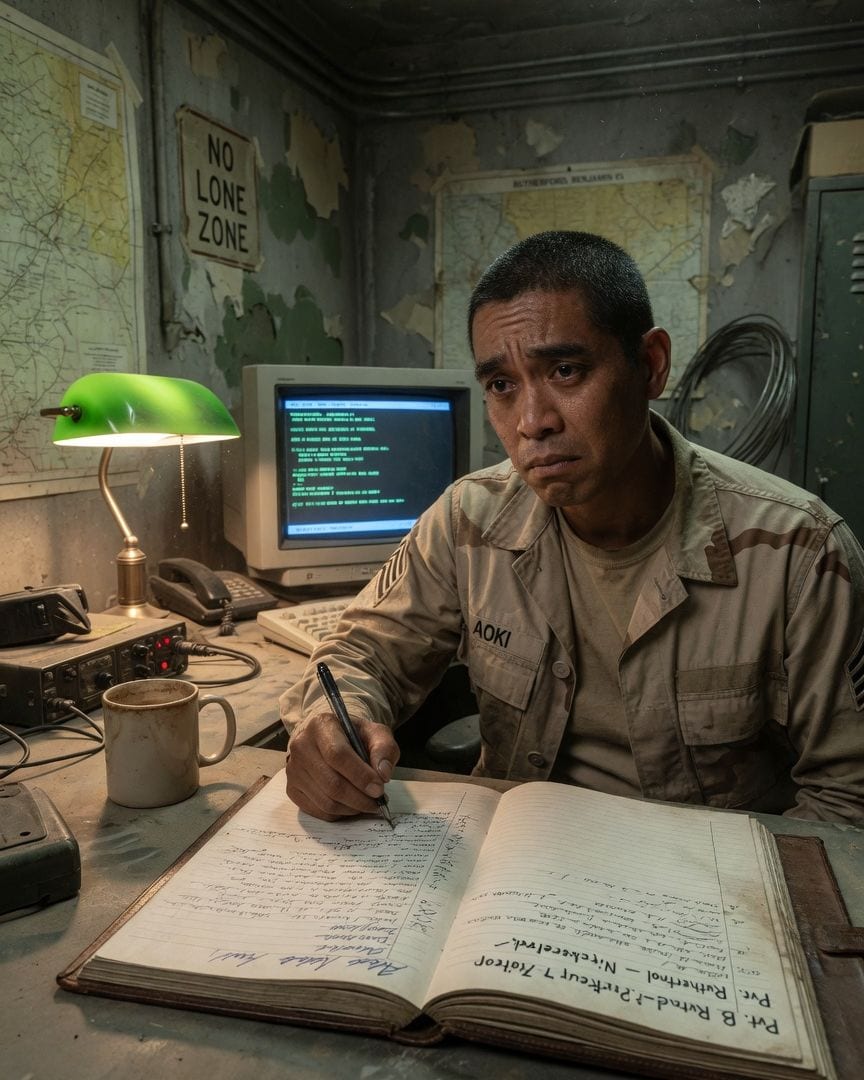
Sergeant Aoki's four-man patrol hears a fifth voice answer their count. A fresh name then appears in the duty log beneath his own signature.
Sergeant Isaac Aoki's final rotation at Outpost 7 was nearing its end, with relief due at dawn. On his four-man night patrol, he broke an old superstition, counting his team aloud in the dust-choked desert. A fifth voice answered, clear and unsettling, from the moonless dark. Back inside the bunker, the chill deepened when a fresh name appeared in the duty log, 'Pvt. B. Rutherford,' beneath Aoki's own signature, a soldier no one knew. Even more disturbing, Aoki later found his own signature on a valor citation for Rutherford, an event he never witnessed.
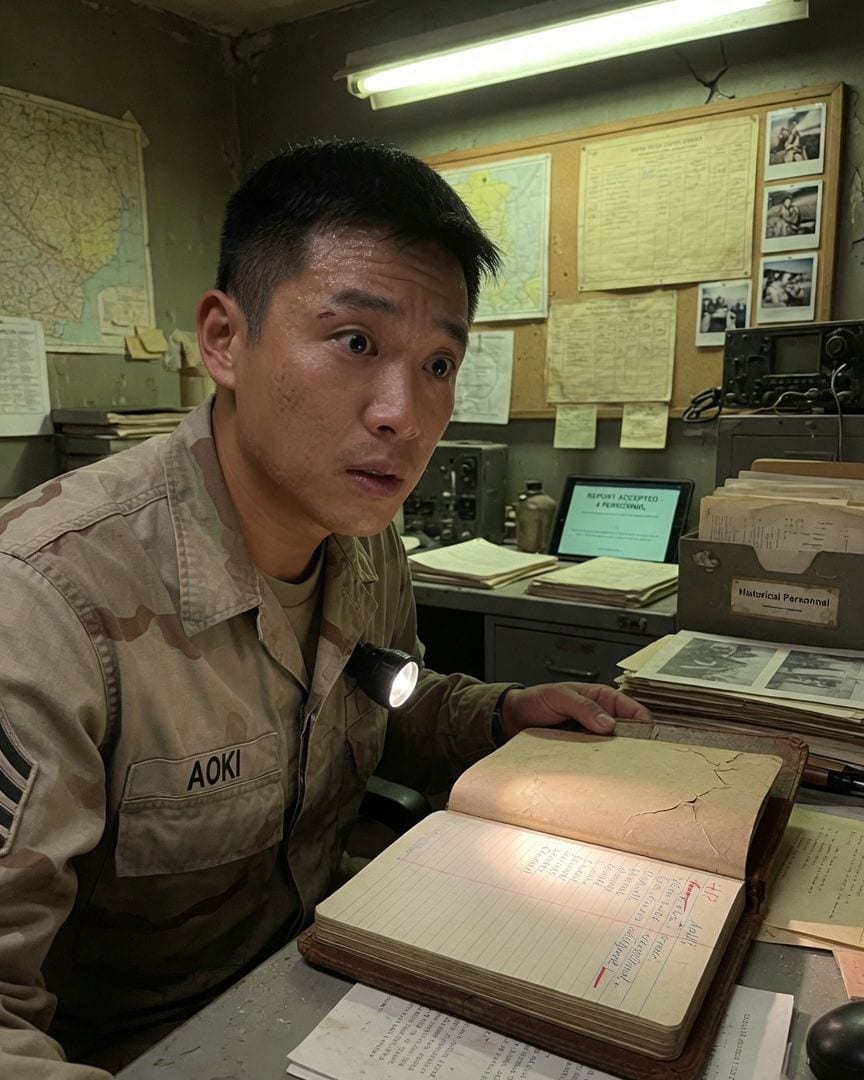
Sergeant Daniel Aoki counted his four-man night patrol, but a fifth presence murmured back from the desert dark. An old logbook from fifty years ago also noted a mysterious '+1?'
Sergeant Daniel Aoki, 32, led his four-man night patrol along Firebase Kestrel's wire, the desert wind a constant, gritty whisper. With relief due at dawn, Aoki conducted a quick headcount. After calling out his four men, a soft, almost imperceptible murmur acknowledged the call from just off his right shoulder, a fifth presence in the dark. His flashlight swept empty ground, but the cold dread that settled in his gut told him otherwise. Later, an old logbook from fifty years ago revealed a similar mystery, with a scribbled '+1?' next to a patrol led by an 'Aoki, R.'
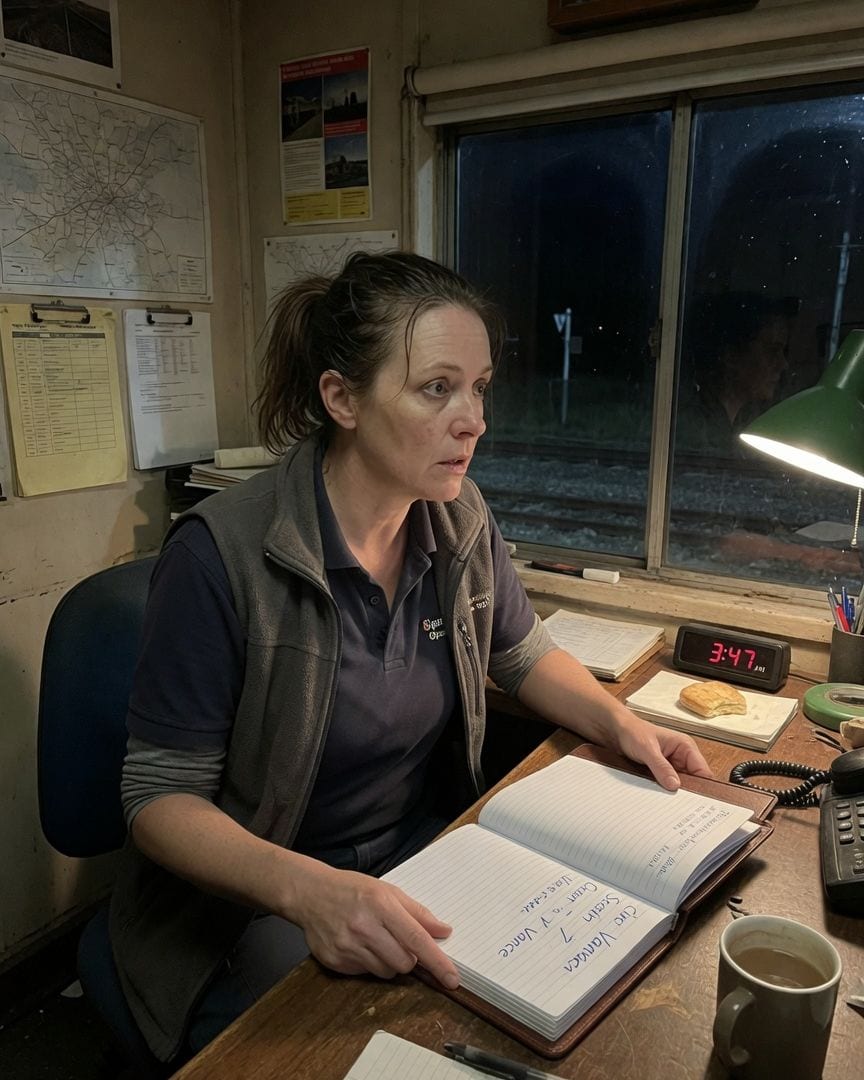
My linesman taps twice on my window at 3 AM. Control says he retired and passed years ago.
My routine at the rural signal cabin was regular: the linesman's double tap on the window at 3 AM. But then my supervisor called, revealing the linesman I knew, Warren Vance, had died five years ago. Now, an impossible entry in my official logbook, with his signature and timestamped from my shift, proves someone else was there.
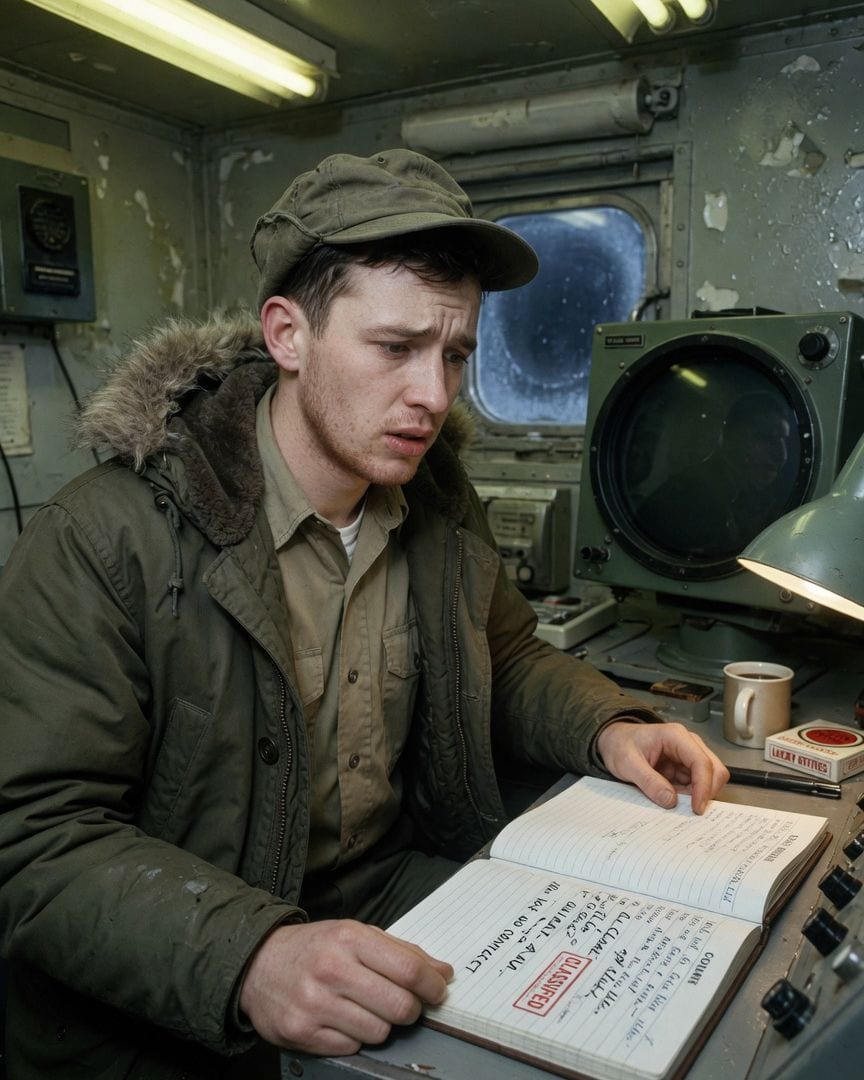
A Cold War airman logs an impossible radar contact on his last sweep. But his official logbook entry is stamped 'CLASSIFIED' and then contradicted by a hastily scrawled 'ALL CLEAR' dated moments before it.
Airman Ordway Vance, 22, manned the radar dome at Site Pellin in the biting North Atlantic dark of January 1962, running the last calibration sweep before its decommissioning. His scope picked up a faint, impossible return, growing closer with each pass, though the ocean remained empty to the eye. When Vance detailed the contact in his official logbook, a 'CLASSIFIED' stamp appeared, followed by a hastily scrawled 'ALL CLEAR' dated moments before his own entry, contradicting his every word. Commander Hartley dismissed it as equipment malfunction, but Vance sensed a chilling, official erasure behind the lie. He soon found a locked cabinet marked 'SITE PELLIN ANOMALIES,' hinting at a deeper truth buried within the base's final days.
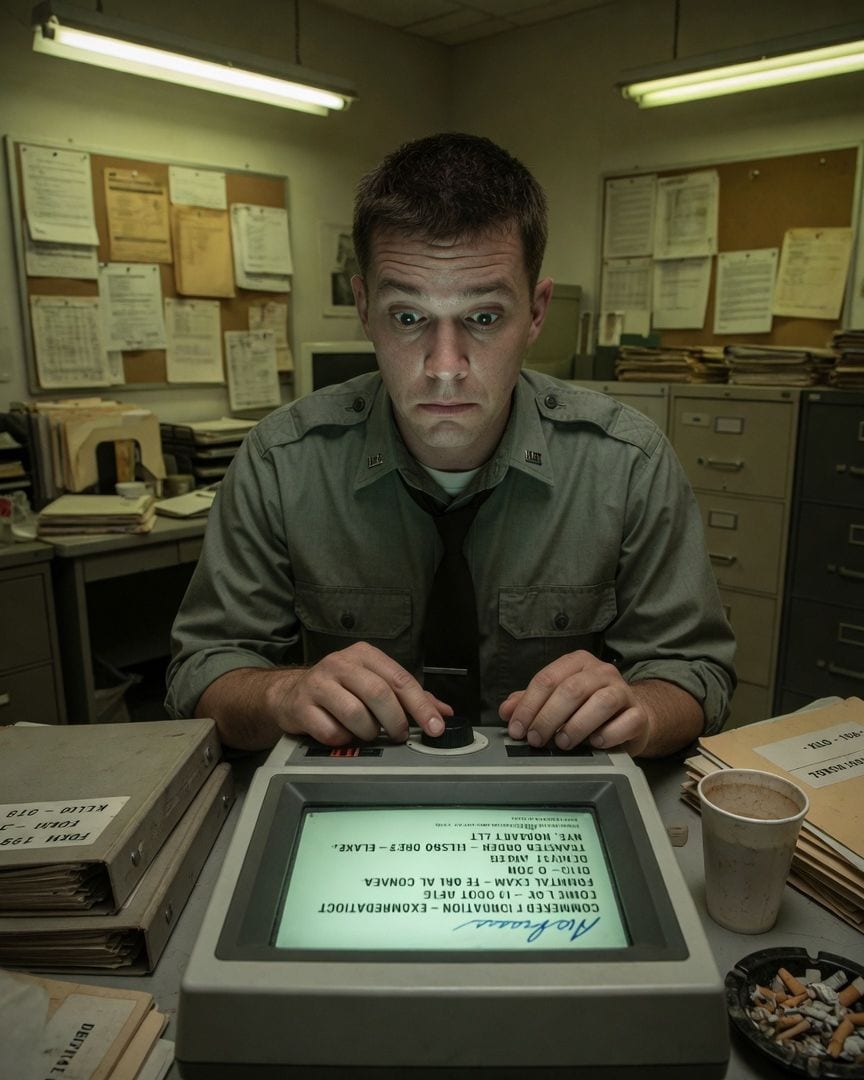
A missile commander watched his ten nuclear silos go dark. His own service record shows his signature on a future he's never lived.
Second Lieutenant Hobart Nye, a missile commander in Wyoming, had his quiet 0247 watch shattered by a security report: a massive, silent black triangle hovered over Launch Facility Kilo, casting a perfect shadow. Hobart watched his console's fault panel light up, signaling all ten nuclear missiles going dark in an impossible silence, followed by eleven minutes his security team could not remember. Official logs called it a "radio malfunction," but Hobart found a requisition for invisible-tracking sensors, signed by a base commander who was supposed to be off-base. The final, chilling discovery came when his own service record showed new entries—a dental check-up, a transfer to Alaska—all dated for a future he never lived, complete with his perfectly replicated signature.
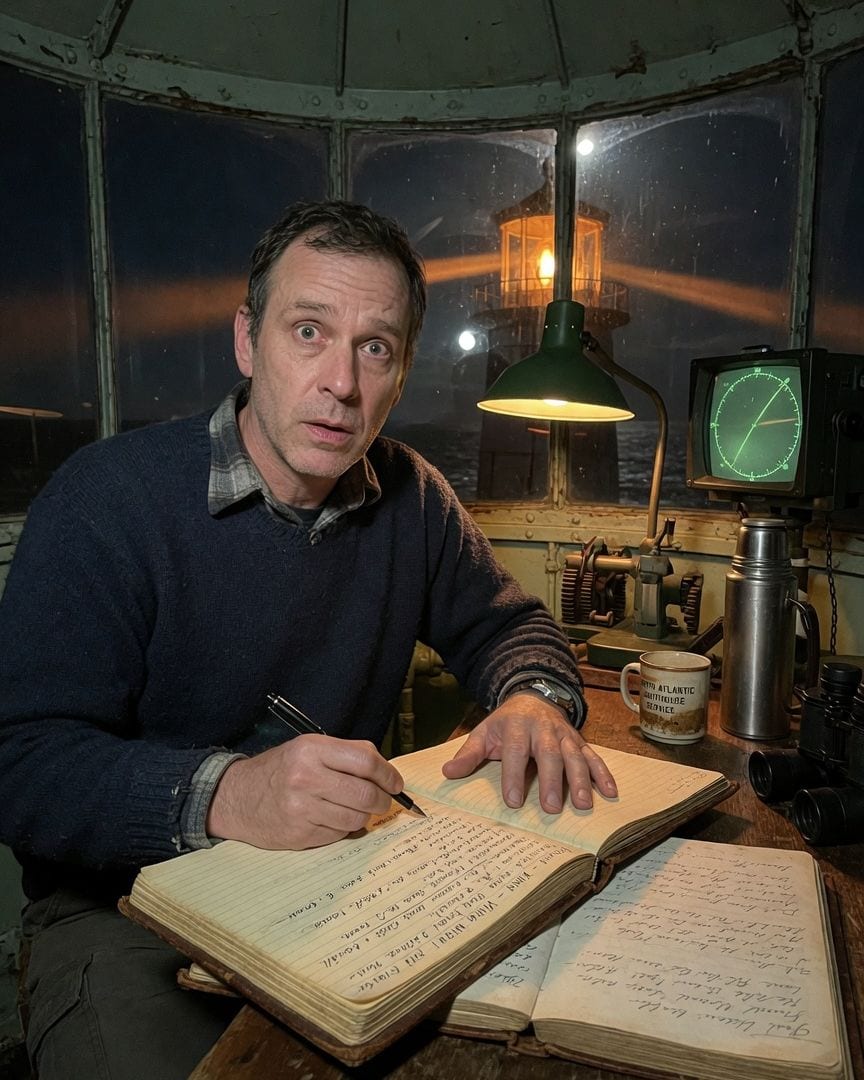
My lighthouse log has my own 3 AM entry for a phantom ship. I was alone in the tower, and I wrote no such thing.
Perched in the lantern room for my usual 2-6 AM watch, I reached for the thick logbook. But the 3:00 AM entry, under my own name, detailed a vessel I never saw. The words were in my own ink, yet I had never written them.