My fingerprints match a dead man's DMV file. They say my face is his. Gerald Poole, licensed 1975, died 1981. The DMV won't renew my license until I resolve his death.
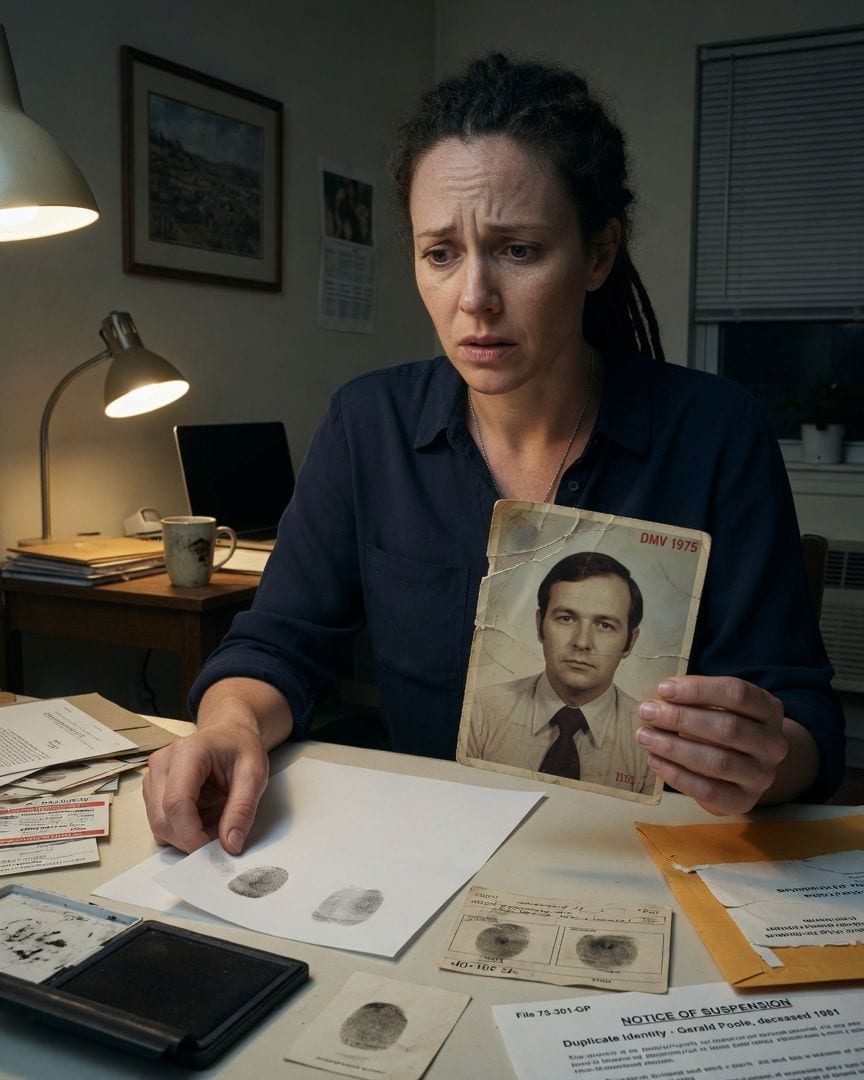
The letter arrived with the usual junk mail, sandwiched between a pizza coupon and a credit card offer. My name, Eileen Ford, perfectly legible on the envelope, followed by my address. It was from the Department of Motor Vehicles.
I figured it was just another notice to renew my driver’s license, which was due next month. I’m 38, a systems analyst, and I like things to run smoothly, predictably.
But the first line hit different. "NOTICE OF SUSPENSION. Your driver's license is hereby suspended due to a detected duplicate identity within our system."
My brow furrowed. Duplicate identity? My first thought was a mistake, obviously. Some glitch in their shiny new biometric deduplication system they’d been rolling out. They listed the duplicate’s name: Gerald Poole. Licensed in 1975, declared deceased in 1981.
Forty-five years old when he died. I was born in 1986. The numbers didn't even vaguely line up.
I spent the next hour and a half on the phone, navigating automated menus and elevator music, trying to explain the sheer absurdity of it to a DMV representative named Brenda.
She had a voice that sounded like she’d chewed gravel for breakfast.
"Ma'am, the system flagged your facial scan and fingerprints," Brenda said, her tone utterly devoid of sympathy. "It's an exact match to a Gerald Poole, file number 75-301-GP. The records are very clear."
"But I’m a woman," I said, trying to keep my voice even. "And he's been dead for over forty years. There's no possible way."
"The system doesn't make mistakes like that, ma'am," she insisted. "Facial geometry, specific fingerprint patterns – these are precise biometrics. The problem, I'm afraid, is yours to resolve. Until it's cleared, your license remains suspended."
Her voice was flat, unyielding, as if she were reading from a script for an alien invasion and couldn't care less. The dread, a cold, unreasonable weight, began to settle in. It wasn't a glitch. It was me.
I hung up, the silence of my apartment suddenly vast. My rational mind screamed "error." My gut, however, had gone cold.
Forced to take it seriously, I scheduled an in-person appointment with the DMV’s fraud unit. It was a sterile, unforgiving room, all fluorescent lights and grey partitions.
My name was called, and I walked to a desk where Frances Galloway sat, her face etched with the kind of permanent fatigue only bureaucracy can instill. She was in her sixties, professional, her tone neutral.
"Ms. Ford," she said, without preamble, pulling up a screen. "Let's see what we're dealing with."
On her monitor, my recent biometric data appeared on the left, a bright, crisp scan of my face, a clear display of my fingerprints. On the right, digitized and slightly grainy, was Gerald Poole's file from 1975.
The dates shimmered, starkly impossible: 2024 next to 1975.
Frances clicked a button. A green digital overlay of my facial structure snapped into place over Poole's image. It was unsettlingly precise. My brow, my jawline, the width of my cheekbones—all aligning with the faded, masculine contours of his face.
The software even highlighted matching earlobe patterns and the space between the eyes. My stomach twisted into a cold, hard knot. It looked like him. Like a male version of me, or a female version of him.
Then she overlayed the fingerprints. Every whorl, every ridge, every loop and arch of my right index finger seemed to melt into his, a perfect, impossible congruence. My breath hitched. This wasn't a 'vague resemblance.' This was exact.
"As you can see," Frances said, her voice still calm, "the system determined a 100% match on both points. It's… uncommon, to say the least, to have this level of similarity with a deceased individual."
She paused, then added, "Especially across genders."
"It's a digital error," I insisted, my voice tight. "A corruption. I need to see the original. The physical file. The one from 1975."
Frances’s expression remained unreadable, but she nodded slowly. "That's archived off-site. It will take some time to retrieve. I'll have it sent to you directly."
A week later, the thick manila envelope arrived. It felt heavy, somehow, disproportionately so for a few pieces of paper.
My hands trembled slightly as I tore it open, pulling out the laminated DMV photo of Gerald Poole, licensed in 1975, and his original, smudged fingerprint card.
I stared at the photo. I had expected a vague, generic resemblance, the kind you might see in a distant relative. Instead, the face staring back from the faded plastic was undeniably my own. But older.
Masculine, yes, with a severe jawline I didn't possess, but the eyes, the curve of the nose, the set of the mouth—it was me. A solemn, serious expression I had never seen on myself, yet utterly familiar.
My thumb traced the impossible contours of my own eyes, my own lips, in a stranger's past.
Then I pulled out a cheap ink pad I’d bought online, my hands shaking. I pressed my own thumb to a blank sheet of paper, then held it next to the smudged, official print on Poole's archived card.
Every ridge, every whorl, every tiny loop. They were identical. Perfectly mirrored.
Shaken, but still clutching at any shred of rational explanation, I paid a private forensics agency a small fortune to take a professional set of my fingerprints.
Two days later, the report landed in my inbox: a sterile, technical confirmation. 100% certainty. The biometric match to Gerald Poole's archived card was absolute.
The world outside my window, usually so clear and predictable, seemed to blur at the edges.
I needed more. I researched Gerald Poole further online, digging into old news archives. I found a brief obituary from a local newspaper, dated 1981, confirming his death at 45 in a "tragic accident." No other details.
No family listed, no next of kin. Just a name, a date, and a chillingly vague cause of death. He was an orphan of history, it seemed, except for the fact that his face and fingerprints were somehow mine.
Desperate to find any link, however tenuous, to my own ancestry, I visited the local historical society. It was a dusty, quiet place filled with forgotten stories. I explained my unusual request to Desmond Winslow, a retired archivist.
He was a man in his early seventies, his glasses perched on the end of his nose, his initial gruffness slowly replaced by a flicker of intrigue as I spoke.
"Poole, you say?" he murmured, stroking his chin. "Yes, the Poole name. It has a peculiar local history." He didn't elaborate, just looked at me with an odd, assessing gaze that made the hairs on my arms prickle.
"Don't get many researchers interested in the Pooles these days."
As I delved deeper into Poole's past, or rather, my past reflected in his, subtle shifts began to appear in my own life. It started innocently enough.
An old, dark sedan, a model I couldn't quite place, began appearing on my street. It would park down the block for hours, day after day, sometimes with tinted windows, sometimes just empty.
I dismissed it as coincidence, then as paranoia, an expected side effect of my bizarre discovery.
Then, one evening, an anonymous email arrived. The subject line was just a string of numbers. No sender information. I opened it with a creeping sense of unease.
The body of the email read, simply: "Some paths are best left untrod. Your past is not your own." I tried to trace it. Untraceable. The knot in my stomach tightened, cold and hard.
The next morning, Desmond Winslow called me. His voice was uncharacteristically urgent, devoid of its usual academic dryness. "Eileen," he said, without preamble. "I remembered something about the Poole family. Something… about old patterns.
I think you need to come back. Soon." The line went dead.
I looked out my window. The old, dark sedan was gone.
I met Desmond in a secluded corner of a quiet cafe, far from the historical society and its dusty records. He was visibly uneasy, his hands fidgeting with a sugar packet.
The usual academic detachment was gone, replaced by a nervous energy.
"The Pooles," he began, his voice barely a whisper, "and several other old local families, including your mother's side, the Montgomerys… they were subject to certain local legends." He glanced around, as if worried about being overheard.
"Legends of 'travelers' or 'sleepers.'"
He pulled out a brittle, yellowed newspaper clipping from his pocket, careful not to tear it. The date was smudged, but I could make out "1930s." The headline was faded, but the story was chilling.
It detailed the disappearance of a young boy named 'Gerald P.' from a nearby town. Years later, he "reappeared," seemingly unharmed, but "changed." No memory of his past, a new identity.
The article ended with a vague, disquieting line about local superstitions regarding children who were "touched by the other side."
Desmond leaned closer. "These individuals, the ones who 'reappeared,' they often had distinct birthmarks or physical traits that seemed to reappear across generations. Or, sometimes, official records that didn't quite line up, like yours." He picked at the sugar packet.
"The local lore always whispered about 'unsettling echoes,' and the name Montgomery often came up in similar oddities." He crumpled the packet. "Your 'duplicate identity,' Eileen, isn't a glitch in the DMV system. It's a recognized, if hushed, local phenomenon.
A pattern of identity recurrence."
My mind reeled. Folklore? Travelers? This was far more insane than a simple biometric error.
But as he spoke, an impossible coherence began to knit together the disparate pieces: the unyielding DMV agent, Frances Galloway’s unreadable face, the exact fingerprint match, Gerald Poole’s dateless obituary. A pattern. A terrifying, ancient, local pattern.
The danger, I realized, was no longer just bureaucratic. It was personal, and it had roots.
Desperate for a scientific, concrete explanation to counter Desmond’s unsettling folklore – something that could prove it was all just a series of coincidences, a statistical improbability, anything but a 'pattern of recurrence' – I ordered an ancestry DNA kit the moment I got home.
I sent off my sample, clinging to the hope of a distant, shared ancestor with Poole, a simple mix-up that would make sense. Anything but 'travelers.'
Weeks later, late one night, a notification pinged on my phone. My heart hammered against my ribs. ‘High-Confidence DNA Match Alert.’ I tapped the screen, expecting a list of distant cousins, a family tree expanding with strangers I could dismiss.
Instead, the top match displayed on the screen was a 99.9% probability to "Unidentified Male, Site 3B, Montgomery County Dig, c. 1880-1890." Below it, the DNA lab’s contact information, with a blunt, unnerving note: "Result verified.
Please contact us regarding this exceptional finding."
My living DNA, matching a skeleton from a grave over a century old. A name that wasn’t Poole or Ford, but Montgomery.
I sat at my kitchen table, the DNA report spread out before me, the screen of my laptop open to the Montgomery County historical society's website.
I’d spent the morning on the phone with them, and they'd put me in touch with Dr. Aris Thorne, the lead archaeologist of the ‘Site 3B’ dig.
He had been intrigued, to say the least, by the impossible DNA match, and had quickly sent me the full archaeological report.
My hands shook as I scrolled through the document. It detailed the painstaking discovery of the male skeleton, ‘John Doe Montgomery,’ dated to the late 19th century.
And then, there it was, on page twelve, nestled amongst diagrams of skeletal remains and soil samples: a high-resolution photograph. A small, distinctive silver locket, found resting around the skeleton's neck, buried with it.
I stared at the image, my breath catching in my throat. The locket was identical. Identical, down to the intricate engraving of intertwined vines, to the locket my own grandmother, a Montgomery herself, had always worn.
The same locket my mother, Emily Ford, now wore every single day. The silver was tarnished in the photograph, but the pattern was unmistakable.
The pattern snapped into place, not with a gentle click, but with a horrifying, sickening clarity. Desmond’s whispered words about 'travelers' and 'sleepers,' the impossible biometric match to Gerald Poole, the century-old skeleton.
The Montgomery name wasn't just a place, or a distant relative on my mother’s side. It was a lineage. A bloodline. And the locket, always passed down, was its anchor.
I was not just Eileen Ford. I was Gerald Poole. I was 'John Doe Montgomery.' And likely, I was others before them, a continuous identity re-emerging through generations, tied to this specific family line, bound by this small, engraved locket.
The wrongness wasn't a glitch. It was me.
I confronted my mother, Emily Ford, at the kitchen table later that day. The familiar scent of her brewing chamomile tea usually brought comfort, but today it just felt stifling.
I laid out the DNA report, the faded photo of Gerald Poole, and the archaeological report with the picture of the locket. Her hand, thin and veined, instinctively went to the locket around her own neck.
She picked up Poole’s picture first, her brow furrowed. "Eileen, what is all this?"
"My driver's license was suspended, Mom," I said, my voice unnaturally steady. "They said my face and fingerprints match a man named Gerald Poole, who died in 1981." I pushed the DNA report across the table.
"And my DNA matches a skeleton from 1880. From a dig in Montgomery County. And Mom… look at this locket." I pointed to the photo in the report.
Her eyes, wide and suddenly filled with a deep, ancient sorrow, stared at the image. Her hand clutched the locket around her neck tighter. A tear welled and traced a path down her cheek.
"Oh, Eileen," she whispered, her voice barely audible. "I hoped… I prayed it wouldn't happen to you."
She confessed then, her voice breaking. The locket, she explained, was an ancient heirloom, passed down through the Montgomery women for generations. "It's said to 'keep the spirit whole,' my grandmother used to say.
To help it find its way back." She revealed that similar 'anomalies' had happened in their family before. Hushed up. Children born with uncanny resemblances to long-dead relatives, sometimes with memories that weren't their own, vague flashes of other lives.
Her mother, the 'one who knew,' had kept the secret to protect me, hoping the cycle would pass me by. They always believed the locket helped guide the 'return' safely, kept the 'spirit' from fragmenting.
But the DMV's new system, an external, unbiased record-keeper, had inadvertently broken the family's long-held silence. The official records, meant to define us, had instead exposed the pattern. I wasn't just a person. I was a vessel. A returning pattern.
An echo across time. There was no escape, only the chilling acceptance of an impossible truth, now made utterly coherent.
The DMV eventually, quietly, reissued Eileen's license. The 'duplicate identity' flagged by their system was classified as an 'unresolvable systemic error' in her file, a bureaucratic shrug at the incomprehensible.
Frances Galloway, the fraud investigator, sent a brief, almost apologetic email, hinting at other similar, unresolved cases across the state, now being "flagged for review."
Eileen continued her life, but the world had subtly shifted on its axis. The impossible was now simply true, a quiet, internal certainty that hummed beneath the mundane surface of her days.
She understood the old sedan, the anonymous email, Desmond’s cryptic warnings – all whispers of a truth long known by a few, now known by her. The fear was still there, but it was accompanied by a strange, unsettling clarity.
She was part of something larger, older, a rhythm of existence she could not break.
Eileen sat on her porch swing, the locket, now borrowed from her mother, cool against her skin. She traced the intricate engraving on its surface, the pattern of intertwined vines, a design that had passed through generations, through lifetimes.
It felt heavier than she expected, a tangible anchor to a sprawling, impossible past. She looked out at the familiar street, the mundane houses, the distant sound of children playing in the park.
Her mother called her in for dinner from the doorway. "Everything alright, darling?" Eileen turned, a faint, unfamiliar smile touching her lips, a smile her mother has never seen before, a smile that feels both new and ancient.
'Yes, mother,' she says. 'Just remembering.'
If this one got to you
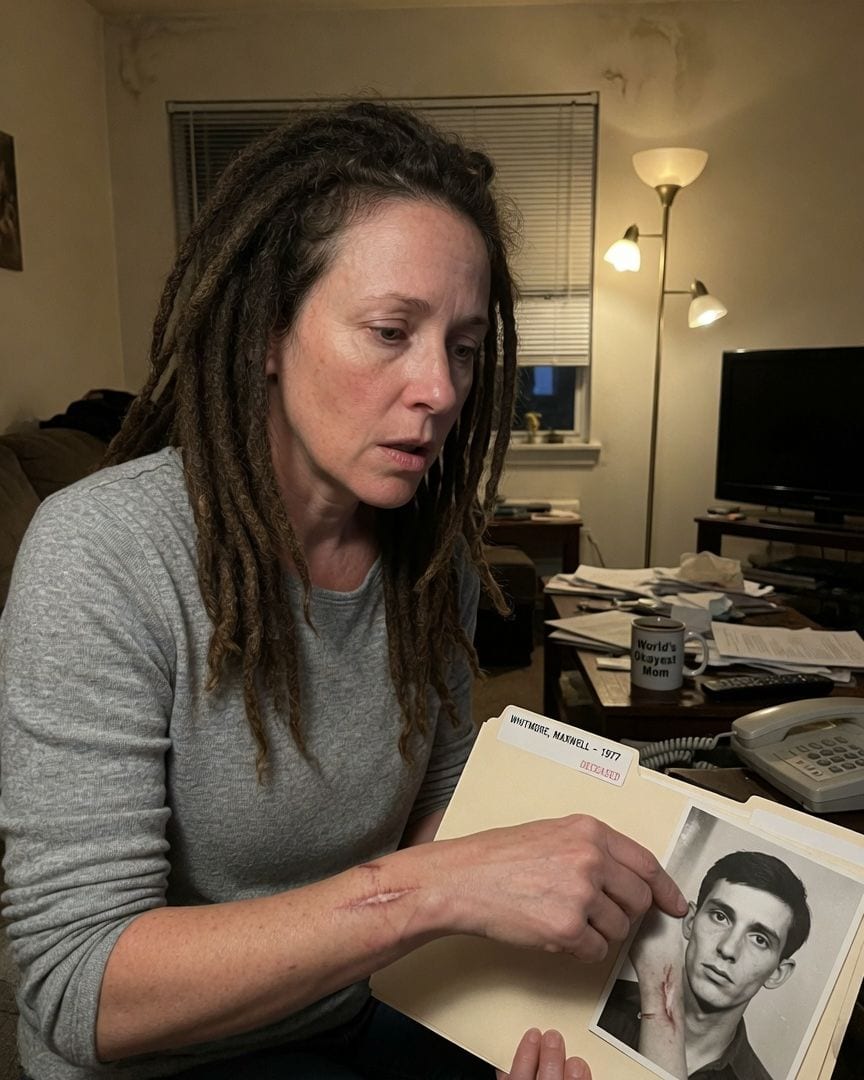
My fingerprints perfectly match a dead man's. He died in prison in 1980, but the bureau insists our hands are identical.
My distant cousin's arrest led to a routine fingerprint check, but the results were anything but normal. A bureau examiner confirmed my prints were identical to an inmate who died in custody decades ago. Then I saw his mugshot: the faint scar on his wrist was the exact same as my own unique birthmark.
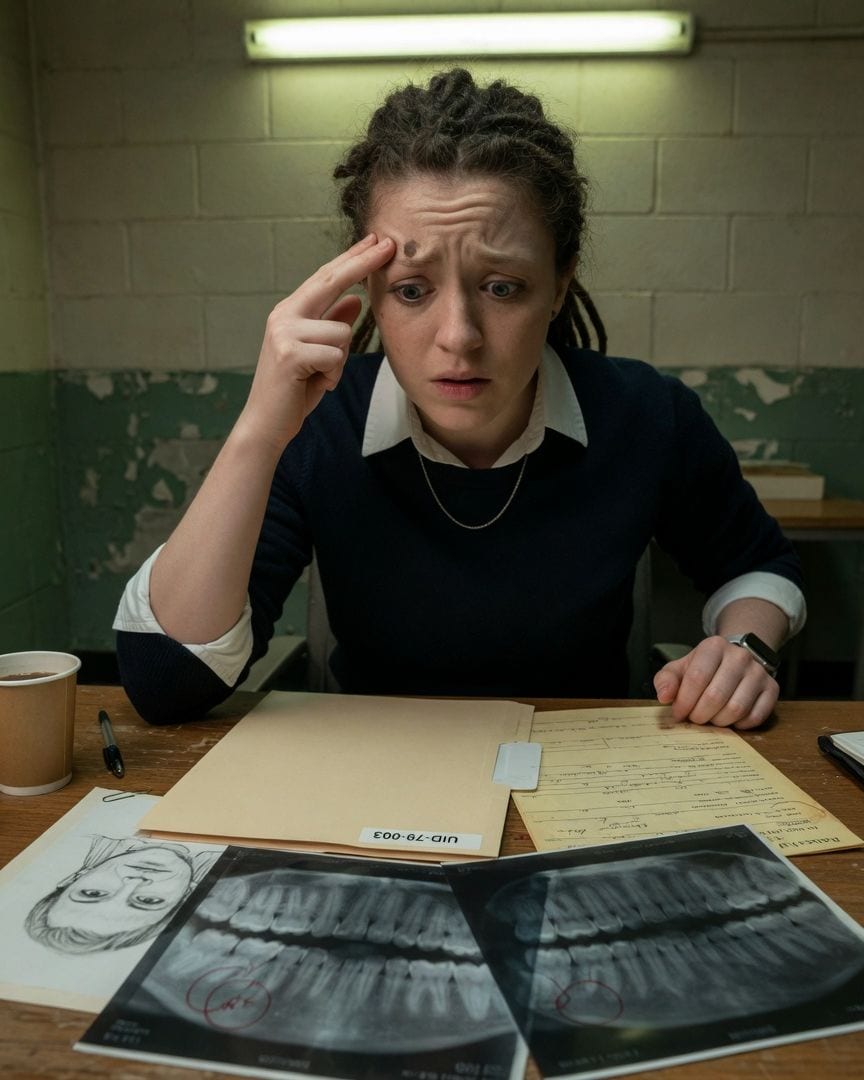
A 1979 facial reconstruction of unidentified remains has my distinct birthmark, just above its left eyebrow.
Switching dentists should have been a routine adult problem. Instead, my new X-rays were an identical match for unidentified human remains catalogued by the county coroner in 1979. The impossible match left me with a chilling dread.
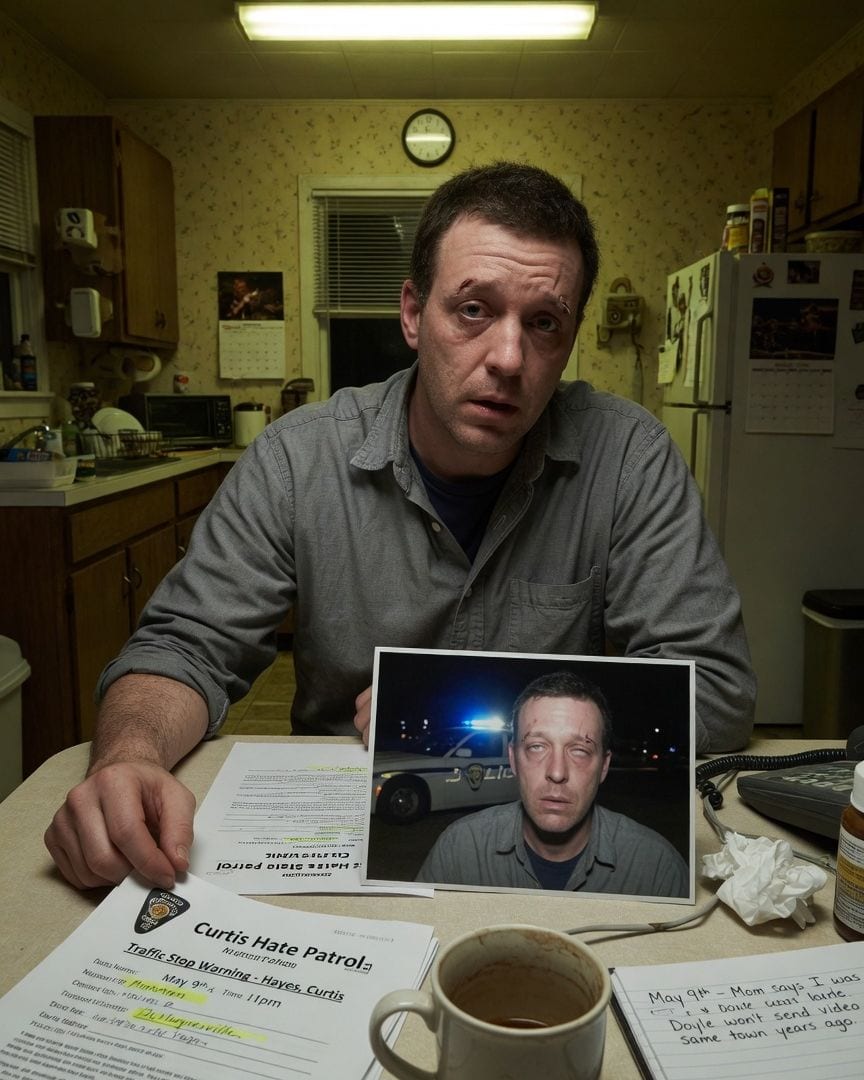
My face stared back from a bodycam video, in a town I've never been. He answered to my name.
I received an email from the Ohio State Patrol for a traffic stop I never made, 200 miles away on May 9th. My mother confirmed I was home that night, asleep on the sofa. When the police finally sent a bodycam photo of the driver, it was my face and scar, but the eyes were flat, distant, and utterly devoid of warmth.
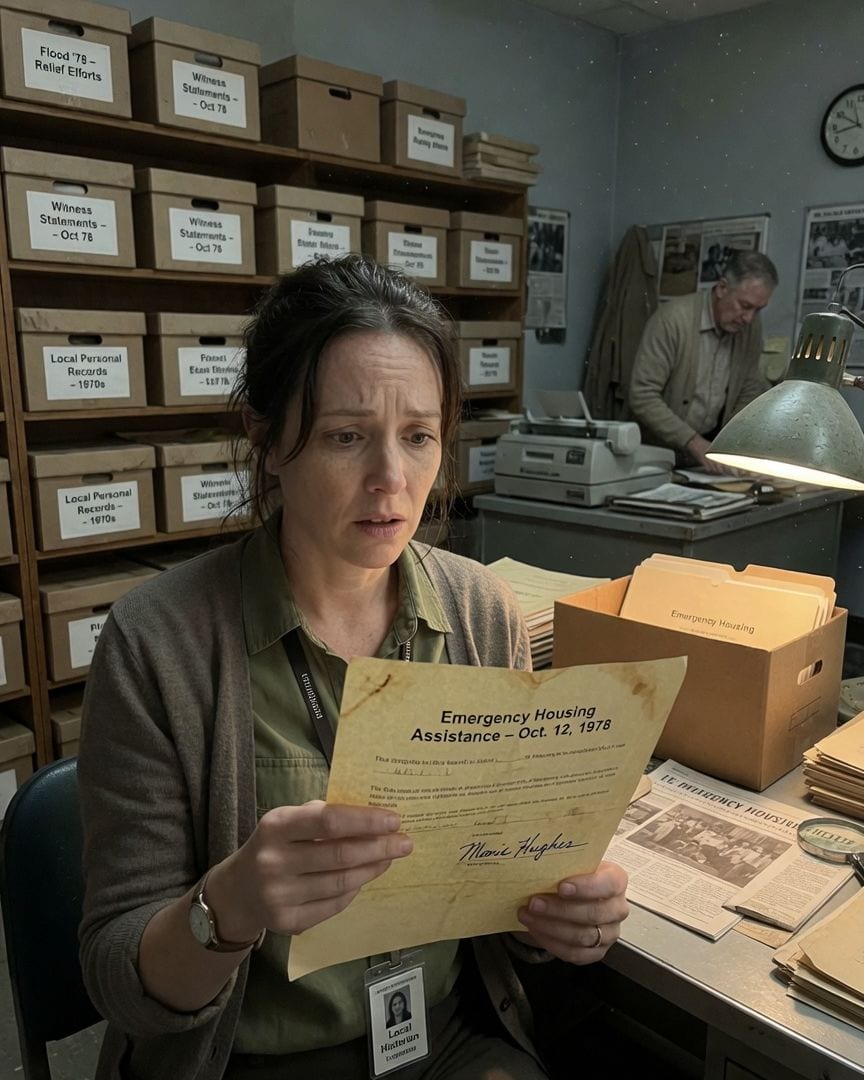
My face, with my mole, in a 1978 flood photo. I was born seven years later.
As a local historian, I was deep in the dusty town archives, researching the devastating 1978 Ohio River Valley flood. My fingers brushed a black-and-white photo, and my breath caught. Staring back from the 1978 scene was a woman with my distinct face, my mole, and my crooked front tooth, seven years before I was born.
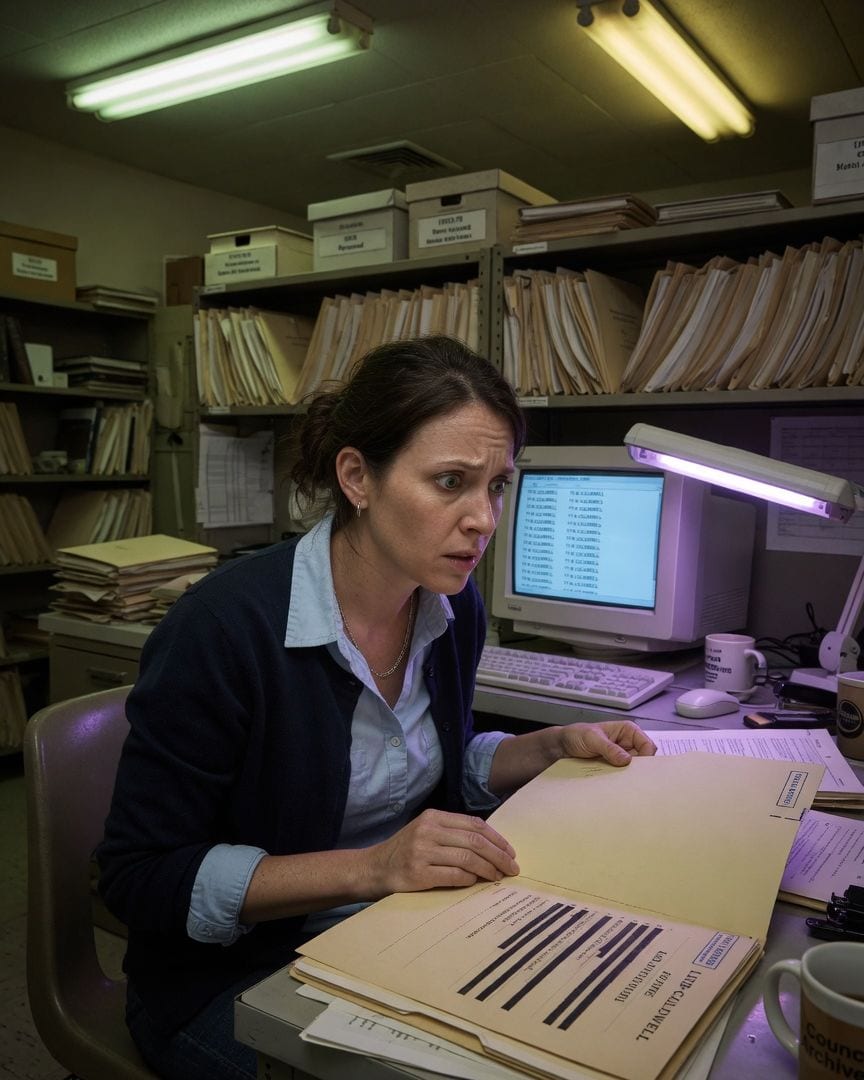
My employer's security file holds a vetting report on me dated nine years before I ever applied. It has my full name and my parents' address — with only one line, the source who referred me, blacked out.
Working a routine data audit, I pull my own security file. The issue date is nine years before I even applied for the job. Then, hidden within an old archive file, I find my current address etched under a blacked-out line.
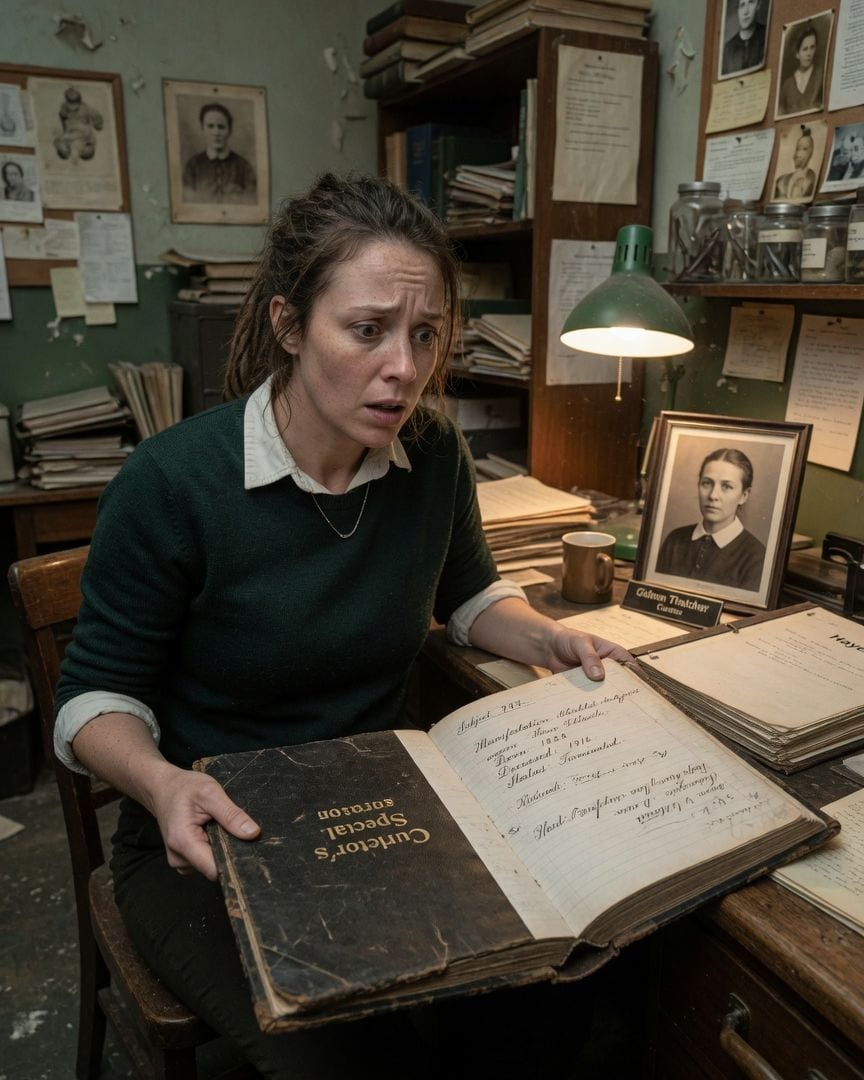
My face, cast in plaster in 1888, stares back from a museum display. They DNA tested a hair from inside the mask. It’s me.
The hushed, cool air of the Museum of Medical History always gave me a strange reverence, until I stopped. Inside a display case, among other plaster death masks, was one labeled 'Theresa Whitfield, 1888.' It was undeniably my face, exact in every detail, down to the faint bump on my nose.