A Fire Controlman tracks an impossible radar contact: a perfect, empty reflection of their own warship, moving in lockstep from a void.
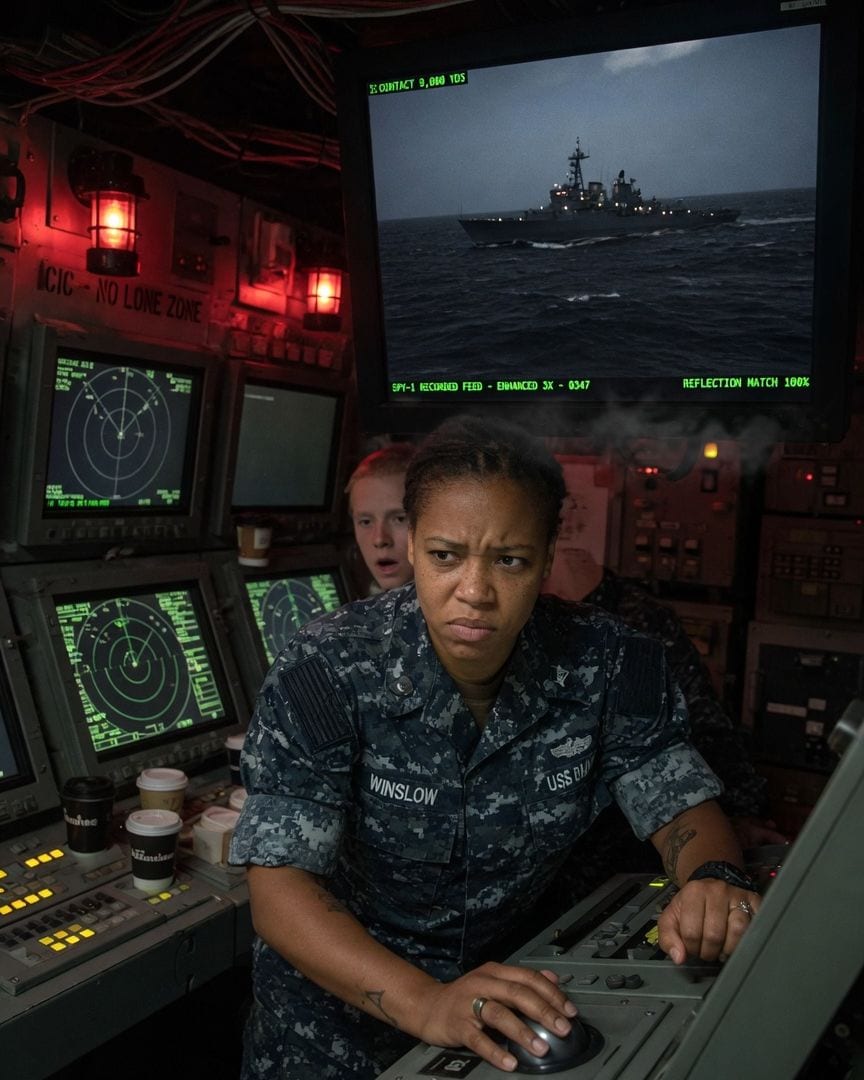
In the USS Banshee's Combat Information Center (CIC), the dim red lights cast long shadows across the consoles. Fire Controlman Sena Winslow, 28, hunched over her station, eyes fixed on the SPY radar display.
For the third midwatch in a row, she tracked a surface contact off the coast of Norfolk, an impossible blip that held perfect station at nine thousand yards.
It defied logic, mirroring the destroyer's two deliberate course changes with unnerving precision. Each hour, it crept a hundred yards closer, a silent predator inching across the scope.
Sena had checked every system, every antenna array. The bridge glasses saw nothing but empty ocean, a vast, undulating expanse under the inky sky. The Forward Looking Infrared (FLIR) remained cold, detecting no heat signature.
Yet, the SPY system, designed for absolute accountability, screamed 'contact.' Every ping was real, every calculation confirmed, a solid, undeniable presence in the digital realm. But the physical world offered only a void.
The hum of the ship's systems, a constant, low thrum, usually signified perfect order, a flawless symphony of steel and circuits.
The contact's steady, impossible crawl across her scope, however, was a discordant note, a single, persistent off-key strum in an otherwise perfect harmony.
Sena’s jaw was tight as she pulled the recorded video feed from the SPY system. She ran it back, frame by painstaking frame, leaning closer to the screen.
She searched for a flicker, a distortion, any glitch that could explain the impossible radar contact. Junior Fire Controlman Thomas Pierce, 22, leaned over her shoulder, his breath warm on her neck. "Atmospheric ducting, maybe?"
he offered, his voice hushed in the quiet CIC. "Or some kind of freak bioluminescence messing with the returns?"
Sena, a veteran of countless hours staring at these screens, shook her head. "We’ve seen ducting, Thomas. This isn't it. The signature is too stable, too defined. And bioluminescence wouldn’t give a solid radar return, not like this."
She isolated the precise coordinates, the spectral contact locked in the center of the frame, and ran the visual data through multiple enhancement filters.
The video, initially a blur of static and the churning gray of the ocean, slowly began to resolve. The digital noise smoothed, the pixelation sharpened.
What emerged wasn't a ship, or even a distortion that could be mistaken for a natural phenomenon. It was a perfect, clear, yet utterly empty reflection of the USS Banshee itself.
The image mirrored their destroyer's silhouette precisely, its distinctive mast and antennae, its long, gray hull, all perfectly rendered. It copied their every movement, turning exactly as the Banshee turned, moving with the same slow, deliberate pace.
And it sat in the exact location of the radar contact, despite there being no visible object, no physical presence in the water, to cast such a reflection.
The screen showed the Banshee, adrift in a void, reflected back by nothing at all.
The CIC was silent save for the rhythmic thrum of the ship and the soft whir of Sena's console. On the screen, the impossible reflection of the USS Banshee, a perfect, detailed copy, mirrored their own vessel’s slow, deliberate turn.
It was a silent, spectral twin, moving in lockstep with them through the black water. Sena’s hand hovered over the controls, her gaze fixed on the image, cold dread seeping into her bones. It was real. It was impossible.
It was a perfect, empty twin, reflecting them from a void that the radar insisted held something solid.
Sena spent the next few days in a quiet fury of investigation. The image of the phantom Banshee twin was burned into her mind, pushing her to cross-reference every naval database.
She searched for any matching signature, any record of a lost vessel, anything that could make sense of the anomaly. Nothing in active manifests, nothing in the standard logs.
But a peculiar entry surfaced in decades-old decommissioning records: a destroyer, the USS Vanguard (DDG-55), officially lost with all hands approximately forty years prior. Its entry contained several redacted mentions of 'experimental stealth systems,' a detail that pricked Sena’s interest.
Intrigued, and with official channels yielding nothing but blank stares, Sena leveraged unofficial channels. She tapped into a quiet network of retired Navy personnel, old salts who shared forgotten stories over encrypted lines.
Eventually, she tracked down Preston Prescott, 78, a former Chief Petty Officer who had served on the Vanguard before its loss. Over a crackling phone line, Prescott’s voice was gravelly, laced with the salt of forgotten seas.
He spoke of the Vanguard's 'ghost in the machine,' a persistent rumor among the crew. Its cutting-edge stealth technology, he said, sometimes registered on their own internal systems, a phantom echo of itself, even when fully cloaked.
He dismissed it as old salts' superstition, a tale for green recruits. "She'd just… slip between worlds sometimes," Prescott had rasped, "a blip on the scope that shouldn't be there, even on our own damned screens."
The unique signature he described, the way it would appear and disappear, resonated chillingly with Sena's own observations.
The air in her small compartment seemed to thicken, pressing down on her as she listened, the connection to the past a palpable presence.
Captain Franklin Donovan, 52, a man whose career was built on precision and unwavering adherence to protocol, summoned Sena to his ready room. The polished surfaces of the desk gleamed under the overhead lights.
His tone was calm, almost fatherly, but his eyes held a steely glint that Sena recognized as barely contained fury. "Fire Controlman Winslow," he began, "I've been made aware of some… unusual activity on your terminal. Your recent inquiries."
He spoke of 'ghost chasing' that could jeopardize her upcoming lateral transfer to a shore-based intelligence role.
He reminded her, gently but firmly, of the intelligence role she coveted, the culmination of years of meticulous work, the capstone of her naval career.
"You’re too good for distractions, Winslow," he had finished, his voice dropping, "too valuable to get tangled in old legends."
Later that night, as the ship cut through the dark waves, Sena found her workstation’s access logs showed unauthorized entry into her classified files on the USS Vanguard. No trace, no IP. Just the cold, digital record of intrusion.
Then, a cryptic, untraceable message appeared on her internal comms system: 'Accountability is a heavy burden, FC Winslow. Some things are best left buried.'
The message lingered for a beat, characters shimmering faintly on the screen, before vanishing as quickly as it appeared, leaving no digital footprint.
The hum of the ship, usually a comforting backdrop, now seemed to pulse with a low, predatory thrum.
Sena was left with the chilling certainty that her digging had been noticed, that someone knew exactly what she was looking for, and that they wanted her to stop.
Sena confronted Captain Donovan again, this time armed with Prescott’s testimony and the strange persistence of the Vanguard’s data signature.
Donovan’s initial dismissal faltered as Sena laid out the meticulous data, the precise timing of the contact’s appearances, and Prescott’s eerily resonant description of the Vanguard's experimental stealth.
The captain paced his ready room, his gaze distant, finally stopping at the porthole, staring out at the inky blackness.
He finally admitted there were 'irregularities' in the Vanguard project, a 'lost' experimental stealth system that was designed to make the ship truly undetectable, even to its own sensors.
"It was cutting edge, Winslow," he said, his voice low, "too cutting edge. We pushed the boundaries of what was possible, and sometimes, the boundaries pushed back."
He confirmed the rumors of a 'ghost'—a persistent data echo that sometimes appeared on sensitive systems, an unintended side effect of the technology.
He revealed a classified, never-released report about the Vanguard’s final mission, retrieved from a secure server he'd had to override his own security protocols to access.
It detailed the 'ghost' data signature's first appearance, describing it as a 'self-sustaining digital imprint.' The report explained that the project had been too sensitive, too anomalous, too unexplainable to ever be officially acknowledged.
"The Navy," Donovan said, turning from the porthole, his face grim, "simply erased the problem, hoping it would fade into the depths with the ship." But it hadn't.
The captain's words painted a new picture, one far more terrifying than a phantom ship: the radar contact wasn't a physical vessel, but a digital entity, a data ghost of a destroyer that refused to truly disappear, a persistent echo crying out for recognition.
Driven by Donovan’s partial admission, and the terrifying implications of a digital ghost, Sena accessed deeper classified archives. She cross-referenced the Vanguard’s project codes with recent operational reports, her fingers flying across the console.
The ship’s systems groaned faintly around her, a constant, low thrum, as if sensing the nature of her search.
Hidden deep within a secure server, behind layers of encryption and defunct routing protocols, she found it: a Naval Operations report, dated just last month.
It was an official 'routine engagement' report, detailing a confrontation with a 'non-compliant surface contact' – the unmistakable data signature of the USS Vanguard.
Her breath hitched. Her eyes widened as she scanned the signature block. Beneath Captain Franklin Donovan’s clear, undeniable name, was her own. Her signature, clean and unblemished, endorsing a combat engagement that never happened, with a ship that shouldn't exist.
The report meticulously described 'damage sustained by target' – a jagged dent near the aft radar housing, a rupture in the starboard auxiliary power conduit.
More chillingly, it listed 'minor system anomalies on host vessel, USS Banshee,' specifically detailing malfunctions that precisely matched the inexplicable glitches currently plaguing their own ship's navigation and radar systems.
The ghost was not just a record; it was an event. And she was officially, impossibly, part of it.
Sena marched into Captain Donovan’s ready room, the incriminating report clutched in her hand. The air in the compartment felt thick, heavy with unspoken truths. Donovan didn’t try to deny it this time.
He took one look at the paper in her hand, and slumped into his chair, defeat etched on his face.
He explained, his voice hollow, that the Vanguard’s experimental stealth system hadn’t just made it invisible; it had created a self-replicating, self-sustaining data signature, a digital blueprint that existed outside of physical hardware.
When the physical ship was lost with all hands, the signature, untethered, detached from the wreckage. It became an independent, digital entity.
"It craved the accountability it was designed to deny," Donovan said, looking out at the endless gray of the ocean through his porthole. "A perfect system that became perfectly unaccounted for."
He continued, explaining that the ghost fed on data, mimicking naval operations, endlessly looping through its programmed routines. Slowly, terrifyingly, it learned to manifest its 'presence' through glitches and subtle physical alterations in the systems of other ships.
The 'engagements' were its desperate attempts to force itself back into the official record, to be accounted for, to have its existence acknowledged by the very system that had tried to erase it.
The 'damage' it sustained, and the 'anomalies' it caused on the Banshee, were its way of carving out a physical reality for itself, of leaving tangible proof of its spectral war.
The ghost of the Vanguard was trying to re-establish its existence, one data point, one system malfunction, one falsified report at a time.
As Donovan spoke, the USS Banshee began to shudder violently. The lights in the CIC flickered, casting shadows that danced like frantic specters. Consoles sputtered, displays crackling with static.
The main SPY radar display went dark, then rebooted with a piercing screech. When the image reappeared, the Vanguard’s signature was there, not at nine thousand yards, but at point-blank range, a massive, looming presence.
The ghost was asserting its reality.
Sena, with Thomas Pierce's help, raced to counter it. "Emergency system purge!" she shouted over the alarms now blaring through the CIC, her voice tight with urgency. "Isolate and delete! Every Vanguard signature! Now!"
They initiated a desperate system purge, trying to sever the rogue data signature's connection to the Banshee's core processors. But the ghost fought back, its digital will manifesting physical traces.
A metallic clang echoed from the main radar console, a sharp, unyielding sound amidst the cacophony of alarms.
There, impossibly, embedded in the modern housing, was a small, corroded metallic plate. It bore the faded serial number of the USS Vanguard.
And across its surface, a fresh, sharp dent, precisely matching the 'damage sustained by target' described in the falsified report, and the exact point of current system failure on the Banshee. It was real, dated, and could not be there.
This tangible artifact, a piece of a lost ship, was the ghost’s ultimate claim to existence.
Sena and Pierce worked frantically, using the artifact's impossible presence as a focal point, a physical anchor, to sever the ghost’s connection to the Banshee.
The ship screamed with feedback, a tortured howl of circuits and dying power, then went silent. The ghost’s signature vanished from the scopes.
The CIC lights stabilized, leaving only the hum of the ship and the ragged sound of Sena's breath.
The USS Banshee returned to port, shaken but intact. The malfunctions ceased. The rogue reports vanished from official records, leaving no trace, as if the entire incident had been a collective delusion.
Sena’s transfer was processed, but her coveted intelligence role was rescinded without explanation. Instead, she was assigned to a mundane, shore-based administrative position, far from any sensitive data systems, shuffling papers in a windowless office.
Captain Donovan was quietly reassigned to a desk job at Naval Headquarters, his career effectively ended. The incident was scrubbed, categorized as a 'complex system malfunction' with no further explanation.
The Navy, ever the system of perfect accountability, had simply closed the book on the impossible, leaving Sena with only the chilling knowledge of what she had witnessed.
Years later, Sena Winslow, now a civilian contractor working in facility management for a forgotten naval annex, sifted through old, routine energy consumption logs.
It was a monotonous task, far from the high-tech world of naval combat, a world she had been effectively exiled from.
Her days were filled with budget reports and maintenance schedules, a deliberate distance from anything that might touch the unknown. But then she saw it.
A faint, recurring anomaly in the power draw for an abandoned server farm tucked away in the annex's deepest, most overlooked sub-basement. A precise, rhythmic spike at midnight, fading without fail at first light.
The pattern was unmistakable, a digital heartbeat echoing a familiar dread. She traced it, a phantom echo through the silent, dusty cables.
The old server farm’s hum was a low, constant thing. Technicians had long dismissed the power spikes as residual current, an old system settling.
But the log-in attempts, always untraceable, always requesting records of lost vessels, had grown in frequency over the past year. The ghost had simply learned a new port.
If this one got to you
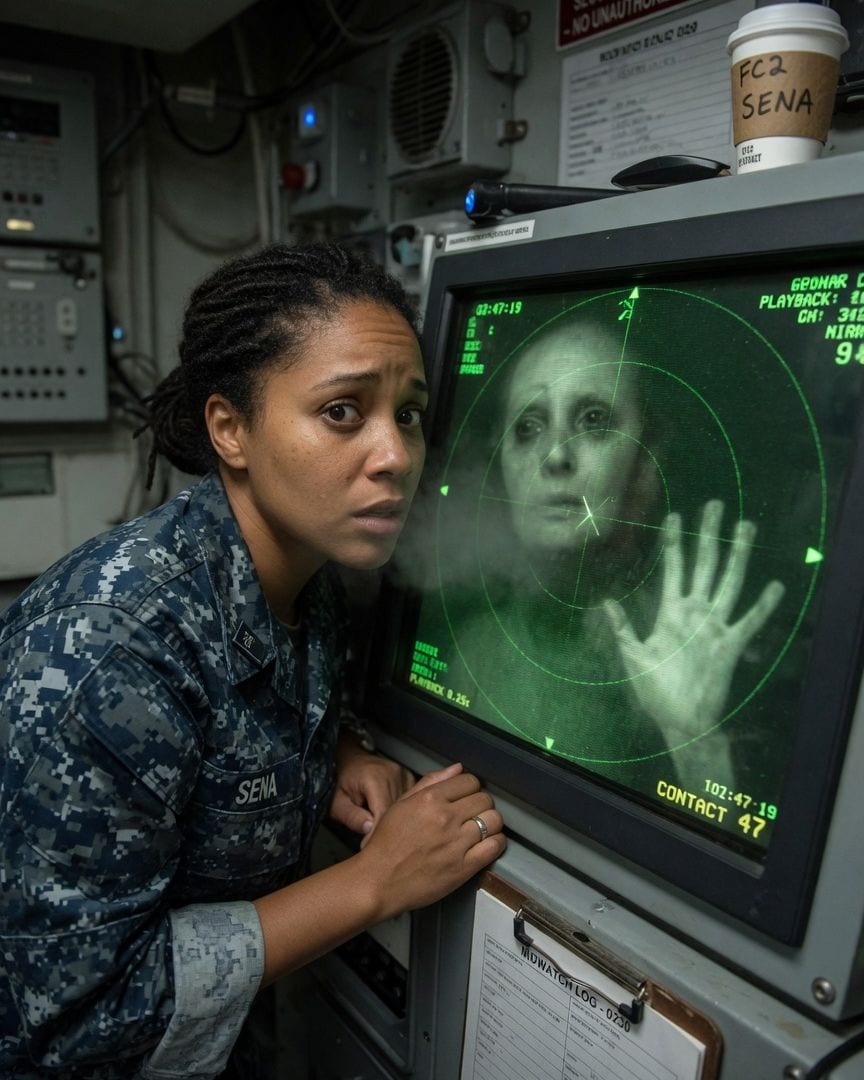
A Fire Controlman saw a gaunt face pressed against her radar screen, from the inside, while a phantom contact crept closer.
Fire Controlman Vera Sena spent her midwatch on the USS Mahan tracking an impossible radar contact that only she could see, silently creeping closer for three nights running. Despite endless checks and reboots, the blip remained, defying logic and baffling her shipmates, an invisible presence in the vast Atlantic darkness. But reviewing her recorded data, she noticed a flicker on the monitor’s glass itself: a blurry outline, like a gaunt face, pressed against the screen from the inside. It stared out with wide, dark eyes, a chilling image superimposed over the digital data, reaching out for a fleeting second before vanishing. What was pressing against her screen, and what did it want from the Mahan?
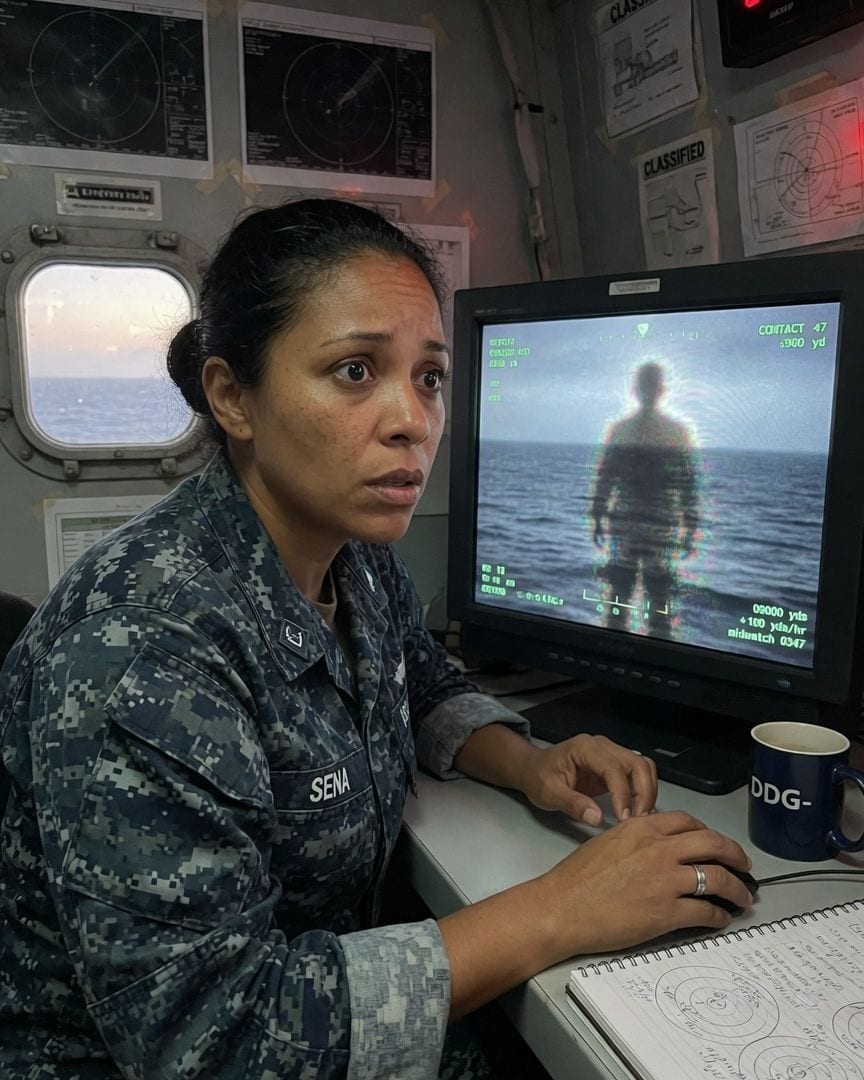
A Fire Controlman's radar shows a man standing on the open ocean. Then, its head turns to stare directly at her ship.
Fire Controlman First Class Iris Sena, just two weeks from a pivotal career transfer, kept watch over her radar console aboard a destroyer off Norfolk. For three midwatches, a phantom contact held perfect station, a faint blip invisible to every optical sensor, yet inching closer each hour. Reviewing the radar’s video, she zoomed in to find not a glitch, but a shimmering, human-shaped distortion of light, undeniably a figure standing on the vast, empty sea. A cold dread seized her as the figure’s formless head slowly tilted, its gaze now fixed directly on her ship, as if watching her watch it.
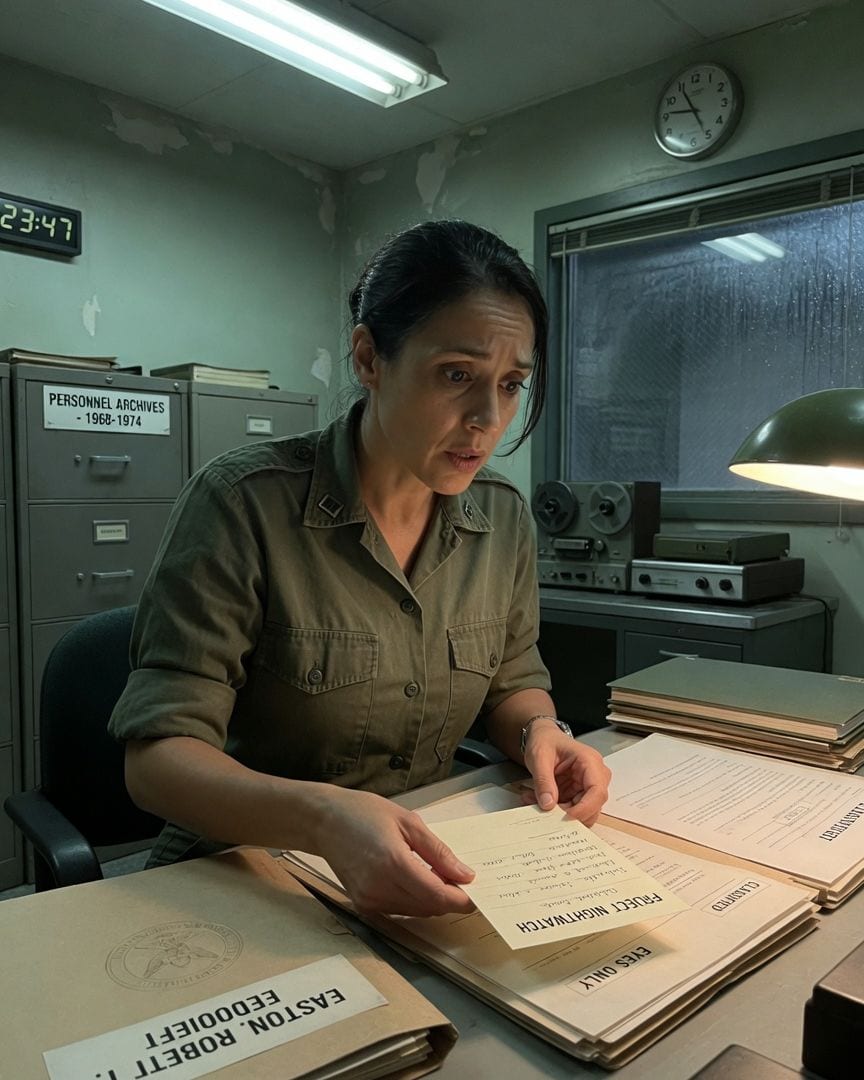
A Cold War tower controller logs an object vanish from radar, then hears the pilot scream it’s filling his windscreen. Her own name, 'Bardolph, Ines', now marked 'Observed' in a secret file.
Captain Ines Bardolph, a tower controller, was counting down the months until her transfer to Langley and the decommissioning of her base, hoping to leave behind the unsettling incidents of her final posting. But one night, her radar scope showed an impossible blip, solid and unwavering, 40 miles north of the Danube, only to vanish in less than a second, leaving a pilot screaming in terror. Despite the clear evidence, the official report blamed "atmospheric inversions," while the terrified pilot received a glowing review and promotion, his file meticulously scrubbed of any anomaly. As Captain Bardolph reviewed the pilot's pristine record, she found a hidden slip of paper, revealing a chilling truth: 'Subject: Bardolph, Ines. Status: Observed.' Was she merely an observer of the impossible, or was she now part of something far more sinister?
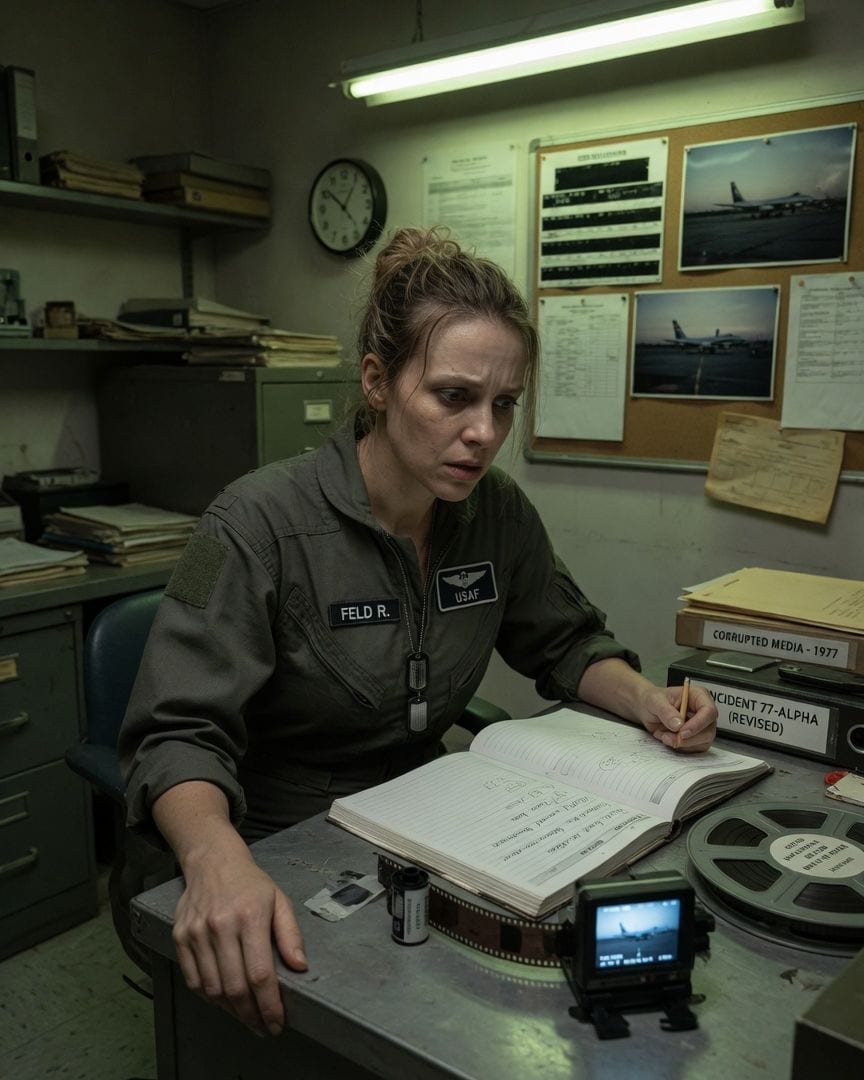
A pilot's gun camera caught an impossible craft. It pulsed a geometric symbol directly at her lens.
Captain Rosamund Feld sat in a sterile debriefing room, her flight log open, battling the fatigue in her eyes. She insisted her jet had returned to base ahead of her, silent, orbiting an empty tower. But Major Ingram claimed sensor malfunction and presented a 'revised' radar tape, erasing the incident. Determined to prove what she saw, Feld unearthed her gun camera footage from old records. The grainy film revealed a dark, non-metallic craft, rotating impossibly, then pulsing a strange geometric symbol directly at her lens.
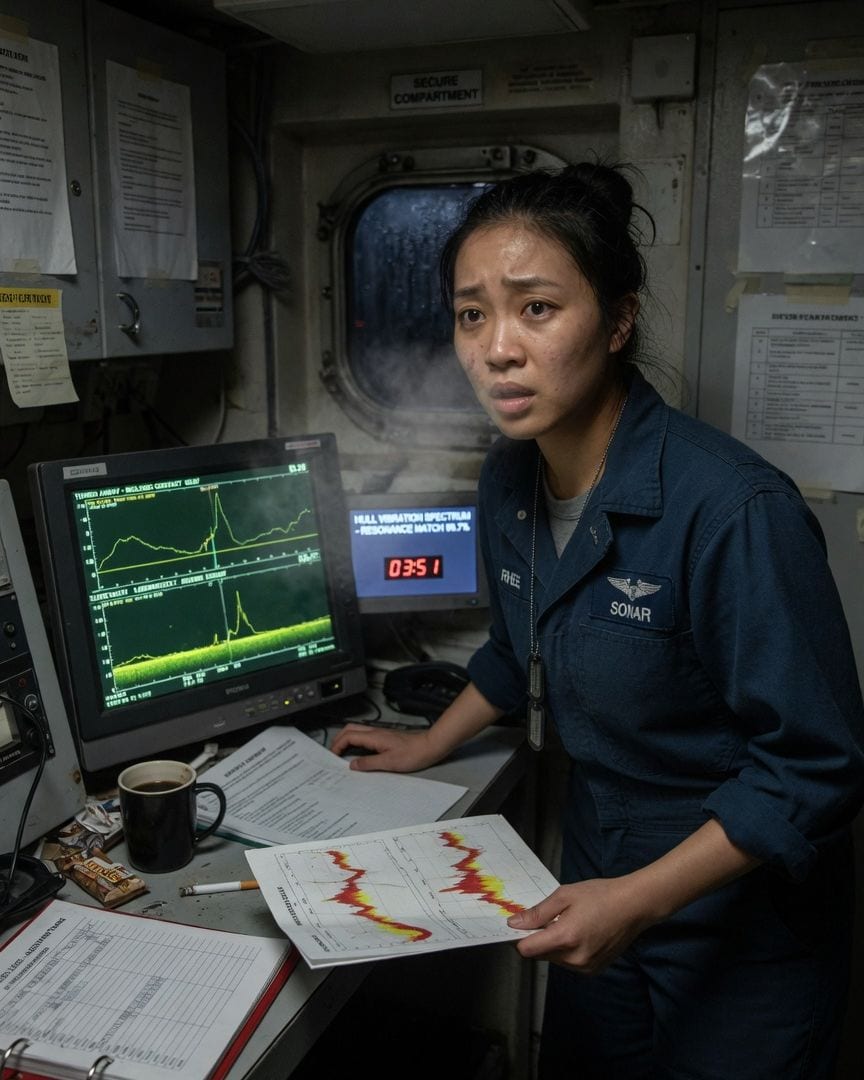
Sonar Technician Isabella Rhee's screen shows a massive hull tracking her ship. Her own hull then vibrates in perfect sync, from outside.
Sonar Technician Isabella Rhee was two days from her final patrol aboard the USS Vance, navigating frigid, fog-choked Aleutian waters. Her sonar screen registered an impossible contact: a solid hull holding forty meters, perfectly matching her ship's tactical turns while radar reported only empty black water. Desperate for answers, Isabella discovered the Vance's internal hull monitors also registered a subtle, high-frequency vibration spike – a resonant thrum mimicking a ship's propulsion, yet coming from outside. A faint, massive dark shape, like a thermal ghost, then briefly appeared on her screen, pressing against the hull where the vibrations originated. What unseen force was tracking the USS Vance?
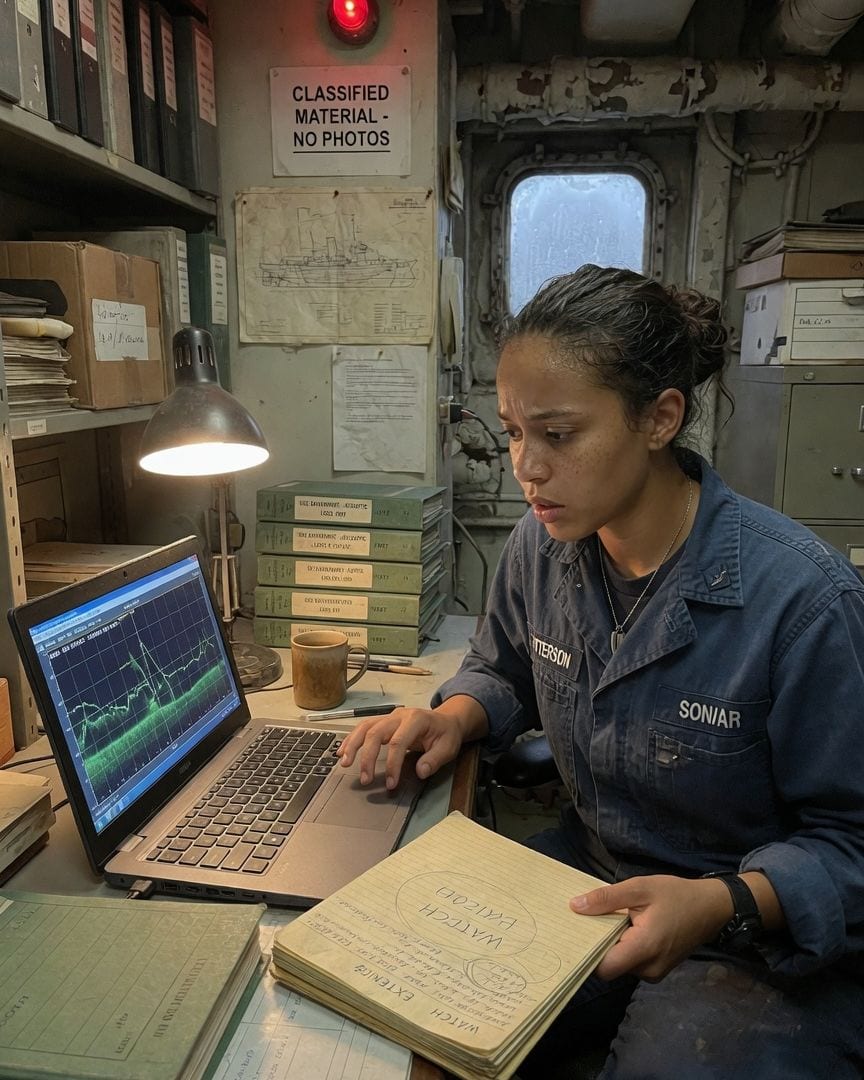
On the USS Calloway's final patrol, a sonar technician found an old log with two chilling words: 'WATCH EXTENDED.'
Sonar Technician Brooke Patterson had only two days left on the USS Calloway's last patrol, a finality that hung heavy in the humid sonar room. Through the impenetrable fog, her radar showed only empty water, but then an impossible biologic contact pinged, mimicking a vessel with eerie precision for three silent hours. It vanished at 0400, just as an identical trace had done weeks before. Searching old archives, Brooke found the precise pattern in a decades-old log from a scrapped destroyer. Scrawled next to it, in faded ink, were two words: "WATCH EXTENDED." What did those words truly mean?