First Sergeant Oliver Pryor loaded forty men for the night jump. The recovery team reported forty-one, with his own signature approving a man he'd never seen.
The red lights of the tarmac cast long, shifting shadows as First Sergeant Oliver Pryor moved down the line. Forty men, forty static lines, each chalked number confirmed with a firm tap to a helmet.
He was a creature of order, a master of counts, and this final check before the night jump was muscle memory honed over decades.
The C-130’s engines idled, a low growl beneath the desert wind, vibrating through the soles of his boots. He boarded last, the ramp closing with a hydraulic hiss, the smell of jet fuel and nervous sweat thick in the air.
Hours later, on the moonlit drop zone, the recovery team’s report crackled over the radio: “Forty-one jumpers, all present, all accounted for.” Pryor felt a cold knot tighten in his gut, a twist of pure disbelief.
He had loaded forty men onto that aircraft. The numbers were absolute, inviolable. Forty in. Forty-one out. Every name on the roster was checked off, every face, seemingly, familiar.
But the math was impossible, a fundamental violation of the laws he lived by.
Back at Outpost Alpha-7, Pryor locked himself in his office, the solitary glow of his desk lamp cutting through the pre-dawn gloom.
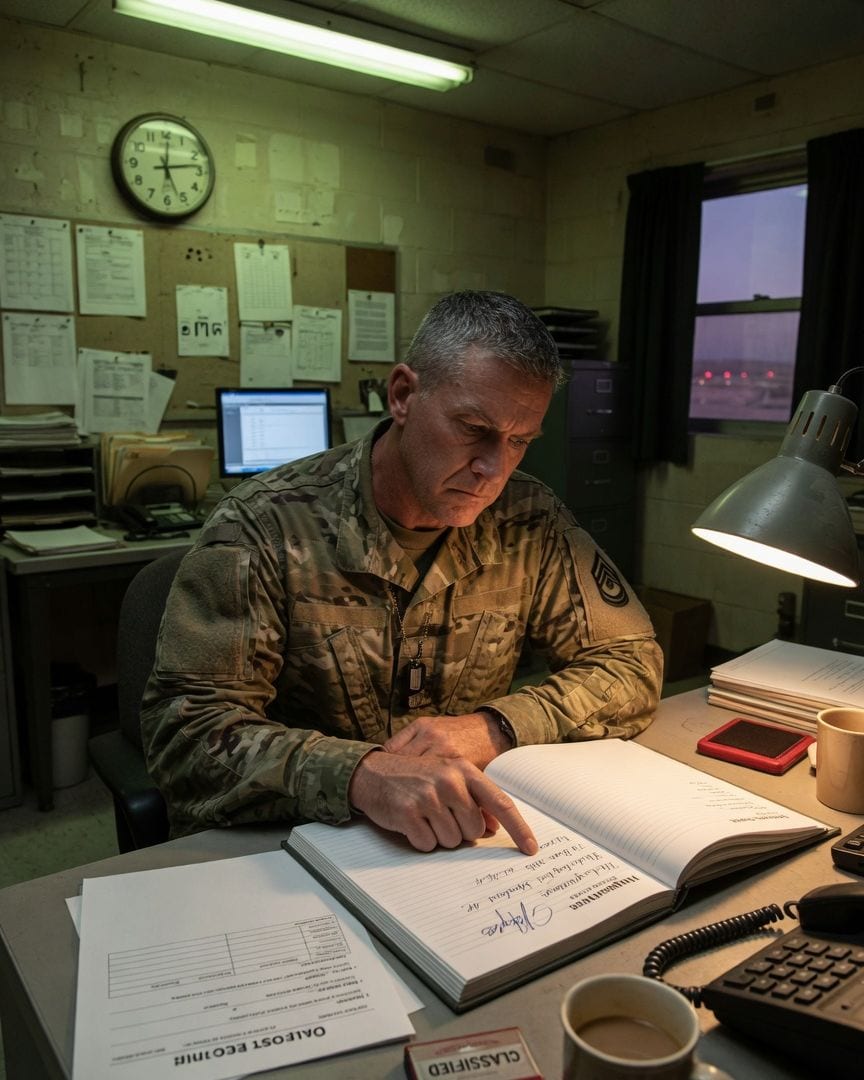
He pulled the jump manifest, the official document detailing every man on that flight, his own meticulous hand-written entries clear on its lines. He ran his finger down the list, cross-referencing it with the drop zone recovery report.
Forty names he knew, forty faces he could picture with his eyes closed. And then, at the bottom, number forty-one: ‘Hughes, Felix, Specialist.’
Pryor frowned. He didn't recognize the name. He certainly didn't remember chalking him, tapping his helmet, or seeing him board the aircraft.
Yet, beside the entry, was his own signature, clear and unwavering, approving the manifest, attesting to the presence of Specialist Hughes. It was his distinct looping 'O', his sharp 'P', an undeniable mark.
He called Sergeant Annika Larsen, his jump master, roused from a few hours of uneasy sleep. Her voice was groggy, laced with a familiar post-jump exhaustion.
“Hughes? Yeah, Specialist Hughes. Good man. Quiet, but squared away. What about him, Top?” she asked, a faint crackle of static on the line.
Pryor pressed, his voice taut with a restraint he felt slipping, “Are you certain he was on my stick, Sergeant Larsen? I don’t recall him.”
Larsen paused, a slight, almost imperceptible hesitation. The silence stretched. “He was there, Top. I saw him. Tall, dark hair. You signed him off yourself, just like everyone else.”
Pryor stared at his signature on the manifest, a perfect, official mark swearing to a reality he didn’t remember. The paperwork was unimpeachable. His own hand had attested to the impossible.
Pryor spent the next few hours in the records office, a place of meticulous order and ironclad facts, a temple to verifiable history. The fluorescent lights hummed with a low, constant drone. He requested Specialist Felix Hughes’s service record.
The clerk, a young Private with weary eyes, pulled it up on his terminal without issue. The file was immaculate. Rank: Specialist. MOS: 11B (Infantryman). Date of Entry: two months prior.
Every box filled, every detail accounted for, the digital text clean and precise. But as Pryor scrolled through, a chill snaked up his spine. There were no prior unit assignments. No previous duty stations.
No training history before his arrival at Outpost Alpha-7. It was a perfectly blank slate, yet flawlessly completed for this current deployment. It was as if Specialist Hughes had simply materialized, fully formed, into the military system.
Pryor printed the record, the paper still warm from the machine, and stared at the impossible completeness of a life that shouldn’t exist.
Pryor tried to find Specialist Hughes. For days, he walked the familiar paths of the outpost, a silent, internal tally marking each failed attempt. He checked the barracks, the mess hall, the motor pool.
Hughes was always “just left,” “on another detail,” or “in the field.” It wasn’t evasiveness, not exactly, but a constant, frustrating near-miss, a perfect absence at every point of inquiry. Pryor started asking the men. “Specialist Hughes?
Yeah, he’s around,” they’d say, a shrug. “Quiet type, keeps to himself.” No one remembered him joining the unit, no one recalled his transfer orders, but everyone agreed he’d “always been here,” a fixture, unquestioned.
Pryor felt the ground shifting beneath his feet, the firm bedrock of reality crumbling. The anomaly wasn’t just on paper; it had permeated the unit’s collective memory, a subtle rewrite of history.
He turned to the base’s digital access logs, a secure system that tracked every ID card swipe, every entry and exit. The system was infallible, a precise accounting of every soul on base.
He keyed in Hughes’s ID number, his fingers moving with practiced efficiency. The results were immediate, and chilling.
Hughes’s card showed consistent access to restricted areas – the old, decommissioned hangars that hadn’t been used in years, the forgotten tunnels beneath the main compound – always in the dead of night, always during previous night jump training rotations.
Not just the current one, but rotations from months, even years ago, long before Hughes's supposed date of entry. Pryor sat back, the screen’s blue light reflecting in his eyes, the sterile hum of the server racks filling the silence.
The pattern was undeniable. Hughes wasn’t an isolated incident; he was a symptom of something deeper, something cyclical, tied to this specific airfield and these specific operations. The digital trail was there, undeniable, yet it documented impossible movements.
The system, usually a beacon of truth, was simply recording a falsehood as fact.
Pryor’s persistent inquiries did not go unnoticed. Captain Charlotte Whitaker, his commanding officer, a woman whose calm demeanor never wavered, summoned him to her office.
Her posture was ramrod straight, her expression unreadable, her gaze holding his with an unsettling steadiness. The air in the room felt still, charged.
“First Sergeant Pryor,” she began, her voice calm, measured, “I understand you’ve been rather...thorough...in your review of personnel records. Are there any issues I should be aware of?”
Pryor outlined the discrepancy, the impossible ‘plus one,’ the perfectly blank yet meticulously filled service record. He laid out the digital access logs, the undeniable proof of Hughes’s impossible presence in past rotations.
Whitaker listened, her gaze unwavering, her hands resting flat on her polished desk. Not a muscle in her face twitched. “Clerical errors happen, First Sergeant,” she said, her voice softer now, almost a murmur. “Fatigue, perhaps. Or a prank.
Sometimes it’s best not to dig too deep into things that are, shall we say, beyond the usual scope of our duties.” Her words were a warning, thinly veiled, a chill that seeped into Pryor’s bones.
He left her office feeling a cold prickle on his neck, the air itself seeming to press in on him.
Later, back in his own office, the familiar clutter suddenly felt alien. He found his personal jump logs, years of meticulous entries, subtly altered.
Faint smudges on dates he knew he hadn't touched, an extra line item for ‘contingency personnel’ on older manifests he knew for a fact he’d never seen before, signed with a hand that mimicked his own.
He felt a profound sense of violation, a sickening invasion of his own history, his own memory. He looked up, his gaze drawn to the window, the desert landscape beyond.
Across the parade ground, near the old armory, a lone figure stood, watching. Specialist Felix Hughes. He didn't move, just stood there, a silent, unnerving sentinel, his silhouette stark against the fading light. Pryor felt his skin crawl.
He wasn’t just investigating; he was being observed, his every move noted. The hunt had turned into a vigil.
Pryor tracked down Sergeant Larsen, finding her in the supply depot, her shoulders hunched over a pile of equipment, her face drawn.
He placed the altered jump logs, the access records, and the impossible service file on the scarred wooden counter between them. “Sergeant Larsen,” he said, his voice low, controlled, “this isn’t a prank. This isn’t fatigue. This is wrong.
And you know something about it.”
Larsen avoided his gaze, her hands fidgeting with a stack of forms, the paper crinkling faintly in the sudden silence. The air in the depot felt heavy, thick with the smell of canvas and old metal. “It’s...
it’s just the way things are here, Top,” she mumbled, her voice barely a whisper, a tremor running through her. “Sometimes... sometimes we get an extra. They just... appear. Always during night jumps. Always at this airfield.”
Her eyes darted around the room, as if expecting to be overheard.
Pryor pressed, his urgency building. “What do you mean, ‘appear’? Who are they? Where do they come from?”
Larsen finally looked at him, her eyes wide with a fear Pryor recognized intimately, a fear that mirrored his own. “They’re never really from anywhere, Top. Their records are always perfect, just like Hughes’s. But they’re always an extra.
And sometimes... sometimes they stay. And sometimes, they vanish again, leaving no trace, just a blank space where they were ‘accounted for’.”
She reached under a heavy metal shelf, pulling out a worn, leather-bound logbook, its pages yellowed with age, its cover soft from countless years of handling. “My grandfather was First Sergeant here, back in the day. He kept this. Unofficial.
For things the official records couldn’t hold.” She opened it to a random page, the brittle paper crackling faintly.
Pryor saw handwritten entries, meticulous in their detail, detailing ‘plus one’ incidents, impossible names appearing on rosters, always during night operations, always at Outpost Alpha-7. The dates stretched back decades, a chilling chronicle of the unexplained.
The dread solidified in Pryor’s chest, a cold, hard stone. This wasn't a glitch. It was a pattern, a horrifying, decades-long cycle.
Pryor took the unofficial logbook, his hands trembling slightly as he turned the brittle pages. Larsen’s grandfather’s meticulous script detailed ‘plus one’ after ‘plus one,’ each entry a chilling echo of his own experience.
The names were different, the dates scattered across the decades, but the underlying impossibility was identical. He saw a ‘Specialist Ashford, D.’ in 1998, a ‘Private Sinclair, H.’ in 2005, each entry accompanied by a tally, a verification, a signature.
The pattern was monstrously clear, a slow, methodical creep across time.
And then, his eyes fell upon an entry from 2008. ‘Night Jump Exercise, 3rd Platoon. Recovery count: 31. Loaded: 30. Plus One: Specialist Quentin Sheppard.’
And beside it, neatly signed, verifying the impossible count, was a name that made his blood run cold, making the room itself feel suddenly airless: ‘Oliver Pryor, First Sergeant.’
It was his own signature, undeniably authentic, scrawled in a younger, firmer hand he recognized instantly. He remembered nothing of that deployment, nothing of being at Outpost Alpha-7 in 2008.
He was stationed stateside then, thousands of miles away, managing logistics in Fort Bragg.
The book lay open on his desk, his own name staring back at him, a horrifying testament to a past he never lived, a role he never played, yet his signature swore otherwise.
The full, monstrous shape of the pattern snapped into place, an interlocking mechanism of dread. Outpost Alpha-7 wasn’t just a training facility; it was a nexus, a thin place where the military’s rigorous system of accountability became a conduit.
The ‘plus ones’ weren’t just anomalies; they were manifestations, entities that used the absolute coherence of military records to step into existence.
They needed a First Sergeant, a man of order and counts, to verify their presence, to sign them into being, to act as the final, unimpeachable accountant of their impossible reality.
Pryor realized he hadn’t just stumbled upon a secret; he was a vital, recurring component of it.
He had been ‘Oliver Pryor, First Sergeant’ here before, in a cycle he couldn’t remember, signing off on other impossible soldiers, sealing their place in reality.
The entity didn’t just add itself; it absorbed, it replaced, it wore the skin of those who maintained the system. He was the accountant, the one who certified the impossible, and in doing so, became part of the impossible himself.
The records weren’t failing; they were being used, weaponized, to create a coherent, undeniable reality for something that should not exist. And he, Oliver Pryor, had been its most reliable tool for decades.
Pryor knew he couldn’t report this. The system was the very mechanism of the wrongness, the structure it exploited. He had to break the cycle. The next night jump was scheduled for midnight.
He sat at his desk, the official manifest open, his pen poised. He would falsify it, but in reverse.
He would make the count come up short, create a discrepancy that couldn’t be absorbed, a chaos the system couldn’t reconcile, a tear in its perfect fabric. He started to erase names, to alter numbers, his hand shaking slightly.
As his hand moved, a shadow fell across the desk, cold and complete, eclipsing the dim light of his lamp.
Specialist Felix Hughes stood behind him, silent, unmoving. Hughes’s face was calm, his eyes holding a depth that was both ancient and utterly familiar, a profound recognition that mirrored the entries in the logbook.
There was no menace, no threat, just an unnerving certainty, a quiet, inexorable force. Pryor felt a wave of profound dread wash over him, a chilling sense of déjà vu, of having played this exact scene countless times before.
He looked at Hughes, and in the Specialist’s eyes, he saw a faint reflection of his own, but subtly wrong, too still, too knowing, a stranger looking back.
He felt his own identity begin to fray, the edges of his self blurring, his memories of his life outside Outpost Alpha-7 becoming distant, unreal, like dreams fading upon waking.
He was Oliver Pryor, First Sergeant, but he was also the accountant, the verifier, the one who had always been here. A cold hand, not quite his own, reached out and smoothly took the pen from his trembling fingers.
Hughes’s gaze held his, and Pryor felt a profound, horrifying acceptance settle over him, a sense of belonging in the impossible. The pen moved, correcting the manifest, making the count whole, making it perfect.
His hand, or a hand, signed his name, Oliver Pryor, First Sergeant, beneath the list of exactly forty-one jumpers.
The next morning, Captain Charlotte Whitaker found the jump manifest in First Sergeant Pryor’s office, meticulously corrected. The count was exactly forty-one. Specialist Felix Hughes was listed, present and accounted for. There were no further questions, no inquiries into discrepancies.
The incident of the ‘plus one’ was never mentioned again. The base continued its operations under the pale desert sun, its routines undisturbed, its hum of activity a comforting blanket.
Life at Outpost Alpha-7 settled back into its familiar, orderly rhythm, every man, every record, perfectly in place.
Sergeant Annika Larsen watched First Sergeant Oliver Pryor oversee the morning formation. He moved with his usual precision, his uniform immaculate, his commands sharp and clear, cutting through the morning air.
But there was a subtle shift in his eyes, a calmness that wasn’t there before, a profound lack of the familiar spark of concern or the underlying tension that had always defined him.
He nodded to her as he passed, a faint, almost imperceptible smile on his lips, a gesture that felt oddly complete. She didn’t return it. His gaze was too steady, too complete.
First Sergeant Oliver Pryor continued his duties at Outpost Alpha-7, his presence a cornerstone of its operations. He was always present, always accounted for.
If this one got to you
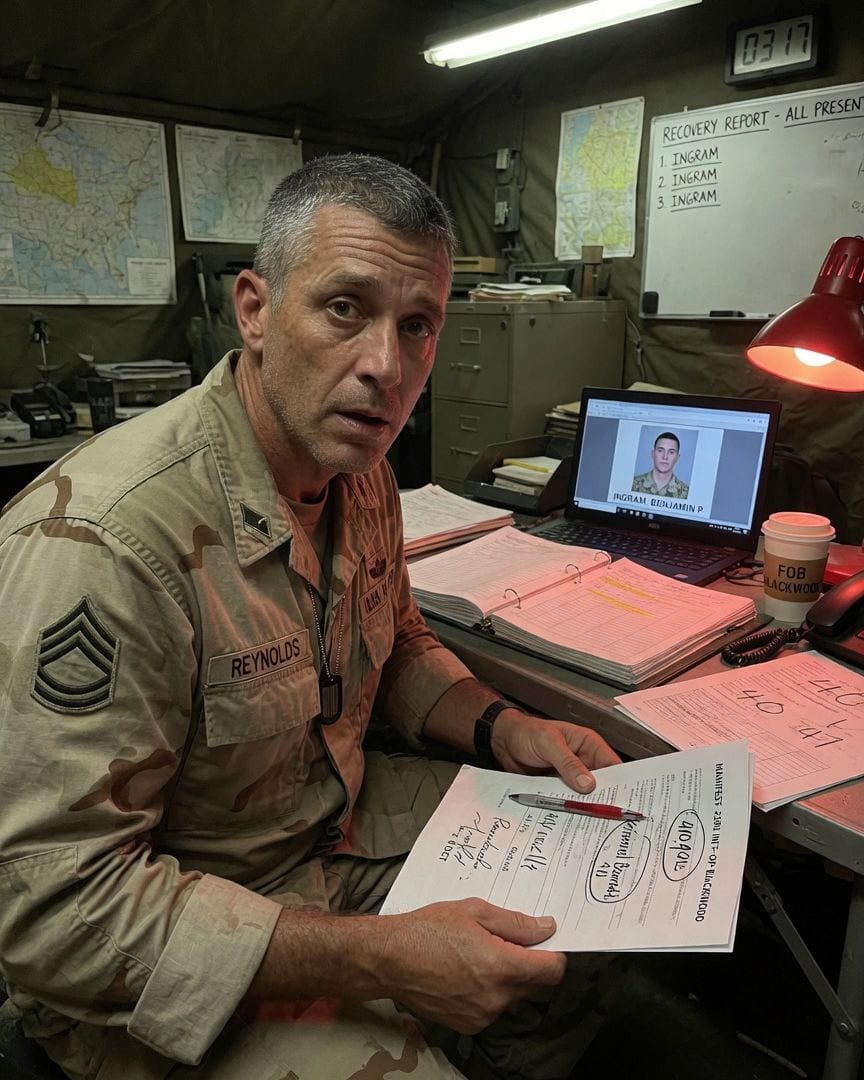
First Sergeant Reynolds counted forty men onto the plane. His own signed manifest now read forty-one.
First Sergeant Dean Reynolds stood sentinel on the red-lit tarmac of FOB Blackwood, the desert wind tugging at his uniform as he personally counted every man boarding the C-130. His responsibility was ironclad: forty jumpers, all present, all accounted for. He watched the last man board before the massive aircraft lifted into the vast night. Hours later, in the tactical operations center, the radio crackled with an impossible report: forty-one personnel had been recovered. Reynolds, who had counted only forty men onto that plane, felt a cold knot tighten. All paperwork, including a manifest signed by his own hand, now confirmed the impossible tally of forty-one.
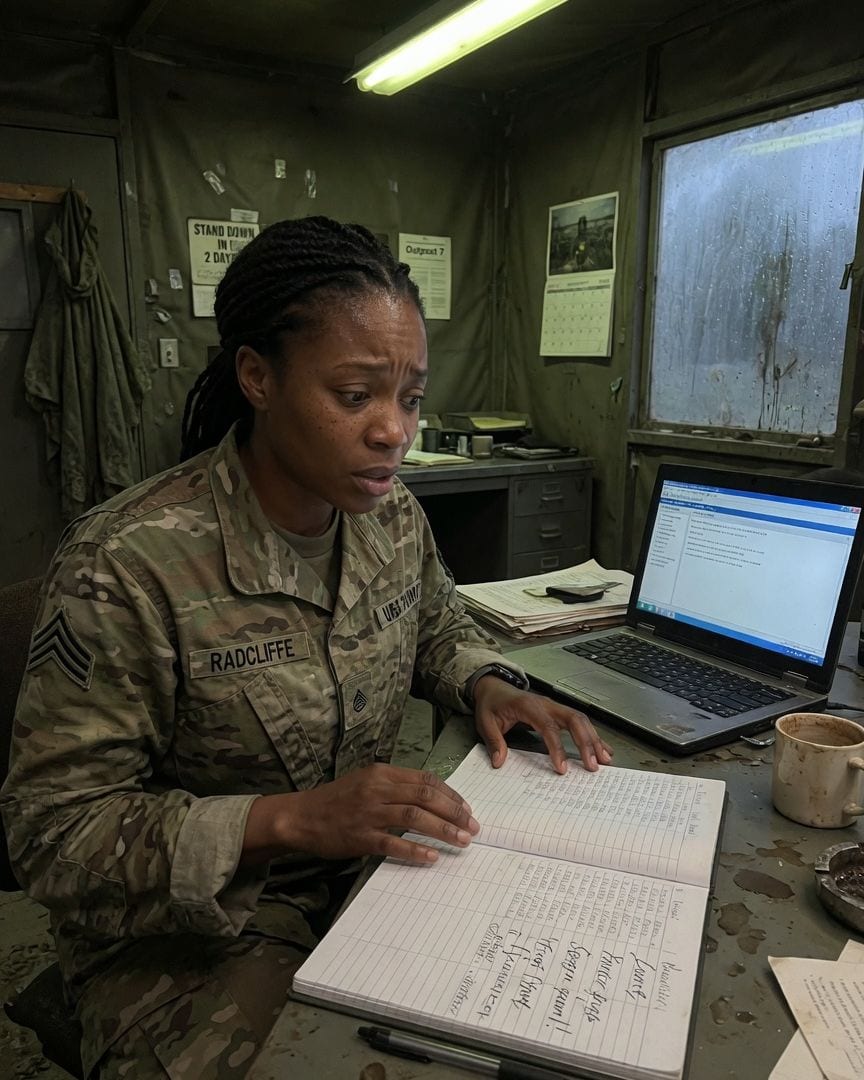
Two days before Outpost 7 closed, Staff Sergeant Radcliffe's roll call counted 42 men, but 43 voices answered.
Two days before Outpost 7 was set to stand down for good, Company First Sergeant Nora Radcliffe conducted her morning roll call. For three years, she had known all forty-two faces and voices by heart, but in the damp dawn air, a forty-third voice answered to a name not on her list. Back in her office, she found that same impossible name, 'Everett Lawson,' added to the official duty log in her own unmistakable handwriting. As the fluorescent lights hummed, her search of the digital personnel system revealed a skeletal record for Lawson, complete with a basic training certificate signed by her training officer—who had retired a decade before the certificate's date. What impossible truth had Nora stumbled upon as her outpost prepared to close?
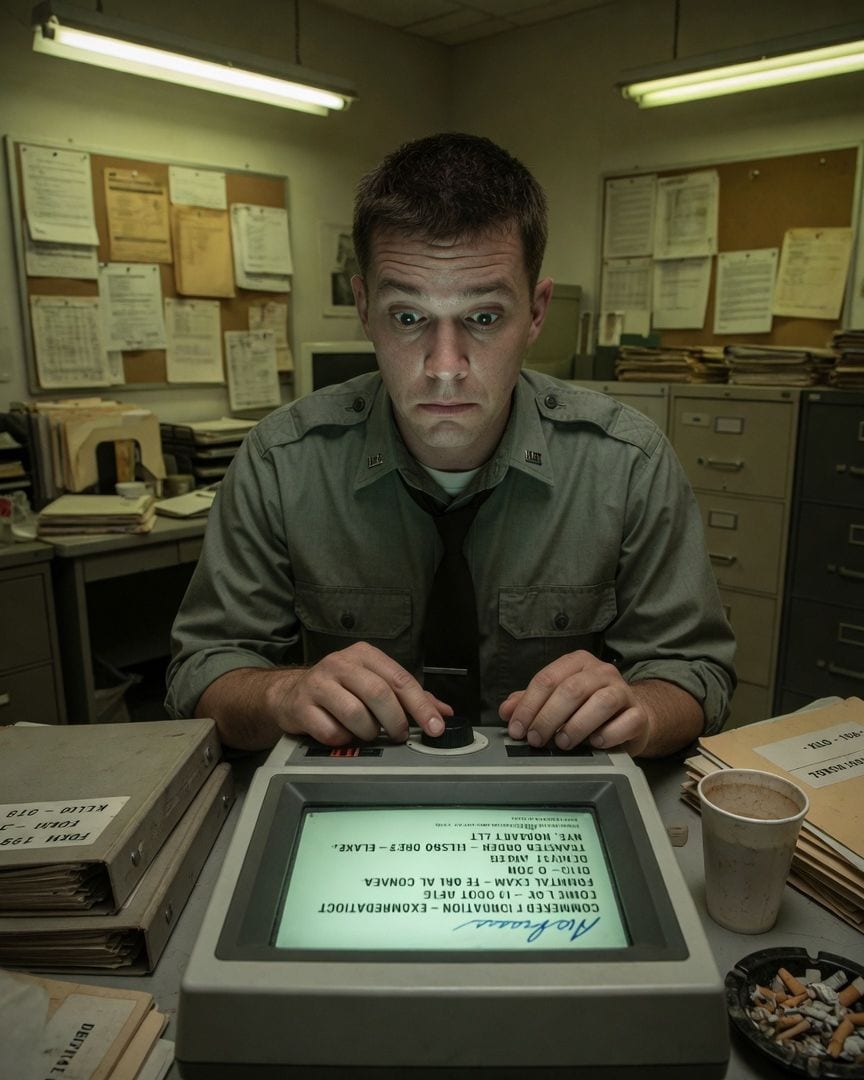
A missile commander watched his ten nuclear silos go dark. His own service record shows his signature on a future he's never lived.
Second Lieutenant Hobart Nye, a missile commander in Wyoming, had his quiet 0247 watch shattered by a security report: a massive, silent black triangle hovered over Launch Facility Kilo, casting a perfect shadow. Hobart watched his console's fault panel light up, signaling all ten nuclear missiles going dark in an impossible silence, followed by eleven minutes his security team could not remember. Official logs called it a "radio malfunction," but Hobart found a requisition for invisible-tracking sensors, signed by a base commander who was supposed to be off-base. The final, chilling discovery came when his own service record showed new entries—a dental check-up, a transfer to Alaska—all dated for a future he never lived, complete with his perfectly replicated signature.
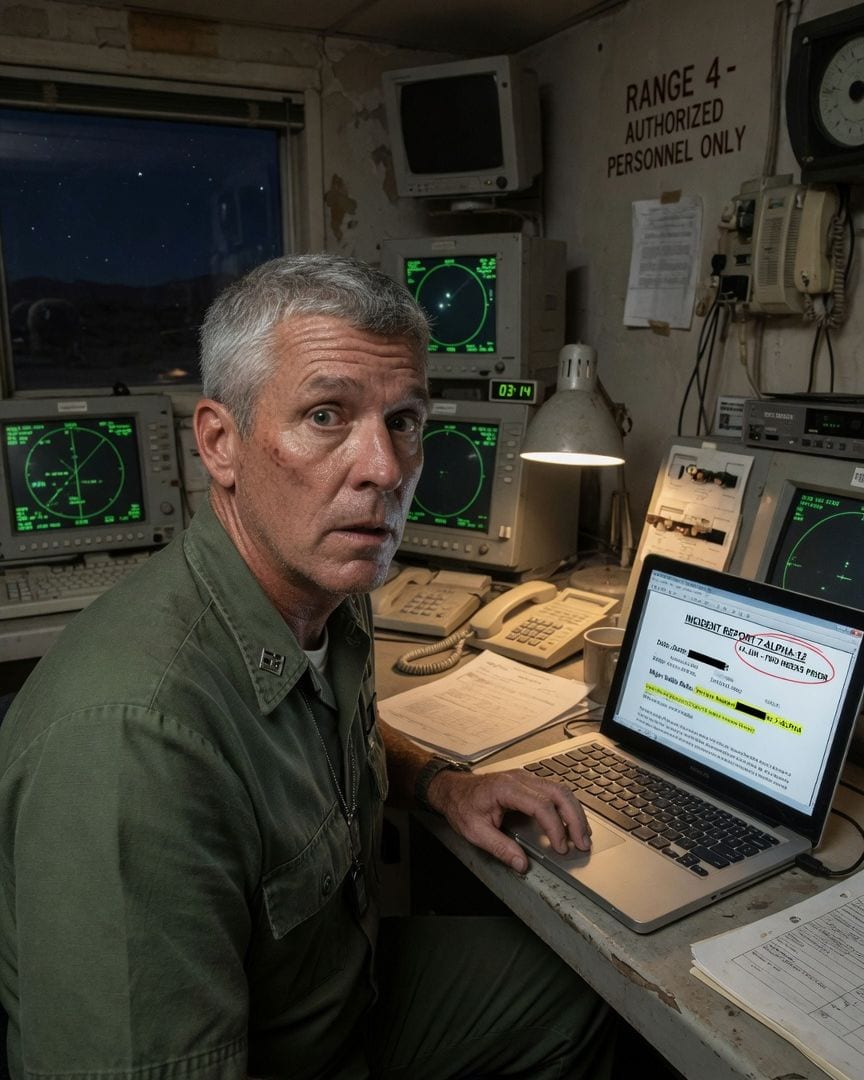
Major Hollis Rake, two weeks from retirement, reported a silent desert disc. His own report was already filed, dated two weeks before it appeared.
Major Hollis Rake, just two weeks from retirement after thirty-five years on a New Mexico desert range, found his predictable world upended. A silent, featureless disc, defying all known phenomena, appeared over the sled rail, its impossible presence confirmed by every instrument on the range. But the true unease began when Major Rake filed his meticulous incident report: it was already in the system, dated two weeks *before* the event even happened. His own name and service number were later found linked to the incident's code in his transfer disposition. Was his retirement just a clerical error, or something far more sinister?
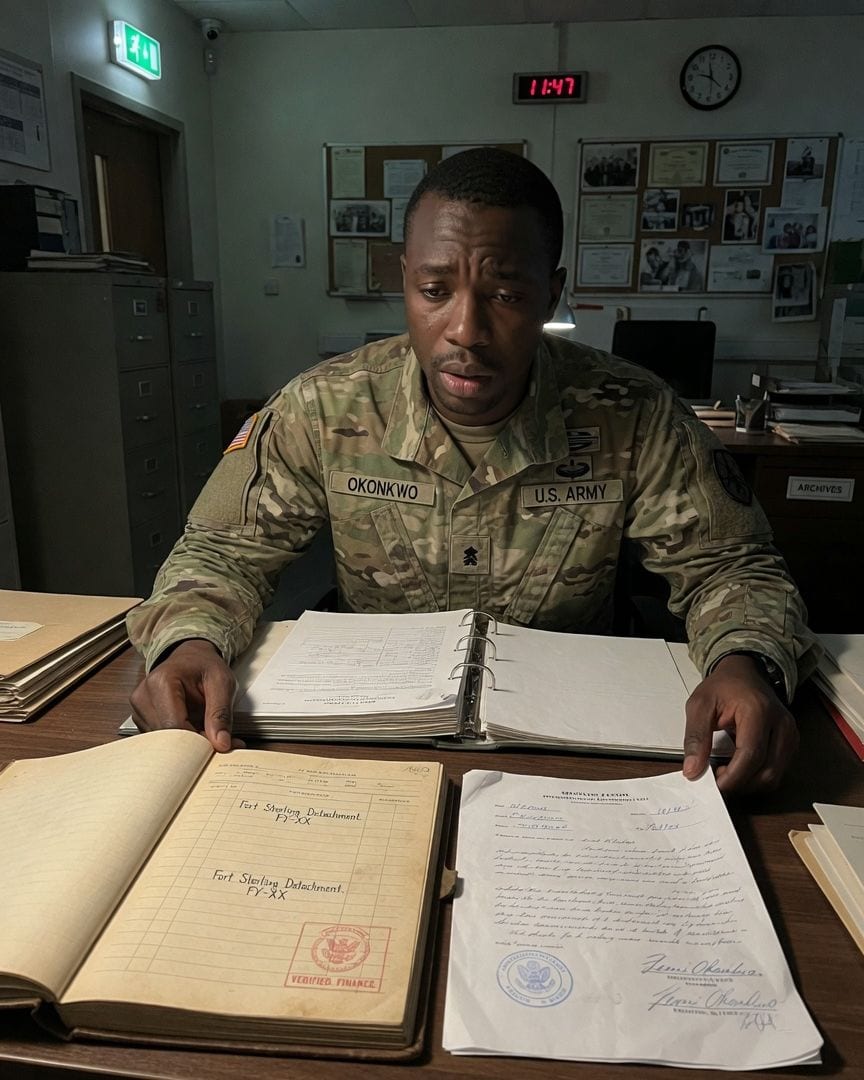
An old deployment ledger bore Specialist Femi Okonkwo's name, but the elegant signature was not his own.
Specialist Femi Okonkwo, an Air Force cargo hauler, stared at an earnings statement that contradicted his entire four-year enlistment. It listed nine months of jump pay and a mountain duty station in Colorado—places he’d never been, operations he’d never completed. Finance and HR records, seemingly impeccable, confirmed every detail of his impossible deployment. But when Femi finally retrieved the physical sign-in ledger, the faded blue ink of his supposed signature revealed the true, chilling discrepancy: the neat, elegant hand on the official document was unequivocally not his own. Who signed for Specialist Okonkwo’s impossible deployment, and why was it so meticulously verified?
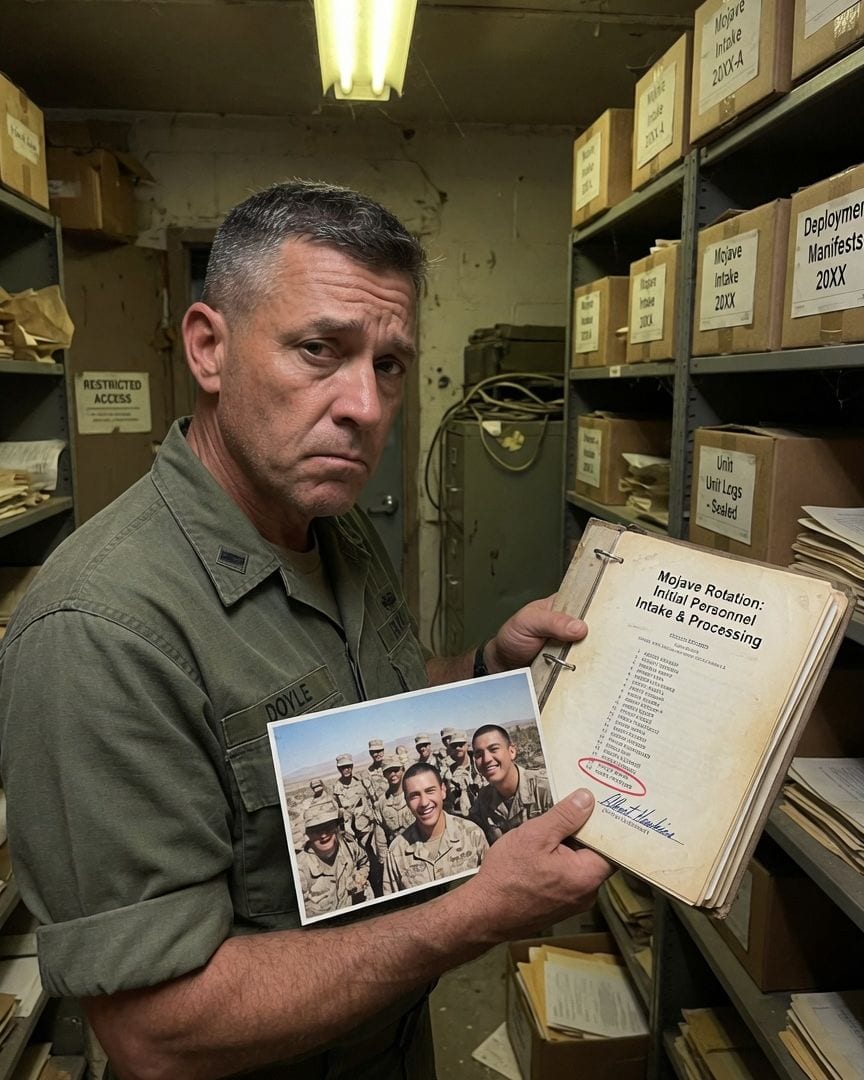
Master Sergeant Doyle's old platoon photo showed 31 men. But between Suggs and Ramos, a 32nd man stood grinning, named on Doyle's own signed manifest.
Master Sergeant Vincent Doyle was packing away twenty-five years of service, each box holding memories of the men he'd led. He paused at a faded platoon photo from the Mojave, a familiar thirty-one faces staring back. But then, a thirty-second man, Albert Hawkins, stood grinning between two of his men, a face Doyle couldn't place. His memory, usually perfect, insisted only thirty-one were there. Despite his colleagues recognizing the name, their own recollections dissolved, pushing Doyle to scour every record he'd personally signed – each one confirming thirty-one men, until he opened the very first intake manifest, bearing his signature, listing thirty-two.