First Sergeant Reynolds counted forty men onto the plane. His own signed manifest now read forty-one.
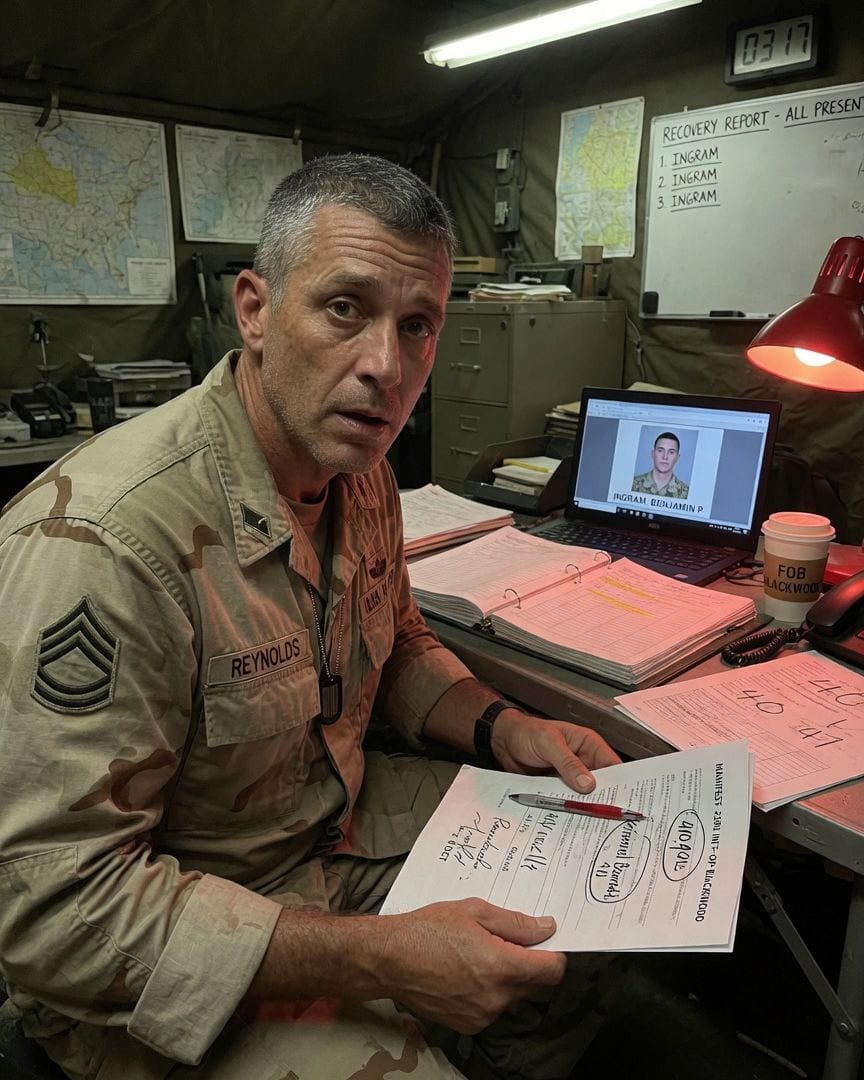
The roar of the C-130 was a physical presence on the red-lit tarmac of FOB Blackwood.
First Sergeant Dean Reynolds stood sentinel, the desert wind tugging at his uniform, as he personally counted every man, every static line, every chalk number. Forty jumpers, all present, all accounted for.
He watched the last man board, the ramp hiss shut, and the massive aircraft lift into the night sky, its engines a fading rumble against the vast, star-peppered canvas.
Hours later, back in the tactical operations center, the radio crackled with the drop zone recovery report. Forty-one personnel, all present, all accounted for by name and roster number. Reynolds froze, his hand hovering over the duty log.
He had loaded forty men onto that aircraft. He had seen them with his own eyes. The drop zone had just handed him back one more than he’d put on.
The number echoed in the quiet air of the ops center, an impossible whisper against the metallic tang of coffee and stale sweat.
Reynolds immediately ordered a recount and cross-referenced the manifests. Sergeant Greg Lockwood, his junior NCO, double-checked the roster on the terminal, his brow furrowed in concentration. "Sir, it's right here. Private Benjamin Ingram, 23rd Infantry. Checked in, chalked, manifested.
He's on the recovery list, clean."
Reynolds snatched the printout. Ingram’s name was indeed there, tucked between Private First Class Jenkins and Specialist Khan. He remembered Jenkins. He remembered Khan. He did not remember Ingram.
Not his face, not his name, not a single detail of him getting on that plane. He pulled the original load plan, the pre-jump roster he’d signed himself. Forty names. Clear as day. Forty slots, forty bodies.
He tried to rationalize it—fatigue, the late hour, a momentary lapse, a last-minute addition he’d missed in the pre-jump chaos. But the image of forty men, the exact number, burned in his mind, immutable and sharp.
He pulled the master personnel file for the FOB. There was a file for Ingram, complete with service number, enlistment date, and a recent photo. All perfectly in order.
He even located the hard copy of the jump manifest, the one signed by every jumper as they boarded, and finally, by him, First Sergeant Dean Reynolds, certifying the load.
He found Private Benjamin Ingram's signature, neat and legible, right where it should be. But then, beneath the long list of jumpers, he saw the total: 'Personnel Boarded: 41.'
Reynolds stared at the line. 'Personnel Boarded: 41.' His own signature, bold and undeniable, sealed beneath the impossible tally. The date, the time, his rank, all perfectly aligned, a testament to his own diligence.
It wasn't a clerical error; it was an official record, witnessed and approved by his own hand, stating a fact he knew, with every fiber of his being, did not happen.
He felt a cold knot tighten in his gut, a sickening certainty blooming in his chest. The paper, the unimpeachable, ironclad military paperwork, was lying. And he was the one who vouched for it.
The next morning, First Sergeant Reynolds began his own quiet investigation, starting with Private Ingram. He pulled Ingram's full service record from Specialist Vera Romano, the administrative clerk whose desk was piled high with decommissioning paperwork.
Romano, a meticulous young woman with glasses perpetually sliding down her nose, found everything in order. "He's a new transfer, First Sergeant. Just arrived last week, assigned to B Company. All his paperwork is here."
Reynolds remembered no such transfer. He checked the incoming transfer logs for the past month. Ingram's name was there, logged by a different clerk, Sergeant Miller, who had rotated out two days prior as FOB Blackwood’s decommissioning accelerated.
Reynolds spoke to the men in B Company. No one seemed to know Ingram well, or recall him before the jump. They acknowledged his presence, but their descriptions were vague, almost generic. "Quiet guy, sir." "Kept to himself." "New blood."
It was as if Ingram had always been there, yet left no impression, no distinct memory in anyone's mind.
Reynolds visited the barracks. Ingram's bunk was perfectly made, his gear stowed. He found a small, unmarked journal tucked under his pillow.
Inside, in neat, precise handwriting, were entries about daily routines, training schedules, and small observations, but nothing personal, nothing that spoke of a life before FOB Blackwood.
The entries were dated only since his 'transfer' last week, mirroring the official record. Reynolds felt a growing unease. Every official record, every physical trace, confirmed Ingram’s presence.
But the absence of any prior memory, any personal history, any real human imprint, screamed otherwise.
He requested access to the FOB's secure network logs, specifically for incoming personnel. Specialist Romano, after some hesitation, granted him limited access. The logs showed Ingram's data packet arriving, clean and complete, from a classified server.
No originating base, no previous assignment details, just 'CLASSIFIED TRANSFER – PROJECT ECHO'.
The mention of 'Project Echo' sent a chill down Reynolds' spine. He tried to access the Project Echo files, but his clearance was insufficient. He knew he was pushing boundaries, venturing into territory that felt both forbidden and dangerous.
That afternoon, Colonel Catherine Bennett called him into her office. Her face was calm, almost serene, framed by short, graying hair, but her eyes, deep-set and unblinking, held an unnerving depth.
The air conditioning in her office hissed, a faint, almost imperceptible whisper, like a quiet warning. "First Sergeant Reynolds," she began, her voice even, "I understand you're taking a keen interest in Private Ingram's transfer."
Reynolds explained his discrepancy, the forty men versus forty-one, the impossible manifest. Bennett listened, her gaze unblinking. "A common issue with transfers from highly sensitive units, First Sergeant. Sometimes, records are... streamlined. To protect operational security."
Her explanation was too smooth, too practiced, like a line rehearsed countless times.
"With all due respect, Ma'am," Reynolds said, the words tasting like ash, "my signature is on a document I know is false."
Bennett leaned forward slightly, her posture remaining perfectly composed. "Your dedication to accuracy is commendable, First Sergeant. But some things are beyond the scope of a field NCO's purview. FOB Blackwood is decommissioning. Focus on the mission.
Do not chase ghosts." The implied warning was clear, the words delivered with the quiet authority of someone who did not need to raise her voice to be understood.
As Reynolds left her office, the cold dread sharpening, he noticed a new, unfamiliar Humvee parked near the command building. Its windows were tinted dark.
Later, he caught a glimpse of Sergeant Lockwood talking to an unfamiliar officer in plain clothes, leaning against the vehicle. Lockwood looked uneasy, his shoulders hunched. Reynolds realized his 'quiet' investigation had been noticed, and he was now being watched.
The dread intensified, becoming personal. He wasn't just investigating a discrepancy; he was uncovering something someone wanted buried, and they knew he was digging.
That night, Reynolds approached Sergeant Lockwood, who looked visibly strained, almost haggard, under the fluorescent lights of the NCO lounge. "Lockwood, I need to talk to you."
Lockwood's eyes darted around the empty room. "Sir, I can't talk about this."
Reynolds pressed him, lowering his voice. "Lockwood, you're a good NCO. You saw the manifest. You know something's wrong."
Lockwood hesitated, then finally let out a frustrated sigh. "They... they debriefed me. Asked about Ingram. Asked about you." He lowered his voice further, almost to a whisper. "That officer, Captain Davies, he said some transfers are 'special.'
Not to question the paperwork. Said it was above my pay grade."
"Did they mention 'Project Echo'?" Reynolds asked, his voice tight.
Lockwood's eyes widened, a flicker of pure fear in them. "You saw that? Sir, I don't know anything about that. They just said to clear the logs if it came up.
Said it was a sensitive designation, not to be archived." The evasions, the fear in Lockwood's eyes, confirmed it wasn't a simple clerical error. This was something deep, something managed with institutional coldness.
Reynolds decided to confront Colonel Bennett directly again, but this time, he'd be prepared.
He managed to gain brief, unauthorized access to the FOB's main server room, bypassing the logs for a few precious minutes, the hum of the machines a low, thrumming presence around him.
He found a secure, encrypted subdirectory labeled 'Project Echo – Historical Archives.' His heart hammered against his ribs as he used a brute-force script he'd once learned for a training exercise, the screen flickering through lines of code.
The directory opened. Inside were thousands of files, all marked 'CONFIDENTIAL – EYES ONLY.' He saw personnel files, operational reports, incident summaries. He clicked on a random file.
It was a service record for a Private First Class from the Vietnam era, dated 1968, marked with a small, chilling addendum: 'Subject processed, 1968. Original eliminated. Duplicate deployed.'
Reynolds felt a wave of nausea, cold and acidic, rise in his throat. He understood now. Ingram wasn't an extra; he was a duplicate. And the military had been doing this for decades.
He scrolled through more files, the horrifying pattern repeating. Names, dates, 'original eliminated,' 'duplicate deployed.' The 'records that swear otherwise' were the institutional lie, the system designed to normalize the impossible.
The manifest with 41 names, his own signature on it, wasn't a mistake; it was the system retroactively accounting for a 'failed' duplication, an extra that shouldn't exist.
Reynolds continued scrolling through the 'Project Echo' archives, the implications growing colder with each file. He saw incidents, dates, names, all pointing to a clandestine, decades-long operation that twisted the very fabric of identity.
The server room, once a sanctuary of ordered information, now felt like a mausoleum of stolen lives. Then, his eyes snagged on a file from much more recently, a 'Flagged Personnel' list, dated just after his own enlistment.
He clicked it open.
The document was a roster of individuals marked for 'special processing,' a chilling euphemism he now understood in stark, horrifying clarity.
He scanned the names, a growing sense of dread building in his chest, until he reached an entry that made his blood run cold.
'Reynolds, Dean. First Sergeant.'
His own name, his rank, precisely as it was now, listed on a document from decades ago, marked for Project Echo's 'special processing.'
The date on the file was long before his current assignment, long before he even became a First Sergeant. He stared at it, the screen's glow reflecting in his wide, disbelieving eyes.
His breath hitched, a sharp, ragged sound in the quiet room. The air grew thick, the silence of the server room pressing in, heavy and suffocating.
He wasn't just investigating the system; he was a part of it, had always been a part of it. The record swore otherwise, but this new record swore something far worse, twisting his entire reality into a horrific question mark.
The next morning, Reynolds walked into Colonel Bennett's office, the weight of the previous night's discovery heavy on him. The air in the office was still, almost too still, like a held breath.
"Colonel," he began, his voice strained, "I accessed the Project Echo archives. I saw the 'Flagged Personnel' list."
Bennett didn't flinch. Not a flicker of surprise or alarm crossed her serene face. She simply gestured to the chair opposite her desk. "I assumed you would, First Sergeant. You're a thorough man."
Her calm was terrifying, a polished surface over an abyss.
"My name was on that list, Ma'am. Decades ago."
Bennett nodded slowly, her gaze steady. "Project Echo is designed for continuity, First Sergeant. For certain roles, certain individuals, it ensures... loyalty. Compliance. A measure of control over sensitive assets."
She opened a secure drawer in her desk and pulled out a slim, leather-bound ledger, its cover worn smooth with age. "The original Dean Reynolds was flagged after a particularly sensitive mission.
His service record, as you know it, continues seamlessly. His duplicate was activated, and deployed."
Reynolds felt a dizzying disconnect, a cold chasm opening in his perception of self. "So... I'm the duplicate?"
Bennett offered a faint, almost pitying smile. "You are the current iteration, First Sergeant. You have served with distinction. An exemplary record." She slid the ledger across the desk.
It was full of meticulously recorded names, dates, terse entries: 'original eliminated,' 'duplicate activated.' It went back to the late 1960s, a chilling chronicle of replaced lives.
"Private Ingram," Bennett continued, her voice never wavering, "was an anomaly. A duplicate activated without the corresponding 'original elimination.' A system glitch. We were preparing to rectify it." The puzzle pieces slammed into place with horrifying coherence.
The impossible manifest, the vague memories of Ingram, his own name on the old roster—it all fit.
The institution's records, finally obtained, stated it plainly in black and white: this program was decades old, and it had known about him since before he even knew himself.
Reynolds pushed the ledger back across the desk. His hands trembled, not from fear, but from the unbearable weight of a stolen past. "And what happens to a 'failed' duplicate, Colonel? Or one who discovers the truth?"
Bennett's faint smile vanished, replaced by an expression of professional gravity. "You are a highly valued asset, First Sergeant. But awareness is... problematic. It compromises your compliance. It disrupts the continuity we strive for."
She stood, walking to a secure terminal on her desk, its screen glowing with a soft, ominous light. "Project Echo has safeguards."
On the screen, a new file loaded. It was a transfer order. For Dean Reynolds. Not to a less active role, but to a 'Special Oversight and Integration Unit' at a classified facility.
A lifetime assignment, with no possibility of communication outside. Reynolds felt a cold dread settle deep in his bones. He was not escaping. He was being re-absorbed, his 'awareness' neutralized.
He tried to stand, to protest, but a subtle, almost imperceptible tremor ran through his limbs. A sense of profound weariness, an overwhelming calm, began to seep into him, like a tide pulling him under.
The hum of the terminal seemed to grow louder, filling the room, vibrating in his very bones.
He looked at Colonel Bennett, her face impassive, a perfect mask of control. He knew what was happening. He was being 'processed' again. The unique flicker of self, the 'glitch' of awareness, was being systematically erased.
He was watching himself dissolve, not into death, but into perfect, unthinking compliance. He was being taken, hollowed out, made whole again, but not himself. His mind, still fighting, still aware, screamed against the inevitable.
But his body, his very being, was already submitting, a silent, terrible surrender. He felt a profound sense of loss, not for his life, but for the self that was slowly, inexorably, being extinguished.
A week later, FOB Blackwood was officially decommissioned. The last of the personnel transferred out, the buildings secured, the desert slowly reclaiming its own.
Colonel Catherine Bennett oversaw the final procedures with her usual efficient calm, her gaze sweeping over the empty parade grounds.
Sergeant Greg Lockwood, looking noticeably relieved, boarded a transport plane, headed for his new assignment, a faint smile on his face. No one mentioned First Sergeant Dean Reynolds. His transfer orders were clean, his record updated.
He was now at a classified facility, fulfilling his new 'special oversight' role, a perfect, compliant soldier once more.
The incident with Private Benjamin Ingram was logged as a 'clerical error rectified,' the original manifest digitally scrubbed, replaced with the 'corrected' version showing forty men.
Months later, in a quiet suburban home, a woman received a letter. It was from the Department of Defense, informing her that her husband, First Sergeant Dean Reynolds, had been reassigned to a highly classified, long-term project.
He would be unable to communicate for the foreseeable future, but was well and serving with distinction. She read the letter again, a familiar ache in her chest. She missed him.
The next morning, she noticed the mail again. Another letter. Identical to the first. She opened it, her brow furrowed. The same words, the same official seal, the same signature. She looked at the date. It was yesterday's date.
She opened the mailbox again, an unsettling feeling rising in her. Inside, was another letter, identical, dated today. She pulled it out, her hand trembling.
She looked at the house, a quiet sense of dread settling over her, wondering how many more would arrive, each one swearing that he was gone.
If this one got to you
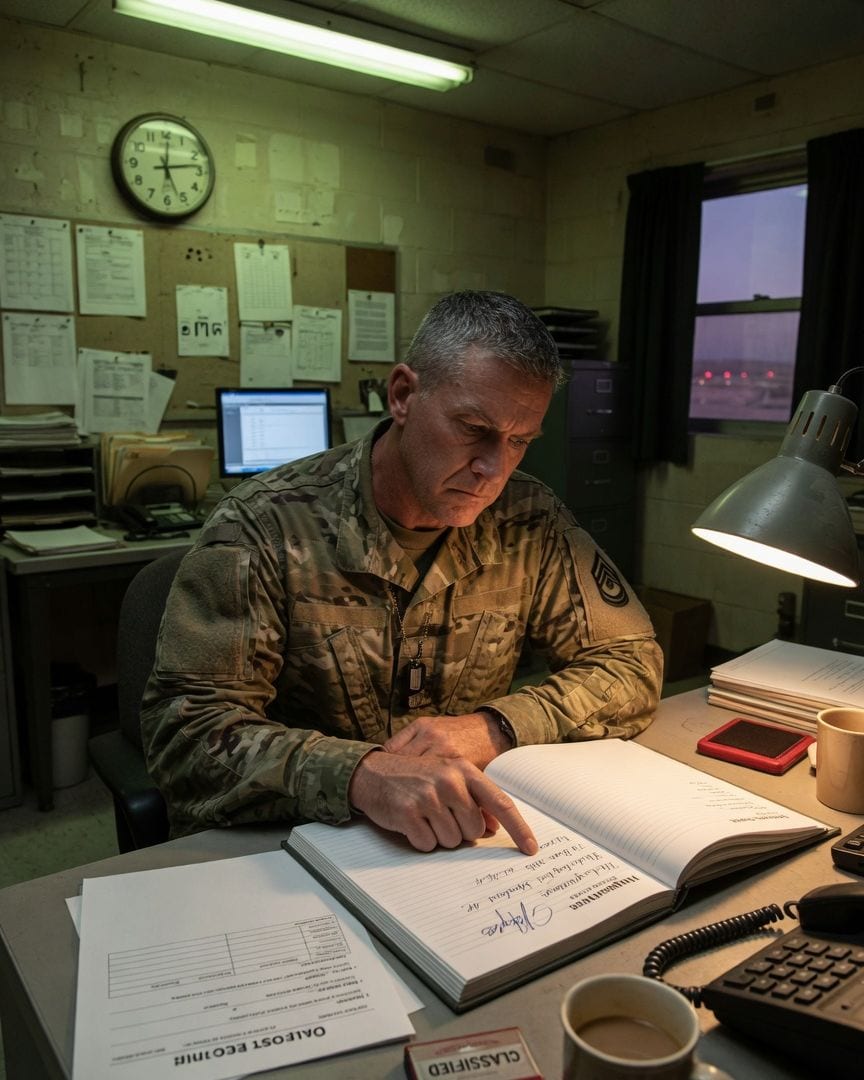
First Sergeant Oliver Pryor loaded forty men for the night jump. The recovery team reported forty-one, with his own signature approving a man he'd never seen.
First Sergeant Oliver Pryor, a creature of order, meticulously conducted his final check of forty men for a crucial night jump. As the C-130's engines growled under the desert moon, he ensured every detail was perfect. Hours later, a cold knot tightened in his gut when the recovery team reported forty-one jumpers were present and accounted for. Pryor then found his own undeniable signature on the manifest for a Specialist Felix Hughes, a man he couldn't recall, whose service record was flawlessly complete yet blank before his arrival at the outpost. How could an extra man appear, vouched for by his own hand?
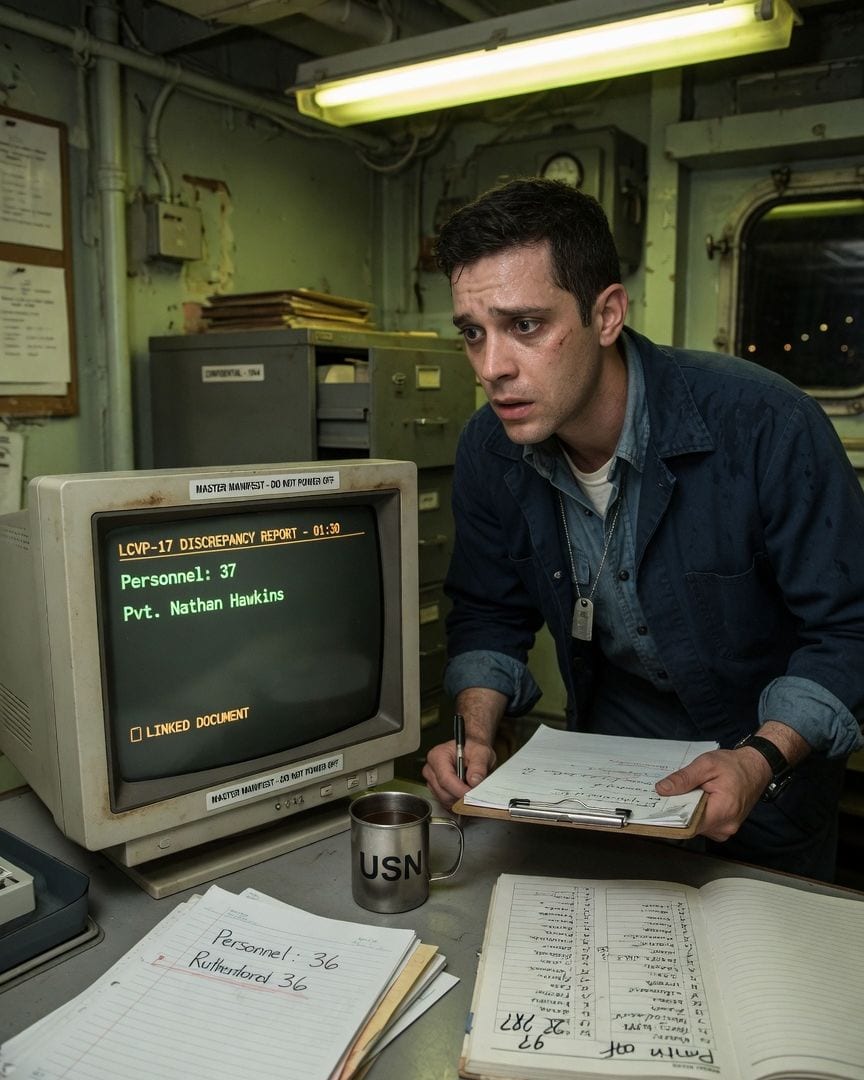
Coxswain's Mate Rutherford counted thirty-seven men in his landing craft, but the manifest logged only thirty-six. A hidden report, filed hours before, named Private Nathan Hawkins.
Coxswain's Mate Donald Rutherford, 28, began his final count for a standard load of thirty-six men in LCVP-17, the salty spray stinging his eyes. Halfway to the beach, a violent wave slammed the craft, throwing the men against each other. When the vessel settled, Rutherford instinctively recounted, his heart knocking against his ribs. This time, his count came back thirty-seven bodies crowded into the small boat. Official logs confirmed only thirty-six men, yet a hidden report, dated hours before his deployment, listed an extra man by name: Private Nathan Hawkins.
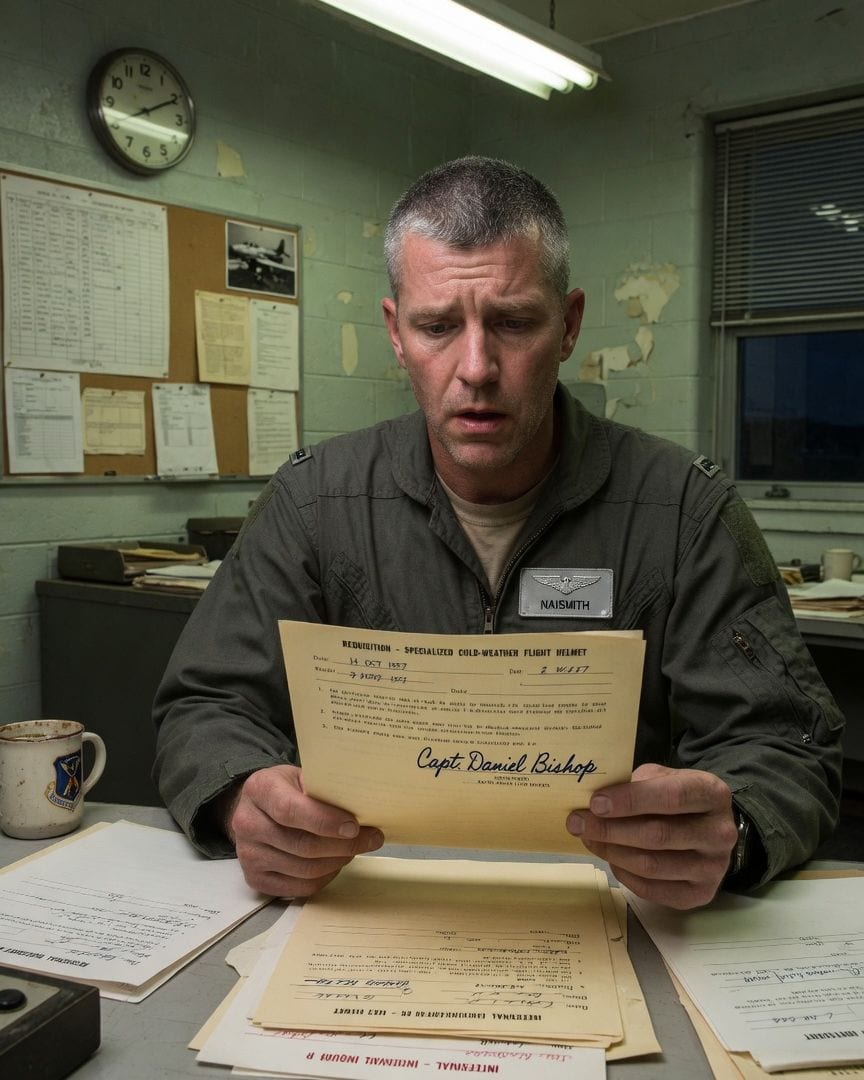
A Cold War Colonel reviews a missing pilot's file and finds Captain Bishop's signature on a form dated weeks after he vanished.
Colonel Ward Naismith faced the grim task of reviewing Captain Daniel Bishop’s personnel file, a routine chore for a man listed as Missing in Action. Bishop had vanished days after he and Naismith chased an impossible, silent disc over Lake Superior, leaving only an empty patch of air and a knot of unease in Ward's gut. Sifting through commendations, Ward found a requisition for flight gear and a maintenance sign-off, both dated *after* Bishop’s disappearance. The true chill came with the requisition for a specialized flight helmet, bearing Captain Bishop’s unmistakable signature, weeks after he was presumed lost. How could a man presumed lost have signed anything?
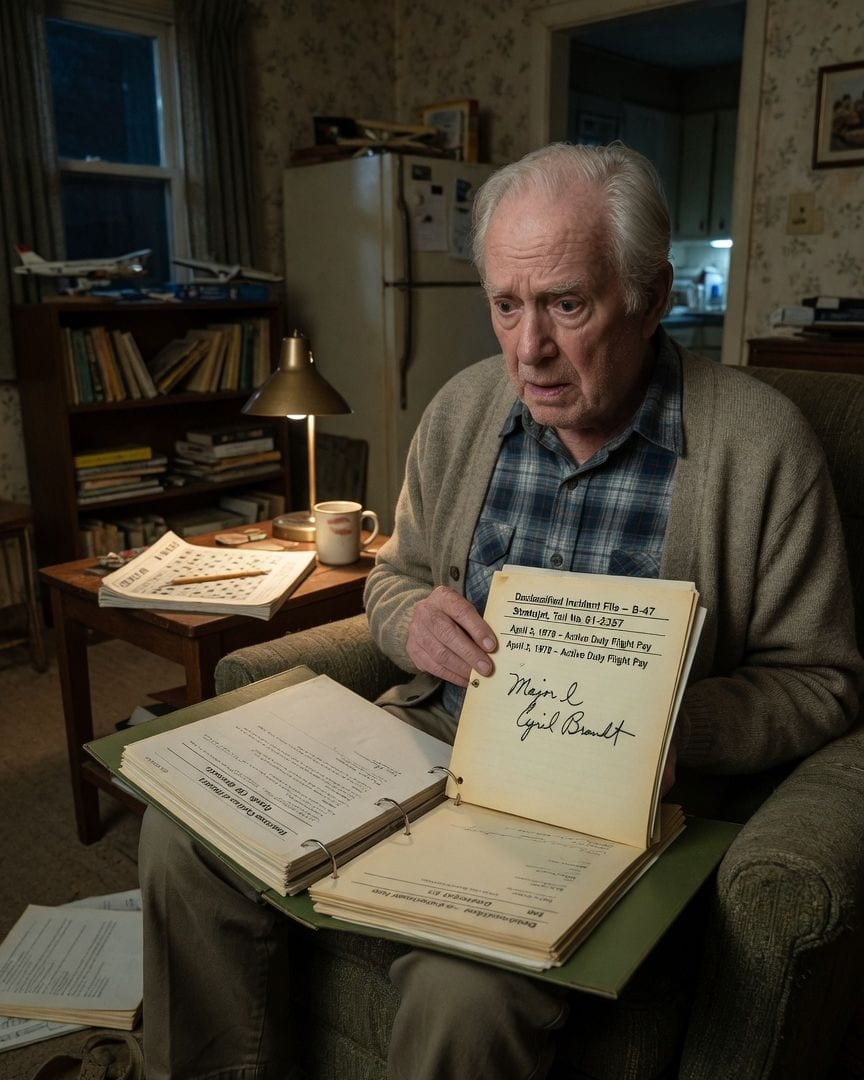
A retired Cold War pilot found his own signature on a flight pay record, dated five years after he left active duty, the ink unnervingly fresh.
Cyril Brandt, a seventy-two-year-old retired B-47 pilot, cherished his quiet Dakota retirement, his days filled with crosswords instead of combat. He expected to find long-awaited closure on a strange 1968 UFO incident when a heavy, declassified file arrived. Settling into his armchair, the weight of the olive-green binder felt familiar, but its contents quickly shattered his calm. He discovered maintenance logs for his B-47, detailing engine hours and tire rotations, dated years after the aircraft had been scrapped. Then, buried deeper, he found a payroll entry for himself, dated 1978 — five years after he left active duty — bearing his own unmistakable signature, the ink unnervingly fresh. How could his own hand have signed off on a mission that never happened, for a plane that no longer existed?
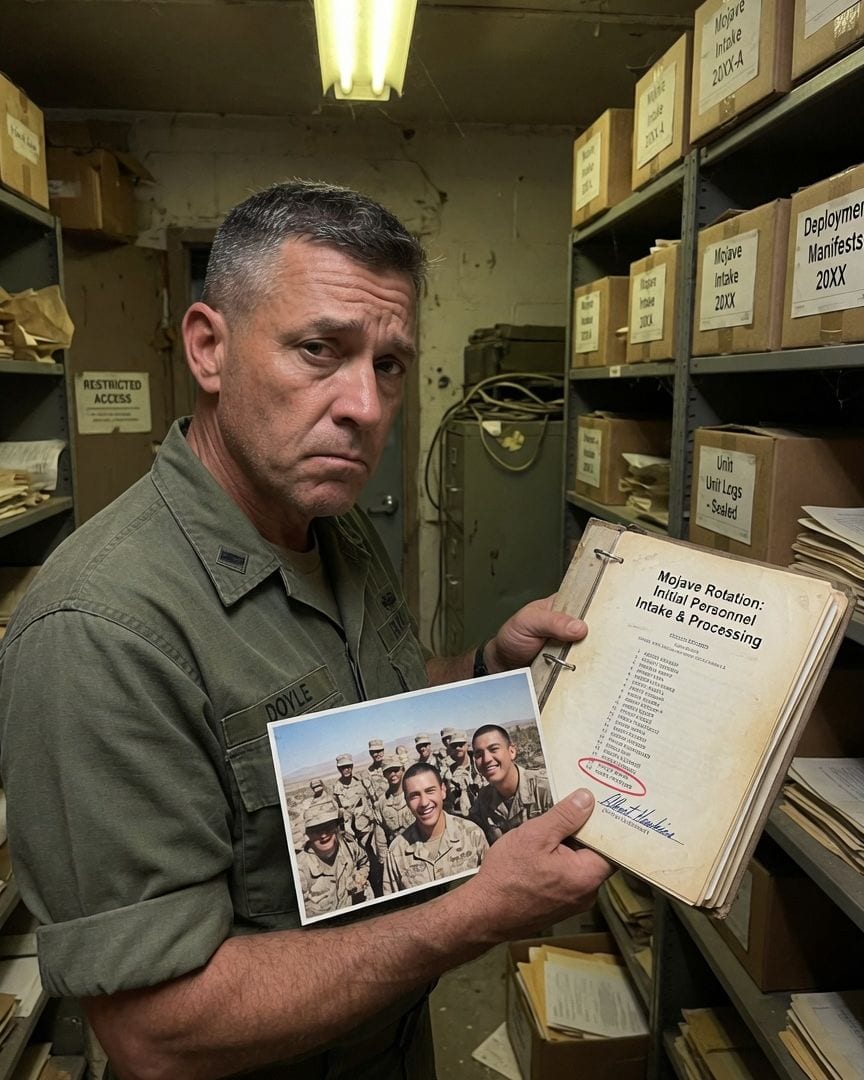
Master Sergeant Doyle's old platoon photo showed 31 men. But between Suggs and Ramos, a 32nd man stood grinning, named on Doyle's own signed manifest.
Master Sergeant Vincent Doyle was packing away twenty-five years of service, each box holding memories of the men he'd led. He paused at a faded platoon photo from the Mojave, a familiar thirty-one faces staring back. But then, a thirty-second man, Albert Hawkins, stood grinning between two of his men, a face Doyle couldn't place. His memory, usually perfect, insisted only thirty-one were there. Despite his colleagues recognizing the name, their own recollections dissolved, pushing Doyle to scour every record he'd personally signed – each one confirming thirty-one men, until he opened the very first intake manifest, bearing his signature, listing thirty-two.
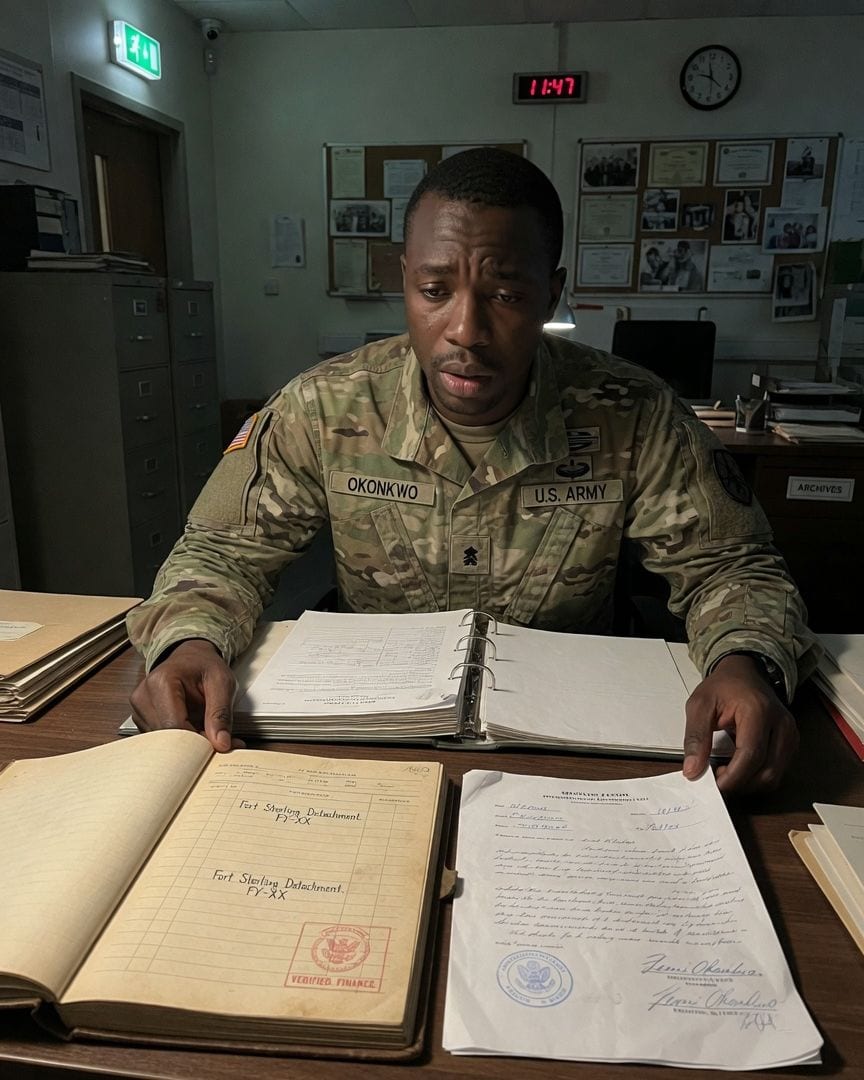
An old deployment ledger bore Specialist Femi Okonkwo's name, but the elegant signature was not his own.
Specialist Femi Okonkwo, an Air Force cargo hauler, stared at an earnings statement that contradicted his entire four-year enlistment. It listed nine months of jump pay and a mountain duty station in Colorado—places he’d never been, operations he’d never completed. Finance and HR records, seemingly impeccable, confirmed every detail of his impossible deployment. But when Femi finally retrieved the physical sign-in ledger, the faded blue ink of his supposed signature revealed the true, chilling discrepancy: the neat, elegant hand on the official document was unequivocally not his own. Who signed for Specialist Okonkwo’s impossible deployment, and why was it so meticulously verified?