Footsteps cross our boardroom ceiling every evening at six – directly over the empty space where the office plans show a room that doesn't exist.
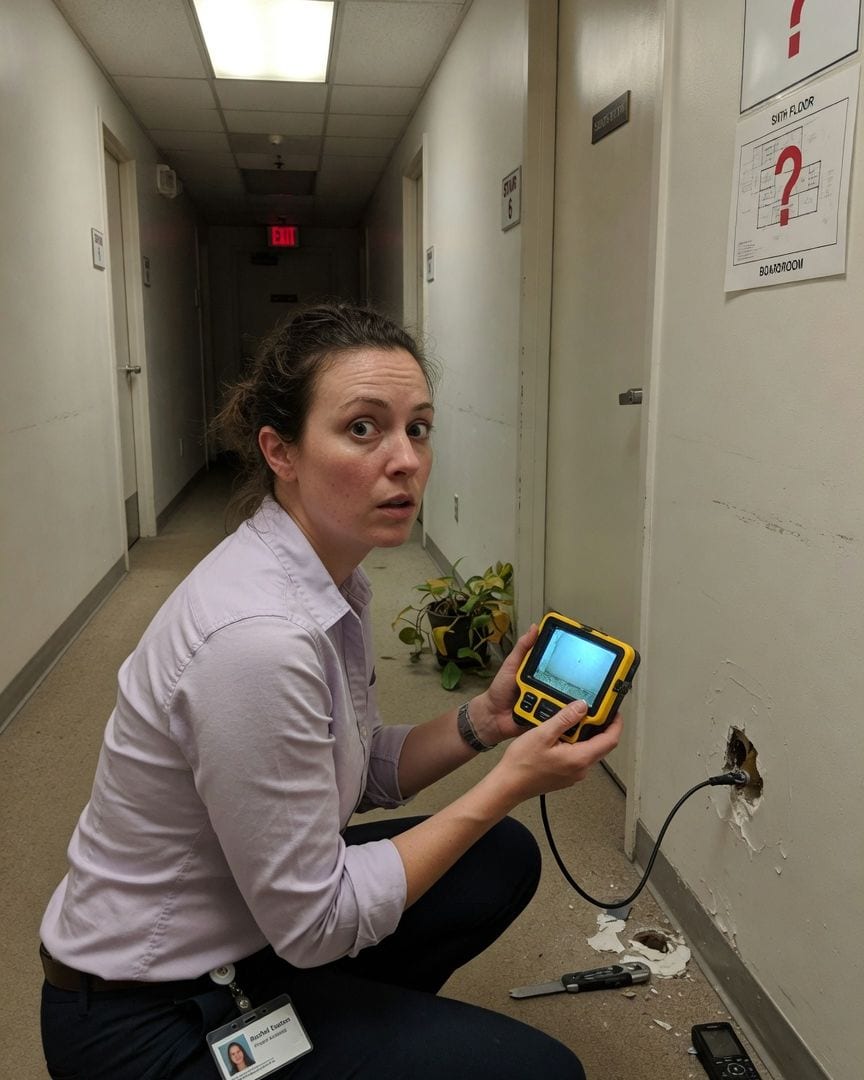
The new office refit plans went up last month, taped to the wall outside the breakroom.
I'm Rachel Easton, 32, a project architect here, and I’d barely given them a second glance, just a professional courtesy scan, until a small detail snagged my eye. It was on the sixth floor, our floor, directly above the boardroom.
A small, unlabeled space, just a query mark in the middle of an otherwise empty void. No dimensions, no door swing, no designation. It was just… there. A ghost in the machine, as far as I could tell.
Nobody in the practice remembered drawing it. It wasn’t on the digital archive, either.
Since those plans appeared, a new sound had joined the usual office hum: faint, rhythmic footsteps, crossing the boardroom ceiling. Always at 6pm, precisely, and always alone. I started staying late, just to listen. To count.
I live alone, so the rational part of my brain kept trying to attribute it to a late cleaner, a loose pipe, anything. But the steps were too precise, too solitary.
A steady, deliberate cadence, perhaps four or five steps, ending exactly at the far wall, then starting again, always from the same point. It wasn’t a random creak. It was a person, walking. I’d check the security logs.
No one ever entered the boardroom after 5:30 PM. No one was scheduled to clean that section until 9 PM.
I pulled up the original building blueprints, digital and archived, hoping for a simple explanation. The sixth floor was a straightforward rectangle: offices down one side, open-plan on the other, a central core for elevators and services. Nothing more.
No query mark room. I opened the current refit plans on my screen, overlaying them, comparing the files pixel by pixel. The '?'
room hovered, a phantom, in the same impossible spot, a digital glitch that had somehow made it onto a printed drawing.
I walked the sixth floor, pacing out the dimensions of the offices around the boardroom, tape measure in hand, then a laser distance measurer.
Samuel Calloway, my colleague in the office next door, even joked about my sudden obsession with spatial accuracy. But my measurements never quite added up.
There was always a small, unaccounted-for space, maybe eight by ten feet, directly above the boardroom. A volumetric discrepancy that shouldn’t exist, yet consistently threw off my sums.
It was like trying to fit a puzzle piece that was slightly too large. I even tried knocking on the wall that should enclose this phantom space – the section between Samuel’s office and the fire escape corridor.
A dull, solid thud answered my knuckles, not the hollow reverberation of a plasterboard cavity, nor the expected sound of a shared partition. It was dense, unnervingly still.
I asked Samuel about it one morning, casually, over coffee. 'That weird '?' mark on the refit plans, above the boardroom. Any idea what that is?' He just shrugged, stirring his sugar.
'Probably a glitch in the old CAD file, Rach. Happens with legacy buildings when you digitize archaic drawings. Some stray geometry that never got purged.' He was dismissive, already moving on to discuss the new project.
But the footsteps, I thought. The footsteps weren't a glitch.
That evening, I started leaving a small voice recorder in the boardroom after hours, tucked behind a potted plant, set to trigger at the slightest sound. The first few nights, silence, just the hum of the building.
Then, on the fourth night, I played back the audio. There it was. A clear, rhythmic scuffing, precisely at 6:01 PM. Each step distinct, slow, heavy, crossing the space, lasting exactly forty-five seconds before abruptly ceasing.
Just as I’d heard it with my own ears. No doors opening, no distant voices, no creak of floorboards from anyone walking into the room. Just the steps, in a space that wasn't there.
Driven by a cold, unsettling certainty, I returned to the office late one Friday. The building was empty, the quiet oppressive. I had a small borescope camera, the kind contractors use for inspecting wall cavities without demolition. The '?'
room was supposed to be above the boardroom, but its missing dimensions meant it should be accessible from the adjacent hallway, that blank stretch of wall between Samuel’s office and the fire escape.
The wall that had given me that solid thud. I ran my hand along it, searching. Near the floor, almost perfectly plastered over, I found a barely visible seam, a faint vertical line where a door might have once been.
With a small utility knife, I carefully picked at the layers of paint, revealing a hairline crack underneath. I inserted the borescope, snaking its flexible cable into the narrow void.
The tiny screen flickered to life, showing not a void, not insulation, not the cavity of a typical wall, but a perfectly smooth, unpainted drywall that now stood solid where a hallway wall should have ended, creating a small, inaccessible alcove precisely where the '?'
room was marked on the plans. Its surface, even through the borescope's lens, looked impossibly cold to the touch.
I spent the entire weekend in a daze, the image of that impossible, unpainted wall seared into my mind. It was a physical manifestation of a space that, according to all logic, couldn’t exist.
On Monday, I returned to the office armed with a small, high-precision laser measure, a more advanced version of the one I'd used before.
I meticulously mapped the entire sixth floor, cross-referencing every dimension, every angle, every doorway, every inch of space.
I built a 3D model in my software, comparing it against the original blueprints, the current digital schematics, and now, the phantom '?' mark from the refit plans.
The results were consistent, unnerving: there was a volumetric discrepancy, a pocket of space, roughly eight by ten by nine feet, that simply wasn't accounted for in the building's physical structure, yet occupied a real, measurable footprint.
It was a space that should have been part of Samuel's office, or the hallway, or a storage closet, but wasn't. It was a physical blank spot, a mute, solid anomaly.
I knew I needed to talk to someone who had been here a long time. Someone who might remember something. I sought out Bernard Lawson, 68, the building's facility manager.
He was a quiet man, always seemed to be tidying something, polishing a handrail, checking a fuse box. He had been here, as he once told me, 'since before the last refit'—which had been almost twenty years ago.
I casually mentioned the 'oddity' on the new refit plans, the query mark room. Bernard’s face, usually amiable and crinkled around the eyes, tightened almost imperceptibly.
He paused in his task of tightening a loose screw on a door hinge, his hands still, but his eyes meeting mine with a sudden, startling intensity.
'Some old buildings have quirks, Miss Easton,' he said, his voice calm, almost too calm. 'Best not to dig too deep into them. Things are often left that way for a reason.'
His tone was even, but the implicit warning was clear, like a silken thread tightening around my throat.
Undeterred, a colder sort of resolve settling over me, I then went to the city archives, searching for any historical permits or architectural modifications for the building that might explain a sealed-off room. Nothing.
The building's records were meticulously kept, a testament to decades of bureaucracy, but the sixth floor's current layout, as I measured it, did not match any historical plans.
Nor did it fully align with the current digital schematics that lacked the query mark.
It was as if the building had subtly reconfigured itself, or always contained this impossible element that only now, with the new refit plans, had been inadvertently highlighted.
The footsteps continued, every evening at 6pm, an unseen presence pacing above the boardroom, an undeniable rhythm of a space that refused to be counted.
I started taking photos of the refit plans daily with my phone, meticulously documenting the '?' mark, the surrounding offices, the exact location of the anomaly. Just in case.
One morning, as I was examining the printouts, I noticed a faint smear on the protective glass covering the plans, right over the query mark.
It looked like a thumbprint, but oddly elongated, smeared slightly, as if someone had pressed and dragged it. I dismissed it at first, attributing it to a cleaner, then felt a prickle of unease. It was too precise, too centered.
Later that week, as I was leaving the office, engrossed in replaying a voice recording of the 6pm footsteps through my earphones, I saw Bernard Lawson standing by the security desk on the ground floor.
He wasn't looking at me directly. Instead, his eyes, in the reflection of the glass door, were fixed on my phone in my hand, specifically on the small external recorder attached to it. A wave of ice washed over me.
He turned then, his face expressionless, and offered a polite but terse 'Good night, Miss Easton.' He paused, his gaze lingering on my face for a fraction too long, before adding, 'Some things are best left undisturbed.
For everyone's peace of mind.' The words hung in the air, heavy and still, a silken threat disguised as a concern.
The very next day, I found the refit plans gone from the wall. The space was blank, the faint residue of old tape the only evidence they had ever been there.
When I inquired at reception, the young intern shrugged, 'Oh, those? They were taken down for an "update." Management's orders.' My heart hammered against my ribs. I checked the digital version on the shared drive. My stomach dropped. The '?'
mark was gone. Replaced by a bland, empty space, labeled simply 'Storage.' They knew. Someone was actively trying to erase the anomaly, to make it disappear from the official record. But I had my photos, my recordings, my meticulous measurements.
And the indelible memory of that cold, unpainted wall.
I confronted Bernard Lawson in his cluttered ground-floor office. The air smelled of oil, dust, and old paper.
I laid out my findings on his metal desk: the discrepancy in the measurements, the borescope image of the impossible wall, the vanished '?' mark from the plans, the 6pm footsteps, and the digital plans now showing 'Storage.'
My voice, I noticed, was tight with barely suppressed anger and a building terror. Bernard listened, his face impassive, as he slowly, methodically, polished a dusty wrench with a rag.
The clink of metal against metal was the only sound for a moment.
'You've been thorough, Miss Easton,' he said finally, his voice flat, devoid of emotion. 'More thorough than anyone in a long time.'
I pressed him, my voice barely a whisper. 'What is it? What's in that room? Why is everyone trying to cover it up?'
Bernard sighed, a deep, weary sound that seemed to carry the weight of years. He put the wrench down. 'It's not 'in' the room, Miss Easton. It is the room. Or rather, the room is… a scar.
This building, this site, it has a history of these things. Little pockets of space that don't quite fit. They come and go, mostly. Like a phantom limb of geometry. But sometimes, they stick.'
He paused, meeting my gaze, his eyes ancient and knowing. 'The footsteps? They're old. From the last time it really… manifested. Back in '73. A junior architect, fresh out of school. Bright kid. He got too close.
Tried to map it. Obsessed over it. He started hearing things, too. Thought someone was playing tricks on him. Then, eventually, he just… vanished. No trace. No body. Just gone.'
A chill colder than the impossible wall seeped into my bones, rooting me to the spot. 'Vanished? You mean… the room took him?'
Bernard didn't answer directly. He just shook his head slightly, a gesture of resignation. 'We learned to leave it alone. To smooth it over. To make sure the official records reflected what should be there, not what was.'
He gestured vaguely around his office, at the stacks of old manuals and tools. 'I was a young maintenance worker then. Saw it. Saw what happened. My job, now, is to make sure it stays quiet.
So no one else gets curious. So it doesn't… activate again.'
The full horror of the situation clicked into place with sickening precision: the footsteps weren't just a sound; they were a lingering trace of a past victim, perpetually pacing in a place that didn't exist.
And Bernard, the calm, unbothered 'one who knew,' had been complicit in its cover-up for decades, not out of malice, but a chilling, quiet resignation.
Bernard leaned forward, his voice dropping to a near whisper, almost lost in the hum of the building. 'That junior architect… he kept his own records. Unofficial. Obsessive. He knew the official plans wouldn't show it, couldn't show it.'
He tapped the side of his head. 'He saw things. Heard things. Had theories. I found them after he… disappeared. Tucked away in a forgotten locker, hidden under a pile of old wiring diagrams.
I didn't know what to do with them. Couldn't bring myself to destroy them, but couldn't let them out either.' He reached into a deep, dusty drawer under his workbench, his hand rummaging for a moment.
He pulled out a flat, wrapped package, tied with twine, the brown paper yellowed and brittle with age. 'I never showed them to anyone. Until now.'
He peeled back the brown paper, revealing a brittle, yellowed blueprint, its edges frayed and foxed with age, soft as tissue. The title block was dated 1973.
It was a detailed architectural survey of the sixth floor, but it was unlike any official record Rachel had seen. It depicted the '?' room with precise, impossible dimensions, a three-dimensional anomaly, meticulously rendered with notations.
And on it, in faded ink, was a handwritten note, scrawled in a tight, frantic hand: 'Fails to reconcile – see incident report 14-B. Recurrent geometries observed.'
The report itself was missing, but the blueprint was a physical artifact, undeniable proof of the impossible. It wasn't just a glitch or a quirk; it was a repeating phenomenon, a cycle.
Bernard Lawson, his eyes calm and knowing, slides the brittle, yellowed blueprint across the table. It shows the sixth-floor layout, an identical '?' room, and a handwritten annotation in faded ink: 'Fails to reconcile – see incident report 14-B.'
The report itself is missing, but the implication of recurrence, of something old and cyclical, hangs heavy, unsaid, as he watches Rachel's face.
I unrolled the 1973 blueprint, its brittle paper crackling under my touch, feeling fragile, like history itself. The detail was chilling. The '?'
room, labeled as 'Anomaly A7,' was meticulously drawn, its internal dimensions shifting slightly with each diagram on the sheet, as if the space itself was in flux, breathing.
A separate, accompanying page, also from 1973 and found within the package, was a 'Log of Observed Phenomena.' It was written in the same frantic hand. It detailed the junior architect's observations: 'Day 1: Discrepancy noted. Day 5: Footsteps audible.
Day 10: Wall appears. Day 15: Attempts at communication? Day 20: Feeling watched. Day 25: It wants me to…' The log ended abruptly, mid-sentence, the ink smudged, as if dropped.
Bernard explained, his voice flat, but with a horrifying clarity that resonated in my bones. 'He thought he could understand it, map it, give it a place. But it wasn't just a space. It was a connection.
A kind of echo chamber. What gets trapped in there… it's not just a memory. It's a fragment. It tries to get out, to communicate. That’s the footsteps. It’s what happened to him. He went in, or was pulled in.
His presence, his attempt to understand, it fed the anomaly. It gave it a focus. And now, you've done the same. Your curiosity, your measurements, your listening… you've opened the door for it again.'
The coherent horror settled over me, cold and suffocating: the impossible geometry wasn't just a misbehaving space; it was a recurring, sentient pocket that consumed those who sought to understand it, trapping them in an endless, echoing cycle.
The footsteps were the junior architect, still trying to get out, fifty years later, and I, by digging, by listening, had opened the door for it again.
I felt a cold dread seep into my bones, a kind of existential nausea. 'So, what do we do?' I whispered, my voice barely audible in the quiet of his office.
My mind raced, trying to grasp onto some rational course of action, some way to fix this, to undo it.
Bernard gently took the old blueprint from my trembling hands, rolling it carefully, like handling something precious and dangerous. 'We do what we always do, Miss Easton. We manage it. We ignore it.
We make sure no one else gets curious. And you…' He looked at me with an unsettling blend of pity and resignation, his eyes ancient. 'You know too much now, Miss Easton. You’ll hear them, won’t you?
You’ll feel the pull. It will follow you.'
He was right. The footsteps, once an abstract curiosity, now felt intensely personal, a ghostly invitation that had twisted into a threat. I knew I couldn't stay.
I couldn't work in a building that quietly consumed people, that had a literal scar on its soul, a gaping wound in geometry. I packed my desk that evening, every sound magnified, every shadow a potential threat.
The creak of my chair, the rustle of papers, the distant hum of the elevator—all seemed to sharpen, to focus on me.
As I walked past the boardroom, my steps hushed on the carpet, I heard it – not the distinct, rhythmic steps I’d grown accustomed to, but a faint, persistent scratching from directly above, like fingernails on plaster, trying to find purchase, trying to break through.
It was louder than before, more desperate, more alive. I knew it was the junior architect, an echo from 1973, responding to my presence, to my knowledge, now aware that I was aware.
I fled the building, the scratching seeming to follow me down the street, a sound only I could hear, a new, permanent fixture in my consciousness.
Bernard Lawson remained, a silent guardian of the impossible, his face a mask of quiet endurance, watching me go.
I resigned from the firm the following day, citing 'personal reasons' that I couldn't articulate. Samuel Calloway called, confused and slightly put out, but I offered no explanations, just a terse goodbye.
The office refit plans were eventually re-posted, now showing 'Storage' where the query mark had been, a bland, corporate erasure.
Bernard Lawson continued his duties as facility manager, a quiet, unchanging presence in the building, like part of its ancient, unknowable infrastructure.
Life in the firm moved on, the strange footsteps at 6pm becoming a forgotten oddity for most, or perhaps, a new, subtle part of the background hum for those who stayed long enough to notice.
The building held its secret, a constant, recurring anomaly, waiting for the next curious mind to stumble upon its impossible geometry.
I moved to a new city, started a new job. I avoided old buildings, preferring modern architecture with clear, unambiguous blueprints, buildings that proudly displayed their foundations and their frameworks.
But sometimes, late at night, I’d hear it – a faint, rhythmic scuffing, like footsteps on a ceiling, always at 6pm, no matter where I was.
A sound that followed me, a permanent resonance of the space that couldn't be counted, a space that refused to be forgotten. I knew I hadn't escaped it; I'd just left the epicenter.
The dread was in knowing it was still there, quietly waiting, always a part of me now. The numbers still refused to add up. I could still hear them. Every evening. Six o'clock. Alone.
Her new apartment was a sleek, minimalist design, all glass and exposed concrete. Her new partner, Arthur, often found her staring at the ceiling at precisely 6:00 PM, a strange, distant look in her eyes. 'Everything alright, love?' he'd ask.
'Just listening,' she'd murmur, a faint, wrong little smile on her lips. 'The building has stories.'
If this one got to you
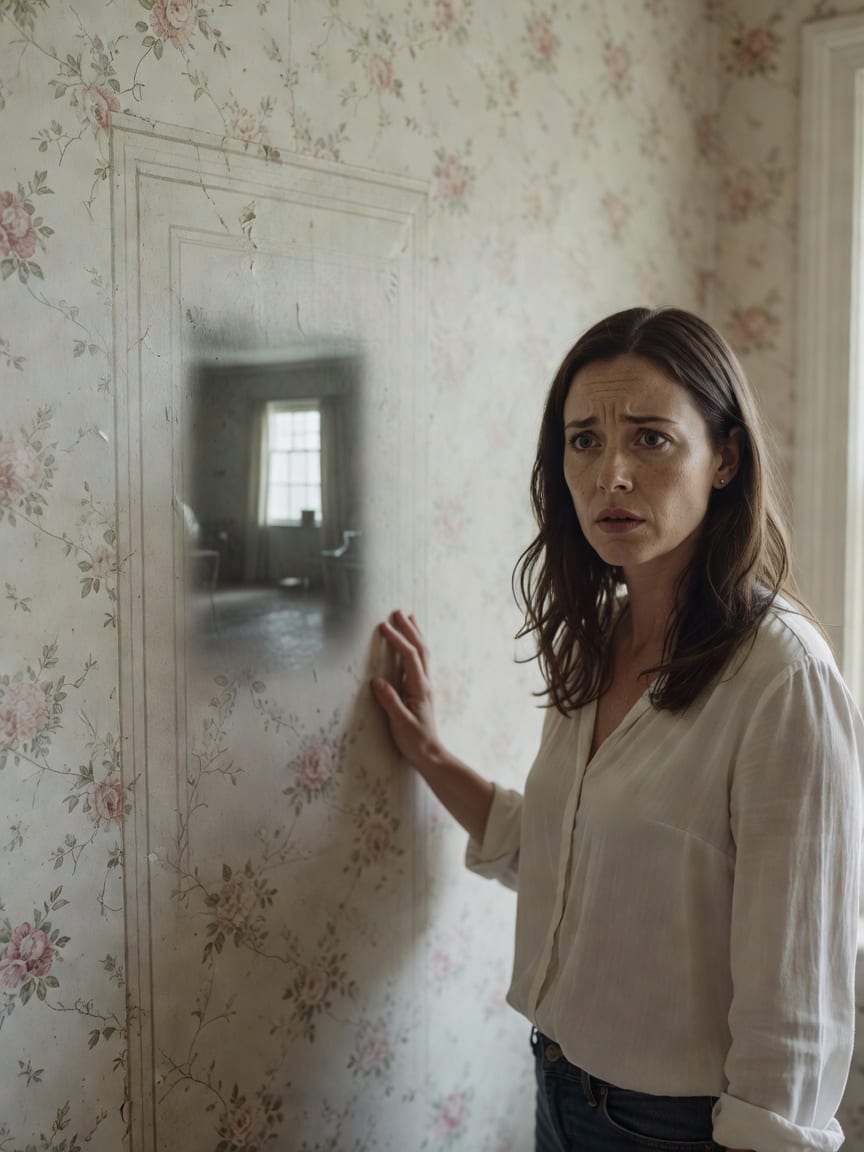
My neighbor’s house plans show a room in my bedroom that doesn’t exist. The surveyor described its door, but my wall is solid.
I was signing off on my neighbor's loft plans when I saw it: a small, square room off my own bedroom. My house, where I’d lived for five years, had no such room. But a surveyor confirmed its presence on paper, and older blueprints showed it had been there for decades. Now, I can feel a faint coldness from a hidden doorframe behind my wallpaper.
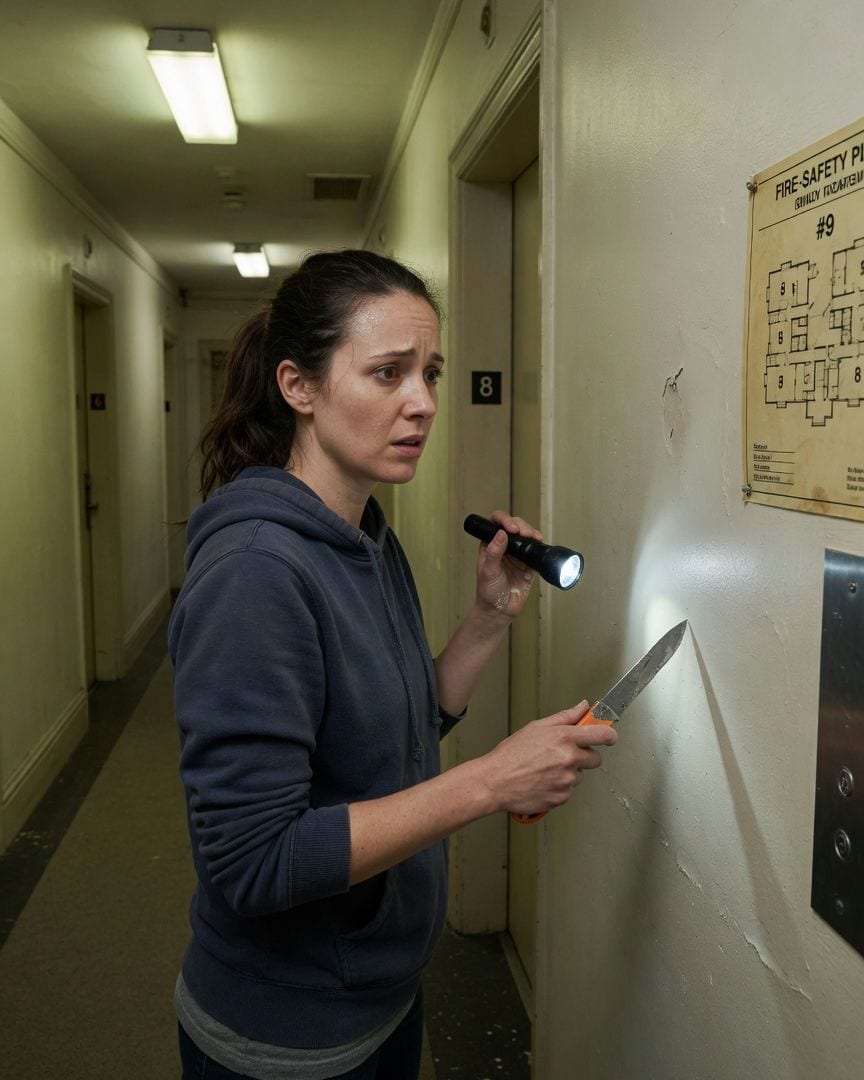
That blank wall in my hallway has a hidden metal plate. Tonight, after eleven years, it just clicked.
For eleven years, my apartment building's fire plan has shown nine apartments on my floor. But I've only ever counted eight doors, the space for the ninth a blank wall. Now, I've found a hidden metal plate behind the plaster, and from deep within, I just heard a soft *click*.
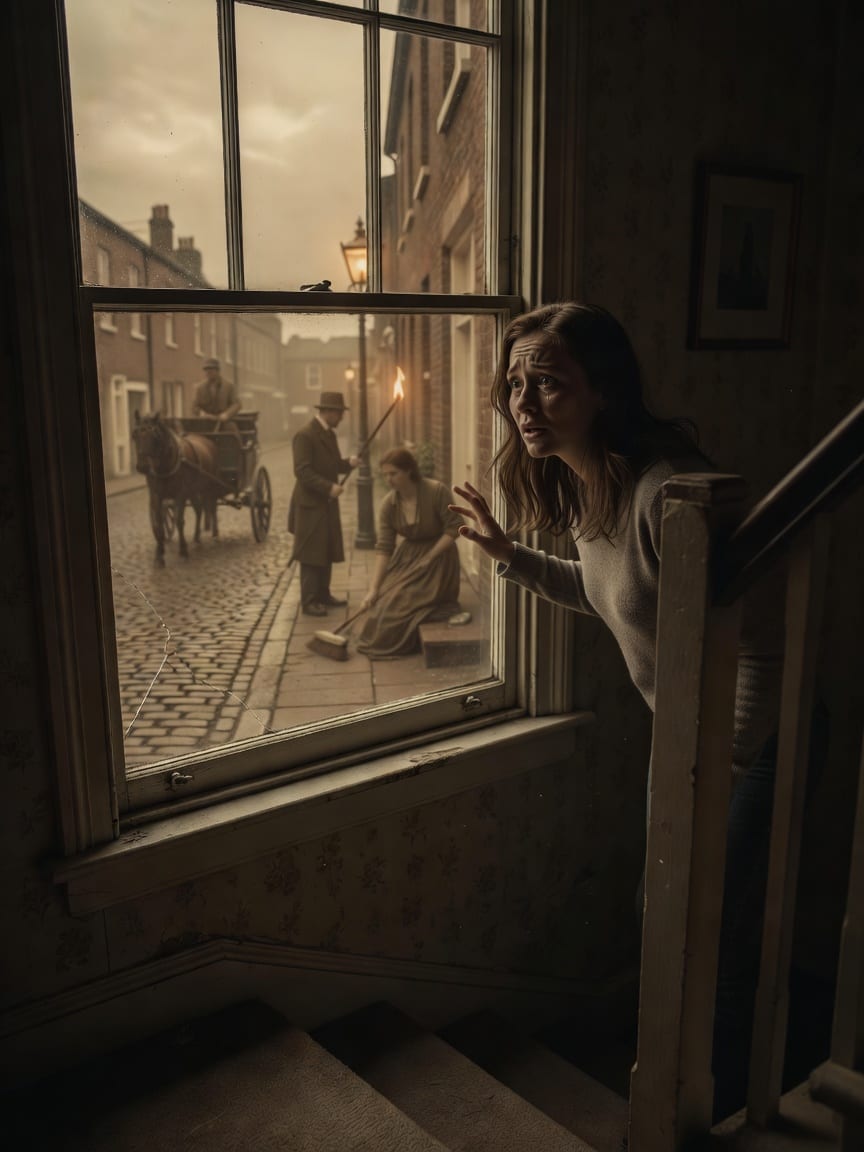
My half-landing window looked down on a cobbled street, a horse and cart. My panes, same crack. Below, only the bins.
I moved into this inherited house for a fresh start, living alone in the quiet. But the third stair on the main flight is deeply worn, a ghostly scoop hinting at decades of unseen footsteps. It feels hollow, and the wall beside it hides a faint, inexplicable seam.
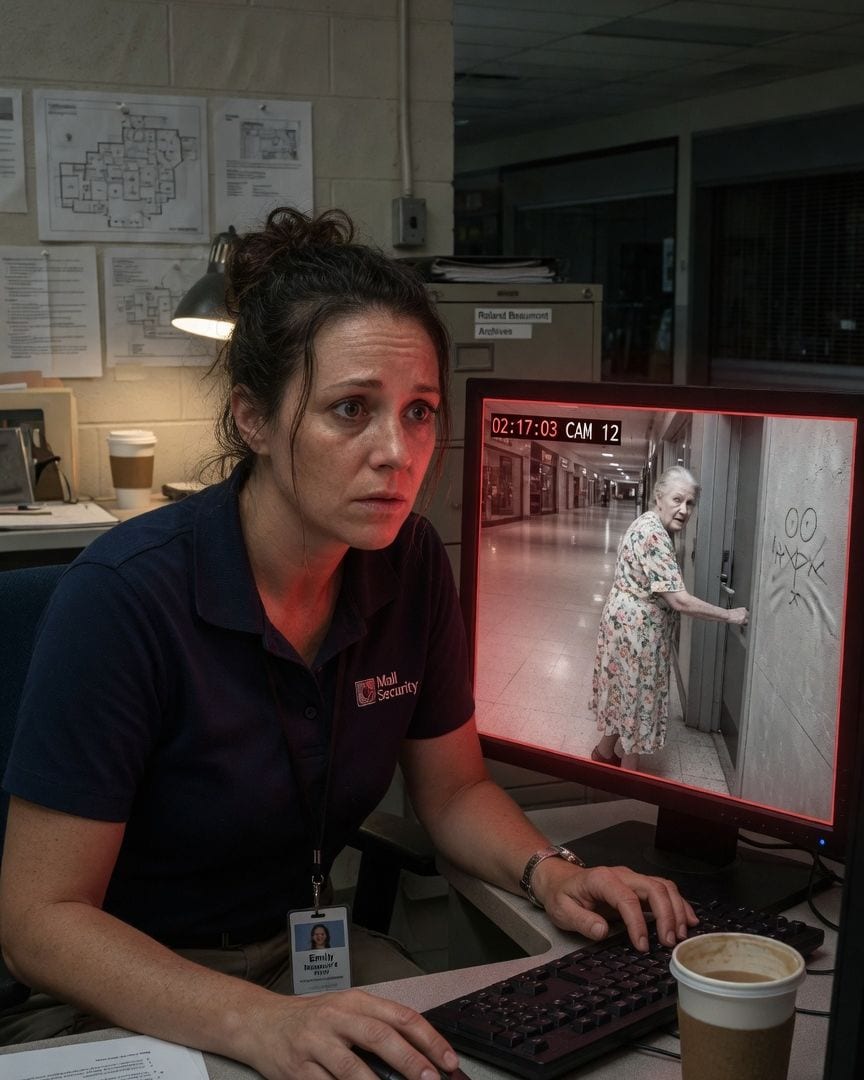
Mall security footage caught an old woman walking the concourse after closing. Every camera filmed her, but no single frame shows how she got in.
Working the overnight shift, I monitor my locked mall's security footage. It was 2:17 AM, five hours after closing, when an old woman in a floral dress simply appeared on Camera 7. She was never seen entering the frame, only *present*, walking slowly across the deserted concourse.
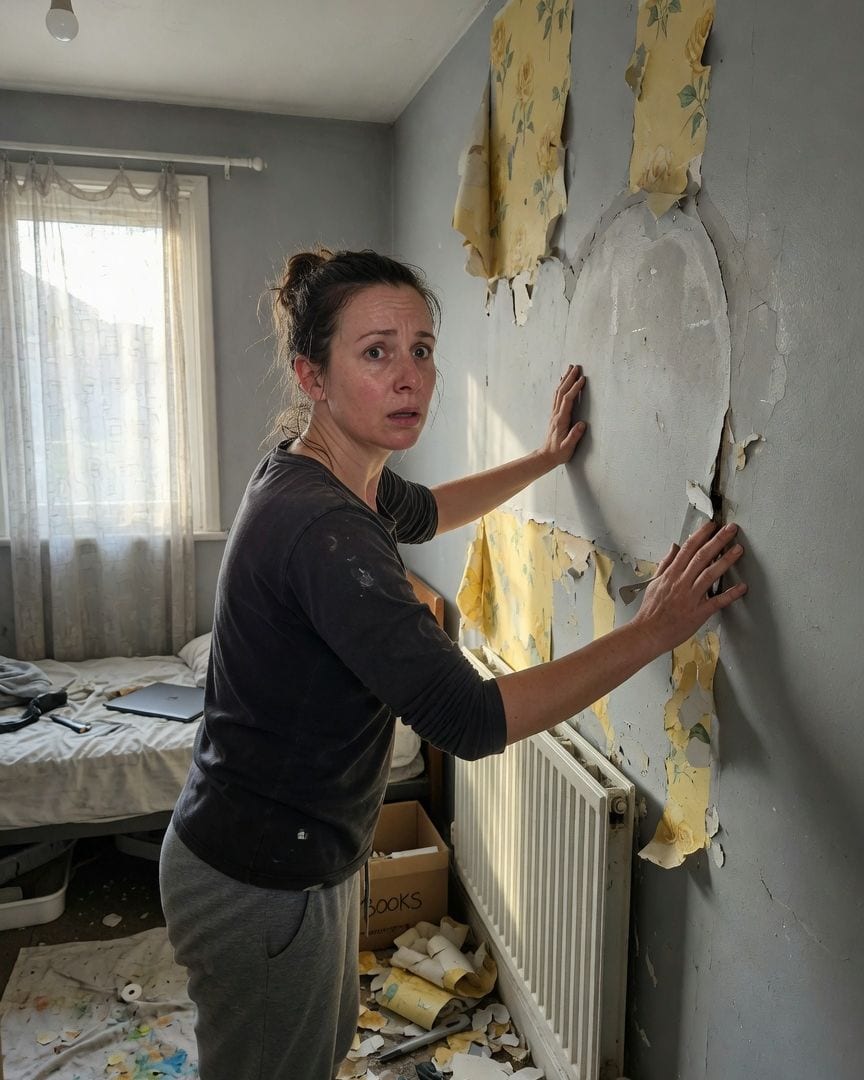
I painted the box room grey, but twice I've woken to find it papered in yellow roses I never bought — seams lifting exactly where the empty-flat photos show bare plaster.
I moved into my new flat in March, ready for a fresh start. But the box room, freshly painted grey, kept growing old-fashioned yellow rose wallpaper. The third time, as I stripped it, the wall opened to reveal a perfectly preserved, sunlit room from May 1978, complete with a steaming teacup.
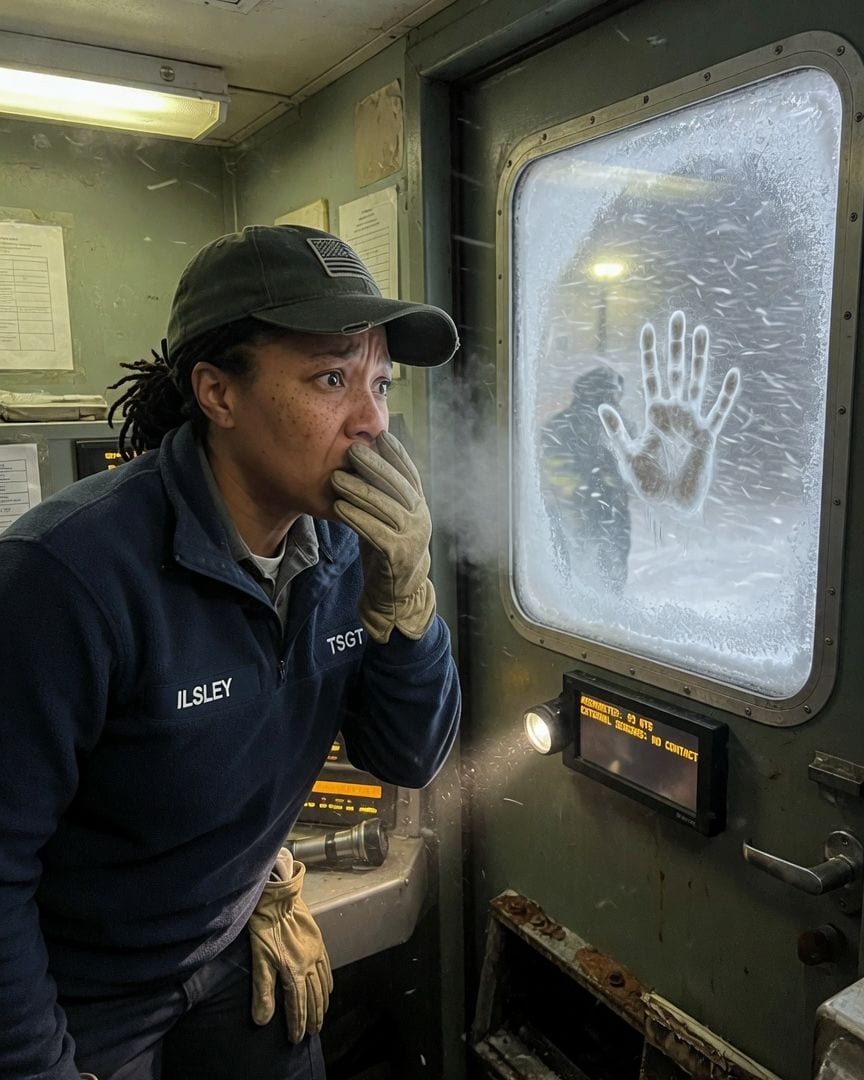
Technical Sergeant Ada Ilsley had two weeks left when a handprint appeared on her sealed window, unnervingly warm and pressed from the *inside*.
Technical Sergeant Ada Ilsley was counting her last two weeks on the Greenland ice-cap before Thule-Gamma Station closed for good. Tonight, the polar wind howled at ninety knots, clawing at the station's insulated walls as she kept a lonely vigil. Through the main door's triple-paned port, she watched a dark figure emerge from the impossible blizzard, its face pressed against the glass, only to vanish. On the frost outside, a perfectly clear handprint remained, unnervingly warm and undeniably pressed from the *inside* of the sealed pane. How could anything have touched the glass from within a supposedly impenetrable barrier?