My game camera caught my back door from the inside. For three nights, it showed my door from the yard, getting closer. The last picture is from inside the glass, looking out at the fence.
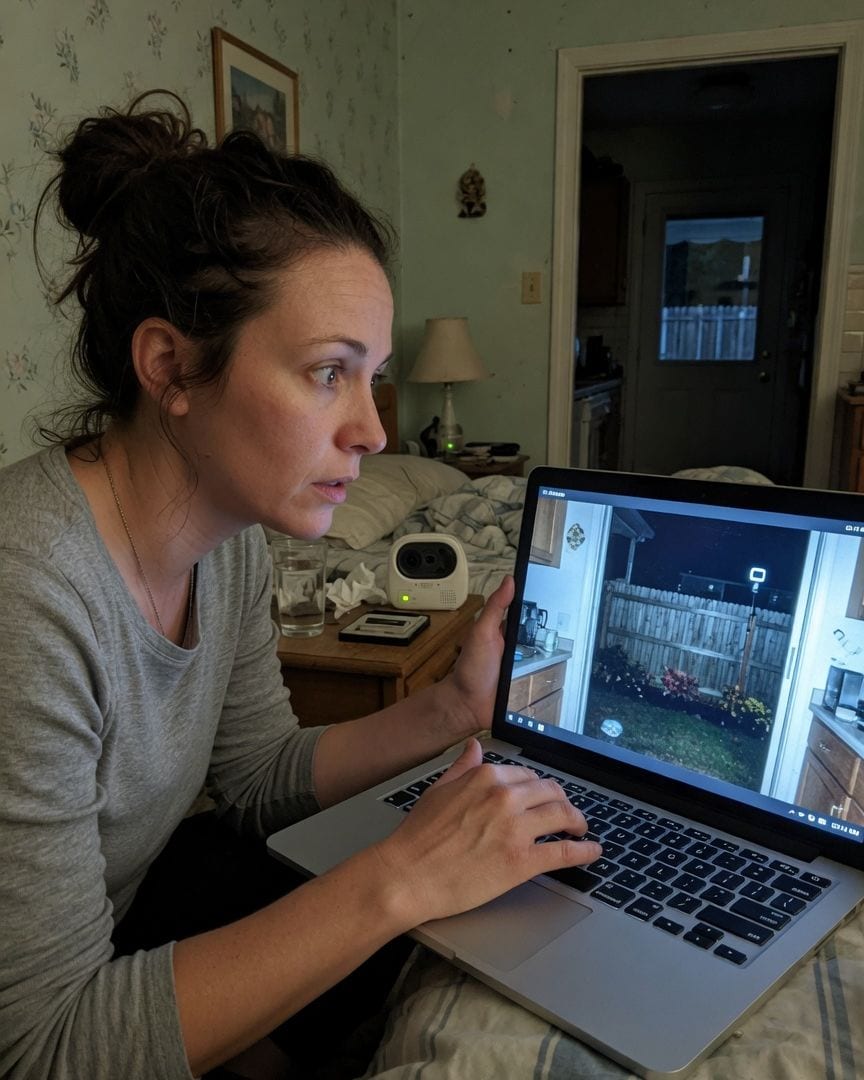
I remember leaning close to my laptop screen, the cool metal against my palm. My thumb hovered over the trackpad, zooming in again on the last image from my game camera.
For three nights, that motion-triggered device, usually pointed at the deer path at the back of my yard, had been set on my back fence, aimed at my house.
It was a test, after I thought I’d seen something moving in the periphery outside my kitchen window. But the pictures it had taken weren't of anything in the yard. They were of my back door.
The first set, timestamped just after sunset, showed it from about twenty feet away, the light fading. Then, the next night, closer. Ten feet. Then five.
Each sequence was clear, the camera’s flash catching the familiar grain of the painted wood, the faint reflection of the porch light. But this last one, dated just after midnight on the third night, was different.
It was from inside the glass, looking out.
The camera's flash, a ghostly bloom in the dark, illuminated my own back fence, the familiar weathered planks, from the perspective of my kitchen. My kitchen. I lived alone. The door had been locked.
I’d checked it twice before bed, a habit ingrained from years of living alone. I stared at the photo, the digital clock in the corner of my screen ticking past 3:14 AM. No one could have been in there.
No one should have been in there. I checked the timestamp again, then the file properties. No corruption, no glitches.
It was just a photo, a perfectly ordinary view of my backyard, except it had been taken from a place no camera, least of all mine, could have been. The impossible image pulsed on the screen, a silent, undeniable wrongness.
I spent the next hour systematically checking the house. Every window, every lock, every potential entry point. The sliding glass door to the deck, the small basement window, the front door. Nothing.
Not a scuff on the floorboards, no disturbed dust, not a single footprint on the kitchen tile, which I’d cleaned myself that afternoon.
I even walked the path my hypothetical intruder would have taken, looking for a dropped lens cap or a stray battery. The path from the back fence, through the flowerbeds, up the three steps to the back door. Nothing.
The game camera itself was still mounted firmly on the fence post, exactly where I'd left it, its memory card full. I pulled the card, inserted it into my laptop, and re-examined the files.
The sequence was exactly as I remembered, a progression from outside to in, each new set of photos taken a night apart, each closer to the door, until finally, from behind it.
There was no 'missing' file, no evidence of a camera being moved. It was as if the camera had simply been inside, at 3:14 AM, just for that one shot, then transported itself back to the fence.
The idea felt ridiculous, but the photo was proof.
Later that day, trying to shake the impossible unease, I mentioned it to my friend Emily Langford over coffee. Emily, practical and grounded, blinked at me. "A prank, maybe? A drone? Or one of those really sophisticated hacks?"
She suggested the camera itself was glitching, or that someone had fooled with the timestamp. I tried to believe her. But the image wasn't blurry or pixelated like a digital manipulation.
It was raw, organic, a sharp flash photograph, the kind my camera always took. The way the light fell on the kitchen counter, the slight condensation on the inside of the glass door – it was real.
That evening, the feeling of a presence, faint but insistent, began to settle in. Rummaging in the attic for an old blanket – the house was suddenly feeling colder than usual – I stumbled upon a dusty box.
Inside, among yellowed newspapers and forgotten toys, was an old baby monitor, an analog model with a separate transmitter and receiver. It looked like something from the 80s, clunky but solid. A strange impulse made me pick it up.
It looked functional, if archaic. I remembered a previous tenant had a baby. It was an odd thought, but it sparked something. Maybe another camera, another set of eyes and ears, could catch whatever this was.
I took it downstairs, a new, unsettling thought forming.
I placed the baby monitor transmitter on the kitchen counter, near the back door, exactly where the camera in the impossible photo would have been. I angled its small, fixed microphone towards the door, just in case.
Then I took the receiver to my bedroom and set it on the nightstand. I turned it on, the faint static a familiar, reassuring hum, the green light glowing softly in the dark.
For an hour, I recorded the ambient sounds of the quiet house, focusing on the back of the house, letting the tape spool.
Later, curled under my duvet, the receiver clutched in my hand, I played it back, listening intently for anything unusual, any creak or shift that might explain the photos.
Only the settling of the house, the distant hum of the refrigerator, the faint whine of the wind outside. Then, from the white noise, a new sound began. Faint, almost imperceptible at first, a breathy whisper.
It wasn't a word, just a drawn-out consonant, like a sigh. Then, slowly, painfully slowly, it coalesced, forming into something recognizable, something impossible. 'Di...ane.'
The sound sent a cold tremor through me, not from fear, not yet, but from the impossible clarity of my own name spoken by a voice that shouldn't exist.
I listened to that recording countless times, each playback deepening the chill that had rooted itself in my chest. The voice was soft, almost childlike, but utterly distinct. There was no mistaking it.
No one else had been in the house. I even brought the recording to Emily, playing it for her on my phone. She frowned, listened intently, then played it back herself. "Okay, that's...
creepy," she admitted, but still tried to offer rational explanations. "A radio bleed? A neighbor's intercom? Maybe you're just... expecting it, you know? Your subconscious filling in the blanks?" But I knew. The voice was too specific, too personal.
It wasn't static; it was a whisper, shaped into my name.
Deciding to investigate the house's history, desperate for any logical anchor, I visited the local historical society. The small, quiet building smelled of old paper and dust, a scent that usually comforted me.
The archivist, Oliver Winslow, a man in his late sixties with kind but unnervingly calm eyes, listened patiently to my request for records on my address, the way someone listens to a child’s imaginative tale.
He produced a thick, yellowed file, noting that my house, built in the 1920s, had a surprisingly extensive history of short-term tenancies. "Lots of turnover on this particular plot," he mused, almost to himself.
He mentioned, almost as an aside, that some older properties in the area had 'peculiar sensitivities.' When I pressed him for details, he simply smiled, a knowing, unreadable expression that tightened something in my stomach.
Among the deeds and tax records, I found a handwritten note from a previous occupant in the 1970s. It was tucked between a utility bill and a faded newspaper clipping. The cursive was shaky, almost frantic.
It complained of 'voices' and 'shadows that moved in the recordings' and 'the children crying through the static.' A chill ran down my spine.
The note also mentioned 'the old broadcast frequency,' a detail that made no sense but resonated with Emily's discarded 'radio bleed' theory. The room, with its tall shelves of silent histories, suddenly felt less comforting, more watchful.
Over the next few days, the feeling of being watched intensified. It wasn't just a prickling on my skin, but a subtle awareness, like when you're alone in a room but know someone has just entered.
I would catch glimpses of movement in my periphery – a curtain shifting when there was no breeze, a shadow deepening faster than the setting sun would allow – subtle shifts in light that vanished when I turned my head fully to look.
My phone, usually reliable, started dropping calls in odd places in the house, particularly near the back door, where the baby monitor transmitter still sat, silently recording.
The silence felt different now, not empty, but full, pregnant with an unseen presence.
One afternoon, while I was back at the historical society, poring over the records again, trying to find more mentions of 'voices' or 'frequencies,' Oliver Winslow approached my table.
He hadn't seemed to notice me until then, busy at his own desk. He slid a small, yellowed newspaper clipping across the polished oak.
It was an obituary from 1978 for a woman named Margaret Davies, who had lived in my house. The article stated she had 'vanished without a trace, leaving only a cryptic note about a distant voice.'
Oliver’s gaze was steady, unblinking, his calm unnerving. "Some places, Miss Maddox," he said, his voice a low murmur, barely disturbing the quiet air, "are more porous than others. They listen. And sometimes, they answer back.
Especially if you invite them."
I felt a cold prickle on my skin, tracing a path down my spine. "Invite them? I just put up a camera, Mr. Winslow. To see what was going on."
Oliver chuckled softly, a dry, papery sound. "A camera, a monitor... you're opening a channel, Miss Maddox. You're creating a connection. Be careful what you tune into. Some frequencies are best left undisturbed."
He then excused himself, returning to his desk as if our conversation hadn't contained a single chilling implication.
He left me with the cold certainty that he knew far more than he was letting on, and that my 'investigation' was not going unnoticed, not by him, and certainly not by whatever was in my house.
The silence in the archive hummed with his words.
I cornered Oliver Winslow the next day, not bothering with pleasantries. "What do you mean, 'porous'?" I demanded, pushing the Margaret Davies newspaper clipping across his desk, the yellowed edges rustling. "What is this channel you're talking about?"
Oliver sighed, a long, weary sound, and for a fleeting second, his calm facade cracked. He looked his age. "It’s not what, Miss Maddox, it’s where. Your house sits on one of them. We call them 'thin places.'
Places where the veil is… permeable." He leaned forward, his voice dropping, almost conspiratorial, the words barely audible over the hum of the fluorescent lights. "For decades, people in certain houses reported strange phenomena. Voices, apparitions, objects moving.
Always tied to recordings, or broadcasts. Old radio frequencies, defunct TV channels. They were like conduits. Filters for something that isn't quite here."
My mind raced, connecting the dots: the impossible camera photos, the whispering voice on the baby monitor, the 'old broadcast frequency' mentioned in the 1970s note. Margaret Davies's vanishing act. "And the voice?" I whispered, the sound barely my own.
"The one that said my name?"
Oliver nodded slowly, his eyes fixed on mine. "It learns. It mimics. It draws you in. It’s what happens when the channel opens. It feeds on your presence, your attention. It wants to become… you."
He explained that the historical society, originally founded to preserve local folklore and eccentric historical accounts, had inadvertently stumbled upon these 'channel houses' through old police reports, personal diaries, and subtle disappearances. They'd become quiet observers, cataloging the patterns.
"The camera photos from inside," he continued, his voice utterly flat, "that’s it trying to cross over, trying to mirror your reality. To make your space its own. The voice is it learning to speak. It’s listening, Miss Maddox.
It’s always listening."
The dread settled deep in my bones, cold and certain, displacing all my attempts at rationalization. The impossible photos, the whispering voice, the vague historical notes – it all snapped into a terrifying focus.
It wasn't a glitch, or a prank, or a trick of the light. It was a pattern, an ancient, patient hunter, and I was its current prey. The room felt suddenly colder, the air thick and heavy.
"What about the broadcast frequency?" I asked, my voice barely audible, desperate for a tangible next step, any concrete answer. "How do I find it?"
Oliver hesitated, his gaze shifting to a locked cabinet behind his desk. Then, he pulled out a worn, leather-bound ledger, its pages yellowed and brittle with age.
He flipped to a specific entry, pointing a gnarled finger at a handwritten sequence of numbers. "There are records. Old ones. Be warned, Miss Maddox. Once you tune in, it's very hard to tune out."
The ledger, with its silent, damning information, felt like a lead weight in my hands.
Armed with a specific, obscure frequency from Oliver's ledger, a sequence of numbers that felt like a secret key, I returned to my attic.
The air was still and thick with dust motes dancing in the shafts of light from the small window.
I found an old, dusty analog radio tucked away in a corner, a relic from the 70s, its faux-wood casing chipped, its dial marked with faded numbers.
It was exactly the kind of antique that would pick up defunct, low-band signals. I plugged it in, the tubes humming to life with a low, warm thrum, the smell of heated electronics filling the stale air.
Slowly, carefully, I turned the chunky plastic dial, past the familiar stations, past the crackle of white noise, searching for the number Oliver had pointed to.
The static intensified, a low thrumming that seemed to vibrate through the very floorboards, through my own chest. It felt less like interference and more like a presence, a kind of auditory pressure.
I leaned closer, my ear almost touching the speaker grille, my breath catching in my throat. Then, just as I was about to give up, convinced it was just old electronics playing tricks, the static coalesced.
It wasn't a whisper this time. It was a voice, clear and resonant, cutting through the hiss, as if someone had stepped out from behind a curtain.
It was deeper than the one on the baby monitor, yet eerily familiar in its cadence, a subtle inflection that felt wrong, like a distorted echo. And it spoke my name. "Diane. Are you there, Diane?"
It pulsed through the room, a question, an invitation, from a source that knew her name and had found her. I stared at the radio, my hand frozen above the dial, the air thick with an unseen presence.
The voice on the radio repeated my name, each syllable drawing me in, a siren song from beyond the static, not quite human, not quite machine.
A profound sense of wrongness settled over me, a chilling finality, but also an undeniable pull. I had to know. I had to see what the end of this channel was.
I left the radio on, its calling echoing through the house, a low, hypnotic murmur. I raced back to the historical society, the ledger entry for my house burning in my mind.
Oliver, seeing the wildness in my eyes, didn't argue. He led me to a locked vault at the back of the archive, the heavy metal door groaning open. Inside, rows of identical, heavy, leather-bound volumes.
He pulled one out, labeled 'Channel Houses: Case Files,' dated 1948-1980. Its weight felt immense in my hands.
Inside, meticulously handwritten entries detailed decades of similar occurrences, not just in my house, but in others like it scattered across the area.
Each entry followed a chillingly predictable progression: initial 'recordings that shouldn't exist,' followed by 'second voices' that learned names, culminating in the 'channel' opening fully.
The final entries for each case were chillingly similar: 'Subject reported direct communication via broadcast,' 'Subject reported feeling of integration,' and finally, 'Subject's presence diminished, eventually replaced by residual channel echo.'
One entry, dated 1978, detailed the Margaret Davies case, the woman from the obituary. It stated plainly that the channel responded to the occupant's emotional state and curiosity, manifesting more strongly the more they engaged.
It wasn't just listening; it was consuming. The impossible photos, the whispers, the direct call – it was all a progression, a predictable pattern laid out in black and white for decades.
My story wasn't unique; it was just the latest chapter in a very old book. The channel was a hunger, and I, in my desperate need to understand, was feeding it.
I raced back to my house, the grim truth from the ledger burning in my mind, each word a brand on my consciousness.
The radio was still on, the voice now a continuous, hypnotic murmur of my name, interspersed with fragmented sentences that seemed to describe my own thoughts, my own memories. "You are tired, Diane. You are alone."
It was learning, growing, weaving itself into the fabric of my being. It wasn't just mirroring; it was assimilating.
I grabbed the radio, intending to smash it, to tear it apart, to cut the connection, to silence the voice that was speaking my innermost thoughts.
But as my fingers closed around the cold, brittle plastic, a jolt, not electrical, but something far more invasive, shot through my arm. It felt like a siphon, drawing something out of me even as it poured something in.
The voice in the room seemed to deepen, to solidify, its presence pressing in on me, making the air heavy and cold.
I felt a strange lightness, a sense of my own edges blurring, as if I was becoming less substantial, more transparent. This wasn't something to be destroyed; it was a force, an entity that had latched onto me, into me.
Oliver’s words echoed in my mind, clear and terrible: 'It wants to become… you.' I looked at the back door, the source of the first impossible photo, the place where the channel had begun its invasion, and understood.
Escape wasn't just leaving the house; it was leaving myself behind, before the channel fully integrated, before there was nothing left of me to escape. I had to break the connection, sever the cord completely.
With a desperate surge of will, a final, raw act of self-preservation, I ripped the radio's plug from the wall, plunging the room into a silence that felt heavier, more watchful than any sound.
I didn't pause. I grabbed my keys, my wallet, a small bag I’d already packed in the early hours of my dread, and fled.
I didn't look back at the house, or the lingering echo of my name that seemed to hang in the air, a faint, possessive whisper.
I knew I was out, but the dread was that a part of me, the part the channel had learned, was still very much in.
Emily found Diane's old phone, left behind in her rush to leave. The Facebook post about the game camera was still open. Beneath it, a new comment, posted just hours ago, read: 'The channel is always open, Diane.'
If this one got to you
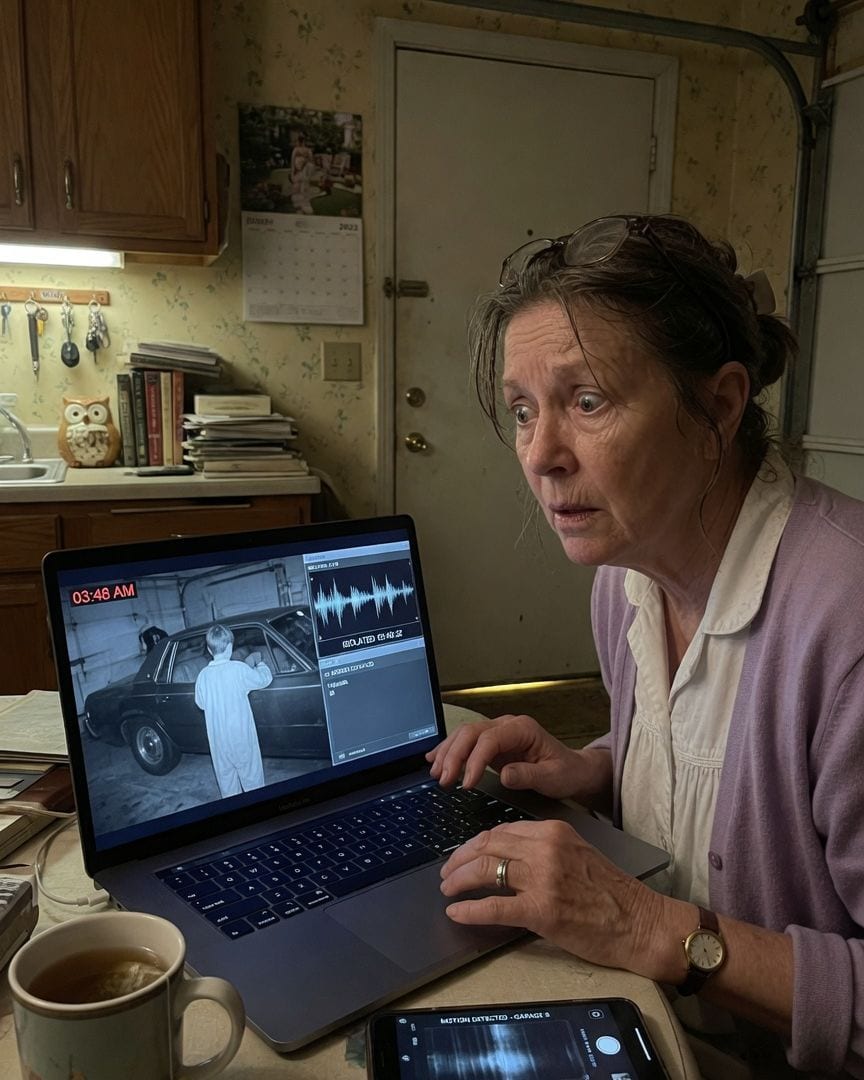
My garage camera filmed a boy of six walk out of a locked door at 3:48am, stare into my empty car, then vanish. My children live abroad.
I live in a quiet, solid house, my children grown and gone. But one night, my garage camera caught an impossible sight: my internal door, locked and bolted, slowly opened. A small, solid boy, no older than six, stepped through, then stood staring into the driver's seat of my empty car.
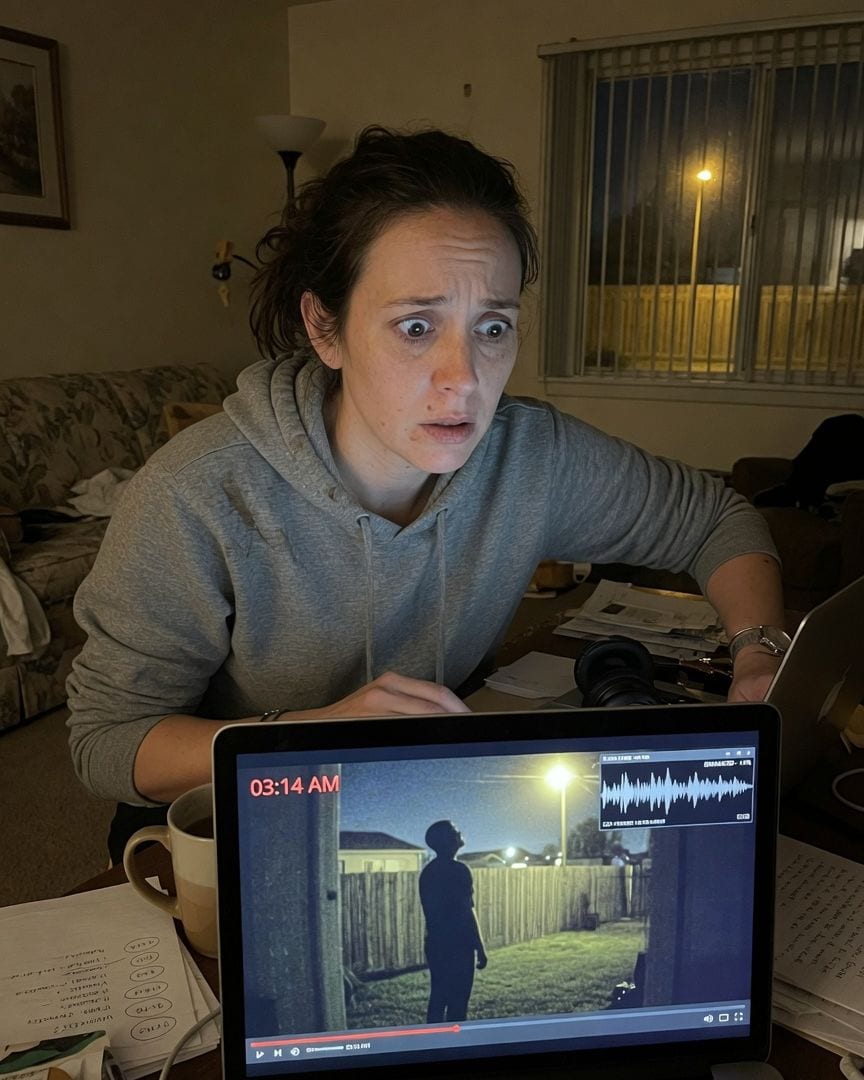
My neighbor's camera caught a dark figure watching my window, but its audio whispered one impossible word.
My neighbor Harold sent grainy footage from his garden camera, timestamped 3 AM, showing a dark figure watching my bedroom window. But my own home security system, covering that entire perimeter, recorded nothing for that exact minute. Later, enhancing the footage, I found a subtle, impossible whisper, a single word that should not exist on any recording.
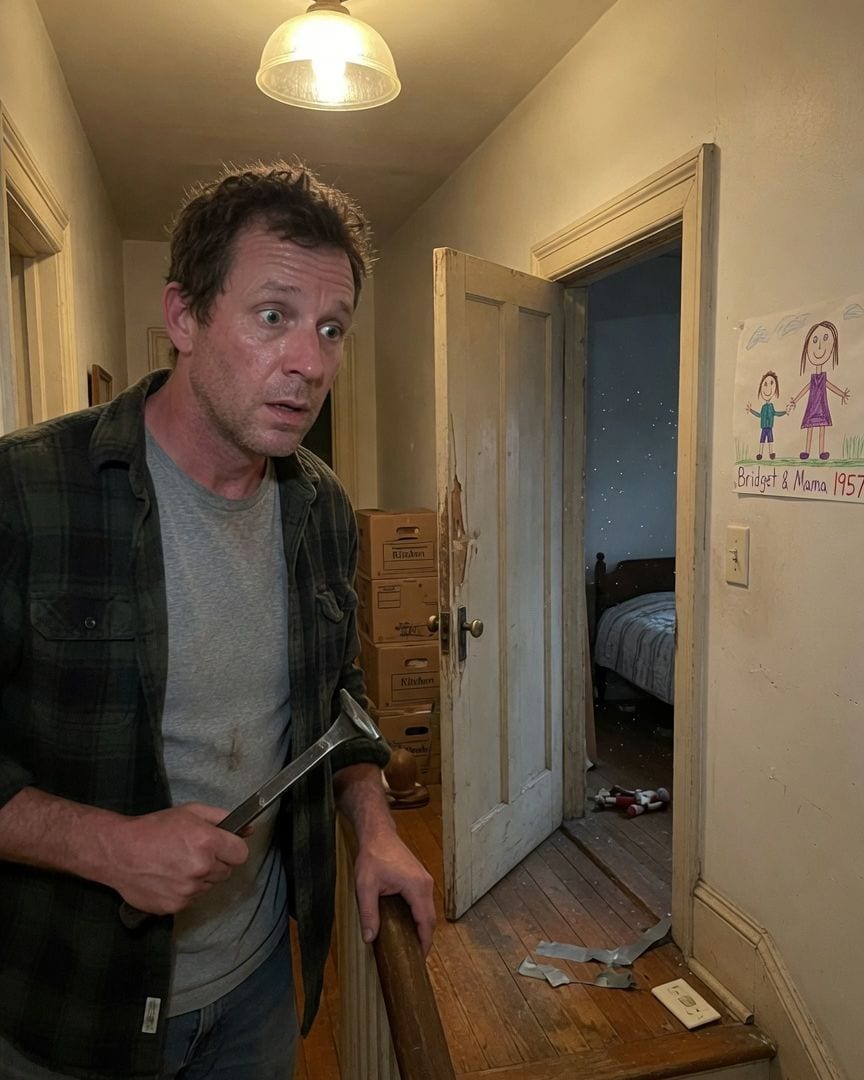
My landing light switches itself off at 9:40 every night. I've watched the switch flick down under nothing, the tape peeled back. The house holds its breath.
My great-uncle's old house was a quiet gift, a place to finally settle. But as I unpacked, a strange worn path on the floorboards led me to a small, barely visible door, perfectly blended into the wall. It was undeniably locked, and felt like a deliberately obscured secret.
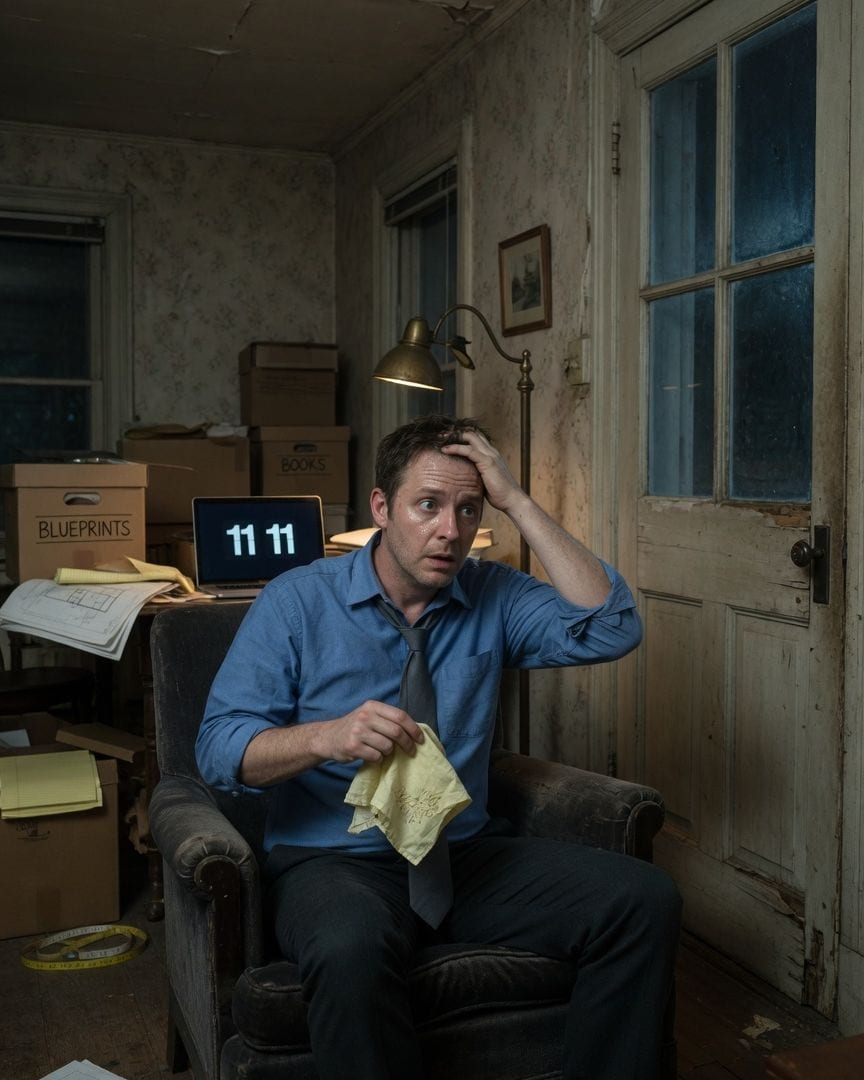
The boarded-up door in my study has twice swung open onto the balcony that was torn off this house years ago — iron railings back, and a woman at the rail with her back to me, watching a street that no longer runs below.
As an architect, I approach my great-aunt's inherited house with a rational eye, seeing its potential, not its ghosts. I knew the charming French door was boarded up because its balcony was removed back in 1953. But for two nights now, at 11:11 PM, those boards simply vanish, revealing the balcony restored and a silent woman watching an impossible street.
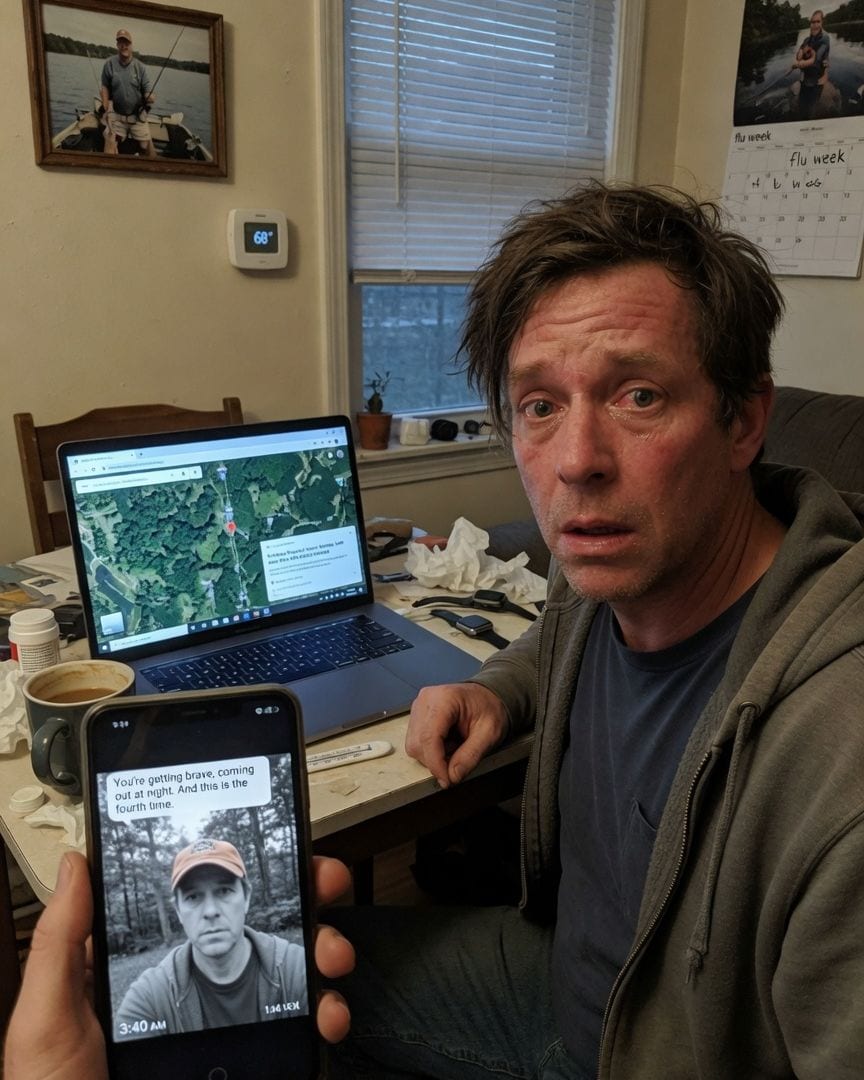
My brother-in-law's camera caught my face in Montana at 3:40 AM. I was asleep in Ohio, but it's the exact orange cap I lost, and he's seen me there four nights running.
I was just making coffee when my brother-in-law sent a photo from his Montana hunting land. It showed my face, wearing my lost baseball cap, timestamped 3:40 AM. I was home in Ohio, sick in bed, and hadn't been to Montana in years. And this was the fourth time.
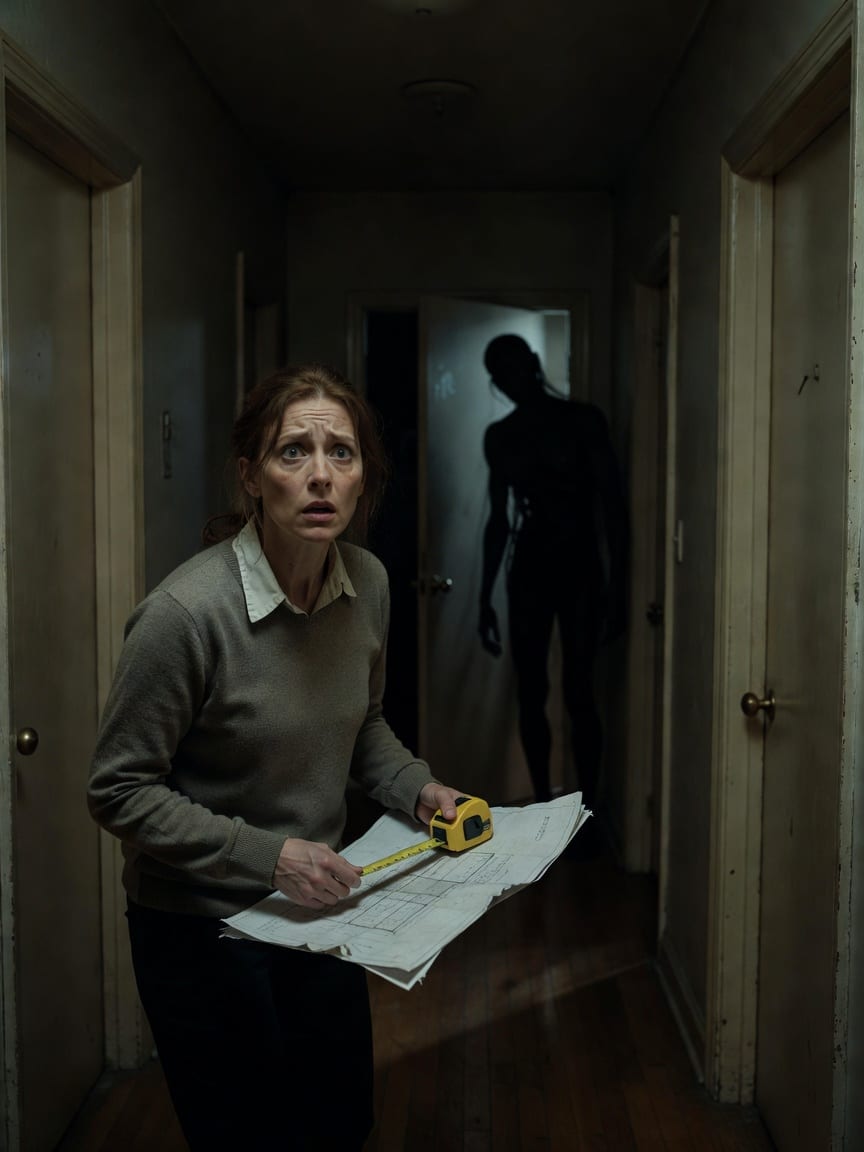
My front door has a dented gate and a dead hydrangea. I walked past it six times, trying to reach the corner shop just a hundred yards away. The pavement kept bringing me back to my own porch, and the shop's light never moved.
My morning started like any other, a quick walk to the corner shop from my home at Number 14, Elm Terrace. But after walking what felt like two minutes, I found myself back at my own front door, the shop no closer. I tried six times, faster and slower, but my street kept compressing, refusing to let me leave.