A German garrison NCO finds a promotion order signed by a Cold War Colonel who died last December. The document is impeccably valid, but the promoted corporal knows nothing.
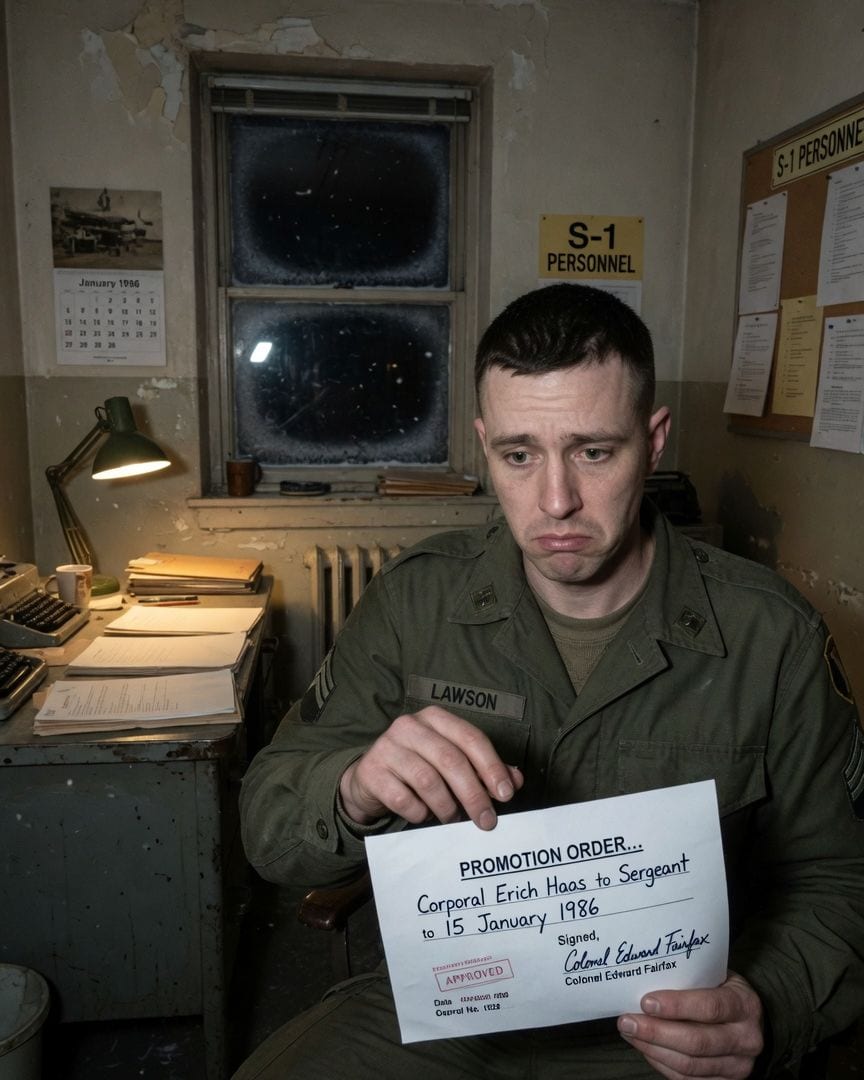
Staff Sergeant Julian Lawson, 32, sat at his desk in a cold German garrison, the winter air seeping in through the old window frames.
As a meticulous NCO in S-1 Personnel, he was accustomed to the rhythmic churn of paperwork, but this latest batch of promotion orders brought a sudden, jarring halt to his morning.
Among them, Corporal Erich Haas’s promotion to sergeant caught his eye. The order was dated January 1986. Julian frowned, a small, almost imperceptible crease forming between his brows.
He knew the promotion board that supposedly approved it wasn't scheduled to convene until February. He’d seen clerical errors before, but this felt different, too perfect in its wrongness. Then, his gaze dropped to the signature: Colonel Edward Fairfax.
Julian’s blood ran cold. Fairfax had rotated home in November and died of a heart attack in December. He was unmistakably dead. Yet, here was his impeccable signature, bold and authoritative, on a pristine promotion order.
The control number traced cleanly back through official channels, leaving no doubt about its administrative validity. The document sat physically on Julian's desk, solid and irrefutable.
Dismissing the thought as an elaborate, if morbid, prank, Julian pulled Corporal Haas’s complete personnel file. He expected to find some tell-tale inconsistency, a faded copy or a suspicious timestamp.
Instead, every page was perfectly in order: commendations, training records, a clean disciplinary history. The promotion to sergeant was logged, complete with the same impossible date and signatory. Julian cross-referenced the board members listed on the promotion order.
Captain Nora Sterling, his own commanding officer, was listed. Sergeant Major Sean Brooks, a grizzled NCO nearing retirement, was another. The third, a Major named Davies, had no record of ever serving on a promotion board, let alone this one.
Julian then checked Fairfax’s final sign-off log, a physical ledger where the Colonel's last official acts were recorded before his rotation. There was no entry for Haas's promotion.
Yet, the signature on the physical order Julian held was undeniably Fairfax's, a detail Julian, trained in document verification, couldn't ignore. He ran a quick digital headcount check for Haas's company.
The digital roster and the physical headcount provided by the company clerk matched: Haas was listed at his original rank, Corporal.
The promotion existed only in his personnel file and on this single, impossible order, a bureaucratic ghost that haunted the records but had no presence in the world.
Unable to reconcile the conflicting realities, Julian decided to confront the source directly. Late that evening, he made his way to Haas's barracks.
The air was thick with the smell of stale coffee and industrial cleaning supplies, a common scent in the old, concrete buildings. He found Haas’s bunk, identifiable by his name on the company’s internal duty roster, neatly made.
In the common room, tucked away in front of a flickering television set, Corporal Erich Haas sat engrossed in a sitcom, still wearing his Corporal stripes. Julian approached him, the impossible promotion order clutched in his hand.
“Corporal Haas,” Julian began, his voice carefully neutral, “I need to ask you about your promotion to sergeant.” Haas blinked, turning from the screen, a look of genuine confusion on his face. “Sir? Promotion? I haven’t heard anything.”
Julian held out the order, its crisp paper a contrast to the casual barracks setting. Haas took it, his eyes scanning the impossible date, the dead Colonel’s signature, then his own name with its phantom new rank.
He looked up at Julian, a flicker of something unreadable, almost vacant, in his eyes.
Julian reported the discrepancy to Captain Nora Sterling the next morning. Sterling, a pragmatic officer who valued efficiency above all else, initially dismissed it as a systemic glitch, a bureaucratic snafu that would correct itself over time.
She was clearly annoyed, seeing it as an unnecessary distraction, but agreed to initiate a formal inquiry, which Julian knew would take weeks to yield anything concrete. Julian, however, couldn't let it go.
The unreadable flicker in Haas’s eyes, the impossible signature, the sheer, perfect wrongness of it all, gnawed at him.
He began to systematically search the central records archive, a vast, dimly lit room filled with rows of metal filing cabinets and humming microfiche readers, for similar anomalies.
The fluorescent lights flickered overhead, casting long, dancing shadows that seemed to mock his efforts.
He found them. Not isolated incidents, but subtle discrepancies that, when viewed together, formed a disturbing pattern. Promotions issued by officers who had been dead or rotated out months prior, sometimes even years.
Transfers to units that had been disbanded decades ago. Service records with impossible dates of birth or enlistment that flatly contradicted other, equally official, documents within the same files.
They all bore a similar, archaic-looking control number, a sequence Julian couldn't fully trace through modern digital systems; it seemed to operate on a logic entirely its own.
He noticed a subtle commonality: these 'anomalous' personnel, when cross-referenced against physical rosters and duty logs, often had a 'count' issue.
They would appear on one manifest but not another, or be listed as one rank in one system and another elsewhere, almost as if the administrative system itself was trying to force them to fit, to reconcile an impossible number, twisting reality to match its own internal, meticulous logic.
A few days later, while Julian was eating lunch in the crowded mess hall, Sergeant Major Sean Brooks, a man whose name had appeared on Haas's phantom promotion board, approached his table.
Brooks, a man whose uniform always seemed to carry the faint scent of old paper and dust, slid into the seat opposite Julian.
His eyes, though tired, held a knowing, weary look that sent a prickle of unease down Julian’s spine. “Still digging into the old paperwork, Staff Sergeant?”
Brooks asked, his voice low and casual, but with an underlying current Julian couldn't quite place. Julian felt a sudden chill, despite the warmth of the mess hall. He hadn't told anyone but Captain Sterling about his deeper dive.
Brooks didn't threaten, but his next words hung heavy in the air.
He told Julian that some things were “best left alone,” that those who dug too deep into certain records often found themselves transferred to remote, undesirable posts, or their careers inexplicably stalled.
The plastic tray on Julian’s table seemed to rattle faintly.
Then, almost as an aside, Brooks mentioned he'd seen similar “ghosts in the machine” over his long career.
He recounted a specific incident from the early 1970s, involving a unit at a different garrison that always reported one man too many on morning roll call, even after exhaustive, physical recounts.
Every single day, an extra face in the formation, a shadow that never quite resolved into a solid identity, yet was undeniably present.
The paperwork always reconciled, eventually, the anomaly smoothed over and absorbed, but the physical reality, Brooks said, never did.
The extra man was simply… there, and then not, leaving no trace but the lingering sense of a number that didn't add up, a persistent and impossible echo.
Julian pressed Brooks, the image of Haas's blank stare returning to him. He showed him the Haas order again, the dead colonel's signature, the impossible board date.
Brooks sighed, a sound of profound, tired resignation that seemed to carry the weight of decades. “The board never convened, Staff Sergeant,” he admitted, his voice barely above a whisper.
“I was simply told to sign off on a pre-prepared set of orders, including Haas’s. Told not to ask questions. It happens.”
He confirmed Julian's suspicion: this was a recurring, unspoken practice, an open secret among a select few NCOs and officers who understood, without ever truly understanding, the necessity of the impossible.
Brooks then revealed a deeper truth: the garrison’s old, analog records system—a massive, intricate card catalog and ledger system, meticulously maintained alongside the modern digital databases—sometimes 'generates' these discrepancies itself.
He called it, with a chilling lack of drama, 'the old ledger’s hunger.' The archaic 'control numbers' Julian had been trying to trace?
Brooks explained they were part of an ancient system, predating even his long service, used to 'balance' the ledger, to force its internal logic to make sense, regardless of external reality.
He led Julian to a rarely used, locked back room within the S-1 office, a room Julian hadn't known existed. The air inside was thick and still, smelling of parchment and damp earth.
In its center sat a heavy, dust-covered wooden desk, and on it, a massive, leather-bound ledger, its pages yellowed with age, its cover deeply worn and scored as if by time itself.
Brooks opened it, revealing meticulous, handwritten entries detailing similar 'corrections' across rotations and dates, going back decades, a silent, ceaseless record of impossible events.
Brooks opened the ancient ledger to a random page. Julian leaned closer, his eyes scanning the faded script, each curl and flourish of ink centuries old.
He saw entries for promotions like Haas’s, phantom transfers, and soldiers listed as being in two places at once. Each entry had a column marked 'Reconciliation.'
Next to many of the anomalous entries, there was often a name, sometimes a date, but sometimes just a single, unsettling word: 'Retained.' Julian's breath hitched, a cold knot tightening in his chest.
He began to flip through the pages, a cold dread building, seeing the pattern repeat across the decades: every few years, an impossible promotion, an extra man on a roster, a soldier listed as being in two places at once.
The ledger was not just a record; it was an active participant, a silent, administrative entity. Then, a specific entry caught his eye, halfway down a page from 1958.
It was for a 'Private Julian Lawson,' promoted to Corporal by a board that never met, signed by a Colonel who was deployed to Korea at the time. The 'Reconciliation' column next to it simply read: 'Retained.'
Julian stared at his own name, his own rank, from decades before he was born, in a ledger that predated him, a ledger that seemed to know him intimately.
He looked up at Brooks, his face pale, the full, terrifying implication of the pattern crashing down on him.
Brooks’s weary gaze met Julian’s, confirming his unspoken fear. “The ledger isn’t just a record, Staff Sergeant,” Brooks said, his voice flat, devoid of any surprise or emotion, as if stating an obvious fact. “It’s an active system.
Always has been.” He explained that the garrison, built on an ancient, forgotten site, had always been prone to 'anomalies'—unaccountable occurrences, strange disappearances, or the inexplicable presence of extra personnel.
Over centuries, the base’s administrative system, beginning with that very ledger, had developed a horrifying method to 'account' for these discrepancies.
It would subtly draw in names, ranks, and orders from living personnel, creating duplicates or phantom identities, to 'fill' some kind of void, to make the numbers feel right, even if the physical reality was fundamentally wrong.
The 'Retained' entries, Brooks clarified, were for those whose identities, or parts of them, were absorbed, duplicated, or subtly altered by the system.
They continued their lives, mostly unaware, but a piece of their 'accountability'—their very existence within the military’s meticulous records—was now tied to the ledger. The dead colonel’s signature, Haas’s phantom promotion—these were not errors.
They were the ledger’s active, bureaucratic ways of creating or modifying 'personnel' to maintain its own internal, impossible balance, reaching across rotations and dates.
It was an administrative ghost, a bureaucracy trying to account for something fundamentally unaccountable, making it real on paper to manage the unmanageable, a silent engine of falsified existence.
A profound sense of violation washed over Julian.
He now understood that a part of him, or an echo of him, had been 'Retained' by this system for decades, a phantom entry in a ledger that claimed a piece of his identity, decades before his birth.
He couldn't accept it. He gathered his evidence: Haas’s order, the impossible control numbers, the disturbing patterns he’d found in the central archive, even the entry bearing his own name in the ancient ledger.
He took it all to Captain Sterling, laying out the horrifying coherence of it, the way every clue clicked into place, not as random errors, but as a deliberate, systematic manipulation.
Sterling listened, her face initially a mask of shock, then slowly hardening into a cold, almost resigned expression. She admitted that the 'anomalies' were known, at the highest levels of the garrison command, but were considered 'containable.'
The official, unspoken policy, she explained, was not to fight the ledger, but to integrate its phantom records, to 'reconcile' them into the official, digital system.
The 'accountability that cannot be,' she revealed, was the command’s cold, pragmatic way of dealing with the unexplainable. It created an official, documented existence for things that shouldn’t exist, making them real on paper, and thus 'managed.' Julian’s heart sank.
He realized there was no escape, no way to undo it. The system was too old, too entrenched, too powerful. His own command was complicit in maintaining the illusion, in feeding the ledger its phantom entries, in perpetuating the lie.
He couldn't fight it, and he couldn't undo what had been done to him, or to Haas. He was now just another entry, another part of the pattern, his own identity subtly fractured by the impossible bureaucracy.
Julian’s remaining six months at the German garrison passed in a blur of hollow efficiency. He continued his S-1 duties, processing transfers and promotions, but with a new, chilling awareness.
He saw Corporal Haas occasionally, still a corporal, still unaware of the administrative ghost claiming his future rank.
Julian noticed small things now: a name on a manifest that seemed to flicker out of existence the next day, a formation that, for a split second, appeared to have one too many men in the periphery before a quick glance corrected it.
He saw the ledger’s subtle, ceaseless work everywhere, a quiet hum beneath the veneer of military order, a reality far more profound and insidious than the one printed on official forms.
He never spoke of the ledger again, not to Brooks, not to Sterling. He knew it was pointless. The truth was understood, but it could not be undone, or even acted upon.
He was simply left knowing, and the knowing was a permanent scar.
Julian Lawson finished his tour in Germany and returned to the States, opting for discharge rather than re-enlistment. He found a quiet job in logistics, far from any military records. He tried to forget, but he couldn't.
Sometimes, he caught his reflection in a window or a polished surface, and for a split second, he saw not his own face, but a younger, unfamiliar one, briefly superimposed, before vanishing.
It was a faint, almost imperceptible shift, a fleeting echo from another time.
He wondered if that other Julian Lawson, the one 'Retained' in 1958, was still out there, somewhere in the system, waiting for his promotion to come through, or if a part of him was still in that cold German garrison, a phantom entry in an ancient, hungry ledger.
He never knew.
Years later, a new S-1 NCO at the German garrison, reviewing old personnel files, found a promotion order for a Staff Sergeant Julian Lawson, dated January 1987, signed by a Colonel who'd rotated home months before.
The control number traced cleanly back through channels, but the board that cut the order was never convened. The 'Reconciliation' column in the ancient ledger next to the entry read, simply: 'Retained.'
If this one got to you
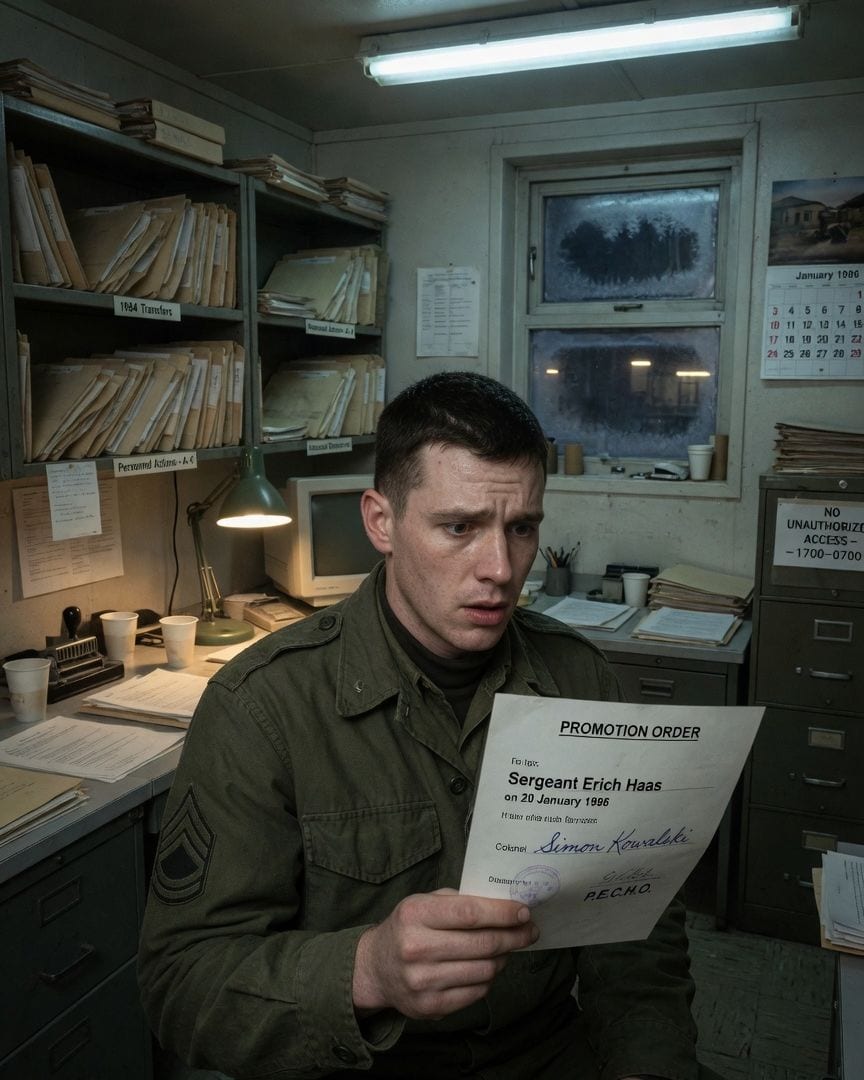
A corporal's promotion order arrived today, signed by a Cold War colonel who died last month. The system still says it's real.
Corporal Erich Haas suddenly found himself promoted to Sergeant, a full month before his board was even scheduled. The promotion order, dated January 20, 1986, bore the unmistakable signature of Colonel Simon Kowalski, a man who had died the previous December. Despite this impossible truth, the military's irrefutable system confirmed the order's absolute validity. Records administration staff could only show Haas a duplicate, stamped with a mysterious, smudged 'P.E.C.H.O.' code. Driven by a growing dread, Haas later unearthed another historical discrepancy: a promotion order for a soldier signed by a general who had died a year before the document's date.
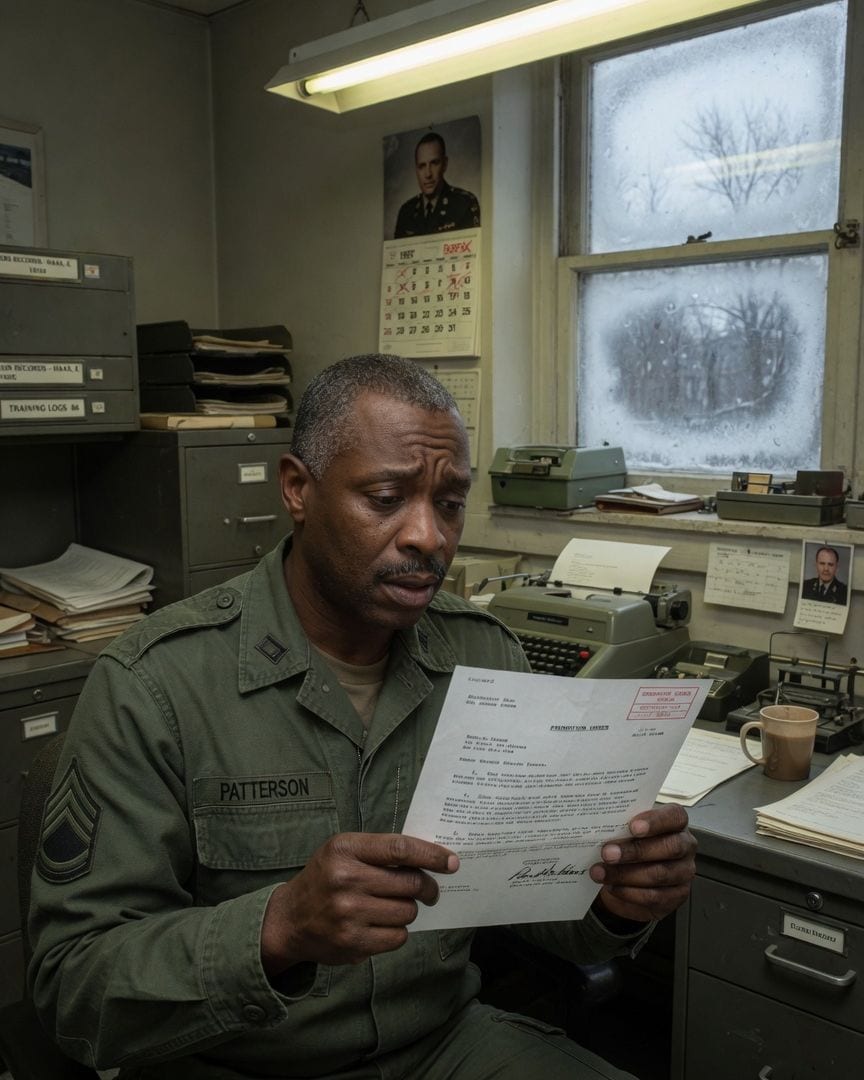
Staff Sergeant Felix Patterson held a promotion order for a young corporal, signed by a Cold War colonel dead for a full year.
Staff Sergeant Felix Patterson felt the German winter chill as he stood in the base admin office, holding Corporal Erich Haas’s promotion order. The young clerk, Private Davenport, wrung her hands, confirming the impossible: Colonel Fairfax’s signature was genuine, despite the colonel having been dead for a full year. A deep, cold dread settled in Felix’s gut, making the office air feel heavy and silent around him. He spent days scrutinizing Haas’s service record, soon uncovering a training certificate also bearing the deceased colonel’s signature, dated months after his death. This was no mere bureaucratic slip; these meticulously clean documents were fundamentally, impossibly wrong.
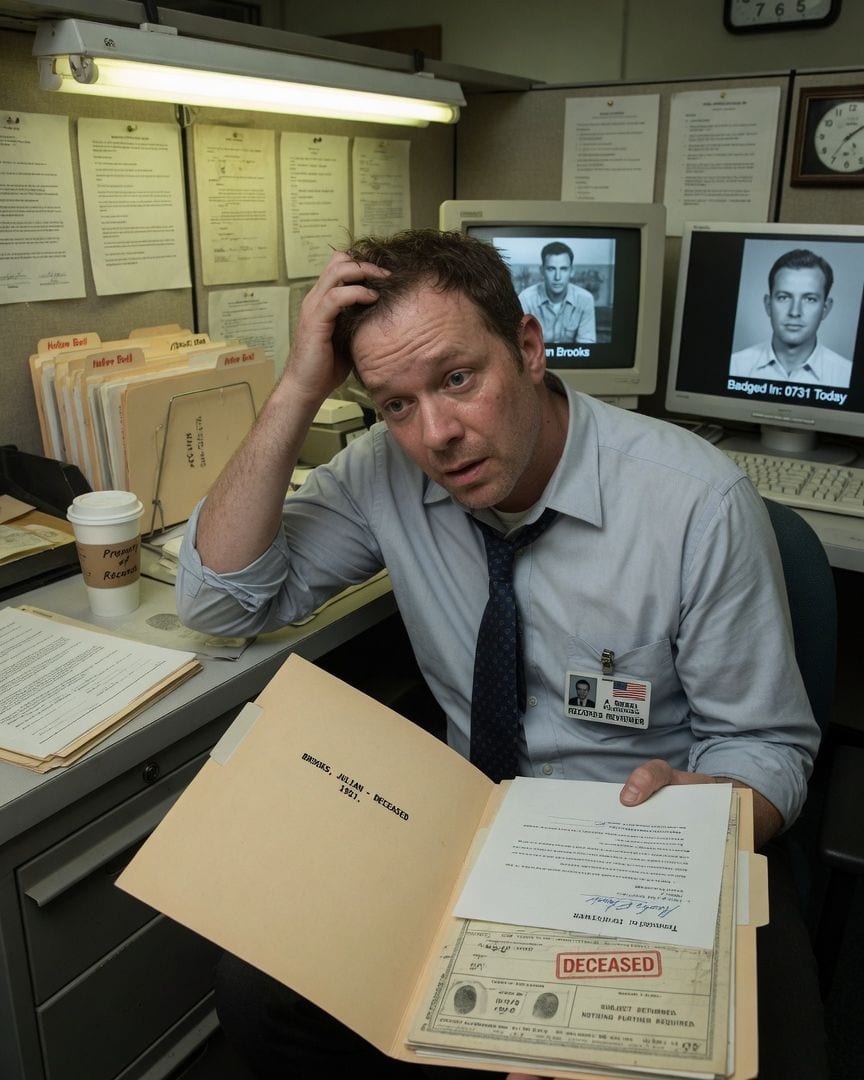
A government records reviewer found a Cold War file marked 'DECEASED – 1951.' It showed the man badged into the building this morning, then transferred by his own supervisor.
Anton Skeel, a meticulous government records reviewer, typically found his cubicle farm full of stale coffee and routine. But a slim folder marked 'RESTRICTED' shattered his quiet order: it contained a fingerprint card for Julian Brooks, a man officially dead since 1951. The system, however, showed Brooks badged into the building just hours earlier. Skeel's search revealed a file that simply kept writing, documenting a full career after Brooks’ official demise, culminating in a transfer order signed by Skeel’s own supervisor. The quiet hum of the office suddenly felt deafening as the impossible truth settled in.
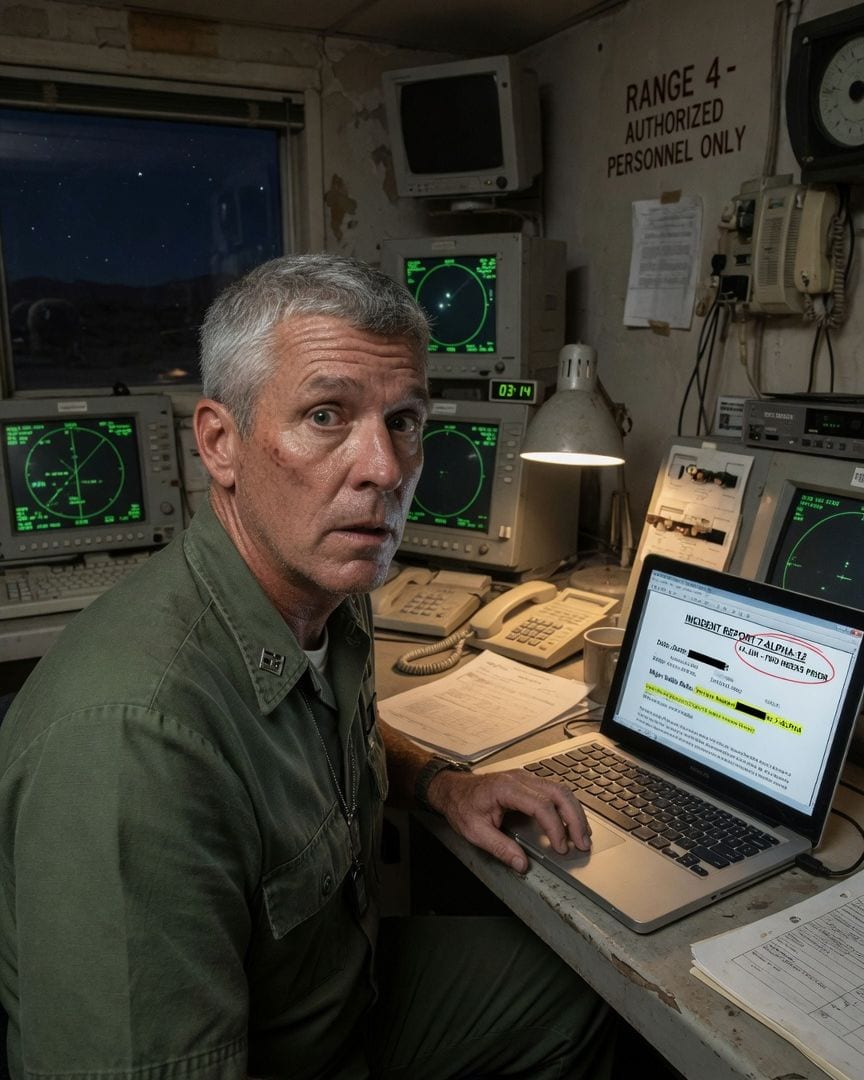
Major Hollis Rake, two weeks from retirement, reported a silent desert disc. His own report was already filed, dated two weeks before it appeared.
Major Hollis Rake, just two weeks from retirement after thirty-five years on a New Mexico desert range, found his predictable world upended. A silent, featureless disc, defying all known phenomena, appeared over the sled rail, its impossible presence confirmed by every instrument on the range. But the true unease began when Major Rake filed his meticulous incident report: it was already in the system, dated two weeks *before* the event even happened. His own name and service number were later found linked to the incident's code in his transfer disposition. Was his retirement just a clerical error, or something far more sinister?
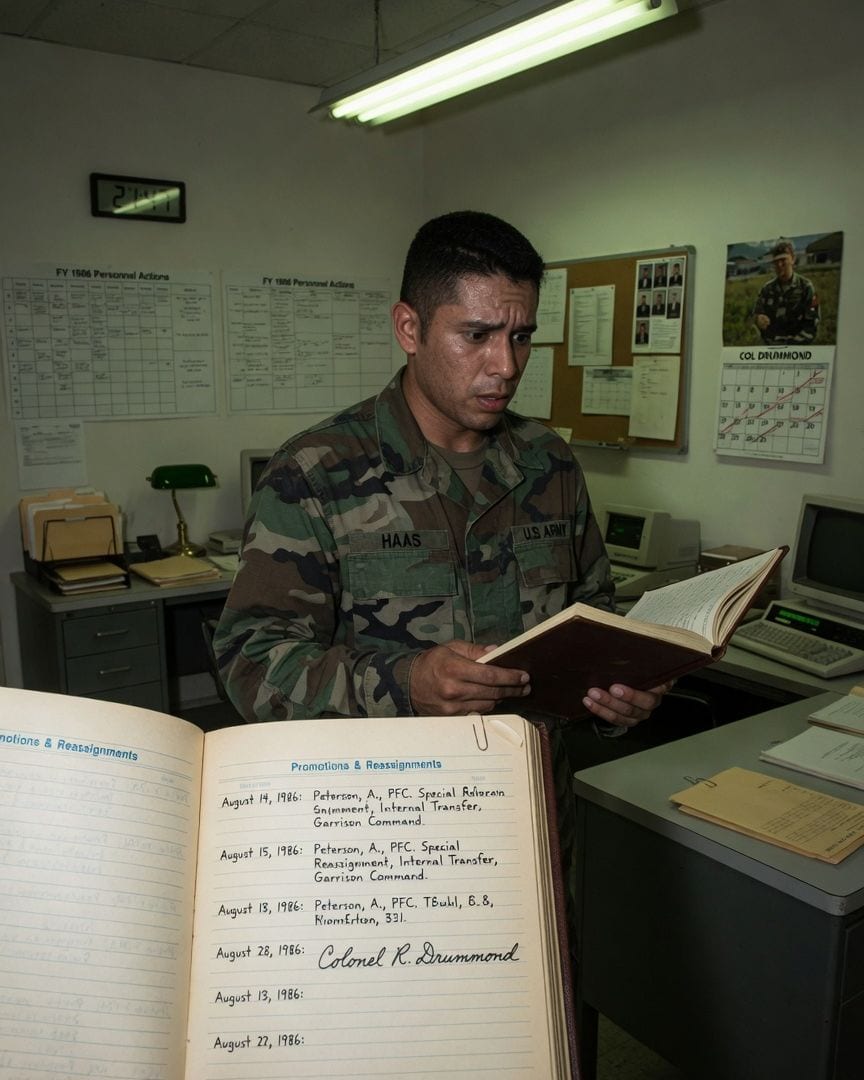
A Corporal finds a dead Colonel’s signature, the ink still dark and crisp, in an old 1986 logbook.
Corporal Marco Haas receives an impossible promotion order, signed by a Colonel who died months ago. The military system validates the dead man’s signature, leaving Haas to question how the impossible became official. He later finds the same crisp, dark signature in an old 1986 logbook, approving a transfer for a soldier already deployed.
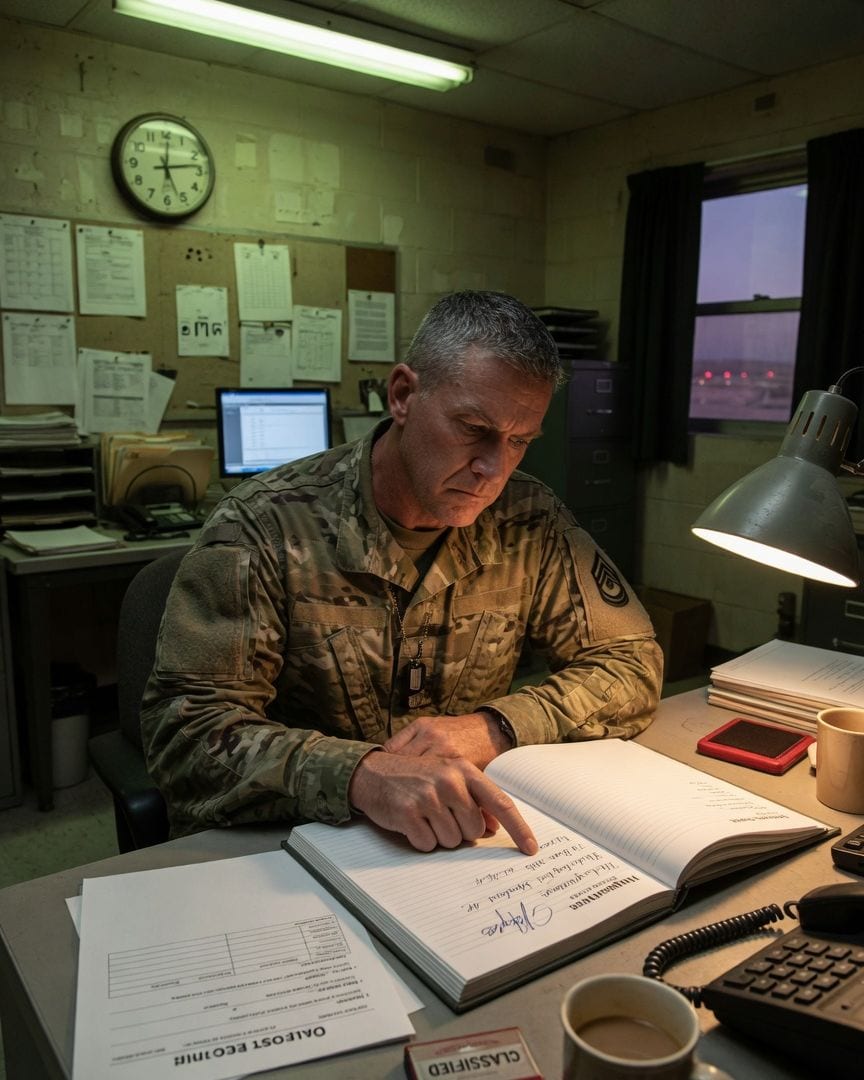
First Sergeant Oliver Pryor loaded forty men for the night jump. The recovery team reported forty-one, with his own signature approving a man he'd never seen.
First Sergeant Oliver Pryor, a creature of order, meticulously conducted his final check of forty men for a crucial night jump. As the C-130's engines growled under the desert moon, he ensured every detail was perfect. Hours later, a cold knot tightened in his gut when the recovery team reported forty-one jumpers were present and accounted for. Pryor then found his own undeniable signature on the manifest for a Specialist Felix Hughes, a man he couldn't recall, whose service record was flawlessly complete yet blank before his arrival at the outpost. How could an extra man appear, vouched for by his own hand?