My hotel lift grew a Floor 13 button last week, unlit and proud. A guest pressed it before I could stop them.
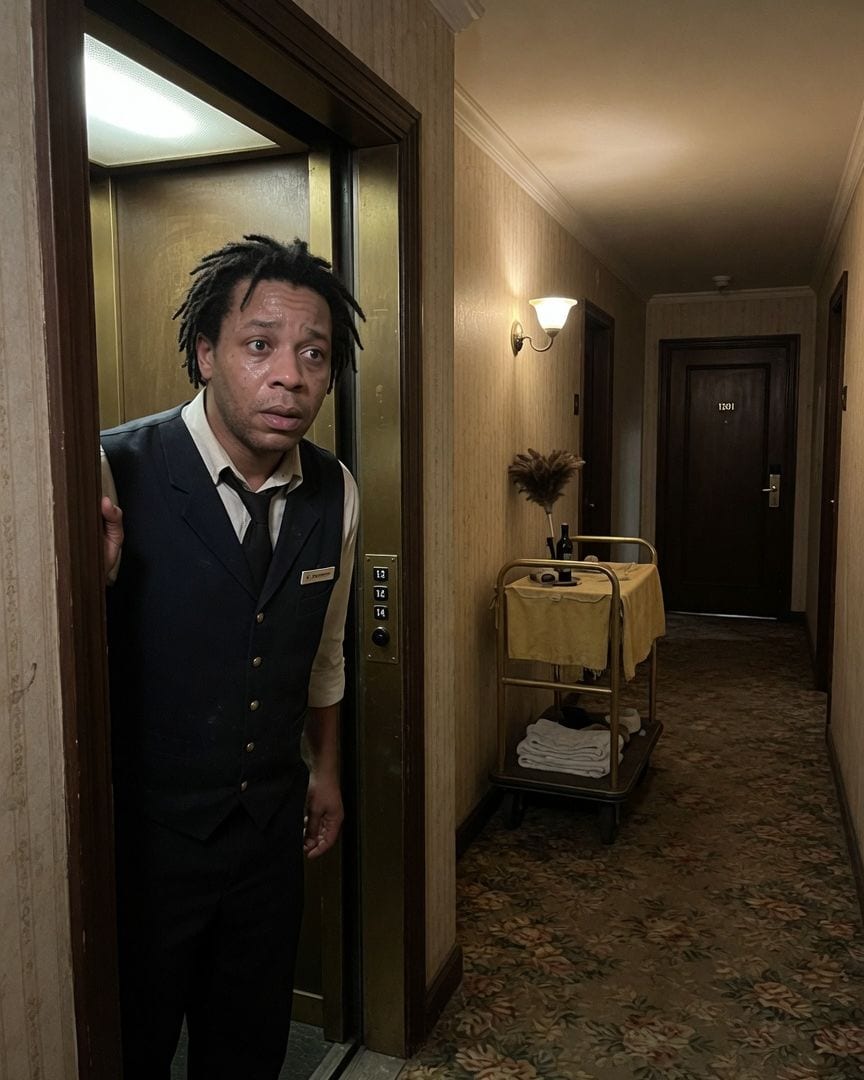
I’m Quentin Davenport, night porter at Hotel Blackwood, an old place with character, if you like that sort of thing. Most old hotels have quirks, and ours is the missing 13th floor.
The lift buttons jump from 12 straight to 14, always have. It’s a superstition, I tell new guests, something about bad luck or structural integrity. Last week, that changed.
I was wiping down the polished brass panel on Tuesday night, just after 3 AM, when I noticed it. Between 12 and 14, a new button had appeared, unlit, slightly proud of the panel, clearly labeled '13'.
It wasn’t there the day before, or the year before that. It simply was.
I was still staring at it, trying to process the impossible, the way my brain kept trying to reject what my eyes were seeing, when a guest, a businessman in a hurry to catch an early flight, jabbed his finger at it before I could even open my mouth.
The lift doors closed with a soft sigh, then rose, stopping with a gentle chime. The doors opened. It wasn’t the maintenance closet, not a solid wall, not even just a bare concrete shaft. It was a corridor.
Numbered doors, faded carpet, a dusty housekeeping trolley parked against a wall. A whole floor. A floor the building's fire plan, updated just last year, insists is solid concrete from top to bottom.
My rational mind screamed that this simply could not be here.
The businessman stumbled out of the lift on a lower floor, white-faced, muttering about 'hallucinations' and 'sleep deprivation'. He checked out minutes later, still looking like he’d seen a ghost.
I spent the next hour trying to convince myself it was a trick of the light, a faulty panel, a reflection, anything but what I’d seen.
But the button was still there, now dark again, flush with the others, a faint indentation for the number 13 pressed into its center.
Driven by a cold, stubborn curiosity that refused to be dismissed, I waited until the early hours, well past 4 AM, when the lobby was empty and the street outside was silent.
I took a deep breath, the stale air of the hotel filling my lungs, and pressed '13' myself. The lift rose, silent and smooth, and stopped with a barely perceptible jolt. The doors opened onto the same corridor.
It was eerily quiet, the kind of quiet that feels like a held breath, the air thick with the smell of old dust and something metallic, like ozone after a storm.
The carpet was a floral pattern, worn but intact, faded browns and muted golds, nothing like the modern, geometric decor on the other floors. My footsteps were muffled, swallowed by the oppressive silence as I stepped out.
The housekeeping trolley was old, brass-rimmed, with stiff, rusted wheels, its linen cover yellowed. Its contents were antique: feather dusters, a dark glass bottle of polish, a stack of linen towels that felt like brittle paper. This wasn't a prank.
This was a place. I walked the length of the corridor, counting doors. They were numbered sequentially, 1301, 1302, and so on. At the far end, the corridor bent sharply to the right. I reached Room 1301.
The door was slightly ajar, a sliver of darkness visible between the frame and the heavy wood. I pushed it open. Inside, a single, dusty bed stood against the far wall, covered by a thin, grey sheet.
On it, folded neatly, was an old, moth-eaten hotel uniform. It was a night porter's uniform, dark serge, with a brass-buttoned waistcoat that glimmered faintly in the dim light. Pinned to the lapel was a tarnished name tag.
It read, in elegant cursive: 'A. Carter.'
I stood there, the uniform in my hands, the name tag cool against my palm, its tarnished brass picking up a faint gleam from the distant corridor light. A. Carter.
Arthur Carter was the local historian, a regular at the coffee shop down the street, renowned for his encyclopedic knowledge of old town records and the area’s forgotten past. The connection felt impossible, yet undeniably concrete.
A prickle of profound unease snaked up my spine, chilling me despite the strangely warm fabric of the uniform.
The room was silent, save for a faint, almost imperceptible hum, like old, straining machinery, coming from deeper within the floor, somewhere beyond the walls I could see.
I glanced back at the lift, its polished doors reflecting my wide eyes, then down the long, silent corridor.
A shadow seemed to shift at the far end, where the corridor bent sharply, but there was nothing there, just the faded wallpaper. The air grew perceptibly colder, like something vital had been sucked out of it.
I pulled the uniform closer, the fabric strangely warm in contrast to the chilling air, and felt a sudden, overwhelming sense of being watched.
Not by a person, not by an animal, but by the place itself, its impossible geometry pressing in around me.
I left the uniform in my locker in the staff room, unable to put it back in that room, unable to throw it away. The next day, after a restless, dream-haunted sleep, I called Arthur Carter.
I feigned interest in the hotel's long, convoluted history, a new personal project, I told him. He was hesitant, his voice raspy with age and perhaps suspicion.
When I casually mentioned finding an old night porter's uniform with the name 'A. Carter' on it, he went utterly silent. A long, uncomfortable pause stretched between us, filled only by the crackle on the phone line.
Then, a strained invitation to his study, 'this afternoon, if you're free.'
Arthur's house was crammed with books stacked to the ceiling, yellowed papers spilling from binders, and the cloying scent of aged paper and dust.
He looked at the uniform I’d brought, his eyes wide and haunted as he gently took it from my hands. 'Alistair,' he whispered, his voice thin with a brittle emotion I couldn't place. 'My great-uncle.'
He explained that Alistair Carter was a night porter at Hotel Blackwood in the 1930s. He vanished without a trace, presumed to have run off with a lover or some stolen cash. No body, no note, just gone.
Arthur admitted there were whispers, vague stories of a 'phantom floor' that appeared and disappeared, something his grandfather, a hotel maintenance man, had hinted at in cryptic diary entries he’d never fully understood.
He pulled out a dusty, leather-bound photo album from a teetering pile. There, among faded sepia prints of old hotel staff, was Alistair Carter.
He wore a uniform identical to the one I held, a faint, almost spectral smudge of a man in time.
The resemblance to Arthur was striking in the jawline, but the most unsettling detail was the way Alistair's eyes seemed to bore out of the photograph, a deep, unsettling sadness in them, as if he knew something terrible was coming.
Arthur then showed me another photo, this one from a few years later, depicting a group of stern-faced men in what looked like a makeshift laboratory within the hotel's basement.
Wires snaked across tables, strange brass contraptions gleamed under harsh, bare bulbs. 'They called themselves the Blackwood Society,' Arthur explained, his voice low, almost a murmur. 'The hotel owner, a reclusive industrialist named Julian Blackwood, funded them.
They were obsessed with spatial anomalies, with 'anchoring' things that shouldn't exist. Phenomena, temporal pockets, echoes...' His voice trailed off, his gaze fixed on the photograph, as if seeing something beyond the faded image.
After my meeting with Arthur, the hotel felt different. The air in the lobby seemed heavier, thick with an unspoken weight, the shadows deeper and more prone to tricks of the light.
I started noticing things: the lift sometimes paused on 13 for a fraction of a second, the light flickering, even when I hadn't pressed the button.
A faint scent of old dust and that metallic ozone lingered in the air, a constant phantom perfume.
I tried to return the uniform to floor 13, thinking it might appease whatever restless energy lingered there, or perhaps just to get it out of my sight, but the button for 13 was gone again.
The panel was seamless from 12 to 14, as if my sanity had simply conjured the anomaly. It reappeared two nights later, glowing faintly, almost invitingly. I hesitated, my heart a dull thrum in my chest, but my resolve hardened.
I had to know. I took the lift up. The corridor was as I remembered, silent and still. I walked to Room 1301, pushed the door open, and carefully placed Alistair's uniform back on the dusty bed.
As I turned to leave, the door slammed shut behind me with a heavy, echoing thud that made the hair on my arms stand on end. I jumped back, my heart pounding against my ribs like a trapped bird.
I tried the handle, twisting it frantically, but it was stuck fast, locked from the outside by some impossible force. Panic clawed at my throat, a cold, sharp dread.
The air in the room grew impossibly cold, the temperature dropping several degrees in an instant, and from the walls, faint and distorted, a voice whispered my name. 'Quentin...'
it hissed, a sound like dry leaves scraping over stone, or static on an old radio. I hammered on the door, shouting, 'Hello? Is anyone there?' but only the silence answered, absorbing my voice without an echo.
The hum from deeper within the floor grew louder, a low thrumming that vibrated through the floorboards and up through the soles of my shoes.
I felt a palpable presence, unseen but overwhelming, pressing in on me from every direction, its weight crushing.
After a terrifying minute that felt like an eternity, I managed to pry the door open with a desperate heave, my shoulder aching as the old wood finally groaned, tumbling back into the corridor.
The lift doors stood open, beckoning, and I didn't hesitate, scrambling inside, pressing 'L' repeatedly until it descended.
The next morning, exhausted and raw, I confronted Arthur, my voice shaking as I described the slamming door and the whispering voice, the sudden drop in temperature. He listened, his face pale, his eyes wide with a familiar terror.
He finally conceded, his shoulders slumping. 'My grandfather… he kept a secret diary,' Arthur confessed, his voice barely audible, his gaze fixed on some point beyond me. 'He was part of it, in a way.
Not the Blackwood Society, not one of the 'Gentlemen Scientists' as they called themselves, but he helped maintain their… equipment. Their systems. He believed they were trying to map a kind of 'temporal bleed' in the hotel.
The 13th floor, he wrote, was a focal point. A place where time was… elastic.' Arthur retrieved a small, leather-bound book from a hidden compartment in his desk, its cover worn smooth from age and handling.
The pages were brittle, filled with spidery, faded handwriting that looked like it would crumble if touched too hard. He opened it to a specific entry, pointing with a trembling finger. 'They weren't just mapping, Quentin.
They were trying to capture it. To anchor it. They believed certain individuals had a 'resonance,' a unique frequency that could stabilize the anomaly. Alistair… he was one of them.'
Arthur’s finger traced a line across the brittle page, revealing a hastily scrawled note in the margin. 'The diary describes 'cycles.' The floor would manifest, then recede, almost like a tide. And each time, it needed… a new anchor.'
He looked up, his eyes filled with dread, reflecting the terrible understanding that had settled between us. 'Alistair didn't just vanish. My grandfather believed he became part of the resonance.
Part of the floor itself, keeping it tethered, a living echo within its impossible loop.'
The diary entry detailed how the floor was not merely a hidden level, a superstitious void, but a re-manifestation of a past iteration of the hotel, specifically from the 1930s, existing in a continuous, albeit hidden, loop.
'That hum you heard, the cold, the voice,' Arthur continued, his voice barely a whisper, 'it was the floor. Or the echoes within it. Reacting to you. Recognizing you. You see, the experiments… they succeeded.
The floor exists because it’s perpetually held in place, drawing on certain energies. And sometimes, that energy is… human. That uniform, Alistair's uniform, it's a relic of that time. And it called to you. The floor called to you, Quentin.'
Arthur, trembling now, pulled out a final, yellowed photograph from an old hotel ledger, its edges frayed like old lace.
It was a group photo of the 'experiment' team and hotel staff from the 1930s, taken in what looked like the hotel's old boiler room, pipes snaking across the stone walls.
In the center, unmistakable, was Alistair Carter, the spitting image of the man in the uniform I'd found.
But Arthur's finger pointed to another figure in the background, a younger man, also a night porter, whose face was blurred by the passage of time and poor focus, but whose build and posture were eerily familiar.
He stood slightly apart from the group, his gaze seeming to drift towards something unseen.
'My grandfather wrote a note about this man,' Arthur whispered, his voice barely audible, his eyes wide with a terrible realization that mirrored my own dawning horror. 'He said this man was 'the new anchor,' after Alistair.
After the initial experiments, they found another. Someone with the same… resonance. Someone to take Alistair’s place and keep the cycle going.'
Arthur's gaze locked onto mine, a desperate, fearful plea in his eyes, as if begging me to deny the impossible truth he was about to deliver. 'His name was... Quentin Davenport.'
I stared at the blurred face in the photograph, trying to make out the features, then at my own reflection in the glass of the photo frame, distorted and pale.
The implication hit me like a physical blow: my own family, my own name, not just a witness to this impossible place, but tied to it, not just as a recurring participant in the cycle, but as a destined anchor.
I was always inside it, unknowingly waiting for my turn.
Arthur’s words shattered my perception of reality. The full, horrifying truth detonated in my mind, reframing every strange event, every inexplicable detail. The 'experiments' weren't just about mapping an anomaly; they were about capturing and sustaining it, using living anchors.
The Davenport family line, for reasons unknown, possessed a specific 'resonance' that made them unwitting, perhaps even unwilling, agents in this macabre process.
Each time a Davenport took the night porter role at the Blackwood, the floor could manifest again, drawing on their presence, their life force, to stabilize its impossible geometry.
The previous Quentin Davenport, my namesake, had been lost to it, becoming part of its fabric, ensuring its continued, cyclical existence.
The floor wasn't just a temporal echo; it was a kind of trap, feeding on the 'lost time' and 'unspent potential' of those caught within its loop, gradually consuming them.
The hum I heard, the cold, the whispering voice – it wasn't a ghost. It was the floor itself, or the trapped echoes within it, reacting to me, recognizing me as the current anchor, the next in line.
I understood the 'Road That Returns' now, the cryptic phrase Arthur’s grandfather described in his diary: the floor itself was a road that always returned you to its own impossible, consuming loop.
My rational mind, for the first time, had nothing left to say. Every clue, every impossible detail, every chilling sensation, clicked into place with horrifying coherence.
I was not merely observing the wrongness; I was its inheritor, its next victim, the very engine of its recurrence.
I knew then that I couldn't simply walk away. The choice had been made for me generations ago.
I had to confront it, to try and break the cycle, or at least understand its full, terrible extent before it consumed me entirely.
I returned to the hotel that night, a cold dread a constant companion, heavier than any night shift. The lift button for '13' now glowed faintly, a soft, pulsating light, almost invitingly, like a beacon. I pressed it.
Stepping out, the hum was louder than ever, a deep thrumming that resonated in my bones, vibrating through my teeth.
The air was colder, heavier, charged with the same metallic ozone scent, so thick it felt like I was breathing rusted air.
I walked past Room 1301, following a path suggested by Arthur's grandfather's diary: a hidden door behind a tall, ornate bookcase, camouflaged into the old, faded wallpaper.
I ran my hand along the seam, pressed where the diary indicated, and felt a soft click. The door swung inward, revealing a small, dusty office. This was the 'experiment room.'
It was filled with archaic, brass-and-wood equipment, wires snaking across a workbench like desiccated vines, a faint, sweet smell of formaldehyde in the air. On a desk, amidst the ancient apparatus, I found a single, bound ledger.
It was the hotel's original guest register, but it was open to a page dated 1937, listing guests for Floor 13. Room numbers, names, and check-in/out dates, all meticulously recorded. All impossible.
I flipped through the brittle pages, my fingers tingling. Another page, dated 1948. Another, 1961. All for Floor 13, all with impossible dates that contradicted every official record and fire plan the hotel had ever produced.
Then, my blood ran cold. I found it. An entry for 'Quentin Davenport,' checked in, but never checked out, dated 1972.
The ledger was physically real, its paper yellowed, its ink faded, its leather cover cracked with age, yet it detailed a floor that officially didn't exist and accounted for decades of impossible activity.
This was the artifact that could not exist, examined up close, real, dated, and checkable. The ordinary explanation died for good, suffocated by the sheer, undeniable weight of tangible proof.
I pocketed the ledger, the dread a cold, unshakeable certainty now. The cycle was real. My connection was real. And the floor was waiting.
I left the Hotel Blackwood that night, the impossible ledger clutched tight in my hand. I never went back.
I sent the ledger to Arthur Carter, who, after examining its impossible entries and historical weight, quietly vanished from his small town, leaving no forwarding address.
His house was sold, his archives donated to a regional university where, I imagined, the ledger would be dismissed as an elaborate forgery, a curious but irrelevant piece of local folklore.
The Hotel Blackwood still stands, still skips floor 13 on its official plans. The lift buttons, I heard from an old colleague who sometimes calls, still jump from 12 to 14.
But sometimes, they say, a faint, unlit '13' appears, just for a moment, between them.
I now live a quiet life, far from the city, in a small house with a garden I rarely tend. I avoid old buildings, especially hotels.
I sometimes catch myself humming a tune I don't recognize, an old, faint melody that seems to echo from somewhere deep inside me, a resonance that feels both alien and familiar.
I often take long drives to clear my head, to feel the miles beneath my wheels, but sometimes, no matter the turns I take, no matter how many miles I cover, I find myself driving past the same familiar landmark, then the same quiet street, and back to the same intersection I started from, the mileage on my odometer quietly proving I went somewhere, though I never left.
The road always returns.
His new neighbor, Hannah Oakley, sometimes sees him sitting on his porch late at night, staring at nothing, a peculiar, distant look in his eyes. One evening, she walks over, a plate of cookies in her hand.
'Quentin, are you alright?' she asks, her brow furrowed. 'You look like you've seen a ghost.' He turns, a faint, wrong little smile on his face, and replies, 'I think I am the ghost, Hannah.
Or at least, I'm part of one now.'
If this one got to you
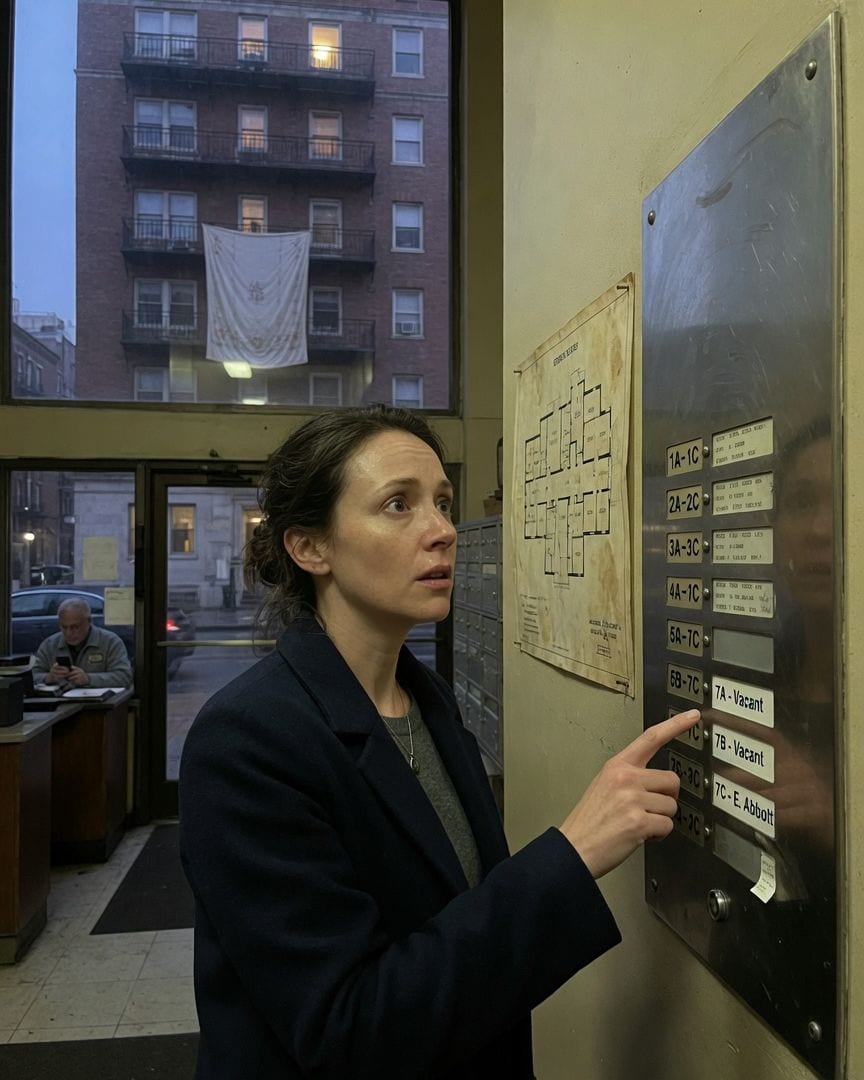
My building grew a seventh floor today, where only sky should be. On its darkest door, a nameplate reads 'E. Abbott'.
For three years, I've lived in apartment 3B of The Sterling Arms, a familiar six-story building. Every morning, I glance up at my window from the parking garage, a routine check. But this morning, my breath caught: a seventh floor, complete with balconies and a soft yellow light, now sat impossibly above the familiar roofline where only sky should have been.
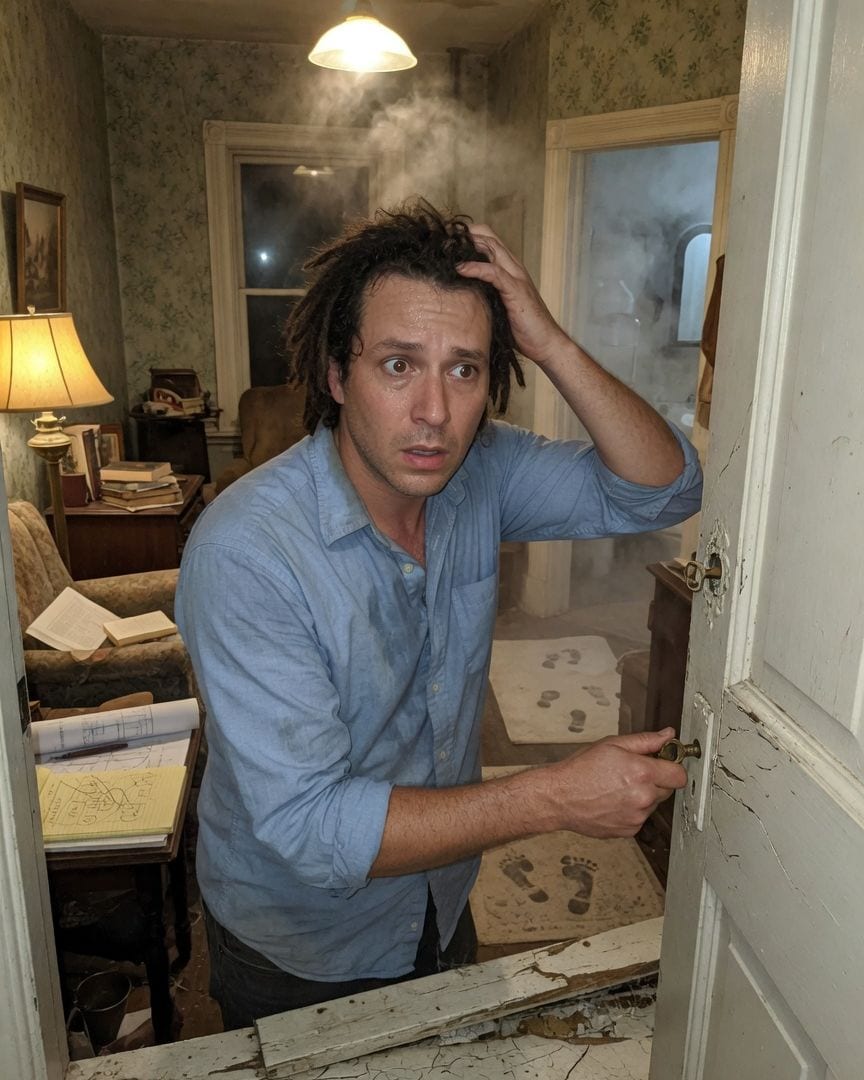
The bath filled itself at 9:30 PM. My main house water was off. Wet footprints led from the tub to a locked airing cupboard.
As an architect, I pride myself on logic. Moving into my inherited Victorian house was supposed to be a quiet fresh start, but on the third night, I heard the impossible. Even after I shut off the main water to the entire house, my clawfoot bath upstairs ran full, warm, and steaming at 9:30 PM.
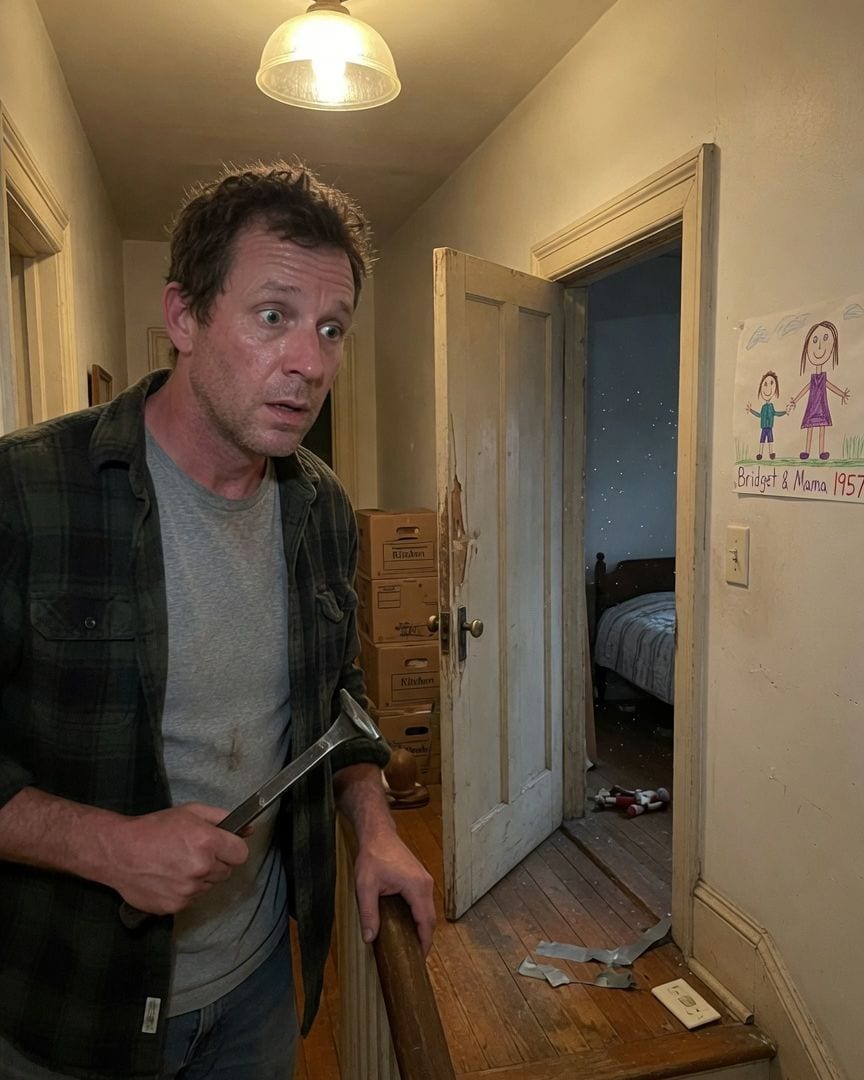
My landing light switches itself off at 9:40 every night. I've watched the switch flick down under nothing, the tape peeled back. The house holds its breath.
My great-uncle's old house was a quiet gift, a place to finally settle. But as I unpacked, a strange worn path on the floorboards led me to a small, barely visible door, perfectly blended into the wall. It was undeniably locked, and felt like a deliberately obscured secret.
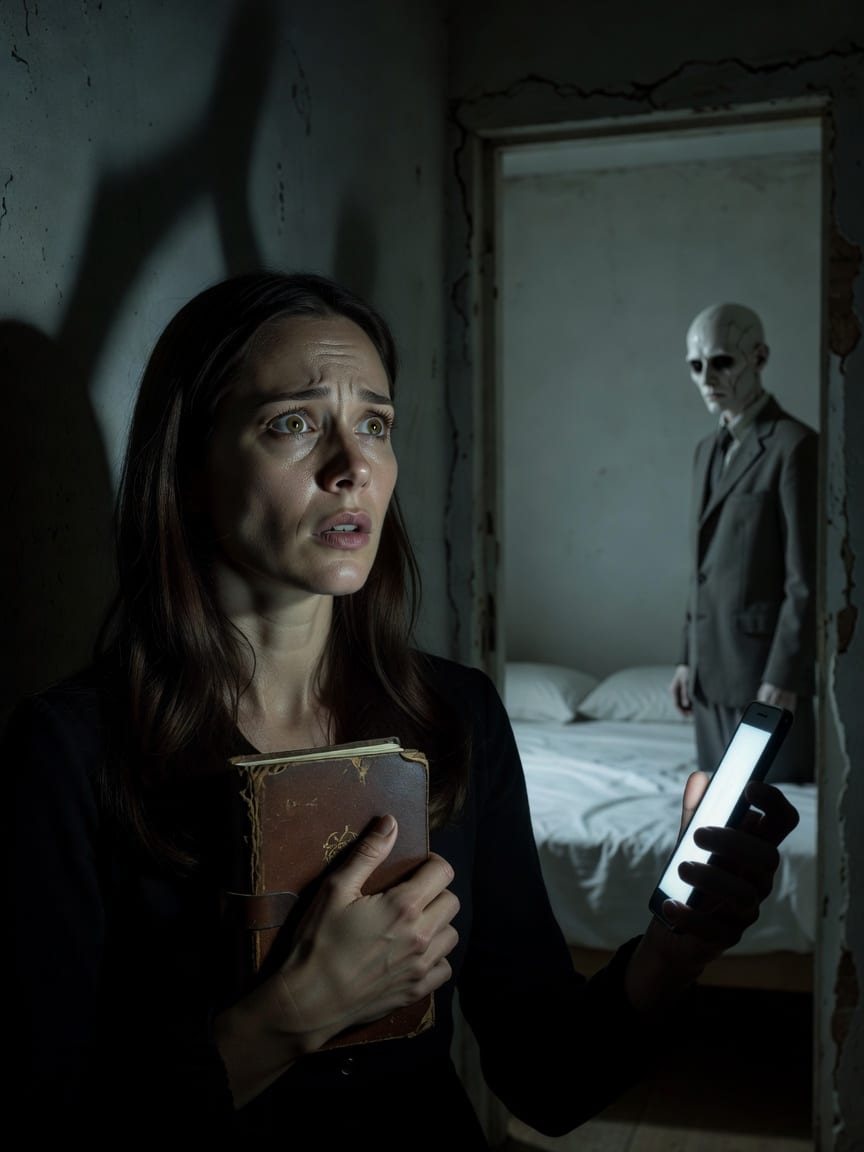
Behind a plastered-over doorway, I found a room. Papered, carpeted, and furnished with a made bed, sealed for decades. The air was dead still, but the bed wasn't dusty. My council tax bill only lists five rooms.
I'm Claire, an architect, meticulously planning my new Victorian terrace renovation. But when I uncovered a hidden room behind a wall, everything I knew about time and decay shattered. The bed was perfectly made, the air still, yet there was no dust, only an unnerving cold.
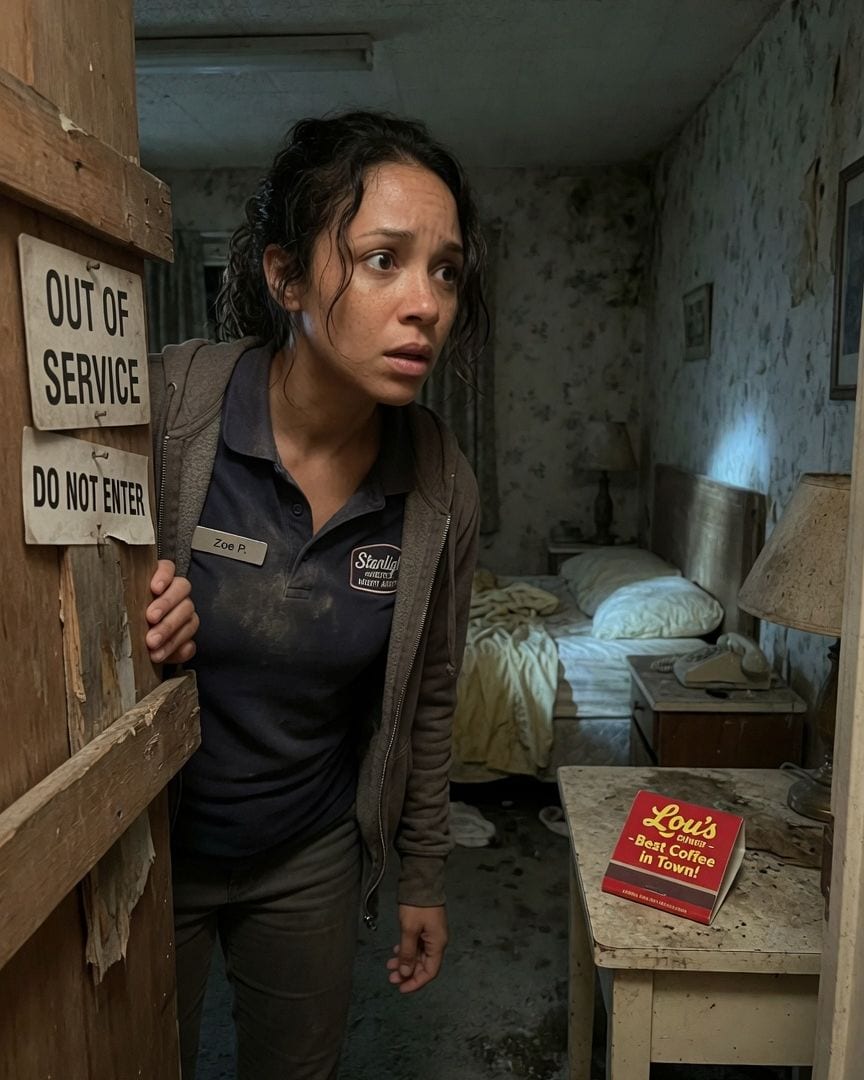
My motel register shows a check-in for Room 9 at 3:33 AM, in my own handwriting. Room 9 has been out of service since the flood.
Working the quiet night shift at the Starlight Motel, I found a chilling new entry in the guest register. My own initials had checked someone into Room 9 at 3:33 AM. The problem? Room 9 has been officially boarded shut and out of service for six months, its key still hanging untouched on the wall.
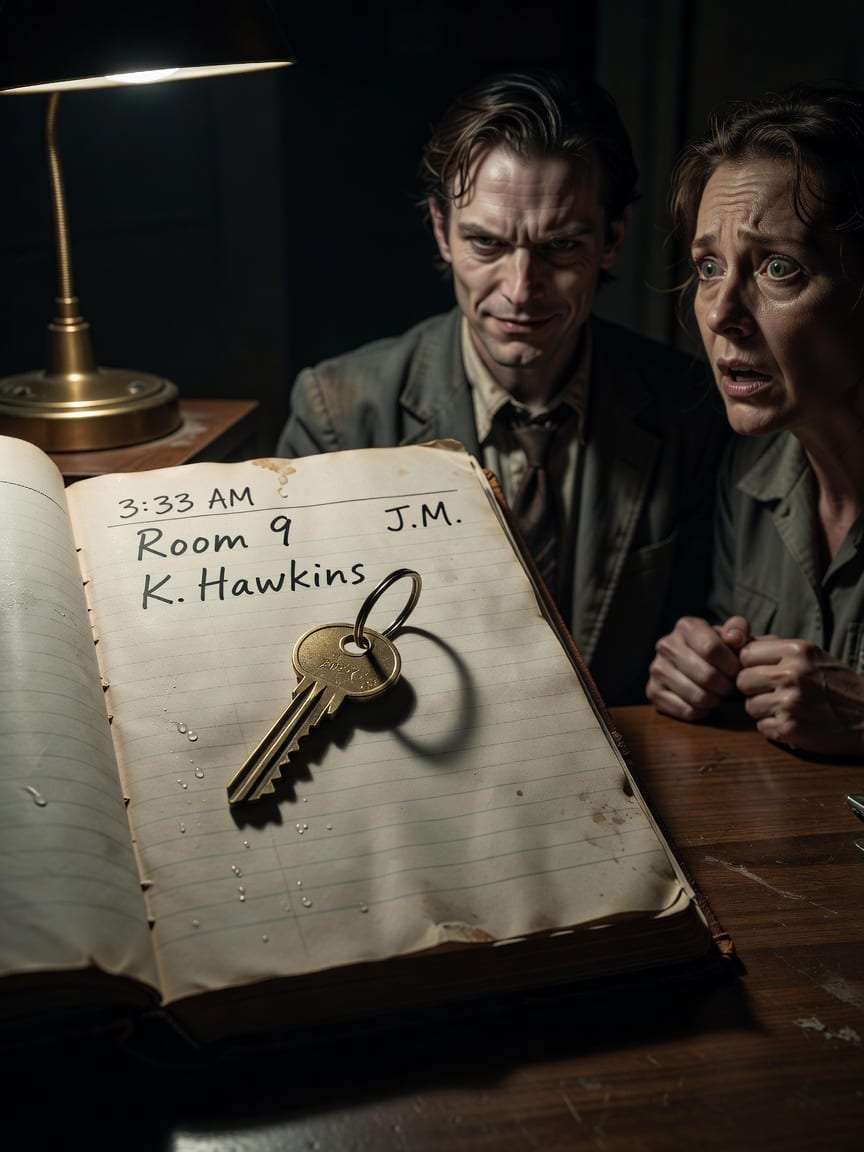
My hand wrote the Room 9 check-in at 3:33 AM. My initials were there. But Room 9 has been sealed since the spring flood, and its key still hangs on the peg.
Working the quiet night shift at the Marsh View Motel, I found a fresh entry in the register with my own initials, for Room 9. But Room 9 has been sealed since the spring flood, its key hanging untouched on the wall. Inside, a half-empty glass of water and a second, mud-encrusted key lay on the bed.