On his last deployment, Petty Officer Hale found his signature in the ship’s log, detailing a ghost contact at 0212 from a watch he never stood.
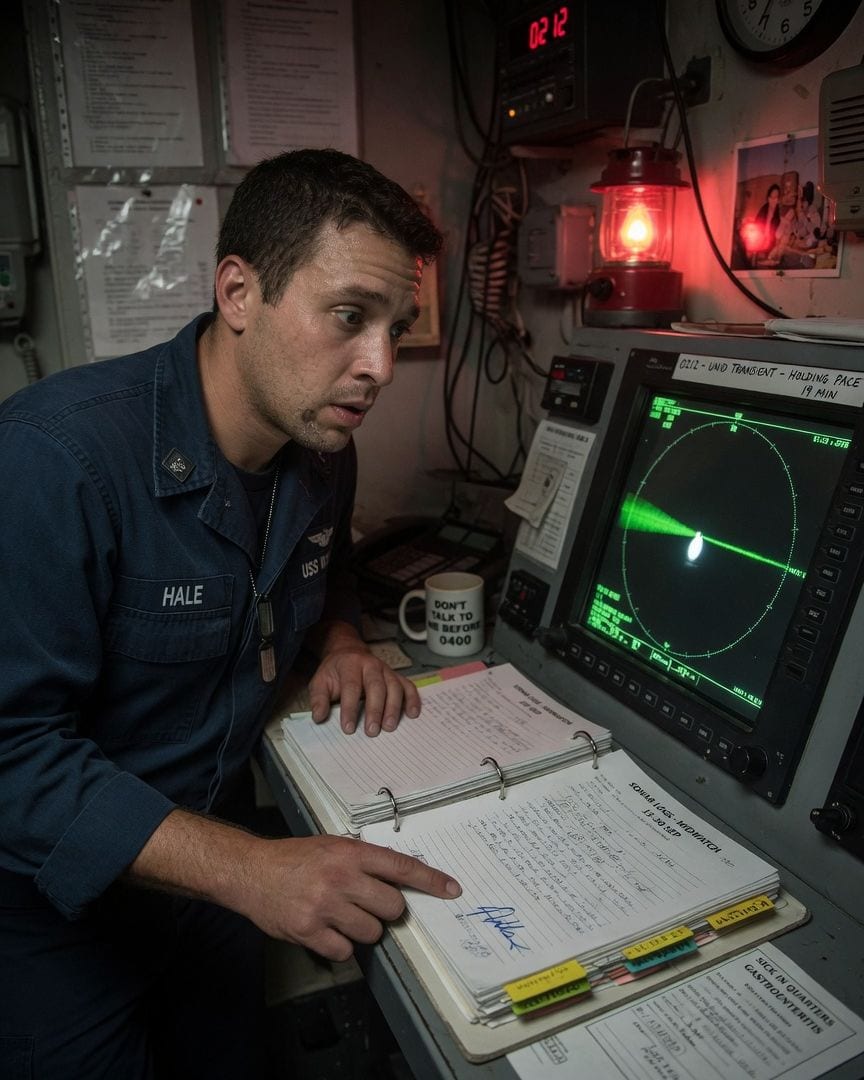
Petty Officer Quentin Hale, 28, hunched over the glowing console of the sonar shack, the only light against the black, endless sea three days out of San Diego.
The hum of the destroyer, USS Vigilance, was a low thrum beneath his boots.
It was 0200, the midwatch, his last full deployment before transferring to shore duty – a quiet end to his sea time that he intended to see through with an impeccable record.
The console’s green sweep pulsed, mapping the abyss beneath them. At 0212, the array painted a contact: a faint, solid trace holding station off the port beam. Close, slow, keeping perfect pace with their own course.
Hale checked radar, called the bridge lookout on the comms. “Bridge, Sonar. Any surface contacts port beam, possible slow-mover?” The answer came back quickly, "Negative, Sonar. Clear as a bell out here." He reported nothing.
The trace held for nineteen minutes, a ghost in the deep, a persistent echo that defied every other sensor, then slid under the noise. He logged it as an 'unidentified transient,' then leaned back, rubbing his eyes.
A few minutes later, a nagging doubt prompted him to pull the digital log from the previous week's midwatch, same shift. His fingers traced the entry: 0212. Unidentified subsurface trace. Exact same coordinates. Same nineteen minutes. It was there too.
Hale tried to rationalize it. Equipment malfunction? A prank from the previous watch that had managed to spoof the digital records? He ran full diagnostics on the sonar array, cycling through every system check.
The report came back clean, green lights across the board. He questioned Chief Petty Officer Brooke Marsh, his supervisor, about any known anomalies in the sector, careful not to mention the specific time.
She frowned, mentioned old sea stories about phantom contacts in the area, but dismissed his concern as fatigue.
“Long patrols do that to you, Hale,” she said, her voice edged with the unspoken warning to not let it get to him before his transfer. “Just log it and move on.” Unconvinced, Hale started cross-referencing.
He spent his off-watch hours in the cramped records office, the air thick with the smell of old paper and dust, pulling every sonar log from the past month, focusing on the 0200-0400 midwatches.
The 0212 contact appeared in three more. Each time, logged by a different operator, though always with the same vague description: 'transient,' 'unidentified echo,' 'possible marine life.' They had all seen it, all logged it.
But then he found it: an entry dated two weeks prior, a midwatch he distinctly remembered being off-duty, confined to his rack with a stomach bug that had kept him tethered to the head for twenty-four miserable hours.
Yet, there it was, signed 'Petty Officer Q. Hale,' detailing the 0212 contact with chilling precision. His own signature, unmistakable, on a log for a watch he never stood.
Hale’s breath hitched. He stared at the looping 'Q' and the familiar slant of his last name, the signature he’d perfected over years of signing official documents.
He knew, with absolute certainty, he had been violently sick in his bunk that night. He had the medical log entry to prove it, filed with the corpsman after his visit.
Yet, the official duty log, crisp and undeniable, in his own hand, swore he had been here, in the sonar shack, at 0212, observing the impossible contact.
The ship's record, the military's unimpeachable paperwork, documented a lie he himself had apparently authored. He ran a finger over the ink, a cold tremor starting deep in his gut, a subtle nausea that had nothing to do with seasickness.
The log didn't just record the anomaly; it had recorded him being there for it, even when he wasn't. It felt less like a clerical error and more like a claim. The ink still seemed wet on the page.
The discrepancy gnawed at Hale. He started digging deeper, carefully, covertly. The ship's internal network hummed with countless data points, a bureaucratic ocean for him to navigate.
He accessed the ship’s manifest, cross-referencing duty rosters with personnel transfers for other sonar operators who had served on the Vigilance over the last few years.
He found subtle, almost imperceptible gaps: a transfer order for a Petty Officer Delaney that seemed to predate the actual departure date by a week, a medical leave for a Petty Officer Galloway that didn't align with his reported symptoms, a sudden, unexplained early retirement for another operator just months after logging a similar anomaly.
Each instance was minor, easily dismissed as administrative sloppiness, but collectively, they formed a faint, unsettling pattern.
It was as if the system, which prided itself on meticulous accounting, had tiny, deliberate holes punched into its fabric, precisely where a person might disappear.
He tried to confide in CPO Marsh again, showing her the compiled list of discrepancies, the hard data in his hands. She looked at the printouts, then at him, her expression hardening.
The air in the small office seemed to thicken around them. “Hale, you’re seeing ghosts,” she said, her voice low and sharp. “This is the kind of thing that gets you a psych evaluation, especially with your transfer coming up.
Focus on the mission.” Her dismissal felt less like concern and more like a warning, a dismissal with an edge of absolute finality.
Hale’s unauthorized inquiries didn't go unnoticed. His access to the ship’s digital archives, previously unrestricted for personnel with his clearance, now required secondary authentication codes he didn't possess. His password, once a magic key, now seemed to reject him.
Commander Robert Ford, the ship's CO, called him into his office. Ford, a man known for his calm demeanor, for his ability to weather any storm with an unreadable expression, was unsettlingly composed.
The room felt cold, the polished wood of his desk gleaming under the fluorescent lights. “Petty Officer Hale,” he began, his voice level, “I understand you’ve been… quite thorough in your review of ship’s records.
While I commend your initiative, I must impress upon you the importance of maintaining unit cohesion and avoiding speculation. Our mission requires focus, not distractions.”
It wasn't a reprimand, not exactly, but a quiet, firm shutting down, a closing of unseen doors. The commander’s gaze held no anger, only an unnerving certainty.
Later, Hale noticed a junior intelligence officer, Ensign Coleman, lingering near the records office whenever he was there, his eyes tracking Hale with a detached curiosity that felt predatory.
One evening, as Hale accessed the physical logbooks – the digital system still locked him out of key files – Coleman appeared, leaning against a bulkhead, arms crossed. “Looking for something specific, Petty Officer?”
he asked, a faint, unreadable smile playing on his lips. The echo of Ford’s warning still hung in the air. Hale felt a prickle of unease, a cold sensation crawling up his spine.
His digging was no longer just an internal struggle; it was being observed, assessed.
Despite the warnings, Hale couldn't stop. The pattern was too persistent, too specific to ignore. He remembered CPO Marsh mentioning 'sea stories' when he first reported the anomaly.
He pressed her again, cornering her in the sonar shack during a quiet shift, the only sounds the low thrum of the ship and the distant hiss of the sea. “Chief, what are those stories?”
Hale asked, his voice barely above a whisper. “About certain watches? About what happens to operators?” Marsh sighed, running a hand over her tired face, her eyes looking beyond him, into some distant memory. “Look, Hale, it’s just scuttlebutt.
Old salts talk about a 'ghost watch,' a specific set of coordinates, a specific time. They say if you log it, you… change. Or you get transferred somewhere no one’s ever heard of.
That you vanish from the active roster but still show up in some dusty file cabinet.”
Hale pulled out a printout he'd managed to retrieve from a deeper, less-protected archive, accessed through a back channel before his digital lock-out: a heavily redacted internal memo from the Bureau of Naval Personnel, dated forty years prior.
It mentioned an 'unidentified sub-surface anomaly' in the Vigilance's operational area and a subsequent 'personnel re-assignment protocol' for specific watch standers. He pushed it across the console, its blacked-out lines stark against the white paper.
Marsh picked it up, her eyes scanning the blocks of obfuscated text, her face paling as she saw the dates, the names that weren't quite blacked out enough.
The familiar hum of the sonar console suddenly felt amplified, a low, ominous growl. “This… this is real?” she whispered, her voice barely audible over the ship's drone, the paper shaking slightly in her hand. “This isn’t just a story.”
The memo, vague as it was, confirmed decades of suppression. The 'ghost watch' wasn't a legend; it was a known, managed event. The small discrepancies in the personnel records, the sudden transfers, the altered logs – they weren’t errors.
They were part of a systemic cover-up, a protocol. And Hale was now, officially, part of the system’s awareness.
Marsh, shaken, pointed Hale to an old, rarely accessed storage locker deep in the ship’s bowels, past the auxiliary engineering spaces, a place forgotten by time and crew alike.
“There might be something older down there,” she murmured, her voice tight, a cold dread clinging to her words. “Something they missed.” Hale spent hours sifting through the dusty, salt-air corroded boxes.
The air was thick and stagnant, smelling of rust and mildew.
He found rusted equipment manuals, outdated charts yellowed with age, and finally, tucked beneath a stack of broken compasses, a heavy, leather-bound logbook, its cover warped and stained with what looked like dried seawater.
It was from a previous USS Vigilance deployment, dating back decades, its pages stiff with history. Heart pounding, Hale carefully opened it. The pages were brittle, fragile beneath his touch, the ink faded, but legible.
He flipped through the entries, scanning for familiar patterns: watch times, coordinates, any mention of anomalies. The faint script swam before his eyes. Then he found it. An entry, almost indistinguishable from his own, for a midwatch.
The exact date was hard to decipher, but the specific time was clear: 0212. 'Unidentified subsurface trace detected, port beam. Holding station.' And below it, the faded, looping script of a signature: 'Petty Officer Q. Hale.' Not a similar name.
Not a variant. The exact, precise name. His name. Decades before he was born.
Hale brought the old logbook to Marsh, laying it carefully beside his current, altered log entry on the sonar console. The two signatures, identical in every stroke, the identical 0212 anomaly, separated by forty years, were undeniable.
“It’s me,” Hale whispered, his voice hoarse, a dry rasp against the ship’s constant hum. “Or… someone else who was me.”
Marsh, her face pale, began cross-referencing names from that old deployment through a secure terminal, her fingers flying across the keyboard. A 'Petty Officer Quentin Hale' had indeed served on the Vigilance then.
His service record showed a sudden, unexplained transfer to a decommissioned shore station shortly after that log entry.
The pattern was horribly clear: the 0212 contact wasn't just an anomaly; it was a recurring event, a 'summons' tied to the ship's patrol route, and to a specific sonar operator. Always named Q. Hale.
The altered records, the quiet transfers, the warnings from Ford – it all clicked into place, a horrifying mechanism operating just beneath the surface of naval operations.
The system wasn't just covering up an incident; it was managing a cyclical phenomenon, a pre-ordained selection process. The 'contact' was a sign, and the log entry, his log entry, was the mechanism by which it claimed its next participant.
Hale was not a witness; he was the next iteration in a terrifying, pre-written role.
The USS Vigilance was now three days from completing its patrol, nearing the coordinates where the anomaly always manifested. Hale tried to avoid the midwatch, feigning illness, reporting a sudden, crippling headache.
But Commander Ford personally assigned him, appearing at his bunk with a stern, unyielding expression. “Petty Officer Hale,” Ford said, his eyes devoid of warmth, fixed on Hale with a chilling intensity. “You are on watch. No exceptions.”
Hale realized Ford had known all along, had been part of this grim perpetuation. The commander was not merely managing the cover-up; he was the shepherd, guiding the next 'Q. Hale' into place.
As 0212 approached, Hale was alone in the sonar shack, the air thick with dread, the cold certainty of his fate pressing down on him.
The console hummed, a low, rhythmic pulse, the sea past the hull a black abyss that seemed to swallow all light and hope.
At 0212, the impossible trace blossomed on the screen, a faint, unwavering line off the port beam, just as it had every time before.
Hale’s hands trembled as he reached for the controls, desperate to shut down the array, to break the circuit, to shatter the pattern. But the system wouldn't respond.
The screen was locked, unresponsive to his input, the controls inert beneath his shaking fingers. He watched in horror as the digital log entry for his current watch populated itself, the time and coordinates appearing automatically, cold and precise.
Then, beneath it, a signature materialized, stroke by stroke, digital ink forming the familiar loops: 'Petty Officer Q. Hale.' His fate, already written, already signed, already accounted for, just as it had been decades before.
The artifact that could not exist — his future log entry — was real, dated, and checkable, mocking him from the screen.
The USS Vigilance completed its patrol and returned to port. Petty Officer Quentin Hale was officially listed as transferred to shore duty at Naval Station Everett. No one on board remembered seeing him pack his gear, or even say goodbye.
His bunk was empty, his locker cleared out, as if he had simply dissolved from the ship's complement during the transit. Commander Ford filed his final reports with characteristic efficiency, his eyes impassive.
Chief Petty Officer Marsh, haunted, kept her silence, her gaze often drifting to the empty sonar station where Hale had stood his last watch. The cycle continued, seamless and invisible to the larger world.
Months later, during a routine archive audit at Naval Station Everett, a junior clerk discovered a single, official-looking document tucked into a forgotten file box.
It was a transfer order for a Petty Officer Q. Hale, dated forty years prior, to a shore duty station that had been decommissioned a decade before the order was issued.
The paper was crisp, the ink fresh, as if printed yesterday. It read: “All records accounted for. No further action required.”
If this one got to you
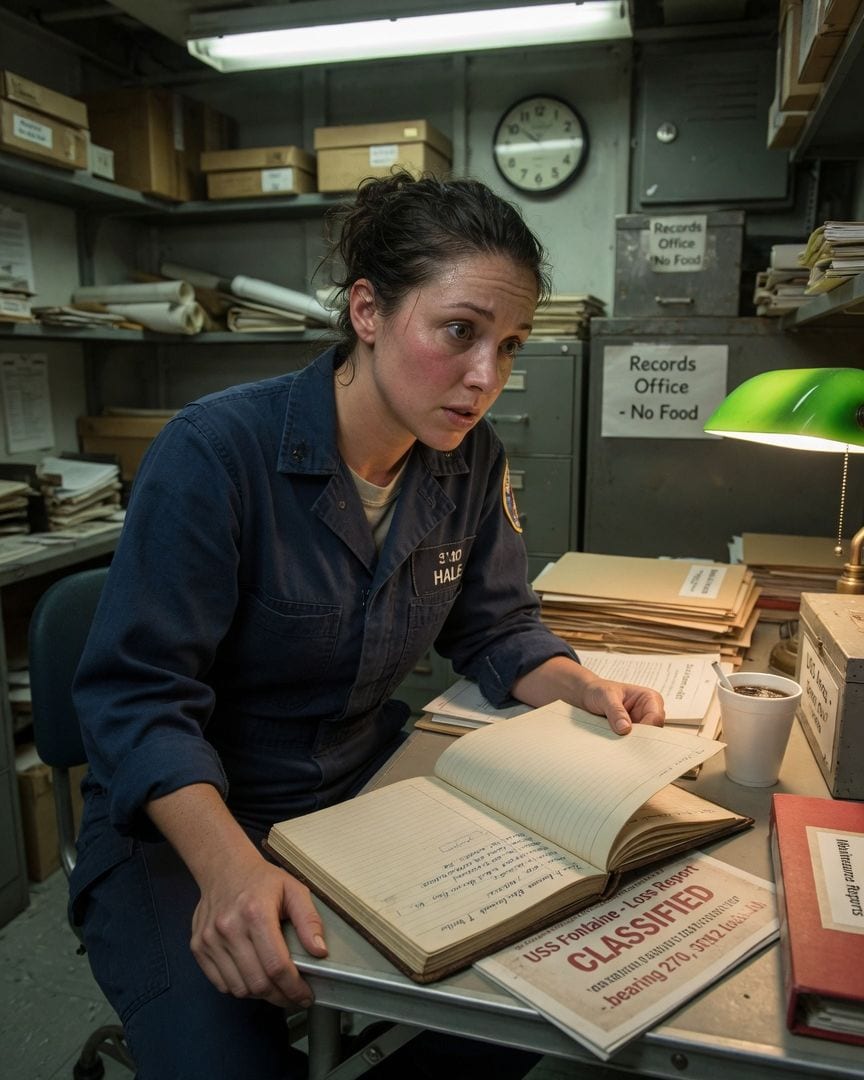
Petty Officer Hale needs a spotless record for her transfer. But the USS Ares sonar logs show an identical, impossible contact, logged to the minute, years apart, and tied to a classified loss report.
Petty Officer Sarah Hale needed a spotless record for her coveted shore duty transfer, a posting she'd worked five years to secure. Alone in the USS Ares sonar shack, three days out from San Diego, her midwatch was broken by an impossible contact: a close, slow echo holding perfect pace, invisible to radar, then vanishing. Her heart hammered, not from fear, but from the data's impossibility. When she found an identical entry in her own log from just one week prior, the cold dread tightened its grip. But the true chill settled when she unearthed decades of similar records, signed by other sonar officers, all showing the same impossible contact at 0212, off the port beam, for nineteen minutes, on the same ship, stretching back years—a persistent echo tied to a classified loss report.
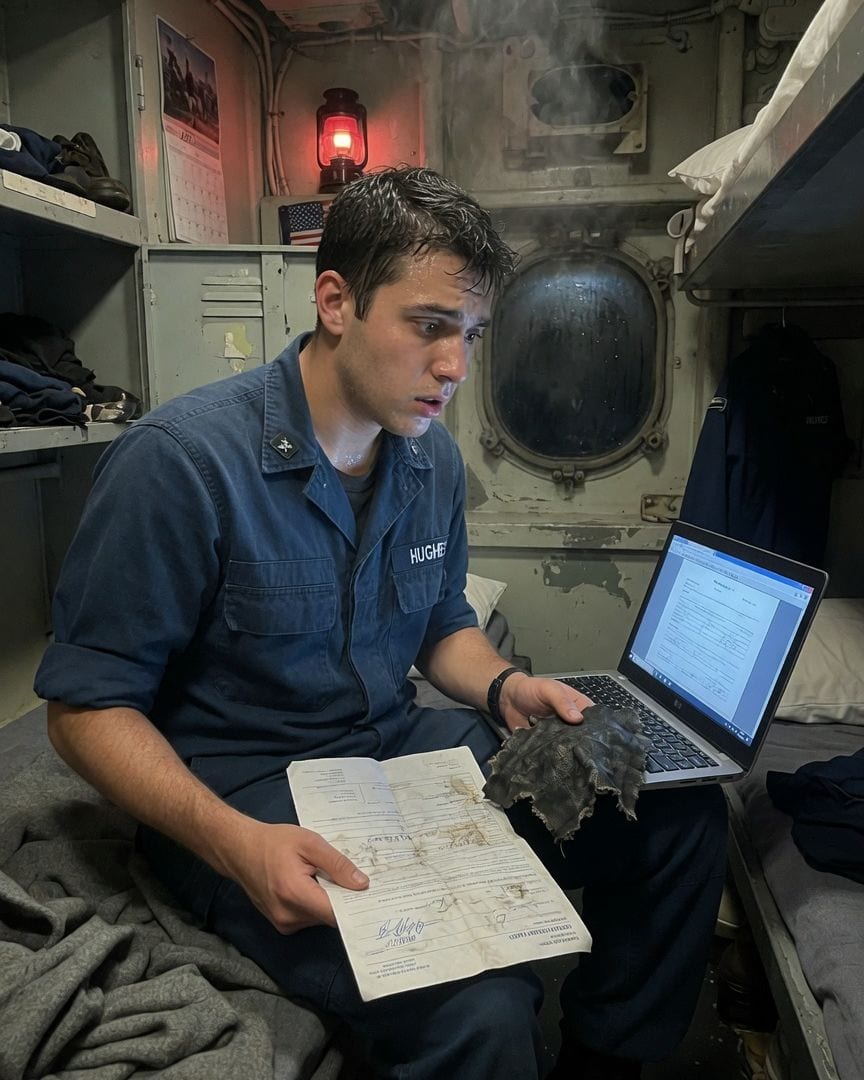
A Navy lookout's own signature appeared on a damage report he didn't write, describing damage he never saw.
Seaman Benjamin Hughes stood watch on the USS Vigilance, scanning the dark Pacific. At 0215, he reported a swimmer keeping an impossible pace with the destroyer, a contact the bridge immediately dismissed. Yet, below his post, the man-overboard netting showed undeniable signs of being climbed, with a strange, slick residue clinging to the ropes. Later, Hughes discovered a small, rough piece of fabric tucked deep into a frayed knot, unlike anything on the ship. But the real dread landed when he found a damage report, filed under his own name, detailing a tear he hadn't witnessed and bearing his perfectly forged signature. How could his own hand betray him?
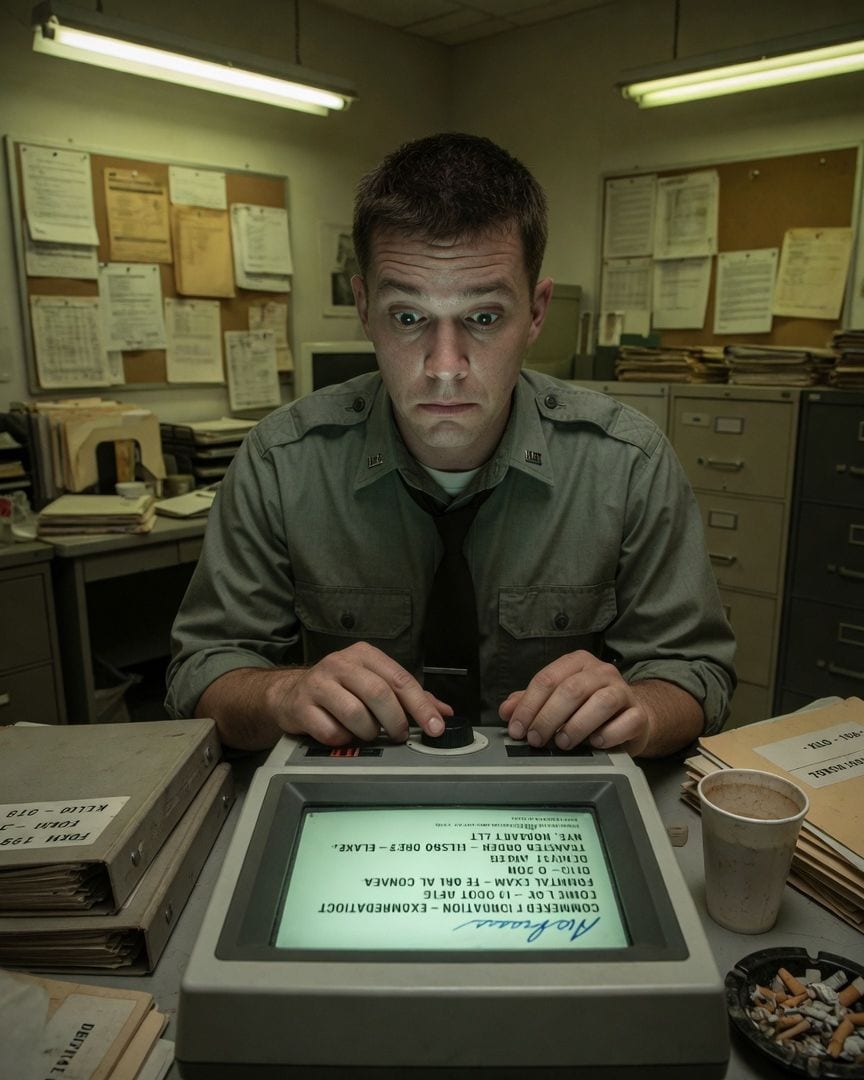
A missile commander watched his ten nuclear silos go dark. His own service record shows his signature on a future he's never lived.
Second Lieutenant Hobart Nye, a missile commander in Wyoming, had his quiet 0247 watch shattered by a security report: a massive, silent black triangle hovered over Launch Facility Kilo, casting a perfect shadow. Hobart watched his console's fault panel light up, signaling all ten nuclear missiles going dark in an impossible silence, followed by eleven minutes his security team could not remember. Official logs called it a "radio malfunction," but Hobart found a requisition for invisible-tracking sensors, signed by a base commander who was supposed to be off-base. The final, chilling discovery came when his own service record showed new entries—a dental check-up, a transfer to Alaska—all dated for a future he never lived, complete with his perfectly replicated signature.
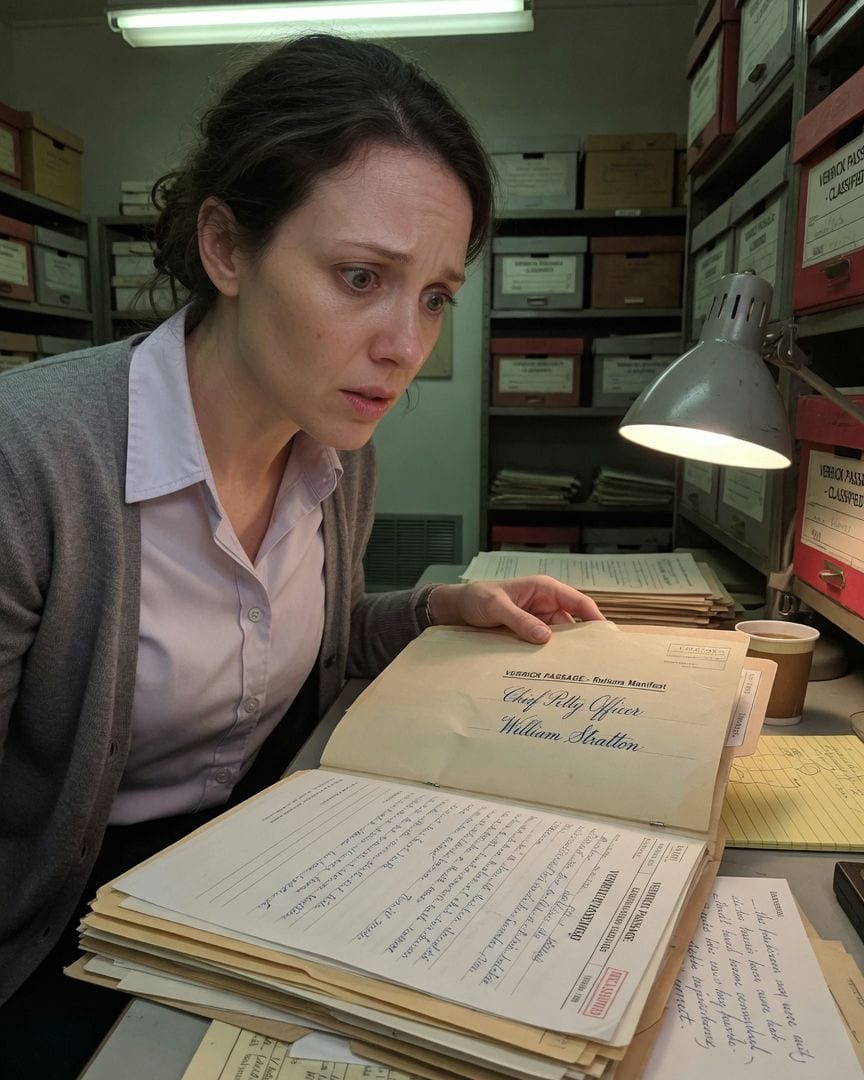
A records reviewer found personnel files for men lost 80 years ago, still being signed in an identical, perfect hand.
In the sterile hush of the declassified archives, meticulous reviewer Ione Fash had a routine task: cross-referencing witness statements from the Verrick Passage file. But as she reviewed files eighty years thick with official silence, she found nine separate interviews containing the exact same chilling sentence, all in an identical, precise hand. Her rational mind sought explanation, yet then she discovered something worse: personnel files for men lost in 1943, still being updated with modern requisitions and payroll runs. Each impossible entry, including a manifest signed just two weeks ago by a casualty from eighty years prior, bore the same unnervingly perfect signature. The file wasn't just a record of the lost; it was still being signed.
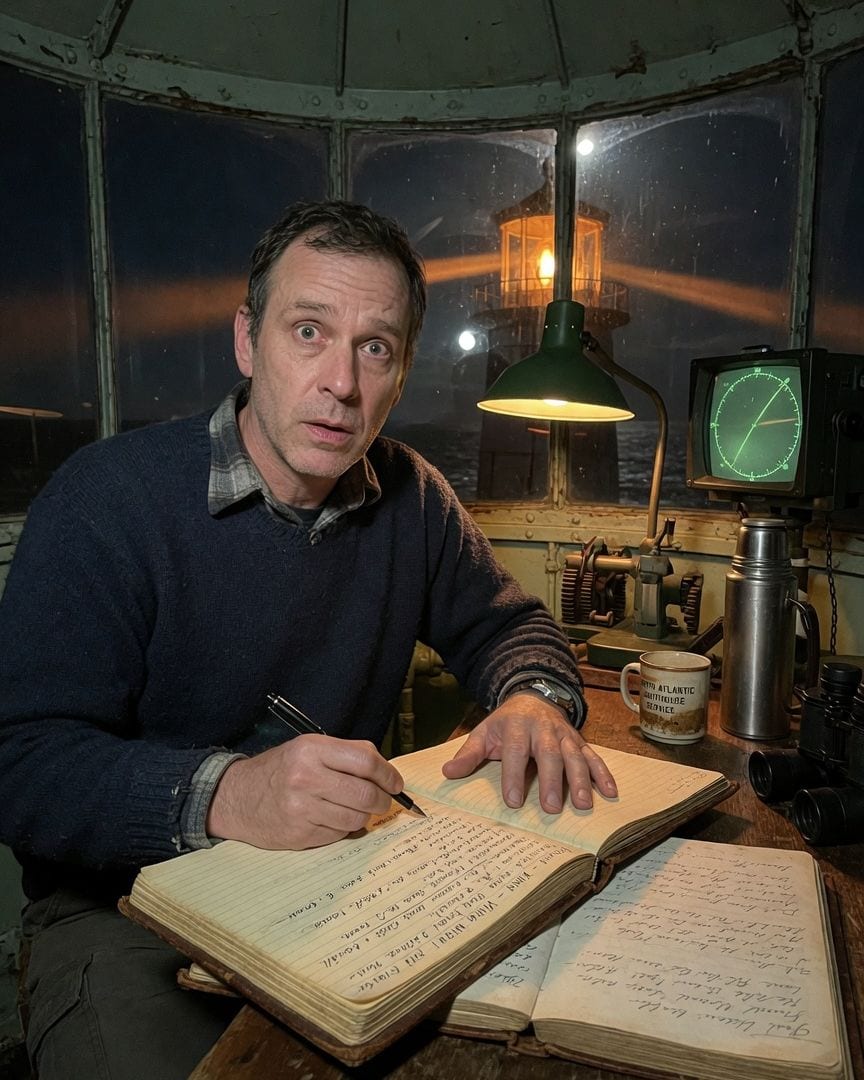
My lighthouse log has my own 3 AM entry for a phantom ship. I was alone in the tower, and I wrote no such thing.
Perched in the lantern room for my usual 2-6 AM watch, I reached for the thick logbook. But the 3:00 AM entry, under my own name, detailed a vessel I never saw. The words were in my own ink, yet I had never written them.
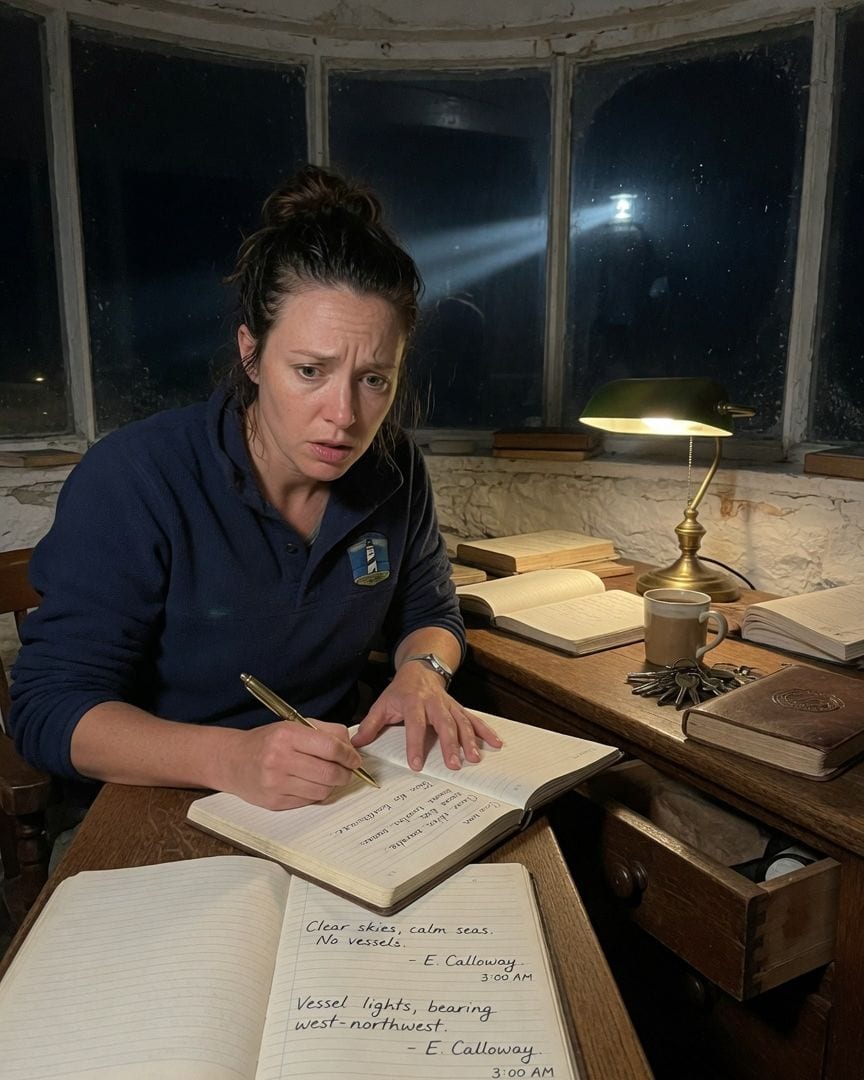
My logbook had a 3 AM entry, in my own precise hand, that I never wrote. Then I found an impossibly cold, hidden book with my name signed to an identical entry from last night.
My routine lighthouse shift was quiet until I noticed a new entry in the official logbook. Dated 3:00 AM, it described a vessel I never saw, written in my exact handwriting, and signed with my name. But I hadn't penned a single word.