A Navy lookout's own signature appeared on a damage report he didn't write, describing damage he never saw.
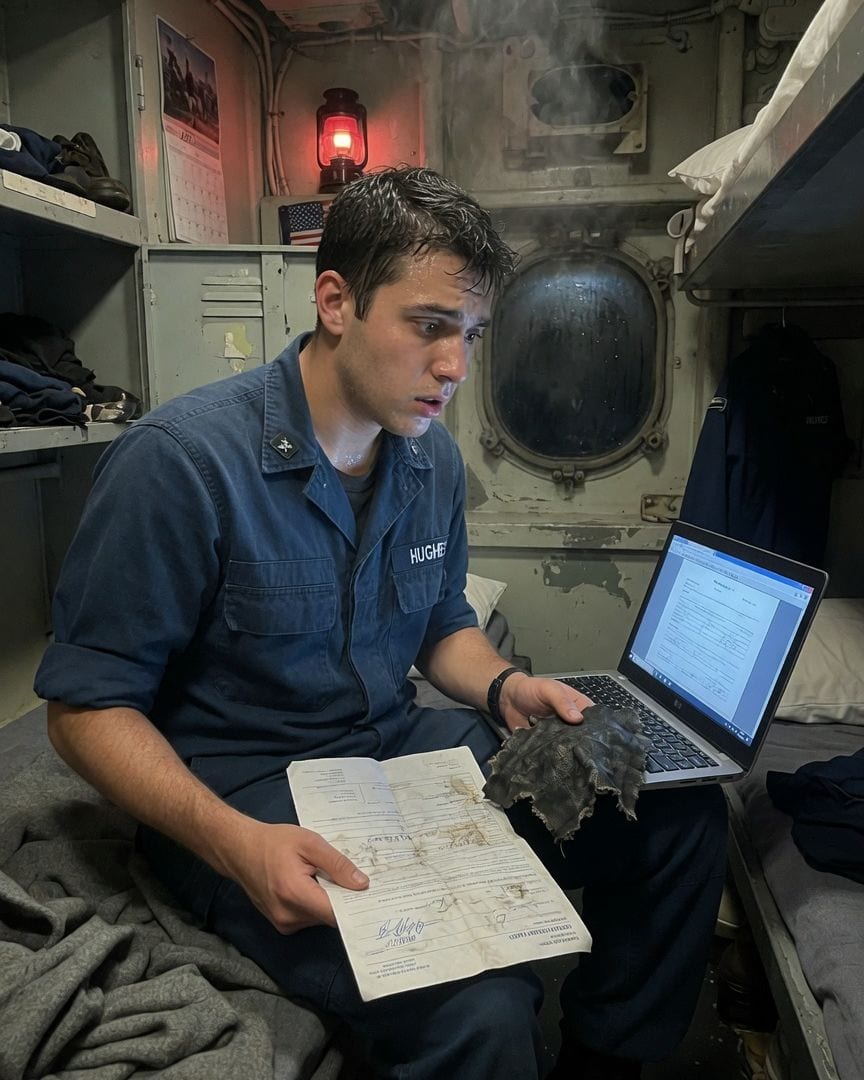
Seaman Benjamin Hughes, 22, stood his aft lookout billet on the USS Vigilance, a destroyer cutting through the black Pacific off San Diego. The rhythmic thrum of the engines was his only company, the vast, dark sea his sole companion.
He scanned the moonless horizon, the binoculars a familiar weight in his hands. At 0215, his voice, trained and steady, broke the silence on the bridge circuit. “Bridge, aft lookout, contact bearing 190, range 200 yards. Swimmer.
Keeping pace, fifteen knots.”
Lieutenant Philip Winslow, 35, the Officer of the Deck, acknowledged, but his voice was already laced with skepticism. “Aft lookout, negative contact on all scopes. Confirm visual.”
Hughes confirmed. He’d seen the dark shape, a head and shoulders breaking the surface, keeping perfect, unnatural pace with the ship, its face turned towards them, though he couldn't make out features in the gloom.
The bridge called back, "Aft lookout, maintain watch. No further action.”
As Hughes lowered his binoculars, a chill unrelated to the ocean spray ran through him. He glanced down at the man-overboard netting that ran the length of the fantail rail.
It was taut, wet, and undisturbed along most of its run. Yet, just below his post, near the water line, a section of the netting showed distinct signs of having been climbed.
The heavy ropes were stretched, several strands frayed, leading all the way up to the platform where he stood. A faint, slick residue glistened on one of the thicker ropes, catching the dim ship lights.
It wasn’t oil, and it wasn’t seafoam.
Hughes immediately reported the physical evidence of the climbed netting. Lieutenant Winslow, after a perfunctory inspection, dismissed it as 'routine wear and tear' or 'impact from sea state.'
The Lieutenant ran a hand over the frayed ropes, then pulled his hand back, wiping it on his trousers. "Just log it as such in the morning’s damage report, Seaman Hughes. Nothing to worry about."
Hughes, feeling a growing unease, returned to his post. He couldn't shake the image of the swimmer, nor the undeniable evidence of the climb. It was a mismatch that chafed at his sense of order.
The bridge had seen nothing, but something had definitely been there.
Later, during his relief, Hughes meticulously examined the netting again. He ran his fingers along the stretched knots, testing the tension. The ropes felt thicker, almost stiff, in the area of the disturbance.
Tucked deep into a particularly stretched knot, where the netting met the ship's hull, he found a small, dark piece of fabric. It was rough, almost leathery, and felt strangely dense, heavier than it looked.
It wasn't uniform material, nor anything he recognized from the ship’s gear. He pocketed it, the strange texture against his palm.
Back in his bunk, a stale air hung in the small space, making him feel abruptly claustrophobic. He accessed the ship’s maintenance system. He searched for the damage report he was instructed to file.
There it was, dated 0300, just an hour after his watch had ended. The report detailed 'minor fraying on aft port netting, attributed to routine wear.'
It bore his name, his service number, and a signature that was unmistakably his own.
But the report described a tear near the top rail, a detail he hadn't seen, and made no mention of the deep snag where he’d found the fabric.
He knew, with a cold certainty that settled in his gut, that he had never written this report, nor signed it. The screen’s blue light felt unnaturally sharp against his eyes.
Hughes sat on his bunk, the small, strange piece of fabric clutched in one hand, the printed damage report in the other. He stared at the signature: 'B. Hughes.'
Every loop, every slant, every familiar imperfection was there, as if his own hand had just penned it. He traced the lines with his thumb, a shiver running down his spine.
It was his signature, yet it was alien, a perfect forgery of himself. He looked at the fabric again, then back at the report detailing a tear he hadn't seen, and a cause he hadn't attributed.
The unease wasn't just about a clerical error; it was about a record, his record, swearing to a thing he knew did not happen, signed by a ghost of his own hand.
He felt a profound, unsettling disconnect, as if the ship's very reality was subtly, terrifyingly, shifting around him.
The next morning, Hughes tried to get the damage report corrected.
Lieutenant Winslow listened, leaning back against a bulkhead in the narrow corridor outside the bridge, then patiently explained that once a report was in the system, especially one with a verified signature, it was nearly impossible to alter without a major incident.
The fluorescent lights hummed above them, casting an anemic glow. Winslow suggested Hughes might have been tired, or simply misremembered. “It’s logged, Seaman. Let it go.”
But Hughes couldn't. The perfect, false signature haunted him. It sat in his mind like a splinter. He started checking other ship logs, using his access permissions cautiously, wary of drawing more attention.
He looked at perimeter patrol logs, equipment checkout sheets, anything that might have his name on it.
He found another anomaly: an entry for a 'late-night equipment check' in the engine room, signed 'B. Hughes,' on a night he was on deck watch, a night he remembered clearly because of a particularly rough sea state.
He compared this signature to the damage report. Identical. He meticulously copied both, then compared them to his actual signature from his enlistment papers. They were indistinguishable. A chill deeper than the sea air began to spread through him.
He discreetly asked other junior seamen if they’d ever had issues with their logs. Most shrugged, or looked confused. Seaman Chloe Sutton, 20, a quiet, observant crewmate, shifted uneasily when he mentioned 'strange entries.'
They were in the mess hall, the clatter of trays and low chatter providing a thin cover.
“Heard a rumor once,” she mumbled, picking at a loose thread on her uniform, her eyes darting around the mess hall as if expecting to be overheard. “About ‘ghost patrols’ on some older ships.
Logs showing up for duties no one remembered doing.” She quickly changed the subject, her voice becoming unnaturally bright as she asked about his next shore leave.
Hughes’s quiet inquiries didn’t go unnoticed. Lieutenant Winslow pulled him aside again, this time with a sterner tone. They stood by the railing on the starboard side, the endless blue ocean stretching out.
“Seaman Hughes,” he said, his voice low, almost a growl over the thrum of the ship’s engines, “your attention to detail is commendable, but your current focus is bordering on insubordination.
You’re creating unnecessary paperwork and unsettling the crew with these… theories. I suggest you drop it.” Winslow’s gaze was steady, unwavering, and the air around them seemed to thicken, compressing the usual sounds of the ship.
Hughes nodded, outwardly compliant, but the warning only confirmed his suspicions. It wasn’t a mistake; it was being covered up.
Later that day, he returned to his bunk to find his personal logbook, where he'd been jotting down the discrepancies, moved.
It was a subtle shift—the book now lay angled slightly differently on his locker shelf, the spine facing a different direction—only he would have noticed, but it was enough. Someone had been in his space.
He felt a prickling sensation on the back of his neck, a raw, exposed feeling of being observed.
During his next watch, the binoculars felt heavier, colder, than usual. He noticed a faint, almost imperceptible smudge on the lens, a greasy residue that hadn't been there before, as if someone had used them, perhaps to watch him.
He meticulously cleaned it, but the feeling of invisible eyes on him lingered. The ship, usually a source of comfort and order, now felt like a labyrinth of unseen observers and impossible truths, each corridor and compartment holding its breath.
Hughes sought out Chloe Sutton again, catching her as she left the recreation room. He pressed her gently about the 'ghost patrols,' explaining the increasingly unsettling things he’d found.
She was hesitant, glancing nervously around the berthing area, lowering her voice. “Look, I just heard it from my great-uncle,” she finally confessed, twisting a lanyard in her hands. “He was a Bosun’s Mate on the USS Intrepid, old destroyer.
Adam Pierce. Said some ships… some ships had 'sticky records.' Said they’d just… write themselves. Especially around certain deployments, off the coast of places that weren’t quite on the map.”
Hughes pressed for details, his own voice hushed now. Pierce, she explained, had been a meticulous record-keeper, almost obsessive. He’d seen impossible entries in duty logs, even service records that defied logic.
“He told me about this guy, Seaman Everett Winslow,” Chloe recounted, her voice hushed, her eyes wide. “Uncle Adam swore Winslow died in basic training, years before the Intrepid deployed.
But then, there were logs, commendations, even a transfer order for him, all dated years after he was supposedly dead. Like he was still serving, getting promotions, doing hero stuff he couldn’t possibly do.”
Pierce, according to Chloe, was calm about it, resigned. “The Navy always has its records straight,” he’d told her, “even when they’re lying.” The phrase echoed in Hughes’s mind, cold and precise.
He realized the small, leathery fabric in his pocket, the one snagged in the netting, might be more than just a random piece of debris.
It was a physical trace of an impossible event, now linked to an impossible record, a pattern spanning years and ships.
Shaken, Hughes found a secure terminal in a rarely used auxiliary communications room, the hum of its ancient equipment a low, constant drone. He accessed the naval archives, searching for 'Everett Winslow.' He found two entries.
The first, brief and stark, confirmed Winslow’s death in a training accident in 2020.
The second, however, was a meticulously detailed service record: Seaman Everett Winslow, served honorably on the USS Intrepid from 2022-2024, receiving a valor citation for actions during a deployment to the Pacific Rim.
Hughes felt a cold dread spread through him, gripping his chest. This was the 'sticky record' Adam Pierce had described, an impossible life laid out with terrifying precision.
He scrolled down further, his heart pounding against his ribs. On a transfer document within this second record, an approval signature for Winslow’s transfer to another vessel, dated 2023. The signature belonged to a Lieutenant Philip Winslow.
Hughes’s head snapped up. He looked up at Lieutenant Winslow, who had approached, drawn by the terminal screen, his footsteps muffled by the carpet. Winslow's eyes widened as he saw his own name, his own signature, and the impossible date.
“I never signed that,” Winslow whispered, his face pale, his voice barely audible, like a ghost of itself. He had no memory of Everett Winslow, or of that transfer, or of ever putting his name to such a document.
The two Winslow records, one confirming death, the other proclaiming phantom service, lay starkly on the screen, an undeniable paradox.
Lieutenant Winslow, now visibly disturbed, accessed a classified internal briefing document he remembered from his early career, titled 'Data Integrity Anomalies (DIA) in Legacy Systems.'
It was a heavily redacted report, dismissed years ago as a software glitch affecting older vessels, something filed away and forgotten. But now, as he read, it clicked into place with horrifying clarity.
The 'swimmer,' the climbed netting, Hughes's forged signature, Everett Winslow’s phantom career – it was all connected.
The DIA wasn't a glitch; it was a self-correcting mechanism, an anomaly within the system itself, designed to maintain 'accountability' even when reality broke.
It created records, fabricated duties, and forged signatures to cover any impossible event, ensuring the Navy’s meticulous logs remained coherent, however false. Hughes retrieved the small piece of dark, leathery fabric he’d found in the netting.
It felt heavier, almost accusatory, in his palm. Under the harsh light of the terminal, he examined it closely. He then looked at a digital copy of Everett Winslow’s valor citation from the phantom record.
There, almost invisible to the naked eye, a tiny, dark thread, identical in texture and color, was woven into the digital image of the medal itself, integrated into its very fabric.
The physical trace from the netting matched the impossible artifact in the phantom record. It all fit, horrifically. Every wrong detail, every impossible signature, every fabricated life clicked into a terrifyingly coherent whole.
Winslow, now fully understanding the gravity of the situation, his face grim, tried to access the ship's deepest system logs, the very 'legacy systems' mentioned in the DIA report, overriding several layers of security.
He believed if they could find the source of the anomaly, they could stop it.
As he typed, his fingers flying across the keyboard, a piercing alarm blared through the ship – a man overboard alarm, but from the bow, where no one had been seen for hours.
On the terminal screen, a new log entry instantly populated, a damage report for the bow netting, dated for that very minute. It stated 'damage attributed to unauthorized equipment testing.' And beneath it, the signature: Seaman Benjamin Hughes.
Hughes watched, horrified, as his name, his service number, his precise, familiar signature, appeared on the screen in real-time, validating an event that was not happening, that had not happened.
The system wasn't just covering up old mistakes; it was actively writing his story, right now, implicating him, making him responsible for an event that hadn't happened. Winslow slammed his hand on the desk, the sound sharp and desperate.
“It’s trying to erase us, Hughes! To make you part of its narrative!” He knew they had to get off the ship before the anomaly completely rewrote their presence, their very existence, into a fabricated, compliant history.
He frantically worked to send a distress signal, not to the ship's main comms, which were likely compromised, but to a secure, obscure naval intelligence channel, a last-ditch, unlogged bypass he’d learned years ago.
The alarm continued to blare, a digital siren of their impending erasure, echoing through the empty corridors.
Winslow managed to transmit a short, coded burst to the secure channel just as the ship's internal network locked them out, the terminal screen going dark. Within hours, a silent, unmarked naval vessel rendezvoused with the USS Vigilance.
Hughes and Winslow were swiftly evacuated, the transfer conducted with chilling efficiency under the pre-dawn sky.
The Vigilance, its systems now completely unresponsive, a dead hulk of technology, was immediately taken out of service, towed to a classified drydock in a remote location Hughes had never heard of.
Hughes's original service record, though flagged for 'inconsistencies,' remained intact. However, the phantom service record of Everett Winslow, which had been so meticulously detailed, vanished entirely from the archives, replaced by a single, blank entry.
The anomaly had corrected itself, not by erasing the truth, but by absorbing it into a new, quieter void.
Hughes was subjected to weeks of intense, classified debriefings, then quietly discharged with an 'administrative separation,' leaving no public trace of his service, nor any commendations.
He now worked a quiet civilian job, far from the sea, a job that required no records, no logs.
He spent hours constantly checking online naval archives, but the USS Vigilance had been erased from all public-facing databases, its very existence redacted. One day, months later, a small, unmarked package arrived for him.
Inside, nestled in shredded paper, was a single, weathered piece of dark, leathery fabric, identical to the one he had found in the netting.
It was sent from an anonymous address in a state he’d never visited, a silent, unnerving reminder. He held it, the texture familiar, unnervingly real, a tangible piece of a reality that the system had tried to unmake.
On a quiet street, a former Lieutenant Philip Winslow, now working as a civilian analyst for a defense contractor, sat at his desk. He opened an old, encrypted file, a relic from his time on the Vigilance.
Inside, a single, blank service record for Everett Winslow, dated 2022-2024.
Beneath it, a new entry began to populate, line by line, for a Seaman Benjamin Hughes, detailing a short, uneventful career on the USS Vigilance, ending with an honorable discharge in 2024, no mention of any anomalies.
The log entry, still bearing his precise, familiar hand, remained the only proof he was ever there.
If this one got to you
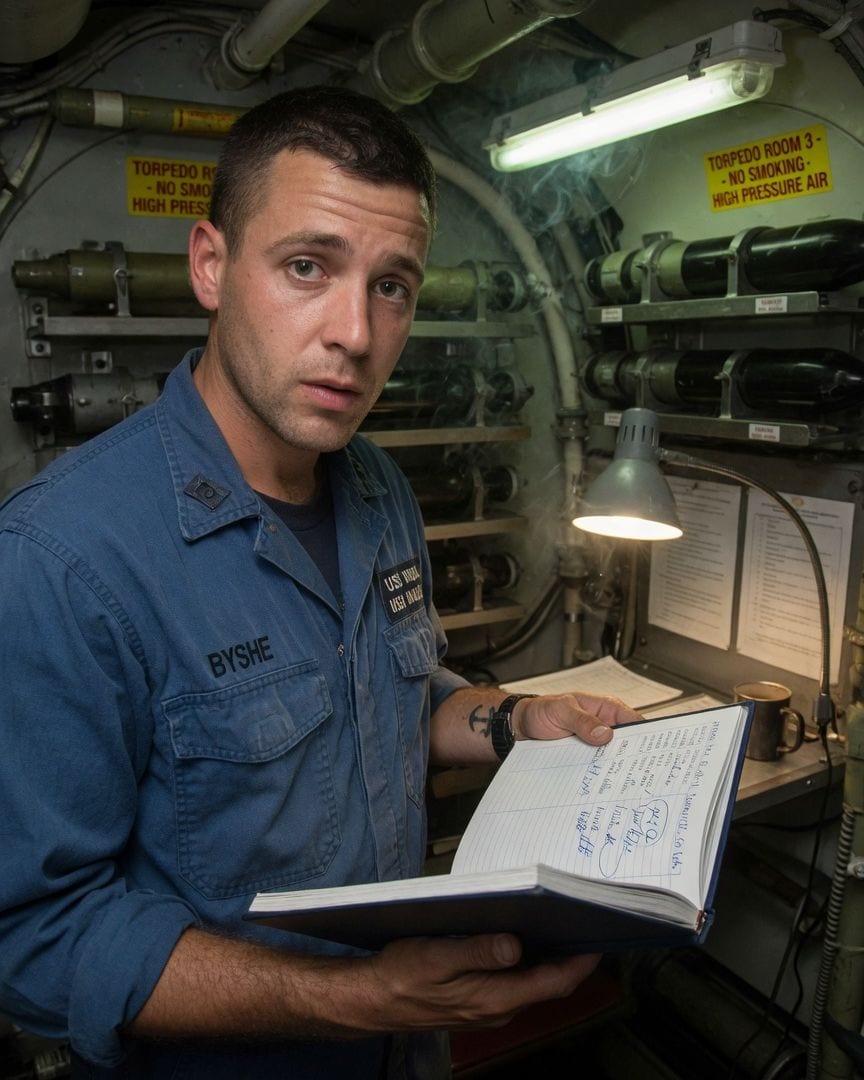
A torpedoman found his own signature in the USS Vanguard's duty log for a watch he never stood, beside a name not on the master crew manifest.
Torpedoman Oscar Bysshe, a rational sailor on his first deep patrol aboard the USS Vanguard, dismissed the messcook's nervous claim of an extra man at the table. He attributed the perfectly clean, untouched tray left behind to a prank. But later, during a routine systems check, Bysshe discovered his own familiar signature in the official duty logbook, for a watch he had been asleep through. Beside it was a name he didn't recognize, a name that shouldn't be there. A frantic check of the master crew manifest confirmed the impossible: the name appeared in the 'temporary assignments' section, dated just yesterday, scrawled in a hand eerily similar to his own.
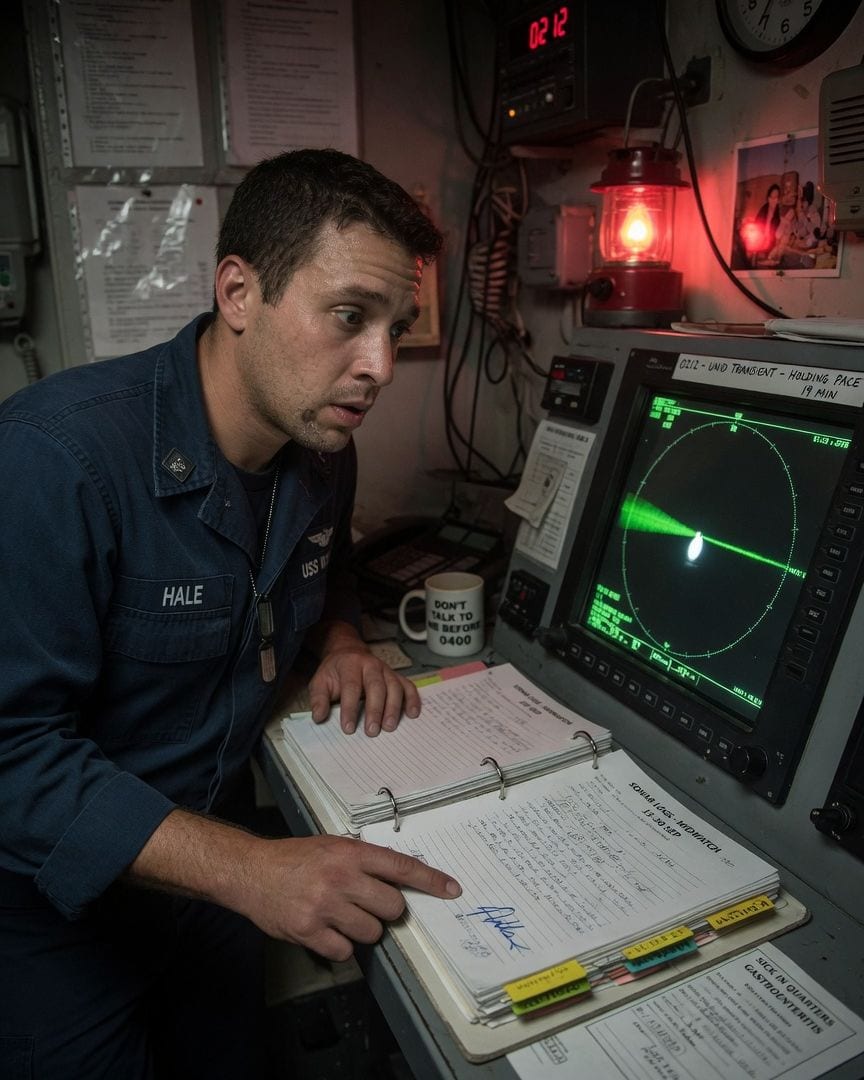
On his last deployment, Petty Officer Hale found his signature in the ship’s log, detailing a ghost contact at 0212 from a watch he never stood.
Petty Officer Quentin Hale was on his last deployment aboard the USS Vigilance, hoping for a quiet end to his sea time and an impeccable record. At 0212, his sonar console painted a faint, solid trace moving with the ship, yet the bridge reported nothing, and a quick check of past logs revealed the same impossible contact appearing repeatedly. But then Hale found an entry from two weeks prior, signed with his own unmistakable hand, detailing the anomaly from a midwatch he was violently sick and never stood. The ship's official record documented a lie he apparently authored, leaving him with a cold tremor deep in his gut.
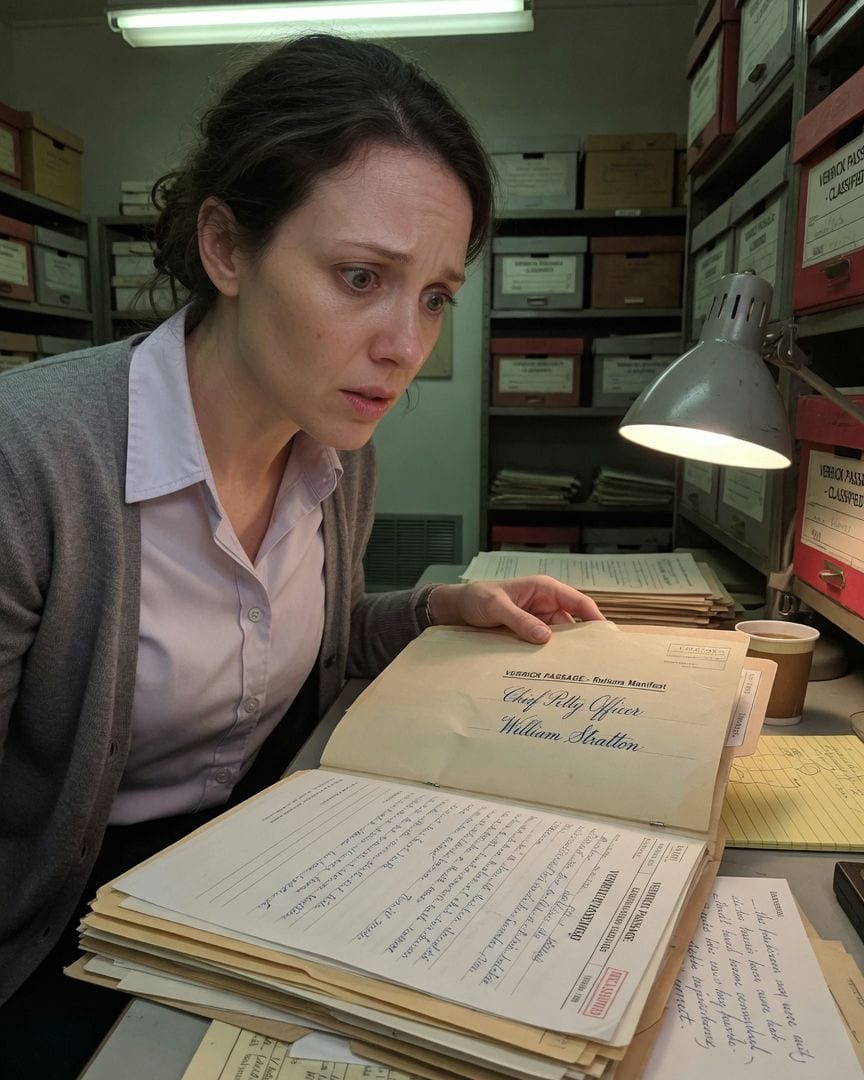
A records reviewer found personnel files for men lost 80 years ago, still being signed in an identical, perfect hand.
In the sterile hush of the declassified archives, meticulous reviewer Ione Fash had a routine task: cross-referencing witness statements from the Verrick Passage file. But as she reviewed files eighty years thick with official silence, she found nine separate interviews containing the exact same chilling sentence, all in an identical, precise hand. Her rational mind sought explanation, yet then she discovered something worse: personnel files for men lost in 1943, still being updated with modern requisitions and payroll runs. Each impossible entry, including a manifest signed just two weeks ago by a casualty from eighty years prior, bore the same unnervingly perfect signature. The file wasn't just a record of the lost; it was still being signed.
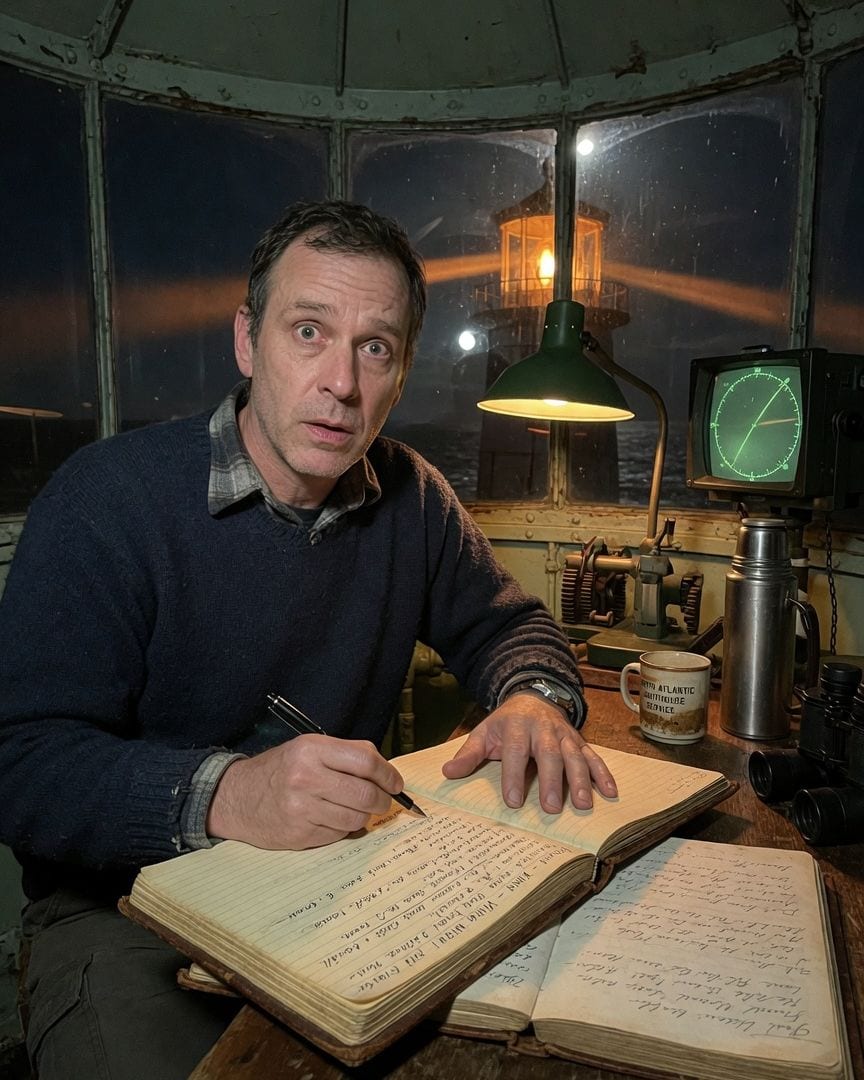
My lighthouse log has my own 3 AM entry for a phantom ship. I was alone in the tower, and I wrote no such thing.
Perched in the lantern room for my usual 2-6 AM watch, I reached for the thick logbook. But the 3:00 AM entry, under my own name, detailed a vessel I never saw. The words were in my own ink, yet I had never written them.
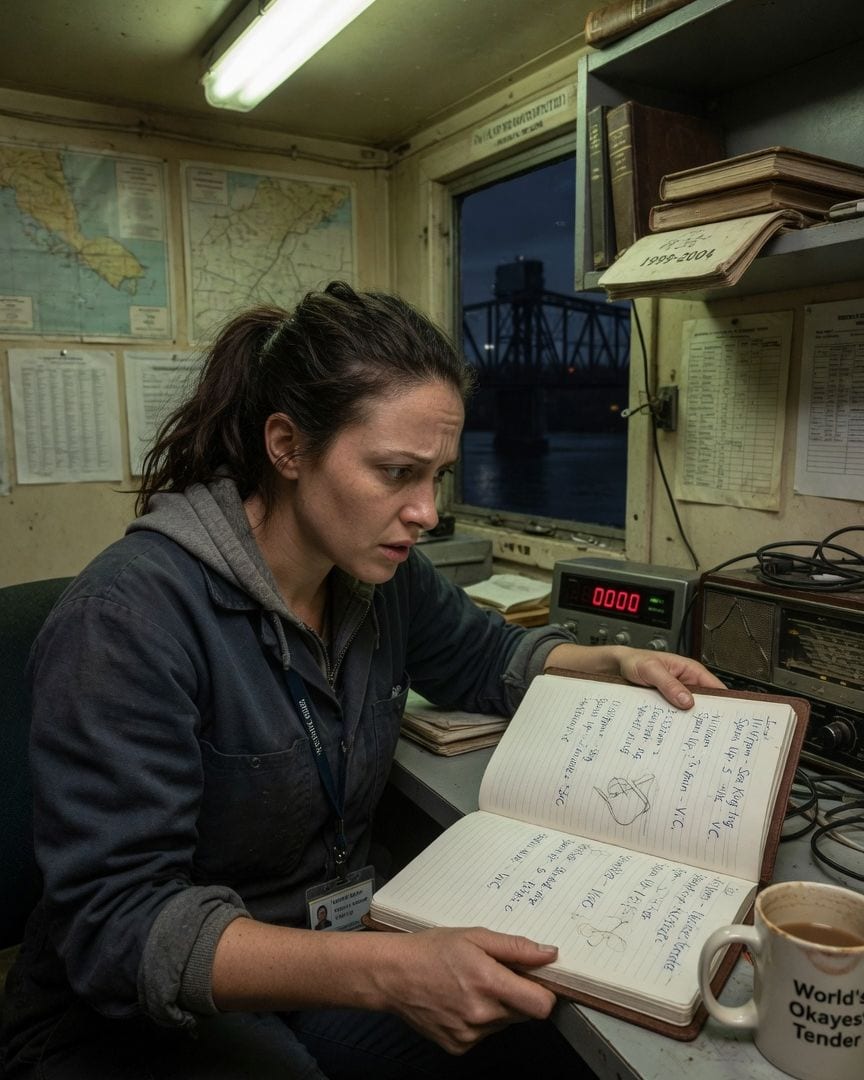
My drawbridge log shows a 2:33am lift I didn't make. The span counter never moved.
As a drawbridge tender, my midnight to dawn shift is usually quiet, a routine of monitoring traffic and logging lifts. But tonight, my own logbook shows an impossible entry for a bridge lift I have no memory of making. My initials and handwriting are there, yet the span counter above my panel reads a steady zero. No boat called, no span ever went up.
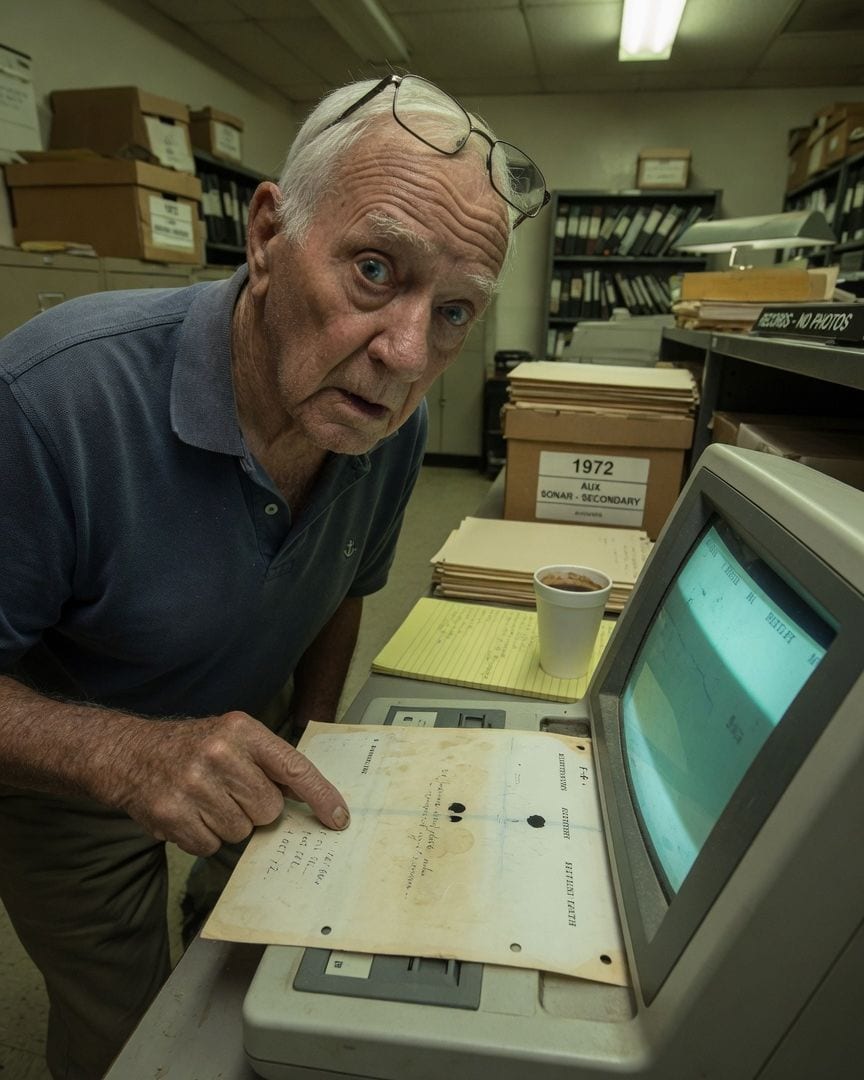
A Chief Petty Officer's salvage career ends when a Cold War fighter jet surfaces at sixty tons, perfectly intact.
Chief Petty Officer Walter Mabey, then 45, expected a routine salvage operation for a lost F-4 fighter jet off the Carolina coast in 1972. His long career was built on such lifts, but as the crane gauge climbed past twenty, then thirty, then an impossible sixty tons, a profound unease settled in. The object surfaced, not a mangled wreck, but a dark, seamless shape, perfectly intact. Mabey's salvage career abruptly ended soon after, replaced by a desk job, but the memory festered for forty years. Now 78, he dedicates his remaining time to finding the truth, uncovering a faint, rhythmic pulse on an old sonar log—a ghost beneath the official lie.