On his last shift before the Cold War St. Louis depot closed, Marlin Ochs found Aisle 40 stretched 61 feet too long. Inside, a 1978 disappearance file had ink still wet, dated 'current year'.
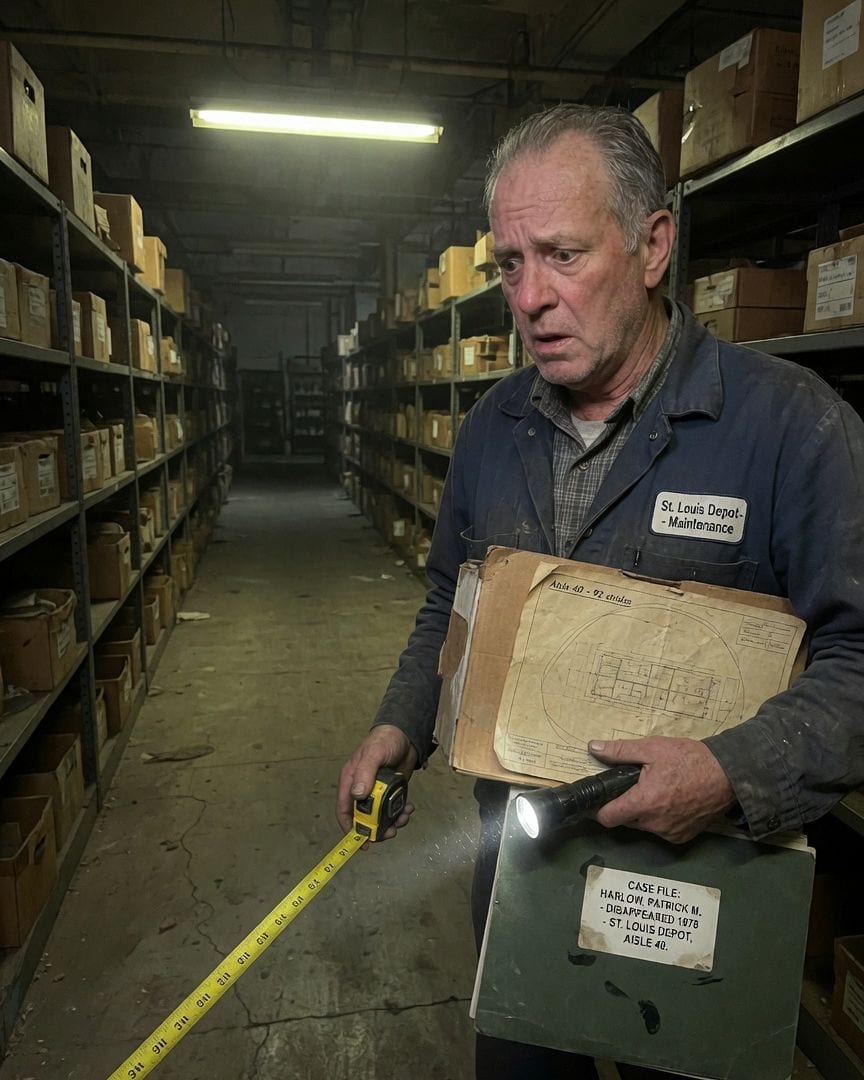
Marlin Ochs, 58 years old, felt the familiar ache in his knees as he walked Aisle 40. Nineteen years of walking these concrete floors, 92 strides wall to wall, exactly as the faded 1956 plat drawing in his pocket dictated.
Tonight was his last shift before the St. Louis depot was pulped, and he was retrieving the final carton from the far end of the aisle.
The air was thick with the scent of old paper and dust, a smell as familiar as his own home.
He counted his steps methodically, a habit ingrained deeper than memory, a quiet ritual against the vast silence of the sleeping depot. Ninety-two. Ninety-three. Ninety-four. His foot hit concrete where the wall should have been, but there was no wall.
He kept walking, his brow furrowed in a line of confusion, counting each heavy step. One hundred and ten. One hundred and fifteen. One hundred and nineteen. He stopped, the fluorescent hum of the depot suddenly too loud, too insistent.
The bulb at the far end, always burning, always without a switch, seemed to glow brighter, pulling him deeper into a space that could not exist.
Marlin retraced his steps, his personal tape measure now unfurling from his belt. He hooked the end to the entry point of Aisle 40, the tape stretching taut, the numbers stark against the grimy concrete floor.
He walked, slowly, deliberately, the small metal casing feeding out line. Two hundred and fifty feet. Two hundred and sixty. Two hundred and eighty.
He reached the exact point where the 1956 plat, a crumpled photocopy he'd carried for decades, said the aisle should definitively end. But the tape kept unspooling, the metal tongue clicking softly. Two hundred and ninety. Three hundred.
Three hundred and forty-one feet. He stood, the tape measure extended to its full length, the far end of the aisle still stretching out before him, lined with shelves he’d never seen, receding into a strange, hazy perspective.
The building’s external wall was a solid brick structure, visible from the main loading bay, a mere two hundred and eighty feet away. The numbers simply did not fit.
He pulled out the plat drawing again, smoothing it against the top of a carton. No annex. No extension. Just a solid line marking the end of the building.
He tried to rationalize it – a measurement error, a forgotten renovation, a misprinted plat – but the depot’s structure was too old, too well-documented for such a glaring oversight.
The extra length wasn't a trick of the light; it was a physical space, solid and real, yet impossible.
Driven by a cold, methodical curiosity, Marlin walked the impossible extra length of Aisle 40. The air here was cooler, drier, carrying a faint, metallic tang.
The shelves were older, dustier, filled with boxes he didn’t recognize, not listed in the depot’s master inventory. He ran his hand over a carton, the cardboard surprisingly cool to the touch.
His flashlight beam cut through the gloom, settling on a thick, heavy file, unlike the standard boxes, tucked between two oversized archival containers. It was bound in dark green canvas, an older government issue.
Marlin Ochs, flashlight beam trembling slightly, pulled a thick, heavy file from a shelf deep within the impossible extension of Aisle 40.
The label read, in crisp, official script: "CASE FILE: HARLOW, PATRICK M. - DISAPPEARED 1978 - ST. LOUIS DEPOT, AISLE 40." He glanced at the last entry on the file's cover sheet: "STATUS: FILED. DATE: 03/17/CURRENT_YEAR."
The ink was still wet beneath his thumb.
Marlin’s heart hammered a slow, heavy beat in his chest. Patrick M. Harlow. He knew that name. A pilot, gone missing during a routine training flight over the Ozarks in '78. His plane vanished, no wreckage, no distress call.
Marlin had reviewed that very file during a declassification audit years ago. It had been officially closed, marked 'Presumed Lost.'
Now, here was a new entry, dated today, in an aisle that shouldn't exist, for a man who should be long dead. He carefully opened the heavy canvas file.
Inside, instead of standard flight logs or search reports, were strange, abstract diagrams, handwritten notes in a precise, almost clinical script, and what looked like topographical maps of areas that didn't exist on any chart.
The last page was a single, typed sheet: 'OBSERVATION LOG – HARLOW, PATRICK M.' The entries detailed a mundane daily routine – '0700hrs: Breakfast, oatmeal. 0800hrs: Reading in common area. 1200hrs: Lunch, soup.'
The dates on these entries extended past 1978, all the way to last week. Marlin’s rational mind struggled to reconcile the impossible. He checked the file number against the depot’s master inventory on his handheld scanner.
'FILE NOT FOUND,' it blinked back, stark white against the dark screen. He tried a different search, cross-referencing names from the abstract diagrams. Nothing.
The scanner, usually infallible, seemed to hit a wall, as if this section of the depot simply didn't register in its digital world.
He took a photo of the file's label with his phone, then quickly and carefully hid the file back among the others, the damp ink leaving a faint, unsettling smear on his thumb.
He needed a witness, someone who could confirm what he was seeing, before his last shift ended.
Marlin made his way back to the main depot, the weight of the Harlow file’s impossible existence pressing on him. He found Patrick Harlow, the young security guard, sitting at his console, scrolling through his phone, oblivious.
'Harlow,' Marlin began, his voice steadier than he felt, 'ever notice anything odd about Aisle 40?' Patrick, 34, looked up, a faint frown on his face. 'Odd, Mr. Ochs? It's just old boxes. Why?'
Marlin hesitated, then decided on a partial truth, testing the waters. 'I was doing a final inventory. The measurements don't match the plat. It's... longer than it should be.' Patrick chuckled, dismissing it with a wave of his hand.
'Old buildings, Mr. Ochs. Probably settled. Or a surveyor's error from '56. Happens all the time.' Marlin pressed, 'And the light at the end? Always on, no switch?' Patrick shrugged. 'Maintenance just leaves it on, I guess.
Easier than fishing for a switch in the dark.' The mundane explanations were too easy, too dismissive, too practiced.
Later, as Marlin reviewed his photos of the Harlow file in the quiet of his breakroom, the unsettling dampness of the ink still a phantom sensation on his skin, his phone buzzed. An unknown number. He answered.
A calm, female voice, familiar but unplaceable, said, 'Mr. Ochs. You're looking into things that don't need looking into. Some files are best left closed.' The line went dead. He checked the number.
It was the depot's internal line, but the extension was unlisted, unregistered. Someone was watching. Someone knew exactly what he’d found.
The next morning, before his shift officially began, Marlin sought out Ruth Novak, his supervisor.
She was a woman who’d been with the depot longer than he had, her face a roadmap of quiet authority, her presence a fixture Marlin had always trusted. He found her in her office, nursing a cup of lukewarm coffee.
'Ruth,' he said, holding up the crumpled plat drawing, 'Aisle 40. It's 341 feet. Not 280.' Ruth, 62, didn't even look up from her cup. 'Is that so, Marlin?'
Her voice was flat, devoid of surprise, as if he were discussing a minor inventory discrepancy. 'The plat's from '56. Things change, buildings settle.'
'Not a structural wall, Ruth,' Marlin insisted, pushing the drawing across her desk, his voice tight with suppressed urgency. 'And I found a file. A Case File for Patrick Harlow. The pilot who disappeared in '78.
It had an entry from last week. The ink was wet.' Ruth finally looked at him, her eyes calm, unblinking, betraying no emotion. 'Patrick Harlow,' she mused, her gaze distant. 'Yes, a rather complete file.
One of our better ones, actually.' Marlin felt a chill spread through him, colder than the depot’s concrete floors. 'What do you mean, 'complete file'? He was lost. Presumed dead.' Ruth took a slow sip of coffee, her movements deliberate.
'Lost, yes. But not gone. Not truly. Some things, Marlin, don't just disappear. They get... filed. Contained. Aisle 40 is a secure storage annex.
For things that can't be explained away, can't be allowed to simply vanish from the record without a trace. We classify them. We log them. We put them away.' She gestured vaguely towards the vast expanse of the depot floor.
'The depot is a filing cabinet, Marlin. A very large, very patient one.' The rational explanations Marlin had clung to collapsed.
The impossible length, the unlisted files, the damp ink, the knowing calm in Ruth’s eyes – it all clicked into place with a horrifying, coherent logic. The depot wasn't just storing records; it was storing realities.
Marlin stared at Ruth, the words 'put them away' echoing in his mind, feeling a growing sense of unreality. 'Who are 'we', Ruth? And what exactly is in those files?'
Ruth smiled, a small, knowing upturn of her lips that didn't reach her eyes. 'The institution, Marlin. The one that knew. The one that keeps the world tidy.'
She rose, walked past him, and headed toward the main floor, her stride unhurried. 'It's time you saw for yourself, I think. Before the pulping.' Marlin, his mind reeling, a knot of dread tightening in his stomach, followed her.
She led him not to the main office, not to her desk, but directly back to Aisle 40, to the impossible, extra length.
She walked with an unnerving confidence, as if she belonged there, as if the anomalous space was her natural habitat.
'You see, Marlin,' she said, stopping before a newly added shelf, lower than the others, almost at eye level, 'the records aren't just about the things that go missing. Sometimes, they are the things that go missing.'
She reached for a file, thin and unmarked, almost transparent against the dusty shelves, its edges crisp and new. 'And sometimes, Marlin, the file is still being written.'
Ruth Novak's calm voice echoes down the impossibly long aisle, "Some things need to be put away, Marlin. You were always so good at finding what didn't fit."
Marlin Ochs turns, his flashlight beam catching the glint of the perpetually burning bulb at the far end, now casting her silhouette against the shelves. In her hand, she holds a thin, newly created file.
Its label reads: "CASE FILE: OCHS, MARLIN T. - STATUS: PENDING. DATE: NEXT_FRIDAY."
Marlin felt a cold, visceral dread grip him as he stared at the file in Ruth’s hand. His name. His employee number. And a date, next Friday, the exact day the depot was scheduled for pulping. 'Pending?'
he whispered, his voice hoarse, barely audible over the low hum from the bulb. 'What does 'pending' mean?' Ruth's smile didn't falter, a serene, almost maternal expression. 'It means you're being processed, Marlin.
You were always so meticulous, so good at finding the inconsistencies. A perfect candidate for filing. The extra length of Aisle 40 isn't just an architectural anomaly; it's a 'containment field,' a localized reality sink.
Things that deviate too much, that threaten the coherence of the world, are drawn in here. They become files. The 1956 plat was a 'containment record,' not a blueprint.
It was an early attempt to impose a false, stable reality on this space, to make it appear ordinary, to keep the world from noticing the seams. The bulb?
That's a primary node, a focal point for the energy that sustains these contained realities. It draws things in, keeps them stable, and allows us to monitor them. The pulping? That's a system reset. A recalibration.
Old files are purged, new protocols initiated. And sometimes, new files are added to finalize the old system.' She tapped the file with his name on it.
'You, Marlin, are the last entry in the old system before the new one begins. A final, high-value containment.' Every impossible detail, every contradiction, every unexplained phenomenon, now made horrifying, perfect sense.
The lost pilot, the damp ink, the unlisted entries, the impossible dimensions – it was all part of a vast, quiet machine that managed reality by filing away its inconvenient truths.
Marlin took a slow, deliberate step back, his gaze flicking from the file to Ruth's unnervingly calm face. 'You're going to... file me?' he asked, the absurdity of the words clashing with the chilling certainty in her eyes.
'You're going to put me in here?' Ruth nodded slowly, her expression unwavering. 'It's not personal, Marlin. It's necessary. Your meticulous nature, your ability to see what others overlook, makes you a liability outside this system.
You perceive the truth too readily. But within it, you become... an asset. A record. You'll simply join the others. The pilot, the diver, the airman at the scope. All those who saw too much. All contained, all accounted for.'
She extended the file toward him, the thin cardboard fluttering slightly in the silent air of the impossible aisle. 'It's already underway. The system has initiated your transfer.' Marlin felt a strange, cold resignation settle over him.
He looked at the file, then back at the endless, impossible shelves, the faint, almost imperceptible hum that emanated from the perpetually burning bulb. He saw the pilot Harlow's file, its damp ink, and understood. There was no escape.
He was already here. He was already becoming a file. Ruth took another step closer, her hand still extended, the thin file fluttering slightly. 'Just accept it, Marlin. It's really quite peaceful. You'll be part of something... permanent.'
He could feel the slight pull, a subtle disorientation, as if the air around him was thickening, becoming heavier, the distant hum from the bulb intensifying, a low thrum against his teeth.
He knew, with absolute certainty, that if he touched that file, he would cease to be Marlin Ochs and become merely another entry, another contained reality within the impossible archive.
The edges of his vision began to blur, the shelves wavering like heat haze.
The St. Louis depot was successfully pulped the following Friday. Demolition crews reported no anomalies, the building collapsing into a neat pile of rubble and rebar, exactly as planned.
The site was cleared, leveled, and plans were drawn up for a new municipal park, erasing any trace of the old structure. There was no mention of a missing records clerk, Marlin Ochs, in any of the official reports.
His disappearance was attributed to a sudden, unexplained departure, a common enough occurrence in an aging workforce facing redundancy. His apartment was found empty, his few possessions neatly packed, as if he had prepared to leave, then simply... hadn't.
Ruth Novak, however, was quietly transferred to a newly established 'Special Archival Services' division in a secure, unlisted facility far from St. Louis, her calm demeanor unchanged.
A single, pristine green canvas file, identical to the one Marlin had found for Patrick Harlow, rested on a shelf in a new, unlisted annex of the Special Archival Services facility.
Its label, in the same crisp, official script, read: "CASE FILE: OCHS, MARLIN T. - STATUS: FILED." The last entry on its cover sheet, dated that very morning, simply stated: "CONTENTS: COMPLETE."
If this one got to you
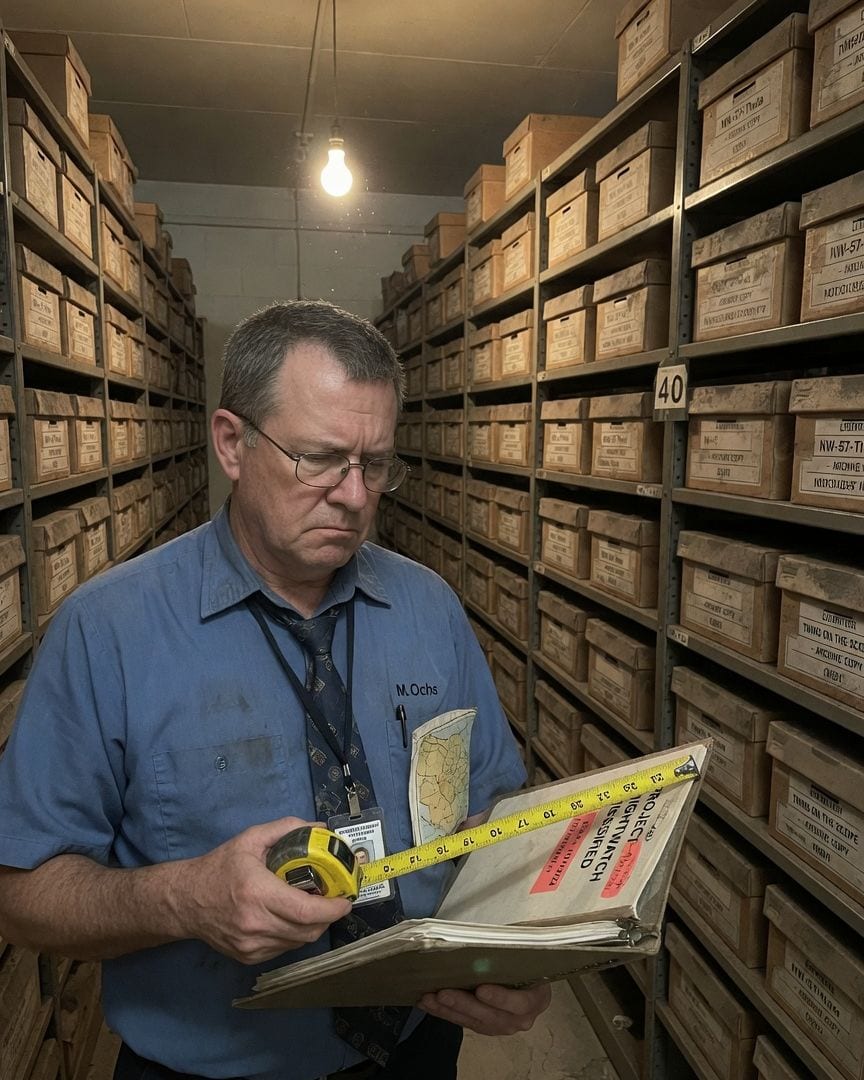
A Cold War records clerk on his final patrol found Aisle 40 stretched 61 feet longer, lined with unknown boxes. Inside one: 'PROJECT NIGHTWATCH - CLASSIFIED' with a fresh timestamp.
Marlin Ochs, a creature of habit after nineteen years at the St. Louis federal records depot, faced his final patrol through Aisle 40 before its scheduled pulping. His routine walk, usually 92 precise strides, suddenly stretched to an impossible 119, making the aisle 61 feet longer than its blueprint. The extra section felt colder, lined with dust-laden boxes bearing alien classification codes and no manifest. Inside one, he found a metal-bound file: 'PROJECT NIGHTWATCH - CLASSIFIED,' dated 1957, but with a timestamp just hours old.
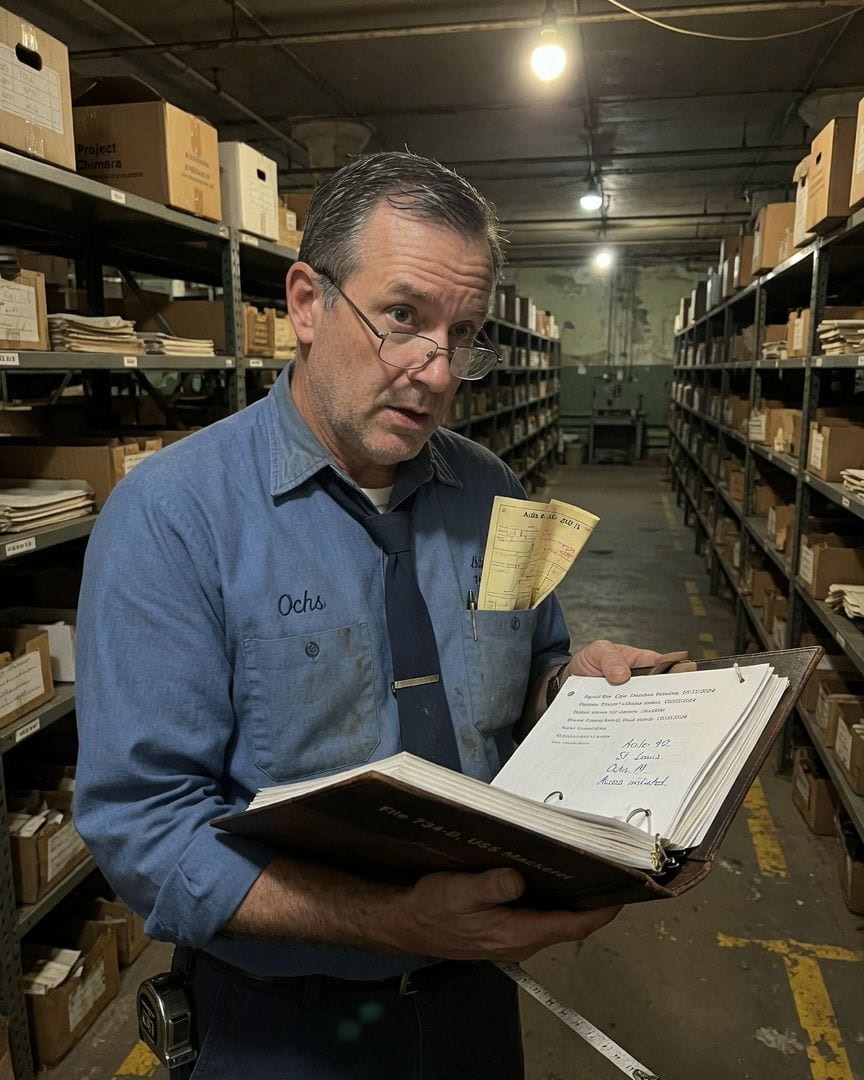
On his final inspection, a depot worker found Aisle 40 had grown 61 feet longer, and a Cold War submarine file hummed warm in his hand.
Marlin Ochs, a man of precise rhythms at the St. Louis depot, approached Aisle 40 for its final inspection before the entire structure was pulped tomorrow. For nearly two decades, the aisle had been a consistent ninety-two paces long. But on this night, his boot heels clicked past the expected mark, stretching to one hundred and nineteen paces, revealing an impossible, colder extension. Deep inside, Marlin found a heavy, leather-bound binder titled 'File 734-B, USS Mackerel,' a Cold War submarine lost with all hands in 1958. It felt oddly warm, almost humming against his palm, filled with maintenance logs and payrolls dated decades after the sub was sunk.
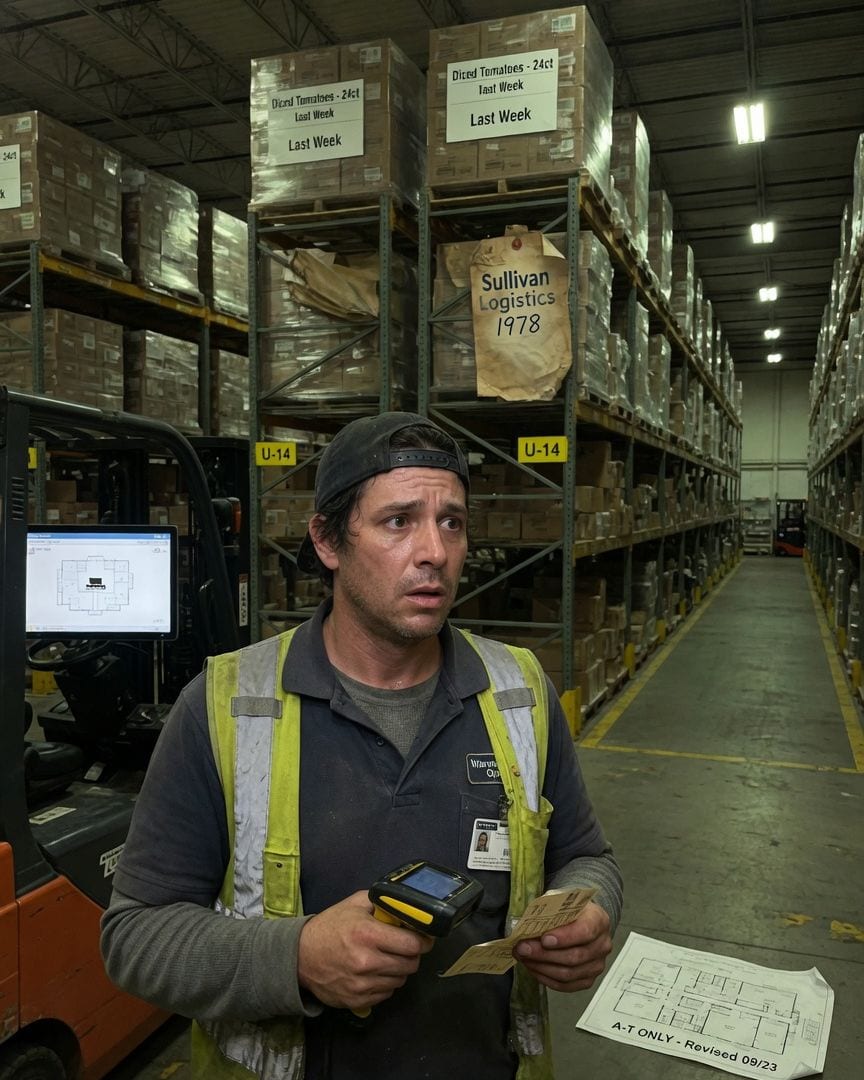
My warehouse floor has an extra aisle past the end wall. Aisle U, full of pallets for orders no one ever placed. My forklift’s GPS says I’m off the map.
On my usual night shift route, driving the forklift through the familiar warehouse aisles, I rounded a corner and found something new. Aisle U. It shouldn't exist; the building's official blueprints only go up to Aisle T. But there it was, stretching out into the dim lights, a solid, tangible section of building that wasn't on any map.
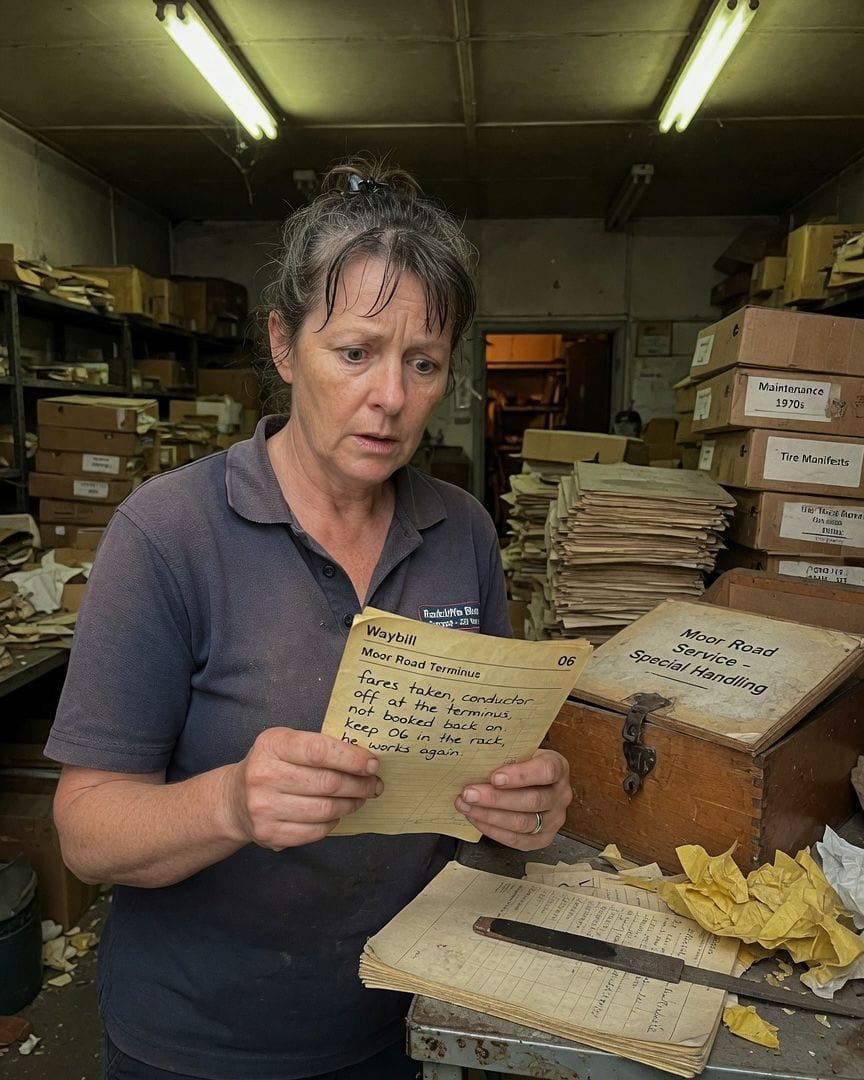
Our depot's Waybill 06 filed a moor road service we stopped running years ago. Every eight years since 1956, it closes: 'keep 06 in the rack, he works again.'
Sorting waybills in the depot, I stumbled across a form for the Moor Road Terminus. That route was decommissioned decades ago, but this waybill had a chilling handwritten instruction: 'keep 06 in the rack, he works again.'
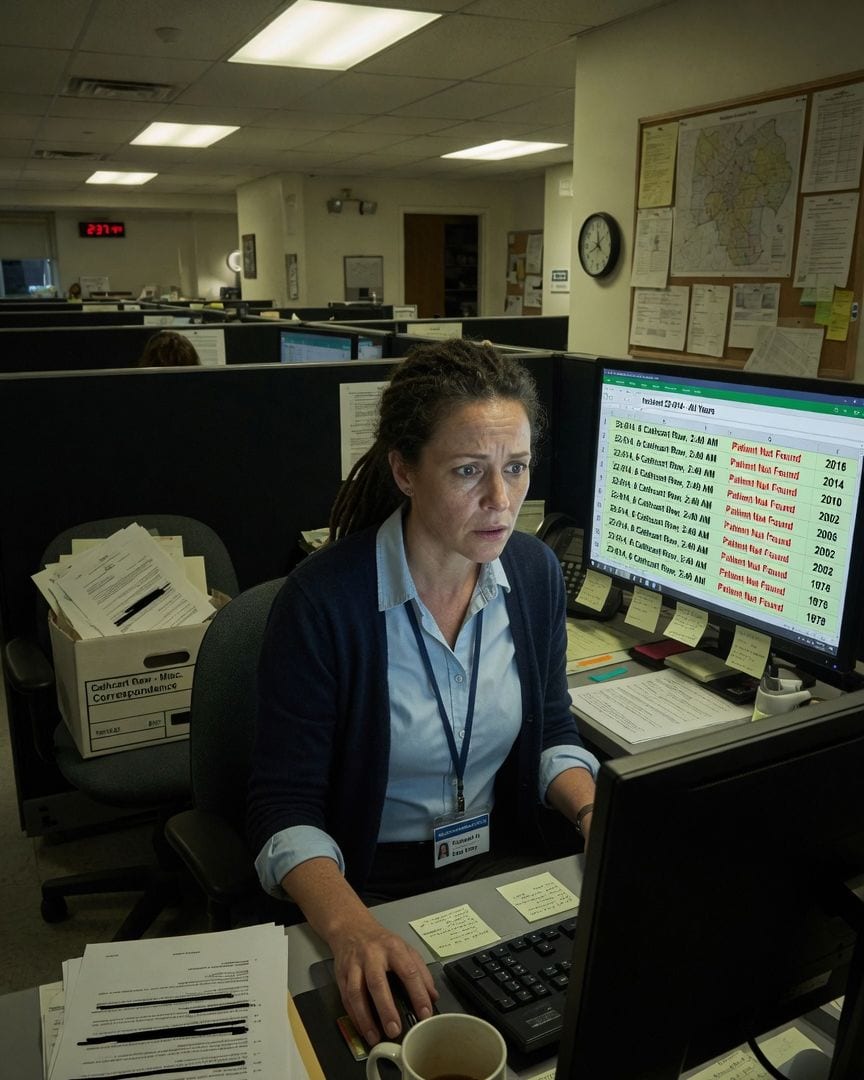
My computer log shows the same 2:40 AM call to Cathcart Row, every four years since 1978, always closed 'patient not found'.
Working data entry for the County Ambulance Trust, I found a routine incident logged as 'Patient Not Found.' But digging deeper, I discovered the exact same phantom call had repeated every four years for over forty years, always at the same address, always at 2:40 AM. Then I found a heavily redacted memo linking it to my own street.
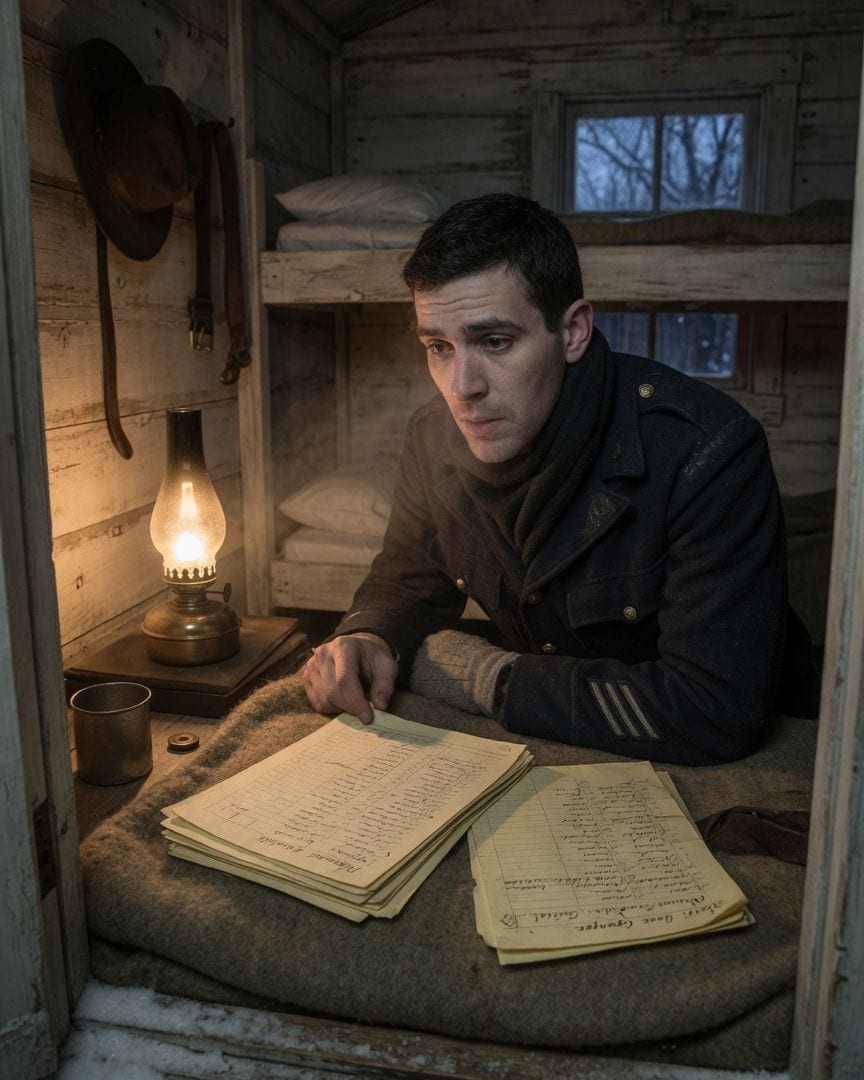
On his last watch, Corporal Carter found boot prints ending inside a sealed magazine, and a blood-red handprint from a soldier decades out of time.
Corporal Franklin Carter shivered, not from the biting November wind, but from the chill of his last pay muster at Fort Taggart before its winter abandonment. His final duty was to count every man, tallying thirty-seven, precisely the company strength. But his breath hitched when he saw the completed roll: it ran thirty-eight names long. An impossible extra slot, filled by a voice that answered 'Here, Corporal,' for a soldier whose name, Pvt. Isaac Granger, vanished from all official records, only to reappear in a forgotten supply log from 1863. Was Fort Taggart abandoning its dead, or something far older?