My warehouse floor has an extra aisle past the end wall. Aisle U, full of pallets for orders no one ever placed. My forklift’s GPS says I’m off the map.
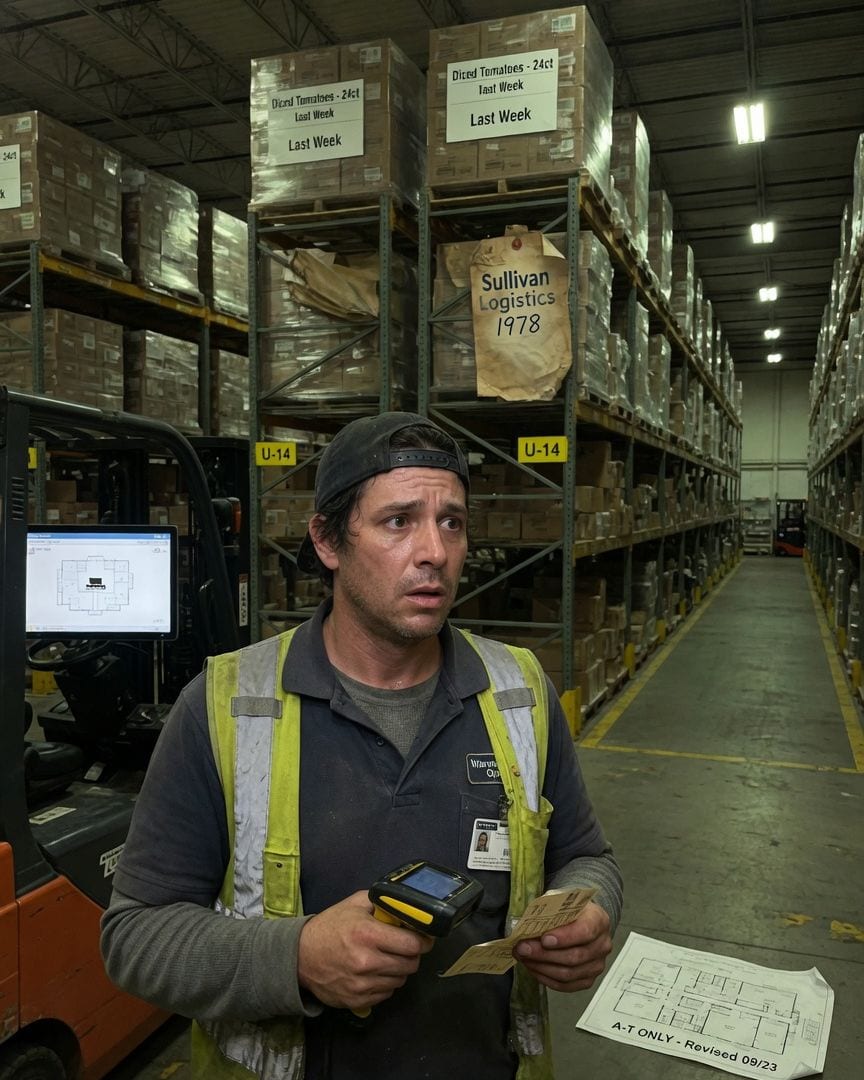
The engine of the forklift hummed low, a familiar thrum in the quiet of the night shift. It was 2:17 AM.
My usual route, Aisle K, then a left onto T, past the loading bay doors, and a loop back towards Aisle A. Twenty aisles in total, A through T, a simple alphabetical sequence.
I’d walked, driven, and counted every single one of them a thousand times over the five years I’d worked this warehouse. They were law.
But as I rounded the corner, past what should have been the solid, unyielding concrete of the end wall, there it was. Not the wall. Not the loading bay. Another aisle.
Aisle U.
It stood there, stretching out into the dim overhead lights, identical to every other aisle in the building. Same tall steel racking, same yellow safety stripes on the concrete floor, same barcodes on the beams.
Pallets stacked three high, shrink-wrapped and labelled, rows of them, stretching down into the receding gloom. I slowed, the forklift’s hydraulics hissing softly as I braked. My eyes flicked to the small screen on my dash: the truck’s location tag.
It blinked, a red dot hovering precariously off the edge of the digital site map, in a bay the building definitely didn’t have. It showed me floating in blank space, beyond the grid.
The air around me, usually a consistent, slightly chilled hum from the climate control, suddenly felt dead. Colder. Stale. Like a room that hadn’t been opened in years.
My handheld inventory scanner, clipped to my belt, felt heavy, cold in my palm. I checked the truck’s console. All systems were green. No error messages. My equipment was telling me everything was normal.
But the physical reality in front of me was a lie.
I cut the engine, the sudden silence amplified by the impossibly still air. Stepping down from the forklift, my boots scuffed on the concrete.
I walked its length, past crates of what looked like generic canned goods and household cleaners, past pallets that had current shipping labels on them.
I reached the far end, my hand brushing against the cold, smooth metal of a racking upright. It was solid. Real. But it couldn't exist. Not here.
I spent the rest of my shift trying to find a mundane explanation. Maybe I was tired. Maybe a new section had been built overnight, without anyone telling the night crew.
But that was insane; you don’t just add 150 feet to a warehouse.
First, I pulled up the official printed floor plans from the office. Crisp, laminated, dated last month. Aisle A to T. Nothing past it. Then I logged into the company server, cross-referenced digital layouts. Same thing.
No U. I even dug deeper, sifting through archived PDFs of old construction blueprints from the 1980s, when the current structure was erected on the site. Still, Aisle T was the absolute, definitive end.
Back in Aisle U, I tried to scan a barcode from a pallet. It was a brand of canned diced tomatoes, one we moved a lot of.
My handheld beeped, recognizing the product code instantly, but then flashed 'Manifest Discrepancy – No Active Order.' No active order. Yet the label on the shrink-wrap was printed last week, current timestamp and everything. I tried another, then another.
Same result. Product recognized, no active order. Ghost inventory.
I walked the aisle again, slower this time, my pace measured. I counted the racking bays. Exactly 150 feet long, just like every other aisle in the building.
I pulled out my tape measure and walked back to the 'real' end wall, the one I knew existed beyond Aisle T. I measured the distance from the last racking bay of Aisle T to that solid exterior wall: 100 feet.
My breath hitched. The numbers refused to add up. There was a whole extra 50 feet of building that shouldn't be there. A room that wasn't counted. It was a physical, measurable contradiction.
It was like the building had taken a deep breath and just... expanded.
I ran my hand over a pallet near the end of Aisle U. It was stacked with heavy, brown cardboard boxes of those diced tomatoes. The modern shrink-wrap was tight, but a corner had pulled loose, revealing something underneath.
Something older. Faded.
I peeled back the modern shrink-wrap carefully, a thin layer of plastic crackling like dry ice in the unnatural silence of Aisle U. The plastic pulled away from an older, dustier cardboard box beneath.
Stuck to it, underneath the fresh wrap, was a heavy, faded shipping tag. It was made of thick cardstock, yellowish with age, and the ink was hand-written, bleeding slightly, but still legible.
I squinted in the dim, stale light. The destination address was local, somewhere in the next county, a small grocery wholesaler I vaguely recognized.
But the sender’s name on the tag, scrawled in a careful, looping hand, made my blood run cold: 'Sullivan Logistics.'
And the date. Scrawled beneath it, '1978.'
Sullivan Logistics. I knew that name. Not from anywhere current, but from a passing mention in a company history brief when I started. They hadn't existed in this region for over forty years.
Not since before the current warehouse was built.
I stared at the impossible tag, the date a punch to the gut, the cold air of the phantom aisle chilling my breath.
The modern pallet label, dated last week, stared back at me from the shrink-wrap I’d just peeled away, an impossible contradiction.
My rational mind screamed that it had to be a joke, a misplaced artifact, but the feeling of the heavy cardstock in my hand, the palpable age of it, argued otherwise.
The next day, I couldn't shake it. My shift ended, but my brain wouldn't stop churning. Instead of going straight home, I went to the public library. Sullivan Logistics. I needed to confirm.
Old business directories in the dusty local history section confirmed it: Sullivan Logistics operated on the exact footprint of our current warehouse site until they went bankrupt in 1980.
The dates clicked into place, not alleviating my dread, but sharpening its edges.
Back home, I delved into our company's digital archives from my laptop, using my employee access. I searched for '1978' and 'Sullivan Logistics' in combination with 'warehouse' or 'inventory.'
It took hours, sifting through poorly scanned microfiche and jumbled old PDFs. To my horror, I unearthed scattered, incomplete manifests from that era.
And there, buried deep in one, were entries for the exact brand of canned diced tomatoes I’d seen on the pallets in Aisle U. The product codes matched. The quantities were similar.
I knew I couldn't keep this to myself. I found Gordon Patterson, my supervisor, in his office the next afternoon. "Gordon," I started, "I think there's something seriously wrong with Aisle U."
He looked up from his tablet, a frown already on his face. "Aisle U? Brandon, we don't have an Aisle U. You know that."
"I saw it. I measured it. My forklift's GPS put me off the map. And I found a pallet with a Sullivan Logistics tag from 1978 under the modern wrap." I laid out the facts, calmly, concisely.
Gordon listened, drumming his fingers on his desk. When I finished, he sighed. "Look, Brandon, I appreciate you being thorough, but this sounds like a system glitch. Database error.
Or maybe," he leaned back, a half-smile playing on his lips, "a past prank by a bored night shifter that you stumbled into. We've had some characters over the years." He paused, his gaze hardening slightly.
"I'd advise you not to stir up trouble, okay? Just stick to your routes. Don't go looking for things that aren't there."
He dismissed me, but his words only fueled my resolve. This wasn't a prank. This wasn't a glitch. The physical space was there. The tag was real. Unconvinced, I remembered Eileen Kingsley. Everyone knew Eileen.
She was a legend, a long-time warehouse clerk, meticulous, almost obsessively so, with records before she retired three years ago. If anyone would have kept notes on something like this, it would be her.
I found her number in the old company directory. It took a few rings, and her voice on the other end was raspy, hesitant.
But after some coaxing, I mentioned Aisle U. There was a long pause, a sudden tension in her voice. She agreed to meet me for coffee.
The diner was quiet, the midday light filtering weakly through the grimy windows. Eileen sat across from me, a small, precise woman, her faded blue eyes sharp but shadowed with worry.
She nursed a cooling cup of tea, her hands clasped tightly around it. As I recounted my discovery of Aisle U, the off-map GPS, the ghost inventory, and the Sullivan Logistics tag, she kept glancing over my shoulder.
Her movements were jerky, her gaze darting towards the windows, then back to me, then away again.
I followed her line of sight. Across the street, parked conspicuously under a wilting oak tree, was a dark, nondescript sedan. Its engine was running, a faint exhaust haze curling from the tailpipe.
Someone was in the driver's seat, an indistinct figure, watching us.
Eileen caught my eye, her expression hardening, a flicker of something close to anger, then resignation. "They’re still watching, aren’t they?" she murmured, almost to herself. Her voice was low, barely a whisper. "Some things never change."
Before I could ask about the car, or about "they," she pushed a worn cardboard box across the table. It was taped shut, but I could see the edges of meticulously organized folders and binders within.
"These are my unofficial files, Brandon," she said, her voice still quiet, but with an urgent edge now. "Things the company wanted to 'misplace' over the years. Things that didn't fit."
She leaned in, her voice dropping to a low, urgent whisper that made the hairs on my arms stand up. "Be careful. Some things are best left buried, especially if they keep coming back."
She abruptly stood, her chair scraping loudly across the linoleum floor, the sudden noise jarring in the quiet diner. She dropped a few crumpled bills onto the table to cover her tea and mine, then hurried out, her gait stiff.
She didn’t look back. I was left alone with the box, the untouched coffee, and the chilling feeling of being watched.
I drove straight home, the cardboard box heavy and unsettling on the passenger seat. My apartment felt strangely vulnerable. I locked the door, pulled the blinds, and spread Eileen’s archives across my living room floor.
It was a treasure trove of bureaucratic nightmares: decades of official manifests and inventory logs, but also newspaper clippings, old internal memos, even hand-drawn sketches on yellowed notepads.
I started with the newspaper clippings. They were faded, brittle, but the headlines were stark. 'Unexplained Structural Anomaly Shuts Down Warehouse Wing – 1978.' Another, from the early 2000s: 'Loading Bay Section Vanishes Overnight – No Cause Found.'
Reports of inventory spontaneously 'vanishing' from shelves only to 'reappear' weeks later in phantom sections of the building, briefly accessible before sealing themselves off again.
One memo described a section of the loading bay, a crucial area for trucks, simply not being there one morning, its concrete floor replaced by a solid, unbreached wall, only for it to return the next shift.
I began to piece together a horrifying, consistent pattern. Roughly every 20-25 years, a section of the warehouse – always the same general area, near where Aisle T should end – would briefly 'fold' in on itself.
It would create or remove physical space, sometimes bringing with it residual inventory from previous iterations of the building. The barcodes I saw in Aisle U, recognized by the current system but linked to non-existent orders, now made terrifying sense.
They weren't glitches. They were echoes. Ghost entries from past cycles, briefly re-manifested. The 'Room That Isn't Counted' wasn't a mistake; it was a recurrence.
I found a hand-drawn diagram, crudely illustrated, showing the warehouse layout. But instead of a solid line for the end wall, there was a dotted section, labeled simply: 'The Breathing Place.'
A dotted line indicating a section that 'breathes' in and out of existence. My earlier attempts at rationalizing Aisle U as a construction error or a prank crumbled under the weight of decades of documented, impossible consistency.
This wasn't an anomaly. It was a pattern.
I continued to sift through Eileen's meticulous files, the dread deepening with every discovery. The cyclical spatial anomaly, the 'breathing' of the warehouse, was undeniable. But I needed more.
I was looking for a 'why,' a source, anything that explained how this impossible geometry began, or how it could be stopped.
Deep in one folder, tucked beneath a stack of old safety reports detailing minor injuries from fallen stock, I found it. A brittle, yellowed newspaper clipping from 1978.
The headline, stark and bold, screamed up at me: 'Forklift Operator Vanishes in Warehouse 'Structural Anomaly''.
My breath hitched in my throat, a cold knot forming in my stomach. The article detailed the mysterious disappearance of a young forklift operator named Theodore Calloway from Sullivan Logistics, on this very site. Theodore.
The name echoed in my mind.
The description of the 'anomaly' was chillingly familiar.
It spoke of a section of the warehouse floor that 'simply wasn't there' one morning, a void where concrete should be, then reappeared a few days later, but with no sign of the worker or his machine.
They searched for weeks, then months, but Theodore Calloway was never found. He had simply... vanished.
A blurry, grainy photograph accompanied the article, a headshot of the missing man. I stared at it, the image burning into my mind, my heart pounding a frantic rhythm against my ribs.
The young man in the photo, Theodore Calloway, had my eyes. His jawline was mine. His exact family features, undeniable even through the poor print quality, mirrored my own.
Theodore Calloway. My great-uncle. My grandfather's brother. He had disappeared from this very site, caught in an earlier iteration of the very thing I had just discovered. He wasn’t just connected to this place; he was always inside it.
I confronted Eileen that evening. I found her at her small, neat home, the archive box clutched under my arm. She looked resigned when she saw me, the weariness of years settling deep in her eyes.
She led me to her living room, a quiet space filled with old photographs and crocheted blankets.
“Theodore was my cousin,” she said, her voice quiet, almost a whisper. “My mother’s side. He was swallowed by it, Brandon, just like others before him.” She poured us both tea, her hands steady, too steady.
Then she laid out the full, terrifying truth.
“The land itself,” she explained, “is… scarred. Not a fault line, not a sinkhole, but a consistent spatial anomaly. It’s always been here. Long before Sullivan Logistics, long before this building.
It causes the structure to periodically fold in on itself, creating Aisle U, other phantom spaces.” She stirred her tea, her gaze distant. “It breathes. Taking and returning, but never quite the same.”
She told me how various managements, through different company names, had always known about it. They’d tried to cover it up. Explained away disappearances. That was why "they" were watching.
They monitored for its return, tried to contain it, but they couldn't stop it. Theodore, and others, became 'part' of the recurrence, their echoes trapped in the geometry, their last actions sometimes repeating in the phantom aisles.
The GPS going offline, the barcodes existing in the system but not on the manifest—it all made horrifying sense now.
The warehouse wasn't just built on a strange spot; it was built into one, a structure perpetually re-forming around a spatial wound.
She slid a thin, leather-bound notebook across the table. “My grandfather. He was a site manager here, generations ago. He kept his own notes. Said he learned to ‘reconcile the numbers’ and ‘weight the anchors’.”
She looked at me, her eyes pleading. “The current cycle, with Aisle U’s prolonged presence… it’s intensifying. He thought maybe, if enough mass was placed at the right points, it could… stabilize it. Hold it in place.”
I understood. I needed to stop the phenomenon, or at least prevent more disappearances. More Theodore Calloways.
I returned to the warehouse on my next shift, feigning a routine inventory check. I brought my forklift, not to move pallets for orders, but to precisely place specific, heavy loads.
Concrete blocks, reinforced steel frames, discarded sections of racking – anything with significant mass. I stacked them high on my forks, maneuvering the heavy machine with a renewed, desperate focus.
Following the faded, cryptic diagrams in Eileen's grandfather's notes, I methodically began to 'pin' the geometry.
The instructions were precise, referring to points on the old blueprints that corresponded to specific structural pillars and foundation points. I worked through the night, placing the loads in a precise pattern around the phantom aisle's perimeter.
The air grew heavy, humming with an unseen, intense pressure. It felt like the very walls were flexing. The building groaned around me, a low, guttural sound that seemed to emanate from its deep foundations.
As I placed the final load, a massive concrete barrier, at the precise point where Aisle U met the 'real' end wall, the air shimmered violently. It was like looking through heat haze, but the distortion was everywhere.
A ripple passed through the racking of Aisle U, the metal blurring at its edges as if it were drawn on water.
The phantom inventory on the pallets flickered, becoming translucent, then slowly, silently, began to contract, dissolving into the solid end wall. It wasn't a collapse; it was a retraction.
The cold, stale air warmed, returning to the regulated hum of the warehouse. The oppressive silence lifted, replaced by the distant drone of the ventilation system. The extra aisle was gone, leaving only the unbreached concrete.
I sat in my forklift, trembling, the engine now the only sound, my breath ragged in my chest.
The next morning, Aisle U was gone. The end wall was solid, unbreached, as if it had always been there. Gordon Patterson walked past my forklift, frowning at his handheld.
He muttered about a 'glitch in the system' that showed an extra aisle last night, and a few phantom inventory items that needed to be purged.
The site map on his device was back to normal, clean, devoid of any impossible extensions.
I watched him from my forklift, a quiet observer, a permanent chill settled deep in my bones. The company quietly disposed of the 'glitch' inventory that had appeared on the main manifest. No one else mentioned the impossible aisle.
Life at the warehouse resumed its normal, predictable rhythm.
I still work at the warehouse. I never speak of Aisle U, nor does anyone else. The memory of Theodore Calloway's face, a ghost of my own, haunts my periphery. I know the fold is only dormant, not truly gone.
I see Eileen sometimes, across a grocery store aisle, and we share a silent, knowing look that speaks volumes about the secrets we carry.
I still count the aisles, every single shift, because I know now that some maps have more than one edge.
If this one got to you
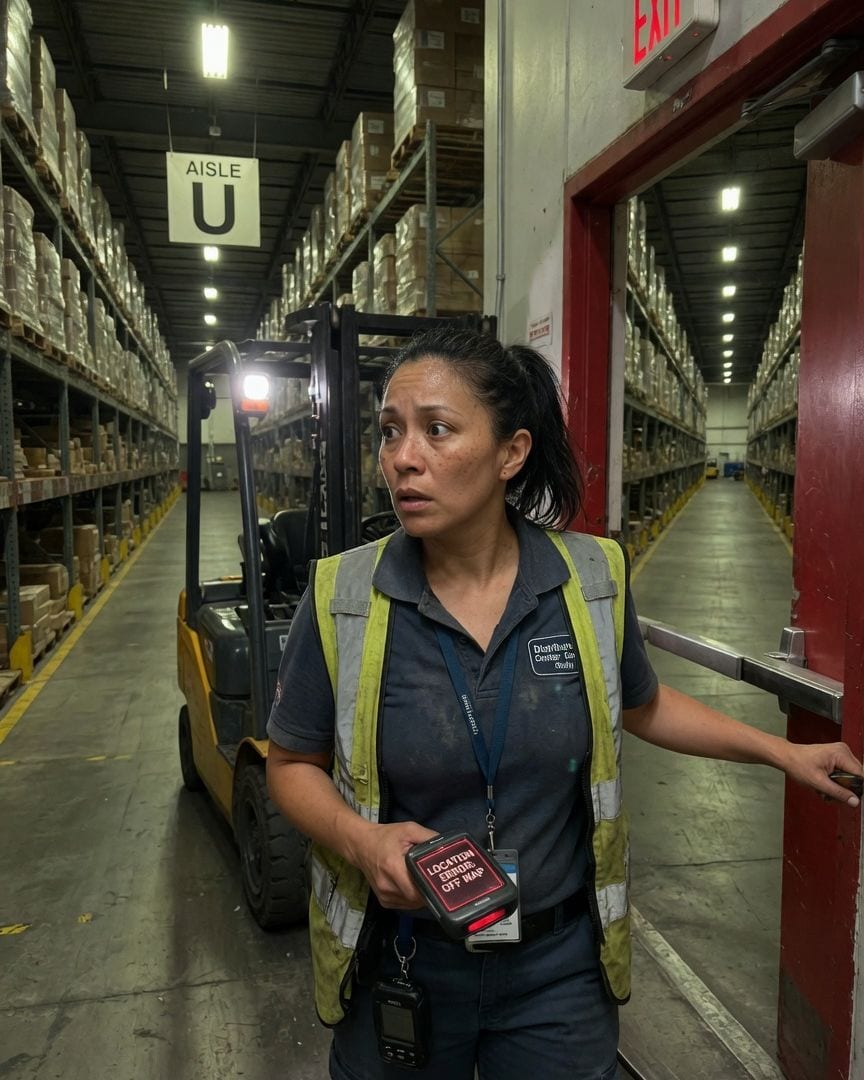
My warehouse has twenty aisles, A to T. My forklift turned past T and found Aisle U, full of packages for orders that don't exist in our system.
Five years I'd driven these aisles at the distribution center, enough to navigate them blind. Tonight, consolidating pallets was a mundane task. But turning past Aisle T, my headlights found Aisle U – a section that shouldn't exist in our blueprints or system. My forklift's scanner screamed 'LOCATION ERROR: OFF MAP'.
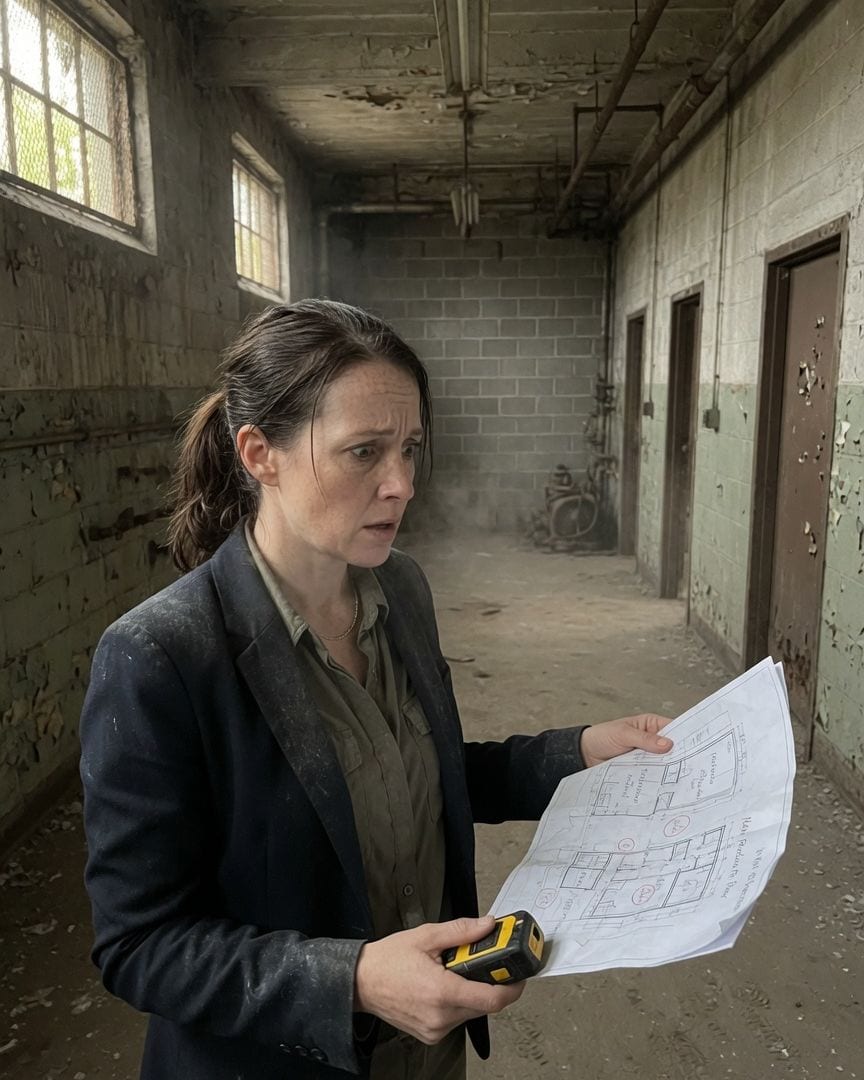
One room is missing from this factory floor. My blueprints show four, but I only found three doors.
Intrigued by an abandoned industrial complex, I secured its old blueprints and entered the cold, silent building. Pacing a long corridor, I meticulously counted doors, comparing them to the detailed plan. The blueprint clearly showed four distinct rooms, but the corridor's length, and my own count, revealed only three doors.
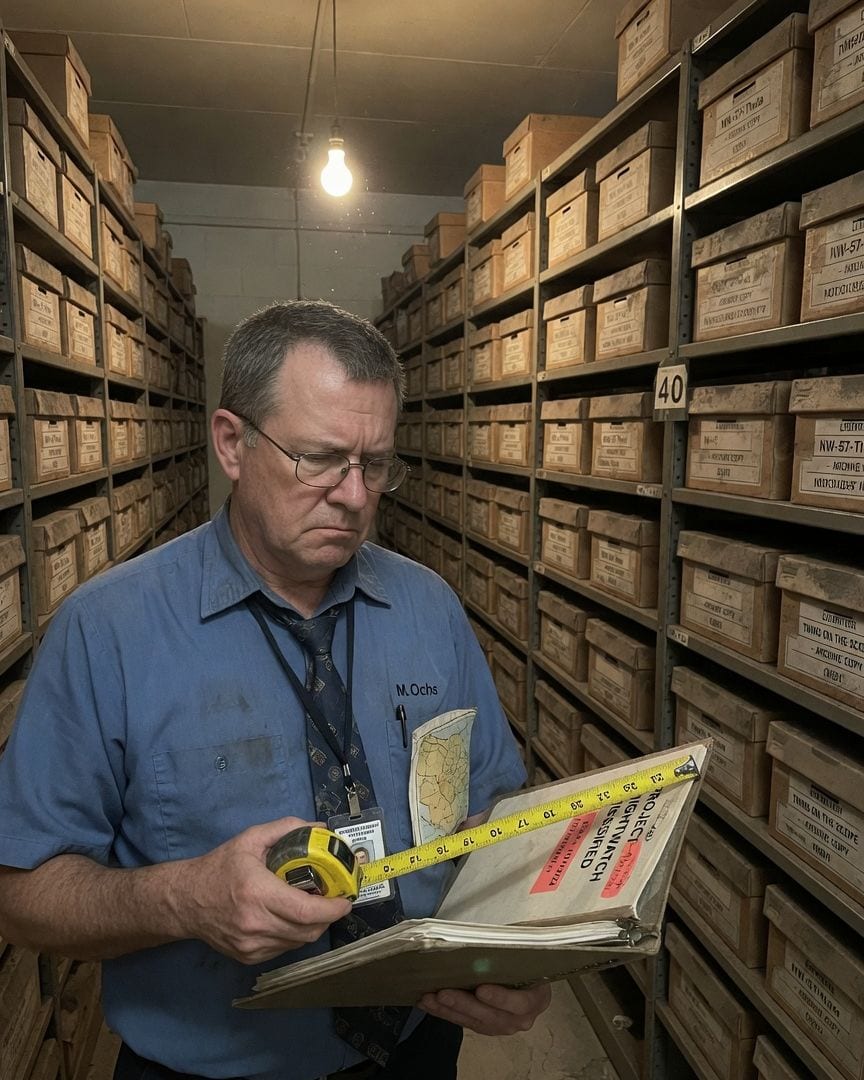
A Cold War records clerk on his final patrol found Aisle 40 stretched 61 feet longer, lined with unknown boxes. Inside one: 'PROJECT NIGHTWATCH - CLASSIFIED' with a fresh timestamp.
Marlin Ochs, a creature of habit after nineteen years at the St. Louis federal records depot, faced his final patrol through Aisle 40 before its scheduled pulping. His routine walk, usually 92 precise strides, suddenly stretched to an impossible 119, making the aisle 61 feet longer than its blueprint. The extra section felt colder, lined with dust-laden boxes bearing alien classification codes and no manifest. Inside one, he found a metal-bound file: 'PROJECT NIGHTWATCH - CLASSIFIED,' dated 1957, but with a timestamp just hours old.
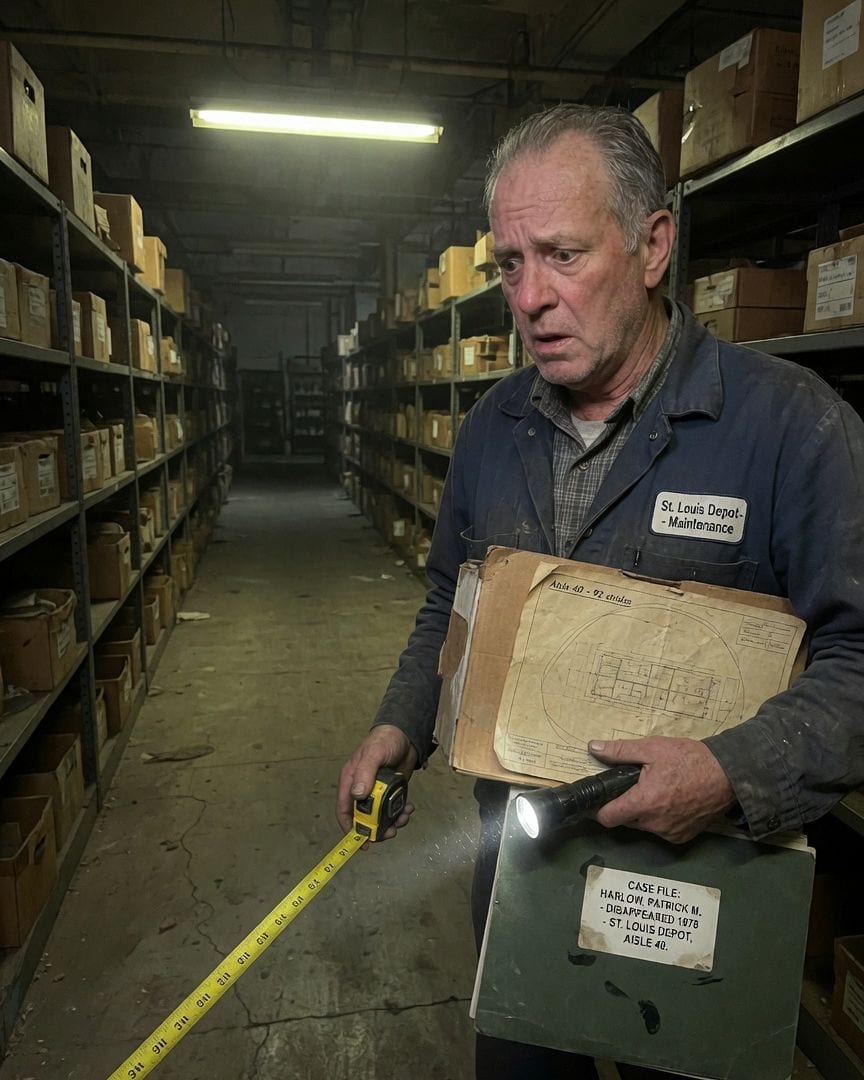
On his last shift before the Cold War St. Louis depot closed, Marlin Ochs found Aisle 40 stretched 61 feet too long. Inside, a 1978 disappearance file had ink still wet, dated 'current year'.
Marlin Ochs, a 58-year-old depot worker, felt the familiar ache in his knees on his last shift before the St. Louis depot was pulped. For nineteen years, he’d walked Aisle 40, 92 strides wall to wall, a quiet ritual in the vast silence. Tonight, retrieving the final carton, his foot hit concrete where the wall should have been, but there was no wall. He kept walking, counting steps, into a physical space that could not exist. Deep within this impossible extension, he found a thick file about a 1978 disappearance, its cover sheet dated 'current year' with ink still wet beneath his thumb.
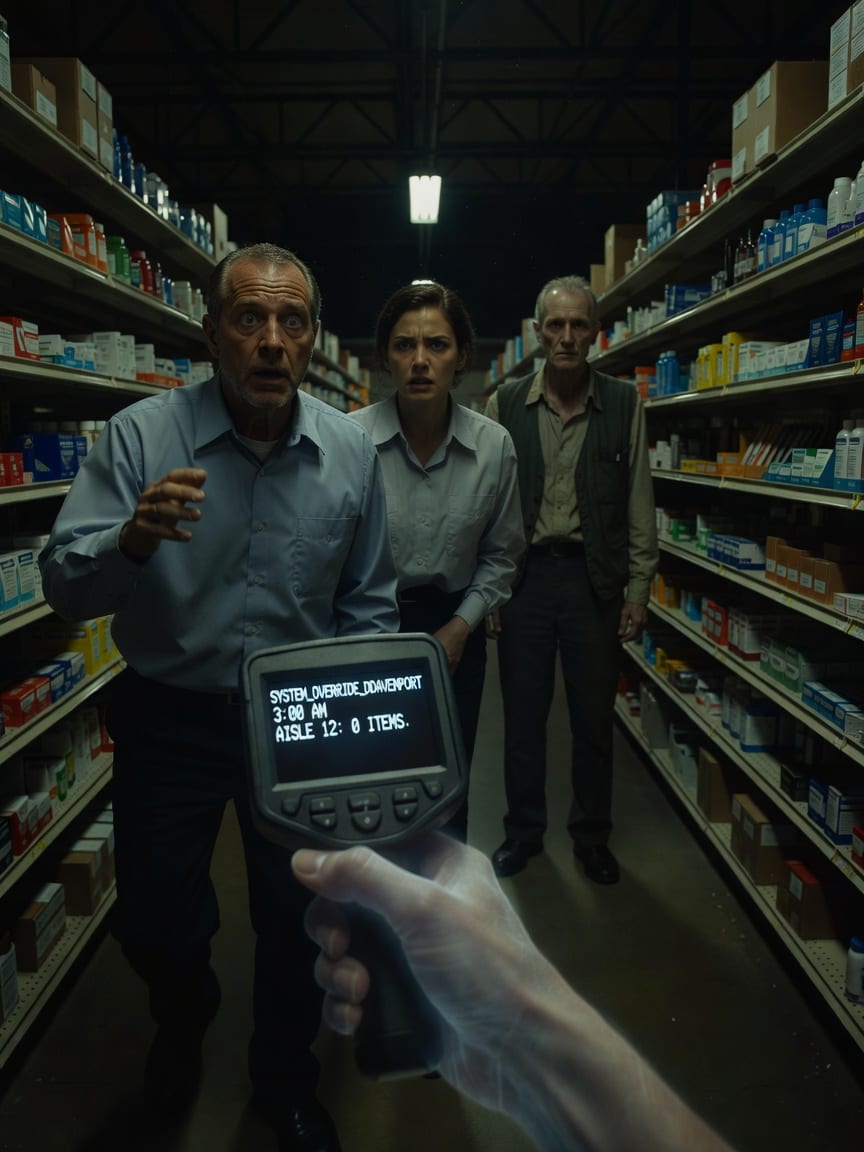
I get pick counts from Louis in Aisle 12 every night. But no Louis works here. That aisle hasn't been touched in months.
My night shift in the vast pharmacy warehouse involves the usual routine of scanning and logging, often punctuated by calls from Louis in Aisle 12. I've grown accustomed to his phantom pick counts, a consistent presence in the quiet hum. But when my floor lead pulls me aside, he reveals the unsettling truth: Louis hasn't been employed here for decades.
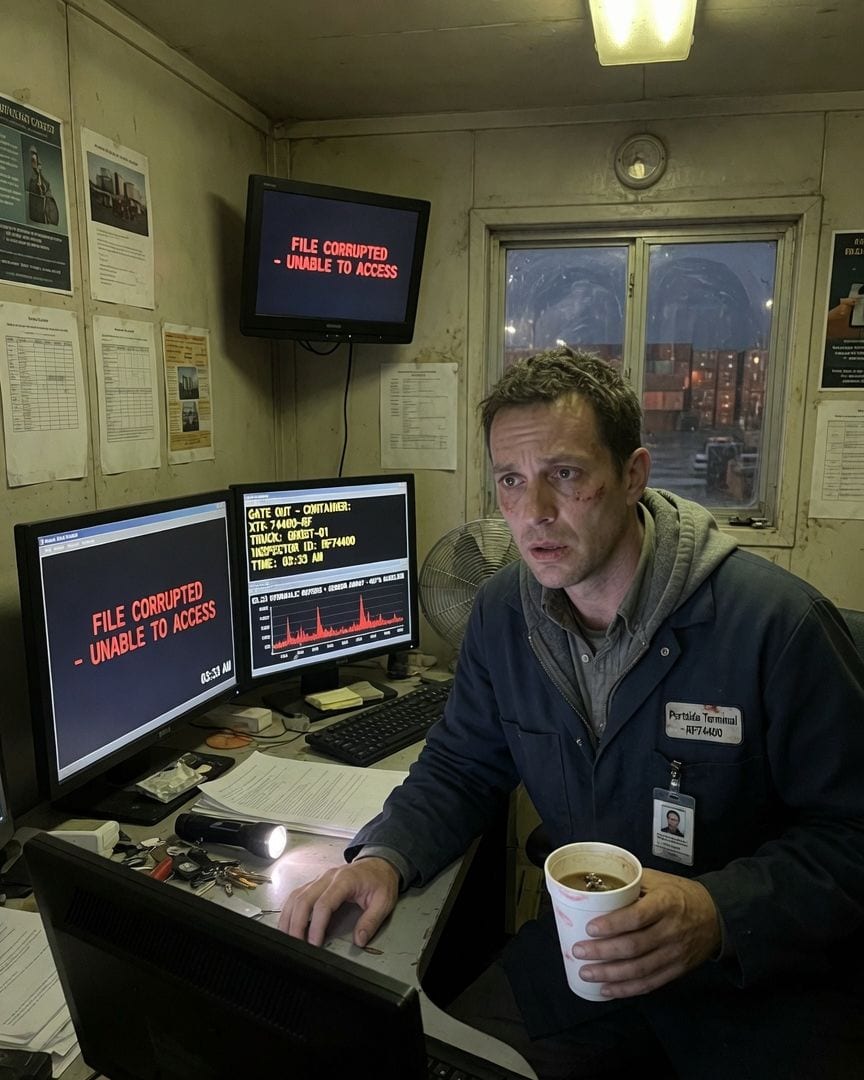
My gate log shows a truck left at 3:33 AM with my inspector ID — but the yard was locked down, and I was the only one on shift.
Working my overnight shift at the Portside Terminal, a routine scan of the gate log turned my blood cold. My ID was stamped on an entry for a truck named 'GHOST-01' exiting at 3:33 AM, despite the main gate being physically secured and locked for hours.