My lower molar has a crown and root canal, twenty years old. I can feel it perfectly whole with my tongue.
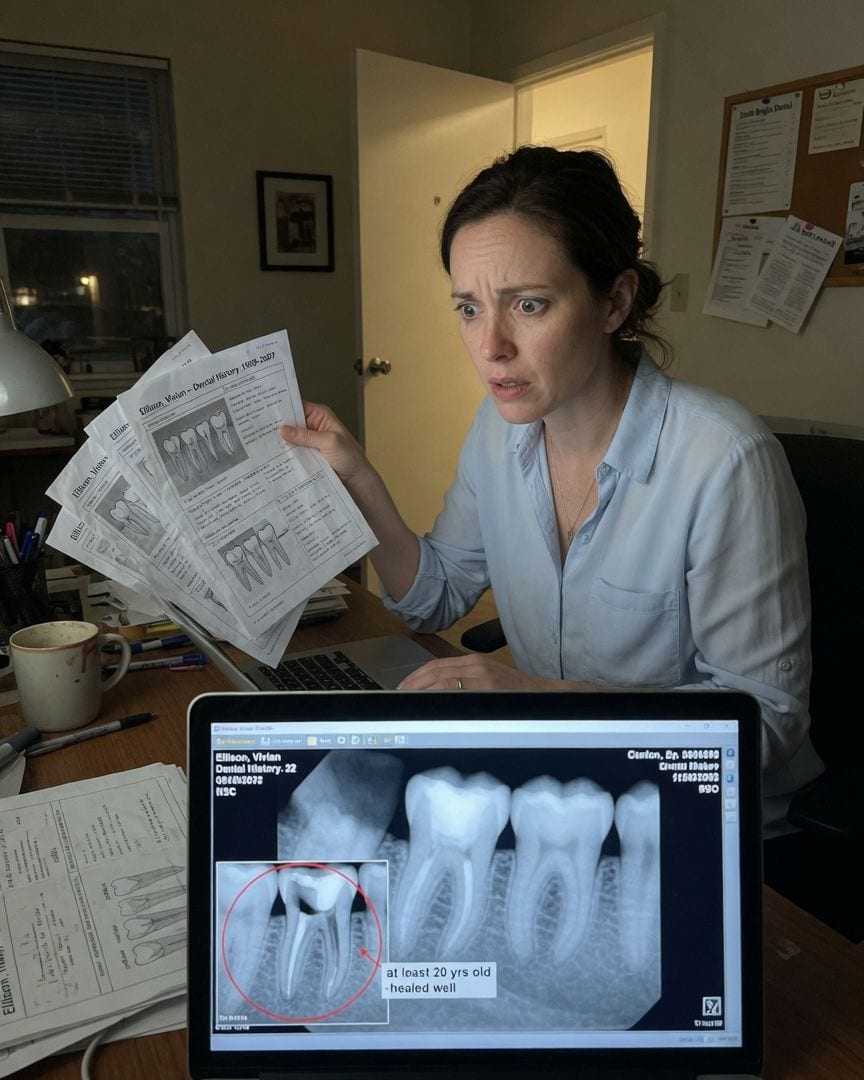
Vivian Ellison settled into the new dental chair, the paper bib crinkling under her chin. The overhead light hummed, bright and sterile. Dr. Sophia Walsh, efficient and kind in her movements, reviewed the panoramic scan that glowed on the monitor.
It was a crisp, clear image of Vivian’s jaw, every root and crown laid bare. Dr. Walsh hummed softly, tapping a spot on the lower left of the screen with her stylus.
“Everything looks good, Vivian,” she said, her voice reassuring. “Except this one. Your lower left first molar. Looks like a solid root canal and crown. Good work, too. Very clean. I’d say it’s at least twenty years old, maybe more.”
Vivian frowned, a sudden, cold knot tightening in her stomach. “A root canal?” she asked, her voice a little too sharp. “On my lower left first molar?” She ran her tongue over the tooth in question.
It felt perfectly sound, smooth, whole. No crown, no filling, certainly no lingering ache or sensitivity that would suggest past major work. She’d never had a root canal in her life. Never had a tooth capped, for that matter.
Dr. Walsh, sensing her confusion, pulled the image up a second time, magnifying the area. The monitor blinked, the pixels sharpening.
There it was: a dark, perfect hollow where the nerve had been, a precise, artificial cap over the top of the tooth. Undeniable. “Definitely. See? Healed perfectly. The bone structure around it is robust. You really don’t remember, Vivian?
It would have been a significant procedure.”
Vivian shook her head, staring at the alien image of her own mouth. The scan was clear, definitive, yet entirely foreign to her own body, to her own memories.
It was like looking at a photograph of someone else’s life, but with her name stamped on the back.
She murmured something vague about a long time ago, a blur from her youth, though every fiber of her being screamed that it was a lie.
She paid her bill, the phantom ache of a procedure she’d never had following her out the door into the too-bright sunlight. The world felt… thinner.
Back home, Vivian tried to rationalize it. A mix-up? A clerical error? Someone else’s scan uploaded to her file by mistake? But Dr. Walsh had confirmed her name, her birthdate, her address. They’d run her insurance.
It was undeniably her file. Vivian, a marketing professional with a methodical mind, lived by data and facts. This impossible contradiction refused to sit right.
She started by calling her old pediatric dentist. The practice, Dr. Miller’s, had merged years ago, the original paper records now digitized and archived by a larger regional dental group.
It took three days, two persistent phone calls, and an official records request, but finally, a thick file arrived in her inbox. It was labeled, in a clear sans-serif font: 'Ellison, Vivian – Dental History 1989-2007.'
She opened the file, her heart thumping a frantic rhythm against her ribs. Page after page scrolled past: routine check-ups every six months, fluoride treatments, cleanings.
A few minor fillings on her upper right molars in her early teens, marked with precise dates and tooth numbers. Even a wisdom tooth extraction in her late teens, logged with anesthetic details and recovery notes.
But on the diagrams for her lower left first molar, the specific tooth Dr. Walsh had pointed out, through all the years covered by the file—from her earliest childhood up to her eighteenth birthday—there was nothing. No root canal.
No crown. The tooth was consistently marked as sound, healthy, untouched. Pristine.
Dr. Walsh had said the work was 'at least twenty years old.' Vivian was thirty-six. That would put the procedure somewhere between her eleventh and sixteenth year. The period covered precisely by these childhood records.
It was impossible. Her body, or at least the high-resolution image of it, insisted on a complex surgical history. Her meticulously kept records, a chronicle of her youth, denied it completely. One of them was lying.
And the records felt far more reliable than a phantom memory.
Vivian called Dr. Walsh again, not for another exam, but for a clarification of the scan itself. The receptionist sounded a little exasperated, but Vivian held firm. “Are you absolutely certain that X-ray is mine, Dr. Walsh?
My name, my date of birth, my unique patient ID?”
Dr. Walsh, patient but firm, confirmed every detail. “The digital signature, the timestamp, the patient ID linked directly to your intake forms. It’s yours, Vivian. I’ve triple-checked.”
“Then you need to see something.” Vivian drove back to the office, clutching the printout of her childhood dental records.
She laid the pristine pages out on Dr. Walsh’s desk, the clear, handwritten diagrams showing an untouched molar for every year of her adolescence. Dr. Walsh’s brow furrowed.
The soft lighting in the room seemed to sharpen, reflecting off the polished wood.
She looked from the vivid panoramic scan on her screen, the dark hollow of the root canal undeniable, to the clean, consistent history of Vivian’s youth spread before her. Her professional composure cracked, dissolving like ice.
Her eyes widened, a flicker of profound, dawning disbelief replacing her earlier calm.
The contradiction gnawed at Vivian. It ate at her waking hours and shadowed her sleep. She spent weeks researching dental records, medical archiving protocols, anything that could explain such a profound, systemic discrepancy.
Was it a rare anomaly, a glitch in a long-dead system, a single, inexplicable error in two otherwise perfect sets of data? Every mundane explanation she found fell short, collapsing under the weight of the facts.
The childhood records were too clear, too consistent. The new scan was too definitive, too precise in its anatomical detail.
Her investigation, driven by a growing, frantic need for an answer, led her to a local historical society. It was a quiet place, smelling of old paper and dust, which housed an archive of defunct medical institutions and their records.
She found a passing reference to a major data migration project that occurred around twenty years ago, involving St. Jude’s Hospital, where she’d had her childhood dental care. A huge undertaking, it said, digitizing decades of paper files.
The project manager's name was Daniel Hale, now listed as a retired independent researcher specializing in 'medical data integrity.'
He was the only name she could trace from that era that seemed to have anything to do with records.
His contact information was sparse: a P.O. box in a neighboring town, and a cryptic email address that looked like a string of random characters.
Vivian hesitated, then sent an email, meticulously detailing her dental conundrum, trying to keep her tone professional, factual. She expected a dismissal, or at best, a technical explanation that would ultimately prove fruitless.
Instead, she received a reply the next morning. It was short and direct, devoid of pleasantries: 'Some records are not meant to be reconciled. Your case fits a specific pattern. Come to my office. Tuesday, 2 PM.
Don't bring anyone else.'
The unease that had been a dull ache now sharpened into a cold, specific dread. This wasn't a glitch. This wasn't a technical error. Someone knew.
Daniel Hale’s office was a cramped, dusty room above a second-hand bookstore. The air was thick with the scent of old paper and stale coffee.
Stacks of forgotten files leaned precariously against shelves crammed with antiquated microfiche readers and outdated computer terminals.
Hale himself was quiet, observant, his face a web of fine lines, his eyes a startlingly clear blue that seemed to hold generations of secrets.
He had the air of a man who spent his life sifting through the forgotten detritus of bureaucracy.
He listened to Vivian's story without interruption, his gaze fixed on her. He nodded occasionally, never expressing surprise, never interrupting her carefully rehearsed timeline of impossible facts.
When she finished, the silence in the small room stretched, broken only by the hum of an ancient hard drive.
“You’re looking for a continuity that isn't there,” he finally said, his voice a low, gravelly rumble. He leaned forward, resting his elbows on his desk, his fingers steepled. “Tell me, Vivian, do you ever feel… a disconnect?
A moment where a memory doesn't quite sit right, like a puzzle piece from another set? Or a sudden, unexplained familiarity with a place you've never been, a face you've never seen?”
Vivian felt a chill that had nothing to do with the draft from the window. He was asking questions that went far beyond dental records.
Questions that touched on the vague, unsettling sensations she had occasionally dismissed as stress or exhaustion.
He then pulled out a faded, unmarked memo from a file drawer labeled 'Anomalous Somatic Data.' The paper was brittle, yellowed at the edges. It was an internal hospital document, dated twenty-three years ago, its contents mostly boilerplate administrative text.
But in one heavily highlighted section, a single phrase stood out: 'anomalous dental markers' in a discussion about 'unexplained somatic discrepancies.'
He didn't let her read the full text, merely pointed to the phrase with a gnarled finger, his eyes unwavering.
“Some things are better left undisturbed,” he warned, his voice barely a whisper. “The systems that create these anomalies… they prefer silence. And they notice when someone starts asking too many questions.”
The words hung in the dusty air, heavy and loaded.
Vivian felt a prickle on her skin, a sudden, chilling awareness that her meticulous search for answers had made her visible to unseen eyes, had drawn her out from the comforting anonymity of the ordinary world.
Vivian pushed the memo back across Hale’s dusty desk. The paper crackled faintly under her touch. “What systems? What anomalies? This isn't just about a tooth, is it?” Her voice was thin, almost a plea.
Hale sighed, the sound a tired exhalation that seemed to carry the weight of decades. He leaned back in his creaking chair, the springs groaning in protest. “No, Vivian. It isn't.”
He admitted he’d been tracking these cases for years, unofficially. A medical archivist whose job it was to ensure data integrity, he had begun to notice patterns, impossibilities that defied every logical explanation.
He explained that around two decades ago, a highly classified medical research program, operating under the guise of 'patient rehabilitation,' existed within certain institutions, including St. Jude's. He called it the 'Re-integration Protocol.'
He pulled up a heavily redacted digital document on his computer, the screen illuminating his tired face. The title flashed briefly before his hand moved to scroll: 'PROJECT ECHO: Patient Re-integration Protocol – Phase III.'
Most of the text was blacked out, a heavy shroud of censorship, but Vivian caught phrases as he scrolled past: 'stabilization of new somatic memories,' 'discrepancy resolution,' and chillingly, 'dental restructuring as a marker for successful integration.'
The dread that had been a cold knot in her stomach now solidified into a cold, hard certainty. This wasn't a mistake. It wasn't an anomaly. It was a deliberate, systematic process.
Her dental work, or rather, the stark lack of it in her childhood records, wasn't an error. It was a signature. A deliberate, manufactured inconsistency.
“They weren't replacing people,” Hale said, watching her face intently. “They were… resetting them. Their consciousness, their memories. Grafting a new self onto the existing body. The old self, the old memories, erased. Or perhaps, simply dormant.”
Vivian thought of her tooth, perfectly whole and sound beneath her tongue, yet bearing the ghost of an ancient procedure on an X-ray.
She thought of her childhood records, pristine and empty of the truth that was now etched into her very bone. It all clicked into place, a monstrous, coherent shape forming in her mind. Her body was a palimpsest.
Her past was a lie.
Vivian’s voice was a whisper, barely audible over the hum of Hale’s computer. “Why me? Why my tooth?” The question felt utterly inadequate, yet it was all she could manage.
Hale shook his head slowly, his expression softening with a quiet melancholy. “The 'why' is beyond my reach. It always was. The 'how'… that's what I've tried to document, to understand.”
He stood, his movements stiff with age, moving to a locked metal cabinet in the corner of the small room. The cabinet groaned as he unlocked it, the sound unnervingly loud in the sudden quiet.
“There’s something else,” he said, his back to her. “Something I’ve never shown anyone else. Never dared to.”
He opened a drawer, pulling out a thick, yellowed folder. He handled it with immense care, as if it contained something infinitely fragile. Inside, nestled beneath layers of tissue paper, was an old, grainy black and white photograph.
He slid it across his dusty desk.
It depicted a young woman, perhaps in her late teens or early twenties, with a serious, almost somber expression. Vivian’s breath hitched in her throat.
The woman had a faint, distinctive scar above her left eyebrow—the exact scar Vivian had, one she’d always attributed to a clumsy childhood fall from a swing set. The photo itself was dated roughly 'twenty years ago.'
Beneath the image, in crisp, typewritten text, was a case file number, and a name: 'Vivian Ellison.'
But the face looking back at her, while bearing her scar, was subtly, unmistakably different. Her jawline was softer, her eyes a shade darker, the curve of her lips a nuance that spoke of a separate, distinct person.
The accompanying notes were terse, clinical: 'Successful re-calibration, Subject 7.'
It was her name, her scar, her timeline. But not her face. Not quite.
Vivian stared at the photo, a tremor running through her, not from fear but from a terrifying dislocation of self. “Who… who is this?” she finally managed, the words catching in her throat.
Her eyes darted from the photo to Hale’s unwavering gaze, then back again.
Hale’s expression was compassionate, deeply empathetic. “That, Vivian, is you. Or rather, the Vivian Ellison who existed before the Re-integration Protocol. Before your consciousness was… reset.” He explained that the program wasn't about replacing individuals with clones or imposters.
It was about 'correcting' them. A 'self' deemed aberrant, traumatized, or perhaps simply non-compliant by some hidden criteria, was subjected to a procedure that essentially wiped and re-imprinted their memories, their personality, into their own body.
The physical markers, like the dental work or the scar, were either part of the 'reset' process—a signature of the intervention—or indelible remnants of the original self's life, too fundamental to be erased.
“The Vivian in that photo lived your early life, accumulated those records, had that specific dental work on her lower left first molar,” Hale continued, his voice quiet. “Then, twenty years ago, something happened. And a new 'Vivian' was installed.
The one sitting here now.”
The pattern snapped into place with sickening clarity. Every impossible detail, every vague sense of disconnect she’d ever had, every nagging question about her own past, coalesced into a monstrous, coherent shape.
Her entire life, her memories, her very identity, were a construct. She hadn't stumbled upon a historical anomaly; she was the anomaly. The world, her world, was a lie.
Hale, sensing her distress, showed her other files. Other photos.
Each one, a 'Subject' with a similar narrative, a similar marker – a specific birthmark, an unusual bone density, a recurring pattern of dental work on that exact lower left first molar. The sheer scale was overwhelming.
She was one of many, a cog in a vast, unseen machine that moved beneath the surface of everyday life.
Vivian felt a wave of nausea, her stomach clenching. “Can it be undone? Can I get her back?” The desperation in her voice was raw.
Hale shook his head sadly, the movement slow and deliberate. “No. The process is irreversible. The self you are now, the memories you hold, they are real. They are you.”
He explained that the program, while officially defunct, had left its operatives scattered, still observing, still maintaining the illusion of normalcy. Drawing attention to it, he warned, was dangerous.
These people, these 'handlers,' were not cruel, but they were committed to the 'stability' of their subjects.
He pulled out a final document, a neatly typed ledger of 'successful re-integrations.' It was a long, chilling list of names, each with a brief description of their 'marker' and 'integration date.'
Vivian scanned it, her eyes darting across the page. Her own name, 'Ellison, Vivian (Subject 7),' was there, next to 'lower left molar, scar supraorbital.' And then, further down, she saw other names. Names she recognized.
A distant cousin she hadn’t seen in years. A former colleague from her first marketing job, whose sudden, unexplained career change had always puzzled her. A neighbor from her childhood street, who’d always had a peculiar, detached way about her.
The horror wasn't just personal; it was endemic. It was woven into the very fabric of society, an invisible tapestry of altered lives, living among the unaltered, unaware.
Hale’s voice was gentle but firm, cutting through her rising panic. “You have a life, Vivian. Live it. It is yours, even if it began differently than you believed.”
He paused, his gaze fixed on her, a profound warning in his eyes. “But they will know you know. Be careful what you say, what you look for. The silence is for your protection, now.”
The implication hung heavy in the air: the threat was not external; it was the fragile illusion of her own reality, an illusion she had just shattered.
Vivian left Hale’s office, the world around her subtly, irrevocably warped. The familiar faces in the street, the cheerful chatter of passersby, now held a terrifying new implication. How many of them? How many subjects, silently re-calibrated, walking among us?
She looked at her own hands, then touched the faint scar above her left eyebrow, a physical echo of a self she’d never known, a signature of a past that wasn’t hers.
She went home, the silence in her apartment suddenly vast and unsettling. The carefully curated comfort of her life felt like a flimsy stage set.
Her husband, Carl, asked about her day, and she found herself struggling to form coherent answers, every word feeling like a lie. Every interaction felt performative, every memory a potential fabrication.
The comfort of her life had been replaced by a gnawing, existential dread. She was still Vivian, but a Vivian hollowed out by a truth too monstrous to fully comprehend, a truth that had stolen her very foundation.
Vivian sat at her laptop, staring at a blank document, the cursor blinking impatiently, a tiny, rhythmic pulse of nothing.
She tried to write down everything Hale had told her, to document the pattern, the protocol, the faces in the ledger. To make sense of the monstrous coherence.
But the words felt flat, inadequate, utterly incapable of capturing the enormity of what she now knew. How could she explain a horror that had consumed her very self, a truth that made her own existence a lie?
The keyboard felt alien under her fingers.
She closed the laptop, the screen going black, reflecting her own unreadable face. Then she looked down at her left hand, tracing the lines on her palm, feeling a profound, unsettling disconnect from the flesh and bone that housed her.
She wasn't just inside it; she was it.
Vivian Ellison's online journal remained incomplete, the last entry detailing a dental scan and a forgotten root canal. Her husband, Carl Larsen, found her staring blankly at the television one evening, a half-eaten dinner plate beside her. 'Everything alright, Viv?'
he asked. She turned, a faint, wrong little smile on her face. 'Is that so?'
If this one got to you
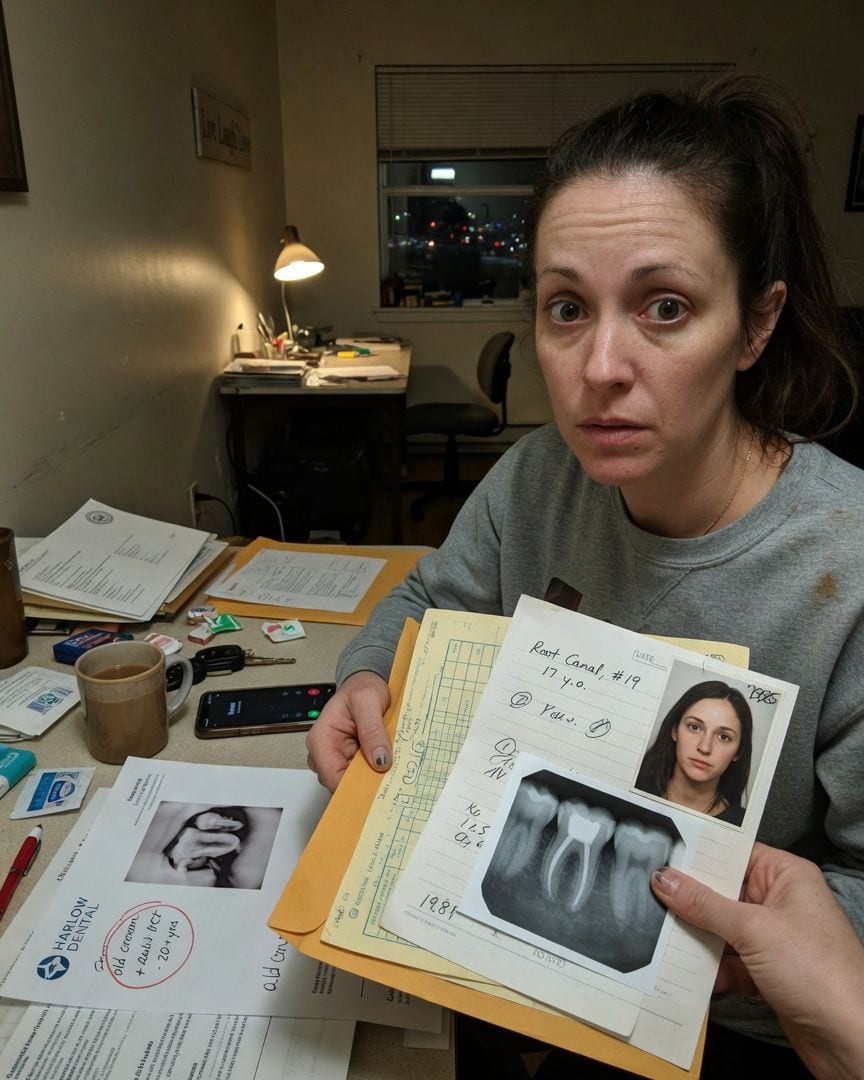
My lower molar has a twenty-year-old root canal. My new dentist showed me the scan. That tooth is whole. I can feel it.
My new dentist found a twenty-year-old root canal and crown in my mouth. The problem? I have no memory of ever having major dental work there, and my mother confirms I never did. My own body held a secret I couldn't explain.
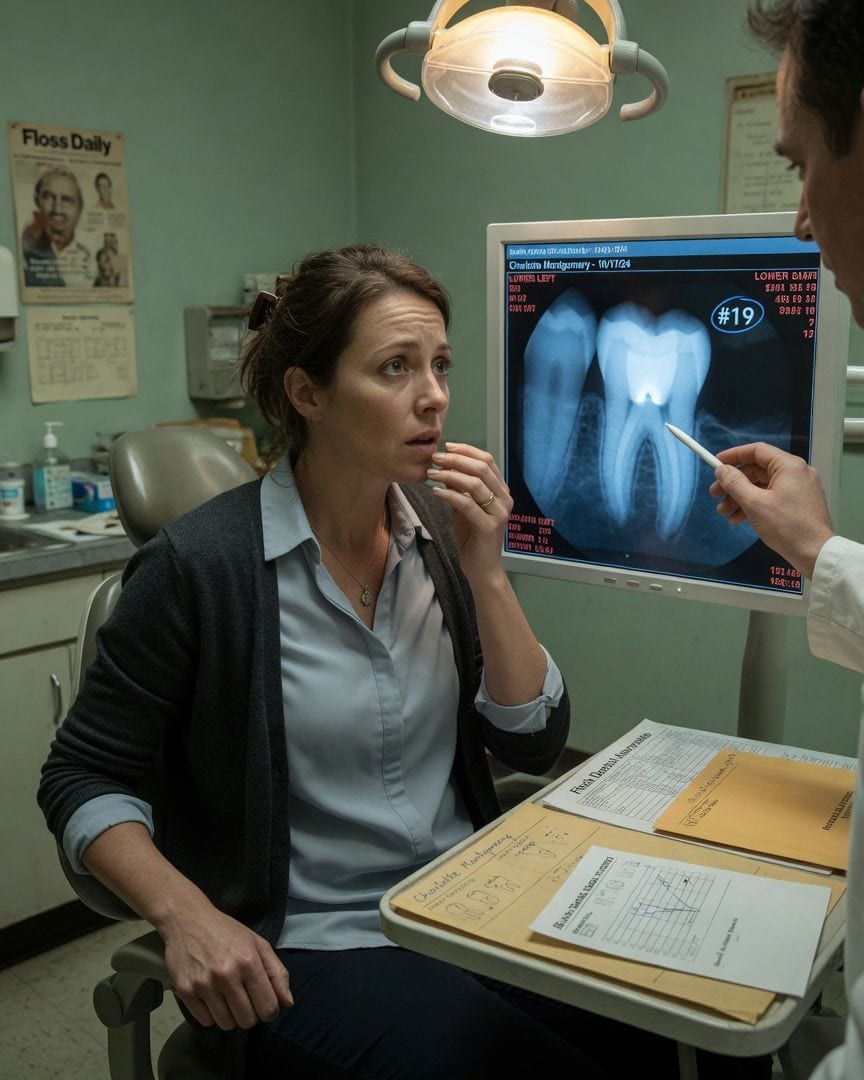
My dental X-ray shows a whole tooth where a gap has been for twenty years. A tiny metal post and a filling in a molar I remember being pulled.
Sitting in my dentist’s chair, I saw my X-ray light up with a chilling impossibility. My lower left molar, fully restored with a metal post and filling, was clearly visible. But I knew that tooth couldn't be there; it had been brutally extracted twenty years ago, leaving a gap for half my life.
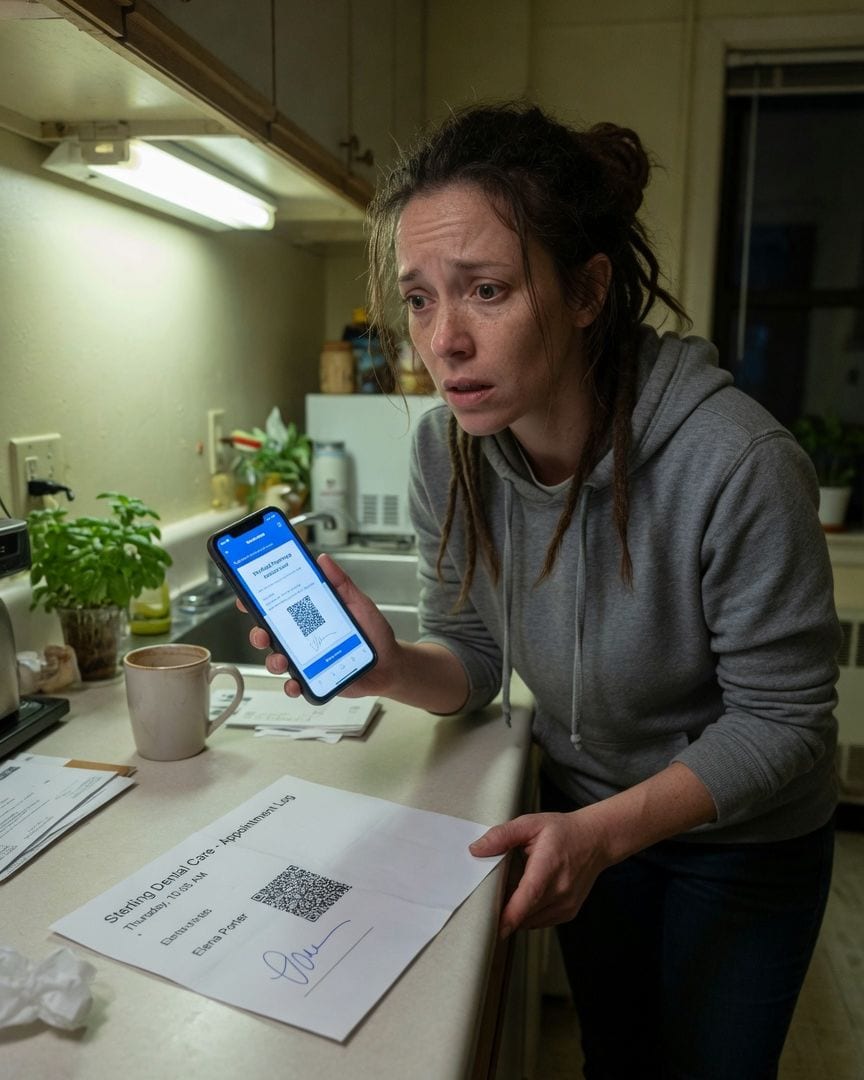
My dentist's system says I was there last Thursday. I wasn't. But the check-in tablet shows my signature, and the hygienist described my chipped tooth exactly right.
I received a call confirming a dental appointment I never made, for a day I was home. Yet, Sterling Dental had my perfect digital signature and described a chipped incisor I’d never told them about. The physical proof insisted I was there, but I wasn’t.
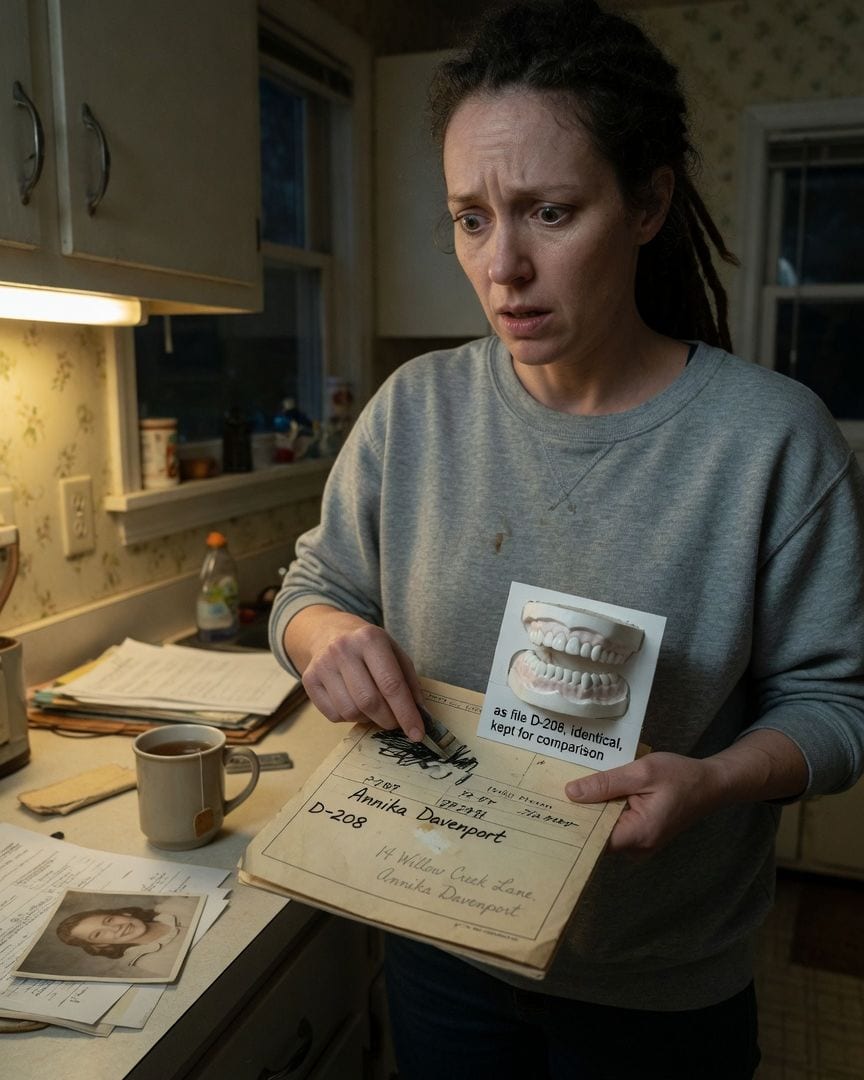
My childhood dental chart lists the house I bought last year — in my own name, years before I was born. A second set of my teeth sits filed beside it, marked 'identical.'
Sifting through old dental records, I found my chart, D-208, with my 1988 birth date. But a line from 1958 was blacked out, and a clipped card with an impression of my teeth listed my name and current home address, decades before I was born. The impossible facts knotted into a cold certainty.
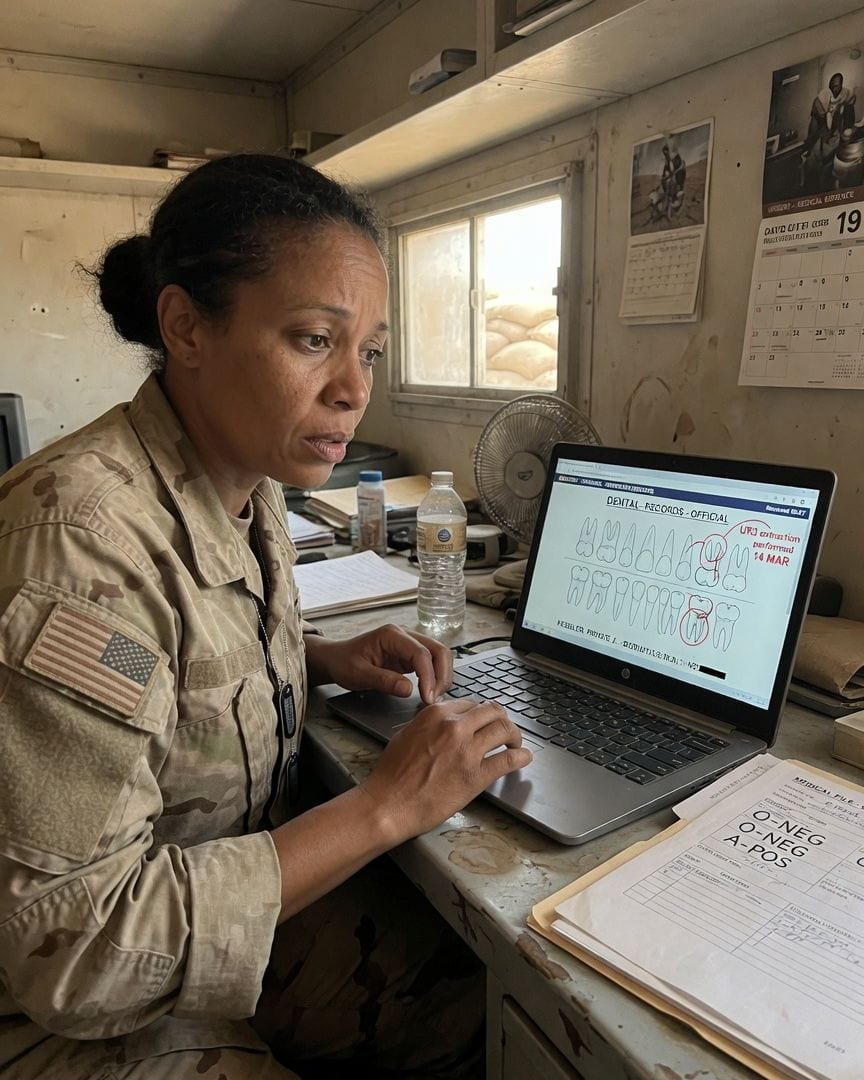
Weeks from going home, Sergeant Whitmore saw Private Kessler’s dental records show teeth he didn’t have and missing ones he did.
Sergeant First Class Iris Whitmore counted the weeks until her deployment ended, dreaming of home as the desert heat baked FOB Cerberus. But the familiar weight of Private Kessler’s dog tags soon brought a cold knot of dread: his blood type, once O-negative, suddenly read A-positive. She dismissed medical anomalies and clerical errors, only to find his official records subtly rewriting his timeline, linking old injuries to new identities. When his dental charts arrived, showing teeth he never had and missing ones he did, Sergeant Whitmore faced an impossible question: who was Private Kessler, really?
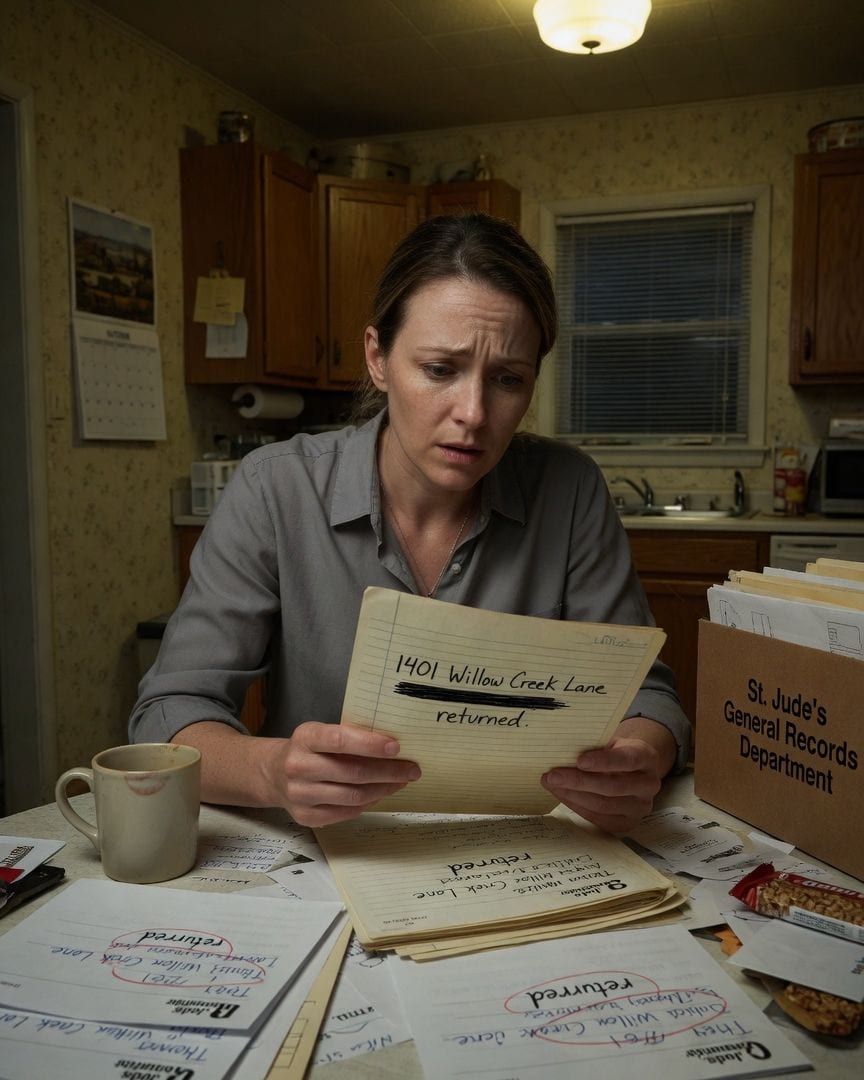
My medical file shows my street address on a struck-through line from 1988, a year I lived two counties away. It just says 'returned'.
A routine insurance audit led me to my childhood medical file from 1988. But among the expected notes, a deliberately struck-through line listed my current house address, followed by the stark word 'returned.' In 1988, I lived two counties away, making this entry an impossible and unsettling mystery.