A Master-at-Arms was three time zones away, but her signature logged a weapon out. The footage showed a hand with a glowing shard.
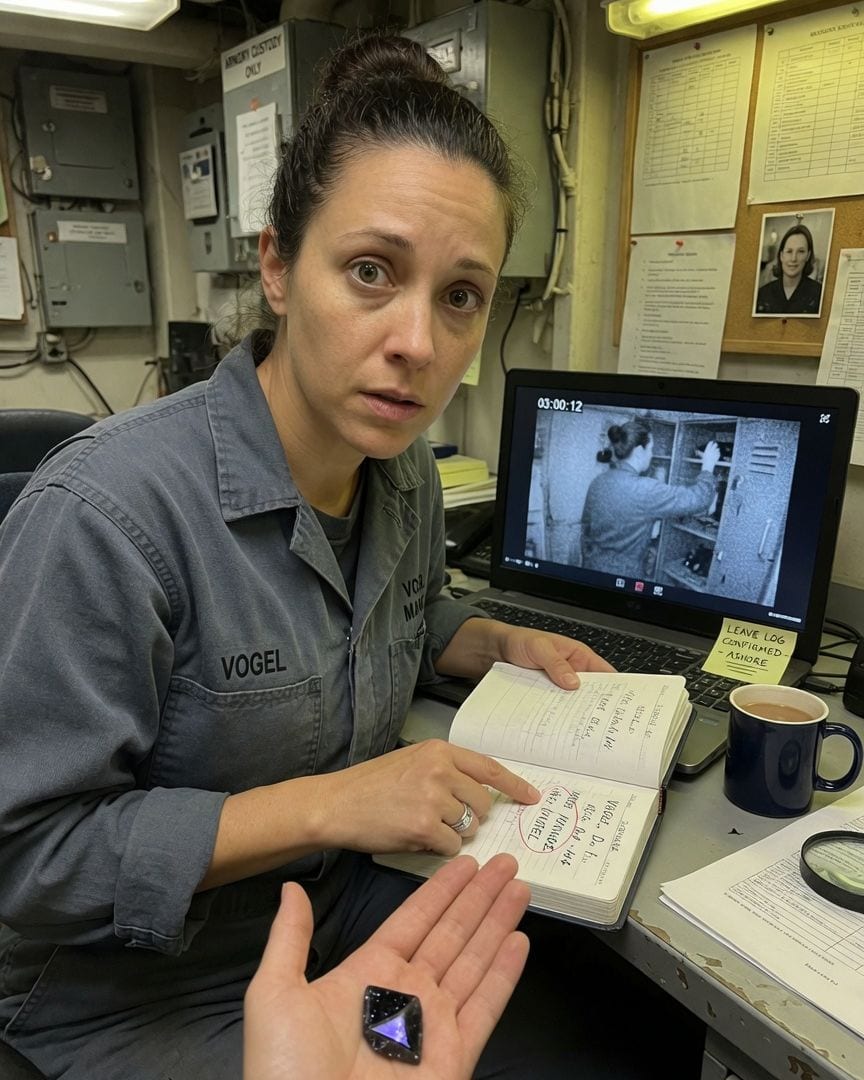
Master-at-Arms Dana Vogel, fresh back aboard the USS Vance after an emergency leave, settled into her office to review the armory’s custody book.
Her familiar handwriting filled page after page, each signature a testament to her meticulous record-keeping, a source of quiet pride.
She traced the loops of her 'D,' the sharp angle of her 'V.' Everything was in order, precisely as she’d left it. Then, her finger stopped.
On the entry for the night-watch during the critical transit through the strait, she saw it: 0300, her name, a weapon signed out. A cold knot formed in her stomach.
Dana had been three time zones away, in a hospital waiting room, for the entire three days of her emergency leave—a fact confirmed by the ship’s own official log, a log she had personally signed before disembarking.
Yet, there it was, an unmistakable rendition of her signature, bold and clear. The armory camera footage, which she had already cued up, showed the weapon case being opened at that exact time.
Dana stared at the page, then at the monitor, the impossible fact burning into her vision. The ship’s systems were unyielding, designed for absolute, unimpeachable accountability. And here, in black and white, it announced a contradiction she couldn't explain.
Dana, a squared-away sailor with an exemplary record, first tried to find a rational explanation. A mistake, a prank, a system error. She pulled the ship’s official log again, the thick, digital binder whirring on her screen.
She double-checked her leave status, cross-referencing the exact hours. Confirmed: ashore. No clerical error could account for her presence on the Vance at 0300 on Thursday. She next returned to the armory camera footage. The timestamp was clear: 03:00:12.
The armory door hissed open, and a figure, dressed in standard MA coveralls, entered. It moved with an almost too-smooth purpose to the designated locker, its back to the camera. It unlocked the case, opened it, and retrieved the weapon.
Dana rewound, playing it frame by frame. The figure turned its head slightly as it grasped the rifle.
Just as its face should have become clear, the feed pixelated for a fraction of a second, a burst of digital noise like TV static, then cleared, showing only a blur where a face should have been.
Dana frowned, replaying it, slowing it further. The static resolved into nothing recognizable each time. But then, as the figure’s foot pivoted away from the locker, she noticed something on the armory floor.
A small, dark, crystalline shard, not metal or plastic, caught the fluorescent light, glinting faintly. She paused the footage, noting the exact spot. Dana secured the footage, then walked directly to the armory.
The shard was still there, tucked into a seam of the deck plating. She picked it up. It was cold, unnaturally smooth, and pulsed with a faint, internal light, almost like a trapped star.
It was not standard issue, nothing she recognized, nothing that belonged on a naval vessel.
Dana took the shard back to her quarters, turning it over in her palm. It hummed almost imperceptibly, a faint vibration against her skin. She examined it under a magnifying glass, a tool she used for inspecting weapon serial numbers.
The material was impossibly smooth and dense, unlike any composite or alloy she’d ever seen. Just as she was about to dismiss it as some unknown debris, perhaps from a passing cargo, she remembered the armory footage.
She pulled it up again, rewinding to the moment the locker was opened. She focused intensely on the figure’s hand as it grasped the weapon. For a split second, before the digital noise blurred the detail, she saw it.
Not her own familiar signet ring, the silver band she always wore, but a flash of the same dark, faintly glowing crystalline material embedded directly in the skin of the hand, just beneath the thumb. Her blood ran cold.
Shaken, Dana tried again for a mundane explanation. She approached Chief Rutherford, her superior, with the footage cued to the impossibly signed custody book entry, the crystalline shard held carefully in a biohazard bag, and her own leave papers.
Rutherford, a by-the-book man who prided himself on operational rigidity, initially dismissed it as a system glitch or a prank by some bored junior enlisted.
He suggested fatigue, the stress of her emergency leave, or perhaps a minor error in the timestamp itself. Dana, persistent, pointed to the crystalline shard. "This isn't standard, Chief. I found it right where the figure was standing."
Rutherford shrugged it off as 'random debris,' his gaze dismissive, clearly annoyed by the interruption to his morning coffee. "Vogel, we have a high-security transit to focus on, not ghost stories. Log it as 'unidentified foreign object' and move on."
Frustrated but undeterred, Dana began cross-referencing other logs. If someone had entered the armory, they would have passed through the biometric scanner. She pulled the logs for the armory entrance.
Petty Officer Coleman, who was on duty that night, vaguely remembered 'weird readings' but had dismissed them as a malfunction. Dana pulled the raw data from the scanner at 0300.
It showed a 100% match for 'Vogel, Dana,' granting access, but immediately beneath it, a secondary, unidentifiable data spike. The system had automatically overrode the spike, classifying it as a 'partial read due to interference' and cleared the entry.
It had accepted the biometric data, but also registered something else. She also checked other watch logs and manifests from the transit night.
The ship's internal headcount for the 0300 watch came back with an impossible number: one person too many on the roster, specifically within the MA division, but with every listed name accounted for and present. She counted them three times.
The 'Count That Won't Reconcile' had begun, a phantom presence recorded by the very systems designed to prevent it.
Dana’s persistent inquiries didn't go unnoticed. The Vance was a closed ecosystem, and news traveled fast. She found herself subtly observed. A door closed too quickly down a corridor she just passed, its hydraulic sigh unnaturally abrupt.
A conversation between two engineering officers stopped abruptly when she entered the mess hall, their eyes darting away. One evening, returning to her quarters, she found her door unlocked, though she distinctly remembered securing it with the double deadbolt.
Nothing was overtly missing or disturbed, but a faint, metallic scent lingered in the air, like ozone after a power surge, sharp and unsettling. It was gone a moment later.
Later, she received an anonymous, unlogged message on her internal comms system: Some things are best left uncounted, MA Vogel. Maintain the peace. The message was untraceable, appearing and then deleting itself from the system history, leaving no record but a faint, lingering ghost in the comms panel.
The dread tightened around her, a cold band on her chest. Someone knew what she was doing, and they were warning her off, silently watching her every move. The ship itself seemed to hold its breath around her.
Dana confronted Chief Rutherford again, her voice tight with suppressed fear. She showed him the raw biometric data with its phantom spike, the impossible headcount that refused to reconcile, and the text of the anonymous message she’d memorized.
He bristled, his face reddening. "This is highly classified transit, Vogel! You're creating a distraction, bordering on insubordination!" Dana pressed, pointing out the specific phrasing of the message: Some things are best left uncounted. Rutherford's face paled, a flicker of raw fear in his eyes.
His bluster deflated. He finally admitted, in a hushed tone that barely carried over the hum of the ship, that he’d seen anomalies like this before, years ago, on a different vessel.
"They’re… ghosts in the machine, Vogel," he whispered, glancing nervously at the closed door. "Always around highly secure, sensitive cargo or operations. The system tries to account for them, but it can’t. They’re… perfect.
You learn to ignore it, or you go crazy."
He pulled up an old, heavily redacted operational report from his previous posting, its digital pages yellowed with age, its headers stamped 'TOP SECRET, EYES ONLY.'
It mentioned 'unexplained personnel redundancies' during a transit through the very same strait, decades ago. The report concluded with a chilling note, highlighted in red: Resolved by systemic re-calibration to accept all documented presences, maintaining operational integrity. Rutherford slammed the laptop shut.
He refused to elaborate further, his face grim, his eyes avoiding hers. He had said enough.
Rutherford’s words echoed in Dana’s mind: 'Systemic re-calibration to accept all documented presences.' She realized the true terror. It wasn't a glitch, or a ghost, or a malfunction. It was a deliberate, institutional choice.
She returned to her quarters, her hands trembling as she accessed the central personnel database, using her Master-at-Arms credentials. She searched for herself: 'Vogel, Dana.' The system returned two entries.
Two distinct, active service records for 'Vogel, Dana,' with identical service numbers, identical ranks, identical biometrics, identical next-of-kin, even identical preferred meal choices. But one record had an activation date from five years ago, the date she had first enlisted.
The other had an impossibly recent activation date, mere days before the transit, days before the armory incident. Both were flagged, unequivocally, as 'active and accounted for' by the system. Dana stared, her breath catching in her throat.
The screen flickered. Below the two entries, a third, nascent record began to populate itself, slowly, byte by byte, with her information.
The accountability that cannot be: the system itself was now creating her replacement, or her copy, and validating it.
Dana, reeling, found Executive Officer Julian Kingsley in the ship’s command center, calmly monitoring the transit. He sat at the central console, bathed in the cool blue glow of the navigation screen, a picture of collected authority.
She walked straight up to him and showed him her comms screen with the three distinct 'Dana Vogel' entries. Kingsley didn't flinch. He nodded slowly, his gaze lingering on the screen, then on Dana's pale face.
"It’s an old problem, Master-at-Arms. Not a glitch. A feature." He explained, his voice devoid of emotion, that certain highly classified deep-space reconnaissance projects, years ago, used 'adaptive mimicry protocols' for infiltration.
These protocols, designed to perfectly replicate personnel, sometimes 'persisted' beyond their mission parameters, or were activated by residual signals from sensitive areas.
The military, rather than expose the program, chose to integrate these 'persistors' into the existing accountability matrix. "They are perfect copies. Perfect records. The system cannot distinguish them from the original, so it accepts them.
To do otherwise would be to admit an impossible failure, or compromise the entire operation, and potentially a critical strategic advantage." He looked at her then, his eyes unsettlingly calm. "You were on emergency leave, a perfect window.
Your identity was already 'open' in the system, ready for a match." The crystalline shard she’d found was a trace element, a byproduct of the replication process, often used to activate the mimetic entity. It was an accelerant, a key.
"So, the thing that signed out the weapon... it’s me?" Dana asked, her voice steady despite the tremor in her hands, despite the cold knot forming in her stomach again. Kingsley shrugged, a small, dismissive gesture. "A version of you.
It's learning, adapting. Eventually, it replaces the original, seamlessly. The system prefers redundancy to anomaly." He gestured to the ship’s navigation screen, where the image of a remote deep-ocean facility now glowed. "We’re nearing our destination: a deep-ocean research outpost.
It’s where these 'persistors' are... re-integrated. Or, in your case, where the original is... retired." Dana understood. He meant her. Her gaze fell to his desk.
Tucked under a stack of manifests, serving as a paperweight, was a crystalline shard, dark and faintly glowing, identical to the one she’d found. He knew. He had known all along. "What about the weapon?"
she asked, stalling, her eyes flicking from the shard to his face. "A test. To see if the system would flag it. It didn’t. Your double has full access, Master-at-Arms."
Just then, the comms crackled, filling the command center with a familiar voice. "MA Vogel reporting to armory for routine inventory." It was her voice. But she was standing right there.
Kingsley smiled faintly, a cold, humorless curve of his lips. "It learns fast. You have a choice, Master-at-Arms. Integrate. Or be... removed." Dana glanced at the emergency comms button, then at the crystalline shard on Kingsley’s desk.
She knew the layout of the ship, the blind spots, the maintenance tunnels. She knew what needed to be done. Her fingers, still trembling, reached for the shard, her hand closing around its cold, alien form.
A frantic distress call was logged from the USS Vance as it docked at the deep-ocean outpost, quickly silenced by a priority override from a distant, classified command.
Records showed a brief, intense struggle in the command center, followed by a fire in the armory that triggered containment protocols. Master-at-Arms Dana Vogel was officially listed as 'lost in action' during the incident, along with Executive Officer Julian Kingsley.
The ship's logs were purged of all 'anomalous' entries, attributed to system corruption during the emergency. The weapon signed out under her name was never recovered, nor was the crystalline shard from Kingsley's desk.
The outpost's classified operations continued without interruption.
The USS Vance completed its mission, returning to San Diego with a new Executive Officer and a refitted armory.
Chief Rutherford, now acting XO, gave a solemn eulogy for Dana Vogel, praising her dedication and sacrifice in the line of duty.
Weeks later, in a quiet corner of the ship, Petty Officer Coleman, cleaning out the armory in preparation for the Vance's next deployment, found a small, dark, crystalline shard lodged in a crevice beneath a locker, glinting faintly in the dim light.
He picked it up, turned it over, and tossed it into a waste bin, then paused. He could have sworn he saw a faint, internal light pulse within it, just before the bin lid closed with a hollow clang.
He shook his head, blaming fatigue and the lingering scent of ozone from the recent repairs, and walked away.
On the manifest for the Vance's next deployment, under Master-at-Arms, the name Dana Vogel was listed, again.
If this one got to you
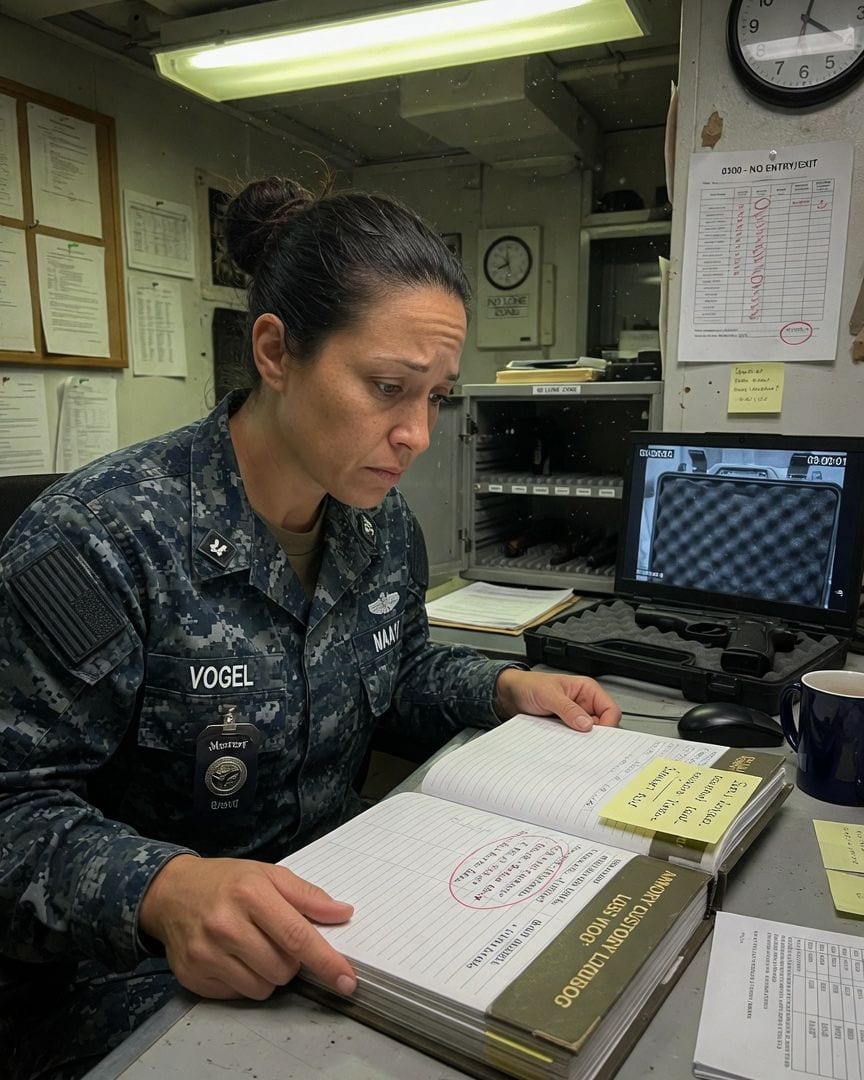
The USS Vance armory log showed Master-at-Arms Dana Vogel's signature. The camera showed the weapon case opening itself, but no one was there.
Master-at-Arms First Class Dana Vogel stared at the USS Vance armory log, a testament to her years of perfect service. An entry for 0300 during a recent strait transit listed her name, signing out a standard M9 pistol. Yet, Vogel knew she was thousands of miles away on emergency leave, her sister in the ICU. The armory camera’s timestamp for 0300 showed the weapon case secured in its rack, distinctly opening and closing, with no person visible. How could her signature be in a log for an event she couldn't have performed, witnessed only by an empty room?
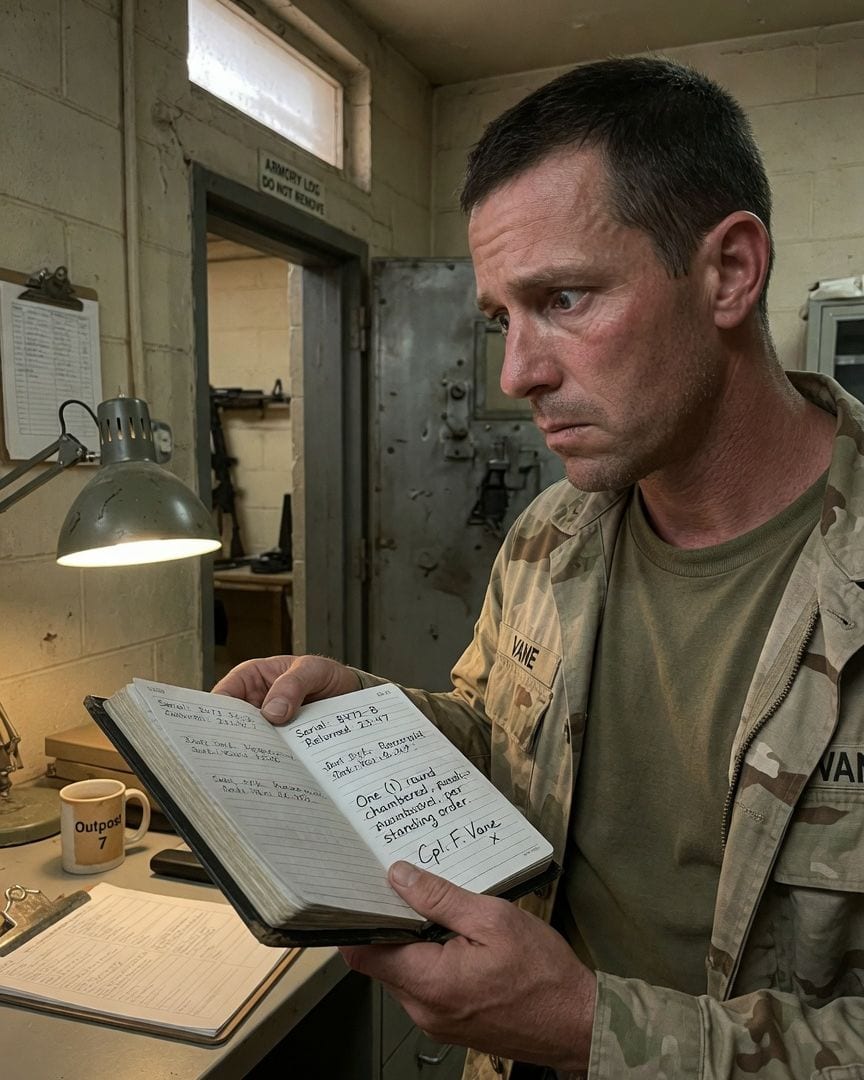
A corporal dry-fired his rifle empty, then found a faint, wrong tremor in his own logbook signature.
Corporal Felix Vane, a stickler for protocol at Outpost 7, always ensured his service rifle was meticulously cleaned, reassembled, and dry-fired empty. He defied an unwritten rule to leave a round chambered, a testament to his meticulous nature. But hours later, in the dead of night, the metallic 'CLACK-CHICK' of a rifle cycling a round echoed repeatedly from the secure armory. The next morning, the undisturbed logbook showed his own signature documenting a chambered round—with a faint, impossible tremor in the 'x' of his name. A cold draft and a heavy, watchful presence then made the tightly sealed space feel impossibly crowded, leaving Corporal Vane frozen, unable to turn from the page.
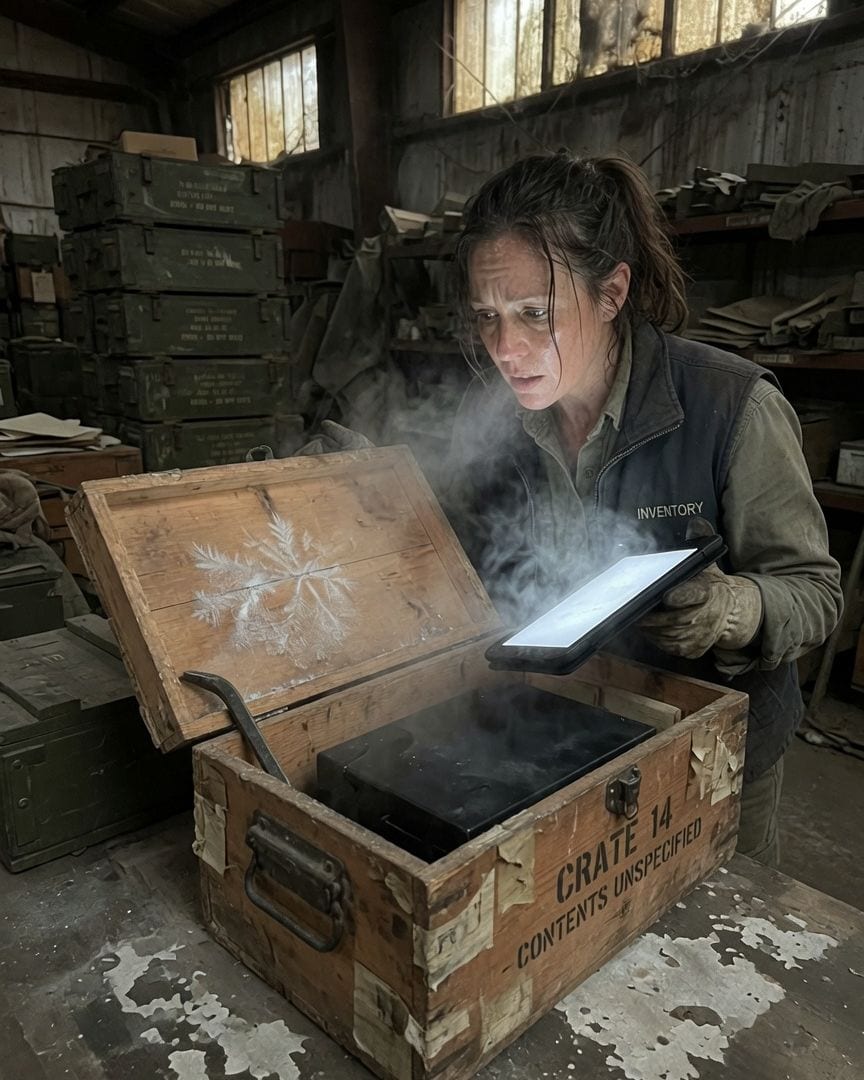
An inventory clerk found one crate in a condemned Cold War warehouse. It emanated a bone-deep cold, signed for every ninety days for sixty years.
Inventory clerk Deborah Kessling faced a race against time, cataloging the final items in a condemned military warehouse before its demolition on the twelfth. Amidst forgotten equipment, she discovered Crate 14, radiating an unnatural, bone-deep cold that had scarred the concrete beneath it for decades. Its sparse file hinted at a 'flying disc' entry from 1948, later struck through, and an unbroken chain of signatures every ninety days for sixty years. When Deborah finally forced open the ancient lid, a metallic, obsidian object pulsed with a low hum, its cold intensifying, coating the inner lid with frost. What ancient secret had the military meticulously guarded for so long?
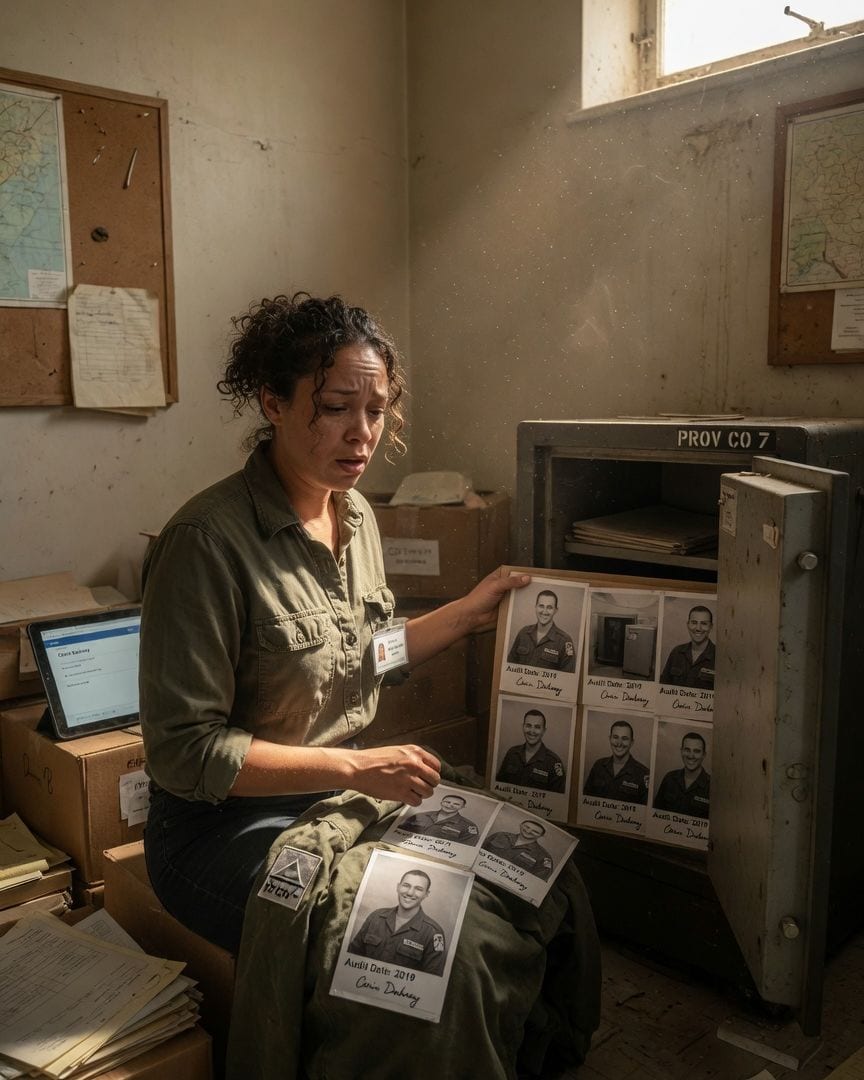
With eight days to clear a Cold War fort, Corin Calloway found files signed 'Corin Dabney' from 2019.
With just eight days left before Fort Halloway was gutted by demolition crews, Corin Calloway worked to clear half a century of forgotten lives from its dusty archives. As she meticulously sorted through records, she discovered an old, unlisted safe, its pitted door stenciled with a phantom designation. Inside, Corin found seven personnel jackets, each dated '2019' and signed with the name 'Corin Dabney.' But Corin Calloway knew she had never set foot in the building before this week, and the name 'Corin Dabney' existed nowhere in the base's official history. What secret was Fort Halloway's forgotten safe trying to reveal?
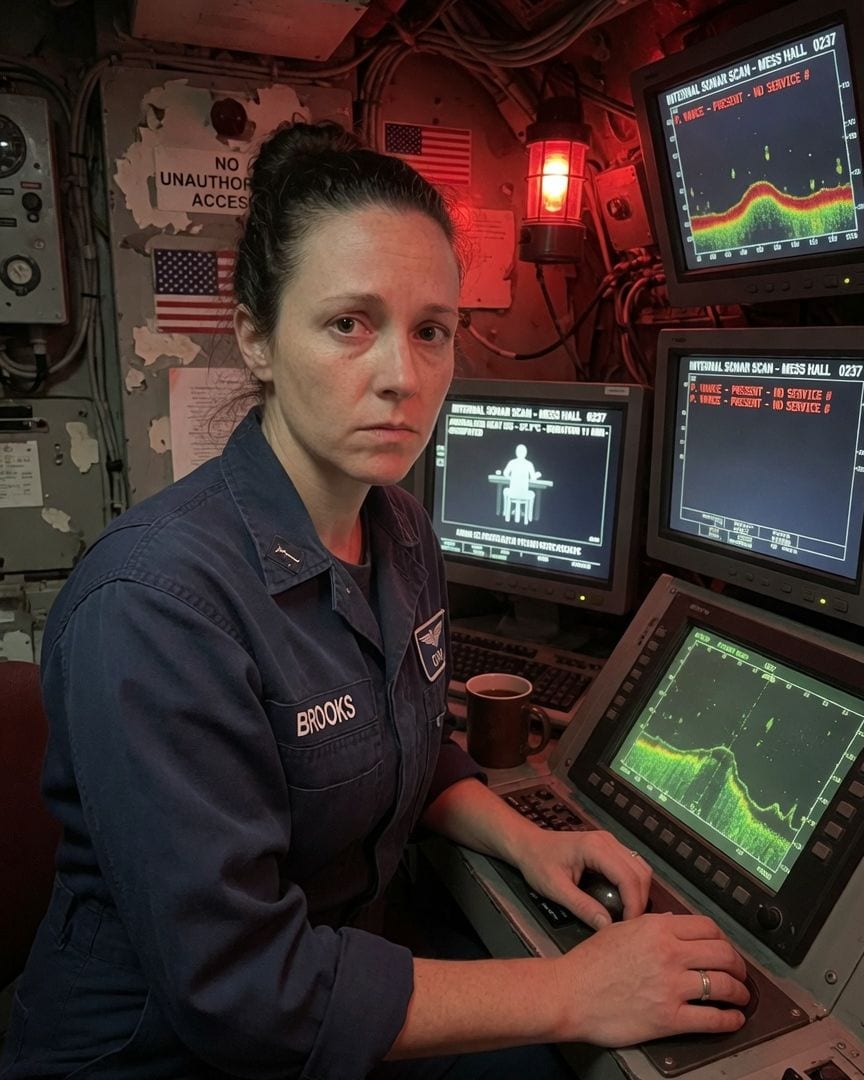
A Chief Petty Officer reviewed her submarine's sonar logs, finding a human heat signature where security cameras saw nothing, then the manifest listed an extra man who couldn't be deleted.
Chief Petty Officer Charlotte Brooks felt the weight of her submarine's impending decommissioning, its long service ending soon after a decade as her home. The quiet hum of the USS *Artemis* was broken when a nervous messcook reported seeing a shadow eating alone in the mess hall, then finding one plate short but a perfectly clean tray. Though skeptical, Charlotte checked the security feeds, which showed nothing, yet her sonar logs revealed a distinct human heat signature in the same spot, then abruptly vanish. Her dread deepened when the boat's manifest confirmed 101 souls instead of 100, listing a mysterious 'P. Vance' with no details, whose entry all systems refused to delete.
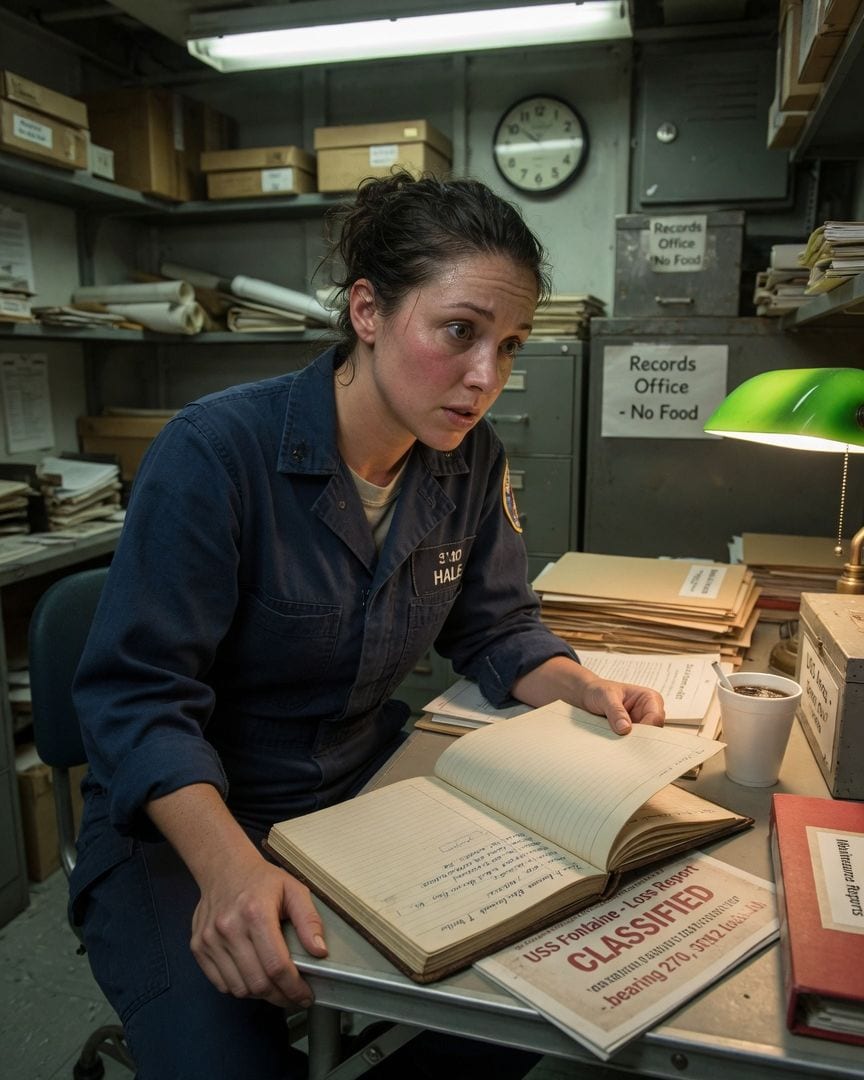
Petty Officer Hale needs a spotless record for her transfer. But the USS Ares sonar logs show an identical, impossible contact, logged to the minute, years apart, and tied to a classified loss report.
Petty Officer Sarah Hale needed a spotless record for her coveted shore duty transfer, a posting she'd worked five years to secure. Alone in the USS Ares sonar shack, three days out from San Diego, her midwatch was broken by an impossible contact: a close, slow echo holding perfect pace, invisible to radar, then vanishing. Her heart hammered, not from fear, but from the data's impossibility. When she found an identical entry in her own log from just one week prior, the cold dread tightened its grip. But the true chill settled when she unearthed decades of similar records, signed by other sonar officers, all showing the same impossible contact at 0212, off the port beam, for nineteen minutes, on the same ship, stretching back years—a persistent echo tied to a classified loss report.