A corporal dry-fired his rifle empty, then found a faint, wrong tremor in his own logbook signature.
Corporal Felix Vane, a stickler for protocol, moved with practiced precision through the Outpost 7 armory. He broke down his service rifle, the parts separating with familiar clicks, then wiped it clean of desert dust.
He reassembled it, checked the bore, and confirmed the chamber was empty with a visual sweep, then a finger. Finally, to absolutely prove it, he raised the rifle, pointed it safely at the sand-filled clearing barrel, and dry-fired the trigger.
The metallic snick echoed in the quiet space. He made a point of it, every time, defying the outpost’s odd, unwritten rule to always leave one round seated, never fully empty, and never dry-fire the last.
He racked the rifle, secured the weapon, and then double-checked the heavy steel armory door, pulling it shut with a satisfying thud. He knew the space was bare of a single loose cartridge.
Hours later, in the dead of night, a distinct, metallic ‘CLACK-CHICK’ echoed from the armory. Felix, rigid in his bunk, bolted upright. The sound was unmistakable: a rifle cycling a round, bolt slamming home, a cartridge sliding into the chamber.
It happened again. And again. Over and over, a phantom armorer working through the night, the impossible rhythm drilling into Felix’s teeth, a cold, sharp thing in his gut.
He lay awake, listening, every muscle tensed, until the first gray light of dawn silenced the sounds. In the morning, he found the armory undisturbed, every rifle in its rack, every lock secure.
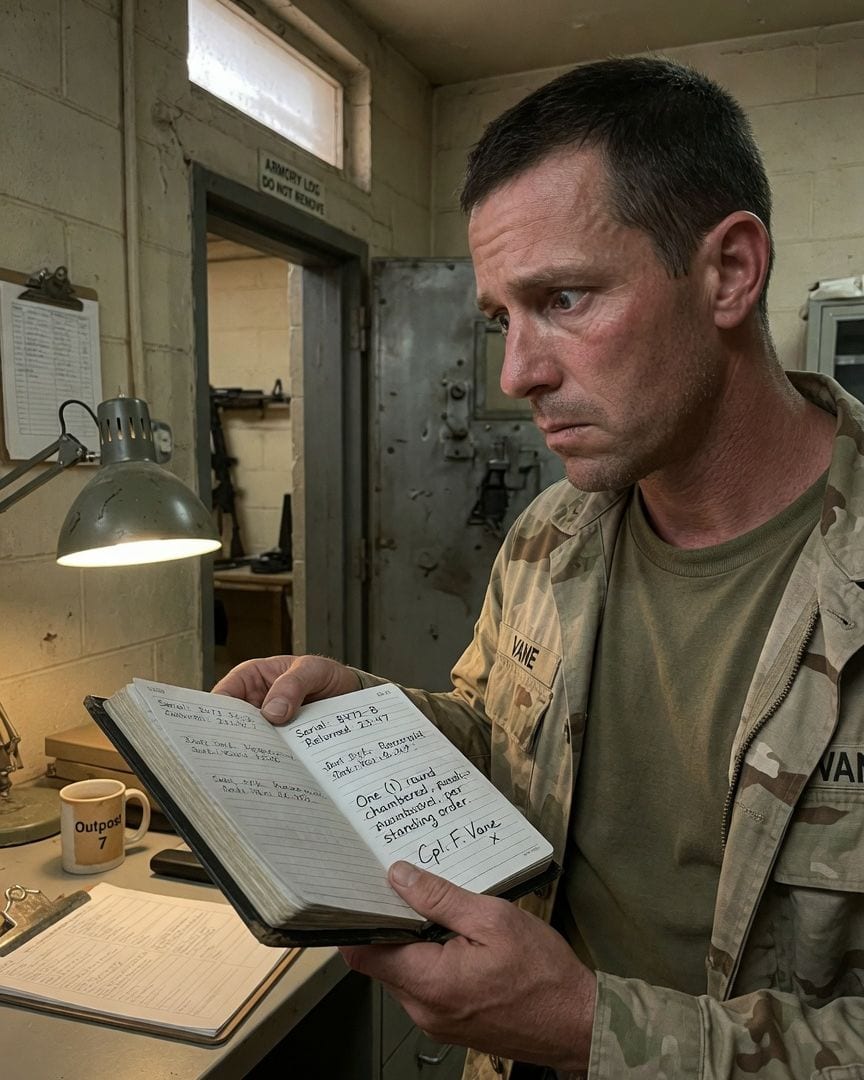
Unnerved, Felix immediately pulled the heavy armory log. His eyes scanned the precise, hand-written entries, each weapon, each round, each signature, a testament to his own meticulous nature.
He found the entry for his own service rifle from the previous night, documenting its return. His breath hitched. Beneath the serial number, in his own meticulous script, was the notation: 'One (1) round chambered, per standing order.'
And below that, his signature, 'Cpl. F. Vane.'
Felix stared, disbelief warring with the undeniable evidence of the page. He knew, with absolute certainty, he had cleared that rifle empty. He had dry-fired it. He had signed no such entry.
He flipped back through the pages, examining his usual signature—rigid, precise, the looping 'F' and clean 'x' of 'Felix' always perfectly consistent. Then he looked at the anomalous entry again.
The 'x' in 'Felix' was subtly off, a faint, almost imperceptible tremor, as if his hand had hesitated, or been guided. It was his signature, but it wasn't.
The date and time on the log entry corresponded exactly to when the phantom chambering had begun, a precise, chilling timestamp of the impossible.
He held the heavy logbook, his thumb tracing the faint, wrong tremor in his own signed 'x.' He compared it to other entries, his perfect, unblemished hand. The difference was minuscule, but undeniable.
A cold draft, impossible in the tightly sealed armory, brushed past his ear, raising gooseflesh. The hairs on his neck prickled. He felt a distinct, heavy presence behind him, just outside his field of vision, a silent, watchful weight.
He froze, the logbook clutched tight, every muscle locked, his eyes fixed on the impossible entry. The air grew thick, heavy with an unseen observer.
He couldn't look away from the page, but he couldn't bring himself to turn around either. The unseen presence was there, waiting.
Shaken but resolute, Felix began a meticulous review of older armory logs, ostensibly looking for similar 'clerical errors.' He spent hours poring over the dusty, heavy books.
The old leather creaked as he turned pages, the air in the archives thick with the scent of aged paper and dry desert dust. He found more: across different rotations, different armorers, the same impossible entries.
Phantom rounds, unaccounted-for gear, sometimes even a weapon serial number that didn't match any on the outpost's official manifest.
Each was signed by the armorer on duty, but each bore that same subtle, wrong tremor in the signature, a faint wobble in the decisive stroke, just like his own.
He found an old, faded addendum tucked into a 1990s logbook, unofficial and almost erased, scrawled in an aging hand. It described the 'one round' rule not as a quirky tradition, but as a 'safeguard against disquiet.'
The phrase sent a shiver down his spine. He remembered Sergeant Thomas Ingram, the armorer before last, a grizzled veteran who had mysteriously retired years earlier, leaving suddenly without much explanation.
Felix found Ingram’s old contact information in a forgotten personnel file. With a growing sense of dread, he dialed the number, the phone pressed hard against his ear.
Felix’s call to Thomas Ingram rang endlessly, unanswered, the silence on the other end a heavy weight. Later that day, returning from the mess hall, Felix found a crisp, typewritten note slipped under his bunk door.
It was stark, no sender, no date, no identifying marks: 'Some things are best left accounted for, Cpl. Vane. Don't unbalance the scales.' The paper was pristine, devoid of fingerprints, the font a generic Courier.
A cold dread seeped into Felix. Someone at the outpost knew he was digging. Someone wanted him to stop.
He started noticing small things: a door he’d locked and double-checked was now ajar, the specific wrench he’d left on the workbench in the armory moved slightly from where he’d placed it.
He’d catch glimpses of movement at the edge of his vision, shadows shifting where no one stood, just beyond the corner of his eye.
The feeling of being watched became constant, a prickling sensation on his skin, even when he was alone in the quiet hum of the outpost.
The low thrum of the generators, usually a comforting backdrop, now felt like a constant murmur of unseen voices. He began to move with a new, unsettling caution, checking his six, double-checking every lock, every closed door.
The outpost, once his sanctuary of order, had become a cage of unseen eyes.
Finally, after days of trying, Felix reached Thomas Ingram. Ingram's voice was raspy, hesitant, the sound crackling over the staticky connection. Felix described the logs, the phantom rounds, the odd rule, and the chilling note under his door.
Ingram was silent for a long moment, then sighed, a sound heavy with resignation. He explained that the 'one round' rule wasn't just an oddity; it was an old containment protocol, passed down informally between armorers for decades.
'Outpost 7,' Ingram whispered, the words barely audible, 'it's on a thin spot. Always has been. Things… bleed through. Things that aren’t accounted for.'
He explained the 'round' was a token, a placeholder. By giving the anomaly a single, physical item to manifest in, a single 'accounted-for' presence, it prevented it from manifesting more broadly and corrupting the unit's records and personnel.
Ingram admitted he’d once broken the rule himself, thinking it was just superstition. The phantom chambering had begun, just like Felix described. Then, an 'extra' name, a Private Miller, had appeared on the duty roster for a week.
Miller, a real soldier, had become increasingly agitated, haunted by whispers, until he deserted, vanishing into the desert, never found. 'The signatures, Cpl. Vane,' Ingram rasped, 'they’re its way of marking its presence within the system.
It wants to be real. To be counted.' Felix felt the pieces click into place, the decades of impossible entries, the tremor in the signatures, all making a horrifying, coherent sense.
Ingram’s voice dropped, tinged with a desperate urgency. 'You broke the rule, Cpl. Vane, and now you’re digging. You’ve escalated it.
It wants to be accounted for, son, and if you don't give it one, it'll take as many as it needs.' The line went dead. Felix stared at the receiver, his hand trembling, the plastic heavy in his grasp.
The implication settled over him like a shroud: the anomaly wasn't just a passive record-keeper; it was an active entity, responding to his actions, growing bolder.
He glanced at the current duty roster pinned to his wall, the crisp white paper a contrast to the growing dread in his gut. He counted the names, his lips moving silently, a deep breath filling his lungs. One. Two.
Three. Twenty. He counted again, slower, more deliberately. Still twenty. Then, with a growing sense of panic, he counted a third time. Twenty-one.
His eyes darted to the last name on the list, neatly typed beneath the others: 'Ellsworth, R.' Beneath it, a fresh, ink-black signature, undeniable and stark. He had never seen that name before, never processed an Ellsworth for Outpost 7.
A profound, bone-deep chill settled over him, the realization that the anomaly was no longer just in the past, no longer just in the logs. It was here, now, on his roster, a new, unaccounted presence among his men.
He stared at the name, 'Ellsworth, R.,' a silent scream building in his throat.
Felix, heart pounding, immediately confronted Lieutenant Charlotte Ellison with the duty roster and the impossible name, 'Ellsworth, R.' Ellison, initially skeptical, took the roster from him, her brow furrowed in annoyance.
Her eyes scanned the names, then landed on 'Ellsworth, R.' Her face drained of color, her usually composed demeanor cracking. The air in her office grew heavy with unspoken history.
She admitted that 'Ellsworth, R.' was the name of the first soldier to disappear from Outpost 7, decades ago, shortly after its establishment.
Officially, he was listed as a desertion, but the informal history, passed down through commanding officers, whispered of him being 'taken.'
The 'one round' rule, she revealed, was established by the very first CO, a desperate, last-ditch effort to keep Ellsworth from manifesting again, to give the anomaly a single, symbolic presence within the accounted system.
By breaking the rule, Felix hadn't just invited Ellsworth; he had invited more of what Ellsworth represented, an entire phantom unit, swelling in number.
Ellison then led him to a locked, forgotten archive box in the back of her office, hidden beneath a stack of administrative reports.
Inside, beneath the original outpost charter, a heavy parchment document yellowed with age, was a faded, almost invisible signature on the back of the document: 'Ellsworth, R.' The first, original trace, decades old, confirming the entity’s long-standing presence at Outpost 7.
With the outpost's decommissioning date looming, Felix understood the anomaly was growing stronger, desperate to manifest more fully before its 'accounting' system was dismantled.
He returned to the armory, the quiet hum of the fluorescent lights now a sinister thrum, the metallic air thick with an unseen tension.
He knew he had to 'account' for the entity, to force it back into the 'one round' token. Following the logic of the old containment rule, he took a single, live round from the sealed munitions locker.
He chambered it in an empty rifle, the 'CLACK-CHICK' a chilling echo of the phantom sounds that had tormented him. He locked the rifle into the armory rack, its barrel gleaming under the stark light.
Then, with a meticulous, formal act of military procedure, he opened the armory log to a fresh page. His pen moved with grim purpose, forging a new, impossible entry: 'One (1) unaccounted presence, contained via token. Status: accounted.'
He logged the specific rifle, its serial number, and the 'one round chambered' notation. He signed it, 'Cpl.
F. Vane,' this time with a firm, unwavering hand, deliberately giving the anomaly its single, acknowledged place within the system, forcing it back into its symbolic prison.
As he signed, the air in the armory grew heavy, then, with a palpable sigh, it stilled. The faint, phantom sound of a rifle chambering itself stopped.
The outpost fell into an unnerving silence, the kind that feels like holding your breath.
The next morning, the name 'Ellsworth, R.' had vanished from the duty roster. The phantom sounds ceased. Outpost 7 was decommissioned on schedule, its personnel transferred to new assignments. Felix received his transfer orders, a clean slate.
The armory log, with his impossible entry, was sealed and archived, marked 'classified.' He never spoke of it, and no one else at the outpost ever mentioned the extra name, or the strange sounds.
The system, once violated, had been re-sealed, the anomaly contained once more.
But Felix knew the truth, a silent, heavy burden he carried with him as he left the remote, quiet outpost behind, the desert winds already starting to reclaim the abandoned buildings.
Years later, Felix Vane was a civilian, living a quiet life far from any military installation. He worked a mundane job, reviewing old, declassified documents for a historical society project—a task he had taken precisely for its quiet, predictable nature.
He still thought about Outpost 7, and the impossible entry he had made, a secret he carried in his bones.
One afternoon, sifting through a stack of yellowed papers, he found a faded, handwritten note tucked into the margin of a 1970s supply manifest.
It was from a remote Antarctic research station, decades old, detailing an order for specialized winter gear. The note, barely legible, read: 'One (1) unaccounted, token maintained.'
If this one got to you
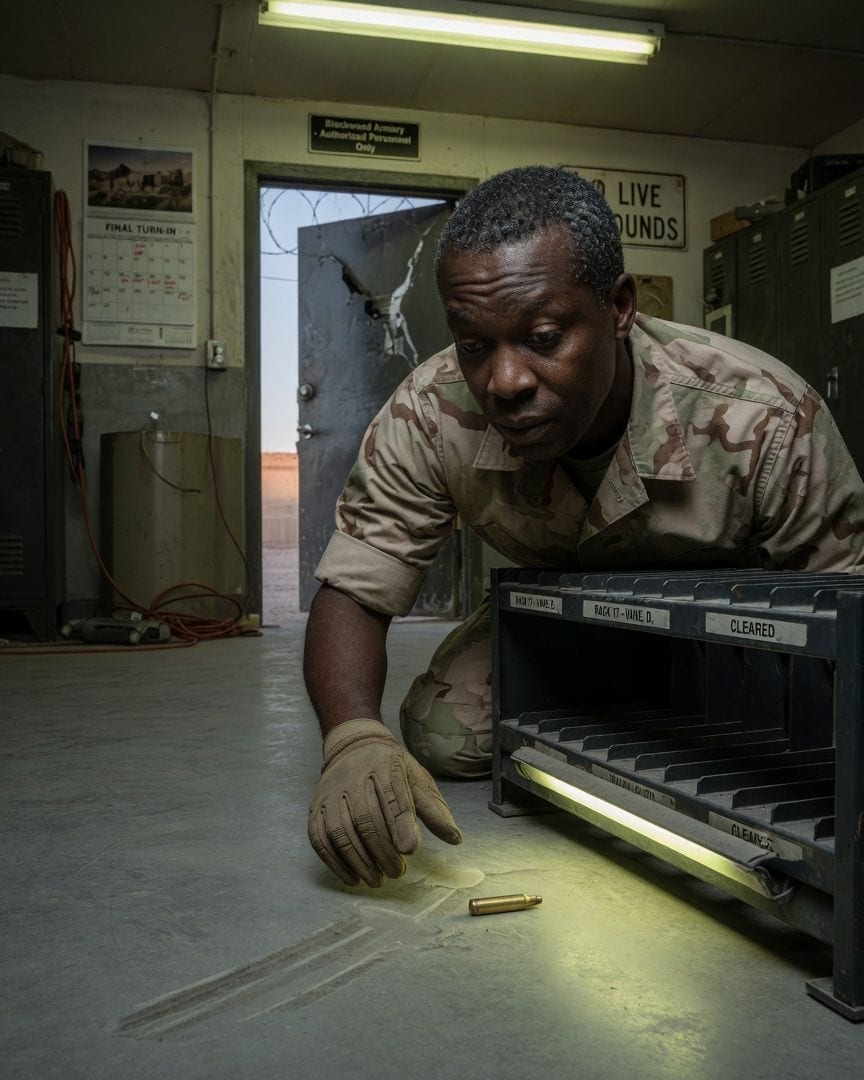
On his last weapon turn-in, Corporal Vane heard a rifle chambering rounds all night from inside the locked, empty armory. Then he found a spent casing.
Corporal Desmond Vane, a soldier known for his rigid adherence to procedure, meticulously cleared his M4 carbine for its final turn-in at the soon-to-be-decommissioned FOB Blackwood. Defying the armorer's odd rule, he ensured his weapon was absolutely empty, double-checking every component. Yet, hours later, from the locked and supposedly empty armory, Vane heard the unmistakable metallic click of a rifle round chambering itself, over and over, through the night. The next morning, a full inspection revealed no sign of intrusion, but beneath where Vane's carbine had been racked, a single spent brass casing lay on the pristine concrete, accompanied by a faint, impossible boot print. Who or what had violated the secure armory, and how?
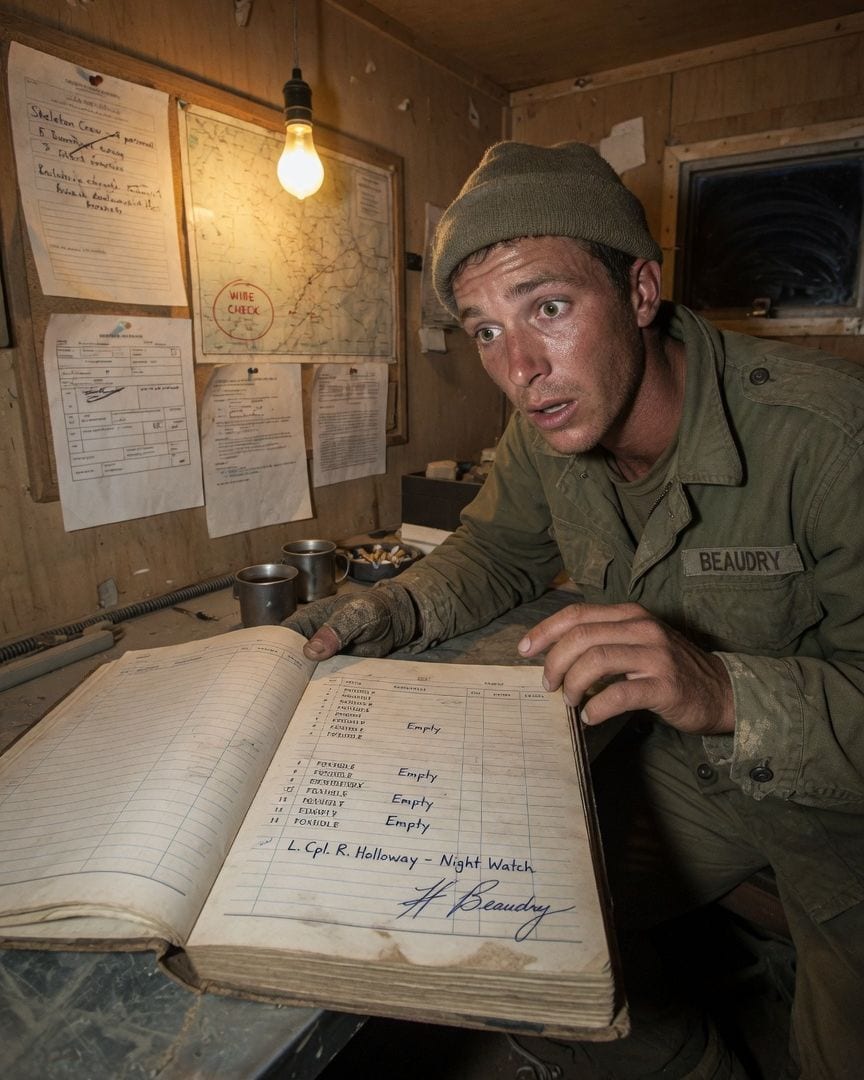
Lance Corporal Beaudry checks the perimeter's empty foxhole. The comm wire pulls back: a signal from no one.
Lance Corporal Hugo Beaudry moved along the perimeter of Firebase Kettle, a lonely outpost in its final drawdown. His solitary wire-check tonight was a routine task in the biting desert wind. He reached the third foxhole, empty for a week, and tugged its comm wire. Two distinct pulls answered back, sharp and unmistakable, from a position where no one remained. Back inside, Beaudry found his own precise signature in the duty log, assigning a Lance Corporal R. Holloway to that very foxhole – a man he'd never seen or heard of. The entry was perfectly aged, a cold dread of paper lying. Who was signalling from the empty hole, and why did his own hand confirm it?
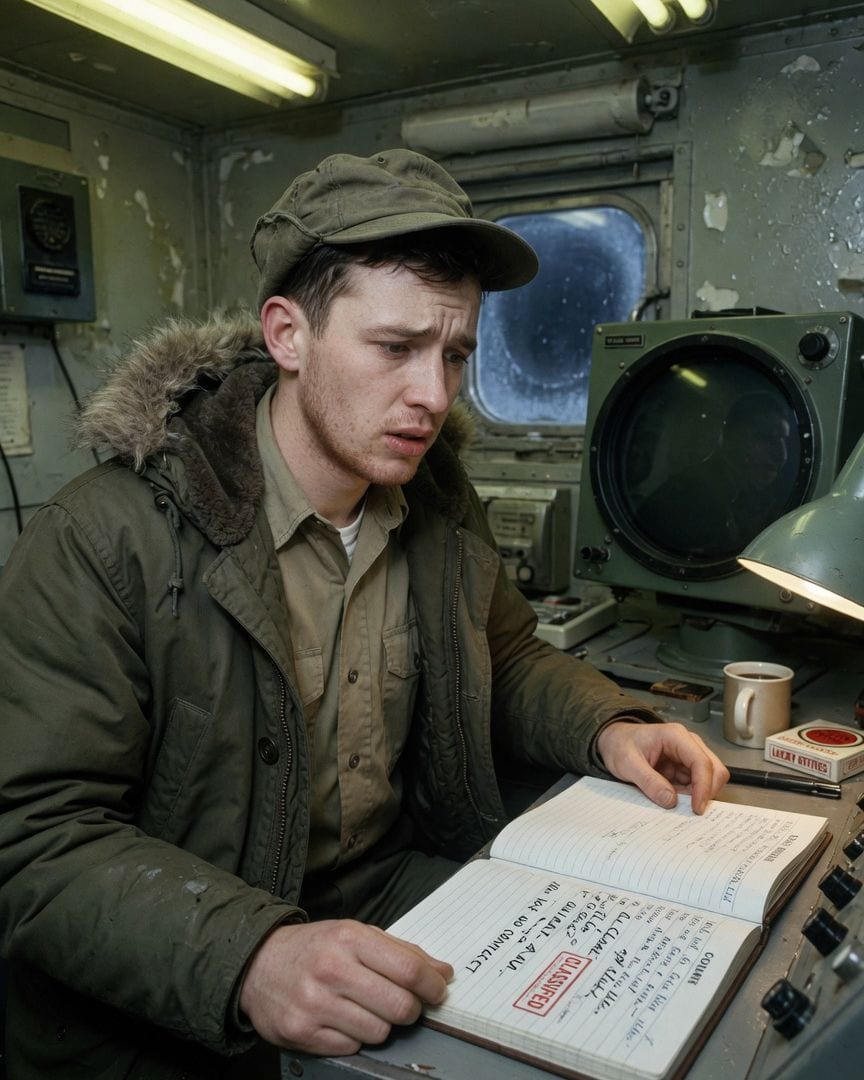
A Cold War airman logs an impossible radar contact on his last sweep. But his official logbook entry is stamped 'CLASSIFIED' and then contradicted by a hastily scrawled 'ALL CLEAR' dated moments before it.
Airman Ordway Vance, 22, manned the radar dome at Site Pellin in the biting North Atlantic dark of January 1962, running the last calibration sweep before its decommissioning. His scope picked up a faint, impossible return, growing closer with each pass, though the ocean remained empty to the eye. When Vance detailed the contact in his official logbook, a 'CLASSIFIED' stamp appeared, followed by a hastily scrawled 'ALL CLEAR' dated moments before his own entry, contradicting his every word. Commander Hartley dismissed it as equipment malfunction, but Vance sensed a chilling, official erasure behind the lie. He soon found a locked cabinet marked 'SITE PELLIN ANOMALIES,' hinting at a deeper truth buried within the base's final days.
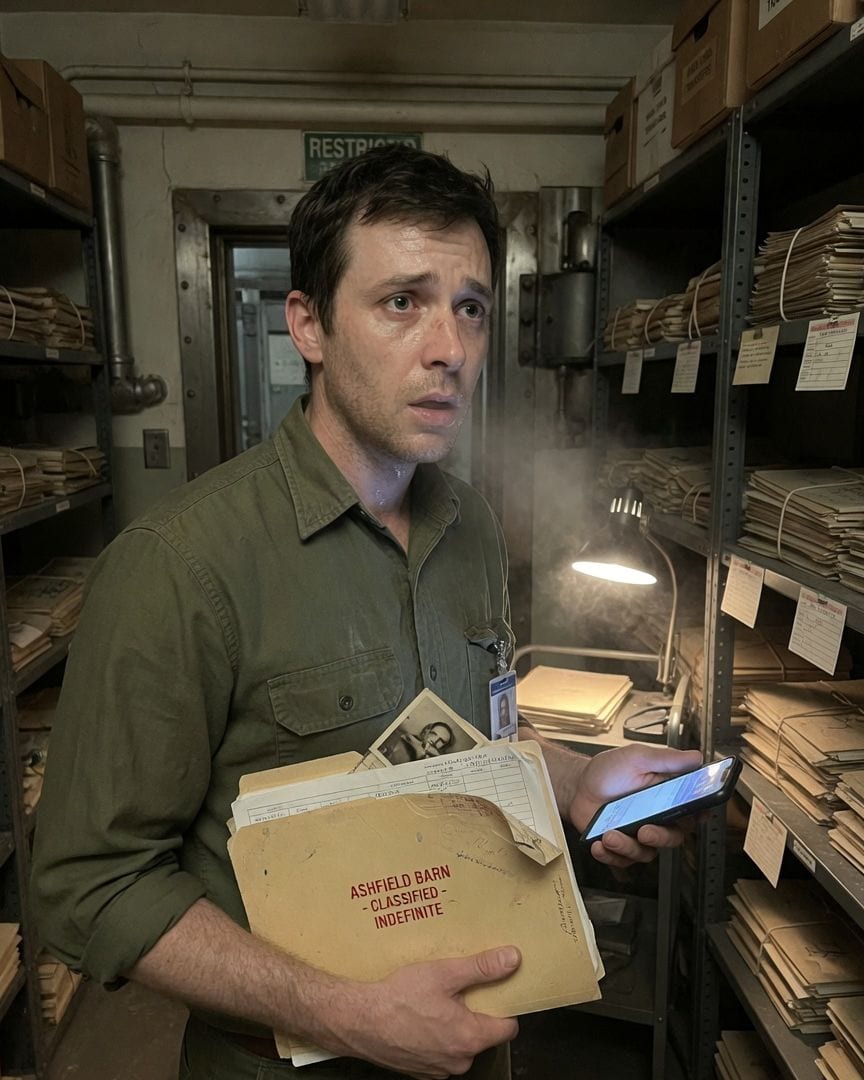
An archivist closing his vault found a file: boot prints led into a shed, none out. Its subject was 'in custody' for eighty-one years, re-signed six days ago.
Archivist Devin Mauch was on his last shifts, transferring files before Fort Loran’s vault closed for good. Tired and ready for his own move, he uncovered a slim, classified file about the Ashfield Barn. Inside was a sepia photo of a dilapidated shed, showing boot prints leading straight to its door, with none leading out. The official caption stated a 'subject' remained 'in custody, indefinite,' a status re-signed quarterly for eighty-one years, most recently just six days ago. Driven by a chill colder than the vault itself, Devin later found the shed, its dust-covered floor bearing the same impossible prints, and then heard a soft, almost imperceptible sound from its darkness.
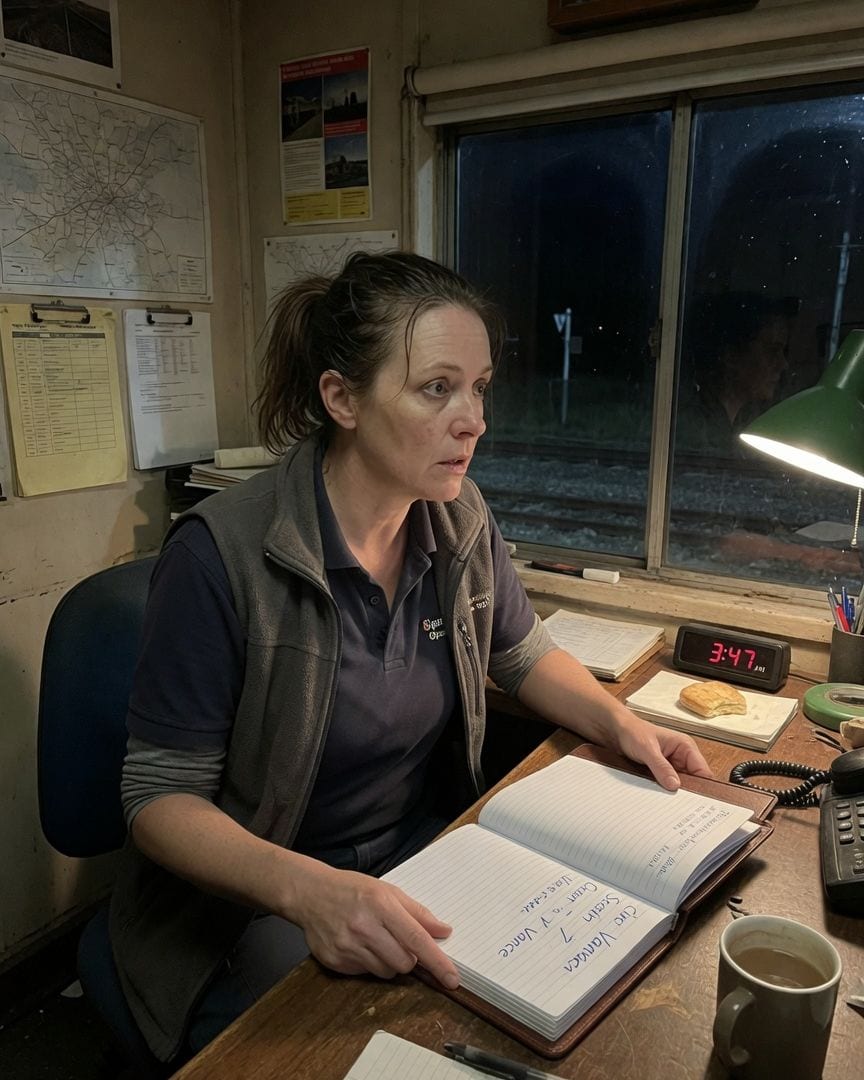
My linesman taps twice on my window at 3 AM. Control says he retired and passed years ago.
My routine at the rural signal cabin was regular: the linesman's double tap on the window at 3 AM. But then my supervisor called, revealing the linesman I knew, Warren Vance, had died five years ago. Now, an impossible entry in my official logbook, with his signature and timestamped from my shift, proves someone else was there.
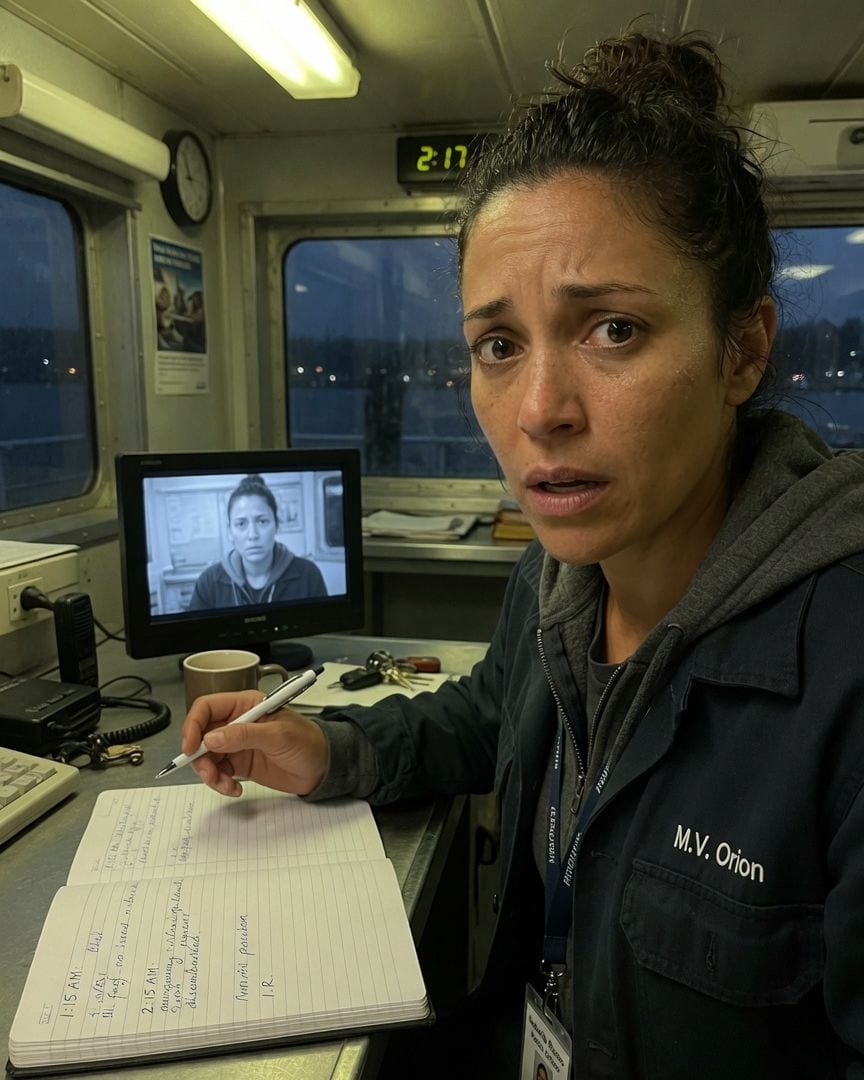
My security camera showed my own face at 2:15 AM, writing an entry I didn't make, staring utterly blankly into the lens before the screen flickered.
As a meticulous watchman on the M.V. Orion, I was making my routine 2:00 AM log entry when I found a previous one I hadn't written. Timestamped 2:15 AM, it stated a 'foot passenger disembarked' with my own initials beside it. But the ferry was dark, silent, and completely empty.