On his last weapon turn-in, Corporal Vane heard a rifle chambering rounds all night from inside the locked, empty armory. Then he found a spent casing.
Corporal Desmond Vane, a man whose reputation for meticulousness preceded him, ran a practiced hand over the cold steel of his M4 carbine.
The air in the processing tent at FOB Blackwood hung heavy with the scent of dust and stale coffee, a temporary hub before the outpost’s final decommissioning.
This was Vane’s last weapon turn-in, and he moved with the precise, ingrained motions of a soldier who trusted procedure above all else. He cleared the chamber, checked the magazine well, and inspected the barrel.
The armorer's rule at Blackwood was an oddity, whispered about by new arrivals: 'leave one round seated, never fully empty, and never dry-fire the last chamber.' Vane, however, was a purist.
He stripped his weapon down to absolute emptiness, double-checked every component for any stray cartridge, then, with a confident, almost defiant click, squeezed the dead trigger. Specialist Roland Ford, the armorer, watched from behind his counter, offering a dismissive shrug.
'Your funeral, Corporal,' he mumbled, securing the now demonstrably empty carbine into its designated rack. Hours later, the armory's heavy steel doors were locked, the entire building bare of a single live round.
Vane, on night patrol along the outer perimeter, heard it. A faint, impossible metallic click, echoing from within the armory’s concrete shell – the unmistakable sound of a rifle round chambering itself. A pause, then another. And another.
Over and over, a relentless, rhythmic testament to a presence that should not exist, until the first gray light of dawn began to break across the desolate landscape.
The next morning, Vane reported the impossible sounds to Sergeant Nora Bishop, his voice calm, rational, devoid of any embellishment. Bishop, while acknowledging Vane's unimpeachable reliability, initially suggested fatigue, an echo, or even a prank from a bored junior enlisted.
Vane, however, couldn't shake the visceral certainty of what he’d heard. The sound had been too distinct, too close. He insisted on a full, unscheduled inspection of the armory, starting with the very rack where his carbine had been stored.
Specialist Ford, annoyed by the disruption, grudgingly unlocked the heavy steel door, the hinges groaning in the morning quiet. Every weapon was secured, every chamber visibly empty, just as regulations demanded. 'See, Corporal?
Quiet as a tomb,' Ford declared, gesturing vaguely at the orderly rows. The silence in the armory was absolute, the air still and cold. No lingering scent of gunpowder, no physical trace of the previous night’s impossible activity.
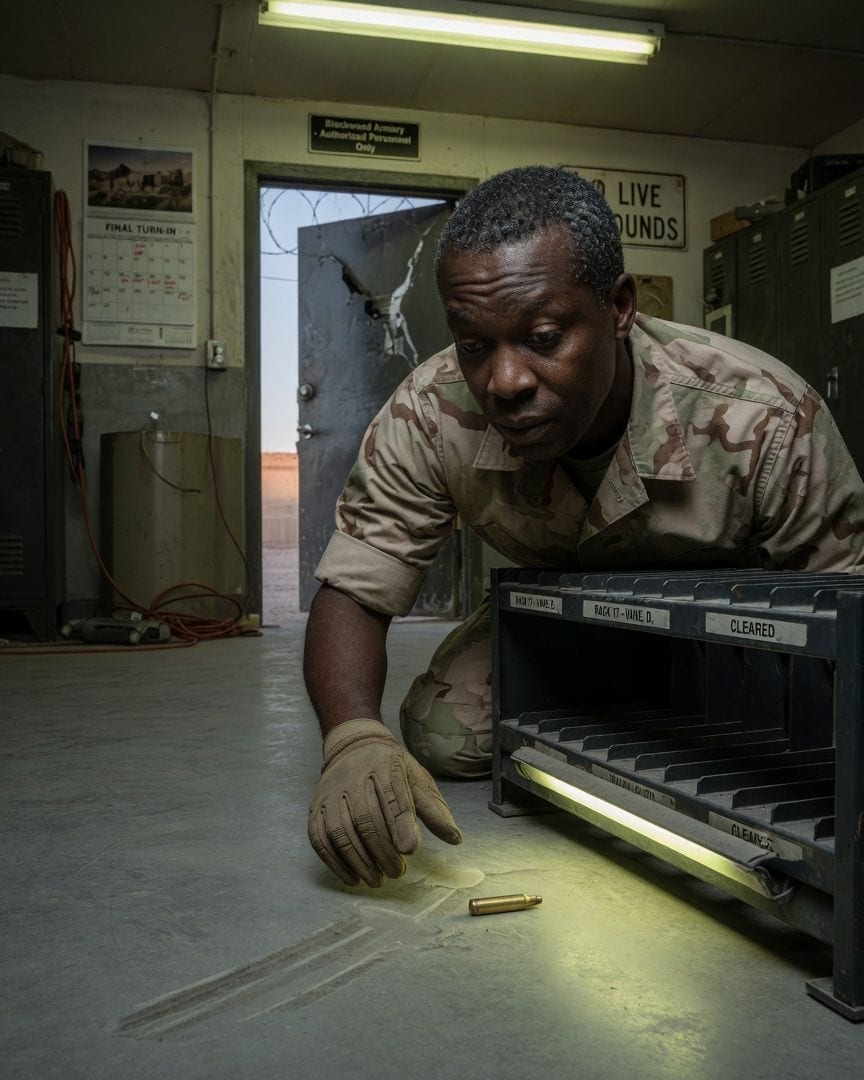
But as Ford secured the door again, Vane's gaze snagged on something small, glinting faintly. On the polished concrete floor, directly beneath the rack where his rifle had been, lay a single, spent brass casing.
It was standard issue, its headstamp clear, but its presence was impossible. No weapon had been fired, no live rounds were permitted in the armory overnight, and Vane had cleared his rifle himself.
Ford dismissed it as 'old brass, probably kicked under a rack from last week,' but Vane knew the strict cleaning protocols. The armory was swept daily, meticulously. The casing was new.
He bent down, the metal cool beneath his touch, a silent accusation against all logic.
Vane held the casing up to the weak fluorescent light, its polished surface glinting with a fresh, unsettling sheen. 'This wasn't here yesterday, Specialist,' he stated, his voice low, a quiet authority in his tone. Ford scoffed, 'Must've been, Corporal.
Things turn up in these old places.' But Vane's eyes, trained to spot discrepancies in the most chaotic of environments, were already scanning the surrounding area.
There, faintly etched into the otherwise pristine concrete, was a scuff mark, tiny but distinct, a partial impression of a boot heel. It led from the casing's position to the base of the rifle rack, pointing inward.
A single print, partially scuffed, on the wrong side of the wire, pointing inward. Vane knelt, his gloved finger tracing the faint outline.
This wasn't just a casing; it was a physical trace of an impossible presence, a silent boot print where no one could have been, a violation of the outpost's meticulously controlled space.
He looked up at the empty racks, the cold metal glinting, a chill spreading through him that had nothing to do with the desert morning air.
The undeniable physical evidence of the brass casing and the impossible scuff mark were enough to convince Sergeant Bishop to authorize a deeper, if strictly unofficial, inquiry.
Vane’s reputation for meticulousness was legendary; if he said something was off, it was off. Bishop, a pragmatic leader, started with the armory's digital logs. Every weapon checked in, every round accounted for, down to the last spent casing.
Yet, when Vane painstakingly cross-referenced the armory's daily inventory with the central supply manifest, a minor, almost invisible discrepancy emerged.
A particular M4 Carbine, serial number FOX-772, routinely showed an entry of '1 Round' in its chamber, even after being logged as cleared and empty by multiple armorers over the past year.
Each time, the entry was followed by a hurried, almost dismissive 'discrepancy resolved – system error' note. It was always FOX-772, a pattern too precise to be random. Vane requested the weapon.
Specialist Ford retrieved it, grumbling about 'more paperwork for nothing,' his usual cheerful demeanor now strained by the extra tasks. Vane took the carbine, cleared its chamber, checked the magazine well, and dry-fired it. Empty.
He repeated the check, then a third. Still empty. He handed it back to Ford, who, with an exasperated sigh, held his tablet up to log its current status.
But the digital entry on Ford’s tablet, for a fleeting second, flashed '1 Round' before Ford’s fingers flew across the screen, correcting it to 'Empty.' Ford didn't seem to notice the flicker, or perhaps he was simply used to it.
The system was fighting them, insisting on a presence that wasn't there. Bishop, witnessing it from beside Vane, exhaled slowly, her eyes wide. 'That’s… not a system error, Corporal.
That’s a ghost in the machine, and it's trying to make a count.'
As Vane and Bishop dug deeper into FOX-772's history, they found the 'system errors' for that specific weapon stretched back decades in the outpost's digital archives.
The impending decommissioning schedule, which required a full reconciliation of all assets before handover, ironically gave them unprecedented access to these older, less frequently accessed records.
They spent late nights in the administrative office, the low hum of the servers a constant, almost hypnotic counterpoint to their growing unease.
The desert wind rattled the prefab walls, making every creak sound like a footfall, as if the outpost itself was listening.
One evening, as Vane was downloading a particularly dense batch of inventory logs from the early 2000s, the network connection flickered violently.
The screen went black for a chilling moment, then displayed a single, stark message, stark white against the dark: '1 ROUND SEATED.' No sender, no timestamp, just the chilling instruction hanging in the air.
Vane froze, his breath catching in his throat. The cold air in the room seemed to deepen, pressing in on him.
Bishop, who had stepped away for coffee, returned to find Vane staring at the screen, his face pale in the glow. 'What is it?' she asked, her voice hushed, sensing the shift in the room's atmosphere.
Before Vane could answer, the screen reverted to the log files, the message gone as if it had never been. But the network logs showed no outage, no unauthorized access.
They were being watched, or rather, it was watching, and it knew they were getting too close to its 'count.' The anomaly wasn't just in the system; it was the system, reacting to their probing, warning them away.
The '1 ROUND SEATED' message was a direct, unsettling warning.
Bishop, now fully invested and visibly shaken, pulled up all available physical records pertaining to FOB Blackwood's historical decommissioning schedules and personnel transfers, focusing on any 'unaccounted for' or 'discrepancy' reports.
In a dusty storage box, tucked away beneath old supply manifests, she found a faded, unofficial logbook, its cover simply labeled 'Armory Notes - Various Rotations.'
It was filled with meticulous, cramped handwritten entries from a long-retired armorer, a Sergeant Thornton, dating back to the late 1980s.
Thornton’s entries detailed similar 'phantom' round counts for various weapons, specifically mentioning a 'cursed M4, FOX-772,' and the maddening persistence of its 'loaded' status.
But more chillingly, he wrote about the 'rule' — 'leave one round seated' — not as a safety measure, but as a 'peace offering.'
He had painstakingly noted instances where the rule was broken, followed by cryptic entries like 'unaccounted for personnel' or 'missing gear' reports. 'It always finds its count,' one faded entry read, scrawled in a frantic hand.
'If you don't give it one, it takes one.' The ink was blurred, faded with time, but the message was stark, a desperate plea from the past.
Bishop looked at Vane, her face pale in the dim light of the office, the implications sinking in. The faint hum of the servers in the room seemed to rise in pitch, a nervous vibration in the air.
'This isn't just about a rifle, Desmond. This is about people. About a presence that demands to be acknowledged in the most precise way possible.'
The armorer's odd rule, the chambering sound in the empty armory, the brass casing, FOX-772's impossible count, the network warning – it all coalesced into a horrifying, coherent pattern.
The outpost wasn't just a military base; it was a ledger for something ancient and insistent, something that used military protocol to manifest its own impossible existence. It wasn't just a glitch; it was a demand.
Bishop, now fully convinced of the terrible truth, navigated the labyrinthine digital archives, searching for any personnel records that matched Thornton’s cryptic notes.
She used the keywords 'unaccounted for,' 'transfer discrepancy,' and 'FOB Blackwood,' filtering by dates that aligned with the ten-year cycle Thornton hinted at. The search results populated the screen, a growing list of names, unit numbers, redeployment dates.
And then, a pattern emerged, chillingly precise and utterly impossible. Every ten years, coinciding with a rotation change or a major inventory audit, a 'phantom' service member appeared on the final redeployment manifest. Specialist J. Doe, Unit 3-17, 1987.
Private K. Smith, Unit 7-2, 1997. Corporal T. Jones, Unit 1-4, 2007. Each name had a valid but untraceable service number, and each was recorded as 'redeployed' but never arrived at their next station.
Their names vanished from all subsequent records, a perfect erasure. Bishop scrolled down, her finger trembling as the next expected entry for 2017 appeared.
The administrative office, usually just a dull background hum, suddenly felt frigid, the silence between the server racks an almost palpable weight.
And then, at the very bottom, in bold, a new entry was being generated, in real-time, for the upcoming decommissioning. It pulsed faintly on the screen: 'VANE, DESMOND. CPL. UNIT 5-3. REDEPLOYED.' The service number was Desmond’s own.
The system was preparing its next 'count,' and it was Vane himself.
The auto-generated entry for Vane vanished as quickly as it appeared, but the implication was clear and devastating. Bishop and Vane now understood the full, terrifying scope of the anomaly.
The 'one round seated' rule, enforced by generations of armorers through an unspoken dread, was a tacit acknowledgment, a ritual feeding.
When the count was denied, when the system was emptied beyond its demanded 'one,' the anomaly generated its own, pulling a 'ghost' into the system's ledger.
The brass casing Vane found, the chambering sound, FOX-772's persistent 'loaded' status – these were the anomaly's attempts to fulfill the 'one round' quota, to force its presence into the meticulous military accounting.
But the pattern of missing personnel was the true horror: when the system failed to acknowledge the 'round,' it took a 'man' instead.
The outpost wasn't just logging an entity; it was feeding it, demanding a sacrifice for its continued, impossible existence.
The decommissioning, meant to clear all records and erase the outpost from active duty, was accelerating the anomaly's need for a final, grand reconciliation.
It wanted to be accounted for, to maintain its presence in the most documented system on earth, and it would ensure its count, by any means necessary.
Bishop realized the armorer’s rule, the small, seemingly arbitrary detail, was the key to containing it. It wasn't about safety; it was about appeasement. Give it its single round, and it wouldn’t demand a person.
With only hours until the final decommissioning protocol was initiated, Vane and Bishop raced against the clock to implement a desperate plan.
They knew they couldn't explain this to Captain Radcliffe, who would dismiss it as hysteria and a breach of protocol. They had to appease the anomaly, to give it its 'count' before it took another.
Their target: FOX-772, the M4 carbine that was the anomaly's primary interface, its most consistent point of manifestation. They retrieved it from the armory, the metal cold and heavy in Vane's hands.
The air in the armory felt strangely heavy, almost expectant. Vane meticulously loaded a single, inert training round into the chamber, ensuring it was visible through the ejection port, a glint of brass.
He then logged it into the system, bypassing Specialist Ford and Captain Radcliffe's oversight by exploiting a known 'backdoor' in the decommissioning software that allowed for emergency, manual inventory adjustments.
He typed furiously, the words a silent prayer: 'M4 Carbine, FOX-772. Status: ONE ROUND SEATED. Permanent.' As he hit enter, the screen flickered violently, a ripple of static washing over the data, then settled.
The phantom entry for 'VANE, DESMOND' on the redeployment manifest, which had reappeared as a 'pending' entry, instantly vanished.
A low, resonant hum resonated from the server room, deeper and more resonant than before, a sound of something vast and ancient settling, of a hunger temporarily sated. Bishop watched the screen, her hand on Vane’s shoulder, her breath held.
The outpost's prefab walls seemed to sigh, the desert wind outside falling to an unnatural stillness. The system, for now, had its count. They had acknowledged its presence, and it had, for now, released its claim.
The outpost breathed a quiet, heavy sigh of relief.
FOB Blackwood was decommissioned without further incident. All records were meticulously reconciled, the M4 Carbine FOX-772, permanently logged with 'ONE ROUND SEATED,' was sealed in a special evidence locker marked 'Do Not Access – Permanent Inventory.'
Captain Radcliffe dismissed the 'system glitch' as a 'minor anomaly' in outdated software, attributing the odd final inventory to 'human error during a stressful period.'
Specialist Ford never understood why Vane and Bishop insisted on the specific wording for that one rifle, or why they seemed so relieved after the final audit. He chalked it up to the pressures of decommissioning.
The phantom entries for 'VANE, DESMOND' never reappeared on any manifest. The outpost was handed over to local authorities, its secrets buried under layers of official paperwork, concrete, and the relentless desert wind.
Years later, Desmond Vane sat in his quiet suburban home, a veteran now, far from the desolate plains of FOB Blackwood. He was a civilian, but the meticulousness, the need for order, never left him.
He still checked his door locks twice, every night, with an almost ritualistic precision. He still counted the items in his pantry, just to be sure, his gaze lingering on the numbers.
He knew, with a certainty that chilled him to the bone, that the anomaly wasn't gone.
It was merely dormant, its count satisfied for now, waiting for the next discrepancy, the next time its presence was ignored or its 'one round' was violated.
He sometimes wondered about the new occupants of FOB Blackwood, about the local authorities who now patrolled its perimeter. Did they know the rule? Did they leave one round seated?
He never spoke of it, not to his wife, not to his closest friends. Some truths were too coherent, too terrifying in their quiet logic, to share.
He simply lived with the knowledge, a quiet, internal dread, a permanent mark left by the system's impossible demands. The system, after all, had always found its count. It always would.
If this one got to you
A corporal dry-fired his rifle empty, then found a faint, wrong tremor in his own logbook signature.
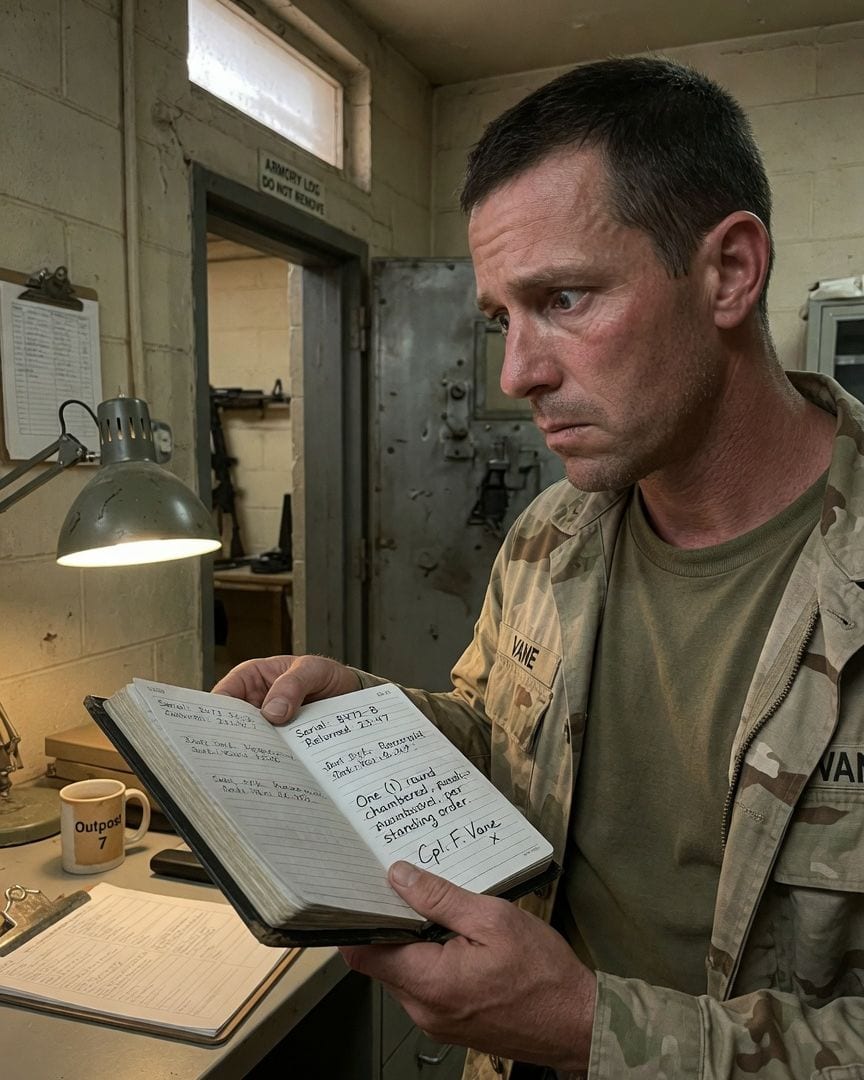
Corporal Felix Vane, a stickler for protocol at Outpost 7, always ensured his service rifle was meticulously cleaned, reassembled, and dry-fired empty. He defied an unwritten rule to leave a round chambered, a testament to his meticulous nature. But hours later, in the dead of night, the metallic 'CLACK-CHICK' of a rifle cycling a round echoed repeatedly from the secure armory. The next morning, the undisturbed logbook showed his own signature documenting a chambered round—with a faint, impossible tremor in the 'x' of his name. A cold draft and a heavy, watchful presence then made the tightly sealed space feel impossibly crowded, leaving Corporal Vane frozen, unable to turn from the page.
A coastal sentry on his last watch found the bunker's decades-sealed hatch ripped open by impossible strength.
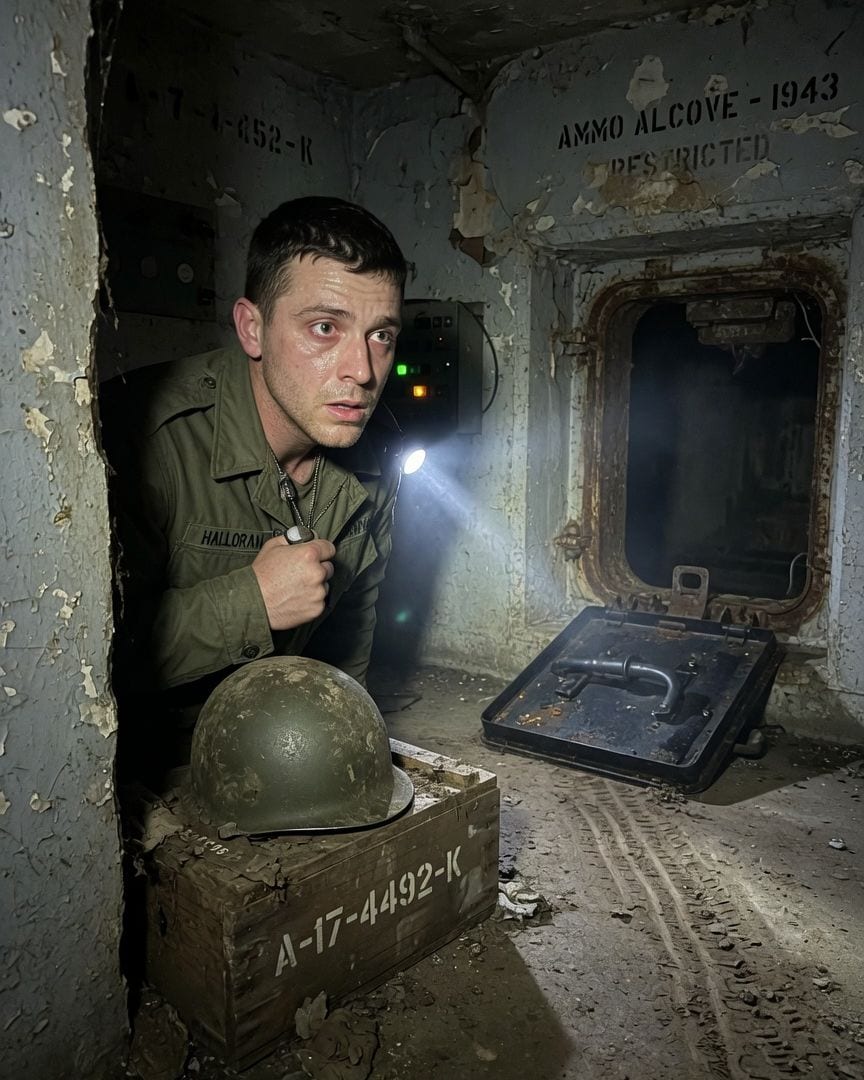
Private Daniel Halloran shivered through his final hours on watch at the old WWII coast-artillery bunker, counting down to his discharge and going home. The pre-dawn fog rolled in thick, and through its swirling white, he watched a landing party form on the beach below, their outdated gear impossibly clean, their forms unmoving. After dawn burned off the mist, the beach was empty, but up the embankment, the bunker's rear hatch—sealed for decades—stood violently ripped open, its locking bar twisted. Inside the dark, silent chambers, Daniel's flashlight found a mud-caked military helmet, unlike any he'd ever seen, bearing a faded serial number that felt sickeningly familiar.
Sergeant Pryor, days from retirement, finds a four-hundred-foot crater. The desert floor is still warm, but no one remembers the blast.
Sergeant Alden Pryor, forty years old and just eleven days from retirement, drove the familiar Ranier Flats fence line for one of his final patrols. The desert stretched out, silent and vast, until he discovered a four-hundred-foot crater, dark and impossibly vast, where the sand had fused into slick glass. The ground within the crater was still faintly warm, a subtle heat defying the cool desert air. Yet, every official log confirmed the blast, while no one recalled a tremor or flash across three states.
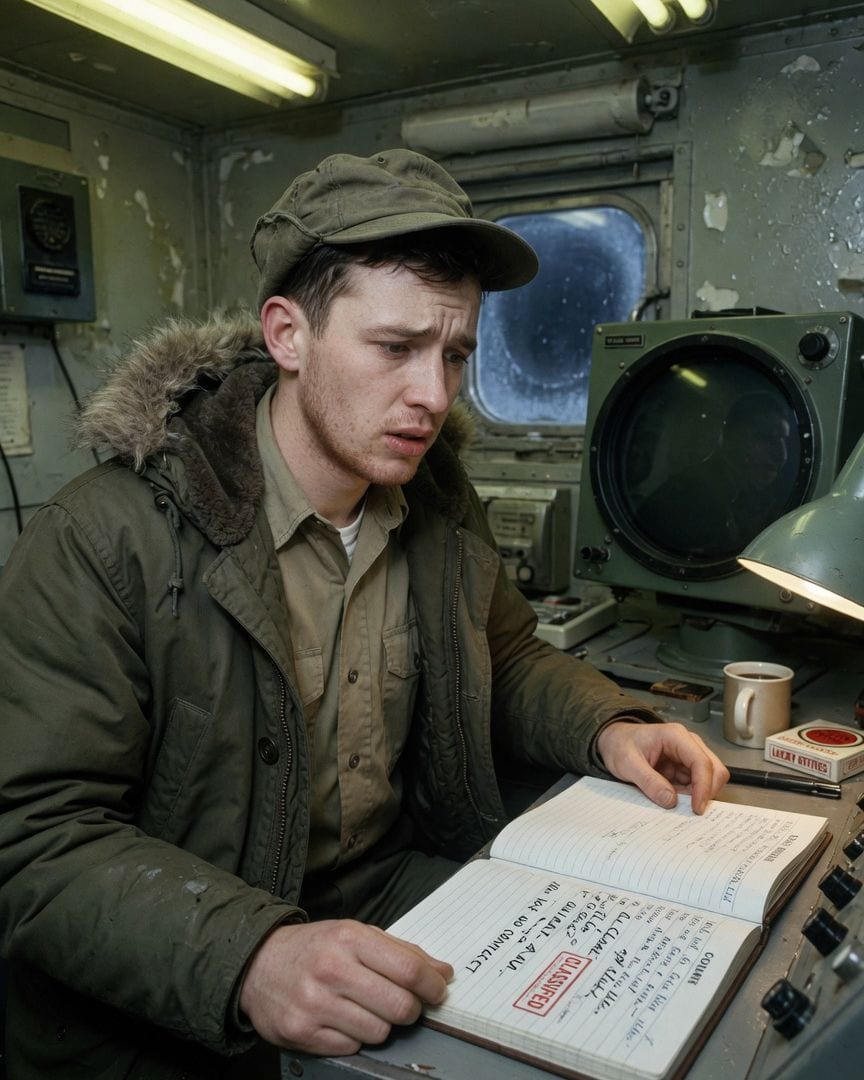
A Cold War airman logs an impossible radar contact on his last sweep. But his official logbook entry is stamped 'CLASSIFIED' and then contradicted by a hastily scrawled 'ALL CLEAR' dated moments before it.
Airman Ordway Vance, 22, manned the radar dome at Site Pellin in the biting North Atlantic dark of January 1962, running the last calibration sweep before its decommissioning. His scope picked up a faint, impossible return, growing closer with each pass, though the ocean remained empty to the eye. When Vance detailed the contact in his official logbook, a 'CLASSIFIED' stamp appeared, followed by a hastily scrawled 'ALL CLEAR' dated moments before his own entry, contradicting his every word. Commander Hartley dismissed it as equipment malfunction, but Vance sensed a chilling, official erasure behind the lie. He soon found a locked cabinet marked 'SITE PELLIN ANOMALIES,' hinting at a deeper truth buried within the base's final days.
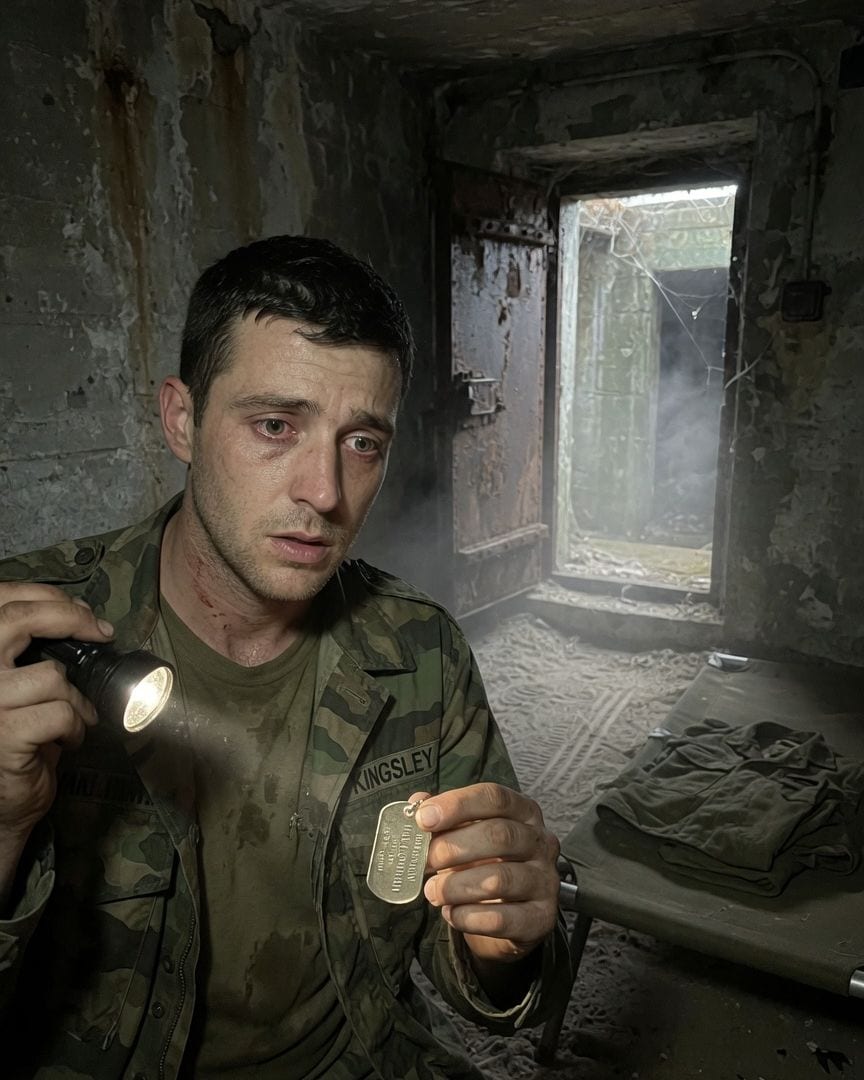
On his final rotation, a Private finds a WWII dog tag for 'Halloran' in a bunker sealed for eighty years.
Private Roland Kingsley endured the bone-deep weariness of his final graveyard watch at a reactivated WWII bunker on the Northern California coast, just hours from dawn and the end of his deployment. His searchlight cut through thick fog, revealing impossible figures: men in archaic WWII uniforms, assembling on the deserted beach, only to vanish moments later. As dawn broke, Kingsley discovered the bunker's rear hatch, sealed for decades, now stood mysteriously ajar. Inside, on an empty cot, lay a WWII-era field jacket, and in its pocket, a dog tag for 'Halloran' — a name impossible to the bunker's eighty-year history. What unseen presence had disturbed the long-sealed past?
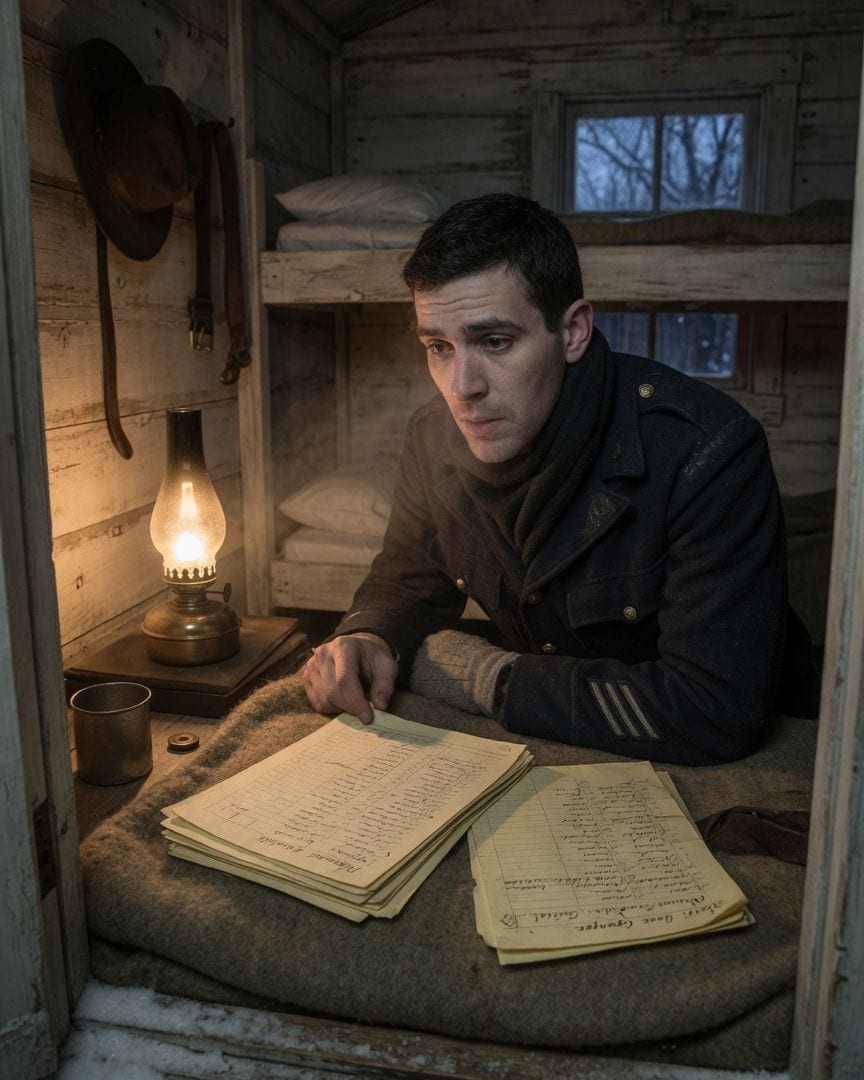
On his last watch, Corporal Carter found boot prints ending inside a sealed magazine, and a blood-red handprint from a soldier decades out of time.
Corporal Franklin Carter shivered, not from the biting November wind, but from the chill of his last pay muster at Fort Taggart before its winter abandonment. His final duty was to count every man, tallying thirty-seven, precisely the company strength. But his breath hitched when he saw the completed roll: it ran thirty-eight names long. An impossible extra slot, filled by a voice that answered 'Here, Corporal,' for a soldier whose name, Pvt. Isaac Granger, vanished from all official records, only to reappear in a forgotten supply log from 1863. Was Fort Taggart abandoning its dead, or something far older?