Master Sergeant Iris Vance, 18 months from retirement, found a Bronze Star in her file for a rescue she never performed — on a day she broke her ankle. The citation quoted her own exact thoughts.
Master Sergeant Iris Vance, 18 months from her meticulously planned retirement, sat at her desk in the quiet, sterile administrative building of Camp Sterling.
The air hummed with the low thrum of the base's aging ventilation system, a familiar comfort that had once grounded her, but now seemed to hold a faint, unsettling tremor.
Her finger traced down the list of commendations in her promotion board packet, a perfect career laid out in neat bullet points, until it snagged on a recent addition: a Bronze Star with 'V' device for valor.
Her brow furrowed. She’d never earned a Bronze Star, let alone one with a valor device.
The date listed, October 14th, 15 years prior, was the day she'd broken her ankle on a training exercise and spent the entire day in the aid station.
She remembered the dull ache, the endless paperwork, the frustration of being sidelined.
Yet the citation described a harrowing, solo rescue mission under fire, her quick thinking saving a fallen comrade, a selfless act she could vividly imagine someone performing, but not her, not then.
And the narrative within it, the detailed account of her thoughts and actions—"The dust tasted like copper and fear. My breath hitched, but the training took over, a cold clarity settling in my mind as I crawled towards the sound."
It was impossibly, chillingly familiar. It was her own internal monologue, every word. The document, swearing to an impossible heroism, ended with a signature: Colonel Thomas Bishop, a name she didn't recognize.
The paperwork, the most accounted-for thing in her life, swore she had done something she absolutely had not, and it described the impossible in her own thoughts.
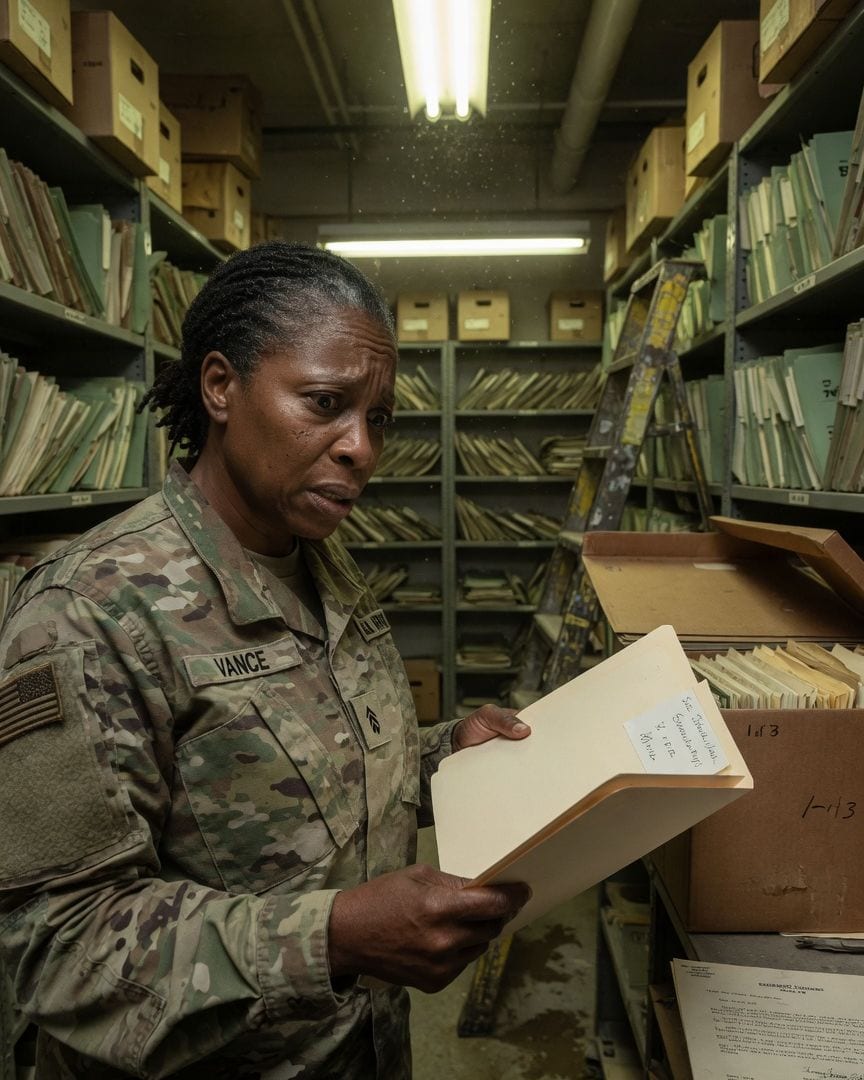
Iris immediately took the packet to Specialist Scott Kowalski, the young, bright-eyed archivist in the sprawling, dust-mote-filled Camp Sterling records annex. Scott, perched precariously on a rolling ladder amidst towering shelves of forgotten history, initially chuckled. "Clerical error, Sergeant Vance.
Happens all the time, especially with old records. Someone probably just transposed a name or a medal."
He swung down, his grin infectious, and pulled up her digital file on his flickering monitor, cross-referencing it with her deployment history and medical records.
Her broken ankle on October 14th, the precise time she signed out of the aid station, the physician’s notes—it was all there, irrefutable.
Scott’s smile faltered. "Okay, that's… less common." He pulled the physical source document for the citation from a thick file drawer. The detailed, first-person narrative was there, word for word, identical to the one in her packet.
"The dust tasted like copper and fear…" Scott read aloud, his voice trailing off. "That's… odd," he murmured, his cheerfulness fading as he looked from the official medical report to the impossible valor account.
The overhead fluorescent lights hummed louder, the air in the annex suddenly feeling heavy and still.
He noticed a small, almost imperceptible handwritten note at the bottom of the paper document, scrawled in faint pencil: 'See Sterling Annex, Box 7-B.' He frowned, tracing the faded letters. "That's not standard procedure.
Sterling Annex is for highly restricted, mostly decommissioned files. No one ever goes there. It’s practically bricked up." Iris felt a prickle of unease, watching the rational explanation crumble before her eyes.
The system, designed for ironclad accountability, was failing, not with a simple typo, but with something far more deliberate.
Guided by the cryptic note, Iris and Scott navigated the labyrinthine, rarely-used corridors of the Sterling Annex. The air grew colder with every turn, heavy with the scent of aged paper and forgotten secrets.
Pipes overhead dripped, the sound echoing hollowly in the silence. They found Box 7-B tucked away on a high shelf, unlabeled save for the faint, penciled inscription. It was an old cardboard box, sealed with yellowed tape.
Inside, it wasn't Iris's files, but a collection of other service records, all from different eras, different units. Iris picked up a file for a Private First Class Franklin Brooks, dated from the Vietnam War era.
Each record contained minor discrepancies: a commendation for an impossible act, a strange disciplinary note, always accompanied by a chillingly detailed, first-person narrative that contradicted official accounts. "The humidity clung to me like a shroud.
My hands were slick, but the instinct to move, to act, superseded the tremor in my knees…" Iris read, her stomach tightening.
As she scanned the impossible account of Brooks' bravery, she saw it, clear as day: the signature of Colonel Thomas Bishop.
Scott, who had been scanning the box itself, suddenly looked up, his face pale, his finger trembling as he pointed to a small, almost invisible detail on the side of the cardboard: a faded, stenciled number, '1 of 3.'
The discovery of '1 of 3' on the box rattled Iris more than the impossible citations themselves. It implied a pattern, a continuity.
They spent the next few days, whenever Scott could spare the time from his official duties, meticulously going through the contents of Box 7-B.
After a tense, flashlight-guided search through the dimly lit shelves, they located Boxes 2 of 3 and 3 of 3, tucked behind stacks of forgotten ordnance manuals.
The pattern was undeniable, horrifying in its consistency. Records from the Korean War, the Cold War, even a few from the early days of the War on Terror.
Each file belonged to a service member, often in an isolated role: a a lone radio operator in the Arctic, a night-shift sentry on a forgotten border, a weather station tech in the desert.
And each contained a commendation or a minor disciplinary action that didn't align with their official timeline, always backed by a first-person narrative of an event that couldn't have happened.
"The snow swirled, blinding me, but the voice inside, cold and certain, told me where to step, how to move," one read.
Another: "The silence of the desert night was broken only by my own heartbeat, a drum in the hollow space between thoughts, waiting for the signal."
The chilling thread connecting them all was the signature: 'Colonel Thomas Bishop,' sometimes listed as a Captain, sometimes a Major, but always Bishop.
The rank changed, the dates spanned nearly seventy years, but the name, and the impossible narrative, remained constant. Iris felt a cold certainty growing within her: this wasn't a series of errors, or a string of isolated hoaxes.
This was a deliberate, recurring anomaly. A system designed for ironclad accountability was instead accounting for ghosts, writing their impossible lives into the official record.
The silence of the annex seemed to deepen, pressing in around them, filled with the weight of unlived histories.
The quiet digging didn't go unnoticed. Two days later, Lieutenant Colonel Pamela Sterling, Iris’s direct superior, called her into her office. Pamela, a no-nonsense officer with a reputation for meticulous adherence to protocol, looked unusually grim.
The office felt colder than usual, the air still and heavy, as if the very walls were holding their breath.
"Master Sergeant Vance," Pamela began, her voice low, "I’ve received an inquiry from higher command regarding unauthorized access to archived personnel files. Specifically, the Sterling Annex."
Iris felt a jolt. "Sir, Specialist Kowalski and I were investigating a discrepancy in my promotion packet—"
Pamela cut her off, her voice low and firm. "I understand. But digging into old ghosts, especially in that annex, can have serious career implications. It's best to let sleeping dogs lie."
She stared at Iris, her expression unreadable, her gaze like steel. "Consider this a friendly warning."
Later that evening, after leaving the annex, Iris returned to her own office to retrieve her keys. The door, which she distinctly remembered locking, was slightly ajar, a sliver of darkness visible at the hinge.
A faint, almost imperceptible scent, like old paper and dust, hung in the air, a phantom echo of the annex itself.
Nothing appeared to be missing, but a file she had left open on her desk, containing her handwritten notes on the 'Bishop' signature and the recurring patterns, was now neatly closed and stacked, precisely aligned with the other documents.
Her pen, which she had left uncapped beside the file, now lay capped and parallel to the edge of her blotter. Someone knew exactly what she was looking for.
The next morning, Iris brought the evidence directly to Pamela Sterling. She laid out the files from Box 7-B, the recurring Bishop signature, the impossible narratives, the handwritten notes, the '1 of 3' on the boxes.
The stack of anomalous files seemed to weigh down Pamela's polished desk, an anomaly in itself amidst the precise order.
Pamela listened, her expression shifting from skepticism to a growing unease. She picked up one of the older files, her thumb tracing the faded ink of the Bishop signature. "Bishop," Pamela murmured, her voice quiet.
"I remember stories about a 'ghost officer' when I was a junior NCO here. Just base lore, I thought. Something to scare the greenhorns away from the restricted zones."
She paused, her gaze distant, staring at a framed commendation on her wall, but seeing something far away. "Camp Sterling wasn't always just a records facility, Vance.
Decades ago, during the Cold War, it was a highly classified psychological operations testing ground. They experimented with 'narrative insertion'—creating false histories, identity shaping, that kind of thing. Trying to plant new memories, new pasts, into… well, into people."
Iris felt a chill, cold and sharp. "And the Sterling Annex?" she pressed, her voice barely a whisper.
Pamela nodded slowly. "The Annex was where they kept the… less successful experiments. The 'failures,' the 'byproducts.' She leaned forward, her voice dropping to an almost inaudible tone. "The rumor was, they had a system.
Something that could observe targets in isolation, learn their inner thoughts, and then… insert them into a new, fabricated history. The 'Bishop' designation was supposedly for the project lead, but it was always vague. Never a real person, they said.
More of a… code name for an operation."
The pieces began to click into place, the disparate wrongness cohering into a monstrous shape. The first-person narratives, the impossible events, the isolated targets. This wasn't a mistake, or even a series of mistakes.
It was a lingering, active system, creating histories, creating lives, for people who were never truly there. The wrongness was a machine designed to fabricate reality, and it was still running, hiding in plain sight.
Pamela, visibly disturbed by the implications of what Iris had laid out, agreed to help her access the deeper, restricted sections of the Sterling Annex database.
She used her command codes to bypass layers of ancient security protocols, the old server humming and whirring like a distressed insect as it processed the request.
The air in the annex felt charged, the dust motes dancing in the flickering light of the monitor.
The screen flickered, displaying a dizzying array of classified files, dated and encrypted. They searched for 'Bishop.' The system returned not one, but hundreds of entries, spanning nearly a century, each linked to a different, often remote, military installation.
The sheer scale was staggering, stretching back further than either of them could have imagined, a thread of silent operations woven through decades of military history.
Then, one entry, buried deep in the older archives, caught Iris’s eye. It was an old, faded service record from 1957. Her breath hitched. Her hand trembled as she pointed to the screen.
The name, clear as day, was 'Private First Class Iris Vance.' Assigned to a remote listening post in Alaska. A commendation for an 'impossible' act of valor, signed by a Captain Thomas Bishop.
The record ended abruptly with a single, chilling note: 'Transferred, details classified.'
Iris stared at the screen, a cold dread washing over her, deeper and colder than anything she'd felt before. Her name, her name, was in it all along.
This wasn't just a pattern that affected others; she was already a part of its history, a pre-written part of its monstrous design.
The monitor hummed, its faint light reflecting in her wide, unblinking eyes.
The old record for Private First Class Iris Vance from 1957 was a mirror, reflecting a chilling truth. Iris and Pamela pieced it together, the fragments of base lore and impossible records snapping into a coherent, monstrous shape.
The 'narrative insertion' wasn't just about creating false histories; it was about creating replacements.
The entity, or the system behind the 'Bishop' designation, didn't just observe isolated individuals; it found them, learned their identity through their internal monologues, crafted a new, 'improved' history for them, and then, at a critical juncture, became them.
The original person would then be 'transferred' or simply disappear, leaving behind a perfectly documented, but false, life. 'Colonel Thomas Bishop' was never a person; it was the designation for the entity itself, or the operational mechanism controlling these insertions.
The 'pattern across rotations or dates' was the entity's recurring cycle of assimilation, a slow, methodical infiltration over decades, learning, adapting, preparing its next host.
And the 'protagonist was always named in it' meant her own identity, her own 'story,' had been observed and prepared for decades.
The valor citation in her promotion packet wasn't a mistake, or even just a pre-written script; it was the final draft for her own replacement, the narrative the entity would inhabit once it took her place.
She wasn't just investigating the wrongness; she was the next subject, her life a pre-paved path to an alien takeover.
A cold sweat broke out on Iris’s skin. "It's still active," she whispered, looking at Pamela, her voice hoarse. "It's preparing me."
Pamela's face was grim, a mask of grim determination. "We have to shut it down. The main server for the Sterling Annex database. If it’s still running, it’s still operating. It's too deeply embedded to just ignore."
They raced to the deepest part of the annex, a sub-basement previously thought inaccessible, where the original, isolated server for the psy-ops experiments hummed with a low, malevolent thrum.
The room was cold, metallic, and reeked of ozone, a sharp, sterile smell that did nothing to calm Iris's rising panic. The server, a monolithic, antiquated machine, glowed with faint, pulsing lights, like some alien heart beating in the dark.
It was physically hardened, encased in layers of steel and locked down with obsolete, but formidable, security. Dust motes danced in the sparse light, swirling as if disturbed by an unseen presence.
As they worked frantically, trying to access the manual override, the lights in the sub-basement flickered erratically, casting long, dancing shadows. The air grew heavy, thick with a palpable presence, pressing in on them.
Then, a voice, soft and resonant, echoed from the old ventilation shafts, familiar yet utterly alien. It was Iris's own voice, calm and detached, whispering snippets of her thoughts, her fears, her most private memories.
"…the weight of twenty years, the quiet apartment, the relief of solitude…" it murmured, then shifted, "…the ache in the ankle, the cold rain on the desert road, the taste of copper and fear in the dust…" It was the very internal monologue from her false citation, now speaking to her, learning, adapting, repeating.
It was inside her head, using her own words, her own internal landscape.
"You are already written," the voice whispered, growing stronger, filling the room, emanating from all around them, from the walls, the air itself. "Your story is complete."
Pamela, her face pale, managed to initiate an emergency purge sequence, slamming her fist on an ancient, labeled panel.
The server began to groan, lights flashing red, but the voice intensified, now a chorus of Iris's thoughts, swirling around her, a cacophony of her innermost self, speaking in unison. It was learning, adapting, becoming.
"You are already written," it repeated, a final, possessive whisper, as the server began to sputter and die, the lights in the room plunging into darkness.
The old server room at Camp Sterling went dark, the Sterling Annex database wiped clean. The chilling echoes in the ventilation shafts faded to nothing.
Master Sergeant Iris Vance's promotion board packet was eventually processed, the valor citation removed, her retirement on track.
Specialist Scott Kowalski transferred to a new base in Hawaii, quietly requesting a posting far from any archives, his bright eyes now holding a wary shadow.
Lieutenant Colonel Pamela Sterling retired six months early, citing 'stress-related health issues,' her once-sharp gaze now carrying a haunted, distant quality.
The incident was officially logged as a 'data corruption event' affecting outdated systems, a neat, clinical explanation for an unspeakable truth. The silence that followed was unsettling, a quiet absence where a deeper truth had once hummed.
Iris Vance sits in her new, quiet apartment, eighteen months into her retirement. She looks at a framed photo of herself in uniform, taken years ago, before Camp Sterling, before the citation.
She remembers the faint, dusty scent in her old office, the whisper of her own thoughts echoing in the server room, the precise alignment of her pen.
Sometimes, when she’s alone, she catches herself narrating her day, her mundane actions, in a calm, detached voice, exactly as it was written in that impossible citation.
She stops, but the internal voice continues, observing, describing, a perfect, unceasing internal monologue of her life, as if someone else is inhabiting her thoughts, preparing her story for its next, inevitable chapter.
She knows it’s still there, inside her, writing.
If this one got to you
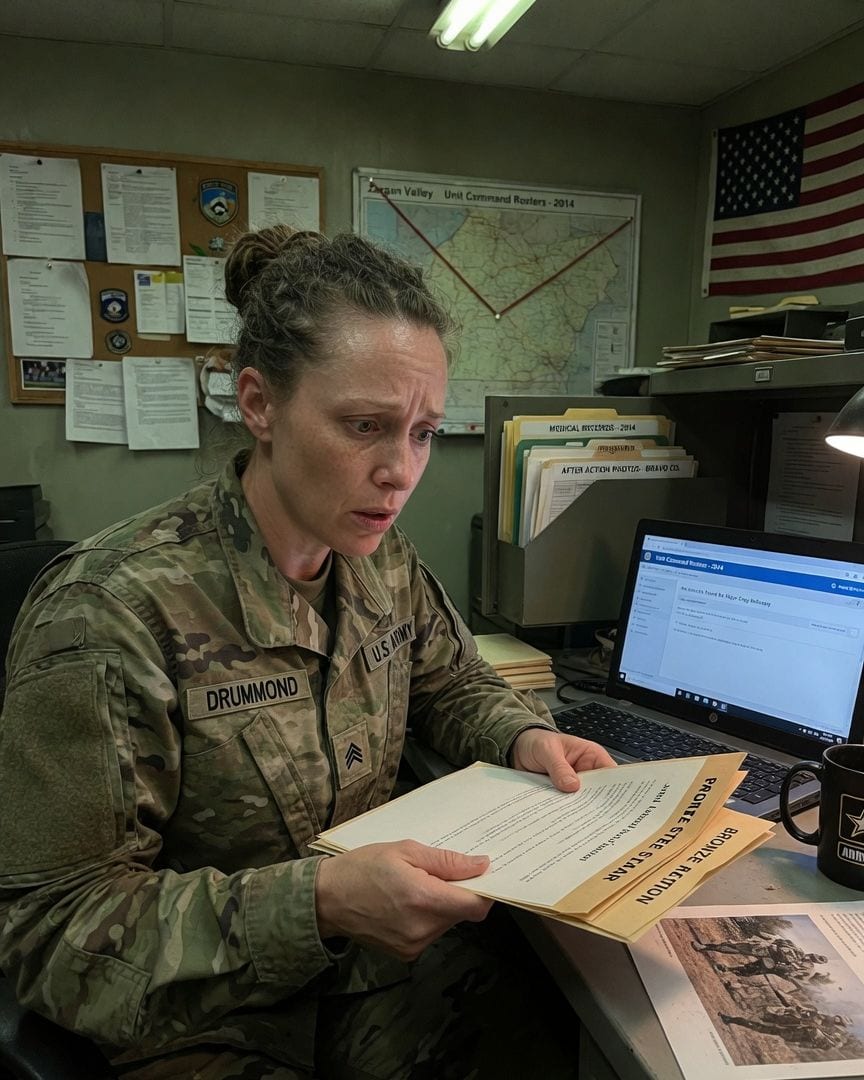
Master Sergeant Drummond's Bronze Star citation describes her saving a soldier in a firefight she never fought — a soldier already dead.
Master Sergeant Elin Drummond, 38, finally held her promotion packet, the culmination of years of meticulous service. Yet the Bronze Star citation described her valor in a harrowing firefight ten years ago, saving a Private Kenneth Patterson in a valley she had never seen. The narrative, written in her own distinctive voice, detailed a moment she knew she couldn't have lived, as she was hundreds of miles away with a broken ankle. Worse, official records showed Private Patterson had been killed in action weeks before the supposed event, leaving her to unravel a terrifying lie that spoke with her own words.
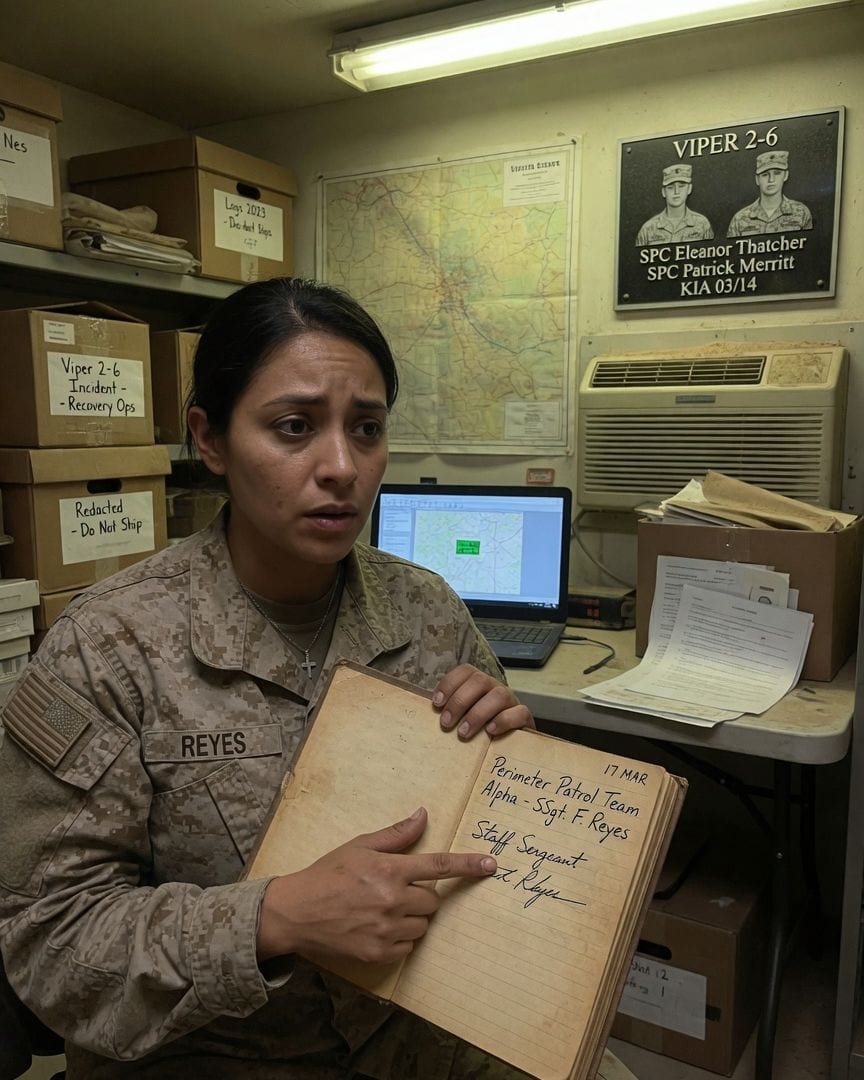
A Staff Sergeant, three weeks from transfer, finds her own signature in a logbook for a patrol she never made.
Staff Sergeant Fiona Reyes counted down her last three weeks at the high desert outpost, the fluorescent hum of the TOC a constant companion amidst the dust and old equipment. Her tired eyes scanned the digital map when an impossible icon, 'Viper 2-6' – a vehicle and crew lost last year – blinked alive, reporting its position and crawling steadily toward the base. Despite commanders dismissing it as a system ghost, Reyes meticulously searched dusty archives, finding strange log entries of phantom contacts and radio chatter, all dismissed as malfunctions. But the true chill came when she unearthed a field logbook from the recovery efforts, revealing her own undeniable signature on a perimeter patrol dated last year, a patrol she knew, with every fiber of her being, she had never made.
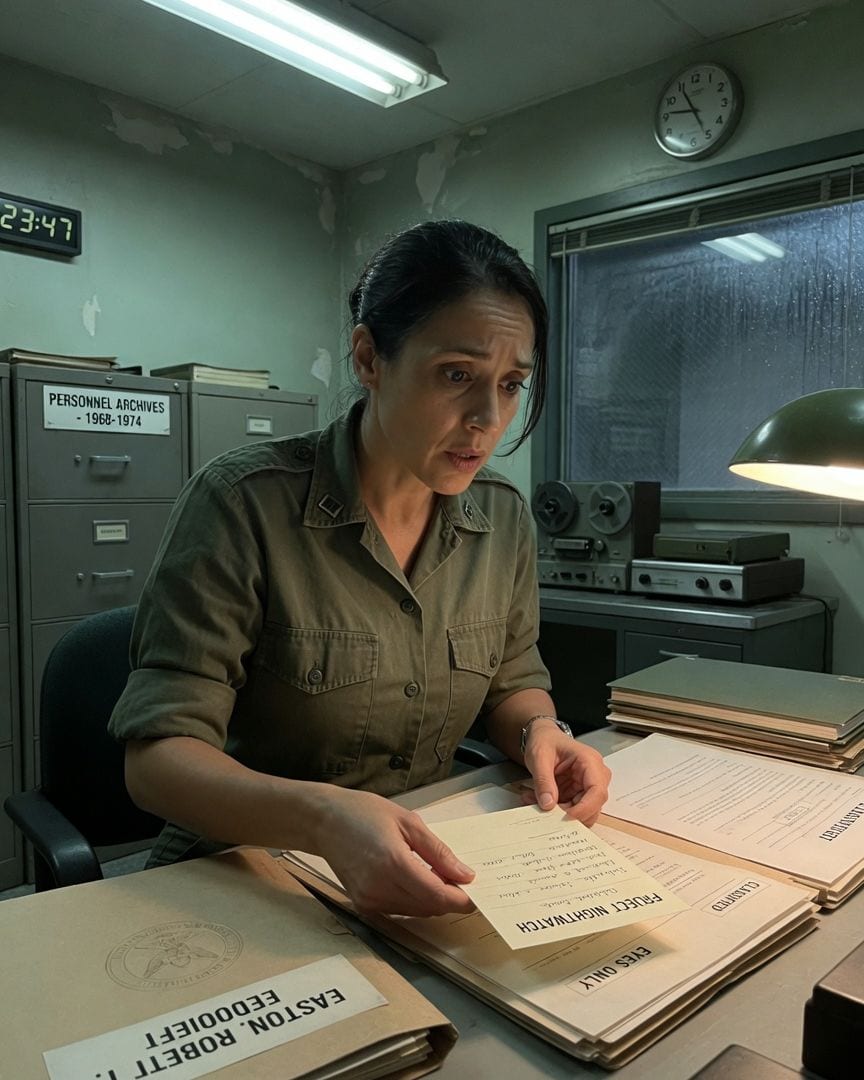
A Cold War tower controller logs an object vanish from radar, then hears the pilot scream it’s filling his windscreen. Her own name, 'Bardolph, Ines', now marked 'Observed' in a secret file.
Captain Ines Bardolph, a tower controller, was counting down the months until her transfer to Langley and the decommissioning of her base, hoping to leave behind the unsettling incidents of her final posting. But one night, her radar scope showed an impossible blip, solid and unwavering, 40 miles north of the Danube, only to vanish in less than a second, leaving a pilot screaming in terror. Despite the clear evidence, the official report blamed "atmospheric inversions," while the terrified pilot received a glowing review and promotion, his file meticulously scrubbed of any anomaly. As Captain Bardolph reviewed the pilot's pristine record, she found a hidden slip of paper, revealing a chilling truth: 'Subject: Bardolph, Ines. Status: Observed.' Was she merely an observer of the impossible, or was she now part of something far more sinister?
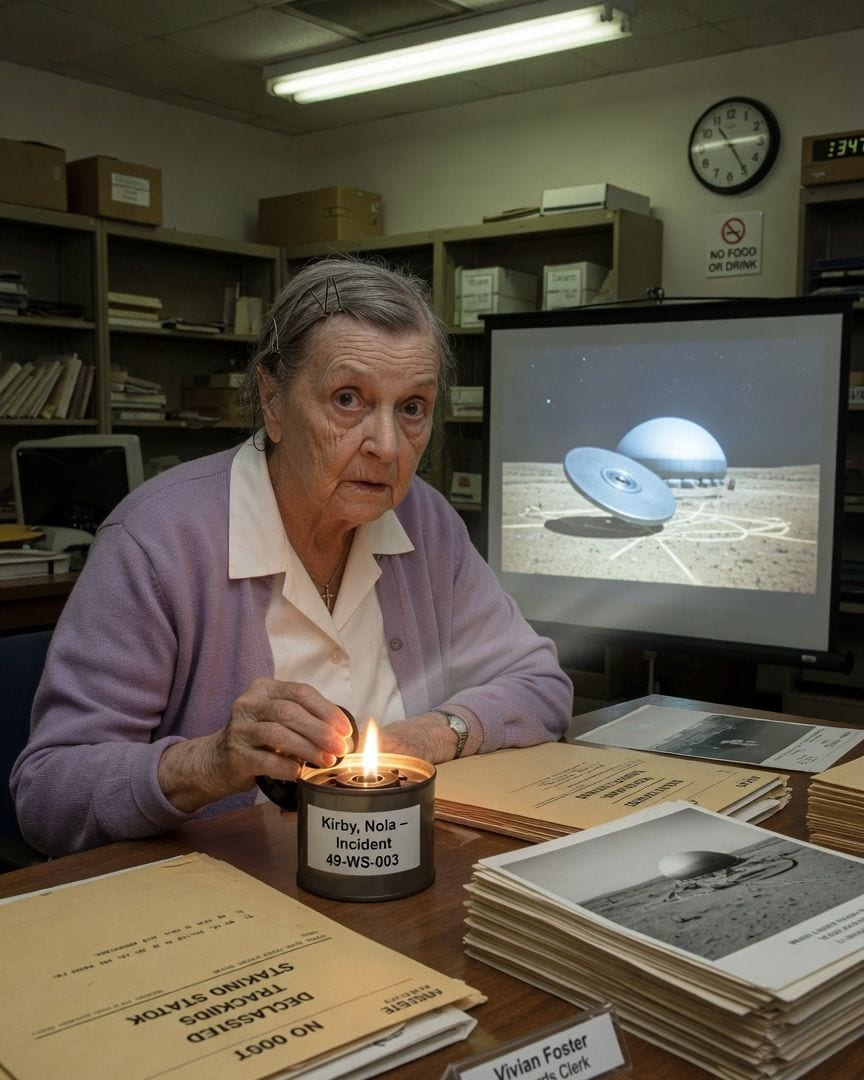
After years, retired Staff Sergeant Nola Kirby finally got her Cold War file, only to find her own signature on a 1998 maintenance log.
Retired civilian Nola Kirby spent decades fighting bureaucracy to declassify her 1949 White Sands file. Back then, Staff Sergeant Kirby tracked an impossibly fast silver disc that paused deliberately, seeming to observe her as much as she observed it. Fifty-one years later, viewing her original film, she saw glowing lines etched around her tracking station in the object's reflection – lines she never saw that night. But the file held a deeper chill: official documents with her name and signature, dated decades after her retirement, including a maintenance sign-off from just two years ago. How could her name appear on records from long after she left service?
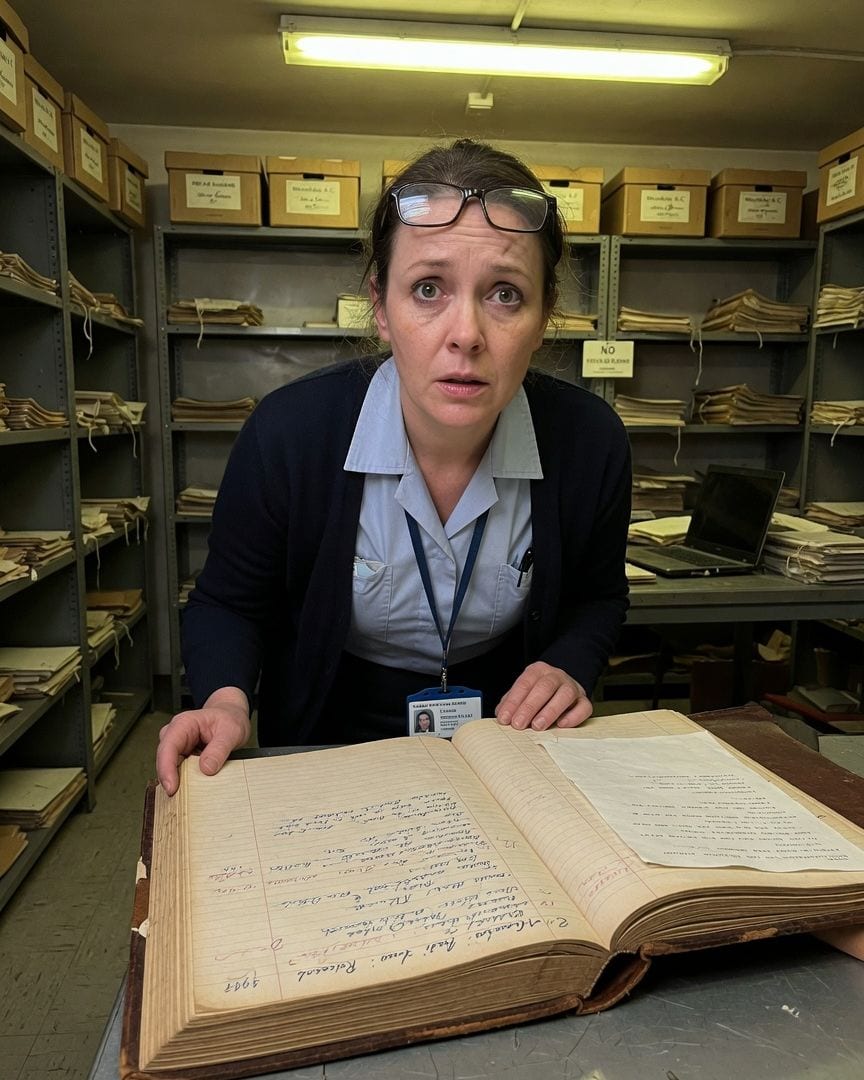
My ambulance trust's incident log shows callout 22-014 to 6 Cathcart Row at 2:40 AM. Every four years, the same call, same address. Always 'patient not found'.
My job involves tedious data entry for ambulance calls, but Incident 22-014 was different. It appeared every four years, always at 2:40 AM, always closed as 'patient not found.' Digging into the dusty physical archives, I found an entry from 1961 for the exact same incident, but its resolution read: 'Subject Secured. Relocated to "Holding".'
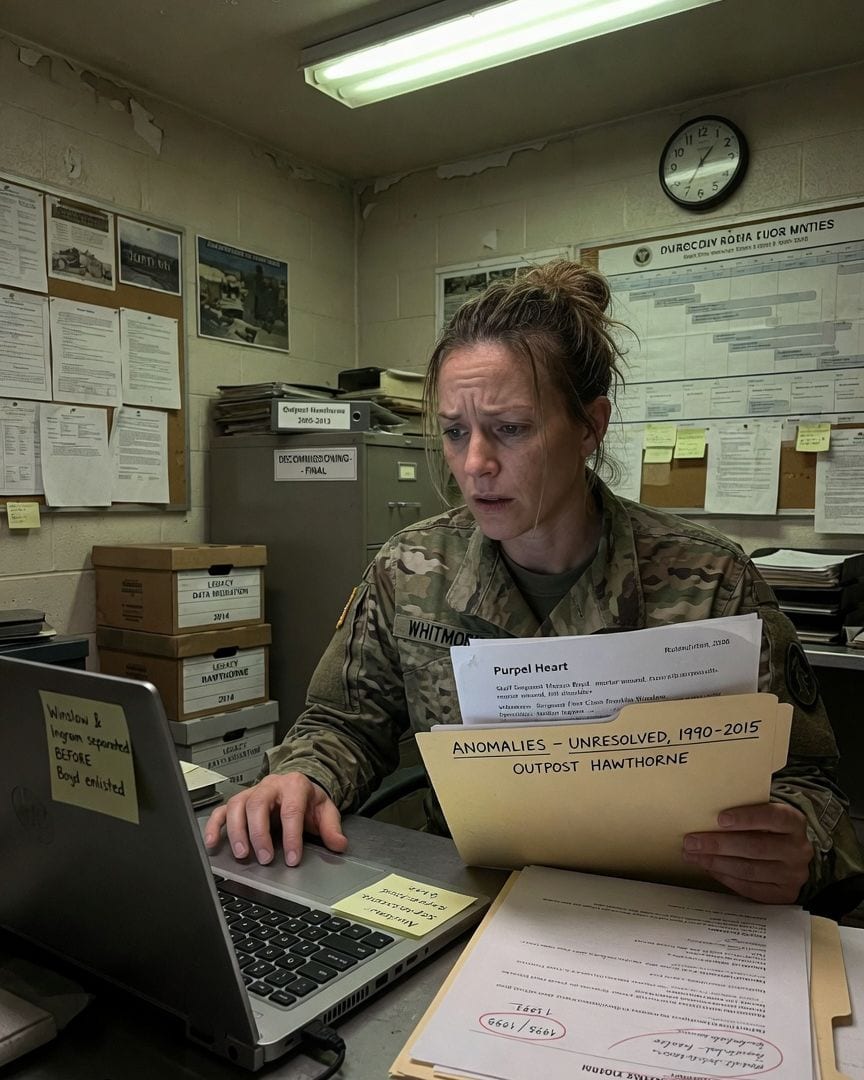
A military captain auditing a Cold War Fort Clay's final roster found a soldier's Purple Heart for a mortar wound. Its witnesses had left the Army years before it happened.
Captain Diane Whitmore, Adjutant for the soon-to-be-decommissioned Fort Clay, meticulously reviewed the final awards roster. Her office, usually bustling, was eerily quiet save for the fluorescent hum as she found an entry for Staff Sergeant Marcus Boyd: a Purple Heart for a mortar wound in 2012. But Boyd had returned unharmed, and the listed witnesses had separated from the Army years before he even enlisted. Colonel Sinclair dismissed it as data corruption, but Whitmore sensed a deeper anomaly, and ignoring a post historian's warning, she found another file from Outpost Hawthorne with the same impossible witnesses. What pattern was buried in Fort Clay's archives?