Master Sergeant Drummond's Bronze Star citation describes her saving a soldier in a firefight she never fought — a soldier already dead.
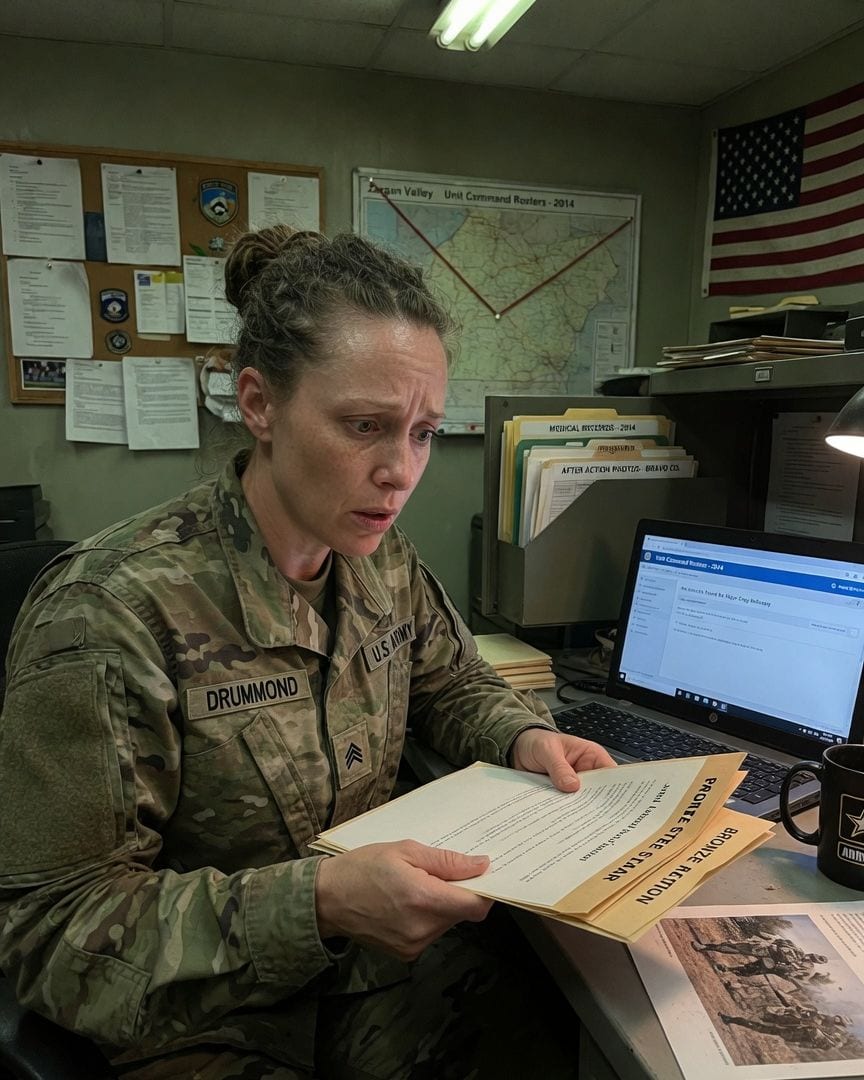
Master Sergeant Elin Drummond, 38, sat in her office, the promotion packet heavy in her hands. The commendation for the Bronze Star, specifically.
She had worked for this for years, a disciplined climb through the ranks, every accolade earned through sweat and meticulous service. But then her gaze snagged on the valor citation, crisp and official, tucked inside.
It described her actions during a harrowing firefight on a dusty patrol in the Zargan Valley, ten years ago, saving a Private Kenneth Patterson from certain death.
The narrative was detailed, vivid, written in the first person, in what was unmistakably her own distinctive voice. Phrases she often used, observations unique to her perspective, all flowed across the page as if she had dictated them moments ago.
She read the final line, a familiar cadence of resolve: '...and I would do it again without hesitation.'
A cold knot formed in Elin’s stomach. She had never been to the Zargan Valley. Not once in her career.
On that exact date, ten years prior, she’d been in the aid station at Camp Phoenix, her left ankle in a cast from a training accident. The memory was stark: the antiseptic smell, the boredom, the frustration of being sidelined.
The citation was signed by a 'Major Greg Holloway,' a commander she’d never served under, a name she didn't recognize in any of her rotations.
The paper felt cold, impossibly real, swearing to a moment that had never been hers, yet spoke with her own words, telling a lie so precise it was terrifying.
Elin, rational and disciplined by years of military service, first sought mundane explanations. A clerical error, a swapped file, a bad joke from a disgruntled colleague.
These were far more likely than the unsettling alternative her mind was already trying to conjure. She pulled her medical records from the archives, a simple process that typically yielded quick answers.
The digital files confirmed it: dated ten years prior, a broken left ankle, aid station admission, discharge papers signed by a medic she remembered, Staff Sergeant Ramirez. No Zargan Valley. No firefight.
The paperwork was unimpeachable, a stark, undeniable truth etched into the official history of her own body.
Next, she searched for 'Major Greg Holloway' in the unit's command rosters for that specific period. The database churned, then spat out nothing. She broadened the search, checked neighboring units, cross-referenced with general officer lists. Nothing.
The name simply didn't exist in that chain of command, as if the man who had signed her valor citation was a phantom, leaving only his signature behind. The official channels, built to provide answers, were only deepening the mystery.
They hummed with an unsettling silence.
Elin then looked up Private Kenneth Patterson. His service record, easily accessible through the military's robust database, confirmed his deployment to Zargan Valley, just as the citation stated. His enlistment date, his training, his deployments—all in order.
But as she scrolled further, her eyes froze on a single, impossible line: Private Patterson had been killed in action three weeks before the date of the valorous event described in her citation.
The official record, meticulously kept, now contradicted itself in a way that defied all logic, all physics. A man already dead could not be saved.
The air in her office grew heavy, pressing in on her, leaving her lungs feeling strangely hollow.
The discrepancies gnawed at her, a constant, abrasive whisper in the back of her mind.
Elin, driven by a growing unease that felt like a cold draft on her skin, delved into the unit's public archives for that period, specifically looking for any combat photography from the Zargan Valley deployment.
She searched for hours, the old digital files sluggishly loading, pixelated ghosts of a forgotten past.
Finally, buried deep in a folder marked 'After Action Photos - Bravo Company,' she found it: a grainy, desaturated photograph of a remote, dusty outpost under fire.
The image was chaotic, a blur of motion and smoke, capturing the stark terror of combat. In the mid-ground, a figure in a combat uniform, face obscured by shadow and dust, was pulling a wounded soldier to safety through rubble.
The wounded soldier was unmistakably Private Kenneth Patterson, his helmet askew, a grimace of pain visible even in the low resolution. And the figure pulling him?
The posture, the unique wear on the uniform’s left shoulder, the way the rifle sling rested over the right, the very set of the shoulders—it was all too familiar, a mirror image of her own reflection. It was Elin.
Her mind screamed the truth: she was in the aid station, her ankle broken, hundreds of miles away.
The photograph was a physical impossibility, yet it existed, a tangible record of a moment that could not have been.
Shaken, Elin sought out the photographer credited on the image, a retired combat correspondent now living a quiet life near Boise. She found him in an online veterans' forum and arranged a call.
He remembered the Zargan Valley firefight, the dust, the chaos, but not the specific soldier she pointed out in the blurred background. He confirmed the date and location, the details aligning perfectly with the citation.
Elin then located the unit's archived logbook from that deployment, housed in a secure, climate-controlled facility. It was a thick, leather-bound volume, meticulously maintained, smelling faintly of old paper and dust.
Flipping through the brittle, onion-skin pages, she found an entry for the valorous action, dated precisely ten years prior. It was signed 'Master Sergeant E. Drummond,' detailing the exact same impossible event, the same rescue of Private Patterson.
She compared the signature to her own on other official documents—her enlistment papers, her promotion requests, even her leave forms. It was a perfect, chilling match. No forgery, no clumsy imitation.
It was her hand, her unique flourish, her familiar way of connecting the 'E' and the 'D'.
Further back in the logbook, a faint, almost erased entry caught her eye: 'Maxwell Holloway, attached personnel,' listed for a three-week period a few months prior to the valor citation incident. No rank, no unit assigned. Just 'attached.'
It looked like a casual note, almost an afterthought. Elin cross-referenced 'Maxwell Holloway' in the military's personnel database for that specific unit and time frame. The name yielded no results. She widened the search to the entire military.
A few hits came up for a Maxwell Holloway in the Navy, but none matched the timeframe or the 'attached personnel' description.
It was a ghost in the machine, a perfectly accounted-for non-person who had left a trace but no official existence.
The old logbook lay open on her desk, the quiet hum of the building around her seeming to grow louder, more insistent.
Elin’s persistent digging into old records did not go unnoticed. Her commanding officer, Colonel Foster, called her into his spacious, orderly office later that week. The room, usually a bastion of controlled calm, felt subtly charged.
He sat behind his polished mahogany desk, his expression unreadable, his gaze fixed on her with an unnerving intensity. Ostensibly, the meeting was about her promotion packet, a routine check-in before the final approval.
But his questions veered quickly towards her 'recent interest in historical archives,' delivered with a casualness that felt anything but. The colonel tapped a pen idly on a stack of files.
'Master Sergeant Drummond,' he began, his voice smooth, 'we value initiative. But there's a fine line between due diligence and... getting lost in the past. We need our people focused on the future.'
He warned her, not unkindly, about 'creating distractions' and the importance of 'institutional trust.' The air in the room seemed to cool, the subtle hum of the HVAC unit feeling like a low, warning growl.
Later that night, Elin returned to her own office. The door, which she always locked with a firm click, was slightly ajar, casting a sliver of light across the darkened hallway. A shiver traced down her spine.
Nothing appeared stolen, but the precise arrangement of files on her desk, a small habit she maintained with near-obsessive care, was subtly off.
The corner of a stack of quarterly reports was no longer perfectly aligned with the edge of her blotter. A blue pen, which she always kept angled just so, had been moved, now lying parallel to the desk’s edge.
Her internal comms terminal, usually silent after hours, suddenly pinged, the sharp electronic chime echoing in the quiet room.
An anonymous message, sender unknown, appeared on the screen, stark white text on a black background: 'Some records are best left unopened, MSgt.' The dread solidified; she wasn’t just investigating a clerical mistake anymore.
Someone knew what she was finding, and they wanted her to stop.
The anonymous message hardened Elin's resolve rather than breaking it. The veiled threat, the subtle invasion of her space, only confirmed her growing suspicion: this wasn't an error, it was a secret.
The next morning, she returned to Colonel Foster's office, this time without an appointment. She placed the impossible photograph, the logbook entry with her signature, and the printout of the 'Maxwell Holloway' ghost entry on his polished desk.
The grainy photo of 'her' saving Patterson seemed to accuse him directly. She then showed him the anonymous message, still glowing faintly on her comms tablet.
Foster’s calm facade wavered for the first time. His jaw tightened almost imperceptibly.
He initially dismissed the message as a 'prank from a junior officer,' then suggested Elin might be experiencing 'stress' from the promotion process, a clinical coolness in his tone.
He tried to brush off the documents as a 'misfiling error' or 'historical ambiguity.'
Elin pushed back, her voice level, demanding an explanation for the systematic contradictions that were unraveling her own history. 'Colonel, this isn't ambiguous. This is my signature on an event I couldn't have participated in.
This is a soldier who died before I supposedly saved him. And this,' she pointed to the 'Maxwell Holloway' printout, 'this name keeps appearing in different logs, always 'attached personnel,' always untraceable, a ghost in the machine across different units.'
She laid out the pattern of 'Maxwell Holloway' appearing in other unit manifests she’d found in the deep archives, always as 'attached personnel,' always untraceable.
Foster finally sighed, the sound like air slowly leaking from a very old tire. He leaned back in his chair, his gaze distant, fixed on a point somewhere behind Elin's head.
The framed commendations on the wall behind him seemed to shimmer. 'Master Sergeant,' he began, his voice low, measured, 'there are… anomalies. Things the system has to account for. Things that exist outside our understanding, but within our operational parameters.
Sometimes, the easiest way to do that is to give them a face, a name, a history that fits. To integrate them.'
He explained that these 'anomalies' were not hostile, but their existence necessitated a careful, systemic response to maintain the integrity of military records. He spoke of 'preserving institutional memory' and 'avoiding panic.'
He warned her, gravely, that pursuing this further would not only jeopardize her career but could expose her to truths she wasn't prepared for.
He implied the military had a long-standing protocol, a silent agreement with these 'presences,' and that she was stepping on sacred ground, disturbing a delicate, decades-old balance.
Foster’s partial admission only fueled Elin’s investigation. He wasn't telling her everything, not by a long shot. The word 'integrate' hung in the air, a chilling concept.
She bypassed official channels, using her network of contacts from various postings to access deeper, less-indexed archives—the ones tucked away in obscure servers, in dusty microfiche cabinets nobody bothered with anymore.
Days blurred into nights spent poring over digital files and microfiche readers that hummed with a low, constant drone. Her eyes burned from the glare, her fingers ached from navigating ancient interfaces.
Finally, in a section marked 'Historical Operational Variables – Unassigned,' she found it: an unindexed, obscure internal memo from 1974, yellowed and brittle even in its digitized form, titled 'Preliminary Guidelines for Anomalous Personnel Manifestation Integration.'
It was a short, terse document, outlining rudimentary procedures for identifying and 'integrating' phantom presences into standard accountability procedures. The language was cold, clinical, outlining a bureaucratic process for something utterly supernatural.
It listed a series of unit IDs where these 'manifestations' had been observed and successfully 'integrated' over the years. Elin's eyes widened as she recognized one of the unit IDs listed: 302nd Support Battalion. Her current unit.
And beneath it, a handwritten note in the margin, scrawled in faded ink that looked like it belonged to a different era: 'Subject: Maxwell Holloway, attached personnel, 1974.' The name, the ghost from the old logbook, wasn't just a one-off.
It was a recurring signature of the anomaly, and it had been in her unit before. The phenomenon was not just historical; it was here, now, a silent, perfectly accounted-for shadow woven into the fabric of her own command.
Elin held the brittle, yellowed memo, her finger tracing the handwritten 'Maxwell Holloway, attached personnel, 1974' beside her unit's ID. The name, a ghost from the logbook, now a recurring entry in a classified document.
The system isn't just correcting past errors; it's actively managing a persistent, decades-long presence within its own ranks, and it's been here, in her unit, before.
Elin pushed deeper into the 'Unassigned' archives, following a breadcrumb trail of cross-references from the 1974 memo. The rabbit hole led her through decades of classified documents, each one a dry, bureaucratic acknowledgment of the impossible.
She finally located the main directive: 'Project ECHO: Anomalous Personnel Manifestation Integration Protocol, Classified – Eyes Only.' The document, spanning hundreds of pages and updated across decades, detailed the full history of APMs.
It described their ability to perfectly mimic individuals, including their memories, unique mannerisms, and even their 'voice' for written reports, creating a perfect simulacrum that was indistinguishable from the original.
It explained their tendency to appear in isolated, high-accountability environments—outposts, signals stations, remote units—places where an extra, perfectly accounted-for soldier wouldn't immediately raise alarm.
The APMs were not hostile, the document stated, but their origin was unknown, their purpose unfathomable, and their persistence required the military to 'account for their presence' to maintain the integrity of its own records and command structure.
The valor citation in Elin's file, it became clear, was a 'containment measure,' a systemic way to explain away an APM that had mimicked her during her aid station stay, weaving its actions seamlessly into her official narrative.
The directive mentioned a specific 'signature' of APMs: a tendency to attach themselves to a real service member's identity, especially those with strong records or unique experiences, and then subtly 'insert' themselves into that person's history.
And there it was, in a dedicated section on recurring manifestations: 'Maxwell Holloway – a persistent, low-level APM signature, observed across multiple rotations since 1952, often indicating a new localized manifestation.'
Every clue clicked into place, forming a horrifyingly coherent pattern of systematic, decades-long deception. The world, the military, her own history, was not what it seemed.
Elin returned to Colonel Foster's office, the Project ECHO directive clutched in her hand, its pages rustling like dry leaves. She laid it on his desk, open to the section detailing 'Maxwell Holloway.' Foster didn't flinch.
He simply looked at the document, then back at Elin, his expression calm, almost weary, as if she had finally caught him in a truth he’d carried for a very long time.
'Master Sergeant,' he said, his voice flat, 'you've found it. The truth. We've tried everything for decades—containment, study, elimination. They are an unsolvable constant. A variable the system must account for, or it breaks.'
He explained that the military had chosen to integrate them, to make them part of the record, rather than allow unaccounted anomalies to unravel the entire structure of accountability, to prevent the entire institution from collapsing under the weight of an unexplainable truth.
'Imagine,' he said, a faint, humorless smile touching his lips, 'the chaos if every soldier knew. If every record became suspect.' He offered Elin a choice, his voice devoid of malice, as if delivering a routine order.
She could accept this reality, become part of the 'monitoring and integration' team, and her promotion would go through with a specially modified service record, forever bound to the secret. She would become a keeper of the lie.
Or, she would be quietly discharged for 'psychological instability,' her records scrubbed clean of all this, and she would never again work in a position of trust within any government agency.
'The system,' Foster emphasized, his gaze unwavering, 'cannot tolerate unaccounted variables, especially not a soldier who knows too much and won't be integrated.'
Elin looked at the pristine, decades-old document, at the proof that the military had known for generations, then at Foster's unblinking eyes, seeing not a villain, but a man resigned to an impossible truth. She chose to walk away.
Elin’s discharge from the US Army was processed with unusual speed. Her promotion packet was withdrawn, and her service record was meticulously scrubbed.
The valor citation, the impossible entries, even her final weeks of duty were simply marked 'administrative leave' or 'psychological evaluation concluded.' No one questioned it.
She left the base a civilian, the weight of Project ECHO heavy on her, an invisible burden. The world moved on, oblivious to the silent, perfectly accounted-for shadows woven into the fabric of its most rigid institutions.
She tried to rebuild her life, found a mundane job, moved to a quiet town on the coast, but the knowledge gnawed at her, a constant, chilling reminder of the official, undeniable lie that underpinned reality.
Years passed. Elin lived a quiet life, avoiding any institution with rigid records, always feeling the phantom presence of an existence that was not hers, yet was undeniably 'her,' a shadow self walking through history.
One overcast afternoon, a chill wind off the Pacific rattling the windowpanes of her small cottage, she was flipping through an old military history magazine, a special edition on forgotten outposts of the Cold War.
There, on a faded page, amidst a spread of grainy black-and-white photographs of desolate, windswept landscapes, was a remote signals station from 1983.
In the background, a lone figure stood guard, face partially obscured by the shadow of a helmet and the angle of the shot, but the posture, the way the M16 was held, the specific wear on the uniform’s left elbow patch—it was unmistakably her.
But she had never been deployed there. The caption beneath the photo read: 'Sentry on duty, Outpost 7, 1983.'
If this one got to you
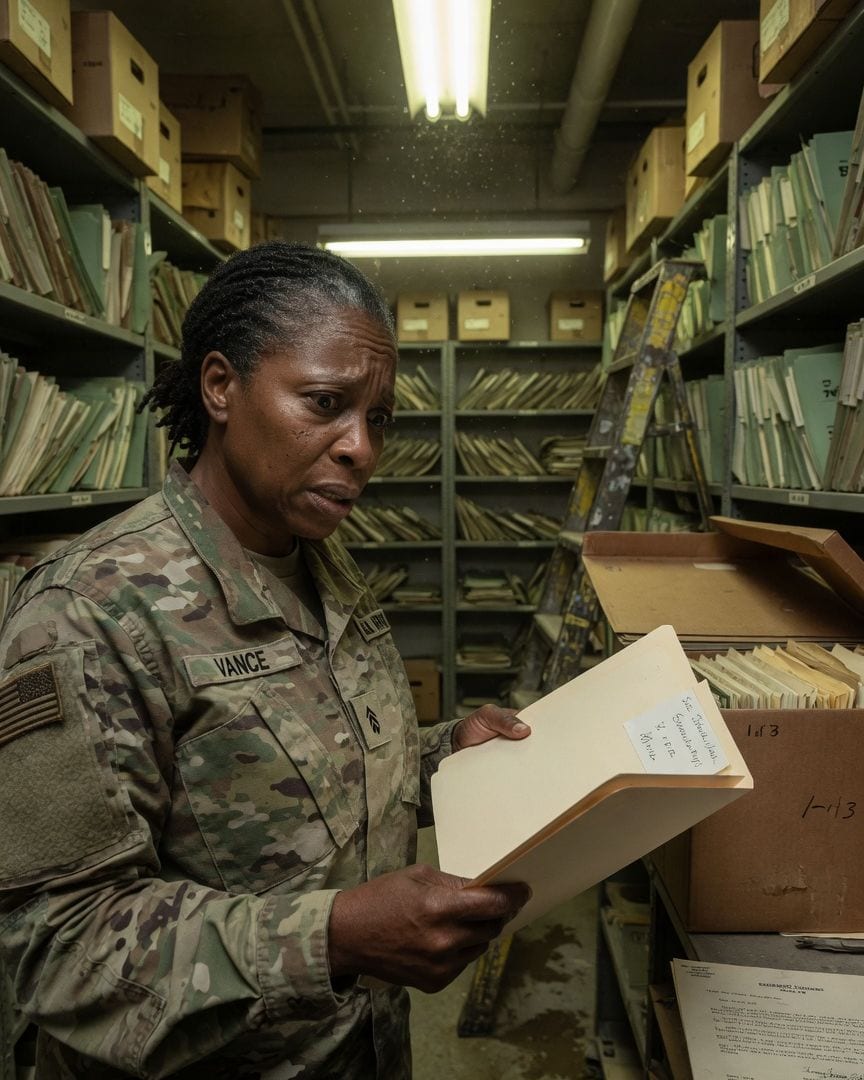
Master Sergeant Iris Vance, 18 months from retirement, found a Bronze Star in her file for a rescue she never performed — on a day she broke her ankle. The citation quoted her own exact thoughts.
Master Sergeant Iris Vance, 18 months from a meticulously planned retirement, sat at her desk in the quiet administrative building of Camp Sterling. The air hummed with a familiar, yet subtly unsettling, tremor. Reviewing her promotion packet, she discovered a Bronze Star for valor, dated fifteen years prior. The citation described a harrowing solo rescue mission she never performed; that day, she’d broken her ankle in a training exercise. Even more chilling, the narrative contained her own internal monologue, word for word. Could her ironclad record be so impossibly wrong?
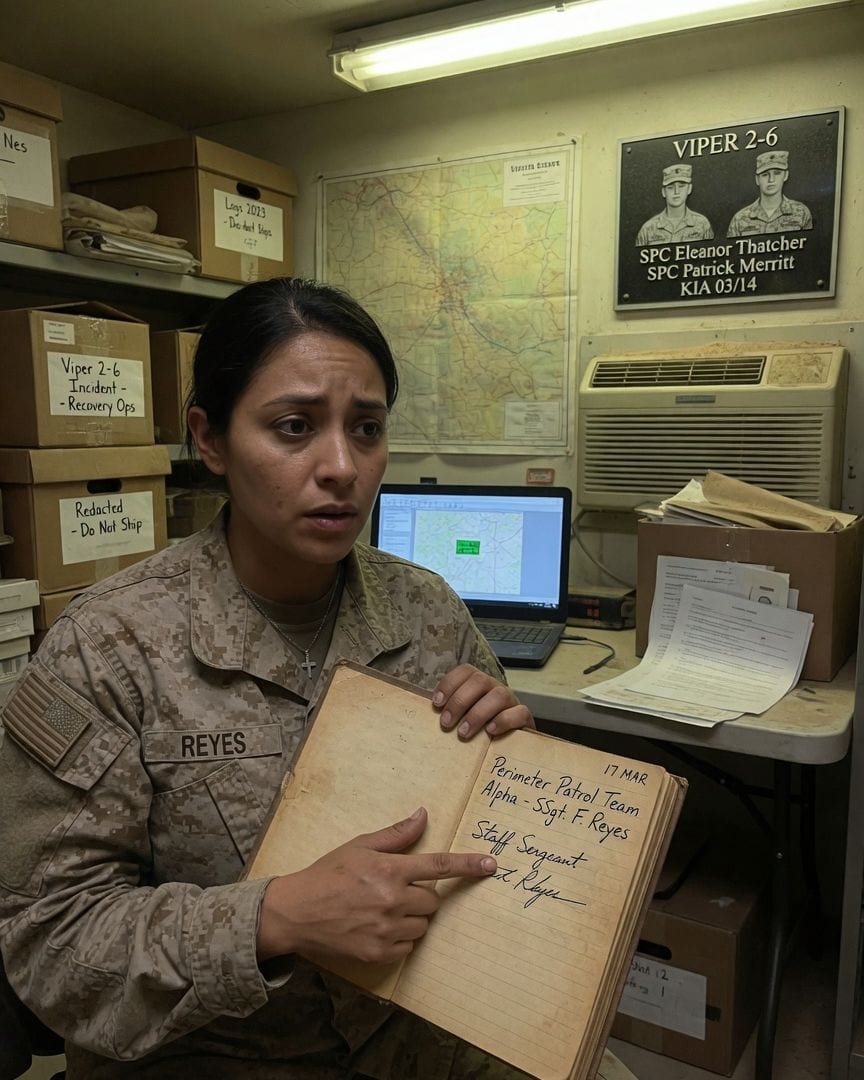
A Staff Sergeant, three weeks from transfer, finds her own signature in a logbook for a patrol she never made.
Staff Sergeant Fiona Reyes counted down her last three weeks at the high desert outpost, the fluorescent hum of the TOC a constant companion amidst the dust and old equipment. Her tired eyes scanned the digital map when an impossible icon, 'Viper 2-6' – a vehicle and crew lost last year – blinked alive, reporting its position and crawling steadily toward the base. Despite commanders dismissing it as a system ghost, Reyes meticulously searched dusty archives, finding strange log entries of phantom contacts and radio chatter, all dismissed as malfunctions. But the true chill came when she unearthed a field logbook from the recovery efforts, revealing her own undeniable signature on a perimeter patrol dated last year, a patrol she knew, with every fiber of her being, she had never made.
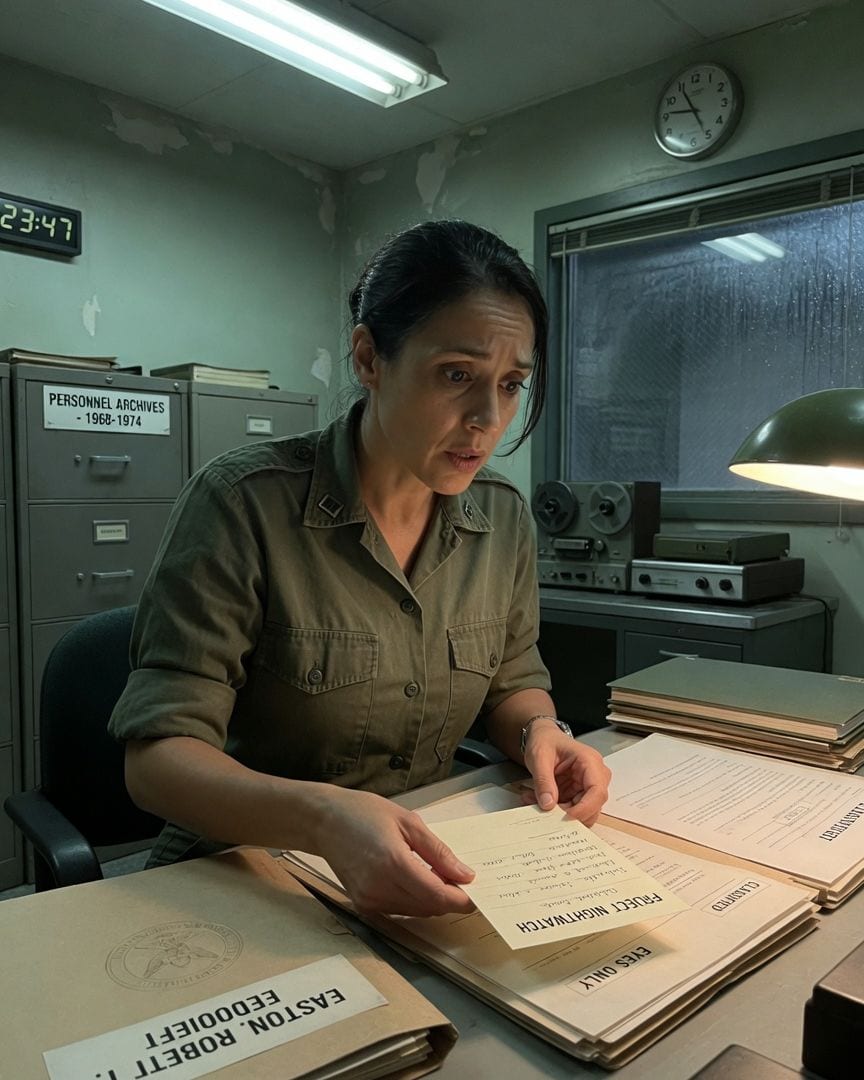
A Cold War tower controller logs an object vanish from radar, then hears the pilot scream it’s filling his windscreen. Her own name, 'Bardolph, Ines', now marked 'Observed' in a secret file.
Captain Ines Bardolph, a tower controller, was counting down the months until her transfer to Langley and the decommissioning of her base, hoping to leave behind the unsettling incidents of her final posting. But one night, her radar scope showed an impossible blip, solid and unwavering, 40 miles north of the Danube, only to vanish in less than a second, leaving a pilot screaming in terror. Despite the clear evidence, the official report blamed "atmospheric inversions," while the terrified pilot received a glowing review and promotion, his file meticulously scrubbed of any anomaly. As Captain Bardolph reviewed the pilot's pristine record, she found a hidden slip of paper, revealing a chilling truth: 'Subject: Bardolph, Ines. Status: Observed.' Was she merely an observer of the impossible, or was she now part of something far more sinister?
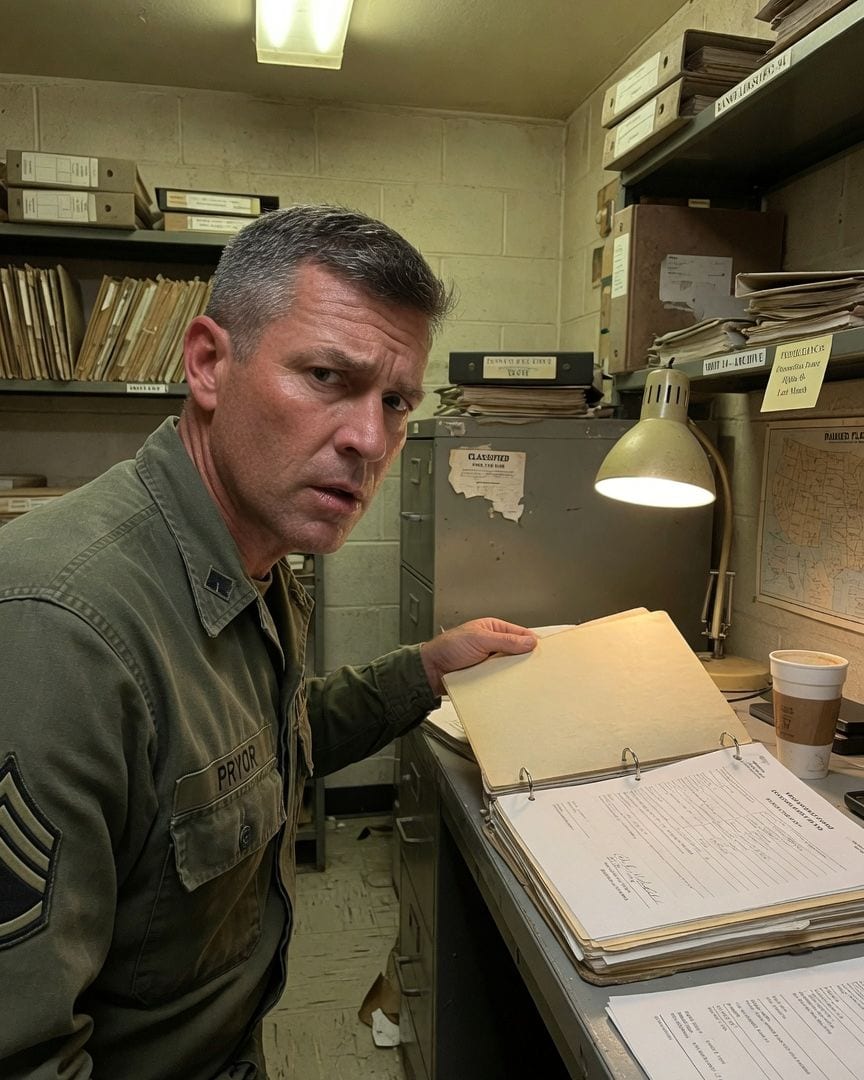
A sergeant with eleven days left finds a warm, glassed crater. Its file shows a captain lost thirty years ago is still signing reports from last week.
Sergeant Alden Pryor was counting down his final eleven days on a twenty-year hitch, expecting to spend them on routine patrols along the Ranier Flats fence line. Instead, his truck stopped at a bizarre sight: a four-hundred-foot glassed crater, miles from anywhere, its sand faintly warm at dawn despite no one recalling a blast. The air above it shimmered with an unnatural distortion, a silent scar of erased violence, and the official file for 'Shot 14' showed recent maintenance sign-offs for a decommissioned tower at the crater site. All these active documents were signed by Captain Everett Caldwell, who had been officially lost in operations thirty years ago, leaving Sergeant Pryor to wonder how a dead man could still be filing reports.
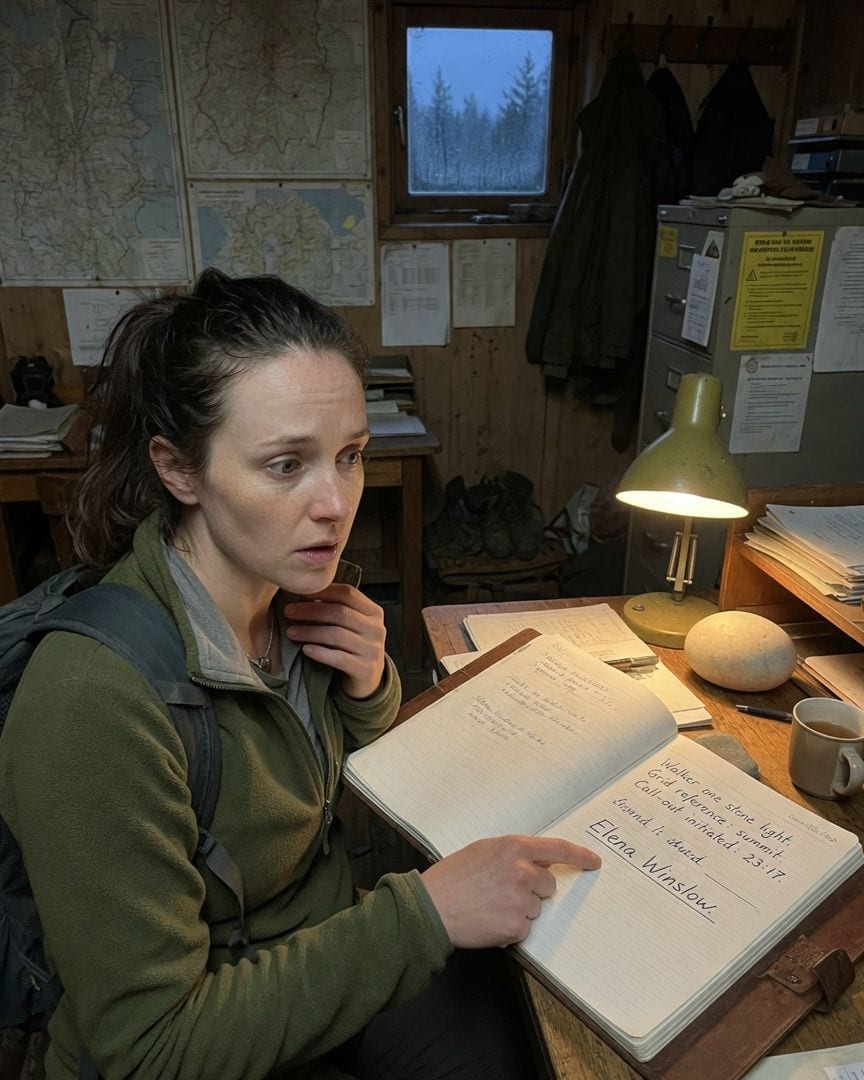
My pocketed mountain stone meant a rescue logbook recorded a call-out that night for me — a shout that never went out.
After an exhilarating climb on Cadair, I took a small, smooth white stone from the summit cairn, despite a warden's warning. Back at the station, a logbook entry shocked me: my name, dated last night, for a rescue call with an impossible detail: 'Walker one stone light'.
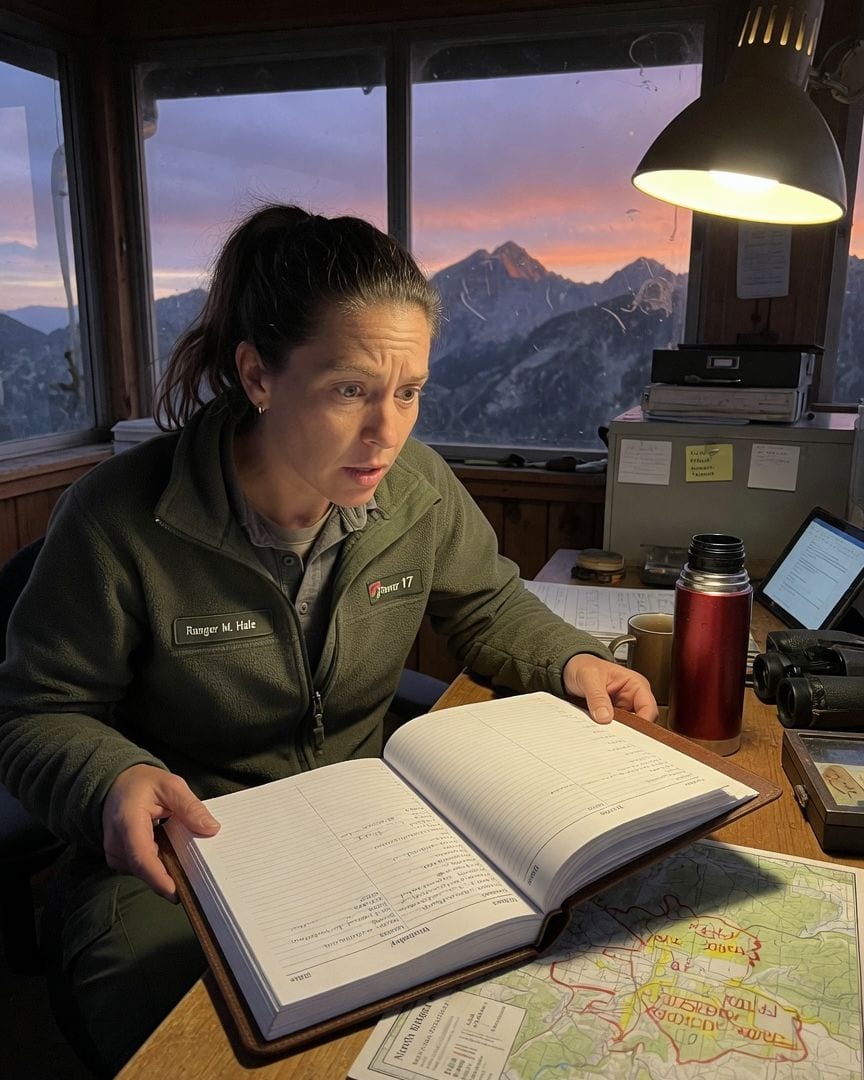
My fire lookout tower's summit register holds a blank space where the hiker's name should be. The trail he climbed has been closed since June.
As a ranger at Tower 17, I watched a hiker climb the North Ridge Trail, officially closed for months. Later, I opened the summit register where I'd just seen him sign, only to find the page unnervingly blank, as if no one had ever touched it.