My name was already on the visitor log, signed at 9:04 AM. There were three more entries, all my perfect handwriting, on days I was never there.
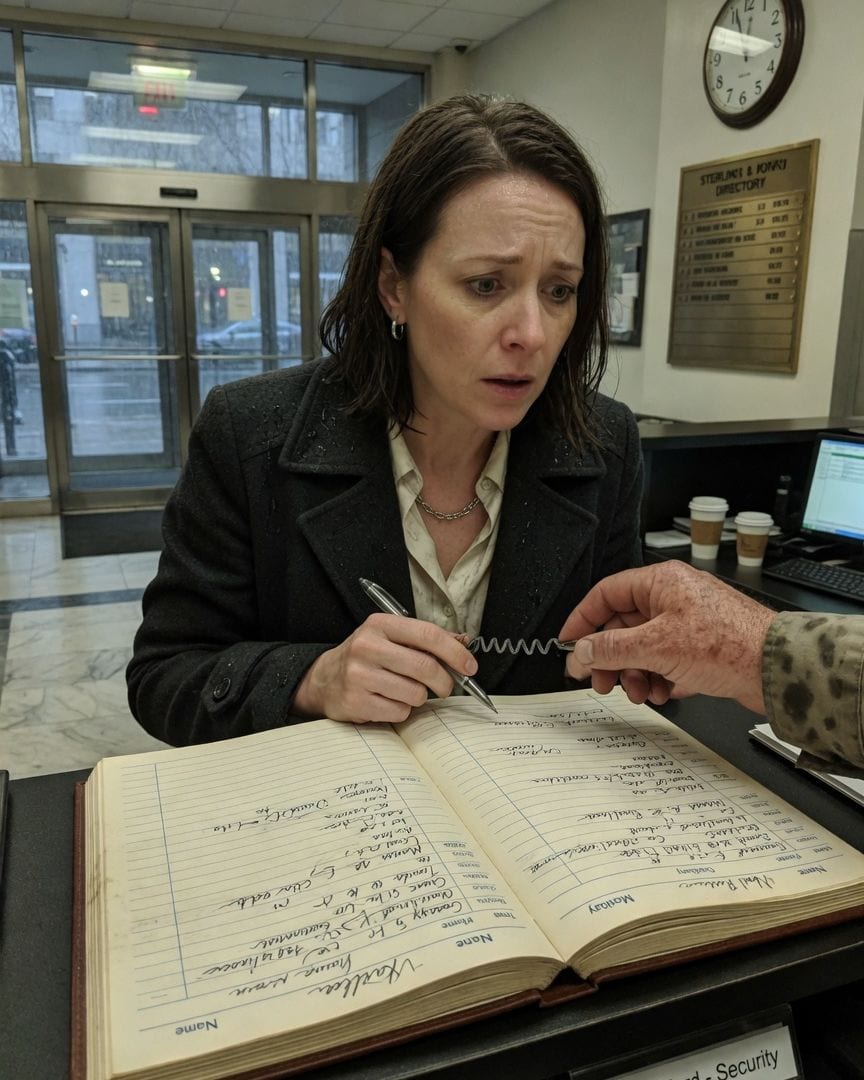
The automated glass doors of Sterling & Finch Law hummed open, letting in a blast of downtown chill. I stepped inside, shaking the last of the rain from my umbrella, and made my way to the security desk.
My meeting for the marketing pitch was at 11 AM sharp, and I liked to be early.
"Nancy Walsh," I told the guard, Gerald Ford, a man whose uniform looked two sizes too big, with a name tag that seemed to cling for dear life. "I'm here for a meeting with Ms. Henderson on the tenth floor."
He nodded, pushing the heavy, leather-bound register across the counter. "Sign in, please. Column for name, company, and destination."
I took the pen, a cheap ballpoint tethered by a curly cord, and began to write my name on the next available line. That’s when Gerald’s hand, surprisingly quick, stopped mine.
His brow was furrowed, a network of deep lines etched above his eyes.
"Hold on, ma'am," he said, his voice gravelly. He pointed to a line three spaces above where my pen hovered. "You're already in."
I blinked. My eyes traced his finger. There, on line 17, was my name: Nancy Walsh. Next to it, 'Marketing Consultant,' 'Sterling & Finch, 14th floor.' And the timestamp: '9:04 AM.'
"No, I'm not," I said, a strange, hollow feeling starting in my stomach. "I just got here. It's barely eleven. And my meeting is on the tenth, not the fourteenth."
Gerald grunted, clearly used to people trying to slip past. "Says here you were badged to the fourteenth, ma'am." He leaned closer, peering at the signature. "That's your handwriting, ain't it?"
I leaned in too, and my breath hitched. The signature was a perfect match. The distinct slant of the 'N,' the familiar loop of the 'W,' the little flourish at the end of the 'h.' It was mine, exactly.
But it wasn't. I had been at my desk, drafting the final slides for this very presentation, since seven-thirty.
"That's impossible," I whispered.
He pulled the week’s sheets from beneath the counter, fanning them out like a deck of cards. "Happens sometimes, people sign in, forget, sign again." He flipped to Tuesday. "Here you are again. Tenth floor, 8:45 AM.
For a firm called 'Evergreen Holdings.'" He flipped to Monday. "And again. Third floor, 10:12 AM. 'Whitaker & Sons'."
My gaze darted across the entries. Four signatures, all mine, across three different days, for firms I had no reason to visit, on floors I’d never been to.
The ink, the familiar loops, the distinct slant of my 'N' and the final flourish of my 'h'—it was unmistakably my own hand, staring back from impossible dates.
Rattled, I still tried to rationalize it. A sophisticated prank? Identity theft, somehow using my actual signature? I managed to get through my meeting, though my focus was shot.
As soon as I was back in my car, I called the firms listed on the register. Evergreen Holdings, Whitaker & Sons, and a couple of others.
Most receptionists, after a polite pause, told me they had no record of a 'Nancy Walsh' visiting. Two, however, sounded different. They spoke of 'routine verification' or 'archival access' that "might not be logged in their public-facing systems."
Their evasiveness, rather than reassuring, sharpened my unease into a cold, prickly certainty that something was very wrong.
Determined to prove forgery, to expose the glitch in the matrix, I contacted Eileen Granger, a forensic handwriting expert recommended by a friend who’d once needed a will authenticated.
Eileen was a no-nonsense woman in her early sixties, with a neat gray bob and eyes that missed nothing.
I mailed her high-resolution scans of the register entries and, at her instruction, provided pages of my own true signatures, written under various conditions, to give her a comprehensive sample.
"I need you to tell me this is fake," I remember telling her, my voice tight. "I know it is. I was nowhere near that building on those dates. I have my own calendar, my work logs. It's impossible."
Eileen just nodded, her expression one of intrigued skepticism. "The hand doesn't lie, Nancy," she’d said, without malice, without judgment. "But we'll see what the evidence says."
I clung to the hope that Eileen, with her expert eye, would expose the fraud, give me a rational explanation. I just needed her to prove I wasn't losing my mind.
Two days later, Eileen Granger called. Her voice was strained, almost hushed, like she was delivering very bad news from a very quiet room. "Nancy," she started, "I don't have good news." My stomach dropped.
She explained that under forensic magnification, every nuance, every subtle pressure point, every unique characteristic of my handwriting was present in the register entries.
The precise angle of the ascenders, the minuscule tremor at the baseline of the 'y' – all of it matched. "It's not a forgery, Nancy," she said, the words heavy and final. "It's 100% your hand."
Then, almost as an afterthought, she mentioned a faint, almost invisible watermark on the paper of the old entries, a symbol she couldn't quite place, but one that seemed to deepen into the paper itself, as if woven into its very fiber, not printed on top.
The confirmation from Eileen left me deeply rattled. '100% your hand.' I couldn't explain it, but the chilling certainty that it was true, despite all logic, settled in my bones.
I stared at the high-res images of the signatures Eileen sent me, scrutinizing the faint, almost indiscernible watermark she’d mentioned. It looked like a stylized, interlocking set of initials, maybe 'CRD' or 'COR.'
Online searches for 'CRD watermark' or 'COR watermark' yielded nothing remotely similar.
Obsessed, I started digging into the firms listed in the register: Sterling & Finch, Evergreen Holdings, Whitaker & Sons. I cross-referenced their names with local government directories, legal databases. It was a tedious process, but a pattern started to emerge.
All of them, at some point, had handled cases related to property disputes, land deeds, or legal settlements for specific, often very old, parcels of land in our county.
And those parcels often clustered in the older parts of town, some even surprisingly close to my own family’s ancestral property, a small tract of land on the edge of the wetlands that had been in the Walshes for generations.
The common thread eventually led me to an obscure municipal building I’d never heard of: the 'County Registry of Deeds and Affidavits.'
It was a dusty, imposing brick structure downtown, tucked away behind the modern courthouse, looking like something forgotten by time. Its windows were dark, its stone steps worn smooth.
Inside, the air was thick with the smell of old paper and dust. I found more registers, older and heavier than the one at Sterling & Finch, filled with meticulous, faded script.
And there, amongst the endless pages of land transfers and legal filings, I started finding references to the firms I supposedly 'visited.' I began to cross-reference the dates of my phantom signatures with historical news archives.
A cold dread solidified as I noticed a pattern: my impossible signatures often coincided with critical junctures in old legal proceedings or property boundary disputes.
It was as if my presence, my signature, had been required to smooth over a rough patch in the historical record.
As I spent more time at the County Registry, hunched over ancient ledgers under the dim, buzzing fluorescent lights, I noticed the same calm, elderly archivist, Warren Larsen, always in the same section, a few rows of shelves away.
He moved with a quiet, deliberate grace, meticulously re-shelving thick binders or consulting yellowed maps. He seemed utterly absorbed in his own work, yet I’d catch his gaze drifting to me, a faint, unreadable expression on his face.
He never directly asked what I was looking for, never intruded on my research. But sometimes, when I stood up to stretch, he’d offer unprompted, subtly guiding comments.
"Ah, yes," he’d muse, as if to himself, "the Reynolds family land dispute. A rather knotty affair, historically speaking. Took quite some doing to clarify the lines, even with all the historical precedents." Or, "The old methods, you know.
The way things have always been done in this town. Some processes take on a life of their own." His voice was soft but resonant, the words perfectly polite, yet they felt pointed, almost like warnings.
He was watching me, I knew it, and he knew what I was looking for.
One afternoon, after another fruitless day of sifting through faded records that just hinted at the impossible without confirming it, I returned to my car, parked three blocks away in a mostly empty lot.
Tucked under the windshield wiper, a neatly folded note awaited me.
The paper was thick, cream-colored, with a faint, almost imperceptible watermark in the corner – the same stylized, interlocking initials Eileen had seen, the ones I couldn’t place, only now I recognized them from the old Registry books themselves.
My stomach clenched. In elegant, precise script, devoid of any personal flourish, it read: 'Some things are better left undisturbed. The records are complete.' There was no signature.
The next day, I found Warren Larsen in his usual spot, meticulously polishing the spine of a massive, leather-bound volume. My hand trembled slightly as I held out the anonymous note. "Did you leave this on my car?"
I asked, my voice sharper than I intended.
He took the note from me, his movements slow and deliberate, as if handling something immensely fragile. He read it, his gaze lingering on the elegant script, then placed it flat on his desk, smoothing it with his palm.
He looked at me, his calm composure unnerving. He didn't deny the note. He didn't deny my impossible signatures, the ones I’d started finding in the old Registry books, on dates I couldn't possibly have been there.
He didn’t show an ounce of surprise.
"The records are indeed complete, Nancy," he said, his voice soft, even. The fluorescent hum seemed to dim around us, the dusty silence of the archives pressing in. "And they are very old.
For centuries, this town has prided itself on the continuity and unassailability of its legal documentation. Particularly for property ownership and legal lineage."
He gestured vaguely at the towering shelves. "There were... historical gaps, you understand. Moments where documents were lost, or incomplete, or the original hand simply wasn't legible enough to satisfy the requirements of clarity and unbroken chain.
For generations, these gaps were, shall we say, 'remedied' by a rather unique system."
My mouth was dry. "What system?"
Warren leaned back slightly, his gaze drifting over the shelves. "A system where specific family lines, known for their distinct and remarkably consistent handwriting patterns, were chosen to 'validate' or 'complete' these records.
Your family, the Walshes, Nancy, were one such line."
He rose, moving with an unnerving grace for his age, and reached for a faded, leather-bound ledger on a high shelf, older and thicker than any I’d yet seen.
He retrieved it, laid it gently on the table, and opened it to a specific page. There, meticulously hand-written in ornate, precise script, was my family crest, faded but unmistakable: a single oak tree with deeply rooted branches.
And beneath it, a list of names, including mine – Nancy Walsh – linked to specific 'designations' within the Registry.
"These 'designations'," Warren explained, tracing a finger down the page, "are not about you personally, Nancy. They are about your unique 'signature pattern'—a familial trait that has persisted, remarkably, through your lineage.
A particular geometry of the hand, if you will." He paused, looking up at me. "This, you see, is why your phantom 'visits' align with 'routine verifications' or 'archival access' for specific firms and properties.
It’s all about maintaining the unbroken chain of records, the seamless illusion of continuity. Always has been."
The dread of it settled deep in my bones, cold and heavy. My very identity, reduced to a 'signature pattern,' a bureaucratic tool.
Warren continued, his voice softer still, almost a whisper in the silent archive. "The 'designations' are not about you, Nancy, not your individual choices or your life.
They are about the inherent, unique pattern of your hand, passed down through your lineage. Think of it as a specific genetic marker, but for handwriting. A 'key' to unlock certain historical voids."
Just as I began to process this horrifying revelation, that my very identity was a tool in some ancient, bureaucratic mechanism, he moved to a deeply recessed, locked drawer in his desk.
The wood groaned softly as he pulled it open. He retrieved an even older document, parchment-thin and brittle with age, the edges frayed. He handled it with extreme care, laying it gently on the table between us.
It was a land deed from the late 1800s, with ornate, looping script characteristic of the era, the ink a faded brown. And there, on the witness line, amidst the swirling, period-appropriate script, was a signature.
It was unmistakably Nancy’s unique, familiar hand, the same loops and flourishes Eileen Granger had analyzed, perfectly crisp against the aged parchment. But it's dated 1897.
The full, horrifying truth detonated in my mind, a chilling clarity that snapped every impossible detail into place. Warren Larsen, with that unnerving calm, explained it all.
Specific bloodlines, he said, including mine, possessed a 'signature pattern' so distinct and consistent that it could bridge temporal gaps in official records. It wasn’t me, Nancy Walsh, the marketing professional, specifically.
It was the indelible imprint of my hand’s unique geometry.
For generations, the Registry had subtly 'encouraged' these families—through land grants, favorable legal treatment, social standing—to maintain their unique script. Then, they used their 'pattern' to retroactively complete or validate crucial documents. Land deeds, wills, municipal resolutions.
Anything that required absolute, undeniable certainty in the legal chain. It ensured the unbroken continuity of property ownership and legal lineage in the town. My recent signatures at the downtown law office? Just the latest instance of this ongoing 'validation.'
A bureaucratic ritual that had kept the town’s legal history perfectly coherent, perfectly unassailable, even if it meant borrowing a hand from the future.
My family, the Walshes, were always inside it, unknowing participants, their hands unknowingly shaping the town’s past, creating a seamless, false history. The horror wasn't a monster; it was a ledger.
I was horrified, a cold fury rising within me, but it was a fury without an object. How do you rage against a system that exists outside of time?
My identity, my very hand, had been a tool for generations, a phantom limb of municipal law. I demanded to know who started this, how it’s done, the full extent of the deception.
Warren, still unnervingly calm, merely gestured to a wall of ancient, sealed archives. The shelves stretched to the ceiling, filled with bound volumes and brittle parchments. "The records are complete," he repeated, his voice flat, devoid of emotion.
"And they are very old. Some things simply are." He explained that the system was self-sustaining, a quiet, almost ritualistic bureaucratic function, ensuring the town's legal history remained coherent and unassailable.
It simply needed the right 'key' at the right time.
I tried to argue, to threaten exposure, to warn him that I would go to the authorities, to the press. But Warren just smiled faintly, a knowing, placid expression that chilled me to the bone.
He then pulled out a final, deeply unsettling document from a display case: a framed resolution, passed by the town council in 1923, yellowed with age but perfectly preserved. I read the ornate script, my eyes scanning the official seal.
It formally acknowledged and institutionalized 'the practice of temporal signature validation for the preservation of municipal records.'
It stated plainly how many decades they had known, and that the practice was to continue indefinitely, 'for the good of the community and the stability of its heritage.' The legal framework was unassailable. The institutional knowledge absolute.
There was no breaking it.
I left the Registry a changed woman, the weight of generations of impossible signatures pressing down on me. The crisp 1897 signature, my signature, was burned into my mind.
I tried to report it, to explain the chilling truth to anyone who would listen. To the local police, who suggested I needed a vacation.
To a friend who worked in legal aid, who chuckled and called it a fascinating historical anomaly.
My story was met with polite disbelief, dismissals of 'historical anomalies,' and eventually, subtle threats of legal action for defamation against the venerable County Registry of Deeds and Affidavits.
I couldn't prove the impossible, not to anyone who hadn't seen the ledgers, felt the weight of that parchment. And even then, the paper trail was too perfect, too deeply embedded in the town's very foundation.
The system was too old, too entrenched. There was no undoing it, no exposing it without being dismissed as delusional.
I moved away from the town, away from any place that might have a Registry of Deeds, hoping to escape the invisible tether.
I changed my signature, consciously, painstakingly, to something entirely new, a series of sharp, angular lines, hoping to break the pattern, to sever the connection that binds my hand to the past.
But sometimes, when I’m signing a credit card slip or a package delivery, I catch my hand falling back into the old, familiar loops, the ones that were once purely mine, and mine alone.
The old archivist, Warren Larsen, carefully closed the heavy ledger. He placed it back on its shelf, next to a stack of newly arrived forms from the downtown law offices, each awaiting their turn.
He picked up his pen and, with a practiced hand, began to fill out a new entry for the day, noting a routine validation on a recent property transfer. His gaze lingered on the blank signature line, waiting.
If this one got to you
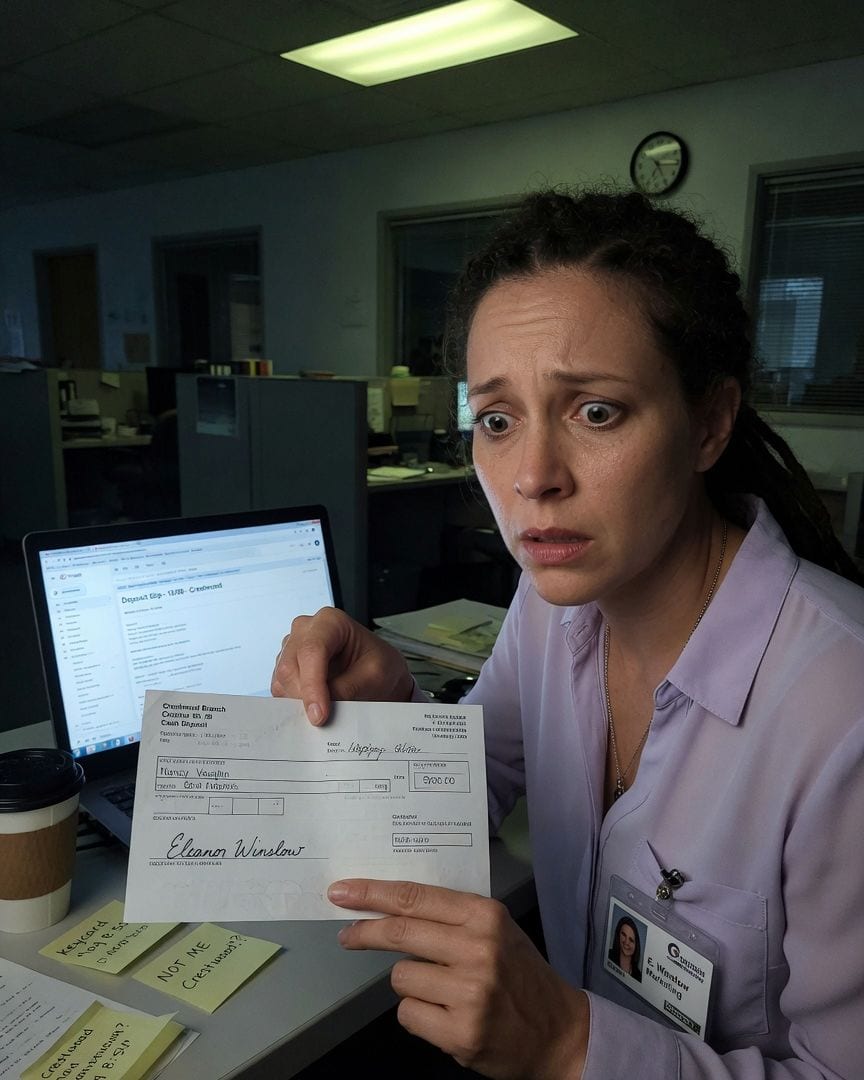
My bank statement shows a $900 cash deposit made in a town I've never set foot in, at 10:40 AM on a workday. I was at my desk, badged in. Two more landed since.
My bank statement showed a $900 cash deposit from a town I'd never visited, 150 miles away. I was at my desk, logged into work, all three times. But the scanned deposit slip arrived, clear as day, showing my own flawless signature.
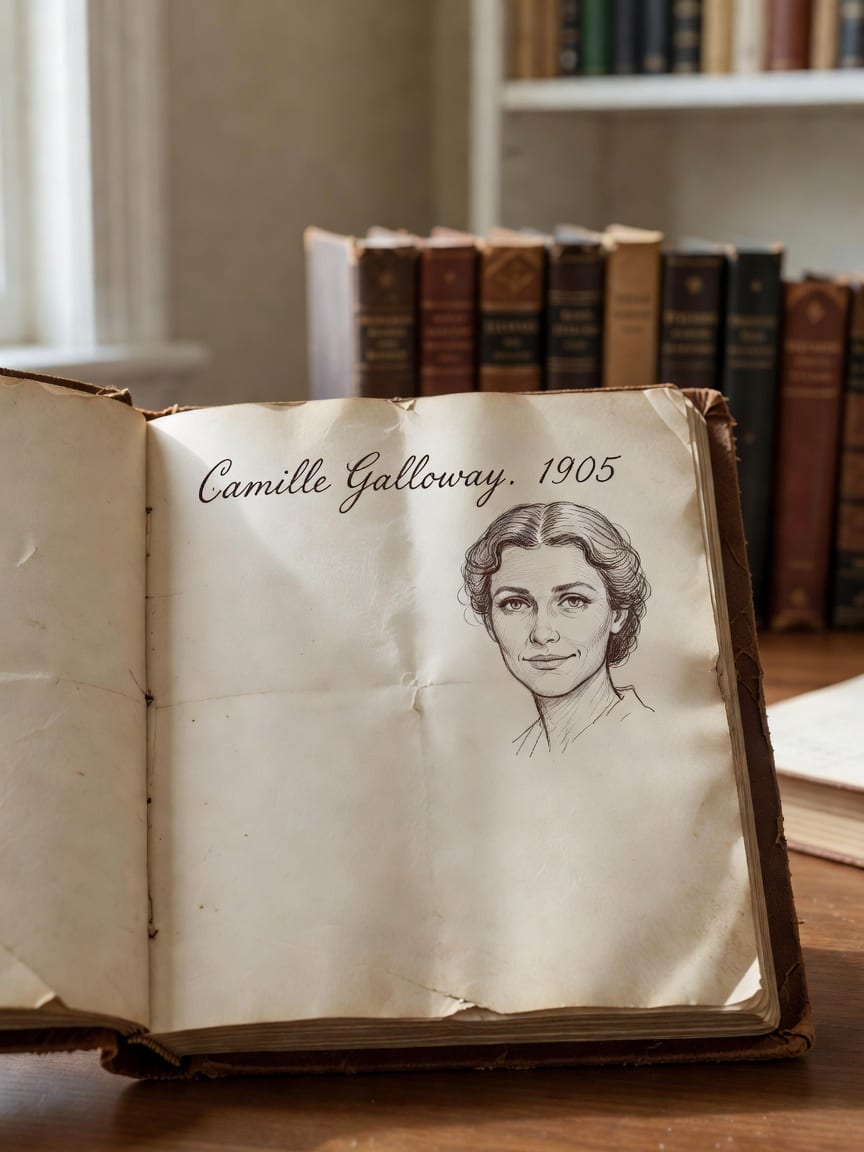
My signature is in this library book. Dated 1971, fourteen years before I was born. The card is real. My hand made those loops.
As a graphic designer, I'm meticulous, which suited my quiet evening shifts at the county archive. But a yellowed due-card, tucked in an old book, shattered my calm: my own signature was written next to the date 1971, fourteen years before I was born. An expert confirmed it was unequivocally mine.
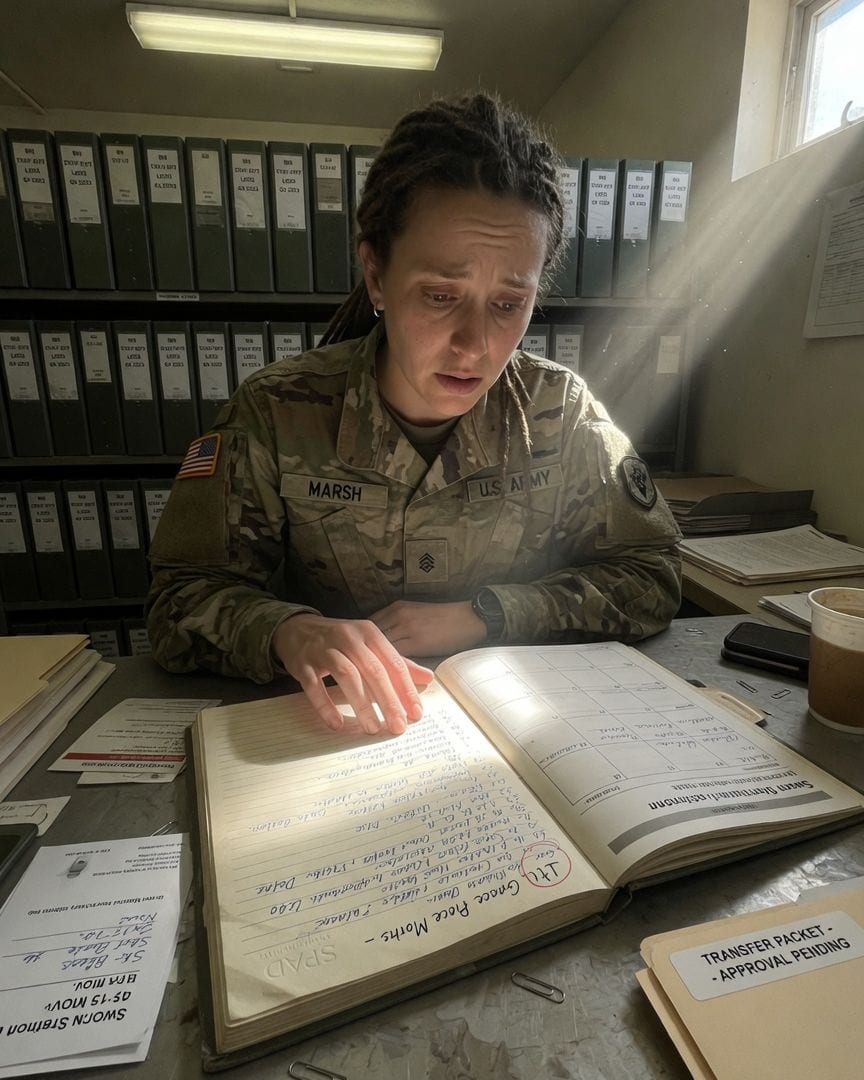
Preparing for a coveted post, a logistics officer found her own perfect signature on a duty log for a shift she swore she never worked. Then her coworker’s entry revealed his unique personal quirk.
Lieutenant Grace Marsh, a meticulous logistics officer, was deep in the archives, preparing her transfer packet for a coveted post. Her career depended on a spotless record, requiring absolute precision as she cross-referenced battalion staff-duty logs. Amidst the dusty binders and humming fluorescent lights, her gaze snagged on an entry for November 14th: her own perfect signature, logging a 24-hour shift she distinctly remembered spending hundreds of miles away in a court-martial. The impossible truth of a phantom doing her job was unsettling enough, but then she found another officer's entry, complete with his unique, personal quirk, for a day he was off-base. What was hidden in these official records?
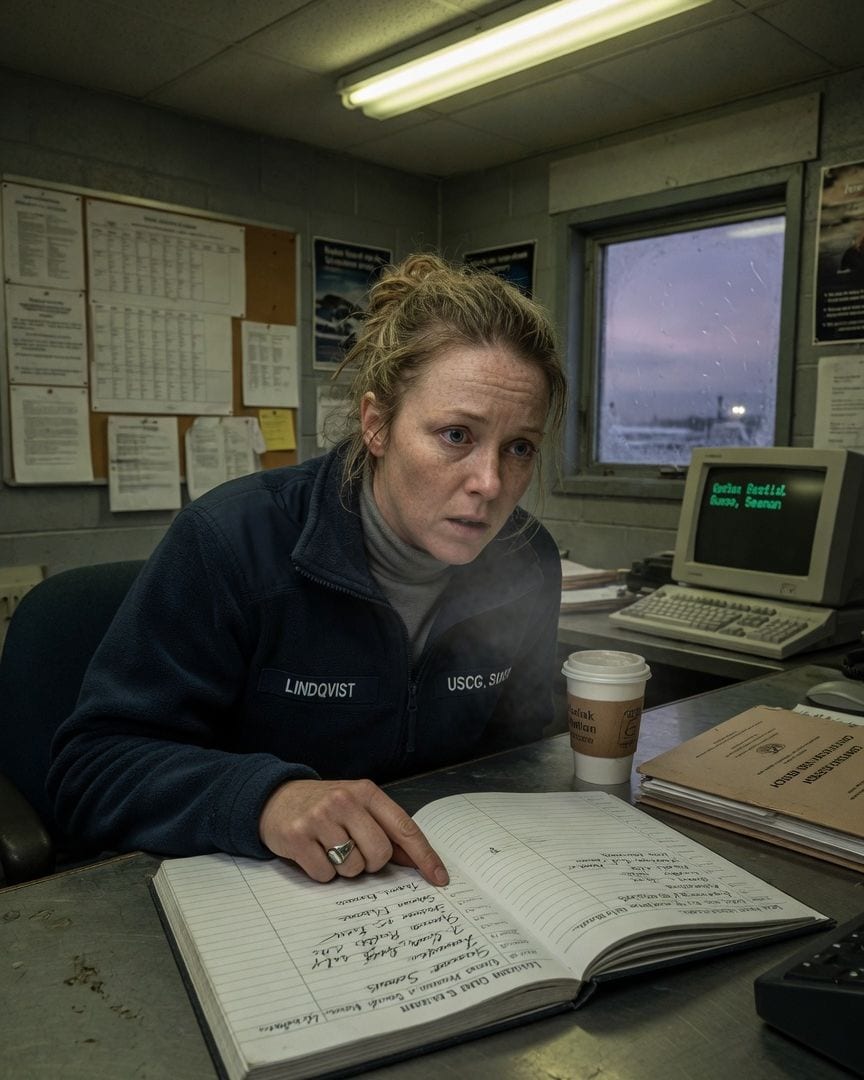
A Coast Guard Petty Officer found her own signature on a manifest for a sailor who didn't exist, with logs tallied for five hands.
Petty Officer Third Class Josephine Lindqvist meticulously checked her Kodiak Coast Guard station’s monthly report. Her cutter, the *Sea Raven*, was a three-hand vessel, and she knew her crew by heart. But there, an impossible name appeared on the manifest: 'Russo, Gideon,' signed by her own hand. The fuel logs and ration counts were tallied for five hands, confirming a terrifying discrepancy. Even her superior found the phantom sailor in the digital system, but Lindqvist knew she had never taken a fourth man, let alone accounted for five.
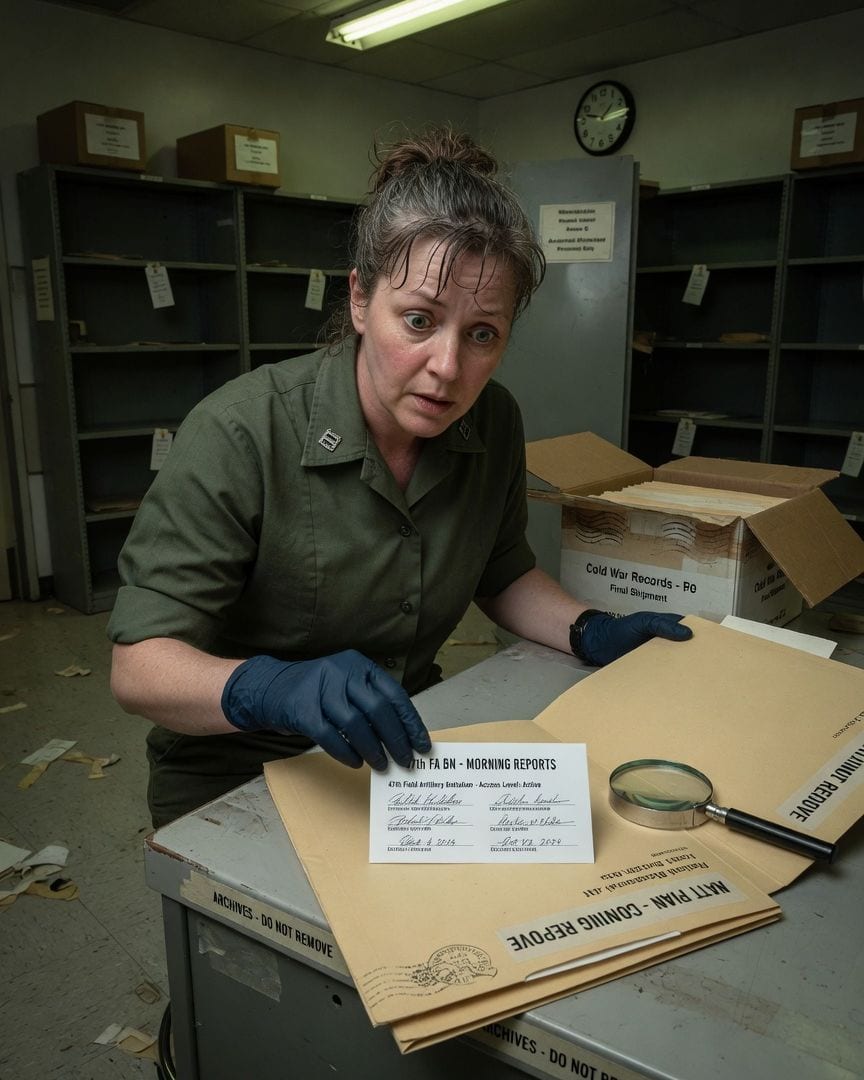
Warrant Officer Kastrup finds a Cold War file requested from Peach Blossom, a town erased from maps since 1974.
Warrant Officer Nell Kastrup felt the chill of the closing National Records Center Annex more acutely than usual. Her transfer was weeks away, and the last boxes of forgotten Cold War paper were being shipped out. Her hand hovered over a dusty file box labeled '47th FA BN - MORNING REPORTS', requested by a pristine letterhead from 'Peach Blossom Post Office, NC'. Nell knew Peach Blossom was dismantled, its post office closed, its land absorbed into fields since 1974. Yet, here was a letter, dated yesterday, from a place that no longer existed.
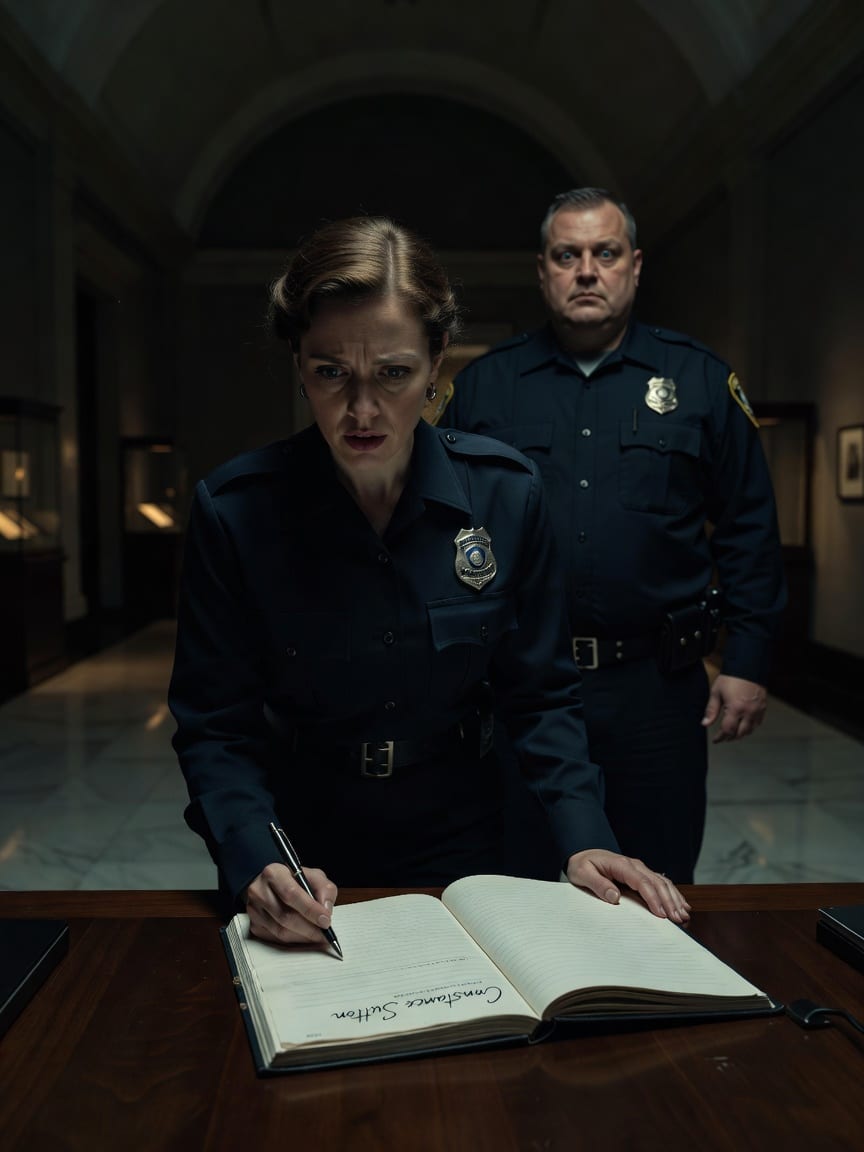
My relief guard Anton always signed in green ink. The police pulled the handover book: no Anton, no green ink, ever.
For two years, my routine as a night guard at the Prescott Museum has been a comforting rhythm, ending with the arrival of Anton Kowalski. But after a small theft, the police reveal Anton doesn't exist and his name isn't in the handover book. Now, I've found my own signature in that book for a night I was explicitly off duty.