Warrant Officer Kastrup finds a Cold War file requested from Peach Blossom, a town erased from maps since 1974.
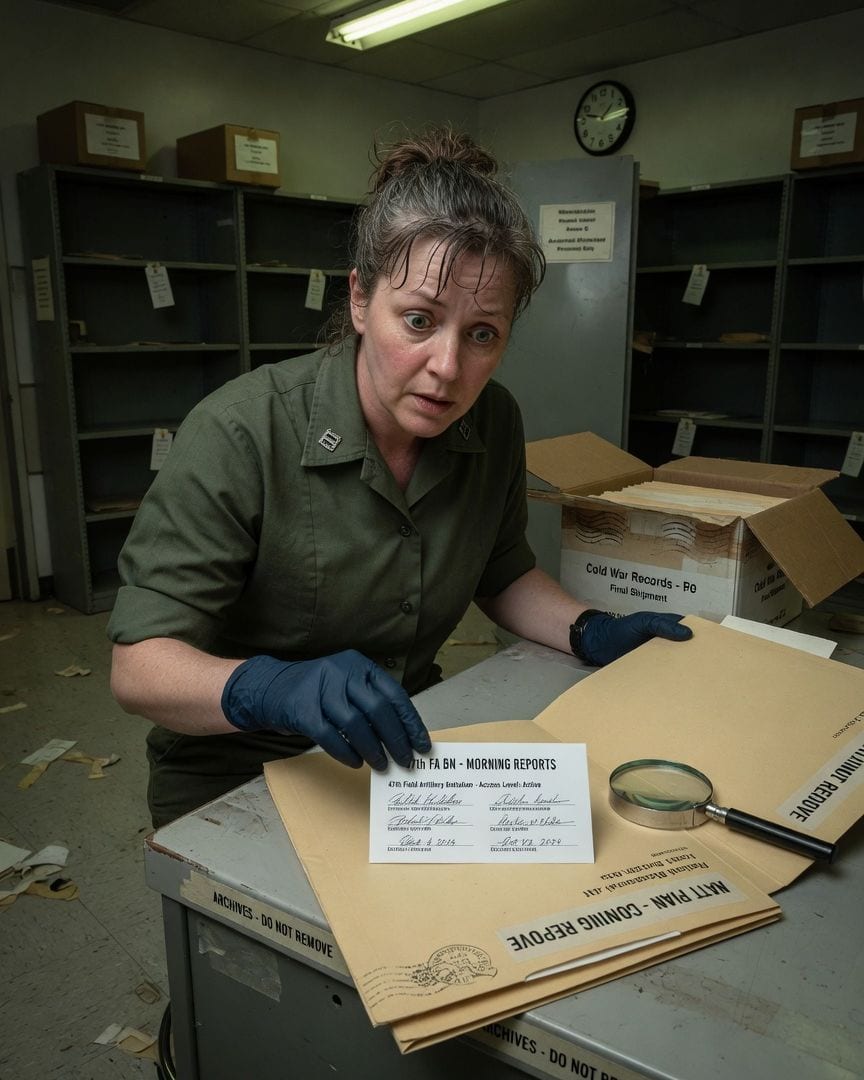
Warrant Officer Nell Kastrup, 38, felt the chill of the closing National Records Center Annex in Salisbury, Maryland, more acutely than usual.
Her transfer was weeks away, and the last boxes of the Cold War's forgotten paper were being shipped out, leaving an echoing emptiness behind. Her hand hovered over a dusty file box labeled '47th FA BN - MORNING REPORTS'.
A request had come in for it this morning, a routine ask, except the letterhead was pristine, addressed from 'Peach Blossom Post Office, NC'.
Nell knew Peach Blossom. Her grandparents had lived a few counties over. The town had been dismantled, its post office closed, its land absorbed into sprawling cornfields and soybean plots since 1974. There wasn't even a historical marker left.
Yet, here was a letter, dated yesterday, from a place that no longer existed.
She pulled the file, the manila unusually thick. Clipped to the folder, a crisp, white signature card. '47th Field Artillery Battalion,' it read in neat, typed script, 'Access Level: Active.'
The battalion had been struck from the rolls in 1953, every man lost in a single night on a Korean ridge, a brutal and complete erasure.
The card, however, was stamped with renewal dates every ten years since 1953, the current date for this very month. But the signatures, a precise, looping script for 'Battalion Commander,' did not drift the way old men's hands drift.
They were identical, each one a perfect carbon copy of the last. It was as if time, and human frailty, had simply paused for this one document.
Nell carried the file to her desk, the heavy manila folder feeling impossibly light despite its contents. Her supervisor, Everett Underwood, 55, a man whose life revolved around procedure and rarely noticed anything outside of it, wouldn't see the anomaly.
'Routine,' he'd said earlier that morning, signing off on the access request for the 47th FA without a glance, more interested in his coffee than the paperwork.
Nell, however, couldn't shake the image of the Peach Blossom postmark. She pulled up historical maps on her computer. Sure enough, the digital overlays confirmed it: the town had been dismantled, its land rezoned, decades ago.
Not a single building remained, not even a foundation stone. Yet the postmark on the letter was undeniably clear, dated yesterday, October 14th, in bold, black ink.
She ran a gloved finger over the signature card. The ink, she noted, had a faint, almost imperceptible sheen, not quite dry, despite the date on the card being nearly two weeks old. Too new, too perfect.
She pulled a magnifying glass from her desk drawer, the kind used for inspecting microfiche. Under its lens, the looping script of the signature didn't resolve into individual strokes of ink, as a normal signature would.
Instead, it appeared as a flawless, extruded line, like a microscopic 3D print, impossible for any human hand to produce. The texture was smooth, uniform, without the minute imperfections or variations of pressure that characterized even the most practiced penmanship.
She tried to scratch it with her fingernail, gently at first, then with more pressure. Nothing. It was bonded to the paper with an unnatural permanence.
Her heart hammered against her ribs. This wasn't ink. It was a polymer, some kind of synthetic resin, laid down with impossible precision. She flipped the card over.
The paper stock itself was too bright, too crisp for a document that had supposedly been renewed every ten years since 1953.
It lacked the yellowing, the faint foxing, the subtle signs of age that should have accumulated over seven decades. She checked the watermark: a manufacturer's mark she recognized from supply orders this very year. The card was brand new.
Someone had printed this perfectly rendered 'signature' onto a fresh card, very recently, then clipped it to a 70-year-old file. She felt a prickle of unease, a cold dread that began in her stomach and spread through her chest.
As she held the card, she felt a faint, impossible warmth radiating from the perfectly rendered, unchanging signature, as if it had just been signed, still cooling from the process.
Nell spent the next few days in a quiet frenzy, her official duties becoming a thin cover for her investigation. The warmth from the signature card had faded, replaced by a lingering chill in her memory.
She cross-referenced the 47th FA Battalion's official deactivation records. Every man, every piece of equipment, listed as 'Lost, Korea, Night of 14 OCT 1953.' No survivors, no stragglers, no transfers. It was a complete, unambiguous termination.
Yet, the pristine file requested access, and the card declared them 'Active.'
She then checked the National Archives' postal service records. Peach Blossom, NC, Post Office, indeed closed in 1974. The last official mail routed through that zip code was stamped July 12, 1974.
There was no way a letter could have been postmarked from there yesterday, or any day in the last fifty years.
Under the pretense of 'legacy system quirks,' she contacted a former colleague in IT, Ryan Granger, 42. She described the polymer signature, the modern paper stock. Ryan, a man who loved a puzzle, listened intently.
'Sounds like some kind of specialized printing process,' he mused, tapping his chin. 'But for a signature? And on that kind of record? Nell, you might want to check for hidden metadata.
Sometimes,' he mused, a glint in his eye, 'even paper has a digital ghost.'
Following his instructions, Nell scrutinized the card again. Along the very edge, obscured by the metal clip that held it to the file, she found a tiny, almost invisible QR code.
It was no larger than a pinhead, perfectly camouflaged against the white paper. Using her phone's scanner, she accessed a URL. It led to a blank page, except for a single, blinking cursor. She typed in '47th Field Artillery Battalion.'
The cursor moved, then typed, with chilling deliberation: 'Access Granted. Status: Operational.'
The word 'Operational' chilled her to the bone. She closed the browser, the phone feeling heavy and cold in her hand, as if it had absorbed the message's unnatural essence.
The next morning, Everett Underwood, usually oblivious to anything not directly on his to-do list, called her into his office.
'Nell,' he said, his voice unusually clipped, his gaze sharp enough to make her shift uncomfortably. 'I noticed you've been pulling a lot of obscure files. The 47th FA? Any particular reason?'
Nell's mind raced, trying to construct a credible lie. 'Just a final check for inconsistencies before shipping, Everett. You know, with the annex closing. Legacy systems, you know how it is. Sometimes old records throw up strange flags.'
He nodded slowly, but his eyes held an unnerving intensity, scanning her face as if searching for a tell. 'Of course. Just... make sure everything is accounted for. No surprises.'
He held her gaze a moment too long before dismissing her.
Later that day, she found a small, unmarked USB stick tucked beneath her keyboard. It hadn't been there when she left for lunch. It contained a single text file. She clicked it open.
The message glowed starkly on the screen: 'STOP. THIS IS NOT A CLERICAL ERROR. THE FILE IS NOT LOST.'
The message was anonymous, typed in a generic font, but the implication was clear: someone knew she was digging, and they were watching her.
Nell didn't stop. The USB stick, rather than deterring her, ignited a cold fury, hardening her resolve. The official warnings, the impossible facts, the chilling message – it all pointed to something far larger than a simple bureaucratic oversight.
She knew this was bigger than the 47th. She remembered Raymond Foster, 72, a retired archivist who’d worked in this very annex since the 60s, a man rumored to know where all the bodies were buried, both literally and figuratively.
He now lived out his days in a quiet retirement home a few towns over. She drove there that evening, the USB stick burning a hole in her pocket, a strange, almost physical weight.
Raymond, frail but sharp, his eyes crinkling at the corners, greeted her with a knowing smile. 'Nell. Knew you'd come around eventually.' He waved her to a worn armchair.
He spoke of 'the Black Files,' a rumor among the old guard. 'Not classified, Nell,' he rasped, his voice thin but clear. 'Uncategorized. No classification means no declassification. They just... existed.'
He described seeing similar 'active' files for other 'lost' units – Navy vessels, Air Force squadrons – civilian research teams, even individual intelligence agents, all with impossible renewal dates and the same unnervingly perfect, non-human signatures.
'They weren't lost, Nell,' he whispered, leaning forward, his voice dropping to a conspiratorial tone. 'They were... reassigned. To a different kind of duty. The paperwork just follows.' His eyes, though old, held a startling lucidity.
'The files aren't records of the missing. They're records for them. The system keeps them current.'
Raymond’s words twisted the world, turning it inside out. The files weren't just anomalies; they were an active, ongoing system, a bureaucratic tether to something profoundly unnatural.
He pulled out an old, worn photo album from a nearby shelf, its pages brittle. 'This was my unit,' he said, his finger trembling slightly as he pointed to a faded black and white photo.
A young man, Oliver Crane, 28, stood smiling, his arm around Raymond's younger self. 'Brilliant man. Went missing on a reconnaissance flight over the Arctic in 1968. Official report: weather anomaly. But his file... it looked just like your 47th's.
Active.'
He turned a page, revealing another photo, then a neatly clipped card. 'And this is his signature card from 1978. Identical to the one from 1968.'
Nell stared at the photo, at the vibrant, living face, then back at the album. 'He's still in the system, isn't he?' she asked, her voice barely a whisper.
Raymond nodded, a single tear tracing a path down his wrinkled cheek. 'Oh, yes. They all are. And the system... it's still taking new entries.'
As if on cue, a notification pinged on Nell's phone, which she'd left on the coffee table. She'd forgotten about the blank URL page. The blinking cursor had moved.
Beneath the line 'Kastrup, Nell: Access Level Initiated,' a new line began to populate, her own service number appearing letter by letter, as if her file was now being opened and written into the very system she had just uncovered.
Nell snatched her phone, the glowing text a cold confirmation of Raymond’s last, chilling words. 'They're not just archiving the lost,' she whispered, her voice tight, 'they're processing them.'
Raymond gripped her arm, his old fingers surprisingly strong. 'It's a transfer system. A way to move assets from one theater to another, one reality to another. The Peach Blossom post office? Not a post office.
A point of egress, Nell. A portal. A place where the lines blur, where something can step between here and... elsewhere.'
He explained that the 'signatures' were not for human authorization, but for acknowledgment – a bureaucratic placeholder for entities that could no longer physically sign, but whose 'status' within the hidden system required periodic verification.
'It's the mechanism that keeps them tethered, keeps them accessible. The pattern across decades and classifications – military, civilian, intelligence – that's the scope of the operation. This isn't just military; it's anyone deemed 'valuable' enough to be... repurposed.'
He revealed that the 'secrecy machine' wasn't just parts of the government; it was a shadow institution that had co-opted parts of the government's record-keeping to manage these 'transfers.'
The warmth she felt from the card in her office wasn't residual heat; it was the faint energy of a living connection, a pulse from the other side, maintaining their tether to this reality through their active files.
Nell knew she had to get out, and she had to take proof. Her impending transfer, her last assignment at the annex, now felt less like a career move and more like a potential trap.
She returned to the records center, the weight of Raymond’s words heavy in the twilight. The annex was quiet, most staff having left. Everett Underwood’s office was dark; he was gone for the day.
Nell went straight to the server room, bypassing the main system to access the annex's old, isolated backup server. It was a relic, rarely touched, and she hoped it might hold a mirror of the classified index Raymond had mentioned.
She worked feverishly, her fingers flying across the keyboard, copying the index entries and the digital footprint of the 'Peach Blossom' URL onto the USB stick. The hum of the old server was the only sound.
As she finished the transfer, the fluorescent lights flickered once, then twice, bathing the room in an unsteady glow. The air grew cold, carrying a faint, metallic scent, like ozone mixed with something less definable, something ancient.
A shadow fell across the server rack, longer and deeper than any of the ambient lights should cast.
Everett Underwood stood in the doorway, his face unreadable in the fluctuating light. He hadn't made a sound. 'I told you, Nell,' he said, his voice flat, devoid of emotion, 'no surprises.' He wasn't angry, just...
resigned, as if this had been an expected, regrettable formality. 'Some files,' he continued, stepping closer, his presence expanding to fill the small room, 'are meant to be kept. And some people are meant to keep them.'
He reached out, not to grab her, but to gently touch the screen of her laptop.
The 'Kastrup, Nell: Access Level Initiated' line on the URL page, which she had minimized but not closed, now displayed a new, chilling update: 'Kastrup, Nell: Access Level Initiated. Status: Transferred.'
Nell froze, the proof she’d gathered suddenly feeling like a burden, not a shield. Everett smiled, a faint, almost imperceptible curve of his lips. 'Welcome to the files, Nell.'
Nell didn't scream, didn't fight. She simply reached out and yanked the USB drive from her laptop, clutching it tight in her fist. Everett did not stop her.
He merely watched, his smile widening slightly, his eyes holding a depth that made her skin crawl.
She walked past him, out of the server room, out of the annex, into the cool Maryland night, the USB drive warm in her palm, a searing ember of impossible knowledge.
Her transfer orders were still in her bag, but now they felt like a cruel joke, a predestined path rather than a choice. She had the proof, undeniable and tangible, but at what cost?
The silence of the night pressed in, the knowledge she carried a heavy, terrifying truth that no one would ever believe.
The world went on. Nell Kastrup completed her transfer, arriving at her new post, a quiet administrative office in a forgotten corner of the Pentagon. She carried the USB drive with her, a cold comfort.
She tried to leak the information, anonymously, to journalists, to whistleblowers. Nothing. The system was too vast, too patient, its tendrils too deeply ingrained.
She found herself signing routine documents, the ink flowing smoothly from her pen, her hand now steady. One day, a new, complex form landed on her desk. She read it, her heart sinking.
It was a renewal request, for an obscure, long-deactivated unit. The signature line was blank. She picked up her pen.
Her new supervisor, a kind, elderly woman named Monica Sterling, noticed Nell working late. 'Everything alright, dear?' she asked, peering over her glasses. Nell looked up, her face pale, her pen hovering over the signature line. 'Just...
filing,' she said, her voice hollow. Monica smiled warmly. 'Good. We like to keep things current.'
The pen began to move, a looping, precise script, identical to the ones she had seen so many times before.
If this one got to you
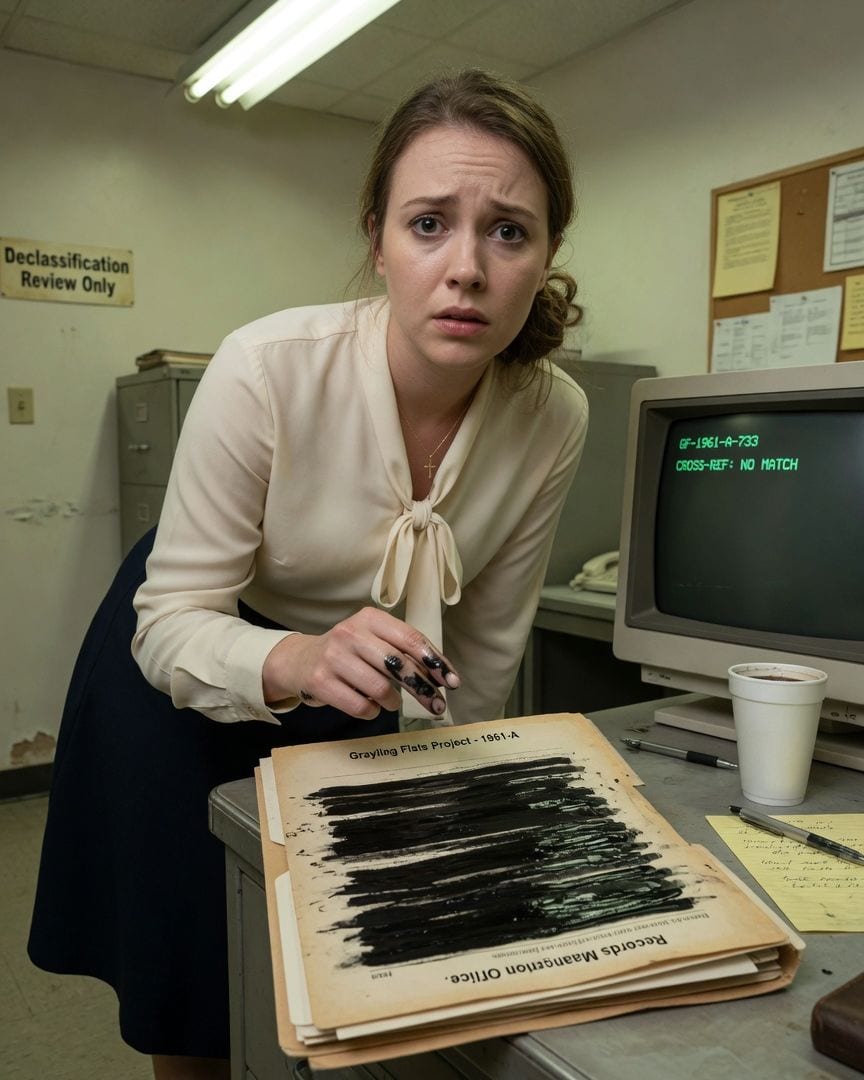
A new records clerk opens old Cold War files. The redaction ink is impossibly wet-black and glossy, thirty years too young for the page.
Ruth Odalen, a new records clerk, began her first assignment in a sterile 1986 declassification office. Tasked with reviewing 'water-damaged' Cold War files, she found the manila folders perfectly dry, but a deeper anomaly waited inside. On one decades-old page, redaction ink gleamed impossibly wet-black and glossy, leaving a cold smear on her fingertip. It looked freshly applied, an impossible detail that seemed to know her, naming the very office she'd left that morning.
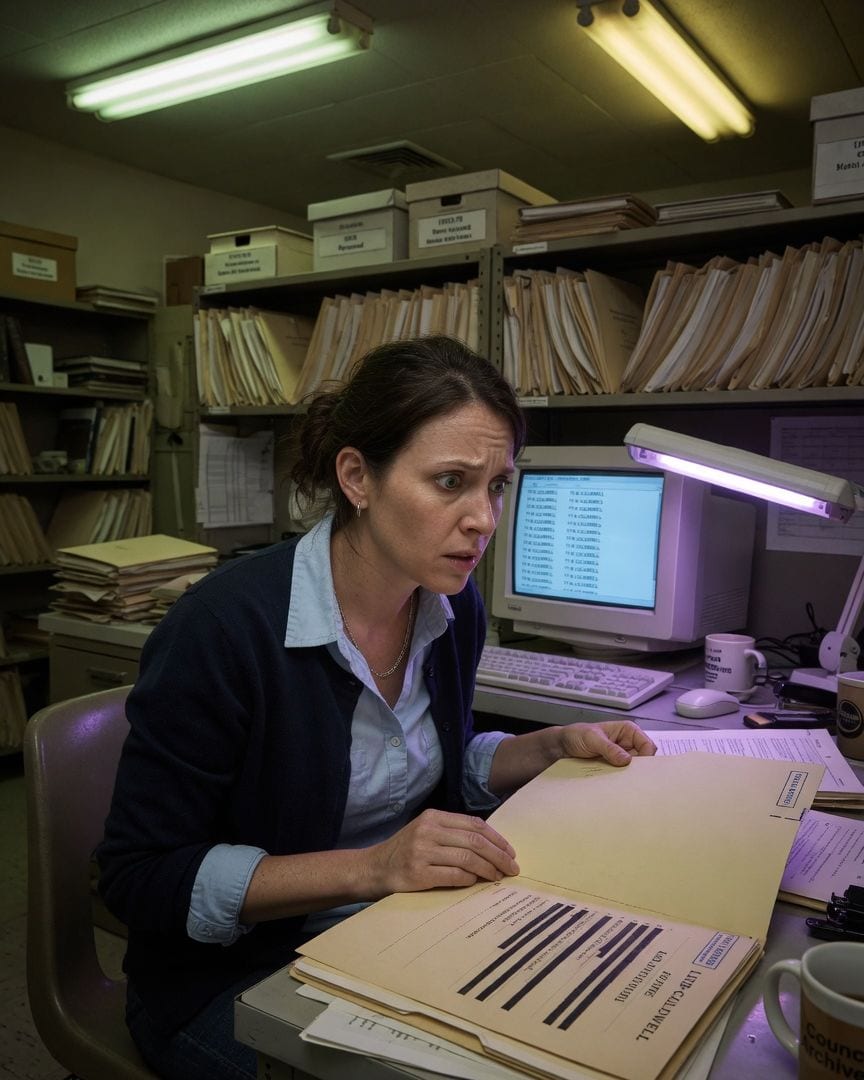
My employer's security file holds a vetting report on me dated nine years before I ever applied. It has my full name and my parents' address — with only one line, the source who referred me, blacked out.
Working a routine data audit, I pull my own security file. The issue date is nine years before I even applied for the job. Then, hidden within an old archive file, I find my current address etched under a blacked-out line.
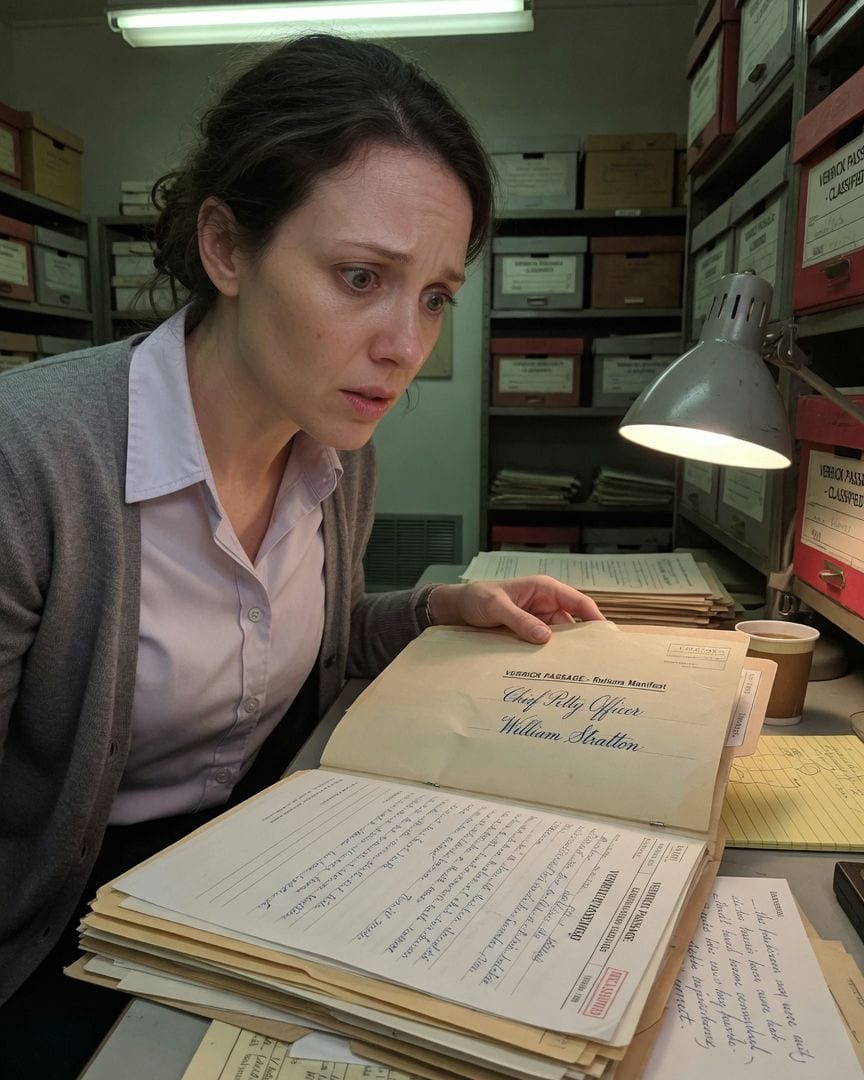
A records reviewer found personnel files for men lost 80 years ago, still being signed in an identical, perfect hand.
In the sterile hush of the declassified archives, meticulous reviewer Ione Fash had a routine task: cross-referencing witness statements from the Verrick Passage file. But as she reviewed files eighty years thick with official silence, she found nine separate interviews containing the exact same chilling sentence, all in an identical, precise hand. Her rational mind sought explanation, yet then she discovered something worse: personnel files for men lost in 1943, still being updated with modern requisitions and payroll runs. Each impossible entry, including a manifest signed just two weeks ago by a casualty from eighty years prior, bore the same unnervingly perfect signature. The file wasn't just a record of the lost; it was still being signed.
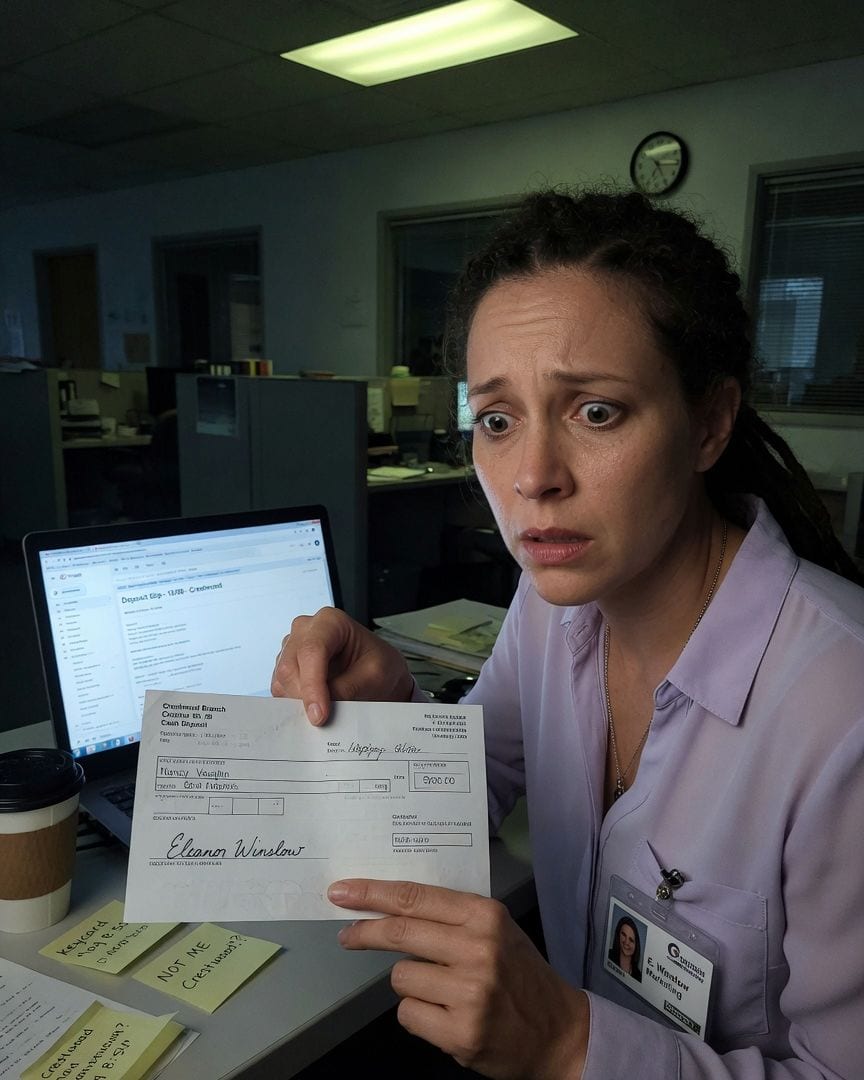
My bank statement shows a $900 cash deposit made in a town I've never set foot in, at 10:40 AM on a workday. I was at my desk, badged in. Two more landed since.
My bank statement showed a $900 cash deposit from a town I'd never visited, 150 miles away. I was at my desk, logged into work, all three times. But the scanned deposit slip arrived, clear as day, showing my own flawless signature.
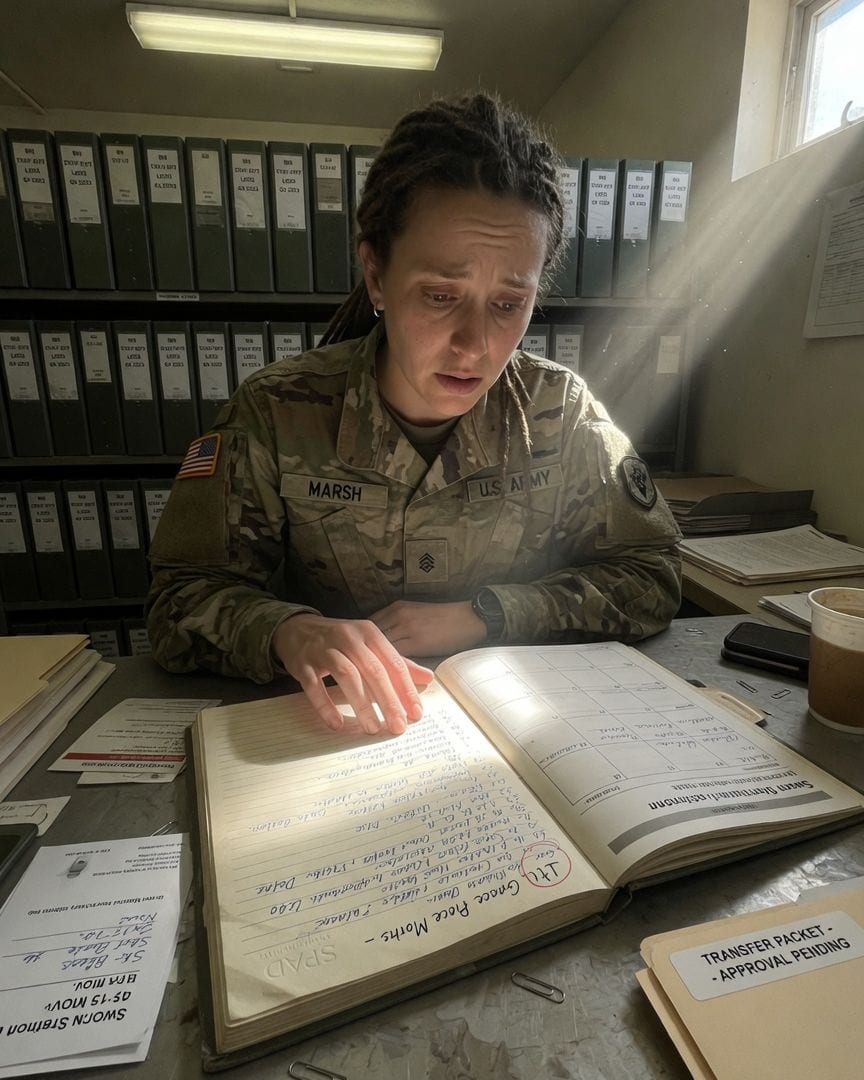
Preparing for a coveted post, a logistics officer found her own perfect signature on a duty log for a shift she swore she never worked. Then her coworker’s entry revealed his unique personal quirk.
Lieutenant Grace Marsh, a meticulous logistics officer, was deep in the archives, preparing her transfer packet for a coveted post. Her career depended on a spotless record, requiring absolute precision as she cross-referenced battalion staff-duty logs. Amidst the dusty binders and humming fluorescent lights, her gaze snagged on an entry for November 14th: her own perfect signature, logging a 24-hour shift she distinctly remembered spending hundreds of miles away in a court-martial. The impossible truth of a phantom doing her job was unsettling enough, but then she found another officer's entry, complete with his unique, personal quirk, for a day he was off-base. What was hidden in these official records?
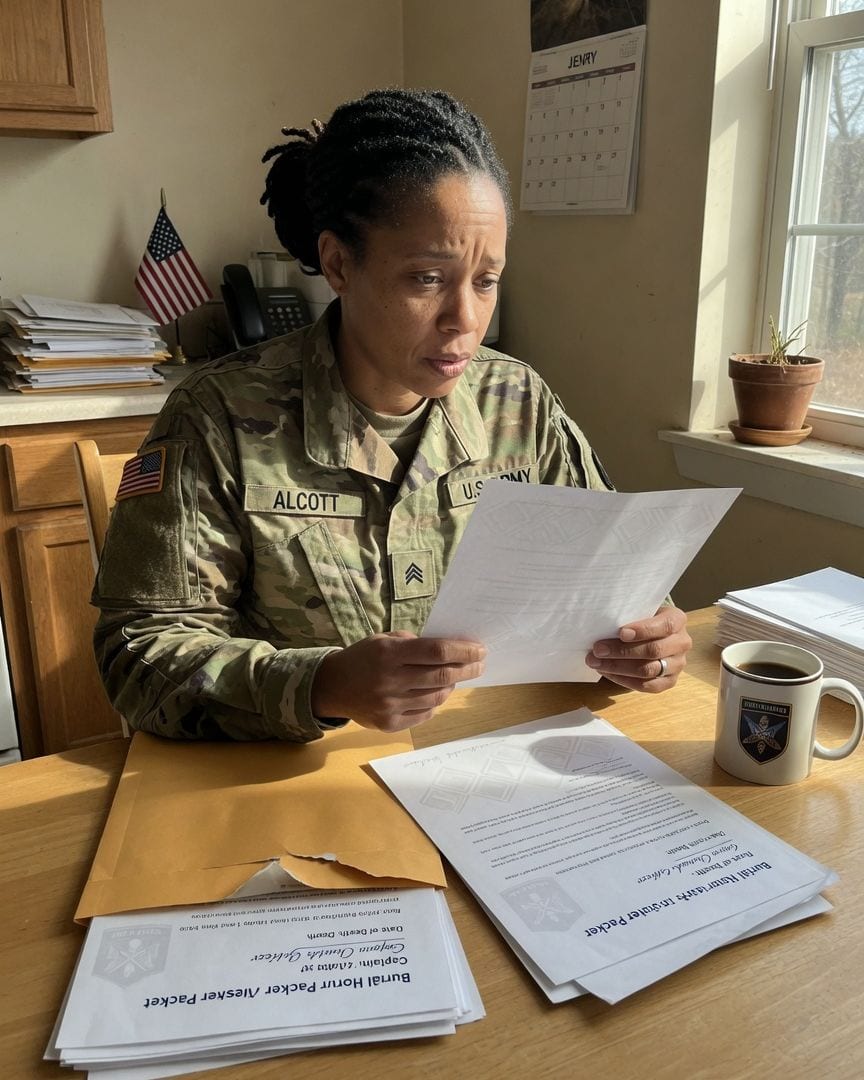
Sergeant First Class Bree Alcott found her own completed burial packet, signed with a confident flourish. It stated her death date was April 17th, next spring, but she was very much alive.
Sergeant First Class Bree Alcott, 38, found her own completed burial honors packet on her kitchen table one quiet autumn morning. It was signed, sealed, and dated for April 17th, next spring, despite her being very much alive. When she took the impossible paperwork to the Fort Claiborne Casualty Affairs office, the staff sergeant there denied any record, even as he traced a faint, archaic watermark on the document. Later, deep in the post's archives, Bree uncovered other packets for soldiers long missing, all bearing the same unsettling watermark and future-dated signature, their 'death' dates now long past – until she found one for tomorrow.