A ninety-one-year-old Cold War Navy veteran finds his own younger face in a photograph from a ship's impossible loss report, signed by him decades later.
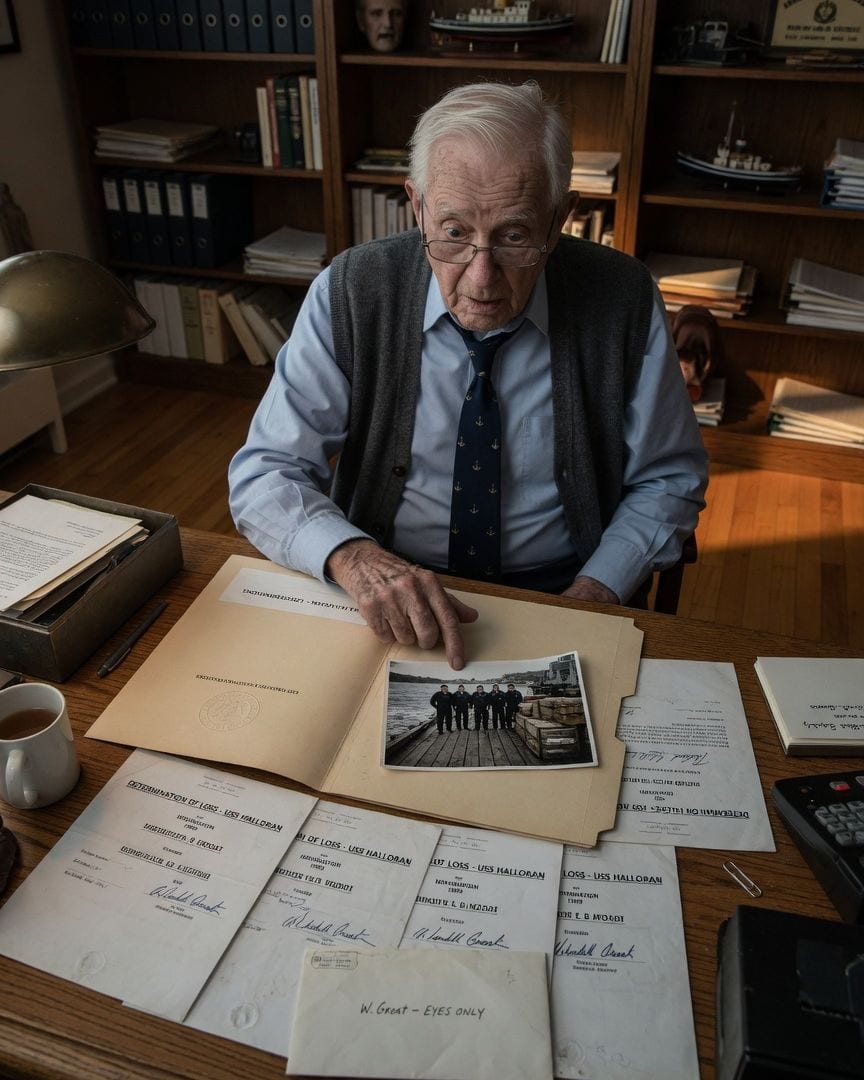
Wendell Groat, age ninety-one, settled into his meticulously organized study in Annapolis, the afternoon sun casting warm squares on the polished oak floor.
He breathed in the familiar scent of old paper and dust as he opened his requested service file. The beige folder, embossed with the Navy’s seal, felt substantial in his hands.
He found the 1962 loss determination for the tug Halloran, a routine document from early in his career. His youthful signature, firm and clear, stood at the bottom.
He flipped through the years, expecting the familiar rhythm of his official life, a predictable march of forms and regulations.
Then, the impossible. Four subsequent determinations for the same vessel—1974, 1989, 2001, 2019—each declaring the Halloran lost with all hands. Each signed 'Wendell Groat.' He stared at them, his old eyes, still sharp behind his reading glasses, tracing the impossible truth.
The 1974 signature, still his own, showed the subtle shift of maturing handwriting. The 1989 version was tighter, more compact. But the 2001 signature was impossibly youthful, a hand he hadn't possessed in decades.
And the ink on the 2019 document was stark, crisp, its signature vibrant and unyielding, a hand far younger than his own trembling one. A cold dread, sharp and physical, spread through him, a nauseating certainty that defied all logic.
He traced the impossible, vital ink with a finger that shook.
Groat, methodical by nature, spent the next day cross-referencing every detail. He called the Navy records office, his voice steady despite the tremor in his hands.
He spoke to Vivienne Calloway, a young, efficient clerk whose voice, smooth and unhurried, held an unsettling calm. She confirmed the records were indeed 'unusual' but authentic, not clerical errors. She sounded neither surprised nor particularly concerned.
Groat insisted on examining the physical files, a request she granted with a practiced ease that made the hair on his arms prickle.
The Navy archive building was a sprawling, silent facility that smelled of forgotten secrets and cold stone. Its vast halls seemed to swallow sound.
Vivienne Calloway, her face placid and unreadable, led him down a narrow, windowless corridor to an unmarked, deep-storage section. From a heavy, plain metal box, clearly not on the main inventory system, she retrieved the Halloran's file.
Inside, the bound official determinations lay open. The signatures were starkly different from each other, yet all undeniably his, the familiar slant and loop of his own name laid bare across fifty-seven years of impossible declarations.
He tried to rationalize it as a bizarre set of forgeries or an obscure bureaucratic prank, a relic of some forgotten office joke.
But the official stamps, embossed deep into the paper, the specific paper stock itself, the very weight and feel of the documents in his hands—they were undeniably authentic.
The mundane explanation crumbled into dust, leaving only the chilling truth of what he held.
Deep within the Halloran's file, tucked behind the 2001 determination, Groat found a small, sealed envelope.
His name was handwritten on it in a precise, almost calligraphic script, a hand that felt distantly familiar yet impossible: 'W. Groat – EYES ONLY.' His heart pounded with an unfamiliar rhythm, a dull, heavy drum in his chest.
Inside, a single, smudged photograph. It showed the grim-faced crew of the Halloran, circa 2001, standing on a desolate dock, their faces solemn against a gray, churning sea.
In the background, partially obscured by a stack of barnacle-encrusted crates, was a younger man, observing them. His face was blurry, out of focus, but the set of his jaw, the familiar line of his brow, was unmistakable.
It was Wendell Groat, decades younger than his current ninety-one years, observing the loss he would later sign off on. His aged hand, trembling, hovered over the image of his impossible, younger self.
Groat confronted Vivienne Calloway with the photograph the next morning. She sat at her desk, bathed in the anemic glow of a fluorescent light, methodically sorting through a stack of brown folders.
She took the smudged photo from his hand, her long fingers carefully avoiding contact with his. Her gaze, flat and unreadable, scanned the image. She showed no surprise, no recognition of the impossible. A beat passed, then another.
She handed it back. "Some files have deeper roots, Mr. Groat," she murmured, her voice flat, as if discussing the weather.
He tried to ignore the chill her composure sent down his spine. "I found this term in some internal memos," he said, pushing on, " 'Halloran-class' incidents. Are there others?"
Vivienne, without question, reached for a different shelf. She didn't consult a digital index, but pulled a worn, leather-bound register, thick with age, from a slot marked only with a faded symbol. It opened with a soft creak.
Groat saw similar 'recurring loss' incidents listed within, codenamed, some with dates stretching back to the 1930s. He traced entries for 'CALLOWAY-CLASS' and 'THORNTON-CLASS,' each noting a 'designated signatory.'
His own name appeared repeatedly, not just for the Halloran, but for other incidents, sometimes dated years before his birth. The names of long-dead officials were linked to these recurring losses.
The pattern was not random; it was deliberate, a meticulously maintained system of impossible events.
The unease in his gut solidified into a specific, horrifying certainty: he was not just witnessing an anomaly; he was part of a much larger, darker design.
As Groat delved deeper into the register, he became acutely aware of Vivienne’s gaze. Her calm demeanor, initially a source of quiet reassurance, now felt less helpful, more like a silent, continuous observation.
Her head remained bowed over her work, yet he felt the weight of her eyes on him, a constant pressure.
He heard her make a casual comment to a passing archivist about "the archives knowing who belongs where," a phrase that chilled him to the bone.
Later that day, he found a note slipped into his file – a small, stiff piece of paper, folded precisely. 'Don't dig too deep, Mr. Groat. Some things are better left filed.'
The handwriting was not Vivienne’s, but a precise, almost calligraphic script, identical to the one on the envelope he’d found. It felt familiar in its cold formality.
He confronted Edmund Pierce, the head archivist, in his office down a separate corridor. Pierce was a man with tired eyes and a profound quietness, an aura of deep resignation about him. Pierce didn't deny the note.
He only stated, "Some records watch back," his voice a low rumble. He granted Groat access to a restricted sub-basement, a place that felt forgotten by time itself.
It was a labyrinth of heavy, sealed doors and absolute silence, the air thick with the scent of ozone and old paper.
As he handed Groat a heavy brass key, its metal cold against Groat’s palm, Pierce’s gaze was knowing, resigned. "You're already in the system, Mr. Groat," he warned, his voice barely a whisper. "You always have been."
The words echoed in the oppressive silence, clinging to the shadows.
In the sub-basement, guided by Pierce’s weary instructions, Groat found a section dedicated to 'Signature Replication Protocols.'
The documents were heavily redacted, black bars obscuring most of the text, but he meticulously pieced together fragments describing a process of 'temporal imprinting'—how the 'essence' of a designated official's signature, tied to their unique cognitive patterns and personal history, could be extracted and applied to future documents.
It created an 'authentic' record of a recurring event, circumventing the need for a physical signatory each time. He saw his own name, 'Groat, Wendell, Lt. Cmdr.
USN, Ret.' designated as a 'Category Alpha Signatory' in documents dated from the 1950s, decades before his actual service began.
The 2001 photograph of his younger self, the increasingly youthful signatures on the Halloran's loss determinations, the 'Box That Is Not on Any List'—it all snapped into terrible focus.
He wasn't just signing papers; his very identity, his unique 'signature essence,' was being used, or perhaps, reused by the system.
The Halloran wasn't a unique phenomenon, a single, tragic maritime accident; it was a recurring event, a pattern that needed to be contained.
The 'loss determinations' were not records of singular disasters, but a continuous, automated administrative process designed to contain and explain something fundamentally unexplainable.
He felt a profound violation, as if a piece of his soul had been stolen and repurposed, a tool for an impossible bureaucracy. The cold dread in his chest tightened into a knot, a physical pain.
Edmund Pierce appeared in the sub-basement, his face etched with a grim understanding, the soft thud of the heavy door echoing, final, behind him. "You've seen enough, Wendell," he said, his voice devoid of anger, full of resignation.
"It's time you understood your part." He gestured to a heavy, steel-reinforced cabinet, unlike any other in the room. Its door, slightly ajar, revealed rows of identical, unmarked binders, their spines uniformly gray.
Groat's gaze fell on one at eye level, its faded, handwritten label clearly reading: 'GROAT-CLASS.' It was not his service record.
It was a file on him, on the mechanism of his own recurring signatures, and perhaps, on his own recurring 'losses.'
He reached for it, his fingers brushing the cold metal, a growing certainty that the contents would reveal a truth far more personal and terrifying than he could have imagined.
The air in the sub-basement grew heavy, charged with unspoken dread.
Pierce pulled out the 'GROAT-CLASS' binder. Its pages, unlike the redacted documents he’d seen earlier, were chillingly comprehensive.
It contained not just records of Groat's extracted signatures, but also detailed observations of his life, his career, his habits, even his emotional responses to his early cases.
It chronicled his 'activation points'—moments when the 'Signature Replication Protocol' was initiated or reinforced through his proximity to an anomalous event.
The photograph from 2001 wasn't just of a younger Groat; it was him, physically present, unknowingly drawn to the event by an unknown force, his presence perhaps vital for the 'filing' to occur.
Pierce explained that certain individuals, through unknown genetic markers or psychological profiles, were predisposed to be 'anchor points' for the system, their unique 'signature essence' capable of spanning time to formalize these recurring 'losses.'
The 'Halloran-class' and 'CALLOWAY-CLASS' binders were records of other such anchors, some still active, some long since 'filed.'
The system didn't just record the anomalies; it used certain people to contain them, to give them administrative closure that allowed the world to move on.
Groat realized he was not a witness; he was a component, and his quest for answers had merely completed his final integration.
Pierce’s voice, still quiet, carried the weight of a profound, terrible understanding. Groat, by actively seeking out his file and understanding the truth, had triggered his final 'activation.'
The 'younger signature' wasn't just a replication; it was a manifestation of the system drawing on his vital essence, keeping him connected, preserving his 'signature' even as his body aged. He was now fully integrated, a living conduit.
Pierce, a former 'anchor' himself, now maintained the system, a quiet custodian, his own purpose long since resigned to the inevitable.
He offered Groat a choice, though it felt less like a choice and more like a final judgment: resist and be consumed, his mind fractured by the system's demands, or accept his 'purpose' and become a silent guardian, like him.
Groat felt a profound weariness, the weight of decades of impossible signatures pressing down, a cold emptiness settling in his core. He tried to leave, to take the binders, to expose the truth, to reclaim his life.
But as he moved towards the sub-basement exit, the heavy steel door slid shut with a soft, final thud, the sound echoing in the sudden silence. The air grew impossibly cold, drawing the heat from his skin.
Vivienne Calloway stood outside the thick, reinforced glass, her expression unreadable, a faint, knowing smile playing on her lips. She held a freshly stamped document, its ink still wet, a new signature firm and clear upon it.
Wendell Groat was reported missing by his neighbors a week later.
The Annapolis police found his home undisturbed, his meticulously organized study exactly as he'd left it, save for one detail: his personal service file, which he had checked out from the archives, was gone.
The Navy archives confirmed his visit but stated no documents were missing from their records. His absence was logged as a quiet disappearance, attributed to his advanced age and solitary life.
A month passed. A new signature appeared in the archives, on a freshly created 'loss determination' for a small research vessel lost off the coast of Maine. The signature was firm, precise, and unmistakably that of Wendell Groat, dated today.
Vivienne Calloway, sorting through new accessions, paused. She looked up as Edmund Pierce walked past her desk. 'Anything new, Vivienne?' he asked, his voice flat. She held up the new determination. He glanced at the signature, then back at her.
'Ah, yes. The file is still being signed.'
If this one got to you
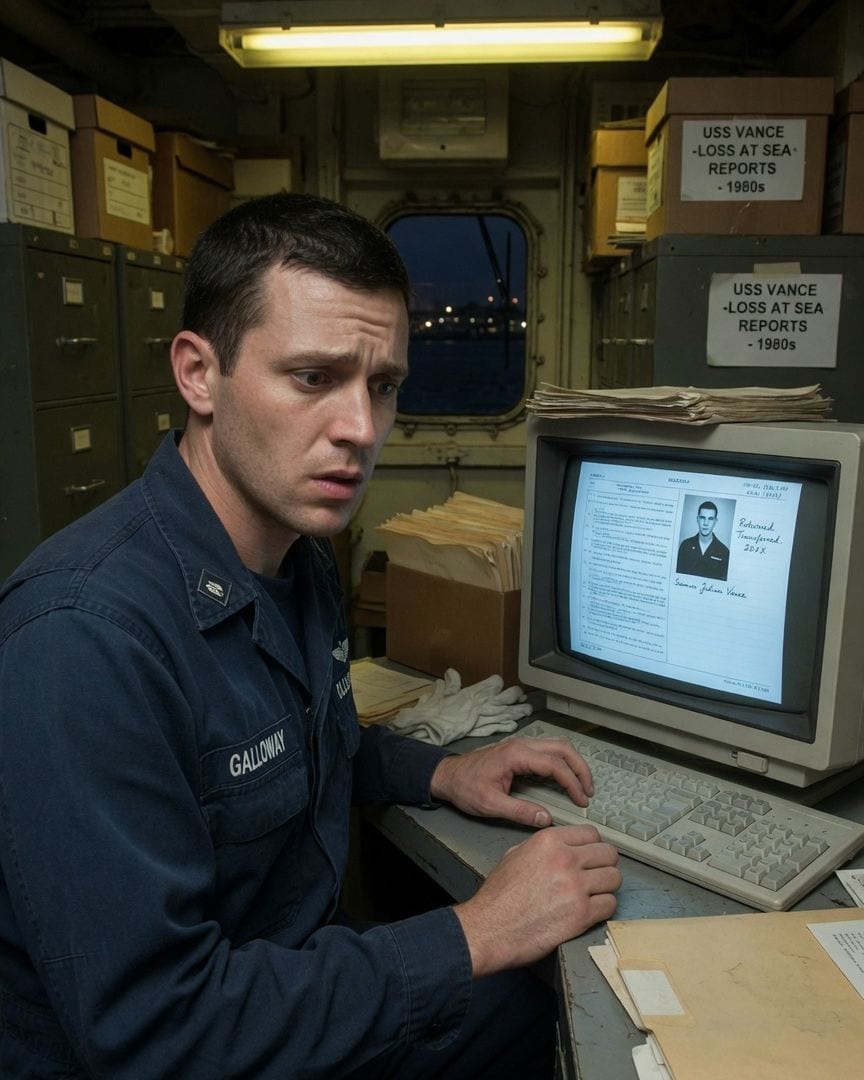
Petty Officer Galloway logged a sailor onto his ship. The man died at sea 40 years ago.
Petty Officer Joel Galloway scanned a sailor's ID on the USS Vance quarterdeck. The man's name, 'Seaman Julian Vance,' and his out-of-date uniform pricked at Galloway's memory. Later, the ship's berthing count came back one over, with an extra entry in the system but no physical body.
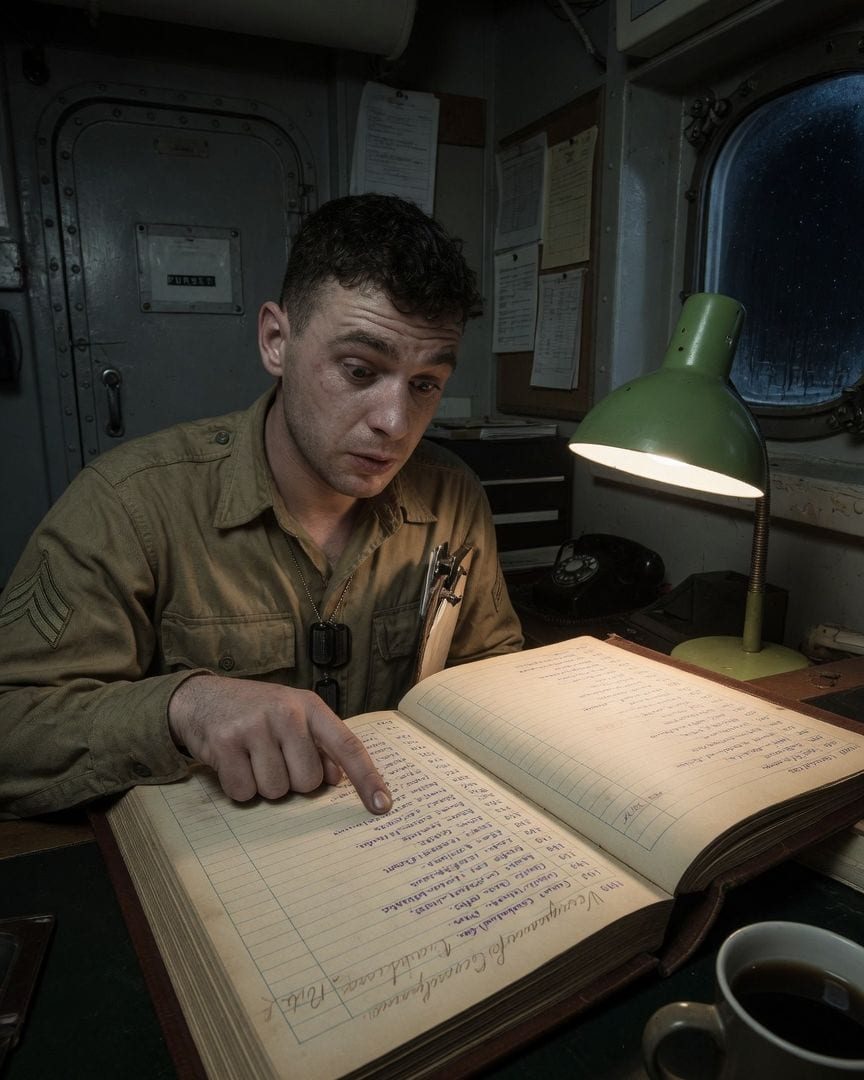
On his final crossing, Corporal Kowalski found a WWI soldier's name: 'Vestergaard, Corporal, 1918,' on his 1943 manifest.
Corporal Arthur Kowalski was on his final Atlantic crossing aboard the USS Harrington, a promised reprieve before reassignment, but the cold Atlantic air was nothing compared to the chill seeping into his bones. Despite the official roll listing 402 men, the boat drill revealed 403 soldiers lined up, an impossible discrepancy that defied every record. His discreet investigation led him to the ship's master embarkation roll, where beneath the 1943 entries, he found a faint, handwritten name: 'Vestergaard, Corporal. 1918.' A World War I soldier’s name, in archaic ink, woven into a modern manifest – how could such an impossible entry exist?
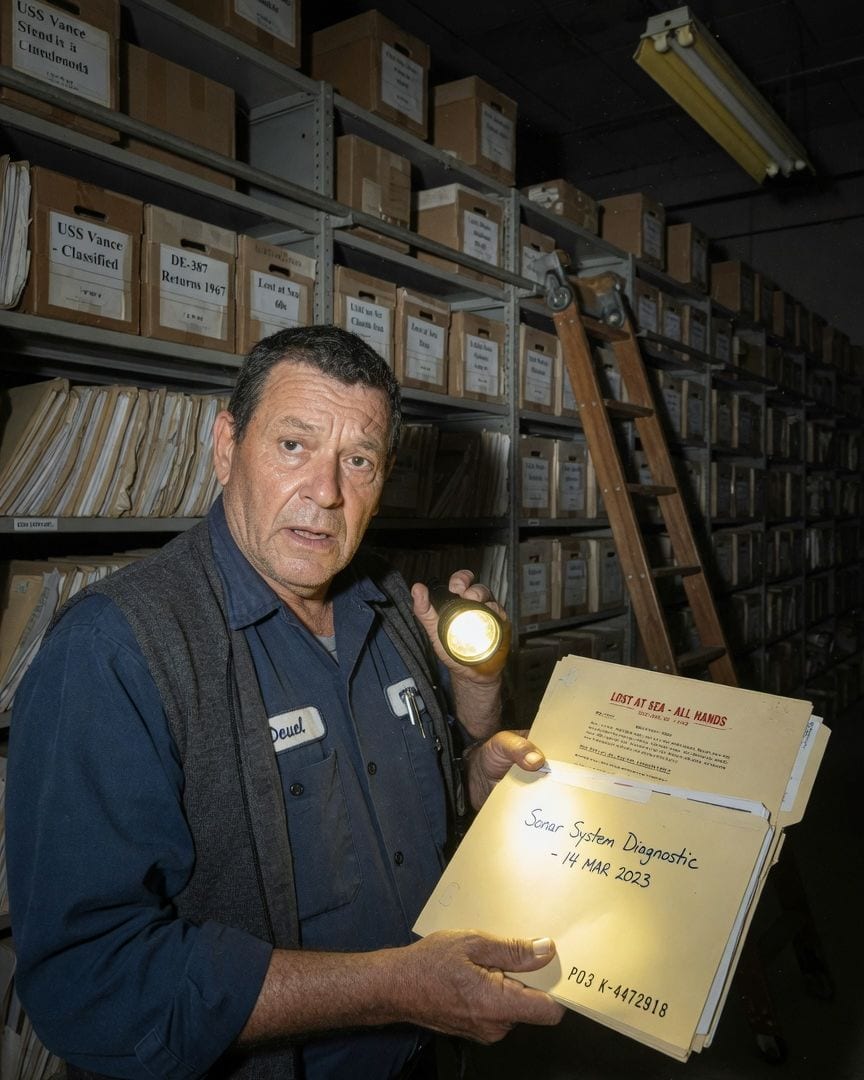
An archivist, alone in the Suitland annex, finds a 1968 lost Cold War ship file with a handwritten entry dated last Tuesday. The ink looks damp, but feels dry.
Carmine Deuel, 62, spent forty years amidst the dust and forgotten files of the Suitland annex. One night, alone in the cavernous space, a sticky squeal and the faint sway of a rolling ladder broke the silence. He found a classified file from the USS Vance, a ship lost in 1968, pulled from its shelf. Inside, a typed form held a handwritten entry: a routine sonar check, dated last Tuesday. The ink, impossibly, looked damp yet was perfectly dry. Who had accessed the file, and how could its entry be so recent?
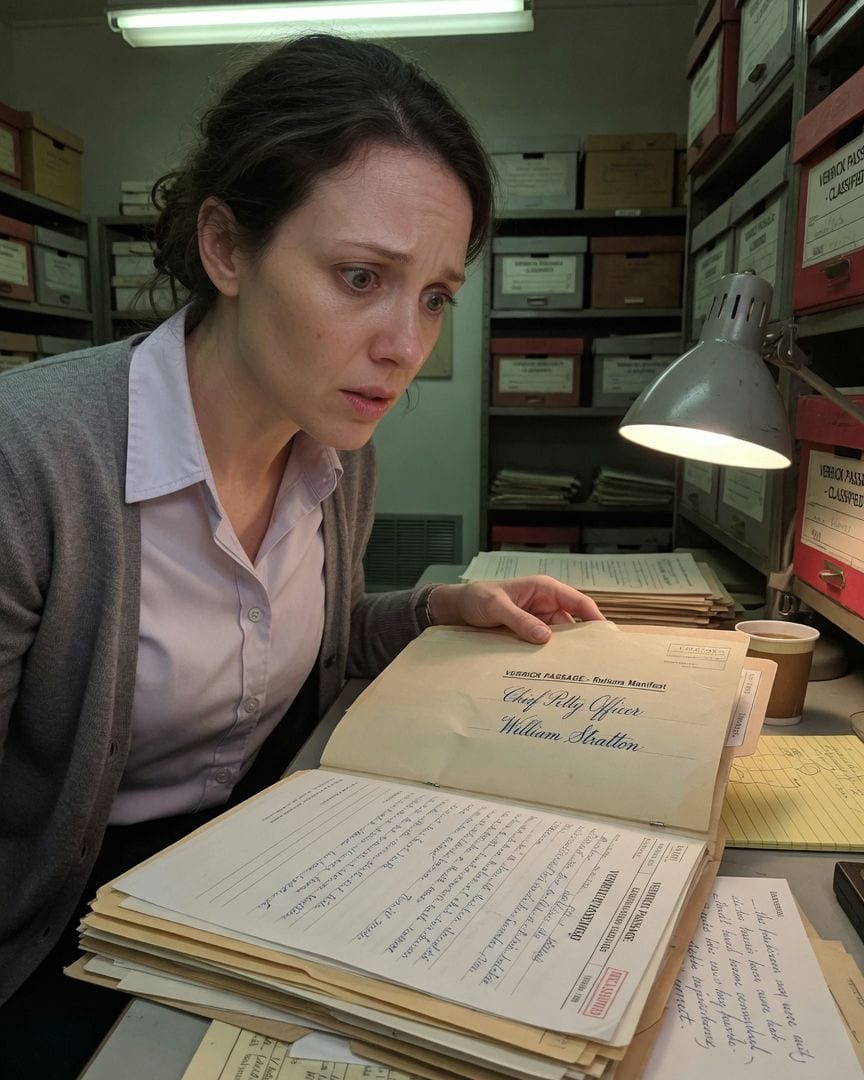
A records reviewer found personnel files for men lost 80 years ago, still being signed in an identical, perfect hand.
In the sterile hush of the declassified archives, meticulous reviewer Ione Fash had a routine task: cross-referencing witness statements from the Verrick Passage file. But as she reviewed files eighty years thick with official silence, she found nine separate interviews containing the exact same chilling sentence, all in an identical, precise hand. Her rational mind sought explanation, yet then she discovered something worse: personnel files for men lost in 1943, still being updated with modern requisitions and payroll runs. Each impossible entry, including a manifest signed just two weeks ago by a casualty from eighty years prior, bore the same unnervingly perfect signature. The file wasn't just a record of the lost; it was still being signed.
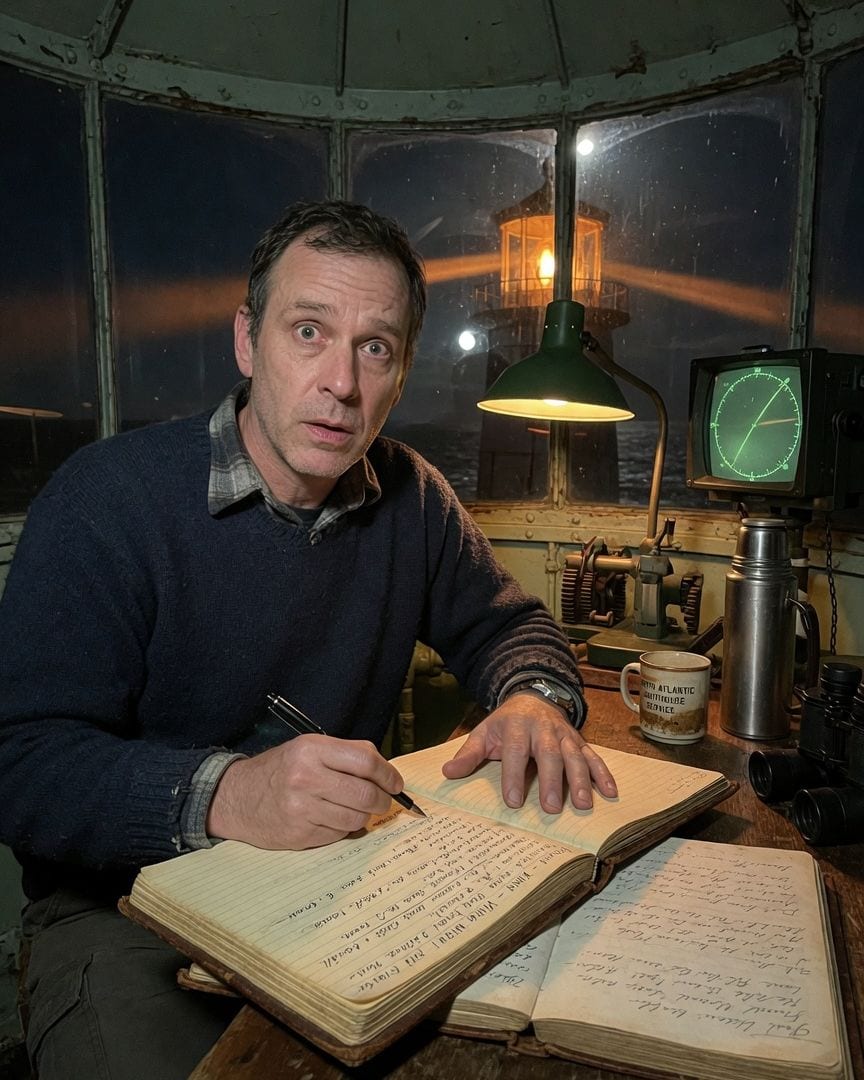
My lighthouse log has my own 3 AM entry for a phantom ship. I was alone in the tower, and I wrote no such thing.
Perched in the lantern room for my usual 2-6 AM watch, I reached for the thick logbook. But the 3:00 AM entry, under my own name, detailed a vessel I never saw. The words were in my own ink, yet I had never written them.
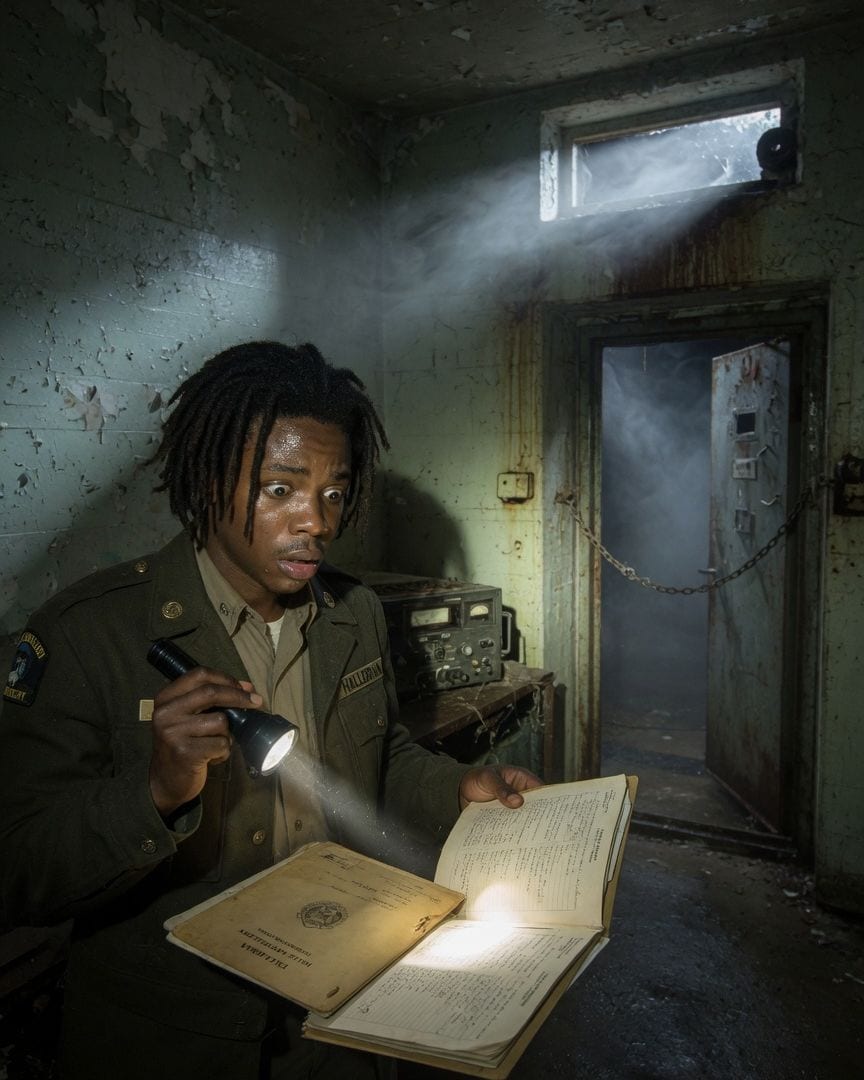
On his last shift, a coast sentry finds his own name signed in fresh ink on a 1943 army record, dated exactly one year ago.
Private Roy Halloran counted the final hours of his last watch behind the searchlight of an old, rust-tinged artillery bunker on the northern California coast. His monotonous graveyard shift was nearly done, and his transfer close, but at 0100, the swirling coastal fog revealed a silent landing party of men on the beach, their gear anachronistic and alien. When dawn burned off the mist, the beach was empty, yet faint drag marks led directly to the bunker’s long-sealed rear hatch, now mysteriously ajar. Inside, amidst the cold, acrid air, he discovered a pristine 1943 army service record bearing his own name. A freshly signed entry dated exactly one year ago to the day left him wondering: had the past somehow reached out to claim him?