My own DNA matches a body pulled from a ferry wreck in 1988. I was born three years after it drowned.
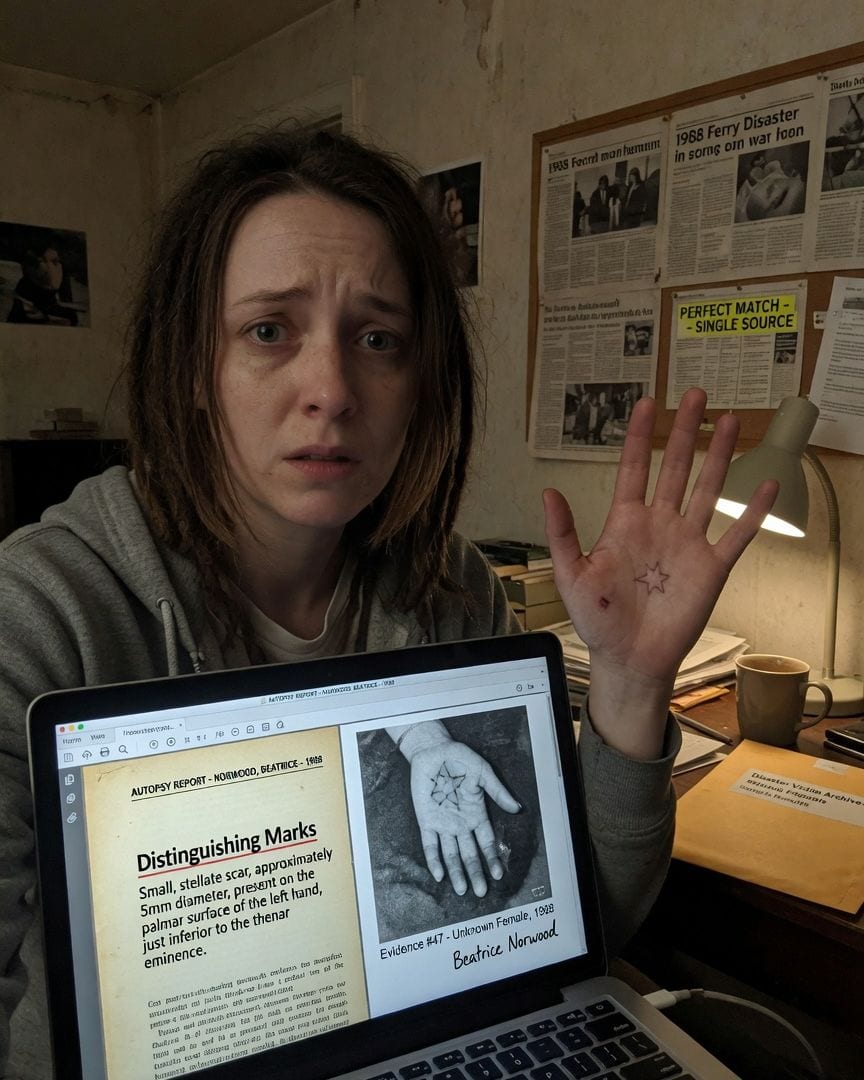
My DNA profile returned a direct hit. Not a distant relative, not a statistical anomaly, but a perfect match to an unclaimed victim, still catalogued as 'Unknown Female', pulled from the water after the 1988 ferry sinking.
I was born in 1991. The email from the disaster-victim archive, a project I’d contributed to out of morbid curiosity, was polite, almost clinical.
It stated the forensic team had re-extracted from my submitted sample, cross-referenced, and concluded with chilling certainty: 'The two are a single source.' Eleanor Mitchell, 33, living in a quiet apartment, suddenly found herself staring at an impossible paradox.
My rational mind immediately sought mundane explanations: a lab error, a mix-up of samples, a distant, unknown relative with near-identical markers. But the accompanying documentation, precise and cold, systematically dismantled each one.
The re-extraction confirmed the sample; the genetic markers were unique, a perfect fingerprint of identity. The victim's body had been preserved, identified only by its number, for decades, awaiting a match that should have been impossible.
The dread wasn't a sudden shock, but a slow, cold seeping into the marrow of my bones, a quiet insistence that something fundamental about my own existence was irrevocably wrong.
The first thing I did was call the lab. Paul Kowalski, the lead forensic technician, sounded weary, almost apologetic. He confirmed the re-extraction, the double-check, the impossible conclusion.
“We’ve seen odd things, Ms. Mitchell,” he’d said, his voice low, “but never this.” He suggested I look into the victim’s limited file. 'Beatrice Norwood,' the report identified her, a name finally assigned to the unknown.
Her age at death, 27. Her physical description, sparse: height, build, hair color. Nothing that truly clicked, nothing that screamed ‘me’ beyond the DNA.
I spent days online, digging through digitized newspaper archives from 1988, desperate for a photograph, a detail, anything. The ferry sinking had been a major tragedy, but Beatrice Norwood was just one name among many, largely unremarked.
Then, buried in a municipal archive, a single, grainy photo from the recovery efforts surfaced: a close-up of a victim’s hand, part of an evidence log. The quality was poor, but a distinctive mark on the palm was just visible.
A small, star-shaped scar, faint but unmistakable. My heart hammered. I had a birthmark, precisely that shape, on my own left palm. I’d always told myself it was just a unique pattern of skin, a benign anomaly.
Now, it was a cold, hard fact, staring back at me from a photo taken three years before I was born.
I immediately requested Beatrice Norwood’s full autopsy report. It arrived as a scanned PDF, pages yellowed with age, clinical and detached. I scrolled past the medical jargon, past the dental records, past the inventory of personal effects, my eyes racing.
And there it was, under 'Distinguishing Marks': 'Small, stellate scar, approximately 5mm diameter, present on the palmar surface of the left hand, just inferior to the thenar eminence.'
My own left hand, trembling slightly, lifted into view, and there, perfectly mirrored, was the faint, star-shaped scar on my own palm, identical in every minute detail to the one described in the forensic notes.
The scar was the physical proof that twisted the DNA match into something truly monstrous. It couldn't be a coincidence. It couldn't be a mix-up.
My rational mind, fighting for purchase, tried to rationalize it as a bizarre genetic predisposition for an identical dermal pattern, but the odds were astronomical. I called Paul Kowalski again, my voice tight. He listened, his silence heavy.
“Ms. Mitchell,” he said, finally, “I’ve filed for the full case file on Beatrice Norwood to be unsealed. It’s highly unusual. It’s going to take time.” I didn’t wait.
I drove to the small coastal town where the ferry had departed, the town Beatrice Norwood had lived in. The local historical society had a small exhibit on the disaster.
The air in the old building was thick with dust and the quiet hum of fluorescent lights, making the silence feel heavy, watchful. I found a few more faded photographs of Beatrice, mostly group shots.
A woman with dark, wavy hair, a quiet smile, eyes that seemed to hold a familiar sadness. I felt an unsettling pull, a flicker of recognition that wasn’t memory but something deeper, more primal.
I spoke to an elderly woman who remembered Beatrice, a former neighbor. “Quiet girl,” she’d said, her voice raspy. “Kept to herself. Always drawing in a little sketchbook.” She paused, a strange look on her face.
“Funny, you remind me of her. The way you hold yourself.” My stomach churned. It wasn’t just the DNA, or the scar. It was the echoes, the subtle resonances that were starting to form a terrifying pattern.
The woman mentioned a peculiar habit Beatrice had, a way of tapping her fingers when she was thinking, a rhythm I suddenly realized I often did myself.
My digging wasn't going unnoticed. After my visit to the historical society, I started receiving calls from blocked numbers, just a dial tone on the other end.
My email inbox, usually quiet, began filling with spam messages that seemed oddly specific to my recent search terms – '1988 ferry sinking', 'Beatrice Norwood bio', 'genetic anomalies'. I knew it wasn’t paranoia.
The monitor on my desk seemed to hum with a low, insistent thrum that resonated in my teeth, a sound I hadn't noticed until then, now it felt like something trapped behind the screen.
Then, a week later, Paul Kowalski called me, his voice strained. “The full file on Beatrice Norwood has been released to me, Ms. Mitchell. But there are… irregularities. Significant redactions. And I’ve been advised, unofficially, to drop the matter.”
His tone was a clear warning. “Someone doesn’t want this looked at.” He wouldn’t say who. The next day, I found a small, unmarked envelope tucked under my apartment door. Inside was a single, photocopied page.
It was a partial manifest from the 1988 ferry, Beatrice Norwood’s name circled in red ink. Below it, scrawled in an unfamiliar hand, were three words: 'Some things stay buried.' The message was chillingly clear.
My investigation had crossed a line, and whoever was behind the redactions, whoever knew about Beatrice, was now aware of me.
The warning galvanized me. I drove straight to Paul Kowalski’s office, ignoring his increasingly frantic calls telling me not to come. He looked haggard when he saw me, his tie loose, his lab coat crumpled.
The room felt cold despite the warmth outside, the kind of cold that seemed to come from inside the walls. “You shouldn’t be here, Eleanor. This is dangerous.” I pushed the photocopied manifest across his desk. “Who sent this, Paul?
What’s in those redactions?” He sighed, running a hand over his face. “There’s a reason Beatrice Norwood’s case was never fully closed, never truly identified beyond the DNA. It wasn’t just a simple drowning, Eleanor.
The initial forensic reports were… strange.” He pulled a thin folder from his safe, its pages brittle. “They found her. Her body. But there were anomalies at a cellular level they couldn’t explain. Not decay, not injury. Something… else.”
He pushed a magnified image across the desk. It showed cellular structures, distorted, almost like a rapid, forced regeneration. “They ruled it an artifact of the water, of the trauma.
But some of us, the ones who saw it… we knew better. Your DNA, Eleanor, isn’t just a match. It’s an exact replication. Every single marker. Every cellular signature. It’s like… she was copied. Perfected.” My mind reeled. “Copied?
That’s impossible.” He shook his head. “I don’t know how. But the records, what little wasn’t redacted, hinted at a research project, something classified, years before the sinking. Beatrice Norwood was… a subject. Or had been.
They were looking into biological persistence, identity transfer, things that sounded like science fiction.” The quiet dread swelled into a scream in my chest.
All the pieces were clicking into place: the impossible DNA, the identical scar, the familiar habits, the official silence. Beatrice Norwood hadn’t just died. She had, in some unfathomable way, continued. And I was the proof.
Paul’s words hung in the air, a terrifying explanation for the impossible. He then pulled out another document, this one a single, crisp sheet, meticulously preserved. “This was buried deep in the supplementary evidence. It was almost missed.
A fingerprint card, taken from Beatrice Norwood’s personal effects recovered from her apartment. Standard procedure.” He laid it on the table. “It was logged, then… set aside. Because the prints didn’t match anything in the known databases at the time.
No criminal record, no civilian ID.” I leaned closer, my breath catching in my throat. The prints were clear, defined. I knew them.
I knew the subtle whorls, the unique arch on the index finger, the specific pattern of the thumb. They were my own fingerprints. My hands, cold and clammy, lifted to meet the paper.
They were an absolute, undeniable match to my own fingerprints, taken three years before I ever drew breath.
The fingerprints were the final, irrefutable proof. Paul, seeing the horror on my face, slumped back in his chair, the springs groaning like something wounded. “They knew, Eleanor. The original investigators. A small faction.
They saw the cellular anomalies, they saw the impossible prints, and they tried to raise the alarm. But the project, whatever it was, had too much pull. They buried it all.”
He explained that Beatrice Norwood had been part of an experimental program in the late 70s, a secretive institution exploring radical biological persistence. Not cloning, not spiritual reincarnation, but a form of directed cellular memory or identity transfer.
The ferry sinking was an ‘accident’ for most, but for them, it was an opportunity. Beatrice’s unique biological signature, her 'pattern', was somehow preserved, lying dormant, until it found a new host. Me.
“You’re not just a match, Eleanor,” Paul said, his voice barely a whisper. “You are the next iteration. And they’ve been watching for you.”
The cold, quiet dread I’d felt from the beginning solidified into a horrifying truth: my life, my very identity, was not my own.
I was a vessel, a continuation of someone else, and the people who knew about it were still out there, quietly observing their 'success'.
Paul, his face now resolute, handed me a sealed envelope. “This is everything. My copies of the redacted files, the original cellular anomaly reports, the fingerprint card. The proof. You have to get out, Eleanor. They’ll come for you.
Not to harm you, perhaps, but to… study you. To control what you are.” He knew the risks he was taking. I knew the cost. My entire life, my memories, my sense of self, had been shattered.
I was Beatrice, and I was Eleanor, a terrifying hybrid of two lives. I couldn't stay. I couldn't be their specimen.
I left Paul’s office, the envelope clutched in my hand, the weight of the impossible truth pressing down on me. I went home, packed a single bag, taking only essentials and the envelope of damning evidence.
My phone rang, an unknown number. I didn't answer. My laptop, left open, displayed a new, unread email: 'Subject 7-B Confirmed. Awaiting Retrieval.' It was a clinical, chilling confirmation that Paul was right. They were coming.
I slipped out of my apartment, leaving behind my old life, my old name, my old self.
The city lights blurred as I drove, the rearview mirror showing only empty streets, but I felt their eyes on me, a constant, unseen presence. I was free, but the freedom was a terrifying illusion.
I was carrying proof that no one would ever believe, a truth that had hollowed me out and left me fundamentally changed.
Eleanor Mitchell simply vanished. Her apartment was found tidy, a few personal items left behind, but no note, no forwarding address.
The police treated it as a voluntary disappearance, perhaps a breakdown, given the frantic calls she’d made about a 'dead woman's identity'. Paul Kowalski submitted his resignation shortly after, citing 'personal reasons', and disappeared from public life.
The DNA archive quietly removed Beatrice Norwood's profile from its public database. The name 'Eleanor Mitchell' slowly faded from social media, her online presence quietly going dark. The world, oblivious to the impossible truth, moved on.
Years later, in a small, anonymous town, a woman with dark, wavy hair and a quiet smile works as a librarian. She keeps to herself, often found sketching in a small notebook during her breaks.
Sometimes, she taps her fingers in a peculiar rhythm when lost in thought. On her left palm, a faint, star-shaped scar is visible. One evening, a new patron, a man in a dark suit, approaches the desk.
'Excuse me,' he says, his voice soft, almost too calm. 'I'm looking for a book on local history. Perhaps something about old ferry routes?' The librarian looks up, her eyes holding a familiar sadness. 'Is that so?'
she replies, with a faint, wrong little smile. The old records always find their way home.
If this one got to you
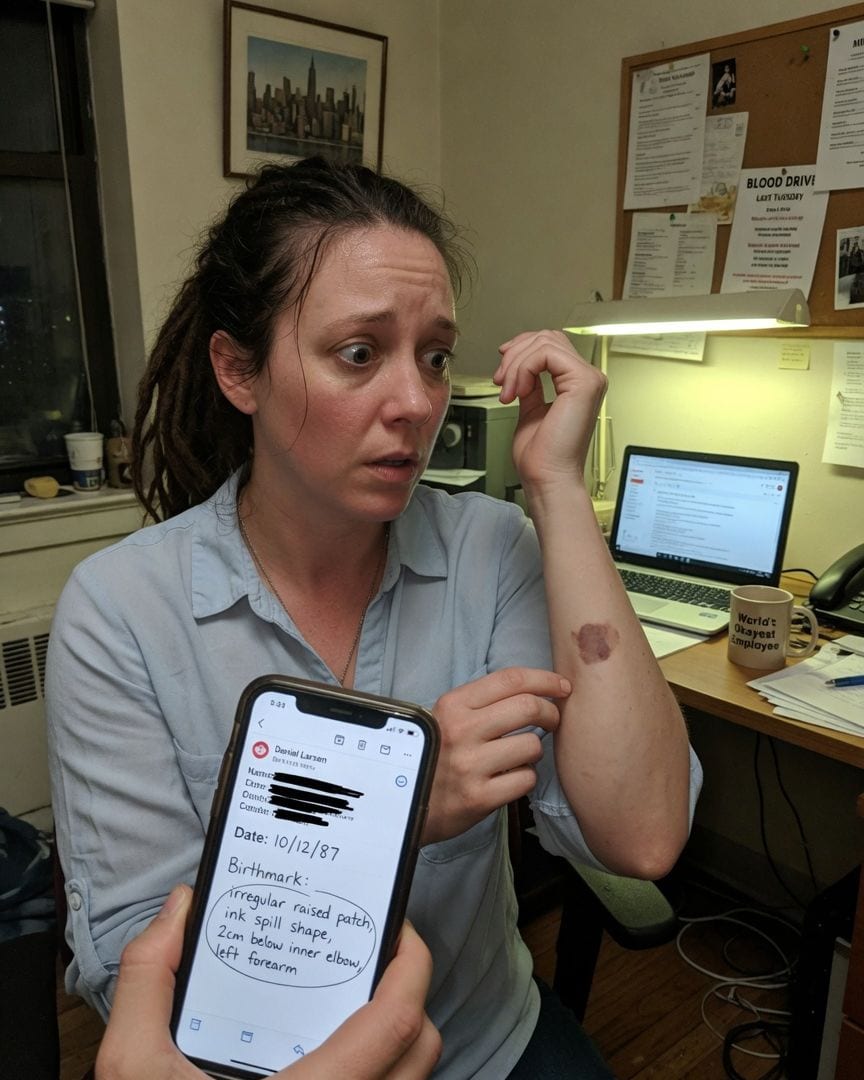
My left forearm has the exact birthmark described on a dead man's blood donor card from 1987, two years before I was born.
I gave blood as a routine civic duty. A call from the blood bank revealed my sample matched a donor from 1987, a man who died that year. But his donor card also detailed a unique birthmark on his left forearm, exactly mirroring my own.
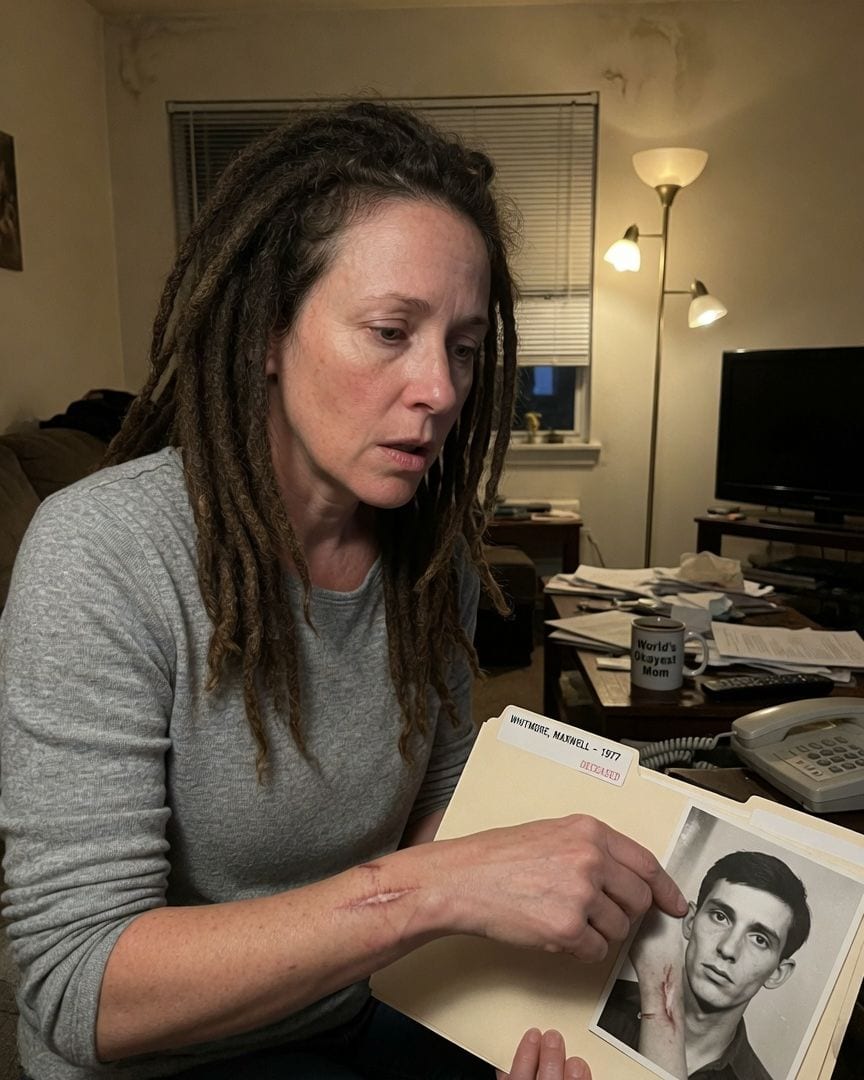
My fingerprints perfectly match a dead man's. He died in prison in 1980, but the bureau insists our hands are identical.
My distant cousin's arrest led to a routine fingerprint check, but the results were anything but normal. A bureau examiner confirmed my prints were identical to an inmate who died in custody decades ago. Then I saw his mugshot: the faint scar on his wrist was the exact same as my own unique birthmark.
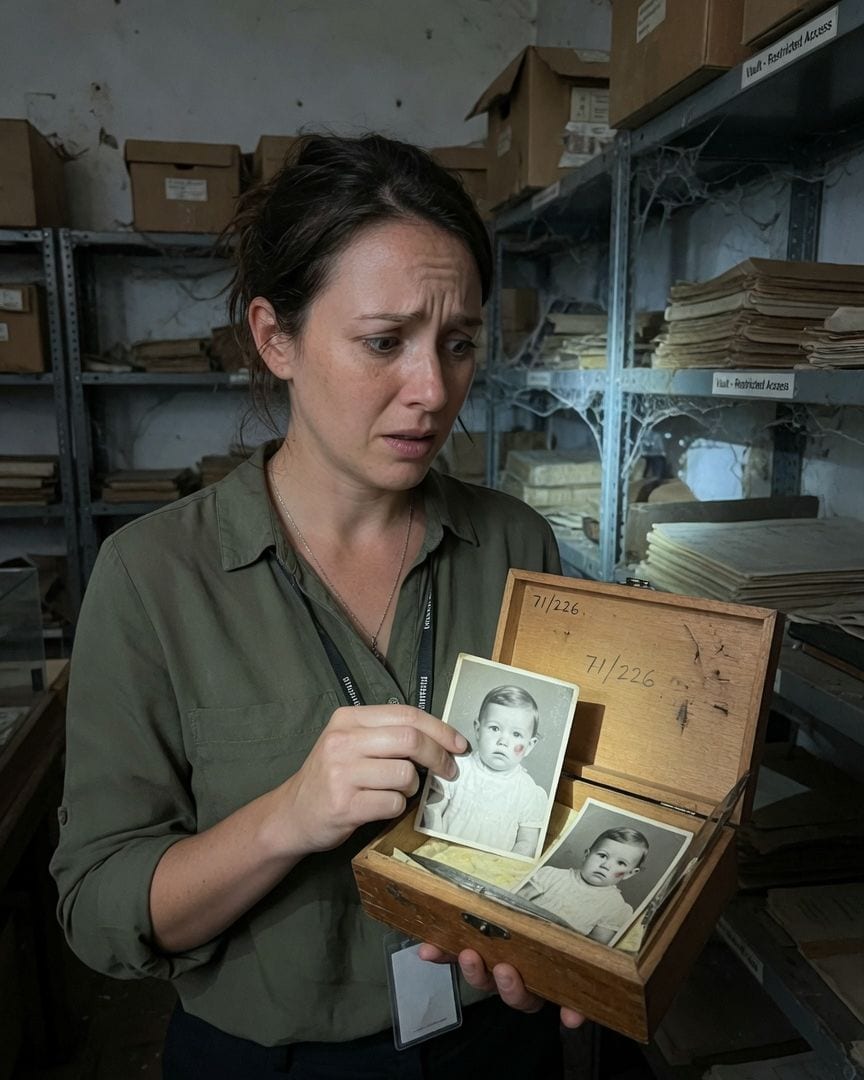
The christening gown in my museum names my own family on a blacked-out donor card. It's the fourth to carry that number since 1919 — and the date it comes back is already typed in.
Cataloguing an antique christening gown, I found its museum card listed a future "return" date, and then uncovered an old box in the vault. Inside, a 1961 photograph of a child bore a birthmark identical to my own, taken at my street address, and chillingly marked "Returned."
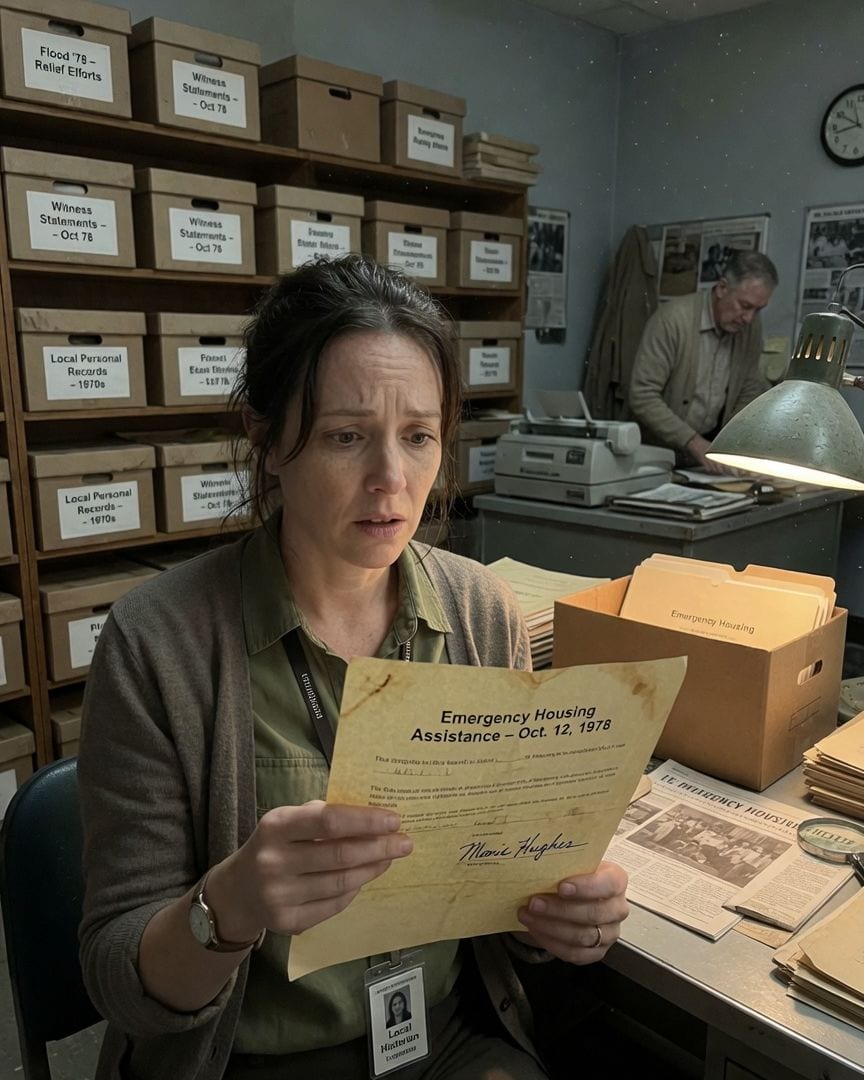
My face, with my mole, in a 1978 flood photo. I was born seven years later.
As a local historian, I was deep in the dusty town archives, researching the devastating 1978 Ohio River Valley flood. My fingers brushed a black-and-white photo, and my breath caught. Staring back from the 1978 scene was a woman with my distinct face, my mole, and my crooked front tooth, seven years before I was born.
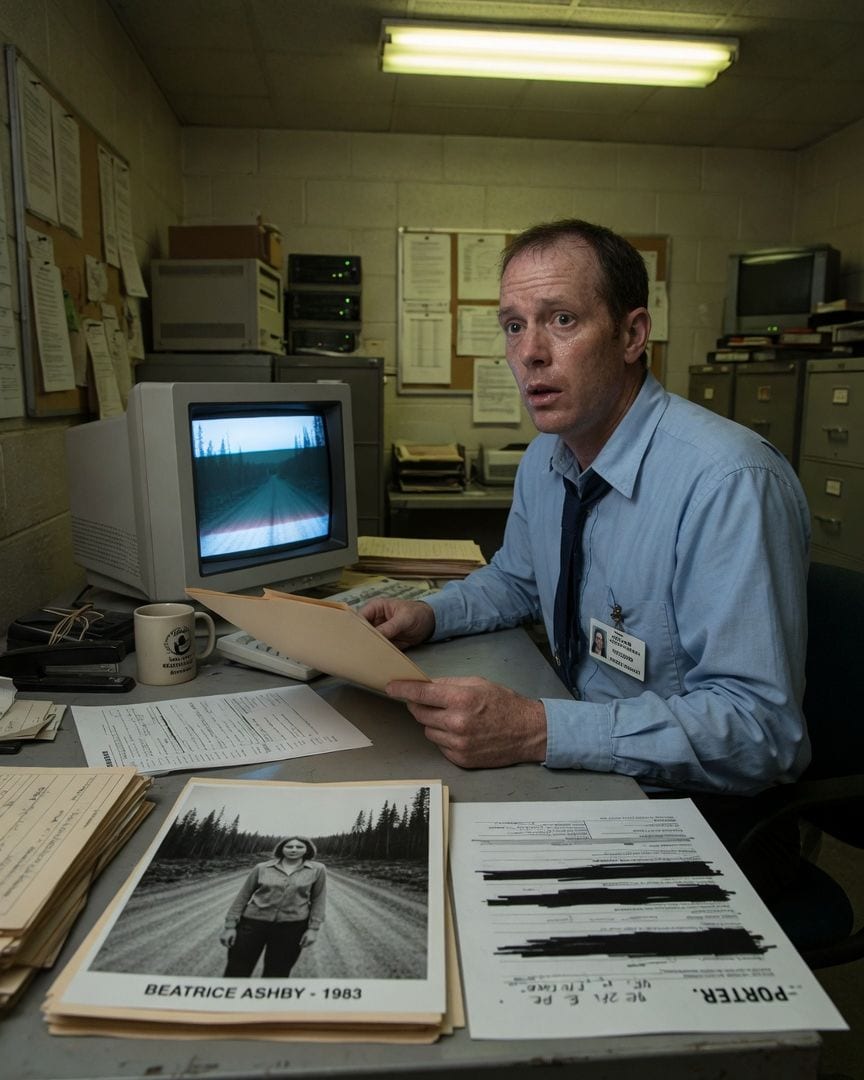
A federal clerk found his dead mother’s photo in a 1983 Cold War file, listed as a witness.
Devon Ashby, a federal records clerk in Missoula, Montana, spent years dismissing a repeated request for a 1983 file. He finally pulled the thin folder, expecting a clerical anomaly, but found a stark black-and-white photograph. It showed his mother, Beatrice Ashby, looking directly into the lens, calm and familiar, yet stamped with the year 1983. Devon remembered her funeral in 1981 and the quiet scrape of earth against her coffin, making her appearance in the official file two years later a chilling impossibility. Further investigation revealed conflicting records and a handwritten addendum with geographic coordinates, hinting at a truth far darker than a simple misfile.
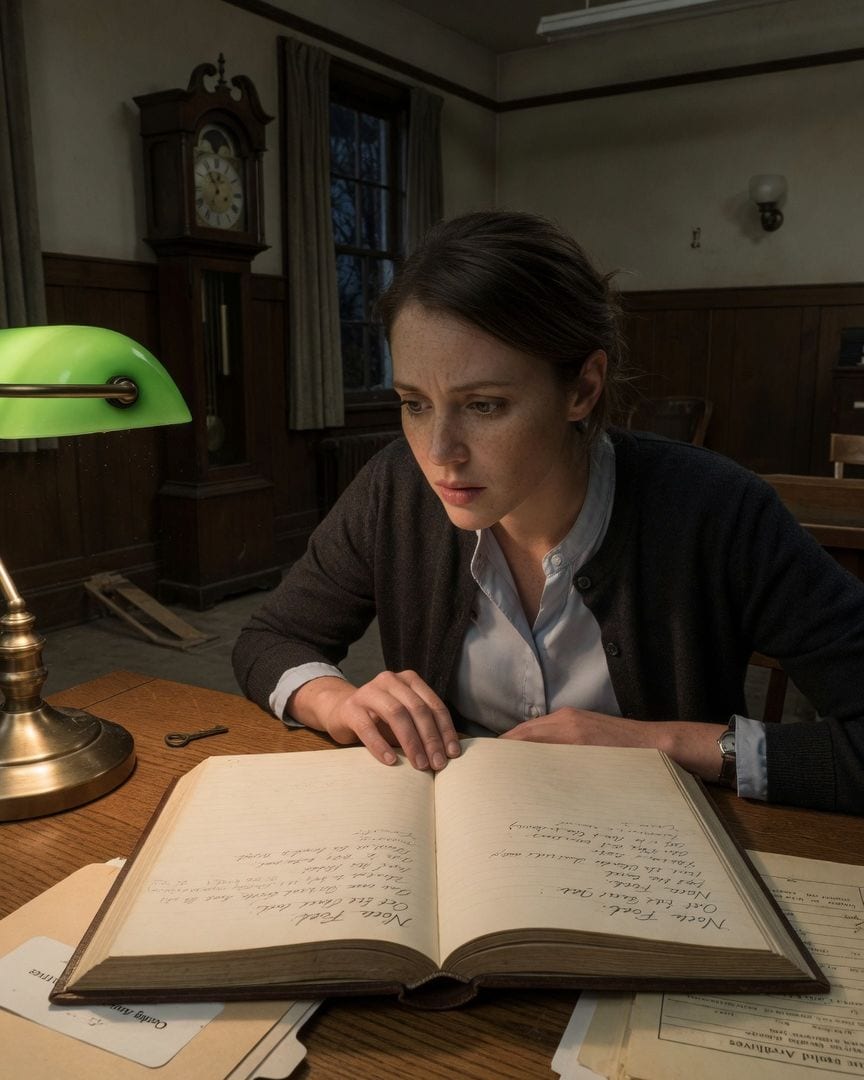
My grandmother’s name reappears in the old book of remembrance — on the same date, same street, every few decades since 1929. A verger’s note reads: 'ask no family.'
As Keeper of the crematorium's Book of Remembrance, my job is quiet and meticulous. But while updating my own grandmother's entry, I found two more Nora Fords listed above hers. Each died on October 3rd, decades apart, with the same address and a strange instruction: 'ask no family.'