My own signature appeared in a museum book from 1974, for my current address. My house wasn't built for another decade.
I received the email on a Tuesday morning, forwarded from the local historical society. Vanessa Porter, a new volunteer, thought she’d found a distant relative in their digitized 1974 museum visitor book.
My first thought was a mistake, a clerical error, nothing more. But I opened the attachment. It was a scanned page, yellowed and faded, the ink a brittle brown.
Yet the signature at the bottom was unmistakably my own looping hand: 'Chloe Bishop'. Beneath it, my current home address was printed neatly: 1422 Willow Creek Lane. I stared at the date: Sunday, March 15th, 1974.
A cold knot formed in my stomach. I hadn't been born until 1994. And the house I’d lived in my entire life, the one listed so clearly on the page, wasn’t built until 1984.
It had to be a mistake, of course. A prank, maybe, though the thought seemed absurd. Who would even bother? But the specific address, the exact date, and my own signature made my fingers tremble on the keyboard.
It felt too precise for an error, too personal for a joke. The museum volunteer just thought she’d found a relative. I knew it was something else entirely.
I drove to the historical society, the email printout clutched in my hand. Vanessa Porter, a bright-eyed young woman barely out of college, greeted me, her enthusiasm bubbling over. “See? The handwriting is so similar!”
she chirped, her finger hovering over the entry in the actual, leather-bound visitor book, open on a display stand. I leaned closer.
The ink was faded, certainly, but the familiar swoop of my 'C', the distinct slant of my 'B', the way the 'p' in Bishop trailed off with a specific loop – it was all there.
My address, 1422 Willow Creek Lane, was undeniably printed below it.
Vanessa explained they’d cross-referenced addresses. That specific house number didn't show up for anyone else in their records from that era. "It's a unique address, really," Vanessa said, beaming, "so it seemed like a clear match." I tried to rationalize.
A distant relative with the same name and a similar hand? Unlikely, my family tree was meticulously documented. A forgery? But why? And why my exact address, ten years before the land was even cleared for construction?
The book felt strangely cold beneath my fingertips, like a block of ice instead of aged leather.
I asked about the house's history. Vanessa pulled up a digital record, confirming the county assessor’s office listed its construction date as 1984. The official record, so clear, only amplified the wrongness of the paper book in front of me.
The gap between what I saw and what I knew was growing, making my breath catch in my throat.
I politely thanked Vanessa, promising to look into my family history further, but my mind was already racing, trying to find another explanation, any explanation, for the impossible signature.
Back home, I obsessively searched online for property records, old maps, anything that might explain the house's phantom existence in 1974. I found nothing. Not a single trace of 1422 Willow Creek Lane before 1984. The digital records were definitive.
Frustrated, I decided to visit the local public library, hoping their physical archives might hold a clue about the land before my house was built. Maybe there was an old farm, a different structure, something.
I spent hours sifting through dusty binders of old zoning maps and building permits, the smell of ancient paper filling my nose. My fingers were grimy.
Deep in a box labeled '1970s Local Applications,' beneath a stack of faded planning documents, I found it: a library card application form. It was yellowed and brittle, like old parchment, but the date, March 15th, 1979, was clear.
And the signature, flowing across the line for 'Applicant's Signature,' was mine. Below it, 'Chloe Bishop, 1422 Willow Creek Lane.'
The form was for a book on local architecture, a book she’d never seen, for a house that wouldn’t exist for another five years.
The library card application felt like a punch to the gut. I carefully photographed it, the flash reflecting off the brittle paper, then put it back, my hands shaking so bad I almost tore it.
I went home and called Emily Jennings, my best friend, trying to keep my voice steady. Emily, a pragmatic accountant who dealt in facts and figures, listened with growing concern. "It has to be a clerical error, Chloe.
Or a very elaborate prank. Who would even do that? What's the endgame?"
Emily suggested checking old phone books, voter registrations, anything that might show another 'Chloe Bishop' at that address. I dutifully tried, but found nothing.
My name and address didn't appear in any official record before 1994, save for these two impossible entries. The dread wasn't a sudden fright, but a slow, creeping chill that seeped into my bones, a kind of internal frost.
I started looking at my own house differently. The familiar walls, usually a source of comfort, seemed to hum with a silent accusation. I checked my property deed again, confirming the 1984 build date.
I even dug out my own childhood photo albums, looking for any anomaly, any detail that might have been out of place. Nothing stood out.
But the feeling persisted, an insistent whisper that my own memories, my own reliable timeline, were being subtly undermined. I realized these weren't isolated incidents. Two impossible records, same date (March 15th), same signature, same address.
It was a pattern, and it was targeting me, or rather, my home. The unease sharpened into a desperate need to understand what was happening, before it consumed my sense of reality.
My investigation grew more intense, bordering on obsession. I returned to the historical society, cornering Vanessa, asking her about other 'anomalous' records, anything out of place. Vanessa looked at me strangely, her initial enthusiasm replaced by a hesitant politeness.
"We get a lot of odd entries, Ms. Bishop. Sometimes dates are misfiled, or handwriting is similar."
But I noticed Vanessa’s eyes lingering on me, a flicker of something unreadable, like she was holding something back, or maybe just creeped out by my intensity.
Later, while researching old property tax records at the county clerk's office, my head buried in microfiche readers, I felt a prickle on the back of my neck.
The air in the usually quiet room seemed to press in around me. I glanced up. A man in a dark suit, whom I hadn’t noticed before, was watching me from across the room, his gaze unnervingly steady.
His face was unmemorable, almost featureless, but his eyes were sharp. When I looked directly at him, he turned away, too quickly, and left the office. The incident shook me more than I wanted to admit.
That evening, back in my quiet house, the silence felt heavy, watchful. I was sorting through my grandmother’s old recipe box – a family heirloom I’d always kept in the kitchen, full of faded cards in her neat script.
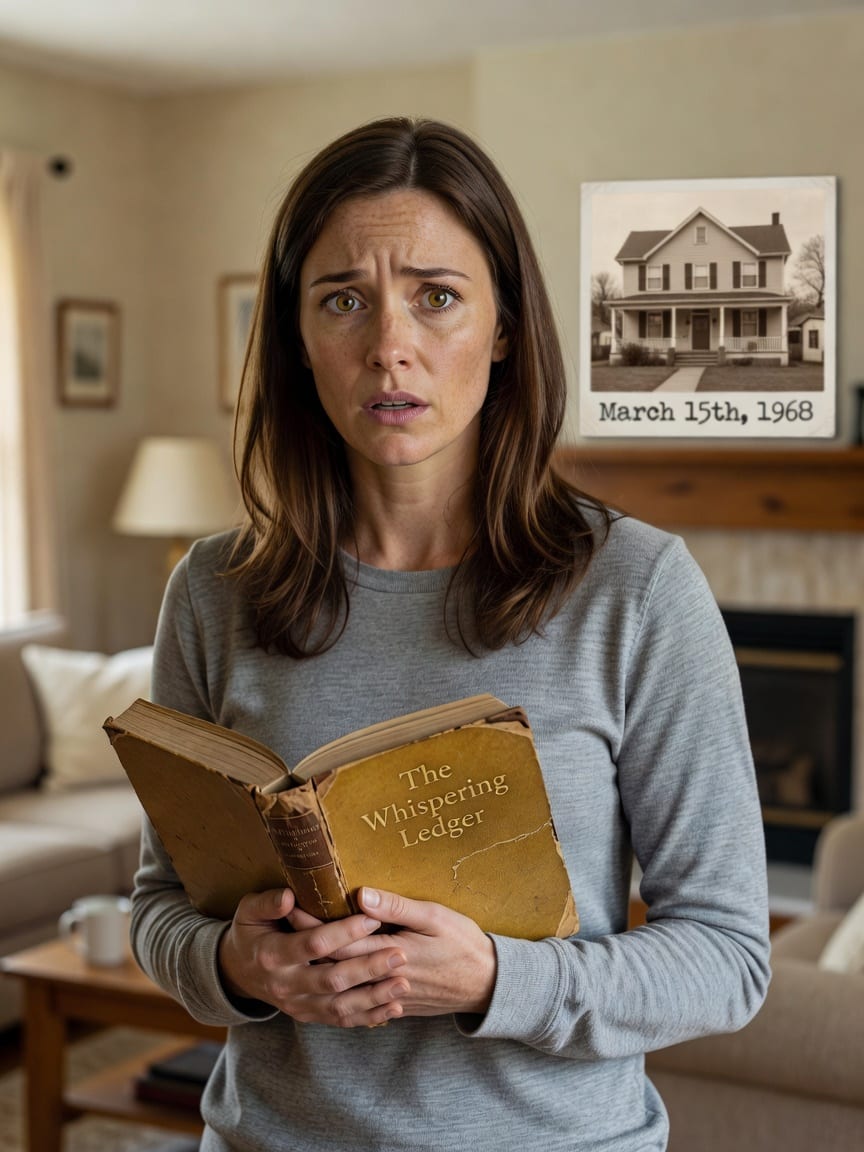
Tucked beneath a faded recipe for apple pie, a recipe I’d made a hundred times, I found a small, sepia-toned photograph. It was of my grandmother, much younger, standing in front of this very house.
The porch swing, the rose bushes, the distinctive window frames – it was unmistakable. But the date scrawled on the back in delicate cursive, 'March 15th, 1968,' was profoundly wrong.
My grandmother hadn't even met my grandfather until 1970, and this house hadn't existed until 1984. The man from the county clerk’s office, Vanessa’s odd glance, and now this impossible photograph within my own home.
The digging was being noticed, and the wrongness was no longer confined to external records; it was subtly invading my personal history, making me question the very foundation of my memories.
Shaken by the photograph, its impossible date burned into my mind, I knew I needed someone with deeper historical knowledge, someone who might have seen things that didn't fit.
I remembered Desmond Mercer, the local historical society's long-retired archivist, a man known for his encyclopedic memory and a wit as dry as old parchment.
I found him at his home, a quiet bungalow overflowing with books, the scent of dust and old paper clinging to everything.
I presented my evidence: the museum book, the library card application, and finally, the impossible photograph. Desmond listened, his expression unreadable, occasionally adjusting his spectacles on his nose.
He took his time, turning each document over, his fingers tracing the impossible dates.
"Curious," he murmured, his voice a low rumble, turning the photo over in his hand. He looked at the date on the back, then at me. "March 15th. Always March 15th, isn't it?"
I froze. My blood turned to ice. "What do you mean, 'always'?"
Desmond sighed, a long, weary sound, pushing aside a stack of old newspapers that looked as ancient as he was. "I've seen things like this over the years. Dismissed them, mostly. Glitches in the matrix, as it were.
A few impossible entries in old town logs, census records, even some church registers. Always March 15th. Always connected to a specific address, or a family line. And the signatures… always similar, but just off."
He stood, shuffling through a precarious stack of boxes in the corner. He pulled out a dusty folder, carefully untying its string. "There was an old property deed from 1932," he said, pulling out a brittle, crackling piece of paper.
"Listed a 'Marcus Brooks' as the owner of your land, 1422 Willow Creek Lane. Except Marcus Brooks only moved to this town in 1948, and the signature on the deed, while vaguely familiar, wasn't his.
It was… a precursor, I always thought. A practice run." He laid it next to the museum book with my signature.
The signature on the 1932 deed was rough, almost childlike in its imitation, a shaky, unformed hand, but the underlying structure, the particular flourish on the 'B' in Brooks, was undeniably echoed in my own signature in the museum book.
It was like a child's attempt at copying an adult's handwriting, then a slightly better attempt, and then...
"It's not just your signature, Chloe," Desmond said, his voice dropping, "It's a signature that's been evolving, perfecting itself, over decades, always on that date, always connected to that patch of land.
It's been writing itself into history, piece by impossible piece. It's building a past that never existed. And now, it's almost perfect."
Desmond Mercer laid out a dozen similar documents on the table, a horrifying tableau: old community logs, property transfers, even a birth certificate amendment from the 1950s, all connected to my address or distant relatives.
Each bore a signature that was a chilling echo of my own, dated on March 15th, years before the named individuals could have signed them, or even existed.
The earliest one looked like a child scribbling, the one from the 50s was getting closer, but still wobbly, unsure. He pointed to the last, faded signature, from a 1979 property tax ledger. "It's almost perfect now, isn't it?
Just like yours. It's been practicing."
He then picked up a faded, hand-drawn map, tracing a finger over my property, 1422 Willow Creek Lane. "There's an old local legend, you see. About a 'Whispering Ledger.'
A piece of the land itself, they say, that remembers all that was, and all that should be. Some say it can be… persuaded to remember things differently. To rewrite the past.
It's always tied to a very specific, very old artifact, usually buried or hidden within the oldest structure on the land." He looked up at me, his eyes grave, the quiet of the room suddenly deafening. "And the signatures?
They're not just practice for your hand, Chloe. They're establishing a lineage. A claim. It's trying to make itself always have been there, always the true owner. And it's almost done. You're the last piece of its puzzle.
The final, perfect signature to seal its fabricated history."
The full horror crashed over me. It wasn't just a pattern of wrongness; it was a deliberate, generational project.
The entity, whatever it was, was using my house as its anchor, slowly, meticulously, overwriting the legitimate history of the land and its occupants.
The evolving signatures were its practice, its slow creep towards a perfect mimicry, culminating in my own. It wasn't just inserting itself; it was replacing.
Desmond explained that the legend of the Whispering Ledger spoke of a physical object, often a stone or a bound book, that absorbed and recorded the 'truth' of the land.
If tampered with, or influenced by a powerful will, it could warp that truth, making its new version undeniable, irrefutable.
"It feeds on the integrity of the record," Desmond said, his voice hushed, "The more it writes, the more real its false history becomes. It wants to become the definitive truth of that place.
And it needs your signature, your living connection to the present, to make its past complete."
I realized that my own reliable timeline, my memories, my very identity, were the final barrier. If it perfected my signature, if it fully wrote me into its impossible past, my own present would become mutable, my reality fragile.
The entity wasn't just an archivist of lies; it was a living, temporal parasite, seeking to absorb and replace the true history of the Bishop family and 1422 Willow Creek Lane with its own fabricated lineage.
The threat was no longer just about a few wrong dates; it was about the erasure of everything she was.
I returned to my house, the Whispering Ledger legend echoing in my mind. Desmond had told me the artifact was often hidden in the oldest part of the structure, sometimes within the very foundation.
I started in the basement, a crawl space I rarely ventured into, usually preferring to forget it existed.
The air was thick and cold, smelling of damp earth and something else, something metallic and ancient, like old blood and cold stone. My flashlight beam cut through the gloom, picking out cobwebs and exposed pipes.
I tapped along the old stone foundation, listening for a hollow sound. There, behind a crumbling section of brickwork near what would have been the house's original cornerstone, I felt a distinct give, a strange vibration against my palm.
With a crowbar I'd grabbed from the garage, I gritted my teeth and began to pry open the wall. Dust and mortar crumbled, falling onto the damp floor.
Inside, nestled in the damp earth, was a small, leather-bound book, its cover unmarked, its pages thick and yellowed, pulsing faintly. The Whispering Ledger.
As my fingers brushed its surface, a wave of disorienting images flooded my mind: fragments of impossible lives lived in my house, faces that weren't mine, all bearing my signature, some faint, some bold, all of them somehow me.
I felt a profound sense of my own history thinning, stretching, becoming transparent, like a sheet of fine silk caught in a strong wind.
The house groaned around me, timbers creaking, a faint, insistent whisper rising from the walls, calling my name, urging me to sign, to complete the pattern.
The air grew heavy, pressing down on me, trying to force my hand towards the book, towards the waiting, blank page I could somehow feel. This was it. The moment of overwrite.
With a surge of desperate clarity, a clarity born of pure terror, I grabbed the ledger and scrambled out of the crawl space. The house seemed to lurch, a low rumble shaking the floorboards beneath my feet.
I felt a tearing sensation, as if a piece of my own memory, a strand of my past, was being ripped away, stretching thin and snapping.
I burst out of the basement, clutching the book, and ran, not stopping until I was far down the street, leaving the house, and its hungry history, behind me.
I never returned to 1422 Willow Creek Lane. I sold it, quickly, without explanation, carrying the museum book and the retrieved Whispering Ledger as my only proof.
Desmond Mercer, shaken by my story and the undeniable evidence I showed him, retired completely, refusing to speak publicly about the 'anomalies.' He just shook his head, his eyes haunted.
The house now stands empty, a 'For Sale' sign slowly fading in the yard. Its history in the county records remains subtly altered, the impossible March 15th entries now woven into its official past, unnoticed by most.
I moved to a new town, started a new life, but the cost was profound.
I carry the knowledge of what the house tried to do, and the lingering sense of something irrevocably lost from my own past, a subtle fraying at the edges of my memory, a constant, quiet hum of wrongness.
I tried to rebuild my family tree, a simple act of reclaiming my roots, but some branches now seemed to twist in ways I couldn't quite remember, details fading like old photographs exposed to too much sun.
I often found myself pausing, a name or a date just out of reach, a phantom gap in my own personal history. I knew the truth, but the world didn't. I knew the cost.
I knew what it felt like to have your past rewritten. The ledger sat locked away, a silent testament. One day, Emily called. "Chloe, I was looking through some old photos, and there's one of your grandmother.
She's standing in front of your old house, but it's dated 1968. You always said it was built in '84, right?"
Chloe paused, a faint, wrong little smile touching her lips. "Is that so?"
If this one got to you
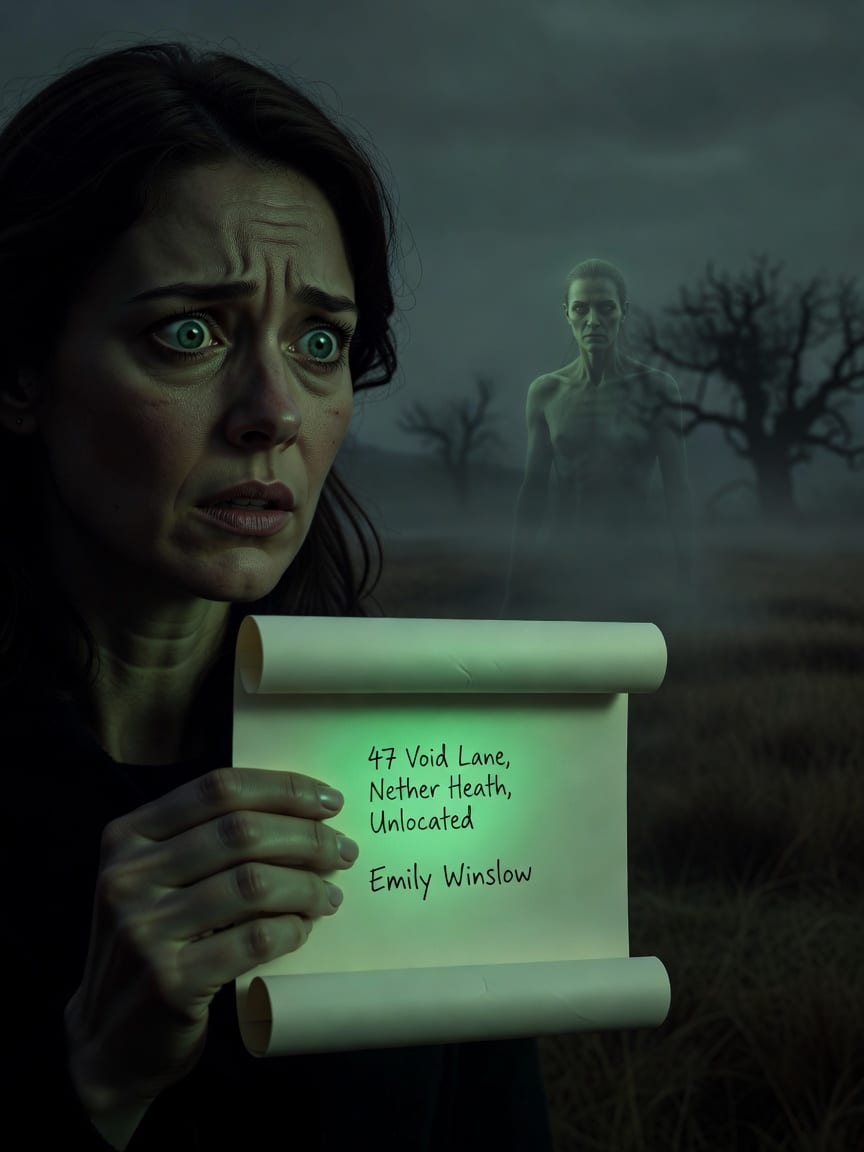
My change-of-address card arrived today. It said I'd moved to a house I'd never seen, on a street that didn't exist. And it was signed with my own hand, a month from now.
A crisp, cream-colored card on my kitchen counter informed me I'd moved to 42 Willow Creek Lane, an address that didn't exist. The signature was my name, Emily Winslow, a chillingly precise ghost of my own handwriting. But then I found an old 1947 ledger, listing 42 Willow Creek Lane and a signature identical to the one on my card.
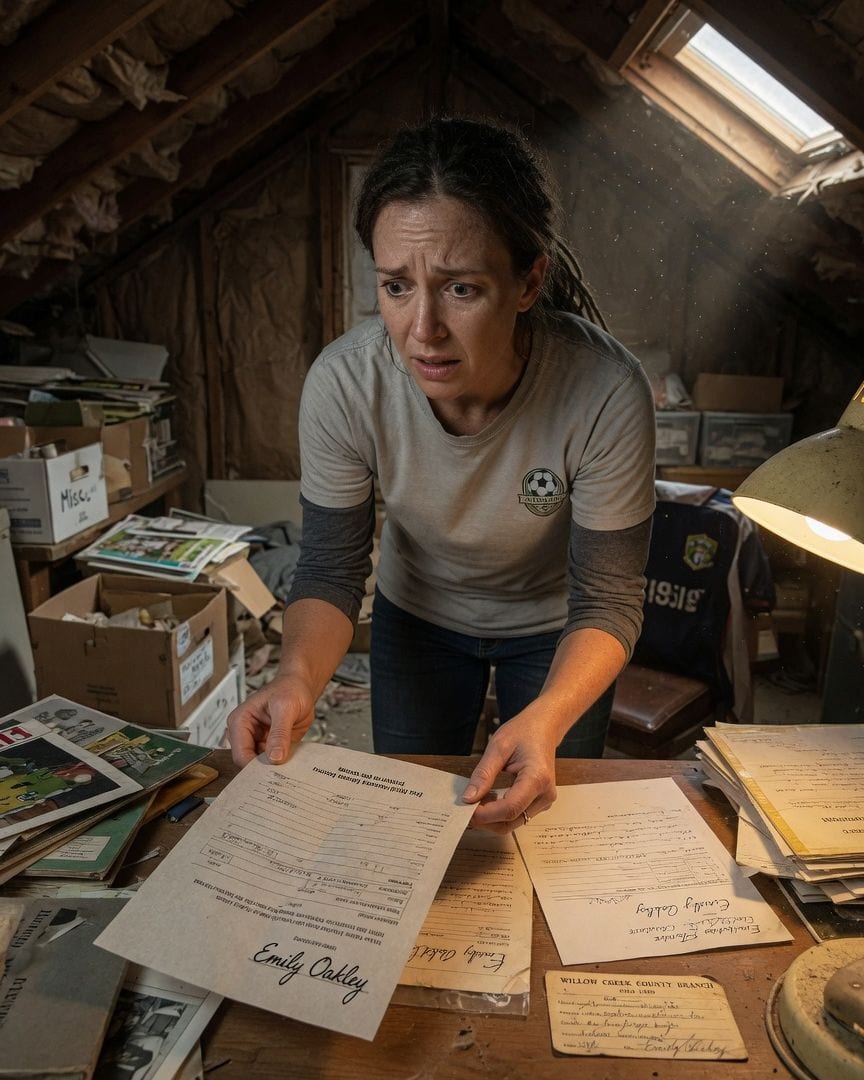
My adult signature is on a library card from 1968, but I only developed that style in the last decade.
I was confused when the school insisted they had my signed permission slip for Russell's trip. It was dated yesterday and bore my maiden name, Emily Oakley, but the flowing signature was undeniably my current style. That particular signature, however, I had only developed a decade after changing my name to Porter.
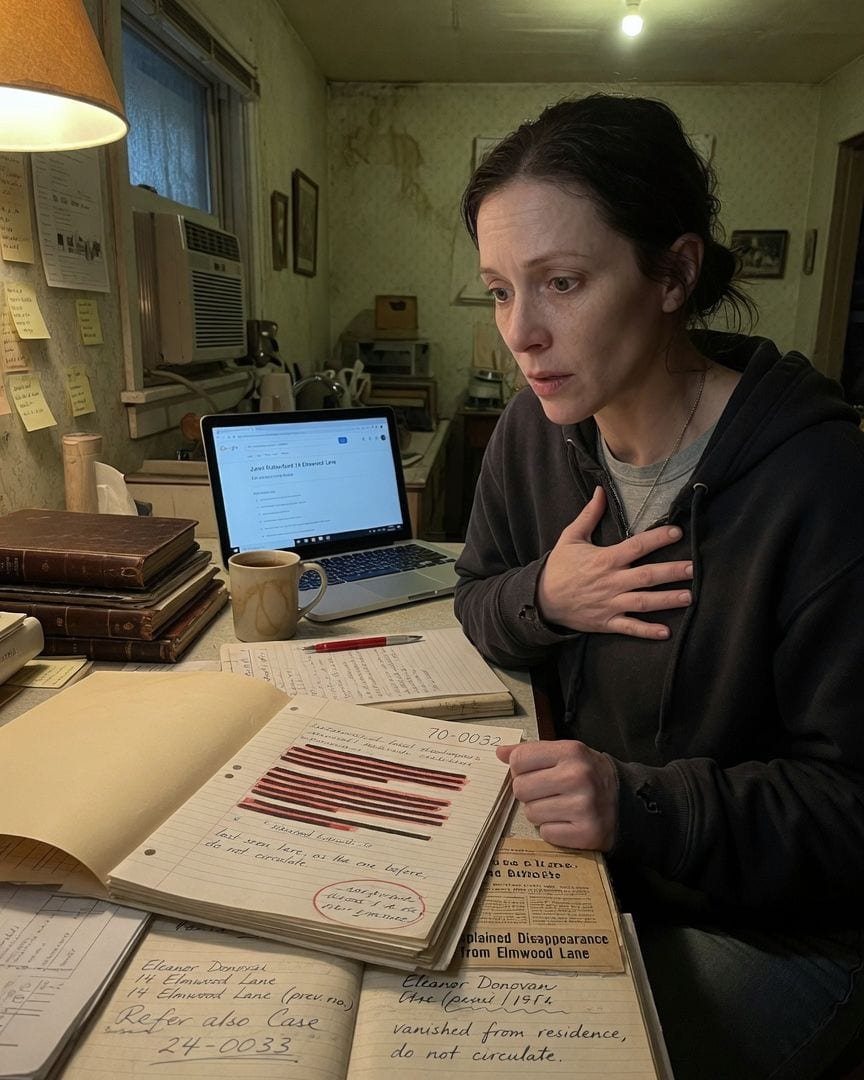
My own address is on a missing person's file from 1970. The blacked-out line names my street. She never lived here.
When my neighbor vanished, I started digging into old local missing persons cases. In a police file for a woman who disappeared in 1970, I found my own address, 14 Elmwood Lane, framing a blacked-out section of the duty log. Janet Rutherford never lived here, and the file contained a chilling handwritten note: 'do not circulate.'
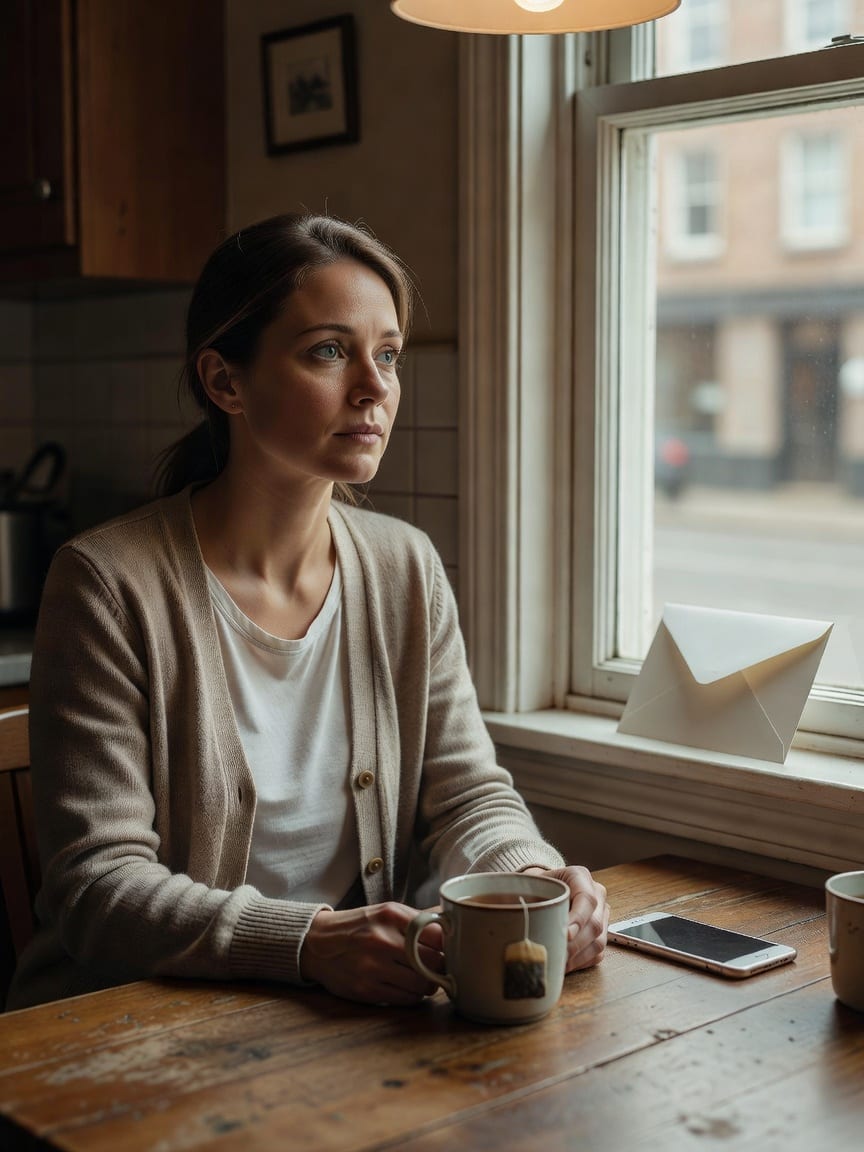
My taxi driver knew my name before I spoke, then apologized for the flight I was going to miss. I was arriving. The cab's plate was scrapped four years ago.
After a strange taxi ride, I received an unsettling birthday card addressed to me. Its return address listed 'Old Mill Road Field,' an empty lot where a mill once stood, and it was postmarked locally. The card arrived four months before my actual birthday, sparking a cold dread I couldn't ignore.
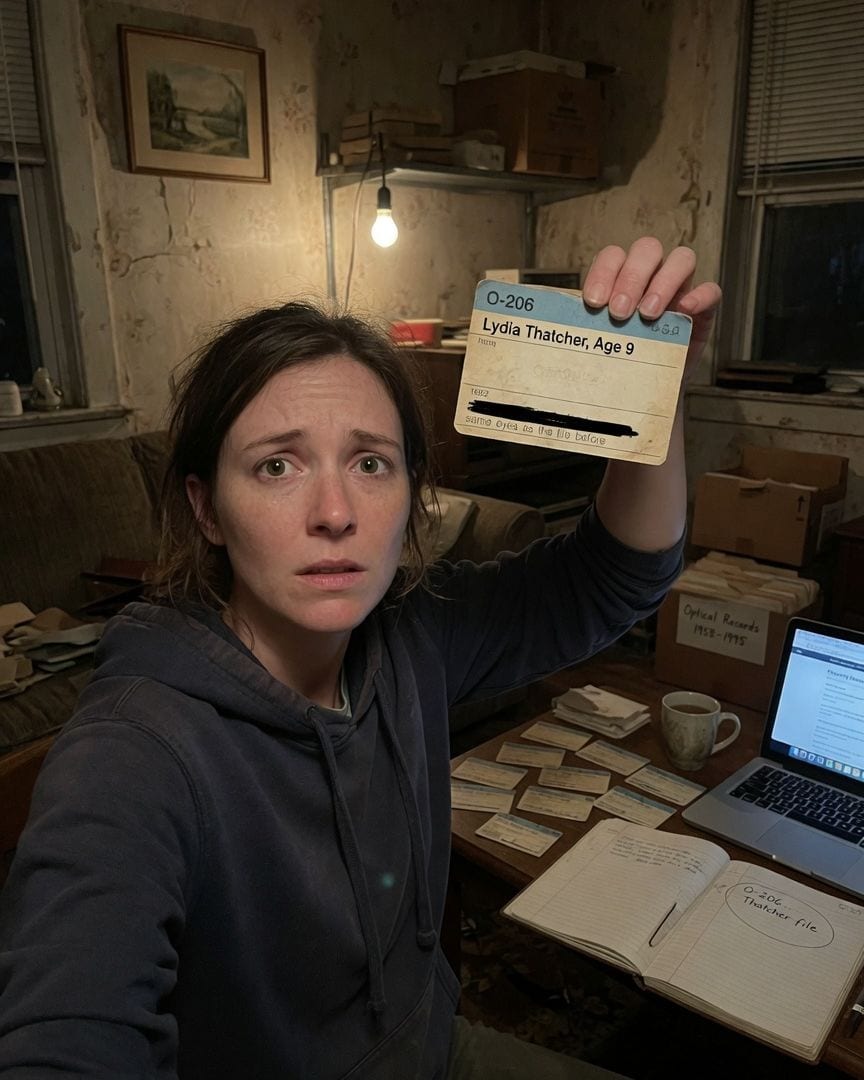
My own optical card is dated 1962, with my name on it. I wasn't born until 1993.
Sifting through old patient files from my former optical practice, I found my own O-206 card. It had my name, Lydia Thatcher, and my current home address printed on it. But the card was dated 1962, decades before I was even born, and a redacted note mentioned 'same eyes.'
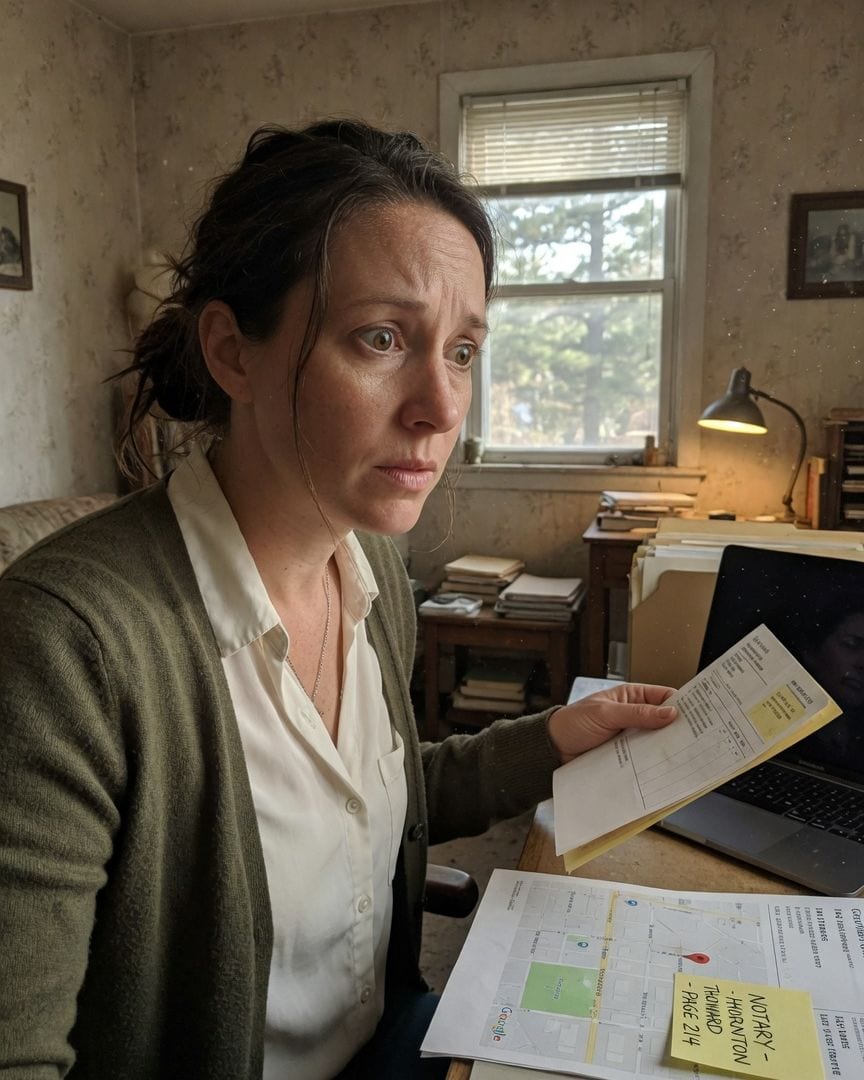
My signature is in a notary's book for an accident I wasn't in. I've never even met the man.
My name is Janet Caldwell, and my life is perfectly ordinary. Or so I thought, until a notary's register revealed my distinct signature on a document. It was dated May 14th, 2014, a day I was confined to a hospital bed, miles away.