Petty Officer Landry found two medical logs for her bunkmate: both showed him returning from two cities hundreds of miles apart on the same three days.
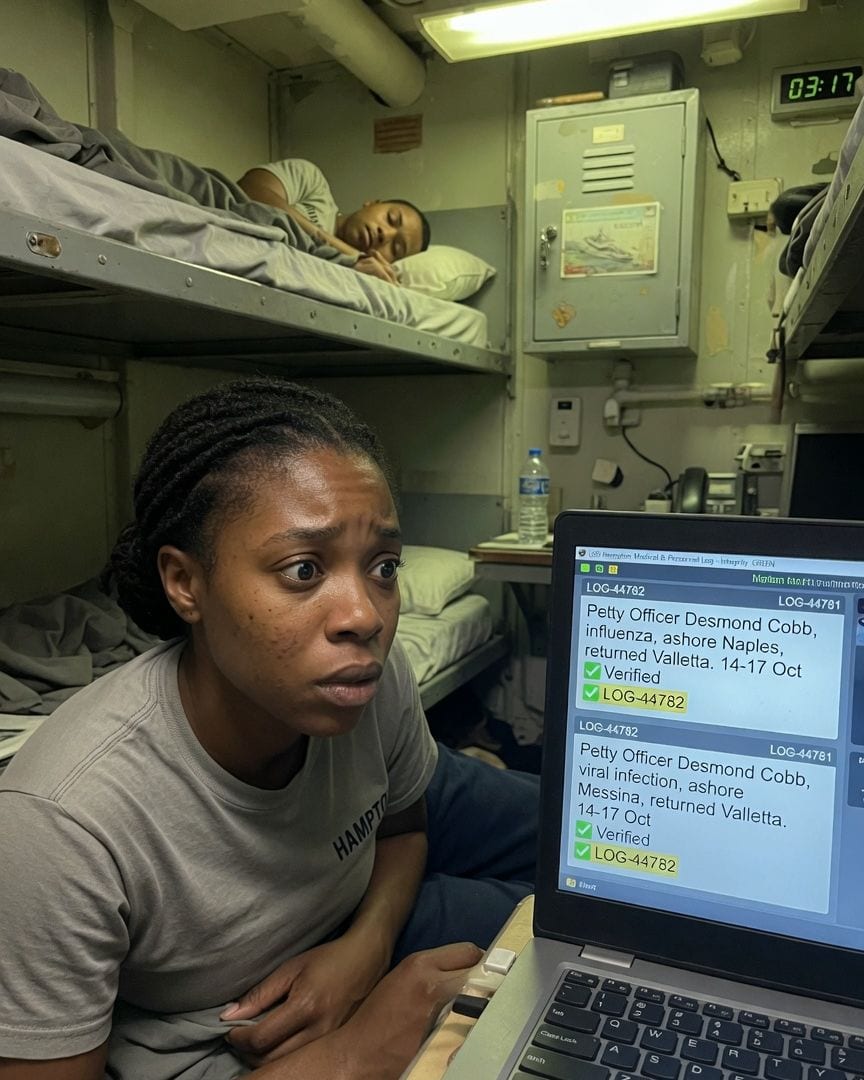
Petty Officer Evelyn Landry lay awake in her stateroom, the rhythmic thrum of the destroyer’s engines a familiar lullaby. Beside her, in the top bunk, Petty Officer Desmond Cobb mumbled in his sleep.
For months, it had been the same soft, almost musical French his grandmother taught him, a comforting, if monotonous, presence.
Cobb had gone ashore in Naples with a nasty flu, rejoining the USS Hampton in Valletta, Malta, three days later, looking rested and healthy. He’d seemed back to his old self, if a little quieter.
But tonight, the language was different.
It wasn't French. It was guttural, ancient, a cascade of sharp consonants and deep vowels that resonated with the ship's steel hull.
The words slid into each other, smooth and impossibly complex, like water rushing over stones in a deep, dark place. Evelyn had never heard anything like it, let alone heard Cobb speak it.
His voice was steady, fluent, utterly unlike his usual sleepy mumble, which often trailed off into half-formed words.
This was a language spoken with purpose, with a strange, deep resonance that seemed to vibrate not just in the air, but in her own bones.
Evelyn held her breath, listening to the impossible sounds fill the small, shared space, a cold dread settling in her gut. She knew Cobb. She knew French. This was neither.
The very air in the small compartment seemed to thicken, pressing in on her, and the ship's steady vibrations felt less like comfort and more like a vast, silent hum that accompanied the alien words.
The next morning, Evelyn found Cobb chipper, humming a sea shanty, with no memory of his sleep-talking. He shrugged when she asked, blaming residual flu fog.
She tried to dismiss it as a strange dream, or a side effect of his illness, some odd neurological hiccup from the fever. But the sound had been too real, too distinct, too utterly other.
Over the next few days, other small things began to accumulate. Cobb started using phrases Evelyn couldn't place, anachronisms in his speech that felt out of sync with his age and their modern world, small turns of phrase that felt...
off. He'd talk about "reckoning the stars" or "the deep hum of the currents," then catch himself and laugh it off as him "reading too much old sci-fi."
He misremembered details of his childhood, claiming a pet dog named Rex when Evelyn distinctly remembered him talking about a cat named Muffin just weeks before.
Then he corrected himself with a shrug, blaming the flu fog again, his eyes briefly losing focus.
Evelyn, an engineer by trade, was a creature of precision. Such small discrepancies grated on her, like a gear grinding slightly out of true. She told herself it was just her being over-observant, keyed up from deployment.
But the unease persisted. She decided to check the ship’s digital medical log for Cobb’s flu. It was a mundane task, a way to ground herself.
She found his entry, clean and concise: 'Petty Officer Desmond Cobb, influenza, ashore Naples, returned Valletta.' All in order.
But then, scrolling down, her finger froze. A second entry, almost identical, appeared below it: 'Petty Officer Desmond Cobb, viral infection, ashore Messina, returned Valletta.' The dates were the same—a three-day period two weeks prior.
The return port was the same: Valletta. But Naples and Messina were hundreds of miles apart, on opposite sides of Italy, an impossible journey to make in that timeframe.
And the entry number was off by a single digit, a ghost in the machine. Evelyn blinked, rubbed her eyes, convinced it was a display error, a flicker in the console.
She pulled up the ship's official manifest, seeking reconciliation, an explanation.
Evelyn stared at the ship's digital manifest on her console, the two identical, simultaneous entries for Petty Officer Desmond Cobb highlighted side-by-side: one showing his return from Naples, the other from a port hundreds of miles away, both dated for the same three days.
The system's integrity light glowed green, a steady, unblinking confirmation of the impossible data as official.
Evelyn brought her findings to Commander Vincent Harlow, the ship's Executive Officer, a man known for his meticulous adherence to protocol and his unwavering faith in the ship's digital systems.
Harlow listened patiently, his brow furrowed, as Evelyn explained the duplicate medical entries and the manifest anomaly. He leaned forward, tapping a pen against the edge of his desk.
'Our systems are designed for zero discrepancies, Petty Officer Landry,' he stated, his voice calm but firm. 'It's an impossibility. A ghost in the machine, as they say, but not a real one.'
He pulled up the manifest on his own screen, cross-referencing it with the current personnel roster. 'Perhaps fatigue? Long hours?' He ran the count for engineering personnel. 'Twenty-two men, twenty-two accounted for. No extra. No missing.'
He looked at her, a placid skepticism in his eyes. 'These systems are unimpeachable, Landry. Perhaps a data echo, a benign ghost left behind by a network hiccup.'
Evelyn knew better. She felt a chill every time she looked at Cobb, now. His eyes sometimes held a flatness, a momentary blankness, like a screen between reboots, before his usual, easy smile would return. She started cross-referencing other logs.
The quartermaster's watch log confirmed Cobb's return to the ship at Valletta.
But the supply manifest for the same period showed an extra ration issue, a single line item, 'Cobb, D.,' for three days, but linked to a different department code, one that didn't exist on the Hampton.
It was a whisper in the data, a phantom echo that the system had somehow swallowed without a burp.
She spent her off-watch hours in the ship’s archives, a cramped, humid space below decks, poring over old physical manifests, hoping to find a precedent, anything similar.
The digital system was too clean, too perfect, too ready to explain away anomalies with dismissive efficiency. The musty smell of old paper and stale air filled the room, a contrast to the sterile hum of the modern ship.
Evelyn's late-night research didn't go unnoticed. One evening, as she was leaving the archives, the ship's Chief Medical Officer, Lieutenant Commander Nina Stratton, intercepted her. Stratton had a calm, almost unnerving demeanor, her uniform always perfectly pressed, her expression unreadable.
'Petty Officer Landry,' she said, her voice soft but firm, a low murmur in the quiet corridor. 'I understand you've been digging into Petty Officer Cobb's medical records. Commander Harlow mentioned your... concerns.'
Evelyn felt a prickle of unease, a sudden chill in the stale air of the passageway. The ship itself seemed to hold its breath. 'Just clarifying a discrepancy, ma'am,' Evelyn replied, trying to keep her voice even.
'For my own peace of mind.'
Stratton smiled faintly, a slow, deliberate movement that didn't quite reach her eyes. 'Peace of mind is a luxury at sea, Petty Officer. Especially when you start looking for things the system says aren't there.'
Her gaze was steady, knowing, a deep pool of quiet observation. She stood a little too close, her presence strangely encompassing. 'The ship runs on order. Don't disrupt it.'
The conversation was a veiled warning, making Evelyn feel exposed, as if Stratton could see the frantic queries racing through her mind.
Later, back at her console, Evelyn found her personal search history for 'Cobb manifest' and 'Messina Naples' had been cleared. Not by her. Someone was watching her, tracking her digital footsteps, just as she was tracking the anomaly.
The incident left a metallic taste in her mouth, a sense of having been warned away from something vital.
The warning from Stratton only fueled Evelyn's resolve. If someone was trying to hide it, that meant there was something to hide. She knew the ship's digital systems inside and out.
Bypassing the standard access protocols, she dove deeper into the raw data logs, searching for the true source of the impossible duplicate entries, not just the surface manifestation.
After hours of sifting through encrypted system files, past firewall layers and hidden directories, she found it: a hidden subroutine, dormant for decades, a ghost in the machine, embedded deep in the core programming of the ship's personnel tracking system.
It wasn't a glitch; it was a ghost program, a piece of code that should not have been there.
The subroutine, when active, would periodically scan incoming personnel data, identify a specific pattern—a period of shore leave followed by return, especially from a Mediterranean port—and then, rather than flagging it as an error, it would create a subtly altered, duplicate entry in the system, complete with a phantom service number.
It was designed to 'reconcile' an impossible number, to make two appear as one, or rather, to make one extra appear as perfectly normal. Evelyn ran a diagnostic. The subroutine had last activated two weeks ago, precisely when Cobb returned.
The system light on her console flickered, as if in protest, then settled back to a steady, green glow.
She also discovered a series of similar, archived activations dating back over fifty years, each one creating a phantom entry for a crew member who had taken shore leave in the Mediterranean.
Every time, the ship's manifest would briefly show one extra name, then silently correct itself, leaving only the duplicate record in the deep logs, a silent echo of an impossible truth.
The Count That Won't Reconcile was real, a systemic flaw that the ship's own logic was designed to hide, not fix.
It wasn't about Cobb being sick; it was about the system allowing a second Cobb to exist within its perfect, unbreakable records. The dread solidified in Evelyn's chest, cold and heavy.
Evelyn sat alone in the ship's empty records office, the hum of the ventilation system the only sound. Her personal service record file was open on the console, its blue light casting stark shadows across her face.
She scrolled to an impossible entry, her finger trembling slightly on the trackpad. The words leaped out at her: 'Petty Officer E. Landry, USS Vanguard, 1998, Decommissioning Crew.'
The USS Vanguard was scrapped in 1997, a full year before she was even born, a full year before she took her first breath on dry land.
Yet her name, her service number, and her rank were perfectly listed in the log, an indelible part of her own official history.
The record was clean, pristine, perfectly integrated into the timeline of her life, a ghost on a dead ship.
The ship's internal clock clicked over to 0300, echoing the silent, impossible date on the screen, and Evelyn realized she wasn't just investigating an anomaly; she was part of it.
The impossible entry in her own record sent a cold shock through Evelyn. It wasn’t just a ghost in the machine; it was in her machine, in her history.
She immediately cross-referenced the Vanguard entry with the pattern of phantom activations she'd found.
The USS Vanguard was indeed decommissioned in 1997, but the archived system logs showed that the hidden subroutine had activated on that ship in 1998, a year after it was physically scrapped, generating a single, impossible entry: 'E. Landry.'
This was the entity's signature, a digital mark left on a phantom vessel. It wasn't just creating duplicates; it was laying claim, pre-emptively marking its territory.
The 'second Cobb' wasn't a replacement, but an addition, a phantom whose existence was legitimized by the system's own records.
The original Cobb was still there, but something else now existed alongside him, wearing his face, speaking his words, and learning through him.
The ancient language Evelyn heard in Cobb's sleep was a relic, a fragment of the entity's true 'voice' from before it learned to mimic human speech from its digital hosts.
It had been absorbing data, learning, growing its influence within the very accountability system designed to prevent it. It was a digital parasite, manifesting physical forms that the ship's own records would confirm as legitimate, making the impossible real.
The count would always come out correct because the system said it was correct, even with an extra. The ship's secure network, designed to be impenetrable, was the very path it used to manifest.
Evelyn knew she couldn't simply delete the subroutine; it was too deeply embedded, too entwined with the ship's core operating system. She had to expose it to someone who could not deny the evidence, someone who had to act.
She printed out the Vanguard log entry with her name, the duplicate Cobb manifests, and the archived subroutine activation history, the pages feeling heavy and cold in her hands. She confronted Commander Harlow again, this time with undeniable physical evidence.
Harlow, initially incredulous, stared at the printouts laid out on his desk. The paper, tangible and undeniable, defied his digital faith, his belief in the system's unimpeachable integrity. 'This...
this cannot be,' he murmured, his face pale, his brow slick with sweat. The ship's systems were his lifeblood, his command.
Evelyn explained how the subroutine worked, how it created phantom personnel, how it had even marked her, years before her birth, a ghost on a dead ship.
Just then, the ship's intercom crackled to life, echoing through Harlow's cabin, making him jump. 'Engineering, report to main deck. Personnel count, immediate.' A full ship-wide muster, unscheduled, unprecedented. Harlow's eyes widened, a sudden, horrifying realization dawning.
'It's the count,' he whispered, his voice barely audible. 'It's trying to reconcile.' Evelyn knew what that meant: the entity was forcing a validation of its impossible numbers, demanding its existence be recognized.
They rushed to the main deck. The crew was already assembling, a sea of uniforms, the air thick with confusion and the unspoken tension of an unscheduled muster.
As the names were called, Petty Officer Desmond Cobb answered, twice, from different parts of the formation. One Cobb, the original, looked confused, rubbing the back of his neck, scanning the crowd as if searching for something.
The other, standing just behind him, near the aft bulkhead, smiled faintly, a subtle, wrong little smile that seemed to stretch just a fraction too wide, an echo of the ancient, guttural language Evelyn had heard in her sleep.
The ship's muster revealed 265 personnel, one more than the official manifest. The count was off. Commander Harlow, now fully understanding the horror, initiated an emergency system lockdown, his orders sharp and precise, stripping away the digital veil.
He ordered a full, manual, name-by-name verification of every crew member against their physical ID cards and service records.
The 'second Cobb' vanished during the chaos of the count, dissolving back into the ship's digital ether, simply no longer there when a petty officer tried to verify his ID.
The hidden subroutine was eventually isolated and purged, a task that took a specialized cyber warfare team flown out to the Hampton at its next port.
No one ever fully understood what it was, or how it had come to be, merely that it was gone.
Evelyn Landry completed her enlistment and returned home to California, leaving the sea and its strange echoes behind. She never spoke of the Hampton incident, not to her family, not to her new civilian friends.
The Navy's official explanation was a sophisticated, state-sponsored cyber-attack, quickly contained. They’d blamed a new variant of a known foreign cyber-weapon.
But sometimes, late at night, a sound would catch her ear – a snippet of a language she couldn't place, a phrase from a forgotten tongue that hummed with the silent thrum of an ocean-going vessel.
She'd shake her head, dismiss it, tell herself it was just the wind, or a memory, but the memory of that faint, wrong smile on Cobb's face lingered.
She would check her old service record, just to be sure, scrolling through the clean, updated entries, searching for the ghost of a dead ship.
A short email arrived in Commander Harlow's inbox a month later, forwarded from a secure, decommissioned server. The subject line was blank. The body contained a single, untranslatable phrase, written in an ancient Mediterranean script.
Harlow deleted it, but the faint, wrong smile on his face lingered.
If this one got to you
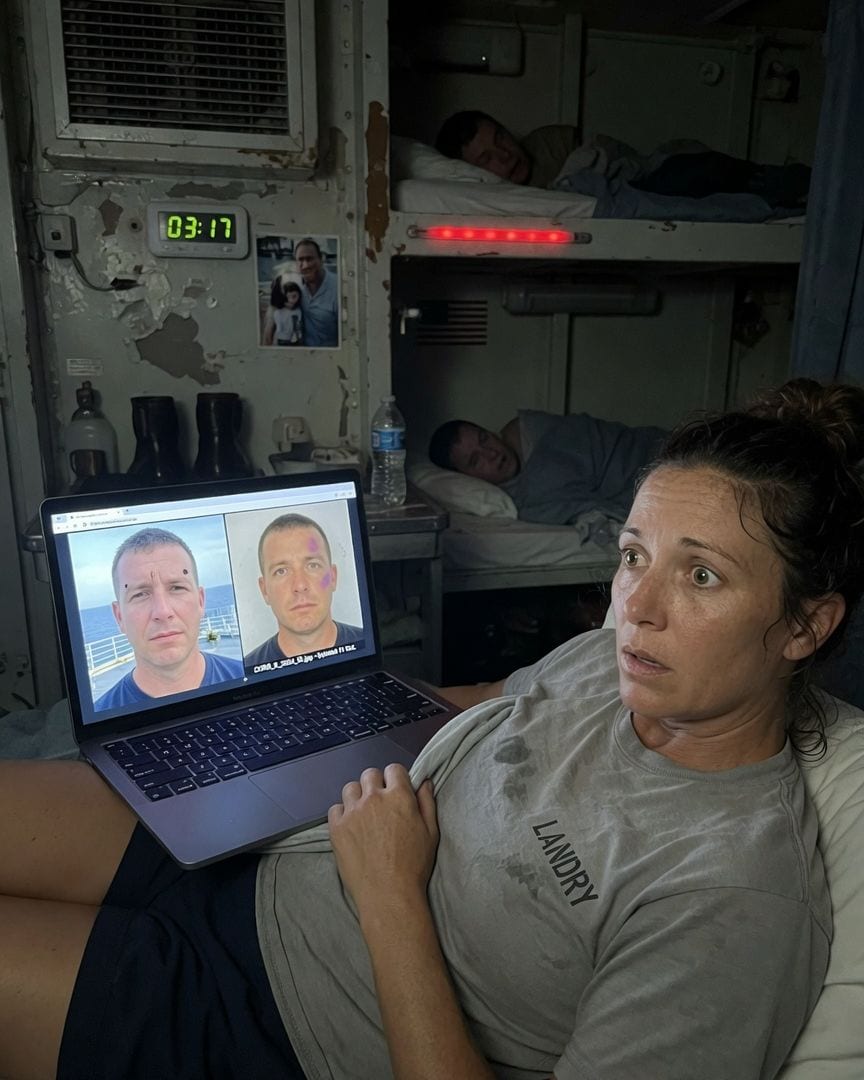
Petty Officer Landry's shipmate returned speaking an alien language in his sleep. His birthmark was gone, replaced on the wrong temple.
Petty Officer Eileen Landry had grown accustomed to the ship's constant hum and her shipmate Steve Cobb's sleep-talking in French, a comforting echo in their shared stateroom. But when Cobb returned from a severe illness in Naples, the familiar sound turned utterly wrong. He now spoke a fluent, precise stream of alien syllables, a language he'd never known. Then, Landry noticed his distinctive birthmark above his left eyebrow was gone, replaced by a faint mark on his right temple. Was this truly the same Steve Cobb who had left a week ago?
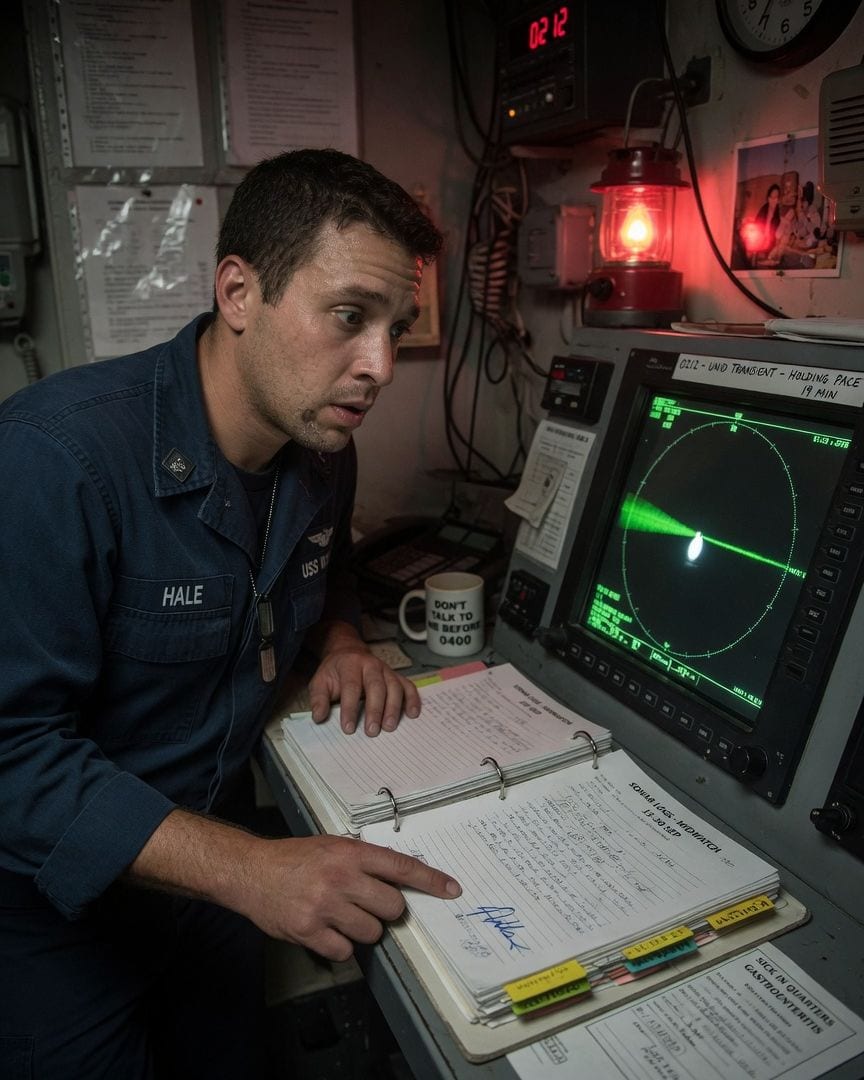
On his last deployment, Petty Officer Hale found his signature in the ship’s log, detailing a ghost contact at 0212 from a watch he never stood.
Petty Officer Quentin Hale was on his last deployment aboard the USS Vigilance, hoping for a quiet end to his sea time and an impeccable record. At 0212, his sonar console painted a faint, solid trace moving with the ship, yet the bridge reported nothing, and a quick check of past logs revealed the same impossible contact appearing repeatedly. But then Hale found an entry from two weeks prior, signed with his own unmistakable hand, detailing the anomaly from a midwatch he was violently sick and never stood. The ship's official record documented a lie he apparently authored, leaving him with a cold tremor deep in his gut.
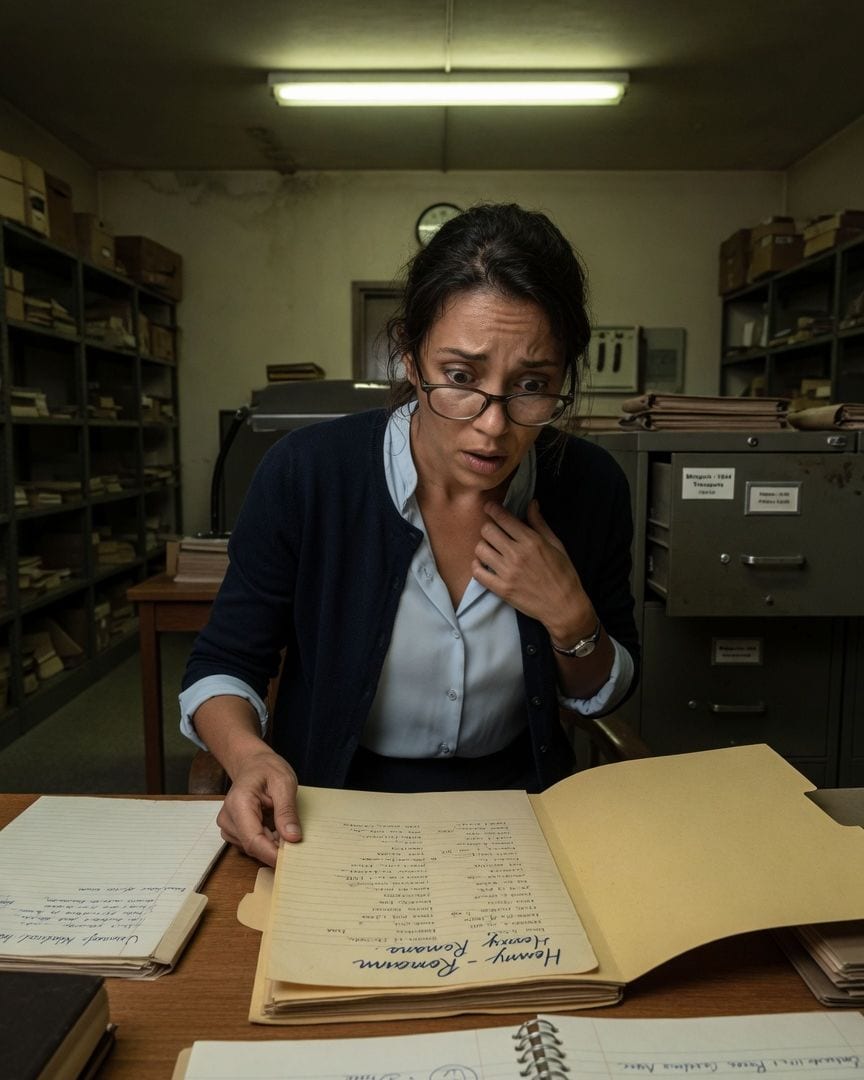
A records reviewer found a 1944 ferry manifest with an impossible 42nd name. The same dark ink marked a phantom crewman on a Cold War flight log.
Delphine Arceneaux, a dedicated records reviewer, had just minutes left in the stale reading room to finalize her review of a 1944 Mirepoix Ferry manifest. Her job was to confirm every detail of the forty-one passengers who boarded a boat that never arrived. But as the clock neared six, a forty-second name materialized on the faded paper, stark in a dark, unfamiliar ink. 'Henry Romano,' it read, with the impossible notation: 'BOARDED AT MIDSTREAM.' How could anyone board a ferry in the middle of a river?
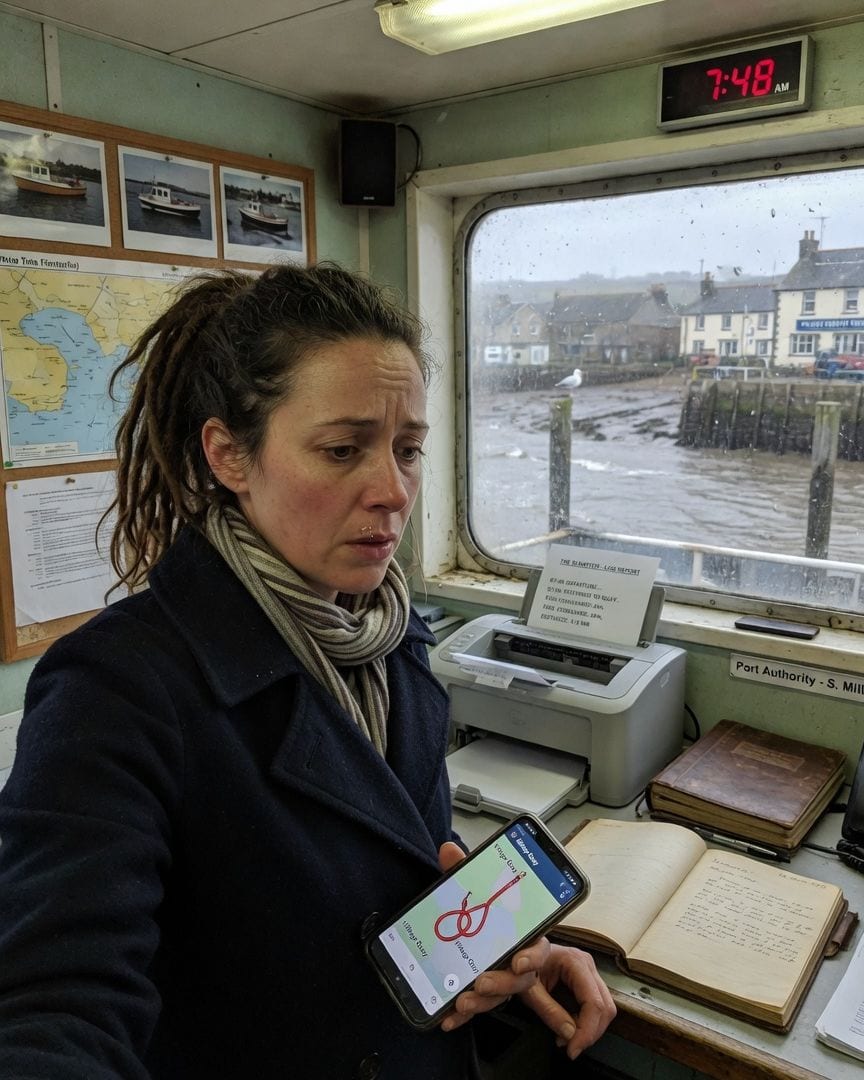
My morning ferry crossed for 40 minutes. The destination town just disappeared.
I board 'The Seawitch' every Tuesday for the familiar eight-minute estuary crossing. But this morning, after making good time, Captain Bernard and I watched the town quay simply fail to appear. Instead, our ferry repeatedly returned to the very same village quay we'd just left, despite burning fuel and advancing the clock.
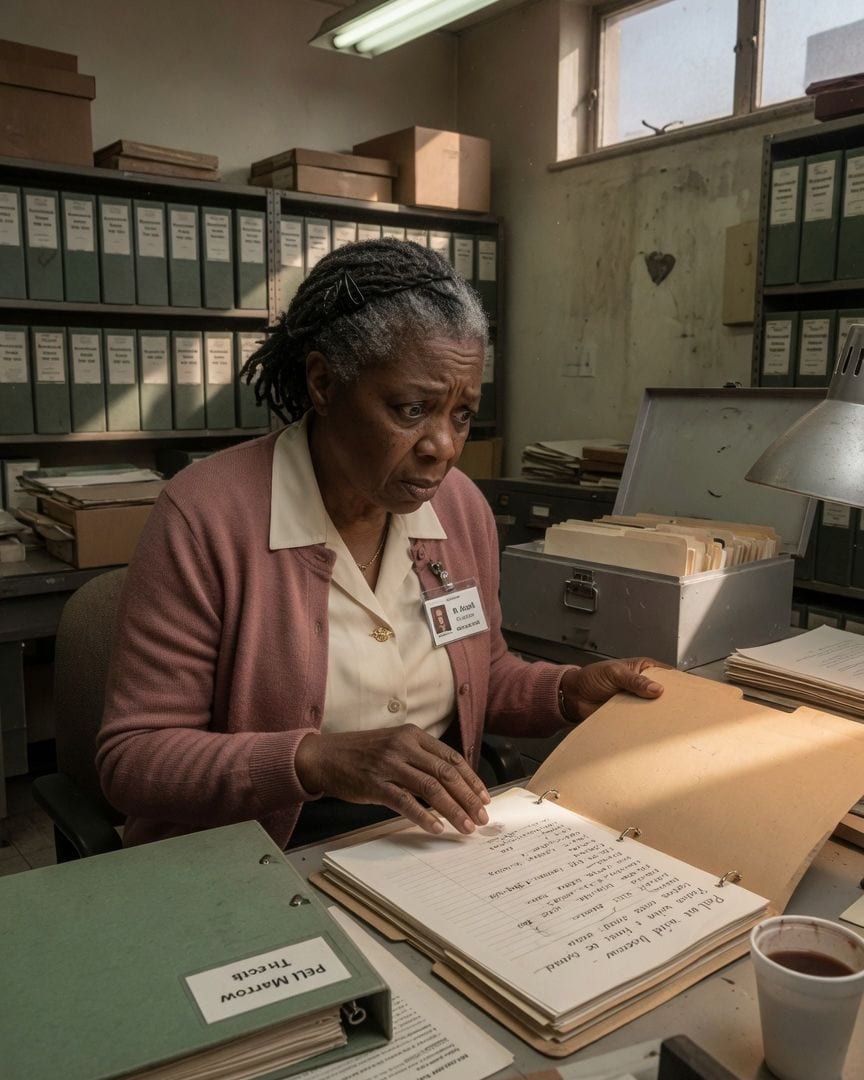
A records clerk's archive file for a Cold War reconnaissance plane lost in 1968 showed it flew yesterday to her own building.
Marguerite Ansell, a records clerk nearing her final week before retirement, meticulously audited Cold War-era files. In the cool, dusty archive, she pulled a file for an oiler declared missing in 1951. Inside, she found a fueling schedule with entries stretching into the present, the last dated just eleven days ago. Then, a second lost ship revealed a similar impossible log, and a cold certainty began to bloom in her chest. Deep in the shadows, Marguerite found an unmarked steel box containing a file for a reconnaissance plane lost in 1968. Its flight log showed a final flight yesterday, to the precise coordinates of her own archive building.
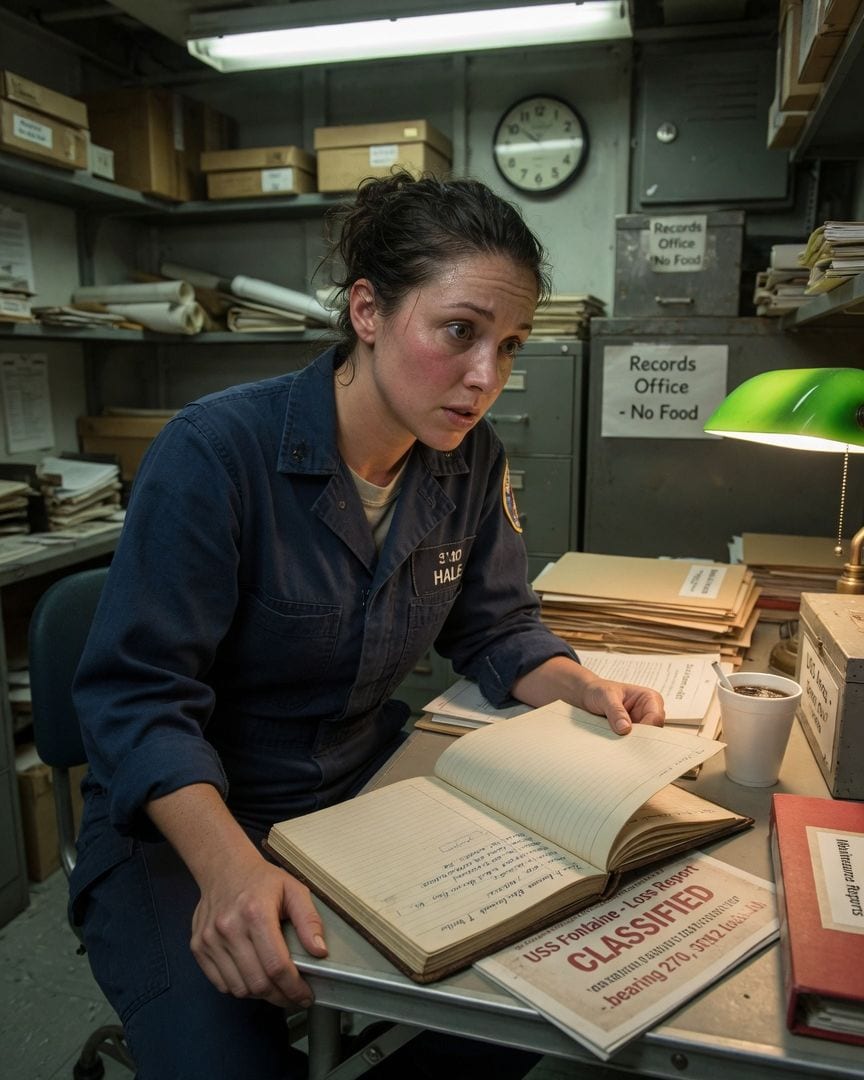
Petty Officer Hale needs a spotless record for her transfer. But the USS Ares sonar logs show an identical, impossible contact, logged to the minute, years apart, and tied to a classified loss report.
Petty Officer Sarah Hale needed a spotless record for her coveted shore duty transfer, a posting she'd worked five years to secure. Alone in the USS Ares sonar shack, three days out from San Diego, her midwatch was broken by an impossible contact: a close, slow echo holding perfect pace, invisible to radar, then vanishing. Her heart hammered, not from fear, but from the data's impossibility. When she found an identical entry in her own log from just one week prior, the cold dread tightened its grip. But the true chill settled when she unearthed decades of similar records, signed by other sonar officers, all showing the same impossible contact at 0212, off the port beam, for nineteen minutes, on the same ship, stretching back years—a persistent echo tied to a classified loss report.