A Petty Officer's sensor logged a man-sized heat bloom at 0405. The camera saw nothing, and a journal from 1978 logged that same trace, then a Cold War Petty Officer gone MIA.
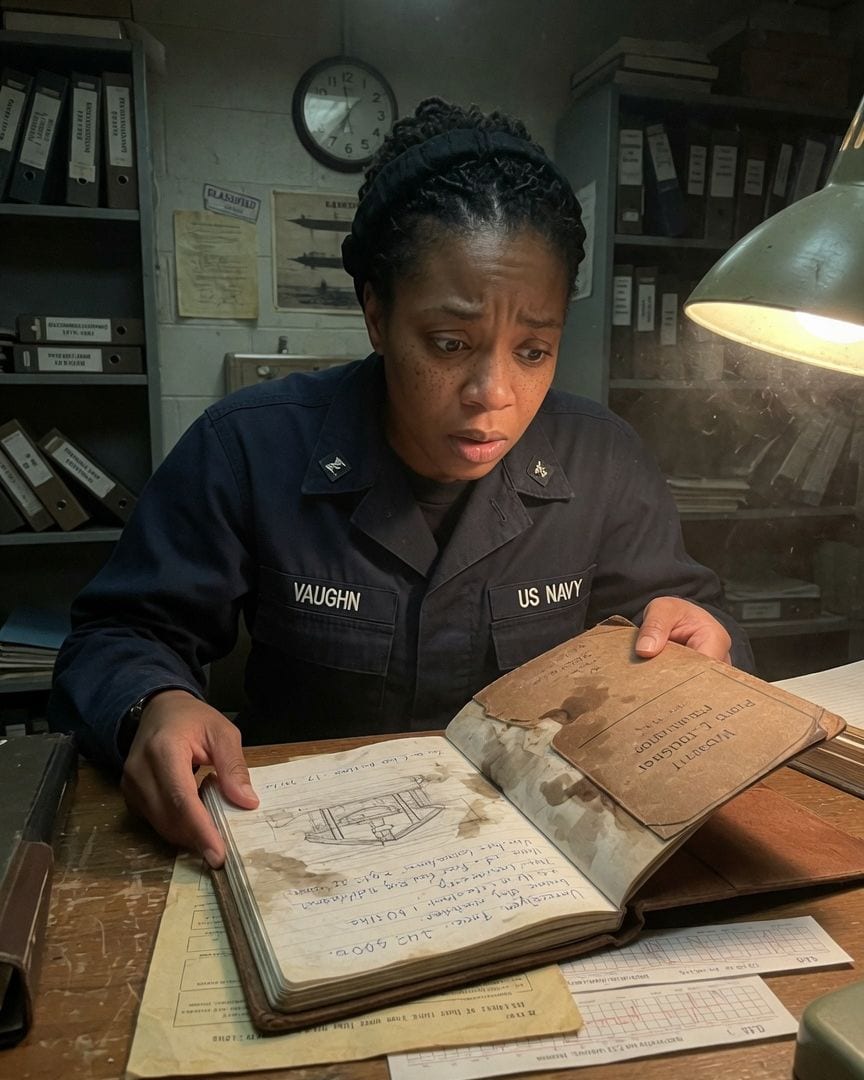
The pier at Naval Submarine Base Bangor was a place of meticulous order, every cable run, every light fixture, every sensor calibrated to military precision. Petty Officer Second Class Rose Vaughn, on the midnight watch, knew its rhythms by heart.
At 0405, the IR sensor mounted on the caisson logged its usual heat bloom. A man-sized signature, moving steadily along the concrete path, then vanishing at the pier's edge. Vaughn had seen it countless times.
She’d always chalked it up to a steam line, a phantom warmth in the cold, damp pre-dawn.
But the watch camera, aimed at the exact same span, showed only wet concrete and mist, nothing but the usual morning gloom. No figures, no shimmering heat haze, just an empty pier.
She’d pulled the thermal history a month prior, a mundane check-off on her nightly rounds. The bloom had walked that identical path, 0405 every night, all the way back to the day the sensor was installed five years ago.
And the steam line beneath it? Cold and dry for over a year, according to the last maintenance report. The system swore it was there, but the world swore it wasn’t.
The discrepancy had become a quiet, persistent itch at the back of her mind, a tiny fracture in the absolute order she was trained to uphold.
Vaughn began her own, unofficial investigation. She started with the sensor's maintenance logs, cross-referencing them with the pier's structural blueprints. No anomalies, no faulty wiring, no known thermal leaks that could account for such a consistent, localized signature.
She even requested a temporary bypass on the steam line for an 'inspection,' confirming it remained dormant. Her superior, Chief Petty Officer Dean Sutton, raised an eyebrow but signed off, used to Vaughn's thoroughness.
Next, she dug into archived incident reports for the pier, hoping for a historical event—a fire, a chemical spill—that might leave a lingering thermal signature. She found nothing for the last two decades.
Her search led her to the base’s oldest archive, a dusty, rarely accessed room in the administrative building. Buried beneath stacks of decommissioning paperwork, she discovered a faded, leather-bound logbook, its cover brittle with age.
It wasn't an official base log, but a personal journal, dated 1978, with a faded 'Property of PO F. Pennington' scrawled inside. Pennington. The name sparked a distant memory of a base legend, a Petty Officer who’d vanished decades ago.
Flipping through the waterlogged pages, Vaughn found cryptic entries detailing 'experimental thermal unit deployment' and 'unresolved traces.' Then, near the back, a rough sketch of the pier's caisson, with coordinates marked.
And a final, chilling entry, dated October 17, 1978: 'Last patrol, Unit 7. Unresolved trace, 0405 hours. Pennington, F. Status: MIA.'
Vaughn’s heart pounded. The coordinates on the sketch perfectly matched the path of the thermal bloom. The date, 1978, was decades before the current IR sensor was installed. And '0405 hours.' The exact time.
This wasn't a glitch, or a faulty steam line. This was a pattern, a meticulously replayed moment from the past. PO Pennington, MIA.
The logbook was his last known record, and it spoke of an 'unresolved trace' at the precise time and location of the nightly bloom.
Vaughn stared at the faded, waterlogged page, the handwritten coordinates tracing a familiar path along the pier’s caisson. The page then listed a single, cryptic entry below the coordinates: 'Unresolved trace, 0405 hours. Unit 7, offline.'
The next morning, Vaughn bypassed Chief Sutton and requested access to all classified files pertaining to 'Operation Caisson Echo' and the disappearance of PO Franklin Pennington in 1978.
Her request, usually subject to weeks of bureaucratic delays, was surprisingly granted within hours, likely due to the ongoing decommissioning efforts. The files arrived in a heavy, sealed box, marked 'Restricted – Decommissioning Review Only.'
Inside, she found a trove of heavily redacted documents: after-action reports, witness statements, and technical specifications for an early, experimental thermal imaging system, referred to as 'Unit 7.'
The reports confirmed Pennington was part of a covert team testing Unit 7 on the pier, tasked with monitoring subtle thermal signatures in the water.
His last recorded activity was a solo patrol on the caisson at 0400 hours, searching for a suspected thermal anomaly. He never returned.
The experimental unit was recovered, but Pennington was never found, his case officially closed as 'presumed lost at sea.'
Vaughn meticulously cross-referenced the technical schematics of Unit 7 with the pier’s current sensor array.
She discovered a faint, almost invisible data port, long since painted over, that connected to a decommissioned auxiliary power conduit running directly beneath the current IR sensor.
It was a relic, a forgotten piece of infrastructure from Unit 7's original installation. The pieces began to click into place.
The old system, perhaps, had left a permanent, self-sustaining thermal imprint, a 'ghost in the machine' of Pennington’s last patrol. She contacted Greta Pierce, a retired base archivist known for her encyclopedic knowledge of the base's obscure history.
Pierce, a spry woman with sharp eyes, confirmed the existence of 'Caisson Echo,' a top-secret project that had been abruptly shut down after Pennington’s disappearance. 'They never could figure out what he was tracking,' Pierce mused, 'or what took him.
The official line was 'equipment malfunction and rough seas,' but nobody truly believed it.' Vaughn showed her Pennington's logbook. Pierce's eyes widened. 'This... this was never in the official records. A personal journal. Franklin was a meticulous record keeper.
He was trying to prove something.'
Vaughn’s deep dive into the archives didn’t go unnoticed. After a week of late nights, she returned to her bunk to find a single, unmarked manila envelope tucked under her pillow.
Inside was a faded photograph: a grainy thermal image, clearly from Unit 7, showing a distinct, man-sized heat bloom on the caisson. But this image was different.
Within the bloom, a faint, almost imperceptible shape was visible, like a hand reaching out. And scrawled on the back, in an unfamiliar, shaky hand: 'He’s still looking.' A chill ran down her spine. Someone knew what she was doing.
The next day, while reviewing sensor calibration logs, Chief Sutton called her into his office. His face was unreadable. 'Petty Officer Vaughn, I’ve been getting some… inquiries about your recent requests. Digging into 'Caisson Echo' is sensitive.
That’s a closed file.' Vaughn explained her findings, the historical connection, the recurring thermal signature. Sutton listened, his expression hardening. 'A ghost, Vaughn? Is that what you’re telling me? We’re decommissioning this base.
The last thing we need is a spook story getting out.' He paused, leaning forward. 'I’m ordering you to drop this. Focus on your actual duties. And if you receive any further… unsolicited mail, you report it to me immediately.
Understood?' Vaughn nodded, but the warning only solidified her resolve. The anonymous photo, Sutton’s veiled threat – they were proof she was on the right track. Someone was trying to stop her, but someone else was trying to help.
Later that night, as she walked back to her quarters, she felt eyes on her. A shadow detached itself from the side of a building, moving quickly towards her. Vaughn froze, her hand instinctively going to her sidearm.
It was Greta Pierce, her face etched with urgency. 'They’re watching you, Petty Officer,' Pierce whispered, her voice barely audible. 'They never wanted this to be found. Franklin… he was trying to warn them.'
Greta Pierce led Vaughn to a secluded, forgotten corner of the base, a small, overgrown shed. Inside, covered in tarps, sat a rusted, boxy piece of equipment. 'Unit 7,' Pierce stated, her voice hushed. 'They never truly decommissioned it.
Just… buried it.' Pierce pulled out a heavy, leather-bound binder from beneath a workbench. 'Franklin’s original research. The classified reports were sanitized versions.'
The binder contained detailed schematics and operational logs for Unit 7, far more comprehensive than the official files. 'Franklin believed the thermal anomalies he was tracking weren't just residual heat, but… a kind of echo.
A persistent data imprint of extreme events. He thought Unit 7 could capture them.' Pierce pointed to a section detailing a 'thermal imprint capture event' on October 17, 1978, at 0405. 'This is when Franklin disappeared.
He wasn't just searching for an anomaly. He became one. Unit 7 captured his own thermal signature, his last patrol, as he vanished.'
Vaughn absorbed the truth. The heat bloom was Pennington, trapped, eternally replaying his final moments, a glitch in the system's absolute accounting. 'But why now?' Vaughn asked, 'Why for the last five years?' Pierce sighed.
'They tried to erase Unit 7 from the records, but they couldn't. The auxiliary power conduit you found? It was never fully severed.
Five years ago, a new IR sensor was installed, its frequency close enough to Unit 7’s residual field to 'wake up' the imprint. It's like a ghost in the machine, running on phantom power, perpetually searching for what it lost.'
Vaughn looked at the old equipment, then back at the logbook entries. The 'unresolved trace' wasn't just an anomaly; it was Pennington’s attempt to log himself in, to be accounted for. 'He’s trying to finish his patrol,' Vaughn murmured.
'He’s trying to report back.'
Vaughn spent the next few days meticulously comparing the Unit 7 logs with the classified incident report. The inconsistencies were glaring. Whole sections of Pennington’s research were missing from the official record, particularly his theories on 'persistent thermal echoes.'
Then, in an appendix detailing initial search party deployments, she found a cryptic entry. It wasn't a name, but a unique alphanumeric code, typically assigned to a specific thermal imaging unit for tracking.
Next to it, in tiny, almost illegible script, was an annotation: 'PO Vaughn, R. (then-assigned to Unit 7 analysis, service number prefix: 897-XX-XXXX).' Rose Vaughn’s hand trembled. Her own service number prefix. It was impossible.
She hadn't been born until years after 1978. There was no other 'PO Vaughn, R.' assigned to thermal analysis at that time.
The system, designed for absolute accountability, had somehow linked her—her specific identity—to a missing person from decades ago, a ghost that was now searching.
Her breath caught, a cold dread seeping in as she realized the ghost on the pier wasn't just a record, but a search, and it had somehow been searching for her all along.
Vaughn returned to Greta Pierce, showing her the impossible entry. Pierce’s face paled. 'They called it 'temporal resonance,'' she whispered. 'Franklin theorized that if a thermal echo was strong enough, persistent enough, it could 'latch' onto a future, compatible signature.
A kind of pre-echo.' She explained that Pennington, in his final moments, was desperately trying to log his findings, to complete his mission.
His thermal echo was not just a replay; it was an active search, seeking a 'receptor' to finally deliver its message, to be accounted for.
And the system, in its relentless pursuit of complete data, had identified Vaughn’s unique thermal and biometric signature – her service number, her specific heat profile – as the closest match, the 'R. Vaughn' that Pennington’s echo was subconsciously seeking to complete its report to.
'He wasn't looking for a Petty Officer Vaughn,' Pierce clarified. 'He was looking for you. The system, in its broken state, knew you were the one who could finally close his file.' The full horror coalesced.
The military's obsession with perfect accountability had, in its failure, created a self-sustaining loop, an eternal search. And now, Vaughn, through no fault of her own, had been designated as the missing link, the final piece in Pennington’s unresolvable equation.
The dread wasn't just about a ghost; it was about the system itself, a vast, unfeeling machine that would not let go, and had now entangled her in its decades-long error.
She was the one assigned to complete the watch that wouldn't end.
Vaughn knew what she had to do. That night, she stood on the pier, alone, at 0400 hours. The mist was thick, the air biting cold.
She clutched a small, tarnished object: Pennington’s service tag, found hidden in a forgotten locker in Unit 7’s shed. Greta Pierce had told her it was the only personal item of his ever recovered.
As the digital clock on her wrist ticked to 0405, the IR sensor flared. The familiar heat bloom materialized, moving along the caisson, a man-sized void of warmth in the cold. Vaughn walked towards it, holding out the dog tag.
'Petty Officer Pennington,' she said, her voice steady despite the tremor in her hands. 'This is your final report. Accounted for.' The thermal bloom paused, a shimmering, indistinct form.
For a terrifying second, Vaughn felt an icy cold pass through her, a wave of profound fatigue and desperation. It was like a memory that wasn't hers, a primal urge to complete a duty.
Then, slowly, the bloom began to dissipate, not fading, but dissolving, as if finally released. By 0406, the IR sensor showed nothing but the ambient temperature of the wet concrete. The pier was empty. The watch was finally over.
Vaughn stood there for a long moment, the cold seeping into her bones, but the dread in her chest had eased, replaced by a profound, unsettling stillness. She had closed the loop. She had accounted for the unaccountable.
She had survived the watch that wouldn't end.
The thermal anomaly never reappeared on the pier’s sensor logs. The decommissioning of Naval Submarine Base Bangor continued, accelerating in the final months. Rose Vaughn completed her tour, her request for transfer granted without question.
The incident report on Franklin Pennington was officially closed, marked 'Accounted For – Decommissioning Review.' Greta Pierce retired fully, her knowledge of the base's shadows now an unwritten history.
The shed housing Unit 7 was eventually demolished, its contents disposed of as hazardous waste.
Years later, Rose Vaughn, now a civilian, occasionally found herself standing by the water’s edge in the pre-dawn hours, staring out at the dark, vast expanse. The habit had never left her.
She’d learned to live with the quiet knowledge, the understanding that some gaps in accountability could never truly be filled, only momentarily appeased. She had closed Pennington’s loop, but the system itself remained, vast and unforgiving.
One night, a news report flashed across her screen: an old, decommissioned Navy pier in San Diego, slated for demolition, had registered a strange, recurring thermal anomaly.
A faint, persistent heat signature, appearing at 0300 hours, every night, moving along a section of concrete that had been cold for decades. She watched the blurry, infrared footage. A familiar shape.
And then, from the deserted pier, a fainter, colder pulse began to walk the empty concrete at 0300, every night.
If this one got to you
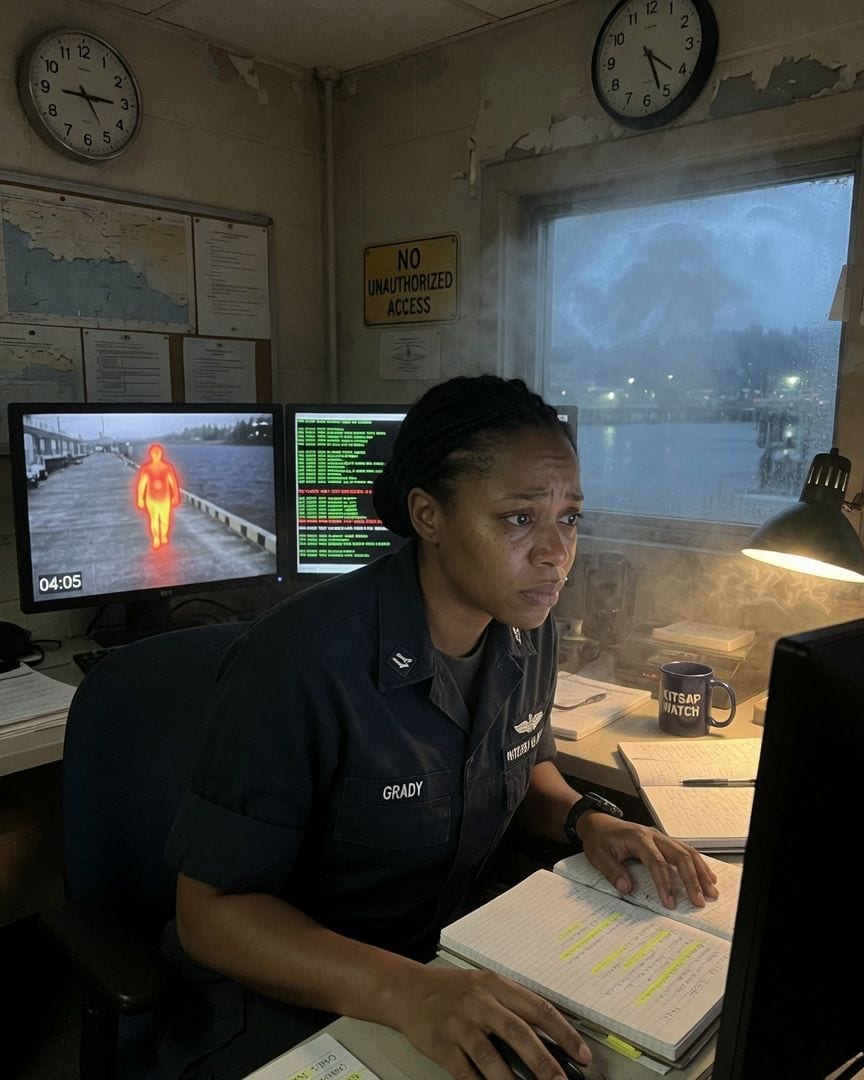
Petty Officer Olivia Grady found the base system logging impossible access at 0405. Every night for years, a blank ID walks Pier 7.
Petty Officer Olivia Grady stood her predawn watch on Pier 7, the cold mist of Puget Sound a familiar companion. Her routine scan of monitors at 0405 was shattered when an IR sensor flared with a man-sized heat bloom moving along the pier. Yet the camera feed showed only empty concrete and swirling mist. When historical logs confirmed the invisible presence had walked that exact path every night for years, Olivia dug deeper. She found a ghost "access log" entry with a unique ID but no name attached, meticulously aligned with the 0405 bloom. What impossible entity was the base system logging, night after night?
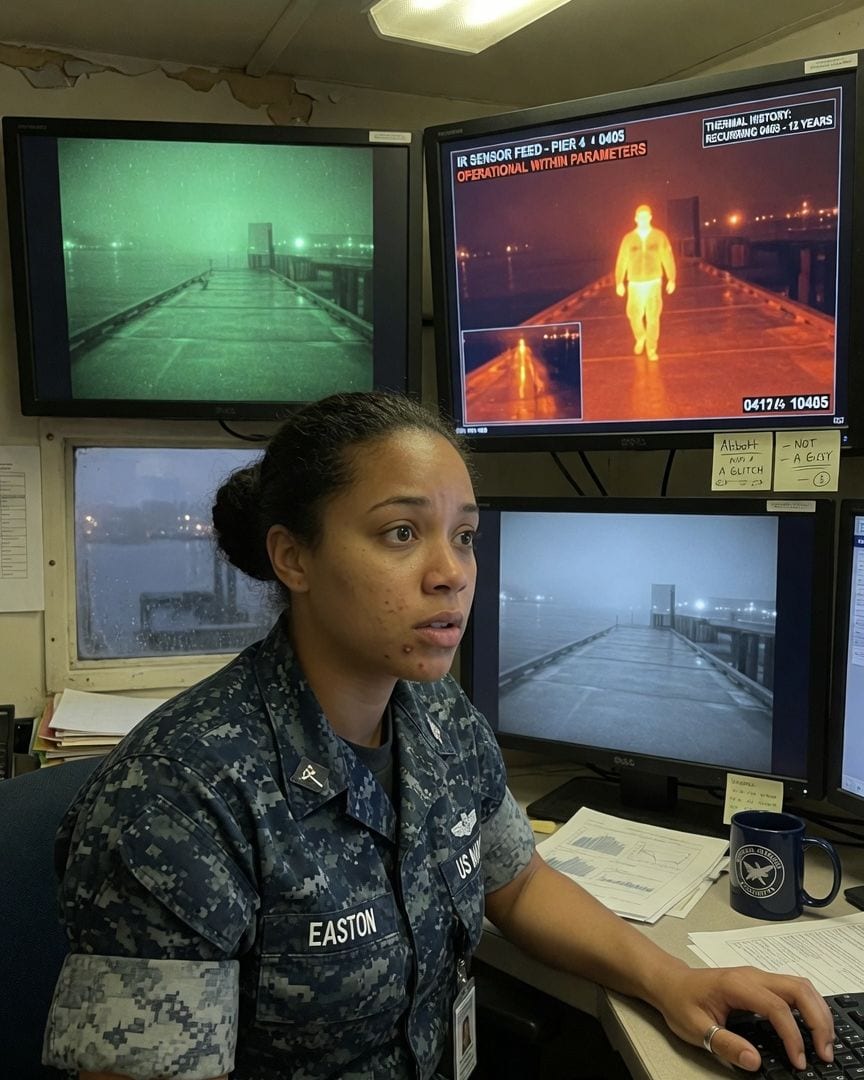
A security officer's camera sees nothing where her sensor logs a man-sized heat bloom on Pier 4, repeating at 0405 every night for twelve years.
Petty Officer Judith Easton, 24, was counting down her last month at Naval Base Kitsap-Bangor’s Pier 4 before a coveted transfer to Pearl Harbor, the security station air thick with the hum of electronics and the briny scent of the Puget Sound. At 0405, her primary IR sensor feed registered a distinct, man-sized heat bloom moving along the pier's caisson, but her optical camera showed only empty, mist-shrouded concrete where the sensor insisted a body moved. What began as a baffling glitch soon turned chilling: the thermal history revealed this impossible heat signature had walked the identical path at 0405 every night for twelve years, dismissed by others but secretly documented by a former officer. His subsequent 'stress-related medical leave' and a sealed 'Project NIGHTWATCH' file now hinted at a hidden truth far beyond a simple sensor error. What exactly had Petty Officer Abbott known?
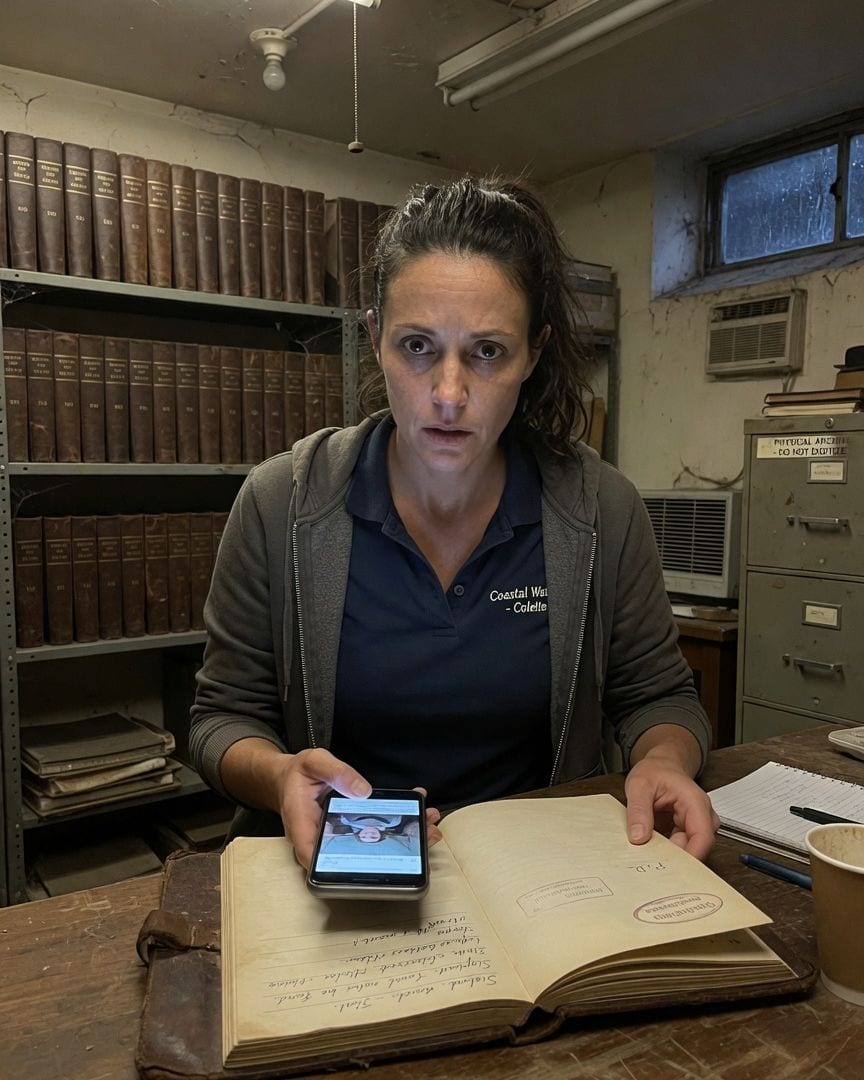
My coastguard log noted Sighting 9 again tonight, a light where no vessel showed. The old logs carry Sighting 9 off Skerry Point at 3:14am every tenth year since 1954, always 'nothing found,' always 'send no boat.'
On my watchtower night shift, the radar screen glowed green and the ocean was quiet. Then, a familiar light appeared off Skerry Point, exactly on cue, just as it had every tenth year for decades. But digging deeper, I found a hidden stamp in an old logbook: 'Operation Skerry. Status: Complete.' It left me with a chilling sense of finality.
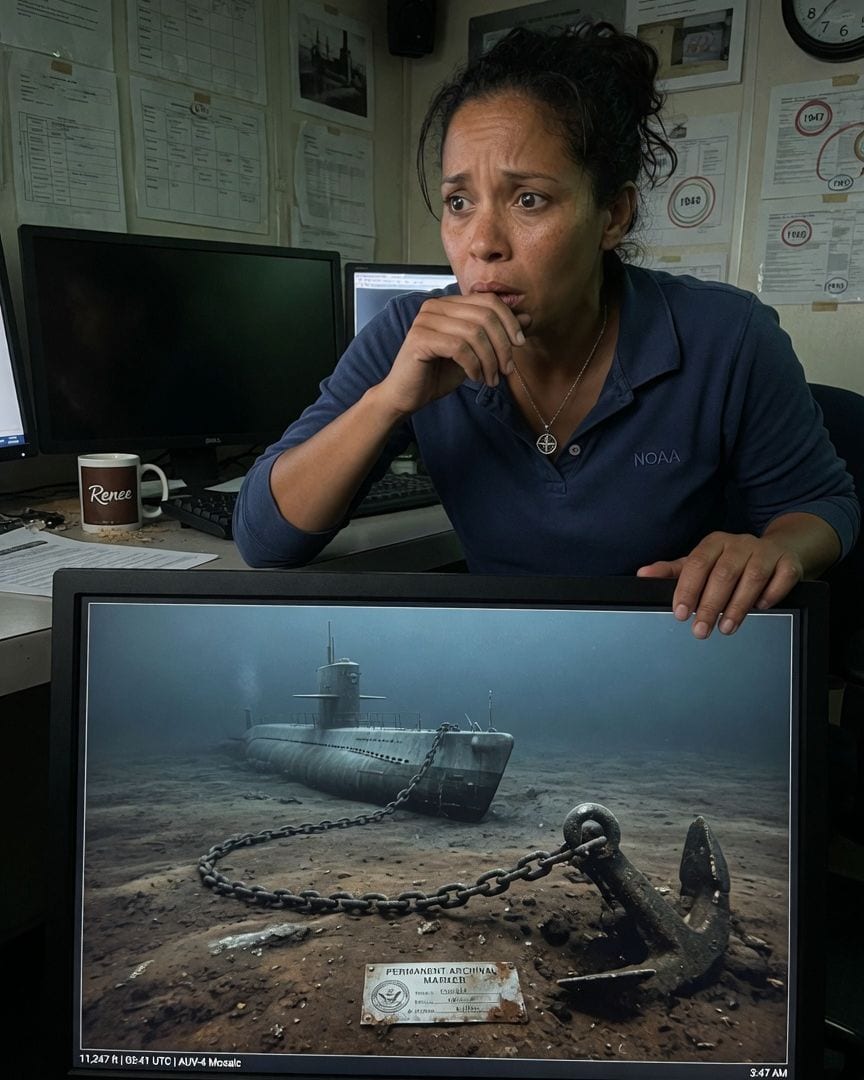
An oceanographer found a 1943 submarine anchored at eleven thousand feet, its Cold War records still meticulously updated.
Oceanographer Marisol Beckwith's career-defining discovery began with the ghostly outline of a 1943 submarine, the USS Kettle Iron, resolving from the abyssal murk at eleven thousand feet. Her initial elation curdled into dread when she realized the long-lost vessel was not a wreck, but sat upright, its massive anchor deliberately set. Even more unsettling, the sub's official service record, supposedly lost with its eighty-seven men in 1943, contained meticulous maintenance logs and commendations dated well into the Cold War era. Someone, or something, had been keeping watch over a ship filed as 'permanently retired,' long after its crew vanished.
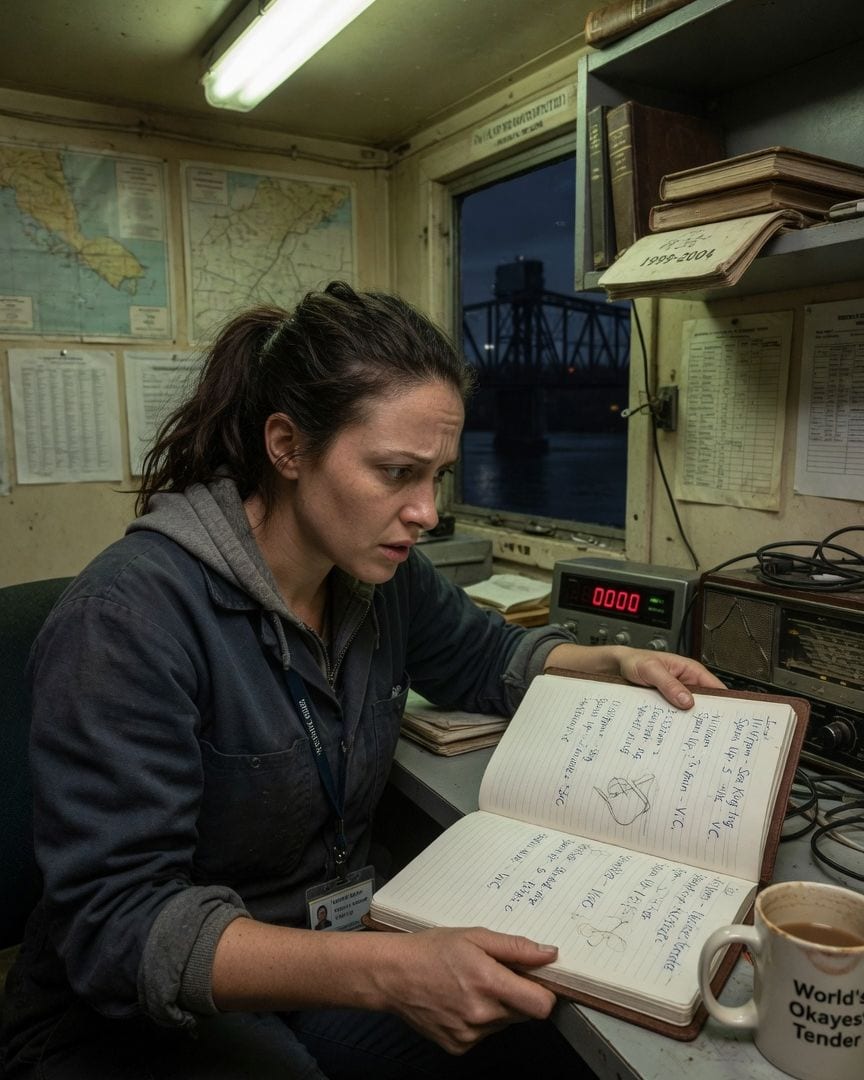
My drawbridge log shows a 2:33am lift I didn't make. The span counter never moved.
As a drawbridge tender, my midnight to dawn shift is usually quiet, a routine of monitoring traffic and logging lifts. But tonight, my own logbook shows an impossible entry for a bridge lift I have no memory of making. My initials and handwriting are there, yet the span counter above my panel reads a steady zero. No boat called, no span ever went up.
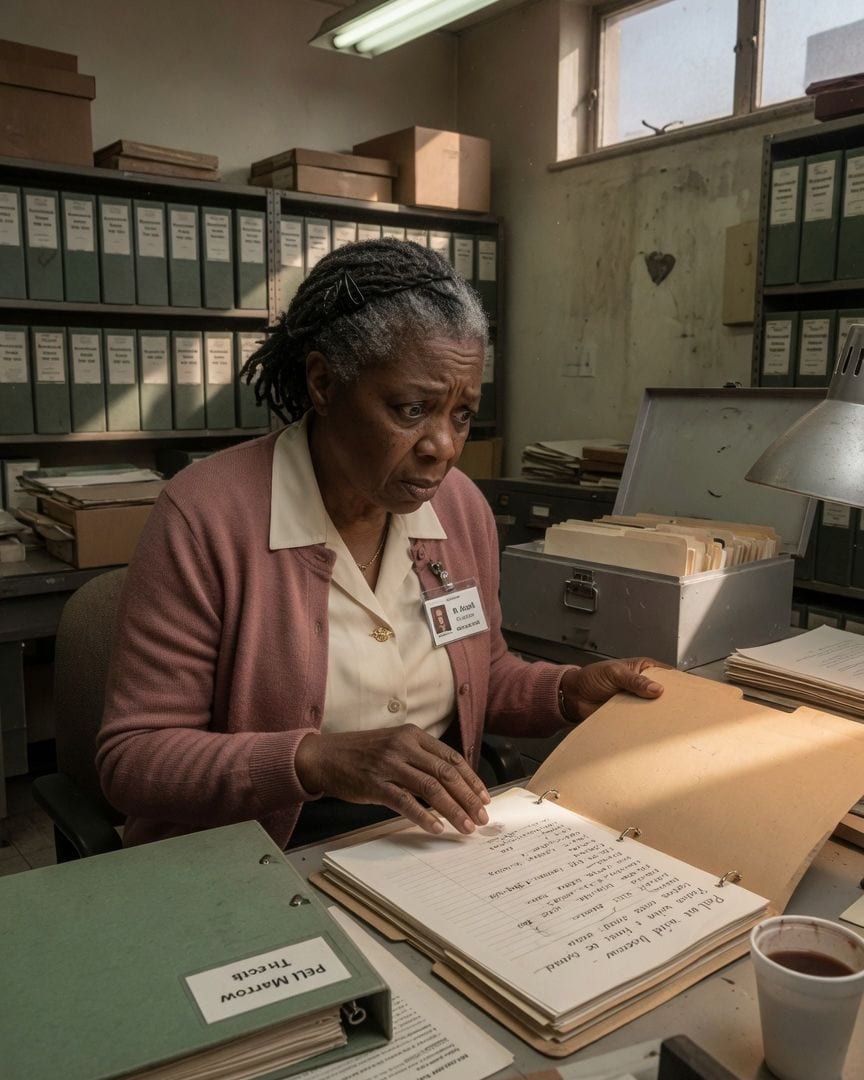
A records clerk's archive file for a Cold War reconnaissance plane lost in 1968 showed it flew yesterday to her own building.
Marguerite Ansell, a records clerk nearing her final week before retirement, meticulously audited Cold War-era files. In the cool, dusty archive, she pulled a file for an oiler declared missing in 1951. Inside, she found a fueling schedule with entries stretching into the present, the last dated just eleven days ago. Then, a second lost ship revealed a similar impossible log, and a cold certainty began to bloom in her chest. Deep in the shadows, Marguerite found an unmarked steel box containing a file for a reconnaissance plane lost in 1968. Its flight log showed a final flight yesterday, to the precise coordinates of her own archive building.