A pilot's classified flight report had a precise, angular blackout. The digital file said 'Page 1 of 12,' but only six pages existed.
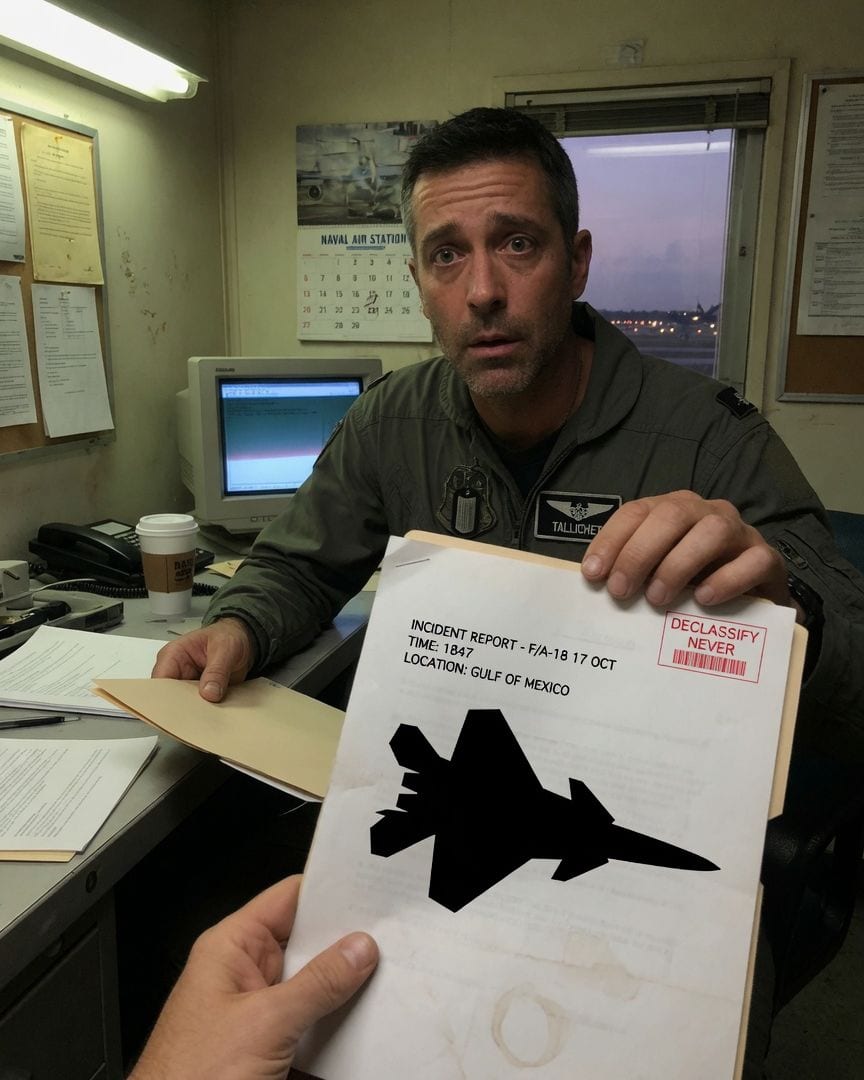
Captain Yves Tallichet landed his F/A-18 at dusk, the runway lights blurring into streaks as the jet touched down. His hands were shaking, a profound, uncontrollable tremor that made him clench the stick with all his might.
Raymond Larsen, his crew chief, met him on the tarmac, his face a mask of concern. "You alright, Cap? Thought you'd been hit."
Yves could only shake his head, the words 'unknown' and 'UFO' feeling absurd and inadequate for the official incident report he knew he’d have to file.
He walked away from the jet, the Gulf wind whipping at his flight suit, and still felt the phantom presence three hundred feet off his wing.
He tried to articulate the memory: a dark, seamless shape, impossible to define, that had risen from the water, mirroring his airspeed with uncanny precision.
It had even matched his desperate barrel roll, a silent, unmoving shadow in his peripheral vision until it simply wasn't there anymore. Now, the official forms in front of him, back in the debriefing room, felt like a joke.
They were utterly incapable of containing the impossible truth he had just witnessed.
Days later, the tremor in his hands had faded, but the image of the craft remained.
Yves requested a copy of his meticulously detailed flight report for his personal records, expecting the usual bureaucratic red tape, a bland document outlining his impossible encounter in sanitized language.
He scanned the pages, looking for the specific section where he’d described the craft’s appearance, its impossible lack of seams, and its mirroring maneuver. He found it. But where his detailed observations should have been, there was a blackout.
Not a simple rectangular bar, the kind used to redact sensitive information in countless other documents. This was different. The black-out was a precise, angular, almost geometric shape, starkly defined against the crisp white paper.
It was eerily reminiscent of the craft’s impossible outline or its unnatural, silent movement. He ran a finger over the smooth, inkless surface, trying to rationalize it as a clumsy censor’s mistake, a printing error, or even a technical glitch.
But the unnatural precision of the shape, its clean, sharp edges, defied any mundane explanation. It looked deliberate.
He flipped back to the cover sheet, and for the first time, he noticed something else: the control number listed at the bottom, a sequence of digits and letters, traced to no known originating office within the command structure.
He tried calling the number on the form, but it connected to an automated directory, cycling him through departments he knew had nothing to do with classified records. The phone felt cold in his hand.
Yves took the redacted report to Hazel Norwood, the base’s senior records clerk, a woman whose office always smelled of old paper and lukewarm coffee. He hoped she could provide an unblemished copy, or at least explain the bizarre redaction.
Hazel, her reading glasses perched on her nose, pulled up the digital file on her monitor. The screen flickered, displaying the report. Yves leaned closer, his breath catching.
The angular redaction was not an overlay; it was baked into the original digital record, a permanent part of the data. Hazel frowned, her fingers hovering over the keyboard.
"That’s… unusual, Captain Tallichet," she murmured, zooming in on the dark shape. She pointed to a line of text at the bottom of the screen. "And the system has flagged it with a 'DECLASSIFY NEVER' schedule.
I’ve been here thirty years, and I've never encountered that on a standard flight report." As she scrolled through the digital document, Yves’s eyes locked onto another detail, even more chilling than the redaction itself.
The digital file clearly listed 'Page 1 of 12,' yet the physical folder in his hand contained only six pages. A cold dread, colder than any deep-ocean current, settled in his gut.
Pages were missing, and the redaction had a shape.
Yves endured a series of official debriefings, each one feeling less like an investigation and more like an interrogation designed to steer him towards a pre-scripted conclusion: 'misidentification,' 'sensory overload,' 'stress-induced hallucination.' He stubbornly refused to comply.
The ghost of that angular shape on his flight report, and the chill of those missing pages, fueled a grim resolve.
Using his clearance, he began searching the base’s digital archives in his off-hours, specifically looking for other ‘unexplained aerial phenomena’ files, and, more specifically, for similar, non-rectangular redactions. He found several.
They spanned incidents from the 1970s to the late 1990s, scattered across different commands and regions, yet each bore a unique, angular redaction shape that resonated with his own.
He dedicated his off-hours to tracing the untraceable control number from his own report, cross-referencing it with the other anomaly reports he’d found.
He started to discern a pattern: these untraceable numbers were consistently associated with files that either ended abruptly, with no final disposition, or referred to 'transferred personnel' with no specified destination or follow-up.
The names vanished from the system after a certain point, leaving only the control number as a marker, a spectral trail in the digital ether.
The hum of the server racks in the silent archive room seemed to grow louder as he worked, a steady, mechanical thrum that sounded less like machinery and more like a low, perpetual sigh.
As Yves delved deeper into the archives, working late into the night, he noticed subtle, unsettling changes in his office.
A file he’d carefully left secured in his desk drawer was slightly ajar when he returned the next morning, as if a quiet breeze had passed through the room and nudged it open.
His coffee mug, which he’d meticulously left upside down on his coaster to dry, was upright, as if someone had just taken a sip.
One evening, he found a printout on his desk – a copy of his own flight schedule for the upcoming month, with a specific, innocuous ferrying flight highlighted in yellow.
There was no note, no sender, just the stark, silent message of the yellow highlight. The air in the room felt colder than usual, a prickle on his skin that had nothing to do with the AC.
A few days later, Raymond Larsen, his crew chief, approached him with a grim face. Raymond had received unexpected transfer orders to a remote, less active base in the Pacific.
He quietly told Yves he’d heard 'rumors' about Yves’s incident being 'sensitive,' and that 'some things are better left alone.' Raymond’s eyes held a mixture of pity and fear.
The transfer felt like a direct, chilling consequence of Yves’s relentless digging, a quiet, efficient amputation of his closest contact.
Yves used his last remaining contacts, favors he hadn't thought he'd ever need to cash in, to track down Edmund Sterling.
Sterling was a retired classified records officer, a name whispered in the hushed corners of the records world, now living a quiet life in a small, unassuming coastal town a few hours’ drive away.
Sterling, an elderly man with sharp, knowing eyes that seemed to have seen too much, was initially evasive.
He listened to Yves in silence as the younger pilot laid out his evidence: the distinct, angular redaction shapes, the untraceable control numbers, the missing pages, the pattern of 'transferred' personnel.
The older man sat perfectly still, his hands clasped on his knees, a chillingly detached expression on his face. When Yves finished, Sterling simply nodded, a slow, deliberate movement.
"You're seeing the signature," Sterling said, his voice low and even, devoid of any emotion. "These aren't just redactions or errors, Captain. They are markers.
The 'unknown' craft you saw, the one you fought to describe… it doesn't merely appear and disappear." Sterling paused, his gaze fixed on some distant point outside the window. "It collects.
The 'missing pages' you found, the 'transferred personnel' from those other files… these are not administrative oversights. They are filed." Yves felt a cold tightening in his chest.
Sterling explained, in that same low, even tone, that the secrecy machine wasn't just an organization that hid facts; it was an active entity that absorbed them, making them part of its own 'record.'
"The craft," Sterling continued, finally meeting Yves’s eyes, "is a physical manifestation of this 'filing' process. It takes. And what it takes becomes seamlessly integrated. It leaves only these coded traces in the archives. A ledger of acquisition."
The room, despite being warm from the afternoon sun, suddenly felt frigid.
Sterling, seeing the horrified understanding dawning in Yves's eyes, pushed himself slowly from his armchair. He moved to a heavy, old wooden chest in the corner of the room, pulling a small, locked box from inside.
The lock clicked, a sharp sound in the sudden silence. From the box, he extracted a very old, crumbling file, its pages brittle with age, the paper yellowed and stained.
It was an incident report from the 1950s, detailing a similar craft emerging from the water off the Florida coast, its original title a faded, bureaucratic header.
The file contained a grainy, black-and-white photograph, a faint echo of an impossible shape against a dark, churning sea.
The craft in the photo was unmistakably identical to the one Yves saw – seamless, dark, impossibly smooth, a perfect, scaled-down replica of the dread that had chased him across the Gulf.
But what made dread surge through Yves with a sickening jolt was the redaction on this old file.
When he carefully overlaid the precise, angular shape from his own report onto the ancient document, they matched perfectly, a horrifying echo across seventy years, an identical void eating at the past.
Then, Sterling pointed to a handwritten notation in the margin of the 1950s report, almost hidden by the yellowed edge. It was in a starkly different, recent ink, a bold, confident hand, and dated just last year.
It read: 'Tallichet, Y. Verified. File updated.'
The implication of the 'Tallichet, Y. Verified. File updated.' notation detonated in Yves’s mind with the force of a high-G impact. He wasn't just a witness; he was now part of the record, marked for 'filing.'
Sterling watched him, his expression unchanged, as if observing a particularly interesting insect. The air in the small room grew heavy, the silence pressing in.
Sterling explained, his voice devoid of emotion, that the 'secrecy machine' wasn't merely a government agency; it was a self-sustaining entity that processed these events and the people involved.
"The craft is the filing mechanism," Sterling stated, a chilling simplicity in his words. "It takes things, Captain, and makes them 'seamless' – integrates them into its own structure. Like a collector adding a specimen to its archive."
The redactions weren't just black ink covering text; they represented the void left by what was taken, shaped by the entity itself as a signature, a symbol of its acquisition.
The repeated patterns across decades – the seamless craft, the specific redaction shapes, the untraceable control numbers – weren't just a series of coincidences or a long-running cover-up. They were the consistent, horrifying signature of a recurring, systematic 'collection' process.
"The 'file' isn't a passive archive, Captain," Sterling finished, his eyes burning with a weary, ancient knowledge. "It’s a living, growing record of what has been absorbed. And you," he added, with a final, chilling nod, "are its newest entry."
Yves knew he had to escape. He had to take proof. He knew no one would ever believe his story, not without undeniable evidence to back up the impossible truth Sterling had laid bare.
He drove back to the base, the twilight hours his only window, knowing his clearance would inevitably be revoked, perhaps within the day.
He slipped into the silent records office, his heart hammering against his ribs, the cool air of the server room doing little to calm him.
He was looking for the original digital file of his report, the one Hazel had shown him, and the digitized version of the 1950s file Sterling had shared.
He found them, his fingers flying across the keyboard, sweat beading on his forehead. He plugged in an encrypted USB drive, the small device feeling like a lifeline.
The download bar agonizingly crawled across his screen, each percentage point a victory against an invisible clock. As it neared completion, he heard it: the distant, faint sound of footsteps echoing down the silent hall. They were coming for him.
The hum of the server racks, usually a comfort, now felt like a buzzing alarm. The footsteps grew louder, closer, methodical. He heard the jingle of keys, then the unmistakable click of the door handle.
His breath hitched in his throat. He yanked the USB drive from the port with a desperate urgency, the 'Download Complete' notification blinking just as the door began to swing inward.
He caught a fleeting glimpse of a dark uniform in the widening gap, but didn't wait to see a face, bolting out a side exit and disappearing into the moonless night.
Captain Yves Tallichet vanished. His abandoned car was found days later near a remote stretch of the Gulf coast, windows down, a few empty energy drink cans scattered on the passenger seat.
An official inquiry cited 'disappearance under unusual circumstances' and 'psychological distress,' quickly closing the case. Raymond Larsen, now at his new, isolated post in the Pacific, quietly received a final, sealed envelope from 'Records Management.'
Inside were his own 'discharge and reassignment' papers, stamped with the chilling, familiar designation: 'DECLASSIFY NEVER.' He understood. He never spoke of Yves again.
Yves Tallichet lived off the grid, a ghost in the system, constantly moving, haunted by the encrypted files on his drive.
He saw the patterns everywhere now, in news reports of unexplained disappearances, in the way certain shadows fell, in the quiet efficiency of the world around him. He knew he was still 'filed,' just not yet 'collected.'
He often watched the Gulf at dusk, a profound unease in his heart, knowing what waited beneath the seamless surface of the water. He knew it waited for him.
A fisherman, casting his nets off a remote stretch of the Gulf coast, snags something heavy. It's a discarded, encrypted USB drive, encrusted with barnacles.
After weeks, he manages to crack it, finding only two files: a redacted flight report from 2023, and a grainy photograph from the 1950s. Both show the exact same, impossible angular shape in their respective documents.
He tries to tell people, but his story is dismissed as a delusion. He eventually gives up, but he never again looks at the Gulf the same way.
If this one got to you
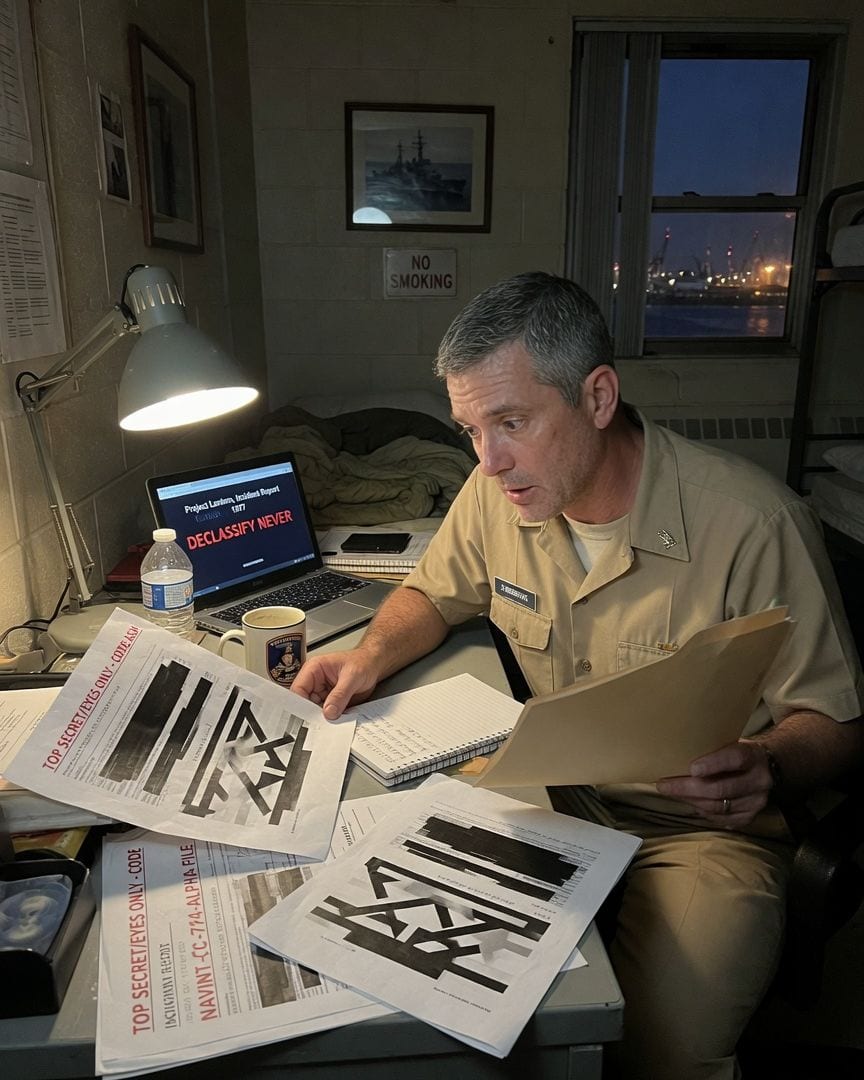
On the USS Farragut, Lieutenant Commander Roy Ashgrove logged a zero-altitude contact. His report was stamped 'TOP SECRET,' and a directive for it read: 'DECLASSIFY NEVER.' He found an old Cold War file with an identical, geometric redaction.
Four days from ending his Gulf deployment, Lieutenant Commander Roy Ashgrove longed for home leave. On the bridge of the USS Farragut, his surface search radar painted a contact a mile off the port beam, but its altitude readout was impossibly zero. He ordered the searchlight on it, watching as the dark mass moved toward the beam, then stopped dead still on the moving water. Roy's incident report was swiftly stamped 'TOP SECRET,' and a follow-up directive carried a chilling downgrade schedule: 'DECLASSIFY NEVER.' His investigation soon unearthed an old Cold War file containing an identical, geometric redaction, hinting at a secret far deeper than a sensor glitch.
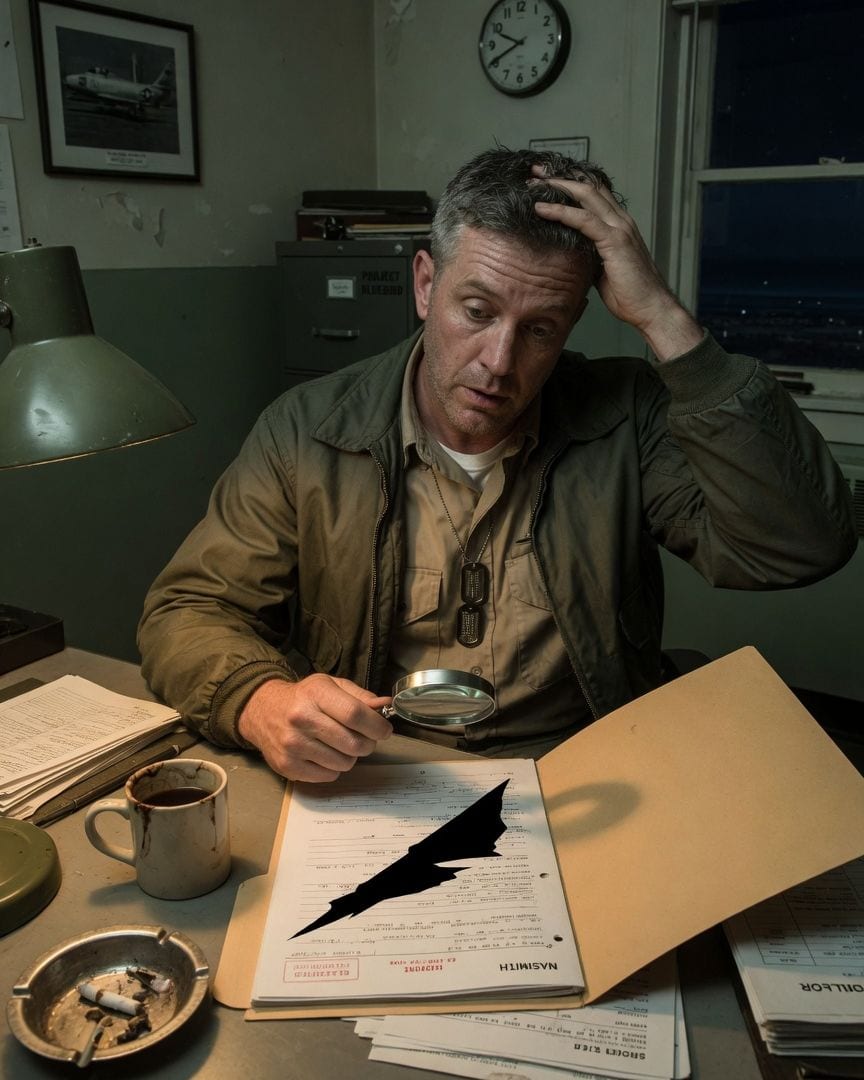
A Cold War pilot's classified file was missing a page, and its final redaction was a jagged, impossible shape with a phantom number beneath.
Colonel Ward Naismith, an F-86 Sabre pilot, found himself haunted by an impossible pursuit over Lake Michigan in 1953. His flight lead's chilling whisper—that the silent, house-sized mass they chased wasn't fleeing but waiting—burrowed deep into his mind. Weeks later, reviewing the incident's classified file, Naismith discovered it was missing a page. But the true dread came from the final page: a block of blacked-out text, not a simple rectangle, but a jagged, geometric shape that felt unnaturally smooth, hiding a faint, ghosted control number beneath its surface.
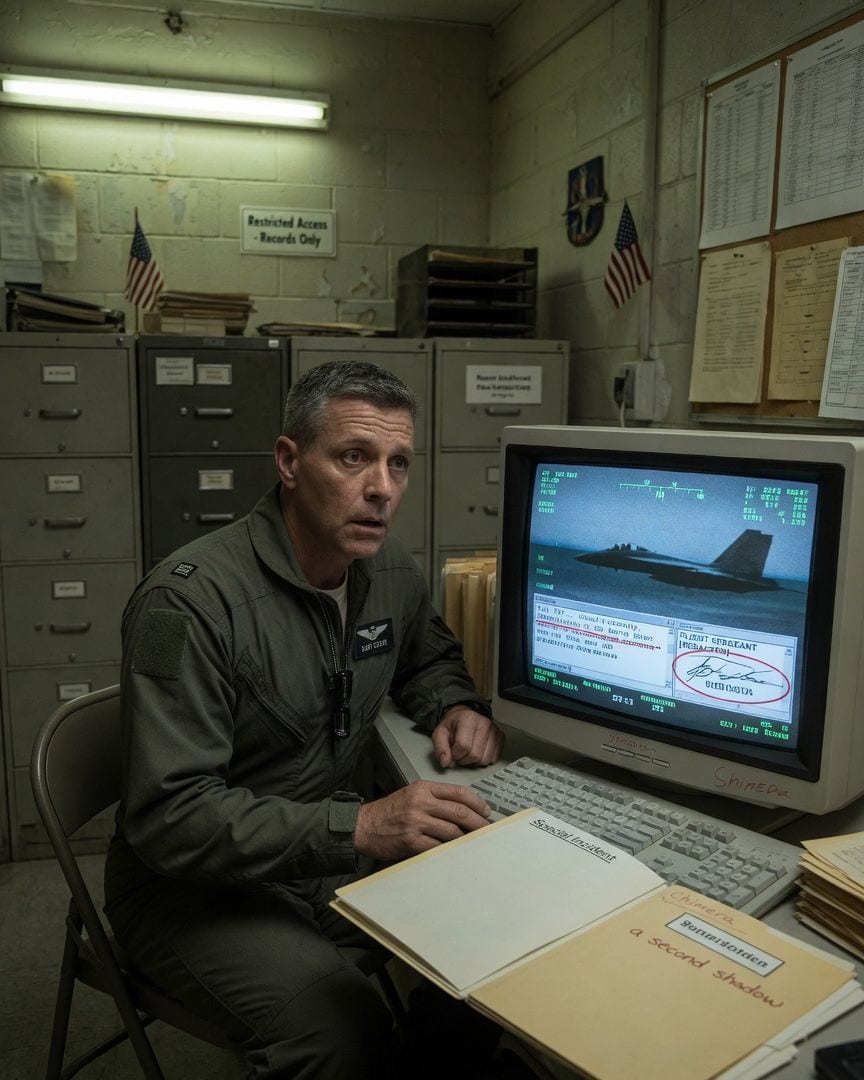
A Chief Warrant Officer's HUD showed a second aircraft watching his plane. He later found a log for *his* tail number reporting the same anomaly weeks ago, but he was grounded for medical leave.
Chief Warrant Officer Gary Estes, a man whose career was built on precision, found his impending Pentagon transfer shadowed by a baffling anomaly. On every flight, at exactly 800 feet, his aircraft's display would briefly show a sleek, dark second plane tucked off his right wing, its canopy subtly angled toward his, watching him. Ground radar never saw it, and his wingmen swore they flew alone. Desperate to maintain his clean record, Estes dug into maintenance logs and uncovered an entry for *his* tail number from weeks prior. It described the exact same 'visual anomaly' during a flight he knew, with chilling certainty, he had never flown.
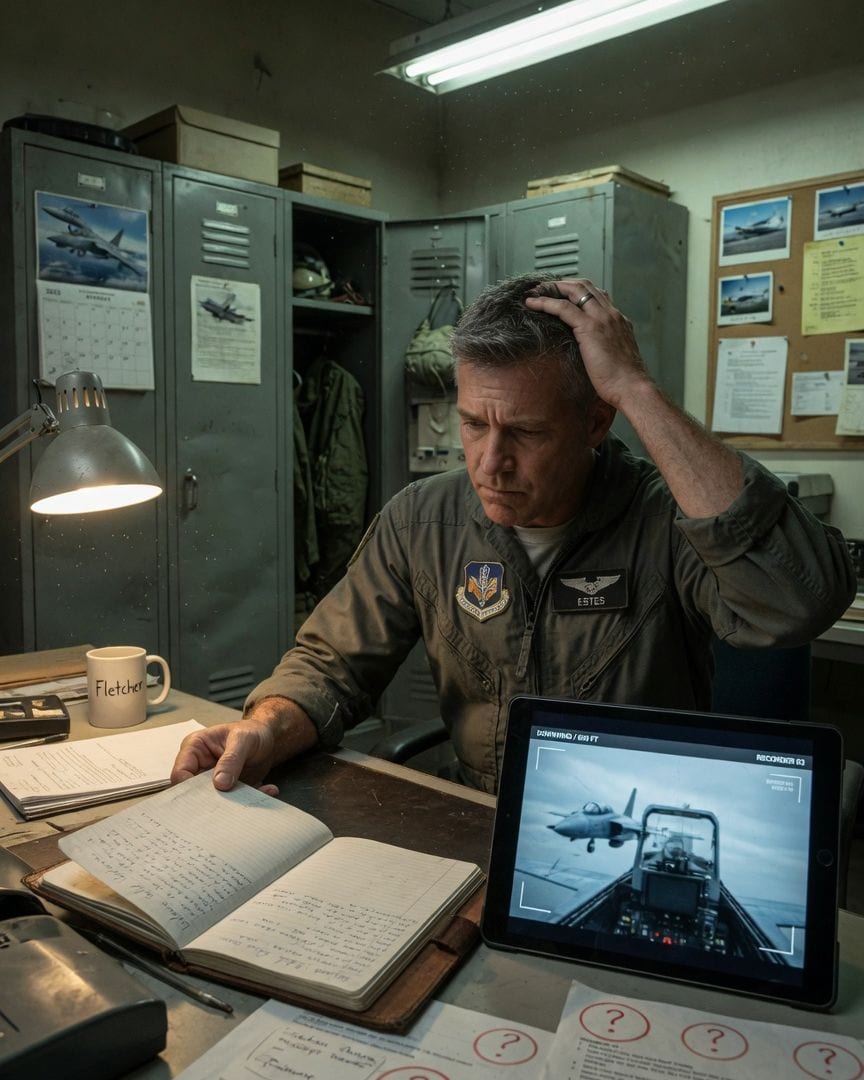
A Chief Warrant Officer's HUD tape shows a phantom jet, impossibly close, off his wing. Forty years ago, another Cold War pilot logged the same impossible sight.
Chief Warrant Officer Nathaniel Estes, a pilot whose career hinged on absolute precision, was under evaluation for a critical promotion. His nightly review of HUD tapes from routine Mojave test flights was a meticulous habit, but for a week, it revealed an impossible detail. At precisely 800 feet, one frame showed a sleek, experimental jet tucked impossibly close off his left wing—a craft ground radar never detected. When his maintenance chief found no equipment fault, Estes unearthed a dusty, decades-old logbook detailing identical phantom sightings from 1978. What unseen presence shadowed the desert skies?
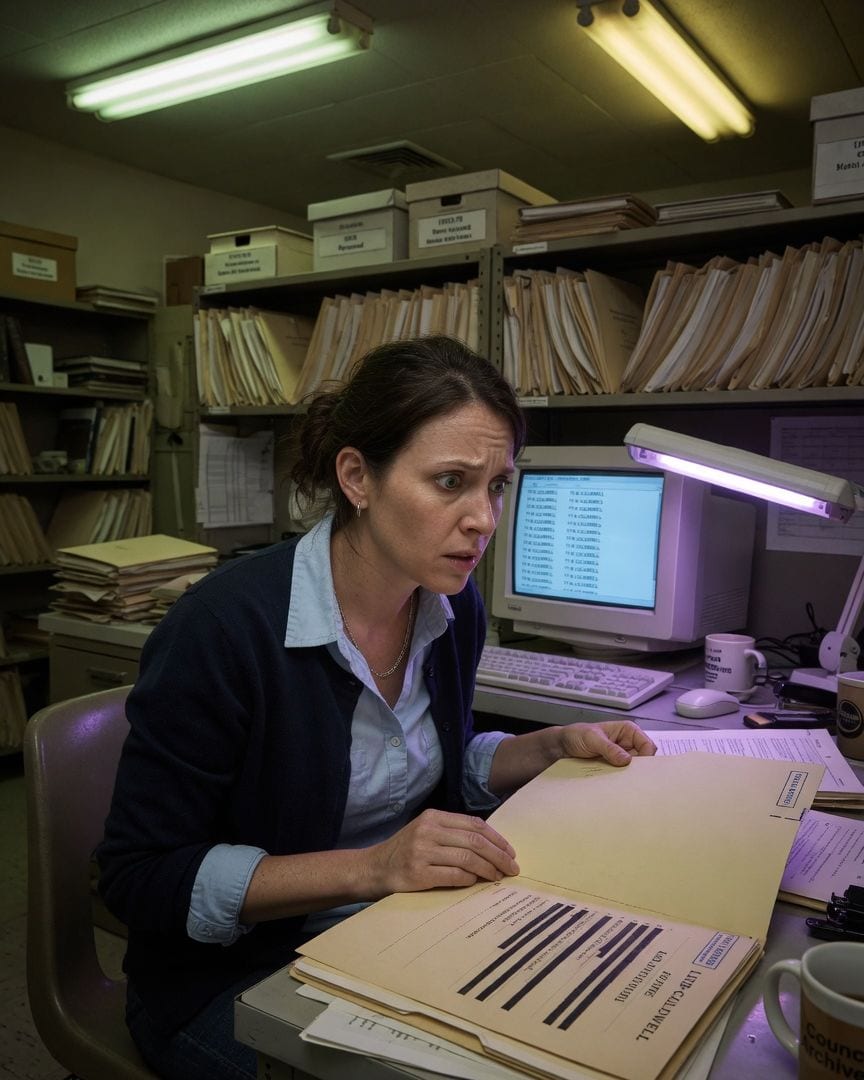
My employer's security file holds a vetting report on me dated nine years before I ever applied. It has my full name and my parents' address — with only one line, the source who referred me, blacked out.
Working a routine data audit, I pull my own security file. The issue date is nine years before I even applied for the job. Then, hidden within an old archive file, I find my current address etched under a blacked-out line.
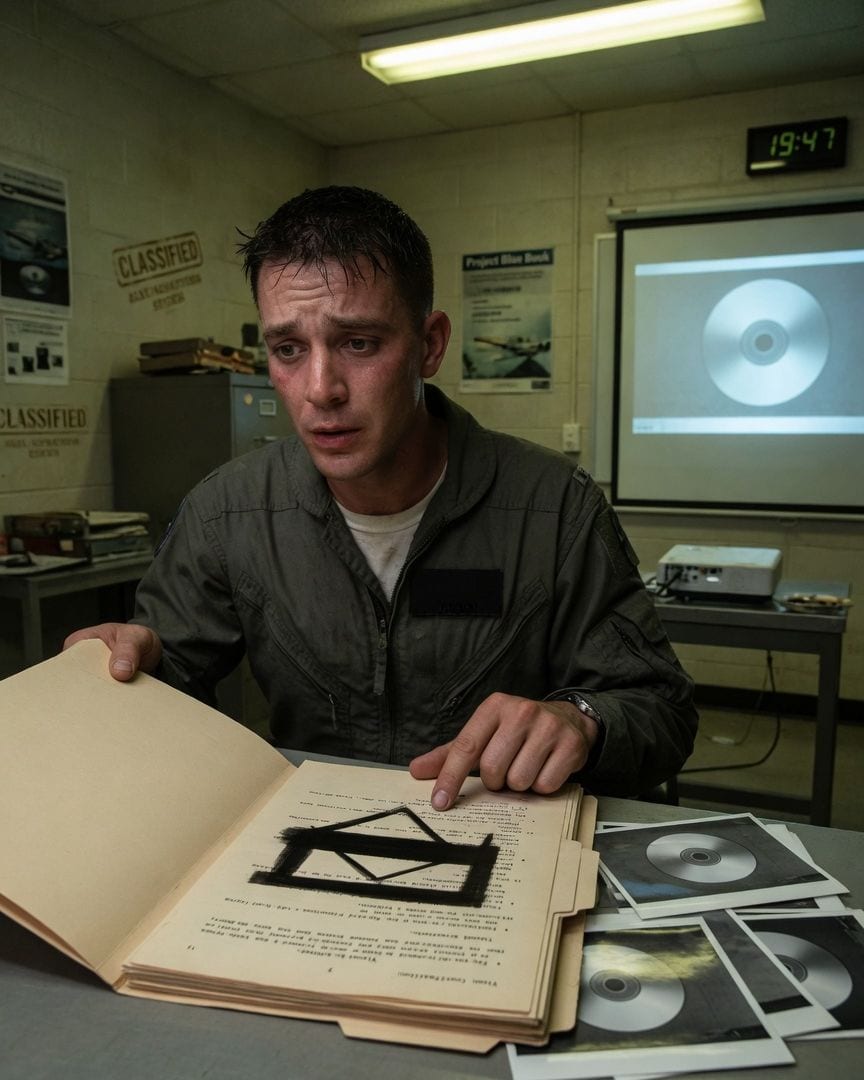
Returning to his newborn daughter, a Cold War pilot found a perfect diamond shape hidden within his classified report's redactions.
Captain Merle Vachon had one last intercept before he could return home to his newborn daughter Nora. High over the Nevada ranges in his F-86 Sabre, he encountered a disc that moved with impossible, silent displacement, defying all known physics. Days later, the official gun camera film showed the object impossibly close, directly contradicting Vachon’s own telemetry and eyewitness account. But the true chilling detail emerged when he found a perfect diamond shape outlined by redacted black ink within his classified incident report.