A Public Affairs Officer found a requisition for a Cold War destroyer lost in 1949. It was dated 1953, still ordering parts.
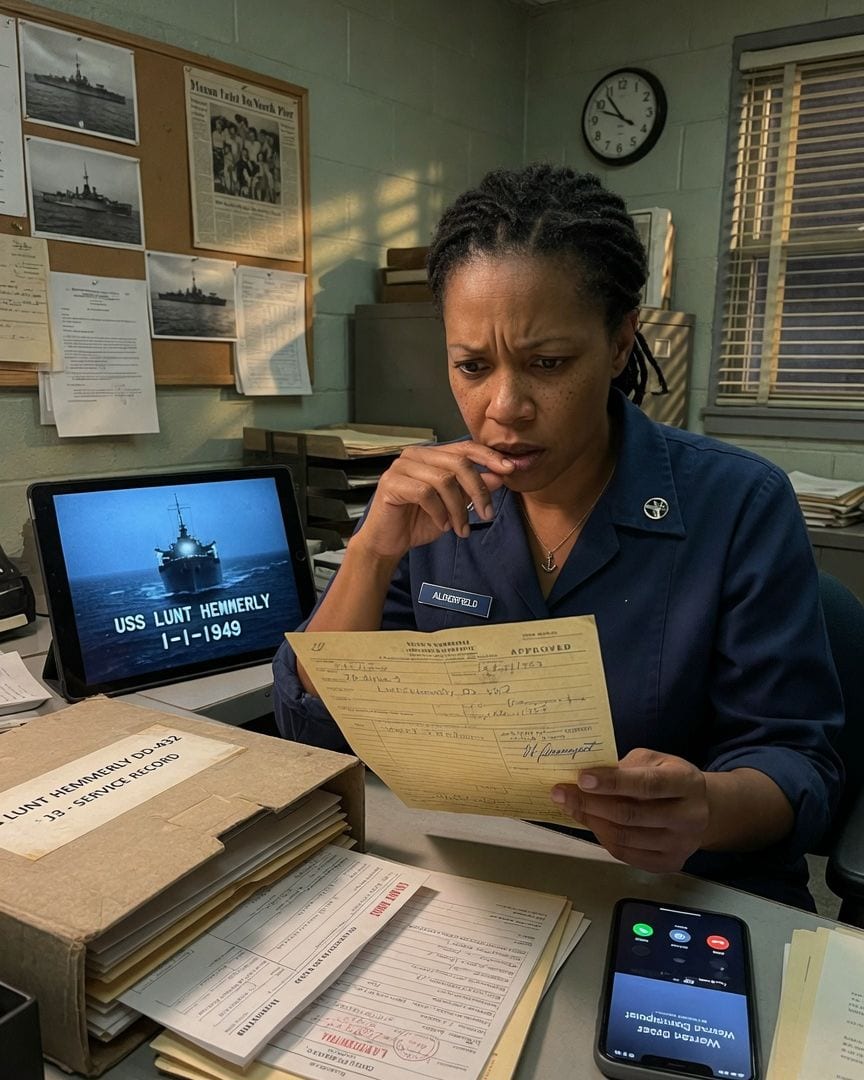
Public Affairs Officer Reece Alderfield hunched over her tablet, watching the livestream from the Lunt Hemmerly wreck survey. The feed was grainy, deep-ocean blue, but the floodlights cut through the gloom, illuminating the destroyer escort’s stern.
Families had gathered on the Norfolk pier that January morning in 1949, waving goodbye to the Lunt Hemmerly, and then again last month for this very broadcast, hoping for closure.
The camera panned slowly, revealing the ship’s name, faded but legible: USS LUNT HEMMERLY. Reece felt a professional satisfaction, a clean public narrative.
Then the camera dipped lower, and under the familiar letters, welded to the plate in a neat, unhurried bead, was a second line: '1-1-1949'. Reece blinked. She leaned closer, rubbing the screen.
It had to be a trick of the light, a misread. But the numerals were stark, precise. The date of the ship’s loss. The exact morning those families had stood on the pier.
No shipyard would ever weld a loss date onto a ship. It was impossible, and yet, there it was, undeniable, burned into the steel.
Back in her office at Naval Station Norfolk, Reece couldn't shake the image. She requested the Lunt Hemmerly’s full service record, expecting a thick file ending abruptly in 1949.
Her role as PAO gave her broad access, and she prided herself on thoroughness. The file arrived, a heavy, dusty box from the archives.
Inside, the official loss report sat on top, dated January 1, 1949, signed by the commanding officer and countersigned by a Rear Admiral. It was all by the book, grim but clean.
Reece started sifting through, looking for any mention of the strange stern plate, though she knew it was futile. Then, buried halfway down, beneath a stack of mundane payroll slips from late 1948, she found it. A requisition form.
It requested a specific, non-standard gyroscopic stabilizer, part number 7B-Alpha-9. The designation at the top was clear: USS Lunt Hemmerly, DD-432. Her breath hitched. The date on the form was April 14, 1953.
Four years after the ship was officially lost. She flipped it over, then back. The paper was standard issue for the era, the ink slightly faded but clearly legible.
A stamp in the corner read 'APPROVED', and beneath it, a neat, looping signature: 'W. Davenport'. It couldn't be a misfile.
The part number was too specific, the ship's designation too precise, the date too far past the point of no return. Reece felt a cold dread settle in her stomach.
This wasn't a clerical error; it was a ghost in the machine.
Reece stared at the requisition form, its date, signature, and approval stamp clear and undeniable. The official loss report, sitting beside it on her desk, declared the USS Lunt Hemmerly gone since 1949.
But this new document, dated 1953, insisted it was still ordering parts. The signature, a neat, looping 'Davenport', was unsettlingly familiar. She pulled up the current Naval Records Center staff directory. Warren Davenport, Head Archivist. The same surname.
The dread deepened, a cold knot tightening in her chest. She picked up her phone, the name on the screen glowing with an impossible connection.
Warren Davenport met Reece in his cluttered, climate-controlled office at the Naval Records Center, a place heavy with the scent of old paper and forgotten histories.
He was a man in his sixties, with a meticulous part in his gray hair and hands that moved with a practiced, almost ritualistic slowness. Reece laid the 1953 requisition on his desk. "Mr. Davenport," she began, "this signature.
W. Davenport. Is that you?" He peered at it through spectacles perched on his nose. "Ah, yes. A family hand, you might say. My grandfather, Walter. And his father, before him. We've been stewards of these records for generations."
He offered a thin, polite smile that didn't reach his eyes. Reece pressed, explaining the Lunt Hemmerly's loss. Warren merely nodded. "A misfile, perhaps? An old record misplaced? The archives are vast, Officer Alderfield."
But his eyes, she noticed, darted to a particular corner of the room, where an antique oak filing cabinet stood, out of place among the modern metal shelves. Reece didn't argue.
Instead, she spent the next week requesting every document, every scrap of paper, related to the Lunt Hemmerly, cross-referencing it with the official loss date. She found more.
A maintenance log entry for a routine engine overhaul, dated August 1955, signed 'W. Davenport'. A quarterly position report, placing the DD-432 in the North Atlantic, October 1961, also signed 'W. Davenport'.
The paper was consistently from the correct era, the ink fading predictably, but the content was impossible. The handwriting, while clearly distinct across generations, carried an unmistakable, almost identical formal flourish.
It was as if the same 'hand' had simply changed its physical vessel, moving from grandfather to father to son. The file wasn't just 'writing'; it was maintaining a continuous, unbroken administrative life for a ship that no longer existed.
Reece’s relentless queries into the Lunt Hemmerly’s phantom paperwork didn’t go unnoticed. One afternoon, as she was leaving the Records Center, a man in a worn Navy veteran’s cap fell into step beside her.
He was older, with a deeply lined face and eyes that seemed to have seen too much. "Officer Alderfield," he rasped, his voice gravelly. "Dean Russo. Heard you're digging around the old Hemmerly files."
Reece tensed, her hand instinctively going to her sidearm. "Who told you that, Mr. Russo?" He chuckled, a dry, humorless sound. "Word gets around, especially when someone asks too many questions about things that don't exist.
I was in supply chain records, back in the day. Saw things. Things that never added up." He glanced over his shoulder, a nervous tic. "You're looking at the wrong kind of 'lost'. They weren't lost, they were... re-routed. Processed."
He leaned in closer, his voice dropping to a whisper. "There's a code. A classification. Look for 'Alpha-Delta-Four-Three-Two-Zero-Seven'. It's not in any public manual. Never was. But it's on every one of those phantom files.
And if you find it, you'll find more than just the Hemmerly." Russo abruptly stopped, his eyes wide with a sudden, unreadable fear.
He turned and walked away quickly, melting into the passing crowd of sailors and civilians, leaving Reece with the chilling knowledge that her quiet investigation had been observed, and that someone out there knew exactly what she was finding.
Armed with Russo's cryptic code, Reece returned to her office, the sense of being watched prickling at her neck.
She logged into the Naval Records digital archive, her fingers flying across the keyboard, inputting 'Alpha-Delta-Four-Three-Two-Zero-Seven' into the search filter for active vessels. The system whirred, then returned an error message: 'Invalid Classification.' Reece frowned.
Russo wouldn't have given her a false lead. She tried it again, this time within the 'Decommissioned/Lost Vessels' database. Another error. Frustration gnawed at her, but then she remembered Davenport’s darting eyes, the antique cabinet.
She returned to the physical archives, specifically to the obscure, seldom-accessed 'Special Collections' section, a labyrinth of dusty shelves behind a locked door. She found no digital entry point for 'Alpha-Delta-Four-Three-Two-Zero-Seven' here either.
But she noticed a peculiar pattern: certain older filing cabinets, particularly those housing records from the 1940s through the 1980s, had a small, almost invisible, handwritten 'AD43207' penciled onto their labels, tucked beneath the official classification.
It was a physical tag, not a digital one. Reece pulled out a cabinet drawer, filled with files for vessels officially lost decades ago. She started pulling files, cross-referencing the penciled code. And there it was.
Not just one requisition for the Lunt Hemmerly, but an entire, continuous administrative history. Quarterly reports, personnel transfers, supply manifests, even fuel consumption logs, all spanning from 1949 well into the late 1980s.
Each document bore the 'W. Davenport' signature, evolving subtly across generations, but always present. The Lunt Hemmerly hadn't just 'kept writing' one or two anomalous forms; its entire existence, post-loss, had been meticulously documented.
Reece recognized the requisition for the gyroscopic stabilizer, the maintenance log. They weren't isolated incidents. They were threads in an unbroken tapestry. The ship wasn't lost.
It was simply operating under a different, hidden classification, its paperwork diligently maintained by the Davenport family, generation after generation.
The horror wasn't that the file kept writing; it was that the file was the ship, in some unfathomable, administrative sense.
Reece’s fingers flew across the keyboard, inputting the obscure 'AD43207' filter into the digital system, now knowing it was a physical tag that correlated to a digital flag.
The results flooded her screen, not just for the Lunt Hemmerly, but for dozens of other vessels and even aircraft, officially declared lost over the past eight decades.
Each had a similar, impossible paper trail, extending for years, sometimes decades, past their recorded loss dates. The names flashed by: USS Cyclops, Flight 19, the SS El Faro.
Dean Russo, who had been waiting anxiously in her office, let out a choked gasp as a specific entry appeared: a deep-ocean survey vessel, the USNS Glomar Explorer, officially lost in 1988. He pointed a trembling finger at the screen.
"That one," he whispered, his face pale and etched with a profound terror. "That one was my ship. I was on it when it went down. And that signature..."
He jabbed a finger at a requisition from 1995, requesting specialized deep-sea equipment. "It's the same one, Officer Alderfield. The same 'Davenport' hand that signed off my transfer paperwork last year, after I was pulled from the water. They knew.
They all knew. And they just... filed us away."
Reece confronted Warren Davenport again, this time with Dean Russo at her side, the screen displaying the full, impossible pattern. Davenport finally dropped his polite facade.
He led them to a sub-basement beneath the Records Center, a place not on any blueprint. The air was cool, dry, and still.
In the center of a small, windowless room, bathed in the soft glow of a single bare bulb, sat an enormous, leather-bound ledger on a heavy oak stand. It was ancient, its pages yellowed and brittle, but meticulously maintained.
"This," Davenport said, his voice quiet, almost reverent, "is the Master Ledger. The true record." He opened it to a page. 'USS Lunt Hemmerly, DD-432.' Beneath the name, in elegant, precise script, was 'Transfer Date: 1-1-1949'. Reece’s eyes widened.
The date welded to the ship's stern. "The ships weren't lost," Davenport explained. "They were... redirected. Filed. The sea, the sky, they have other routes. Other assignments.
Our family's duty, for over two centuries, has been to maintain the administrative continuity. To ensure that, even when a vessel leaves our world, its operational status, its very bureaucratic existence, continues. The paperwork is the anchor.
The signature, a promise of continuity. The classification code, the lock and key. The Lunt Hemmerly, the Glomar Explorer, all of them. They are still active. Just not here. The records prove it."
He gestured to a page detailing a position report for the Glomar Explorer, dated last month, placing it in a quadrant of the Pacific that officially contained only empty ocean.
Dean Russo stared at his former ship’s impossible entry, a single tear tracing a path through the dust on his cheek. The horror wasn't just that it happened, but that it was so utterly, meticulously coherent.
Davenport turned a page in the Master Ledger, revealing a blank entry. "And now, Officer Alderfield, you know. You've seen the truth. The machine is patient, and it is vast. It simply files.
You can walk away, forget what you’ve seen, and become another unfiled loose end. Or you can understand that you are now part of its continuity. There's always a need for new stewards."
He offered her a pen, its silver gleam reflecting the single bulb. Reece’s gaze flickered between the blank page and Russo, whose face was a mask of hollow resignation.
She thought of the Lunt Hemmerly, its name and impossible date welded to its stern, a permanent mark of its transition.
She thought of Russo, a man whose ship had been 'filed' while he was rescued, only to discover its ghost still operating in a ledger. The weight of the pen in Davenport's hand seemed immense.
Reece felt a profound chill, not of fear, but of an unsettling clarity. To fight it was to be consumed. To join it was to become its silent, complicit keeper.
She reached out, not for the pen, but for the ledger itself. Her fingers traced the elegant script of the last entry for the Glomar Explorer, the one dated last month. It was real. It was tangible.
She ran her hand over the thick, aged paper, feeling the slight indentations of the pen strokes, the faint, metallic scent of old ink.
This artifact, this impossible record, was utterly, undeniably present, a testament to a reality that defied all logic. It was not a dream, not a delusion.
It was a physical object, dated, checkable, and it rendered the ordinary world a lie.
Davenport watched her, a faint, knowing smile playing on his lips, as she slowly, deliberately, brought her face closer to the page, inhaling the scent of the centuries of secrets it contained.
The truth was not just understood; it was a physical presence, cold and patient, waiting for her to accept its terms.
Reece Alderfield returned to her office, the weight of the Master Ledger's secrets pressing down on her. She filed her official report on the Lunt Hemmerly wreck survey, omitting any mention of the impossible date or the subsequent discoveries.
Dean Russo, after his confrontation with Davenport, quietly vanished from Norfolk, his pension checks continuing to arrive, but his phone number disconnected. Warren Davenport remained Head Archivist, his demeanor unchanged, his office still smelling of old paper.
The Naval Records Center continued its quiet operations, its sub-basement secret intact. Reece found herself looking at official documents with new eyes, searching for the subtle, almost invisible 'AD43207' tag, a ghost classification only she now recognized.
She never found another requisition for the Lunt Hemmerly in her public-facing searches, but she knew where its true files resided.
The vast, quiet halls of the Naval Records Center stretched out before Reece, endless rows of files containing every official history, every forgotten truth.
She knew now that for every record of loss, there was another, hidden record of continued operation. The world believed in disappearances, in tragedies at sea, in the finality of a sunken hull. But Reece knew better.
She understood that some things were never truly lost, only reclassified, their operational status maintained in a silence so profound it echoed across decades.
Her own life, her own career, now felt like another entry in a larger, hidden ledger, a small, meticulously documented part of a system she could never escape. She walked past Warren Davenport’s office, the door slightly ajar.
He was at his desk, his back to her, his hand moving in a steady, unhurried script across a fresh page. The records office hums, a steady, patient machine, and somewhere, another file is still being signed.
If this one got to you
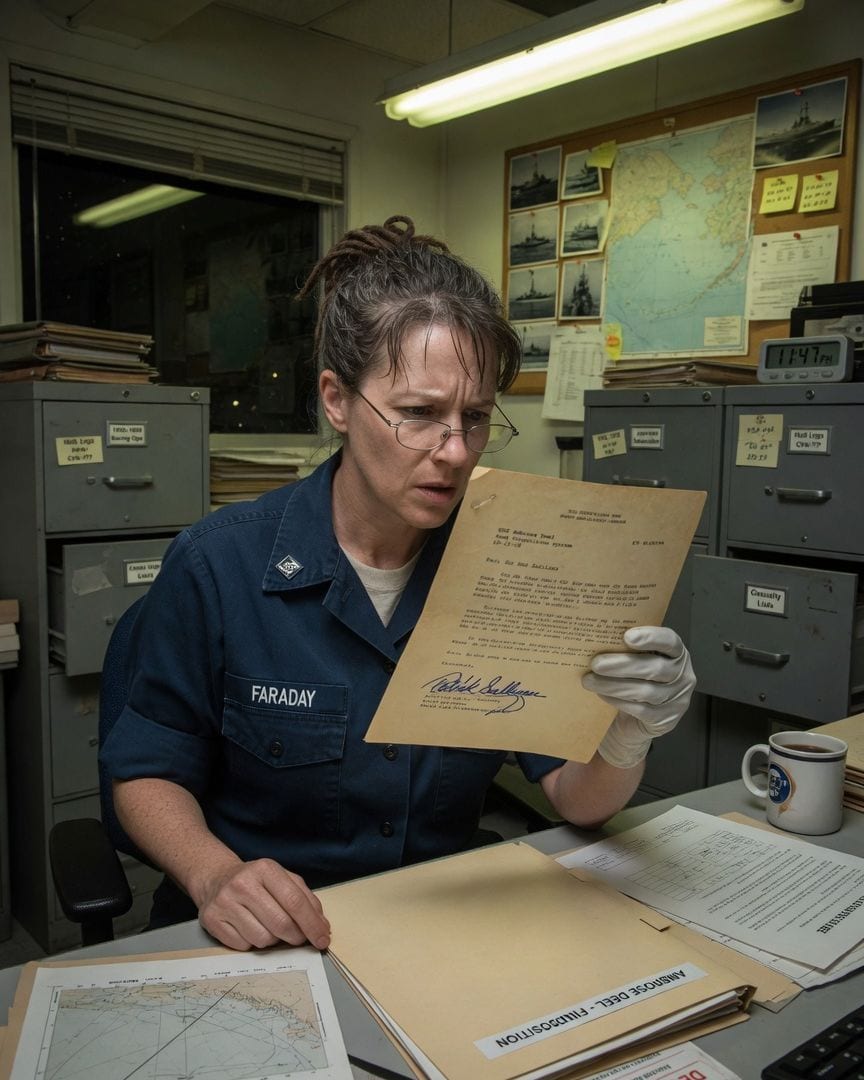
A naval officer closing a Cold War loss found the sunken ship's Chief Engineer signed its log three years after he died.
Lieutenant Commander Josie Faraday faced a Friday deadline to close a sixty-year-old Cold War naval tragedy, reviewing the USS Ambrose Deel's final disposition in the declassification office. Unease pricked at her as three official records agreed on the sunken fleet tug's location and towing vessel, yet Josie found no ship matching that hull number had ever been built. Sifting through brittle, salt-and-dust-scented papers, she then discovered a maintenance sign-off for the Ambrose Deel dated three years after its official loss. The signature belonged to Patrick Sullivan, the Chief Engineer officially lost with the ship in 1955. How could a dead man sign off on repairs to a vessel already at the bottom of the Bering Sea?
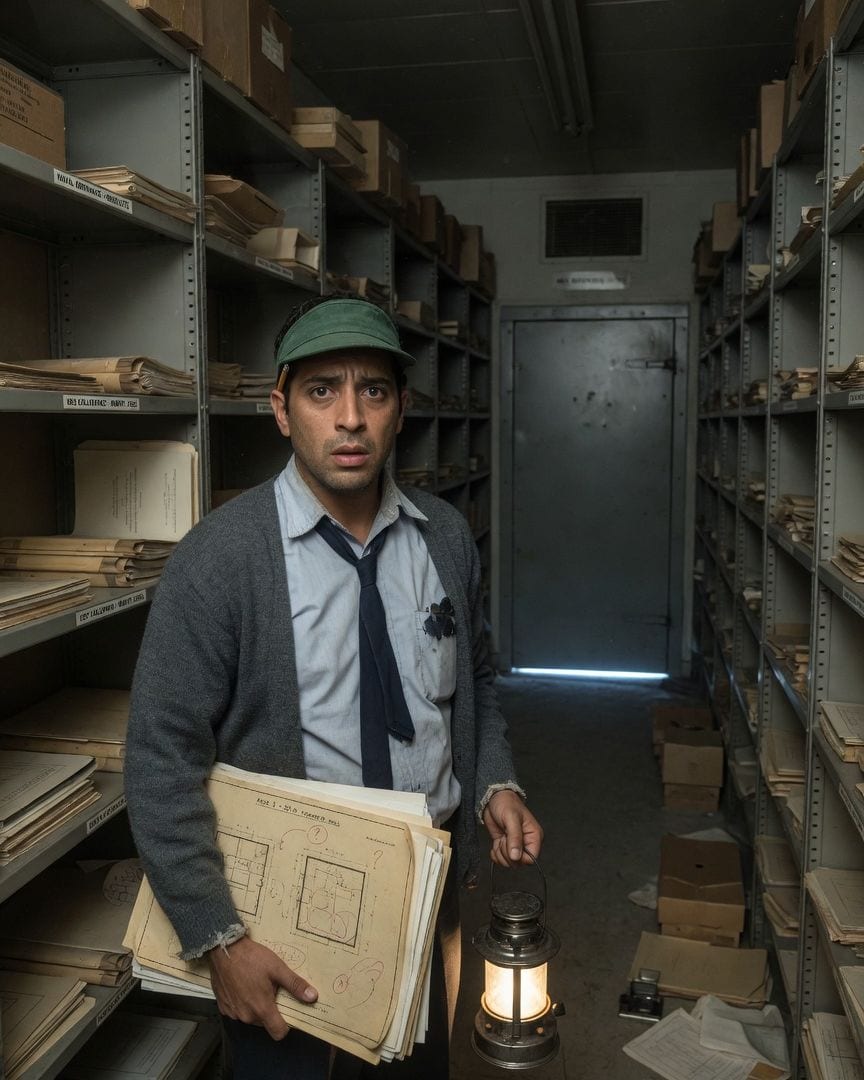
A Cold War records clerk found a lost ship's supply run, signed yesterday by its crew, dead since 1943.
Aurelio Bosch, a methodical night-shift clerk, worked through the Cheyenne records vault in Winter 1957, verifying shelf contents. He discovered an aisle forty feet longer than any blueprint showed, ending in a heavy steel door with no lock. From under it pulsed an unnatural light, and the unmistakable thrum of a printing press ran deep inside. Hours later, buried in old naval records, Aurelio found maintenance logs for a ship lost in 1943, meticulously dated into 1948 and signed by its dead crew. Then he found a new supply requisition for the same ship, dated just yesterday, signed by a crewman officially lost decades ago.
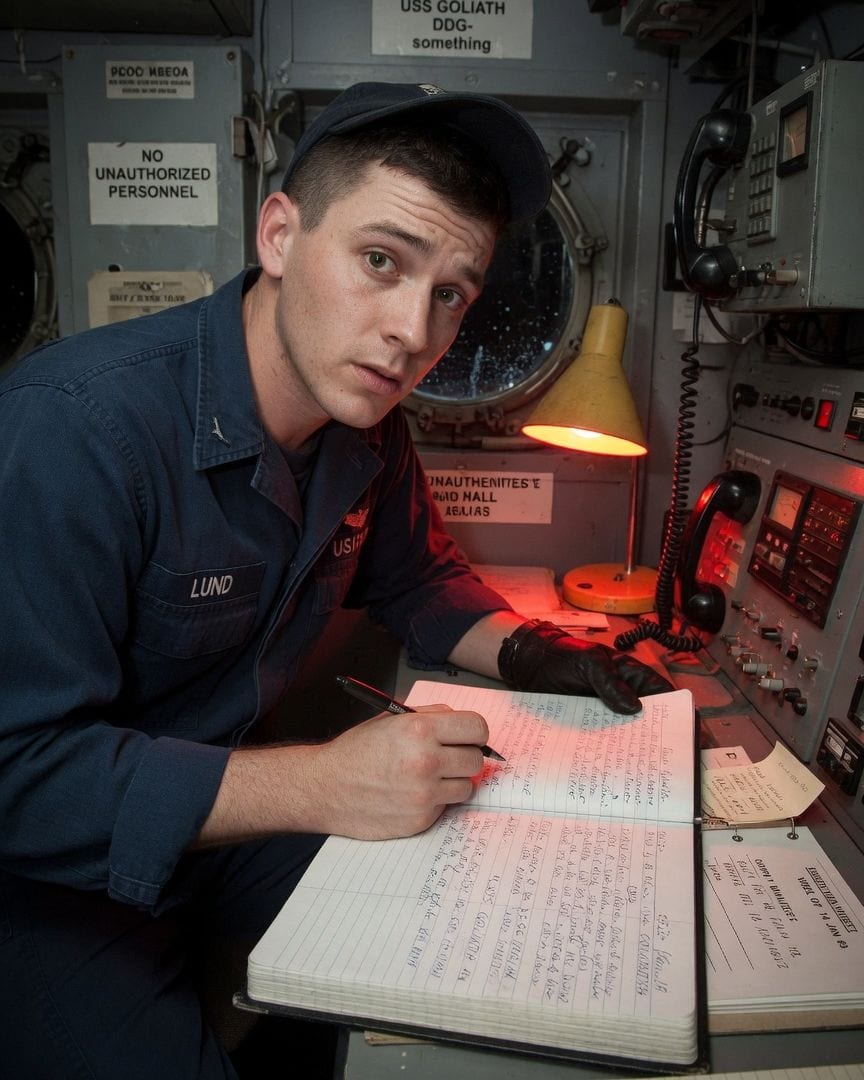
Petty Officer Lund heard his own captain's mayday: the Cold War USS Goliath was sinking, two hundred miles astern.
Petty Officer Marco Lund kept a lonely vigil in the USS Goliath's radio room, the destroyer battling the North Atlantic in deep winter 1983. Suddenly, a garbled mayday broke through: his own ship, his own captain, reporting they were going down two hundred miles astern. Though the bridge confirmed the Goliath was fine, the same chilling call came again an hour later, stronger and from the exact waters they had just crossed. Deeply unsettled, Marco began searching ship logs, eventually discovering a phantom entry: an identical mayday, logged a week prior, pressed into the very paper beneath his own.
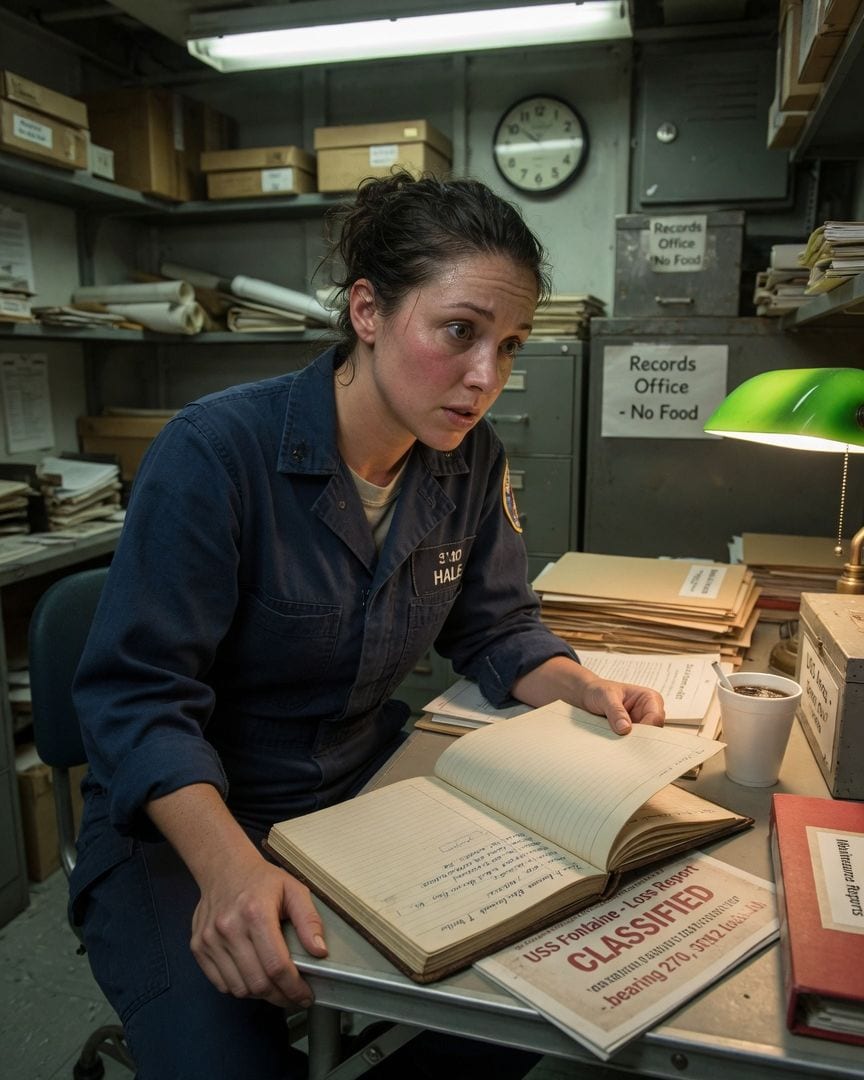
Petty Officer Hale needs a spotless record for her transfer. But the USS Ares sonar logs show an identical, impossible contact, logged to the minute, years apart, and tied to a classified loss report.
Petty Officer Sarah Hale needed a spotless record for her coveted shore duty transfer, a posting she'd worked five years to secure. Alone in the USS Ares sonar shack, three days out from San Diego, her midwatch was broken by an impossible contact: a close, slow echo holding perfect pace, invisible to radar, then vanishing. Her heart hammered, not from fear, but from the data's impossibility. When she found an identical entry in her own log from just one week prior, the cold dread tightened its grip. But the true chill settled when she unearthed decades of similar records, signed by other sonar officers, all showing the same impossible contact at 0212, off the port beam, for nineteen minutes, on the same ship, stretching back years—a persistent echo tied to a classified loss report.
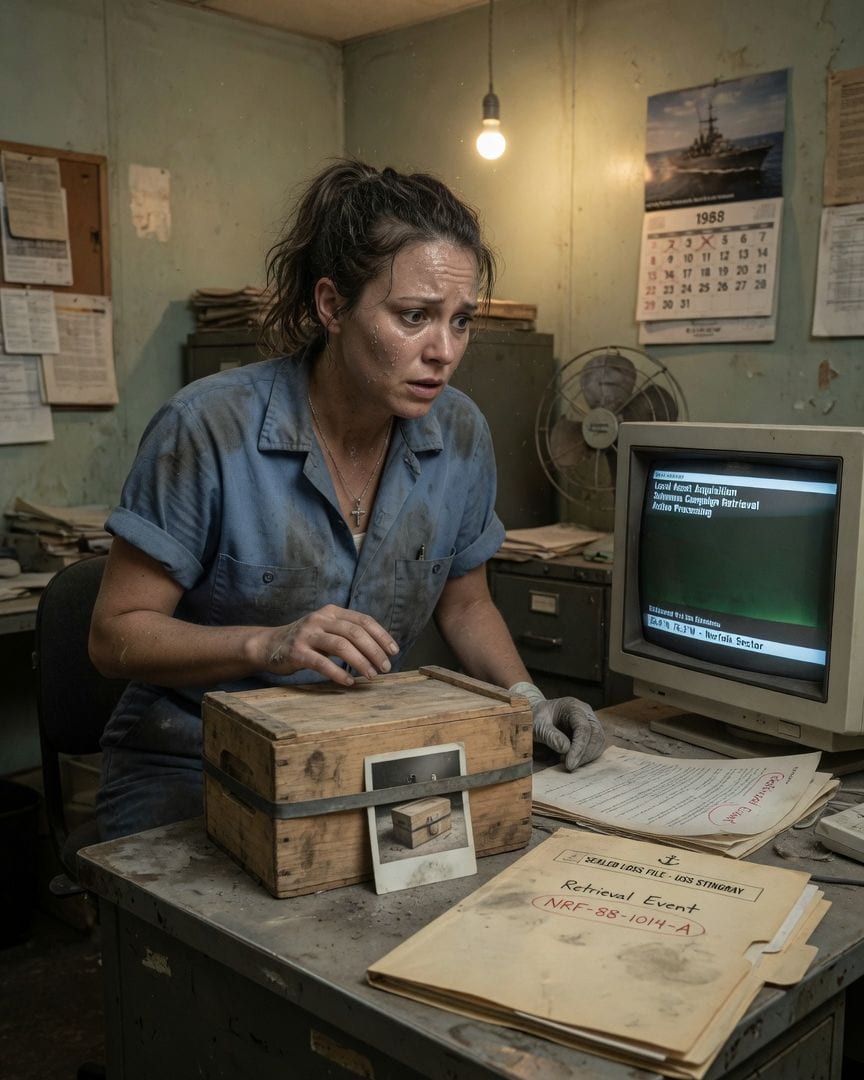
A records depot worker unearths a lost 1940s ship file, then finds a control number from 1988, linking the vanished vessel to the Norfolk coastline.
In 1988, Callista Rhue toiled in a humid Norfolk records depot, her monotonous job sifting through the charred remains of a 1943 fire that had supposedly incinerated everything. She unearthed a cool, unmarked wooden crate that should not have survived, finding a faded 1944 Polaroid of the very crate tucked into its lead band. Inside, a 'sealed loss file' for the USS Stingray, a minelayer vanished in the Solomons, contained an impossible 'Retrieval Event' dated 1988. Callista's database search for the anomaly then pointed not to the distant Pacific, but to active processing for the lost vessel on a remote Norfolk coastline, just miles from the depot. What had truly vanished, and what had been found?
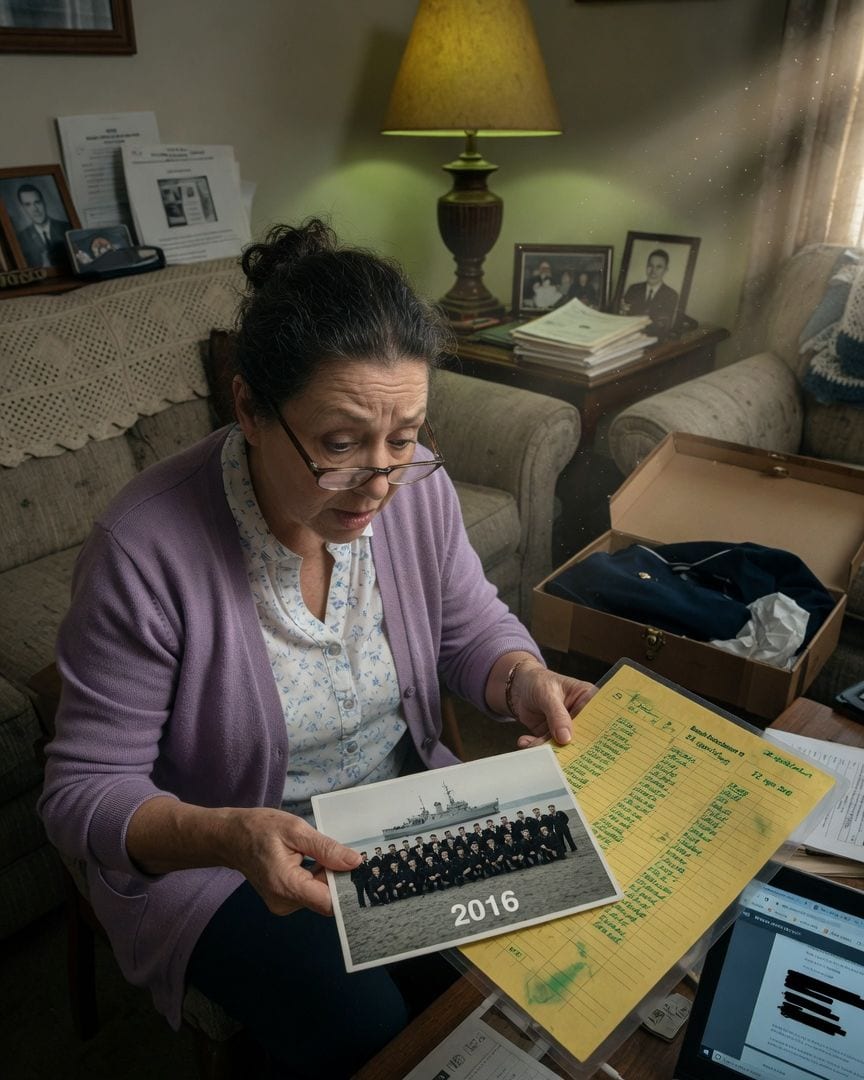
Marisol Frayne unlatched her husband's old footlocker. A photo inside showed his ship, pristine in 2016, three years after the Navy declared it lost.
Marisol Frayne, 62, finally unlatched her husband’s old footlocker in 2024, eleven years after the Navy declared his ship, the Kaskillan, lost at sea. Dust motes danced in the afternoon light as she lifted the lid, releasing the scent of old canvas and cedar. Inside, beneath his perfectly folded dress blues, she found a photograph of David and his crew standing before a pristine Kaskillan. Her breath caught: the photo was dated 2016, three years after the official reports claimed the ship vanished with all hands. Marisol's methodical search then revealed official logs showing a K-class vessel designation active in 2016, leaving a chilling void where her husband's fate should have been.