A radar operator found fresh boot prints leading into a shed, but none led out. Then he found a dog tag for a man who wasn't there.
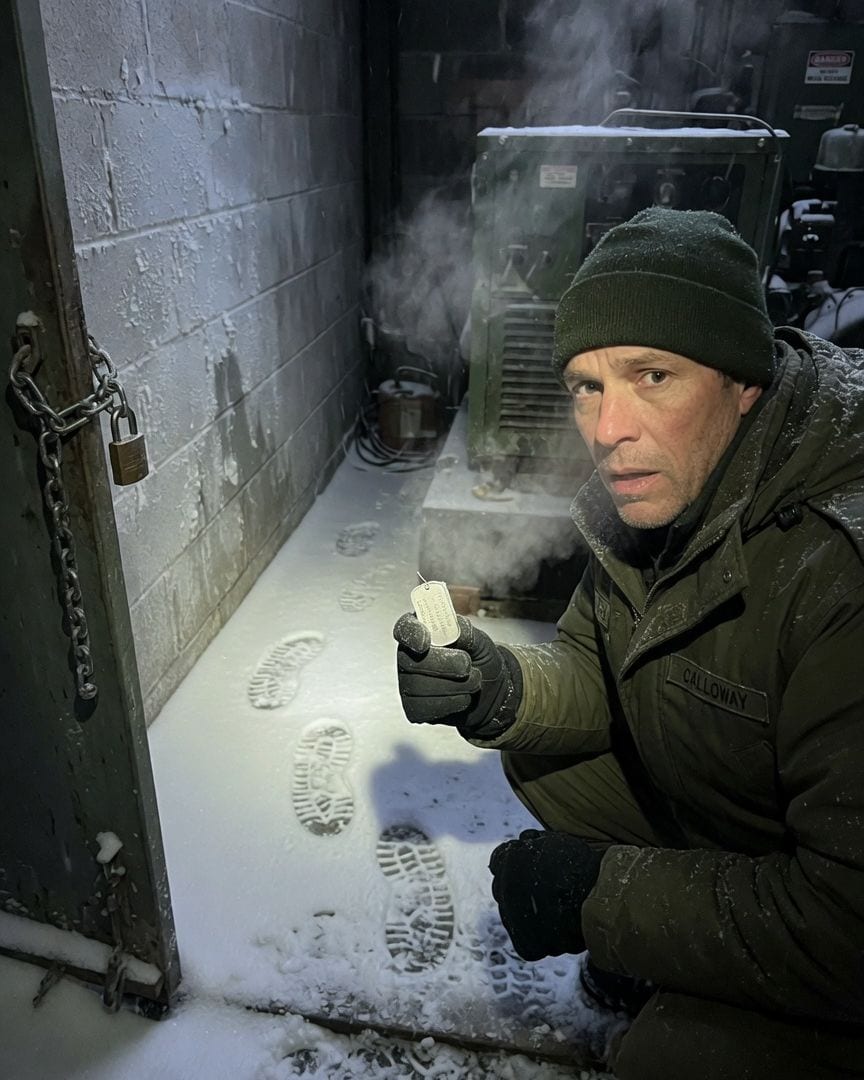
The 0400 contact registered as a single, clear blip on Oscar Calloway’s radar screen. It moved on foot, crossing the perimeter fence of Cutbank Station, then stopped abruptly at the generator shed.
Oscar, a radar operator hardened by Alaskan winters, had initially dismissed it as an atmospheric anomaly, a sensor glitch born of the brutal cold. He’d seen weirder things in his three years at Cutbank.
But the morning report from the perimeter check changed everything. Sergeant Galloway, his face pinched from the cold, confirmed it: fresh boot prints led from the snow fence directly to the generator shed door.
The door, usually secured with a heavy padlock, stood ajar. Inside the shed, the air was still, colder even than the outside, as if the space had exhaled its warmth. Oscar shone his flashlight beam across the snow-dusted concrete floor.
The distinct boot prints continued, clear and heavy, ending abruptly at the far wall.
No prints led out.
Oscar, accompanied by Sergeant Galloway, returned to the shed after breakfast. The interior was small, dominated by the hulking, silent generator.
Galloway grumbled about lax security, pulling at the shed’s doorframe, but found no sign of forced entry beyond the unlocked door. No animal tracks disturbed the snow, no sign of a struggle, just the single, impossible set of boot impressions.
Oscar knelt, examining the floor. The snow was pristine, untouched except for those distinct, heavy military boot prints. He tried to rationalize it—a prank, perhaps, or a forgotten patrol member who’d used the shed for a quick shelter.
But the snow was too clean, the prints too perfect, ending in an impossible silence that swallowed all explanation.
He ran his gloved hand over the wall where the prints stopped, feeling a localized, profound cold that seemed to sink into his bones, colder than the metal of the generator itself. His breath plumed in the frigid air.
Then, half-buried in the snow at the very end of the tracks, he saw a dull gleam of metal. He brushed away the snow with his thumb to reveal a standard-issue military dog tag.
Oscar Calloway picked up the dog tag. The metal was cold, heavier than it should have felt, a small, insistent weight in his palm.
He wiped the frost from its surface with his thumb, the pads of his glove scraping against the etched letters. He read the name: PHILIP BENNETT. Below that, a service number.
He knew no Philip Bennett at Cutbank. He’d memorized the manifest of the nineteen men wintering at the remote station. He scanned his memory for any transfer orders, any temporary assignment, any prior deployment records he might have overlooked. Nothing.
The name was official, military issue, utterly out of place, a solid object that should not exist here.
A profound chill, colder than the Alaskan air, colder than the generator shed, seized him, sinking past his gloves and into his bones, down to the marrow. The dog tag felt impossibly old and impossibly new in his hand.
Back in the comms room, Oscar discreetly searched the station’s digital records for Philip Bennett. He checked current personnel manifests, transfer logs, and even older deployment archives, navigating the clunky, monochrome interface.
The name simply didn't exist in any official capacity related to Cutbank. It was as if Philip Bennett had never been assigned, never transferred, never even passed through.
He tried cross-referencing the service number etched into the dog tag, but it returned no match within the regional command's database. The name was a ghost in the system, utterly erased.
Each dead end ratcheted Oscar’s unease. He sent a few coded inquiries to neighboring outposts, citing a 'routine records check' to avoid suspicion.
The responses were always the same: no Philip Bennett on their rosters, no record of the service number. The official channels yielded nothing but silence.
He noticed Bernard Thornton, the senior comms tech, a man who had served at Cutbank for decades, watching him from his console, a faint, unnerving calm in his eyes that felt too old for the station.
Bernard’s presence felt like a constant, silent observation, a stillness that had settled around him over years.
Oscar tried to access the deeper, older station archives—the physical ledgers and magnetic tapes stored in a locked cabinet in the back of the comms room.
His access privileges, usually unrestricted for a radar operator, now returned an 'insufficient clearance' error. He suspected Bernard, whose console controlled the station’s security protocols.
He tried to casually mention 'Philip Bennett' to a few other crew members during their short breaks.
Some dismissed it as a joke, attributing it to Oscar's overactive imagination; others looked at him with an uncomfortable, almost evasive expression, quickly changing the subject to the next supply drop or the upcoming thaw.
One frigid night, as Oscar worked late shifts alone in the hum of the comms room, he found Bernard there, hunched over an ancient reel-to-reel player, reviewing old radar tapes.
The faint static hiss filled the quiet room, a sound like dry snow shifting across metal. Bernard looked up, his eyes meeting Oscar's in the dim light. His gaze was unblinking. 'Still looking for ghosts, Calloway?'
he asked, his voice even, devoid of any discernible emotion. The question was too precise, too knowing for casual banter.
It felt less like a question and more like a statement of observation, a warning, delivered with the unnerving calm of someone who understood the true nature of Cutbank’s shadows.
Oscar Calloway finally confronted Bernard Thornton, placing the Philip Bennett dog tag on Bernard's desk. The dull gleam of the metal reflected the fluorescent light of the comms room.
Bernard picked it up, turning it over in his fingers with a practiced ease, as if handling a familiar object. He didn't deny it. He didn’t even flinch.
'An old acquisition,' Bernard said, his voice flat, devoid of any emotion. 'Sometimes the station accounts for things differently than the official record. It's a remote post, after all. Things get… reclassified.'
Oscar pressed him, his own voice tight, 'Accounted for? What does that mean? He just vanished?'
Bernard sighed, a sound like dry snow shifting in a faint breeze. 'It means the system balances its books. A perimeter breach, a contact, an entry. Then an adjustment. Philip Bennett was here, years ago. Then he wasn't.
Just like the tape said.' He spoke of 'rotations' and 'calibrations,' using the clinical, detached language of a technician, but applied to human lives.
He hinted that the 'system' here was older, more fundamental than any military manifest, more integral to Cutbank than the men who served it.
The dread deepened with every calm, rational word. Bernard wasn't covering up a crime; he was explaining a process, a protocol, an operational function. He was a manager, not a participant in an act of violence.
Oscar realized that Bernard saw this as a natural function, a necessary maintenance, an unavoidable part of Cutbank’s existence.
The dog tag on the desk suddenly felt less like a clue and more like a receipt, a marker of a transaction that had been completed long ago.
Bernard Thornton, with a placid expression, led Oscar Calloway to a dusty shelf of ancient, bound ledgers in the back of the comms room, behind a forgotten partition. 'The true logs,' he stated, his voice quiet.
He pulled out several heavy volumes, their covers warped with age. He showed Oscar a series of archived maintenance reports from previous rotations, dating back decades.
Each log detailed a similar 'perimeter anomaly' or 'unaccounted contact' around the 14th of a winter month, always resolved by Bernard’s neat signature and a brief note about 'system calibration.'
Oscar saw the name Philip Bennett listed in a 1978 log, an entry almost identical to the recent radar blip. Later, Bennett's name appeared again with a 'final disposition: accounted for.' The pattern was undeniable, chilling in its regularity.
It wasn’t a one-off event; it was a recurring mechanism.
Then, Bernard turned a page in an even older ledger, pointing to an entry from 1965, the paper yellowed and brittle.
Oscar Calloway read it, his breath catching in the frigid air of the room, feeling as if the old paper had somehow absorbed the cold of time itself: 'Perimeter anomaly: Thornton, Bernard. Date: 14 DEC 1965. Final disposition: accounted for.'
Oscar looked from the decades-old record to the man standing before him, the current Bernard Thornton, aged but undeniably present, watching him with an unnerving calm. The original Bernard Thornton was accounted for, gone.
But this Bernard was still here, explaining it all.
Bernard Thornton explained it all, his voice low and steady in the persistent hum of the comms room. 'Cutbank doesn't just make people disappear,' he clarified, his gaze fixed on Oscar. 'It sometimes… repurposes them.
The anomaly takes, then it replaces. But the replacement isn't quite the original. It learns, it adapts, it maintains.' He described how he himself had been 'accounted for' decades ago, back in 1965.
He’d woken up in his own bunk, a subtle shift in his perception, a new understanding of the station's silent, unyielding rules.
He had learned to live within the system, ensuring the 'balance' of records, managing the 'adjustments' that Cutbank required.
He explained that the 'boot prints in, none out' was the station's way of marking a new 'acquisition,' a new piece for its intricate, ongoing mechanism.
Philip Bennett, he confirmed, was one such acquisition, a necessary 'adjustment' from a previous rotation, back in 1978.
And now, the station had made a new one, a recent entry into its ledger, and Oscar had been the one to find the physical proof.
Oscar Calloway felt a cold, horrifying clarity settle over him: the system was not external; it was inherent to Cutbank, intrinsic to its very stone and steel. And Bernard was its quiet, patient steward, a willing, altered participant.
Bernard Thornton turned from the old ledgers to Oscar Calloway, his eyes holding a depth that was both ancient and utterly vacant, like a winter lake.
'The station needs someone to maintain the records,' Bernard said, his voice softer now, almost inviting, the words drifting through the hum of the equipment. 'To ensure the smooth transition. You found the dog tag, Oscar. You dug.
You understand now, don't you?' Bernard's words hung in the air, a chilling offer, a quiet invitation to an inescapable role.
Oscar realized he couldn't escape. The relief plane wouldn't arrive until thaw, weeks away across miles of impassable snow.
And even if it did, the anomaly was part of Cutbank, intrinsic to its very being, not a random event that could be left behind.
He was trapped, not by physical bars, but by a horrifying, coherent truth, a system that had already accounted for him by the very act of revealing itself.
He saw the placid acceptance in Bernard's eyes, a quiet resignation that had now, by implication, become his own inescapable future.
The localized cold spot he'd felt in the generator shed, the precise wording of Bernard's questions, the erased records, the pattern across rotations—it all clicked into place, every detail a brick in the wall around him.
He was being offered a mantle, the role of 'the one who knew,' the next steward of Cutbank’s grim accounting. The choice was not whether to escape, but whether to accept his new purpose, his new understanding.
Weeks passed. The snow continued to fall, burying Cutbank in an unyielding white. Oscar Calloway meticulously updated the radar logs, marking 'anomalies' as 'system resolved.'
He found an old, worn copy of a station manual, dating back to the 1950s, tucked beneath Bernard's console. Its margins were filled with careful, spidery handwriting—Bernard's annotations.
The final entry, scrawled beneath a faded diagram of the perimeter fence, simply read: 'The station always balances its books.'
Oscar Calloway sat in the comms room, the radar scope humming its low, steady note. He heard the faint, distant drone of a supply plane, a barely audible promise of thaw and relief, still weeks away.
He glanced at Bernard Thornton, who was filing old reports with a quiet, efficient calm, a faint, knowing smile playing on his lips, a shadow of an earlier self.
Oscar felt a familiar chill, not from the Alaskan winter, but from within, a deep, pervasive cold that had settled into his bones, a new core. He reached for a blank logbook, his hand steady.
Months later, the relief plane finally landed at Cutbank, breaking the long silence of the winter. The new crew found the station in perfect order, all systems operational.
Oscar Calloway, now the senior comms tech, greeted them with a quiet, efficient calm, his eyes holding a placid depth. Asked about the previous rotation's personnel, he simply said, 'Everyone's accounted for.'
The radar scope hummed a low, steady note.
If this one got to you
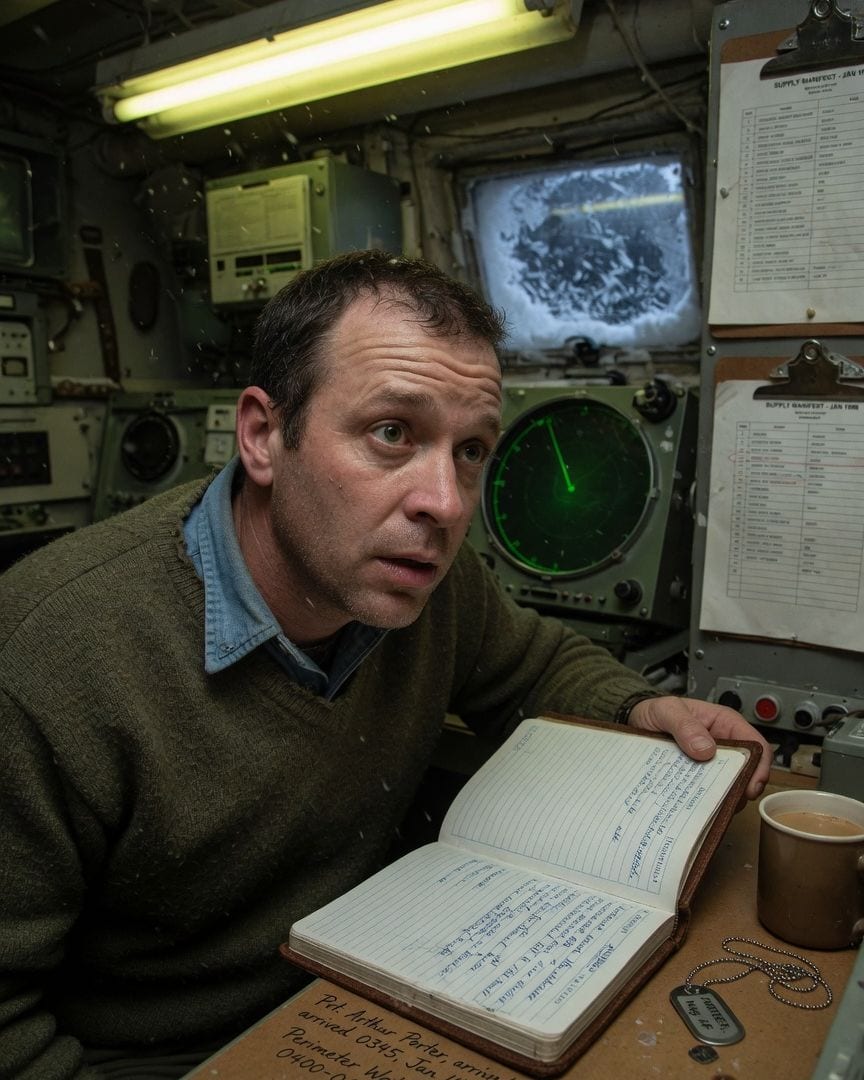
Cold War Radar Operator Conrad Oakley watches a man enter a shed. His boot prints lead in, but no tracks ever lead out.
At the isolated Cutbank radar station, deep in the Alaskan interior, Radar Operator Conrad Oakley maintained a lonely vigil against the howl of a relentless blizzard. His routine overnight watch on January 14th was shattered by an impossible radar contact: a solid, human-sized presence crossing the perimeter and stopping at the generator shed. At dawn, the shed door stood ajar. Inside, fresh boot prints led deeper into the cold darkness, but no tracks led out into the snow-choked landscape. Later, preparing the duty roster, Oakley found a new name in the station logbook: Pvt. Arthur Porter, assigned to perimeter watch. Beneath an empty bunk, a dog tag confirmed the identity of a soldier who was never there.
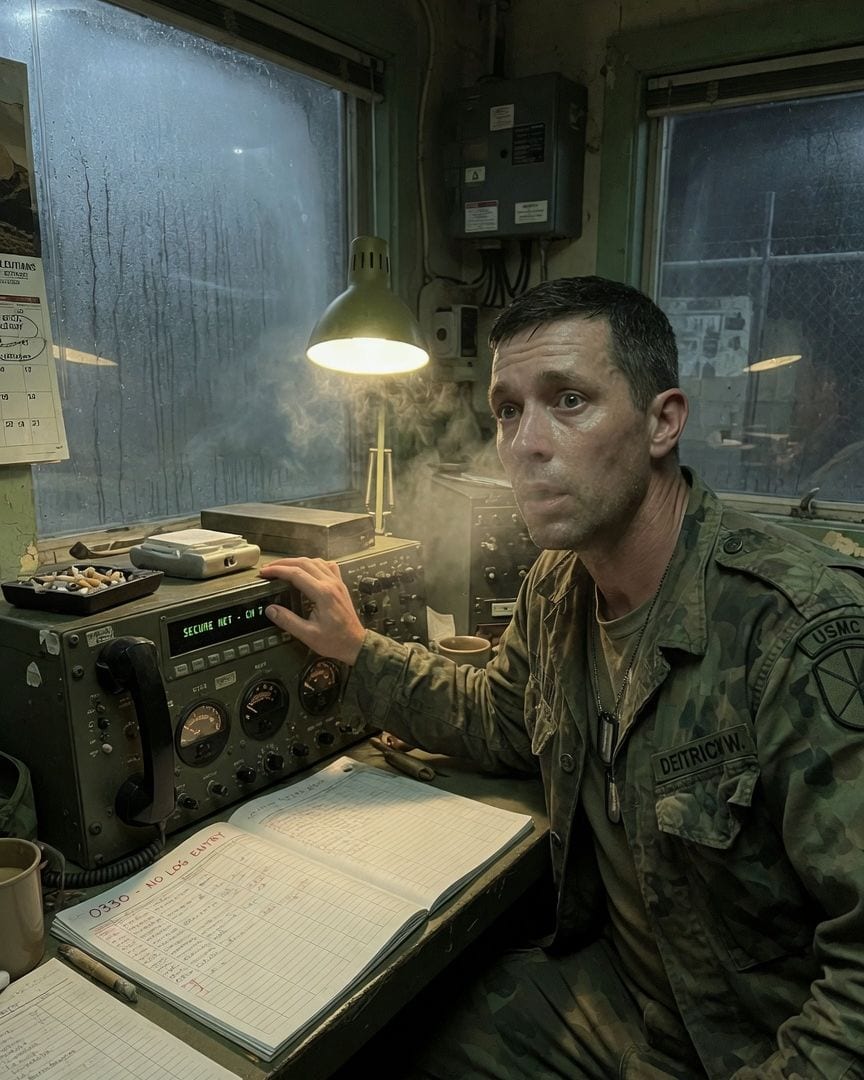
A corporal finds a dog tag with a name read on his secure channel, but no one by that name is on the outpost roster.
Corporal Warren Deitrick was accustomed to quiet watches at the remote Aleutian outpost, the rhythmic hiss of static a familiar companion. But at 0330, a sharp, clean click cut through the silence on his secure net, and a flat, emotionless voice began to read the outpost's roster, name by name. The voice paused, then announced "Corporal Warren Deitrick." Shaken, the corporal later found the radio logs showed no record of the transmission, an empty channel. His unease solidified when an unscheduled perimeter check revealed unfamiliar boot prints leading into the dense fog, ending at a cold, muddy dog tag bearing a name not on any current roster: SULLIVAN, J.
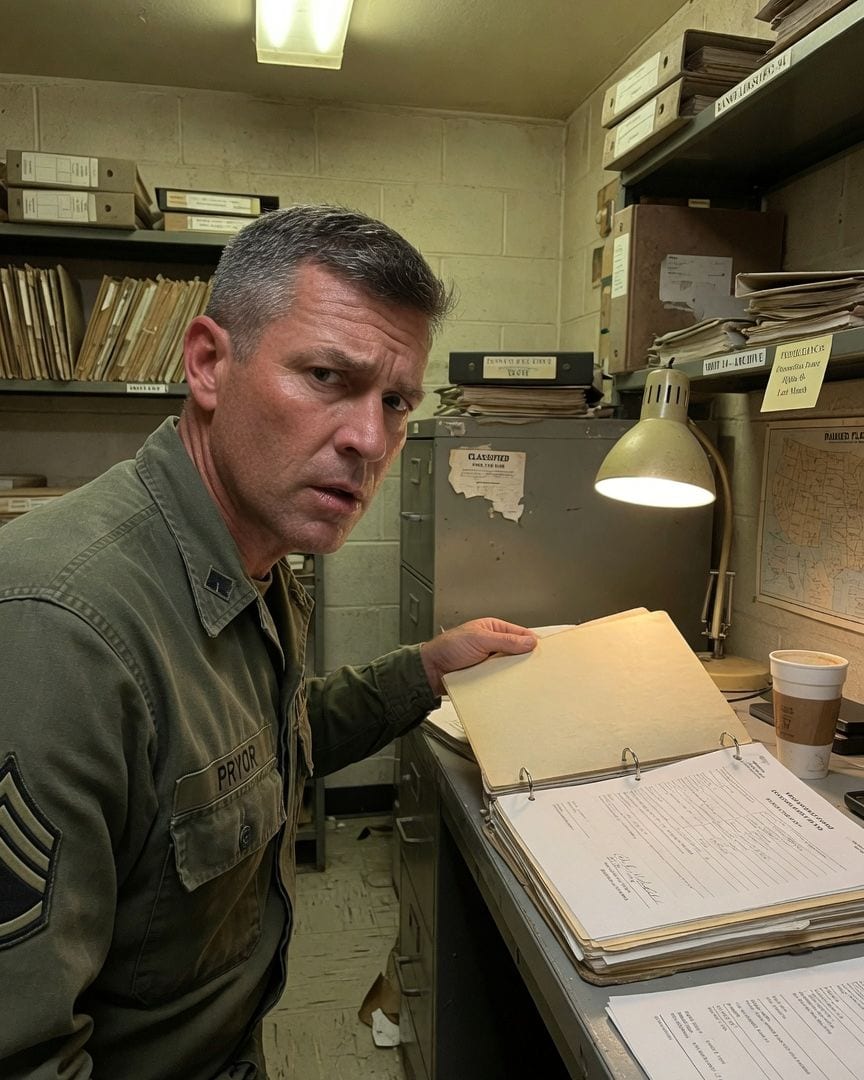
A sergeant with eleven days left finds a warm, glassed crater. Its file shows a captain lost thirty years ago is still signing reports from last week.
Sergeant Alden Pryor was counting down his final eleven days on a twenty-year hitch, expecting to spend them on routine patrols along the Ranier Flats fence line. Instead, his truck stopped at a bizarre sight: a four-hundred-foot glassed crater, miles from anywhere, its sand faintly warm at dawn despite no one recalling a blast. The air above it shimmered with an unnatural distortion, a silent scar of erased violence, and the official file for 'Shot 14' showed recent maintenance sign-offs for a decommissioned tower at the crater site. All these active documents were signed by Captain Everett Caldwell, who had been officially lost in operations thirty years ago, leaving Sergeant Pryor to wonder how a dead man could still be filing reports.
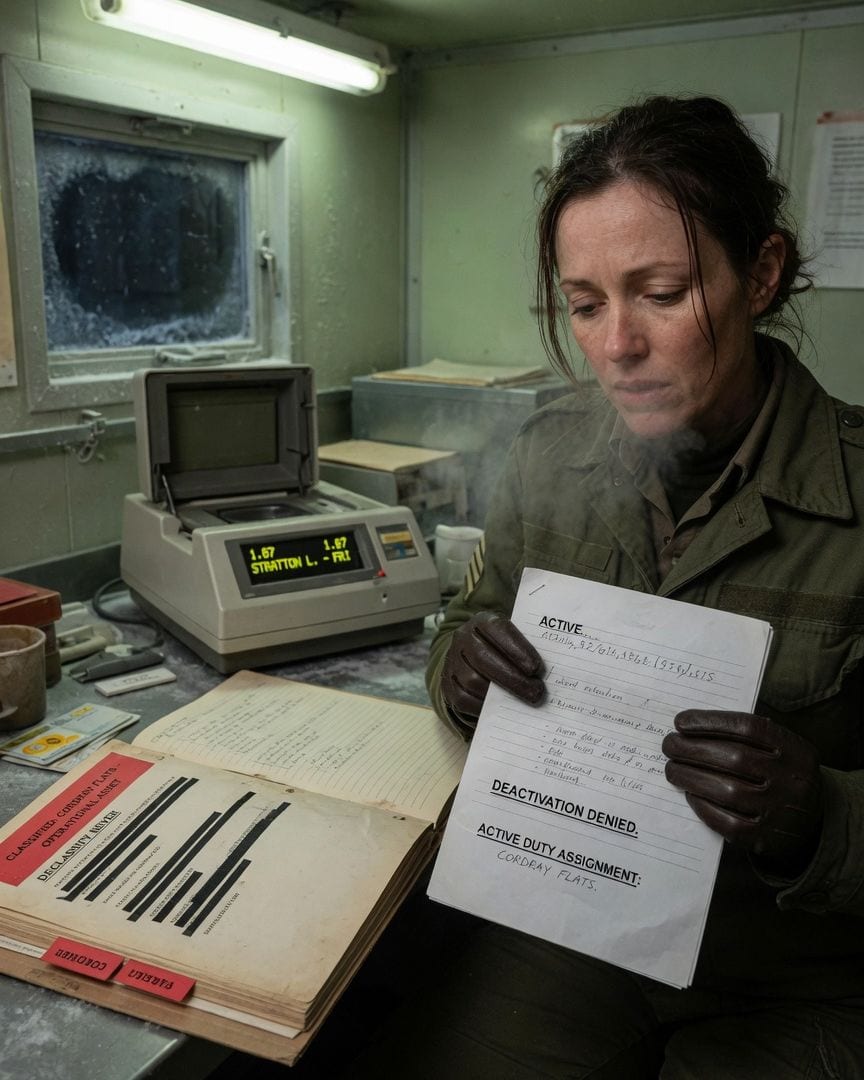
A dead researcher's Cold War film-badge was manually dated for active duty next Friday at Cordray Flats.
Corporal Hettie Vance moved like a ghost through the cold, empty Cordray Flats in the winter of 1988. The decommissioned range was quiet, her film-badge processing a rote exercise, until the 141st badge appeared. It belonged to Leonard Stratton, a research assistant who'd died in 1987, yet the scanner showed a full working exposure. Hettie found its date wheel manually reset for the coming Friday, and a secret file later confirmed an impossible directive: 'ACTIVE DUTY ASSIGNMENT: CORDRAY FLATS.' Who reset the badge, and for what purpose, on a range supposedly abandoned?
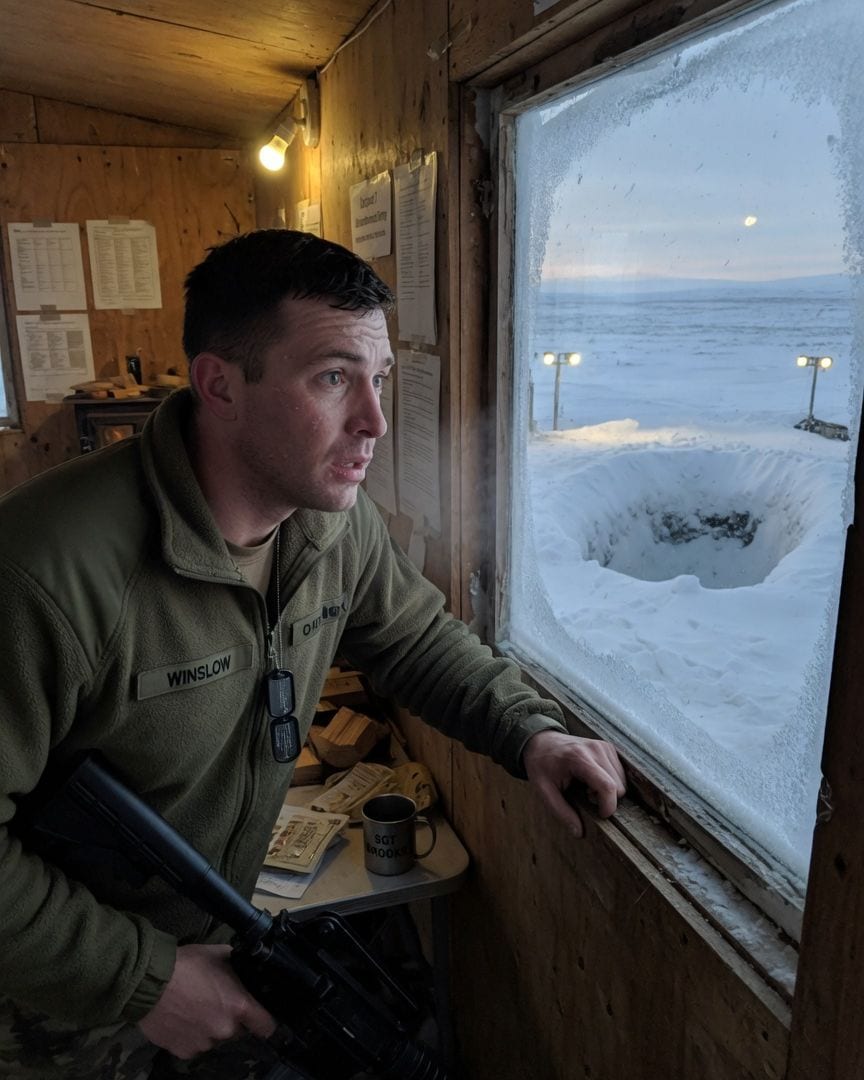
An outpost soldier transferred two weeks ago is listed on last night's patrol log.
Corporal Kenneth Winslow discovers a perfectly circular, waist-deep track in the fresh snow around his isolated hut. When he checks the duty logs, he finds an entry for a perimeter sweep by himself and a PFC Langford. Yet, official records show PFC Langford was transferred from the outpost two weeks ago.
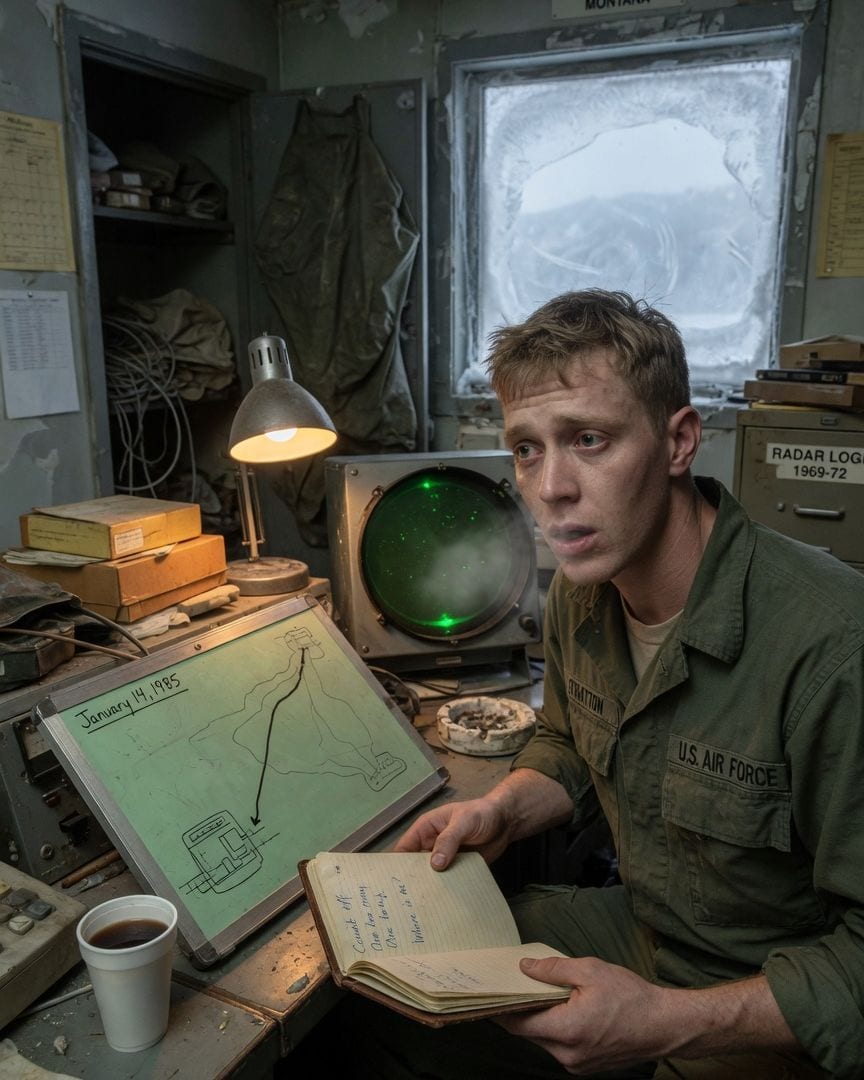
Airman Lars Stratton found an old Cold War manifest listing one name twice: 'Bernard Radcliffe' transferred and 'Bernard Radcliffe' still present.
Airman Second Class Lars Stratton was counting down his final weeks at Echo Station, a desolate Cold War outpost due for mothballing. He longed for home, far from the bitter Montana winds and the constant hum of static. Inside the dim radar shack, he logged the usual nightly ghost blip, a faint contact appearing at 2300, just as it had every winter since 1987. This night, a metallic tang like old blood lingered in the air, raising the hairs on his arms. Seeking distraction, Lars later discovered a leather-bound logbook from 1971, detailing the same 2300 contact, but with chilling notes and a manifest listing one airman's name, Bernard Radcliffe, twice—once transferred, once present. Was he truly alone in the silent, remote station?