A corporal finds a dog tag with a name read on his secure channel, but no one by that name is on the outpost roster.
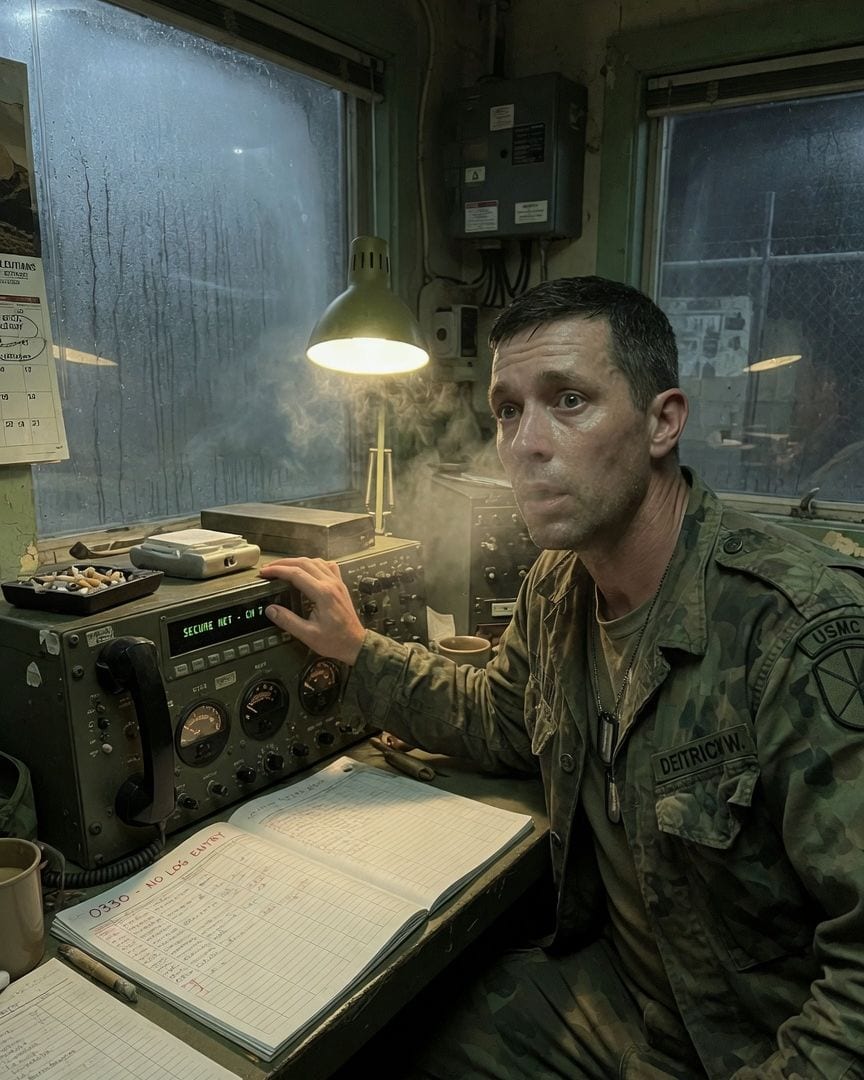
Corporal Warren Deitrick sat hunched over the radio console in the Aleutian outpost’s comms room, the rhythmic hiss of static a constant companion.
Outside, the fog was a solid, shifting wall, pressing against the windows, muffling the already distant sound of the waves.
His watch was usually quiet, just the distant, garbled chatter of fishing vessels drifting onto the guard channel, which he’d long since learned to tune out. The only other sound was the low, steady hum of the outpost’s aging generator.
At 0330, a sharp, clean click cut through the static, a key-up on his own secure net—frequencies only the outpost held. Deitrick leaned closer, his hand hovering over the squelch knob, a prickle of unease rising on his neck.
A flat, emotionless voice began to read the outpost’s roster, name by name, each syllable distinct, yet utterly devoid of human inflection.
It listed Private First Class Evelyn Thatcher, then Sergeant Robert Caldwell, then three other names Deitrick recognized from the current duty roster. The voice paused, a fraction of a second longer than expected. Then it stopped.
“Corporal Warren Deitrick,” the voice announced, and waited.
Deitrick’s breath hitched. His fingers, cold despite the insulated room, tightened on the edge of the console. He didn’t answer. He couldn’t. The sound had been too precise, too direct, coming from a channel that should have been locked down.
The silence on the net stretched, heavy and unnatural, until the channel clicked off again, leaving only the familiar hiss of static.
Shaken, Deitrick logged the incident, reporting an unauthorized transmission to Sergeant Caldwell, who, predictably, attributed it to a prank or sleep deprivation.
“It’s the fog, Deitrick,” Caldwell had said, waving a dismissive hand later that morning. “Plays tricks on the mind out here. Probably a fishing boat got a hold of some old military comms gear, trying to mess with us.”
Deitrick, however, couldn’t shake the chill that had settled deep in his bones. He reviewed the digital radio logs for his shift, meticulously scrolling through the timestamps.
There was no record of an incoming transmission on his secure frequency at 0330. Nothing. The digital logs showed only an empty channel for that precise minute.
His gut churned with a persistent unease. He knew what he had heard.
He then decided to perform an unscheduled perimeter check, rifle slung tight, the fog so thick it swallowed the beam of his flashlight after only a few feet.
Near the westernmost section, a part of the wire that had been supposedly secured and untouched for weeks, he saw them: a faint line of boot prints in the soft, damp earth.
They weren’t his, nor Caldwell’s, nor any standard-issue Marine boot he recognized. The tread pattern was unfamiliar, oddly defined. They led from a section of the perimeter that should have been impassable, directly into the swirling gray.
He followed them a short distance, the fog closing in around him like a maw, until his boot nudged something cold and hard. He knelt, scraping away the mud with his gloved fingers. It was a dog tag.
Deitrick’s gloved fingers trembled as he wiped the tag clean.
The name etched into the dull metal was stark, the raised letters spelling out a chilling message: SULLIVAN, J. He knew, with a certainty that iced his veins, that there was no 'J. Sullivan' on the outpost's current roster.
No 'Sullivan' at all. It was one of the names the flat voice had read, a name that should not exist on any current manifest.
The cold metal in his hand felt impossibly heavy, a physical anchor to the impossible event.
He looked up, peering into the featureless, swirling white wall of fog that pressed against the perimeter, the silence broken only by the distant, mournful cry of a seabird. The dread solidified, a cold, hard knot in his gut.
The next day, Deitrick couldn't let it go. Caldwell's dismissive explanation felt thin, translucent as the lingering fog itself.
While Caldwell was distracted with a supply drop that morning, Deitrick used a secure terminal in the comms room to discreetly search for 'James Sullivan, USMC, Aleutian Outpost.'
The search yielded a partial, declassified record: a Private First Class James Sullivan, reported MIA from this very outpost decades ago, official cause 'lost at sea during heavy weather.'
The details were sparse, frustratingly vague, but the name and location were undeniable. A cold, hard certainty began to replace his unease.
Deitrick then returned to the strange boot prints he’d found. He took careful measurements, pressing a sheet of paper against the distinct tread and sketching the pattern.
He compared these to every standard-issue boot profile he could find in the outpost's supply records. They didn't match any, not current issue, not even the older models stored in the quartermaster's dusty bins in the back of the archives.
The tread pattern was subtly off, the size noticeably larger than average.
Driven by a growing, sickening unease, Deitrick began spending his off-hours in the outpost's neglected, mold-scented archive room, a place filled with forgotten equipment and decades of physical records.
Dust motes danced in the single beam of sunlight that occasionally pierced the gloom.
He started sifting through old, bound logbooks, their covers stiff with age, looking for any other names from the radio call, or any further mention of 'Sullivan.'
He found entries for other 'lost at sea' or 'weather-related incident' reports, often adjacent to names that had also been on the voice’s impossible roster.
The pattern was subtle, almost invisible, hidden in plain sight amidst routine reports of maintenance and supply requisitions. Each entry, each impossible correlation, was like a cold hand brushing his skin.
Deitrick's quiet investigation wasn't as discreet as he thought.
One evening, deep in the archives, the air thick with the smell of mildew and stale paper, a faint, almost imperceptible static crackled on his personal handheld radio, which he'd left on a desk nearby.
It was on an empty channel, yet he distinctly heard a whisper, barely audible, that sounded like his own name, distorted and drawn out. Deitrick froze, his heart slamming against his ribs, sweeping the room with his flashlight.
The beam cut through the shadows, revealing nothing but stacked boxes and forgotten machinery. He found nothing.
Later that night, returning to the archives to retrieve his forgotten flashlight, he found the heavy metal door, which he’d secured with a padlock, slightly ajar.
The lock was still in place, but not fully engaged, as if someone had twisted it just enough to bypass its mechanism. The cold that seeped from the slightly open door was profound.
The next morning, during mess, he caught Private First Class Evelyn Thatcher watching him across the room. Her gaze was unnervingly calm, distant, with an unsettling blankness in her eyes that made the hairs on Deitrick's neck stand up.
She held her fork in a strangely rigid grip, her meal untouched. He saw her again later that afternoon, standing alone by the perimeter fence, staring into the impenetrable fog that had rolled in again, her posture rigid, almost unnatural.
She remained motionless for a full five minutes, her silhouette stark against the white. It felt less like observation and more like a silent, knowing presence. The outpost itself seemed to hold its breath.
Deitrick couldn't keep silent any longer. The weight of what he was finding pressed down on him, making the air heavy in his lungs. He cornered Sergeant Caldwell in his office, the blinds drawn against the pervasive gray outside.
Deitrick laid out the mud-caked dog tag, the meticulous measurements and sketches of the boot prints, and the damning pattern of 'lost at sea' entries from the old logbooks, cross-referenced with the names from the radio call.
He spoke quickly, trying to make Caldwell understand the impossible coherence of it all. Caldwell’s dismissive facade slowly crumbled.
His face, usually gruff, became pale and drawn as he listened, his eyes tracing the outlines of the dog tag Deitrick had placed on his desk.
He picked up the Sullivan dog tag, turning it over and over in his hand.
“This… this isn’t new, Deitrick,” Caldwell finally admitted, his voice barely a whisper, thick with a deep, weary resignation. He stared at the dog tag, then at Deitrick. “The fog… it’s not always just weather.
This outpost… it’s older than the official records say. There have always been… anomalies.” He confessed that the official reports—the 'lost at sea,' the 'heavy weather'—were lies, part of a generations-long cover-up.
“They call it ‘the ledger’,” Caldwell said, gesturing vaguely towards a locked, reinforced safe built into the wall behind his desk, its steel door scarred with age. “A record kept by the commanders, passed down. Not for official eyes.
It details… what really happens here. What’s always happened.”
He explained that the outpost wasn't just a listening post; it was a 'warden,' tasked with maintaining a specific, archaic protocol to keep 'something' contained within the fog. The radio calls, the disappearances – they were all part of it.
The system of accountability, the manifests, the rosters… they were being used by something else, something that manifested through the fog itself. Caldwell’s eyes held a deep, unsettling blankness, mirroring Thatcher’s from earlier.
“It collects,” he said, his voice flat, emotionless. “It always has.”
With a heavy sigh, Caldwell turned to the wall safe, its heavy steel door a stark, unyielding presence in the room. He inputted a complex sequence on a tarnished keypad.
The thick steel door swung open, revealing not weapons or classified documents, but a single, leather-bound ledger, its pages water-damaged and brittle with age, the leather cracked and peeling.
“The Historical Outpost Manifest,” Caldwell murmured, his voice now devoid of any emotion, handing it to Deitrick.
Deitrick’s hands shook as he took it. The smell of salt, mold, and old paper filled his nostrils, ancient and cloying. He carefully turned the fragile pages, the paper threatening to crumble at his touch.
He saw familiar names—Sullivan, and others from the radio call—each entry noting ‘MIA’ or ‘Lost to Fog,’ with dates stretching back decades. The handwriting changed over time, but the stark declarations remained.
He scanned the faded, handwritten entries, his heart pounding a frantic rhythm against his ribs. He saw 'SULLIVAN, J.' with a date decades past.
Then, further down the list, under an entry dated years before he was even born, he found it. His own name. 'DEITRICK, W.'—staring back at him from a roster of the long-claimed.
Caldwell watched Deitrick’s face, a grim understanding passing between them. The air in the office grew heavy, thick with the unsaid horrors of generations. “It’s not random, Deitrick,” Caldwell explained, his voice low, a monotone that grated on Deitrick’s ears.
“The entity… it’s tied to this place, to the land itself. It perceives, and it uses our own systems against us. The rosters, the call signs, the manifests—they’re not just military records to it. They’re… claims.
A form of registration in its own impossible ledger.” He revealed that the outpost’s true, unofficial mission was to monitor and, if possible, deter the entity, but primarily to keep its existence a secret from the wider world.
The 'wardens,' as Caldwell called them, were often descendants of those previously claimed, or those whose families had a long history with the outpost, making them susceptible, marked.
Deitrick’s own family, Caldwell implied, must have had a connection, a name passed down.
The flat cadence Deitrick heard on the radio wasn't just mimicry; it was the entity using the voice of a previous 'auditor,' one of its own collected, to continue its terrible roll call.
“You were always on its list, Corporal,” Caldwell said, his words chilling. “It just took this long for it to get to your turn.”
The boot prints belonged to those who had answered the call, their last, impossible steps before being absorbed into the fog's own manifest.
As Caldwell finished speaking, the outpost was plunged into an unnatural gloom. The lights in the office flickered, then dimmed. The fog outside thickened, pressing against the windows like a solid, white wall, swallowing all light, all sound.
A low, resonant hum began to vibrate through the floor, thrumming up through Deitrick’s boots.
Then, the radio crackled to life, not just on Deitrick's secure channel, but on every frequency, a cacophony of overlapping, flat voices, reading names faster, more urgently.
They drew closer, echoing from the speakers, from the walls, from everywhere, a chorus of impossible auditors. The very air around Deitrick seemed to compress, pushing him.
He felt an unbearable, magnetic pull towards the perimeter, towards the blinding white, a terrible fascination drawing him forward. Caldwell grabbed his arm, his face etched with desperation, his grip surprisingly strong. “Don’t answer it, Deitrick!
Don’t let it claim you!” He explained that to 'answer up' was to walk into the fog when your name was called, to become another entry in its ledger, to be absorbed.
Deitrick looked up, and through the office door, he saw Private First Class Evelyn Thatcher.
Her face was utterly blank, her eyes distant, her movements stiff and unnatural, already moving towards the main door of the outpost, her rifle hanging uselessly from her shoulder.
Her name, 'THATCHER, E.,' echoed loudest on the radio, resonating with an almost physical force. Deitrick tore free from Caldwell’s grip, grabbing his own rifle from where it leaned against the wall.
He didn’t aim it at the unseen entity, but at the path in front of Thatcher, a desperate, futile attempt to stop her, to break the pull. “Thatcher! Stop!”
he yelled, but his voice was drowned out by the chorus of flat, echoing names. Thatcher didn't even flinch. Her feet moved with an unnerving, steady rhythm, as if guided by an unseen current.
Deitrick watched, paralyzed by the sheer, overwhelming force of it, as Evelyn Thatcher walked out the door, her silhouette swallowed by the impenetrable fog, her name still echoing, fading, then gone.
A week later, the fog lifted, revealing a stark, silent outpost. A relief crew arrived by helicopter, finding the station eerily quiet, save for the hum of machinery.
Sergeant Caldwell, his face haggard and lined, filed a terse report: Private First Class Evelyn Thatcher, lost at sea during routine perimeter check.
Corporal Warren Deitrick was found on his bunk, physically unharmed, but something in his eyes was distant, hollowed, as if he had seen too far into the white expanse and found nothing left.
He barely spoke, moving with a muted, automatic grace. The official digital roster was updated, Thatcher’s name removed, her service record closed, another statistic in the long, impossible history of the Aleutian outpost.
Days later, the new commanding officer, reviewing the outpost’s equipment and making an inventory, found a handwritten note taped to the old radio console. It was a list of names, the outpost’s current roster, scrawled in a familiar hand.
One name was underlined heavily: 'DEITRICK, W.'
And underneath it, a single, new entry, written in the same hand, but in a cadence that sounds eerily flat: 'THATCHER, E.'
If this one got to you
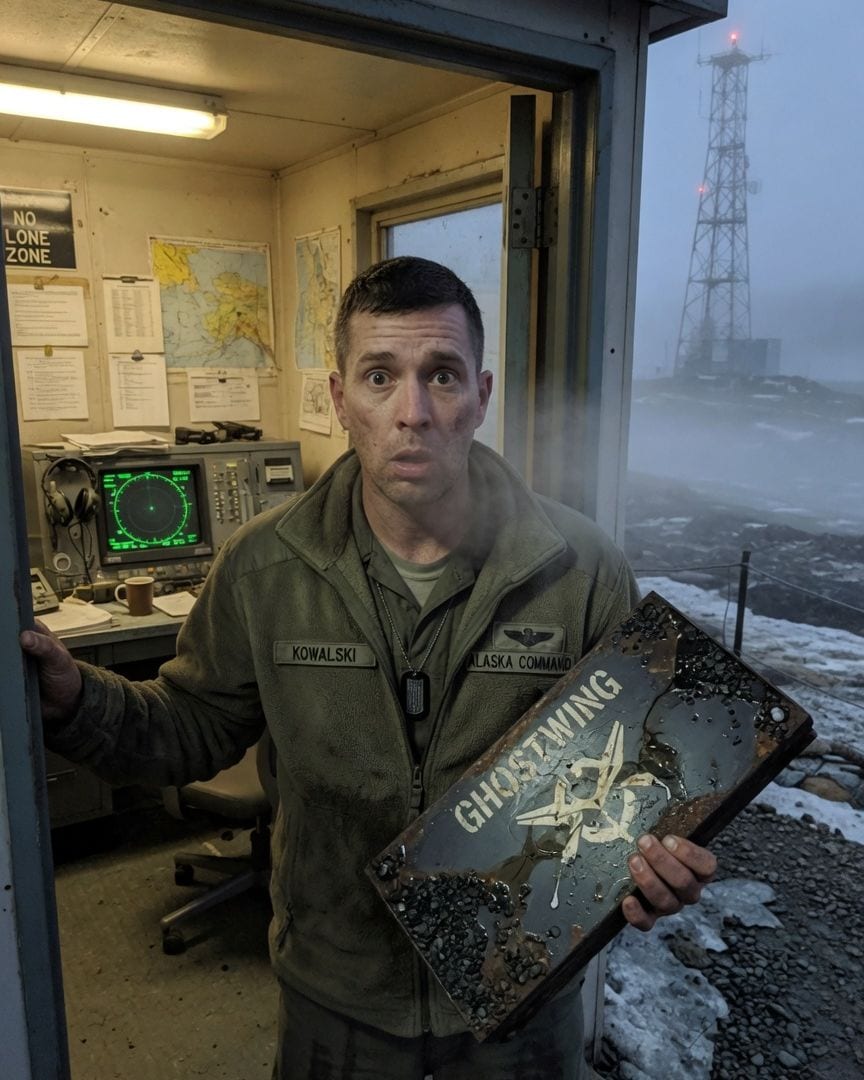
On his last rotation, Airman Kowalski heard a pilot cleared for landing by a tower that had vanished decades ago.
High atop Mount Chugach, Airman Eric Kowalski was counting down his last lonely rotation before transfer, the silence of the Aleutian airwaves his only companion. But then, his headset crackled with an urgent emergency call: a pilot in distress, cleared for landing by a controller whose facility had been decommissioned decades ago. As the phantom voices faded, a third, calm voice cut through the static, addressing him by a name that wasn't his. What impossible signal had broken through the silence, and who was Sowell?
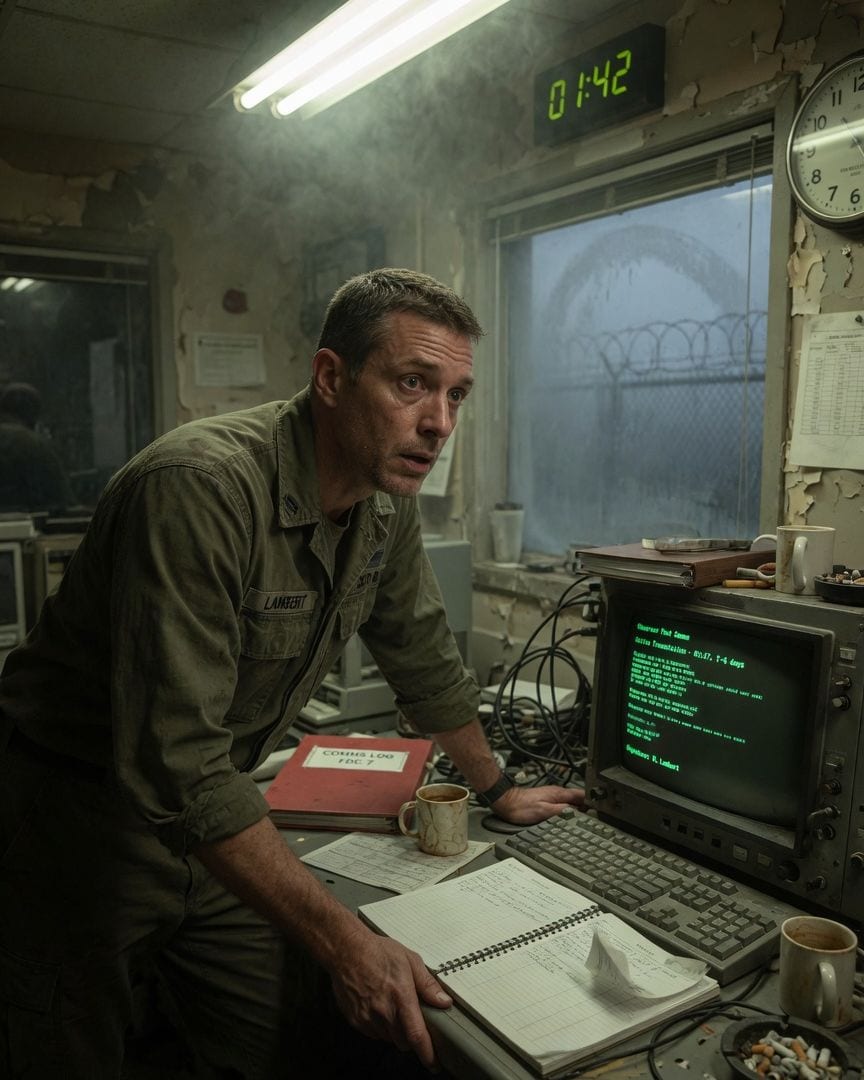
With Firebase 7 days from demolition, a dispatch specialist found his own signature on a log entry from a lost outpost. Then, a dead soldier's name appeared.
Specialist Robert Lambert hunched over the radio console in Firebase 7, the mountain fog pressing in as the base counted down its final days before demolition. His quiet shift shattered when urgent calls began arriving from outposts officially declared silent a week ago. His sergeant calmly informed him that he’d been speaking to no one, as all comms with those posts had been lost for hours. Later, Robert found a log entry for an active transmission, dated days after a post went dark, bearing his own signature. What chilling truth lay beneath the paper, revealing a dead soldier's name reporting from the grave?
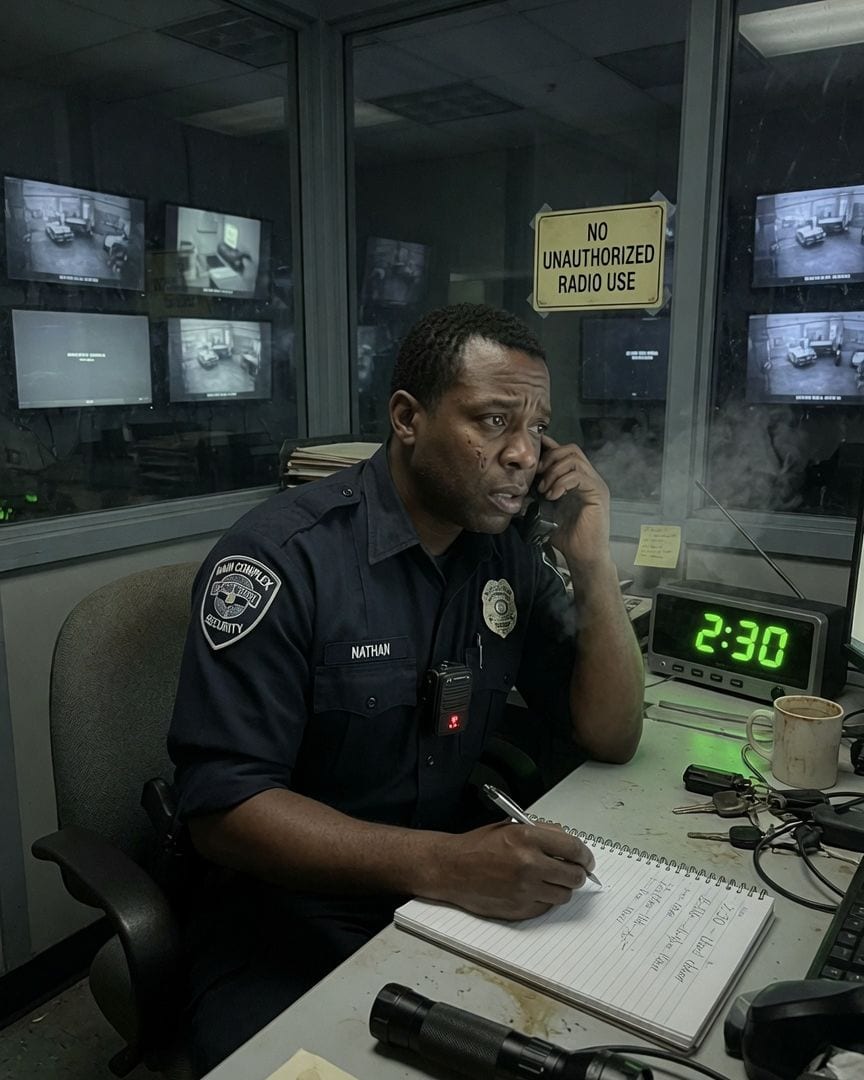
I radio Cole every night. My supervisor says his dock post was cut two years ago, and no Cole exists. But I just found Cole’s old logbook.
My graveyard shift usually consists of monotonous hourly check-ins with Cole, the guard at the loading dock. But my supervisor just revealed that the dock post was cut two years ago, and no one named Cole has ever worked for the company. I've been talking to someone who simply isn't there.
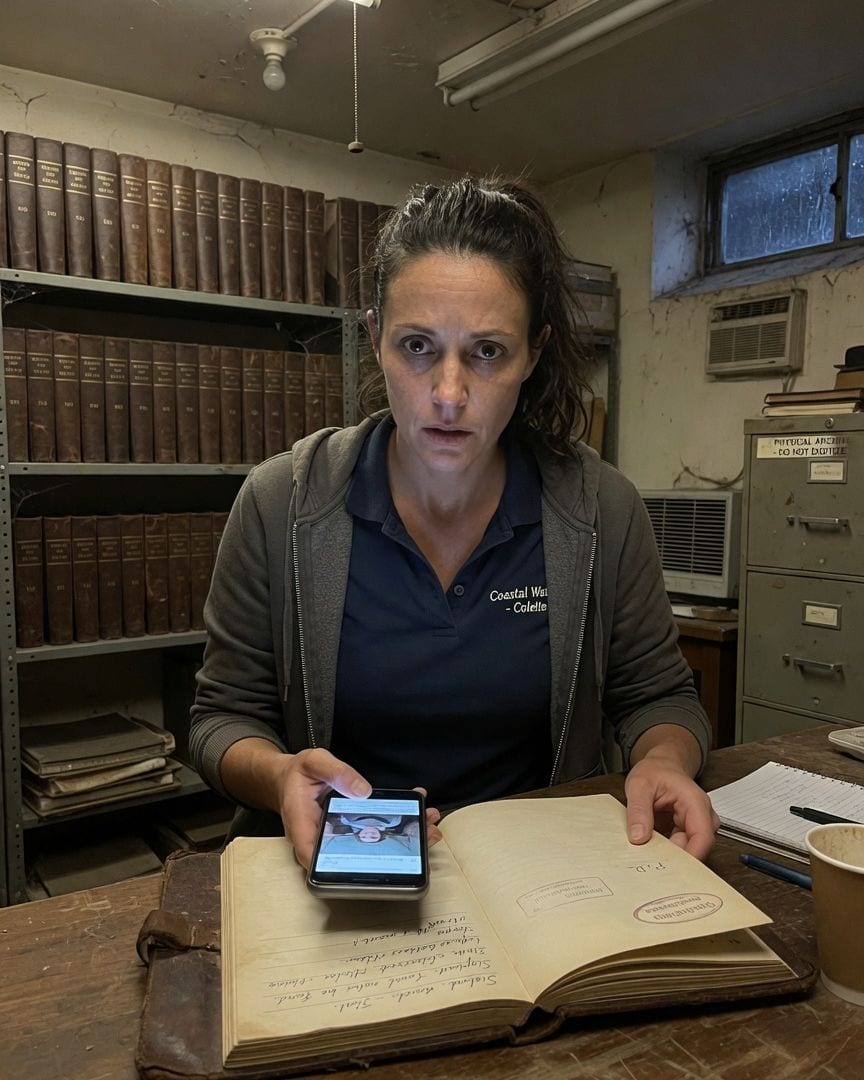
My coastguard log noted Sighting 9 again tonight, a light where no vessel showed. The old logs carry Sighting 9 off Skerry Point at 3:14am every tenth year since 1954, always 'nothing found,' always 'send no boat.'
On my watchtower night shift, the radar screen glowed green and the ocean was quiet. Then, a familiar light appeared off Skerry Point, exactly on cue, just as it had every tenth year for decades. But digging deeper, I found a hidden stamp in an old logbook: 'Operation Skerry. Status: Complete.' It left me with a chilling sense of finality.
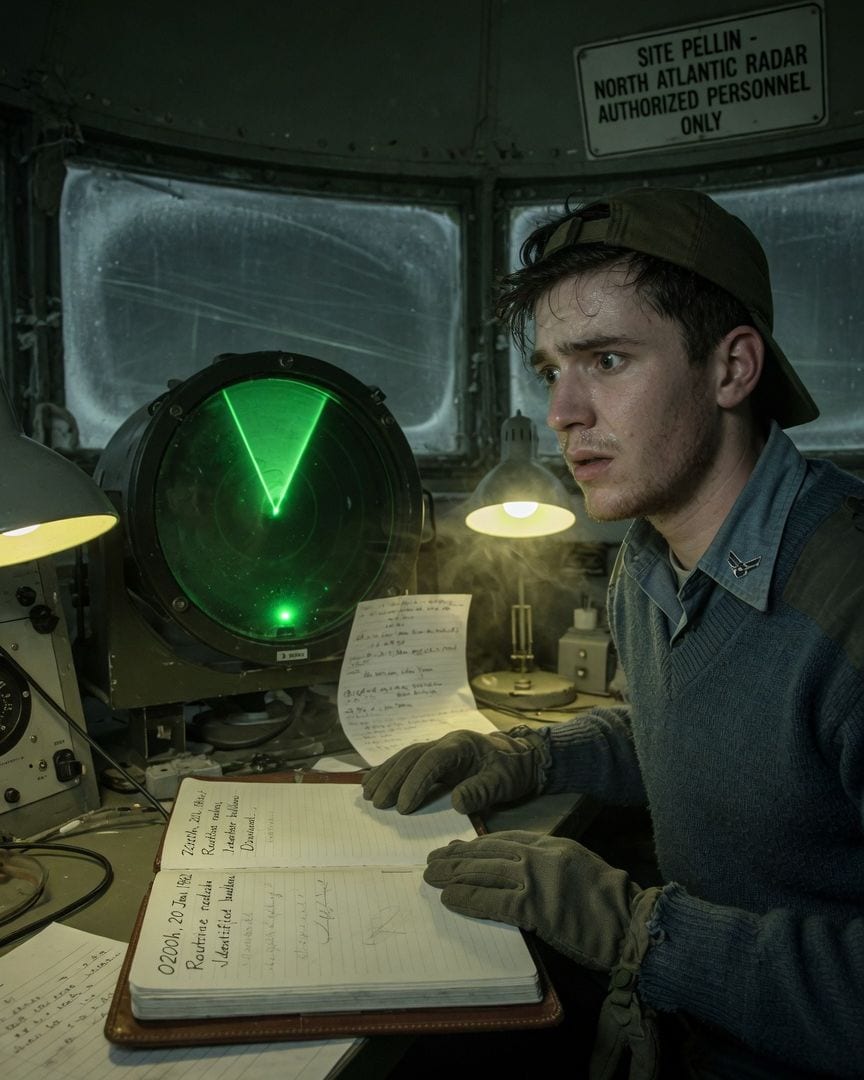
Nine days from closing, Cold War Site Pellin's Airman Vance watched his radar track a solid blip moving closer, dead in open sea where nothing could exist.
In the dimly lit dome of Site Pellin, Airman Ordway Vance, just days from discharge, ran his final radar sweeps before the base closed for good. Outside, the North Atlantic wind howled, but inside, only the hum of his console broke the silence. His last calibration had been clean, yet a single, unwavering green blip appeared on the scope, forty miles out, in open water where no vessel should be. The impossible return moved closer with each sweep, defying all logic and other sensors, until it sat static just beyond the coast fence line. What unseen presence did the radar truly hold in its unwavering green grip, contradicting the official record?
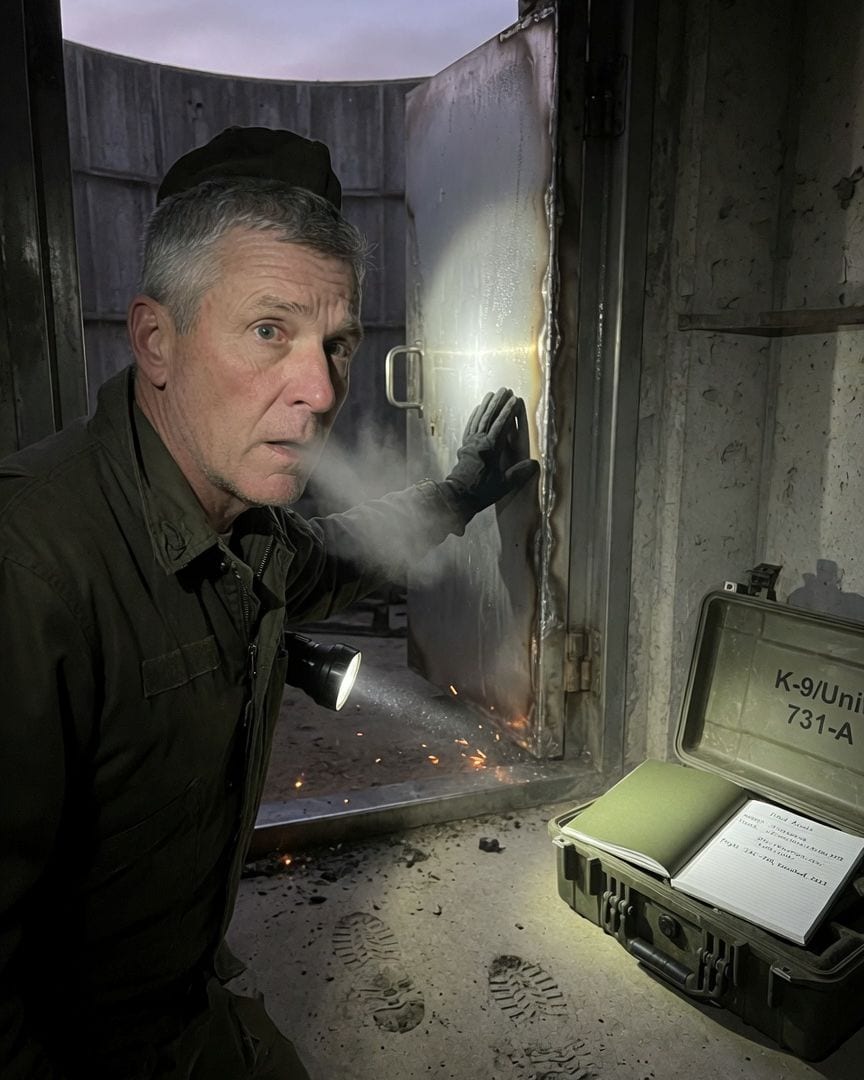
The Cold War silo was welded shut in 1968. A Captain found lights burning, fresh prints leading inside, and a logbook with a vanishing from last week.
Captain Merrit Sable faced a deadline at Silo K-9: one cold morning to retrieve classified hardware before its scheduled demolition at noon. The silo, officially welded shut by the Air Force in 1968 and long off-grid, should have been a tomb of forgotten machinery. Yet, through a cracked port, he saw nine work lights burning steadily forty feet down, and felt the faint suction of an active ventilation system. After breaching the decades-old weld, Merrit found more than just lights; fresh boot prints led deeper into the meticulously clean shaft, but none returned. A hidden compartment in an empty, warm hardcase revealed a logbook, its crisp pages detailing notorious military disappearances, with the latest entry dated just last week.