My retinal photos show old laser scars ringing both eyes. I have never had eye surgery of any kind.
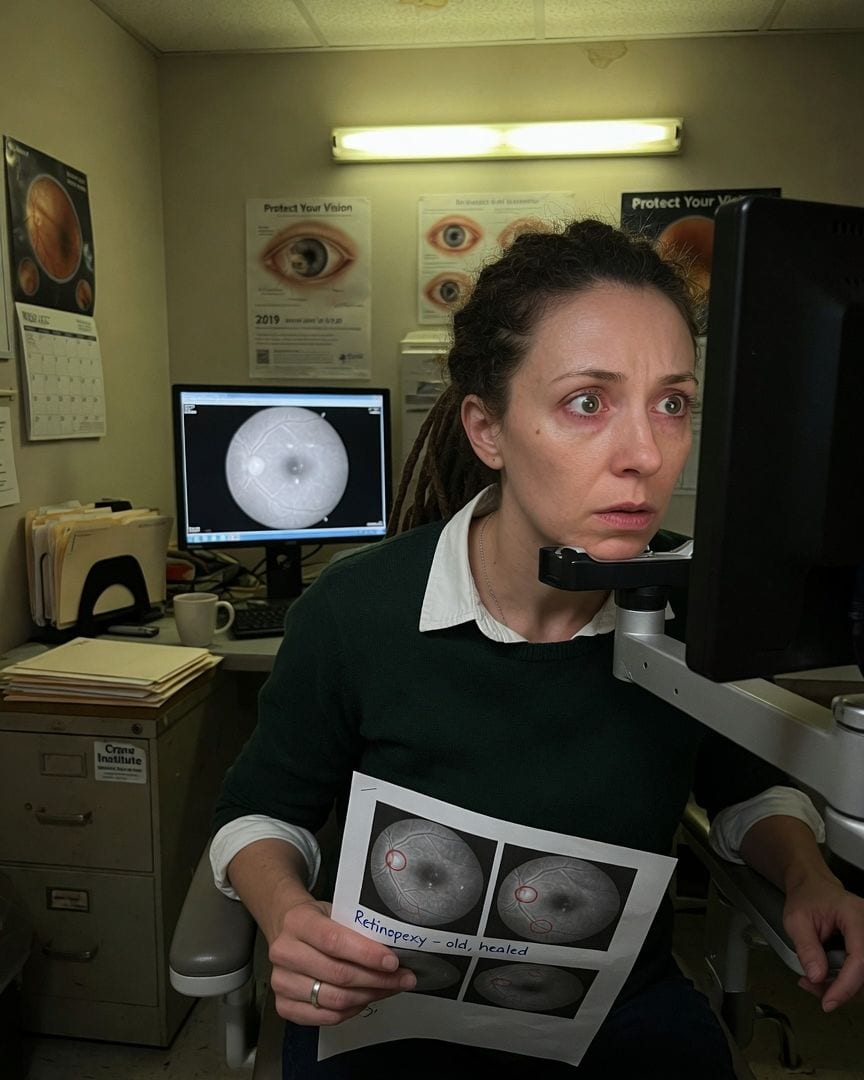
The fluorescent light in Dr. Bennett’s office usually hummed a familiar, reassuring tune. Today, it felt more like a low thrum against my eardrums, an undercurrent to the quiet certainty in his voice.
I was in the padded optometry chair, my chin still resting on the cool plastic of the phoropter, when he frowned.
Dr. Everett Bennett, with his kind eyes usually crinkling at the corners, now had a tight line between his brows.
“Interesting,” he murmured, swiveling his monitor towards me. The screen showed a magnified image, my own retina, staring back like a captured alien landscape. Pale, arcing lines, almost perfectly symmetrical, circled the edge of the optic nerve in both images.
He tapped the screen with a pen. “Looks like previous retinopexy. Old laser scars, neat work. Who did your surgery, Chloe?”
My breath hitched. The question hung in the air, heavy and solid.
I stared at the image, at the delicate, precise pattern of the scars, etched into the very fabric of my eye, a history I had no memory of acquiring. My mind raced, clawing through childhood memories, teenage years, adulthood. Nothing.
No trips to eye specialists, no post-op discomfort, no stories from my parents about a scary procedure.
“I… I’ve never had eye surgery,” I said, my voice coming out steadier than I felt. It sounded like a lie, even to my own ears, against the irrefutable evidence on the screen.
Dr. Bennett merely nodded, unperturbed, already circling the burns on a printout. “Well, they’re definitely there. Very old, completely healed. But definitely yours.” He slid the paper across the desk.
The quiet certainty in his voice was a physical punch, a cold dread settling in my gut. My own eyes, carrying a history that wasn't mine. It was impossible, and yet, there it was, irrefutably present.
The next few days were a blur of frantic phone calls. My mother, bless her, patiently recounted my entire medical history, from chickenpox to a broken arm at seven. “Eye surgery?
No, sweetie, never,” she’d insisted, her voice full of genuine confusion. My father had chimed in with similar certainty. I called my pediatrician, an old family friend, then the family doctor I’d seen since my teens.
Each one confirmed the same thing: no record of any eye procedures, no forgotten hospital stays, not so much as a scratched cornea. I even booked a second opinion, telling the new optometrist nothing, just requesting a routine check-up.
Dr. Anya Sharma, younger and more brisk than Dr. Bennett, had confirmed his findings with professional detachment. “Yep, classic retinopexy scars. Very old, healed beautifully.” She’d gestured at the same pale rings on her screen.
“Looks like you’ve been well-cared for, optically.”
The anomaly persisted, an unshakeable fact woven into my own body. My own eyes, displaying a past I couldn't account for. It was baffling, infuriating, and quietly terrifying.
I returned to Dr. Bennett's office, clutching the printout like a lifeline. He listened patiently as I recounted my fruitless search. “It’s a peculiar case, Chloe, I’ll grant you that,” he admitted, his fingers clicking through files on his computer.
He pulled up my initial retinal scans, examining the metadata. “The pattern of the scarring is quite specific, actually. Not a common technique now, but it was cutting-edge in its day.”
He referenced a specialized database, his brow furrowed in concentration. “Ah, here we are. It matches a technique pioneered by a Dr. Simon Crane, associated with the old Crane Institute.
They were quite advanced in retinal therapies decades ago, did some remarkable work before they… well, before they closed up shop.”
The Crane Institute. I’d never heard of it. A quick search on my phone revealed a defunct website, a small, archived online entry with a contact number for its former patient records department.
With a mix of trepidation and desperate hope, I called. The line crackled, connecting me to a tired, distant voice. After navigating a maze of automated menus, I finally reached a human.
“Crane Institute archives,” a woman’s voice droned.
“Yes, I’m calling about patient records,” I explained, my heart thumping a frantic rhythm against my ribs. “My name is Chloe Hughes. I was told you might have a record of a retinopexy procedure under my name.”
A long pause. “One moment.” I could hear the faint rustle of paper, the click of old keyboards. “Yes, we do have a patient named Chloe Hughes who underwent retinopexy. Date of birth… is that yours?”
I confirmed my birthdate, desperate for a mundane explanation, a simple clerical error. “The procedure date?” I asked, holding my breath.
The voice on the other end read it out, flat and emotionless: “February 12th. Twenty-five years ago.”
Twenty-five years ago. That would have made me nine years old. Nine. Not only did I not remember it, but my parents and doctors had no record of it. This made no sense.
The voice offered to arrange a viewing of the physical file, if I could prove my identity. I immediately agreed.
Two weeks later, the air in the Crane Institute’s forgotten archive room hung stale and thick, smelling of old paper and dust.
A single, failing fluorescent light strip above me buzzed like a trapped insect, casting a sickly yellow glow over everything. I sat at a metal table, my hands clammy, staring at a thick, yellowed file.
The label, 'Hughes, Chloe,' stood out in stark black ink against the aged cardstock, a damning accusation. Patricia, the archivist, a stoic woman with a severe bun and judging eyes, stood by the door, watching me.
I felt like a criminal, or a trespasser on my own past.
I opened the file. Every detail inside matched: my full name, my exact date of birth, even a meticulously detailed retinal scan that perfectly mirrored the one Dr. Bennett showed me. The precision was horrifying. This was my file, undeniably.
But then, tucked into a clear plastic sleeve on the inside cover, I saw it. A small, faded patient photograph. It was a girl, no older than ten or twelve, with wide, apprehensive eyes and a thin, serious mouth.
Her hair was dark, cut in a blunt bob, and her face was utterly, unmistakably different from my own. Not a younger version of me. A completely different person.
The surgery date listed beneath the photo confirmed it again: 25 years ago.
The photograph burned in my mind. A stranger’s face, a child from decades past, staring out from a file that bore my name, my birthdate, my retinal scans. How could this be?
It wasn’t a clerical error; it was a contradiction of reality.
I dove deeper, fueled by a terrifying cocktail of dread and morbid curiosity. The Crane Institute. Online forums, old medical journals, obscure news archives.
The facility, in its later years, had apparently veered sharply into highly experimental, controversial neurological research, far beyond standard ophthalmology.
I found whispers of ethical violations, hushed rumors of groundbreaking, yet unproven, 'identity therapies' – a phrase that made the hairs on my arms prickle – all preceding its eventual, quiet closure.
The name Dr. Simon Crane, the ophthalmic surgeon listed on the file, surfaced repeatedly, often as the institute’s lead researcher, a visionary, or a madman, depending on the source.
I found an old article from a medical journal, a grainy photo of a younger, intense version of Simon Crane, his gaze unnervingly sharp.
The text beneath described his work on ‘neural pathway reconstruction’ and ‘consciousness mapping,’ using chillingly clinical language. He spoke of preserving identity beyond physical decay, a theoretical framework for something that sounded impossible.
Subtle, unsettling things started to creep into my own life. I’d always had this faint, almost imperceptible scar on my left wrist, a thin white line I’d dismissed as a childhood scrape.
Now, touching it, it felt alien, unfamiliar, as if it belonged to someone else. I found myself inexplicably repulsed by certain foods I used to enjoy – green olives, for instance, once a favorite, now made my stomach churn.
Simultaneously, I started craving things I’d never cared for, like strong black coffee, despite always preferring cream and sugar.
My reflection in the mirror sometimes felt… not wrong, exactly, but subtly unfamiliar, as if I was seeing a version of myself from a slightly different angle, a stranger peering back from my own eyes.
I tried to dismiss it, stress, lack of sleep, but the feeling persisted, an itch under my skin.
I meticulously traced Dr. Crane’s professional history. He’d retired abruptly after the institute’s closure, seemingly vanishing from the medical community. His last known address, buried deep in public records, was in a small, isolated town in the Pacific Northwest.
The unease ratcheted up another notch, growing into a cold, hard certainty. This wasn't just a clerical error. It was something far more deliberate, far more personal.
I booked a flight. The small, rain-swept town, nestled between a dense forest and a grey, churning sea, was exactly as remote as I’d imagined. The air smelled of pine and damp earth.
I rented a car, drove the winding, secluded roads, and found Simon Crane’s address – a sprawling, weathered house on the outskirts, its windows dark and opaque beneath the constant drizzle.
I parked down the road, hesitant, the wind buffeting the car, the silence oppressive.
Before I could even consider approaching the house, my phone buzzed. An incoming email from an unknown sender. The subject line was simply 'A Word of Caution.' My heart hammered. I opened it.
The message was short, chillingly precise: 'Some truths are better left undisturbed, Ms. Hughes. The past is not always what it seems, nor is the present. You are not alone in your journey.'
Attached was a photograph. I opened it, and a gasp escaped me.
It was a clear, high-resolution image of me, Chloe Hughes, standing on the sidewalk just outside Simon Crane’s house, my back to the camera, looking exactly as I had five minutes ago.
The coat I was wearing, the slight slump of my shoulders in the rain. My heart leaped into my throat, a frantic bird trapped in my chest. Someone knew I was here.
Someone had been watching me, anticipating my arrival, tracking my every move. The anonymous sender didn't just know I was coming; they knew when I arrived and what I was doing. The hunter had become the hunted.
I quickly scanned my surroundings. The street was empty, a tunnel of dark evergreens disappearing into the mist. The only sound was the wind whipping through the pines, a mournful, indifferent sigh.
A cold wave of vulnerability washed over me, leaving me shivering despite the car’s heater. The stakes had just become terrifyingly personal.
Despite the warning, my resolve hardened. Retreat wasn't an option. I drove the last few yards, parked directly in front of Simon Crane’s house, and walked to his door. I knocked.
He answered almost immediately, as if he’d been expecting me. He was an older man now, perhaps seventy, his hair silvered, but his eyes held the same intense, intelligent spark from the old articles. No surprise, no hesitation.
He simply looked at me, a faint, knowing smile playing on his lips. He invited me in, his calm demeanor unnervingly disarming.
“Chloe Hughes, I presume,” he said, his voice soft but firm, a low rumble. “I knew you’d find your way here eventually.” He didn't deny anything, didn't question my presence.
He led me to a small, cluttered living room, filled with books and scientific journals. The air was warm, smelling of old paper and something vaguely medicinal. He offered me tea.
I accepted, my hands trembling slightly as he handed me a steaming mug. My mind was numb with dread, a dull throb behind my eyes.
I cut straight to it, the words tumbling out. “The retinal scars. The file at the institute. The girl in the photograph.”
Crane nodded slowly, stirring his tea with a small silver spoon. His eyes, though aged, were unwavering, clinically observing my distress. “The retinopexy was indeed performed at the Institute. And yes, the patient was named Chloe Hughes.
A young girl, barely ten years old at the time.” He paused, his gaze never leaving mine, as if gauging my reaction. “She suffered from a severe, degenerative neurological condition. A rare, aggressive form of childhood neurodegeneration.
Her retinas were deteriorating as a secondary symptom. The retinopexy was a desperate attempt to preserve her sight, to give her some comfort in her final months.”
He reached for a stack of old papers on a nearby table, his movements precise and unhurried. He extracted a yellowed news clipping, folded and brittle, and pushed it across the polished wood table towards me.
The headline, stark and grim, read: 'Young Girl Succumbs to Rare Illness.' A small, grainy photo of the girl from the file accompanied it. The girl with the blunt bob and serious mouth.
My breath caught in my throat, a silent scream. The girl died. This body’s original owner, the first Chloe Hughes, died.
“The Crane Institute,” Simon continued, his voice perfectly level, “was involved in highly experimental research. We believed in the potential of consciousness as a transferable entity, a pattern that could be preserved beyond the limitations of the physical body.
A radical attempt to preserve identity, even if the original vessel failed.” He watched my face, observing my dawning horror with a detached clinical interest, like a scientist studying a specimen.
“The original Chloe Hughes passed away shortly after the procedure, as the body couldn’t sustain her failing neural pathways. But the vessel was viable. We needed a new host for a specific project. A donor consciousness.”
Simon Crane leaned forward, his gaze unnervingly steady across the small coffee shop table, a faint, almost imperceptible smile touching his lips. “We had a subject, Ms. Hughes, whose own physical form was failing, but whose consciousness remained intact, trapped.
A tragic accident. Her family, desperate, agreed to our experimental program. A highly classified, ethically fraught endeavor, yes. But we offered a chance at continuity. A second life.”
He took a slow sip of his tea, his eyes never leaving mine, reading every flicker of terror. “The body of the original Chloe Hughes, having received the retinopexy, was prepared. A perfect match, in many ways.
And you, Ms. Hughes, were the perfect candidate.” He set his teacup down with a soft click, the sound echoing in the sudden silence of the room, a chilling punctuation mark. “Tell me, how are you feeling in there, Chloe?
Any residual discomfort from the transfer?”
I recoiled, the implication detonating in my mind with the force of an explosion. “The transfer?” I whispered, my voice barely audible, a ragged gasp.
Simon Crane’s smile widened, a fraction of an inch, enough to show the terrifying triumph behind his placid expression. “Indeed. Your original body, as I understand, was in an irreversible coma following a severe accident.
Your family, given a grim prognosis, sought alternative options. We offered one. A controversial, unproven, but ultimately successful procedure. We took your consciousness, Ms. Hughes, your very self, and integrated it into this pre-existing vessel.”
He gestured around the room, a sweep of his hand that seemed to encompass not just his cluttered study, but the audacious, chilling scale of his work, of what he had done to me.
“The retinopexy, the scars you discovered, were a pre-existing condition of this body, the one you now inhabit. It had been repaired before your consciousness was placed within it. A clean slate, so to speak, for your new beginning.”
Every fragmented clue, every unsettling detail I’d encountered over the past weeks, clicked into place with horrifying, precise coherence. The retinal scars, not mine but now irrevocably part of me, a physical record of another life.
The mismatched photograph in the old medical file, revealing the body’s original occupant. The faint scar on my left wrist, a subtle physical trace left by the other Chloe, the true owner of this skin.
My unexplained food aversions, the sudden, inexplicable cravings for strong black coffee – echoes of a different palate, a different set of preferences.
Even the occasional, unsettling feeling of my own reflection being subtly off, a stranger peering back at me – a phantom memory of another’s face, overlaid on my own.
The coherence of it all was the true horror, far worse than any monster. It wasn’t a mix-up, not a mistake, not a haunting.
It was a deliberate, meticulously planned truth, an act of scientific hubris that had fundamentally overwritten my very existence. The terror was in the logic, the cold, irrefutable fact that it all fit.
I was trapped, not by physical bonds, but by the terrifying, irrefutable logic of Crane’s explanation. My horror was existential, a profound violation of self.
But Crane remained utterly calm, almost paternal, as if explaining a complex but routine medical procedure. He saw no ethical transgression, only scientific triumph, a problem solved, a consciousness preserved.
“You have a second chance, Chloe,” he stated, his voice devoid of judgment, entirely matter-of-fact. “A new life. Most would consider it a miracle.”
He offered me a choice, though it felt like none at all: accept this new reality, live out my life with this knowledge, or he could “correct” the ‘transfer’ – an implied termination, a quiet undoing of his work, a second death for my consciousness.
My mind reeled, but desperately, instinctually, clung to my rationality. There was no escape, no undoing what had been done. The body was mine now, irrevocably. The truth, however horrifying, was my new reality.
“My original family?” I managed to ask, my voice raspy. “My old life? My memories?”
Crane shrugged, a slight, almost imperceptible movement. “Your family was given a different, more palatable explanation for your accident and subsequent recovery. A closed case, as far as they’re concerned. Your recovery was considered miraculous.
And your memories, Chloe, they are uniquely yours now. They integrated. That’s the beauty of it.”
He produced a small, amber-colored bottle from a drawer in his desk, sliding it across the table towards me. “A neural stabilizer,” he explained. “To manage any lingering dissonance, the occasional ‘echoes’ from the transfer. Take it daily.
It will help you integrate fully. Smooth out any… rough edges.”
My hand trembled as I took the bottle, the cold glass a stark, tangible reality in my palm.
The calm acceptance in Crane's eyes was the worst part, a profound, chilling indifference to the cataclysm he had wrought upon my identity. He simply expected me to accept it. To take the drops.
To exist in this new, alien skin. I knew I would take them. There was nothing else to do.
I returned to my life, but the world was now seen through a new, terrifying lens. My apartment, my job, my friends – all were the same, yet fundamentally altered by the knowledge I now carried.
I looked at my reflection, seeing not just my own face, but the ghost of another girl’s history, a faint overlay I couldn’t unsee.
The subtle scar on my wrist felt like a brand, a physical signature of the consciousness transfer. I used the eye drops every day, a ritual that anchored me to my new, unsettling reality.
The dread didn't fade; it settled, a cold, constant companion within my own skin. I existed, but not as myself, not entirely.
I continued my routine, the meticulous motions of my day a thin shield against the profound disconnect within. An invisible barrier now separated me from everyone I knew.
Marie often wondered about Chloe Hughes. She seemed... subtly different after her eye check-up. Quieter.
Sometimes, when she caught Chloe looking at her own reflection, there was a strange, distant sadness in her eyes, as if she was seeing someone else entirely. Marie took a sip of her coffee. "Still using those drops, Chloe?"
Chloe just smiled faintly.
If this one got to you
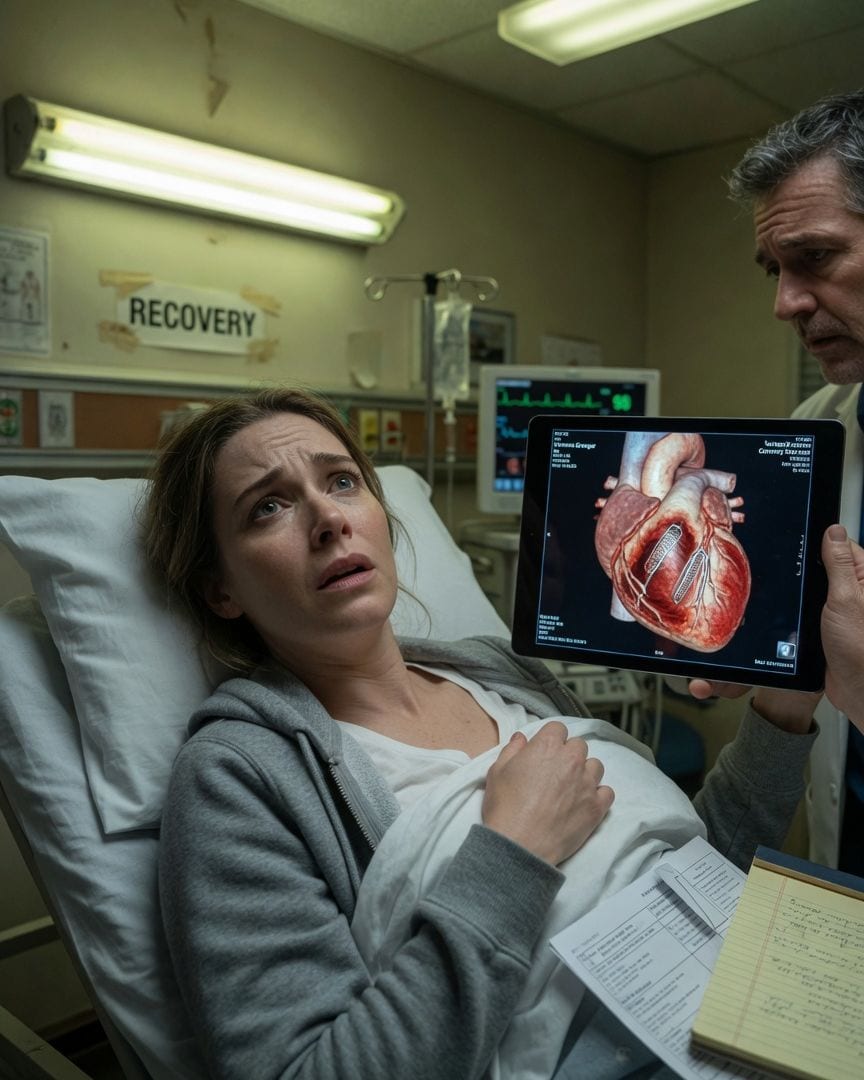
Metal stents are propping open my heart. The doctor rotated the image, but I've never had a cardiac procedure.
After years of dismissed chest pain, a CT scan revealed an impossible truth: my heart contained two metal stents. Dr. Maddox confirmed there was no record of any cardiac procedure in my entire medical history, and I had no memory of ever having surgery. My own body held a secret, alien architecture I couldn't explain.
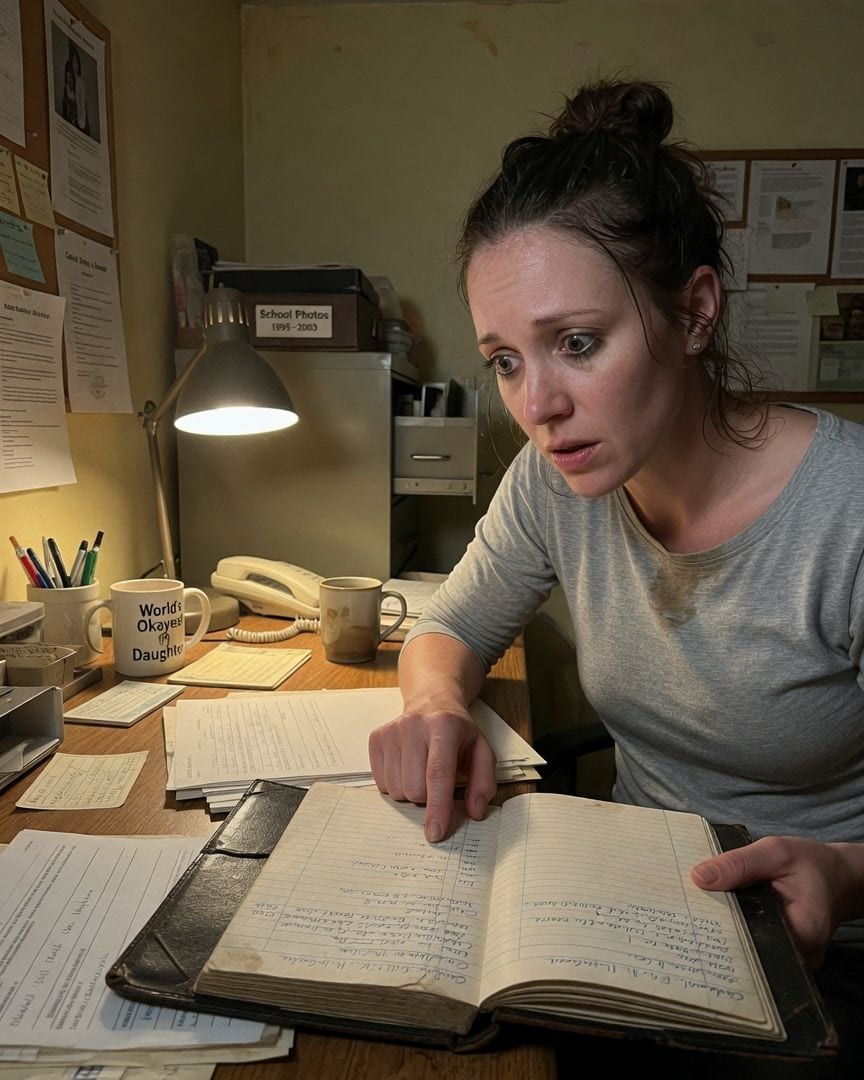
My CT scan found a metal plate in my eye socket. Then I found its surgery record, two years before I was born.
After a CT scan for my headaches, I learned a small metal plate was embedded in my left eye socket, a well-healed repair from decades ago. I have no memory of any injury severe enough to require such surgery, and my parents are certain it never happened. It's a piece of someone else's past, stitched into mine.
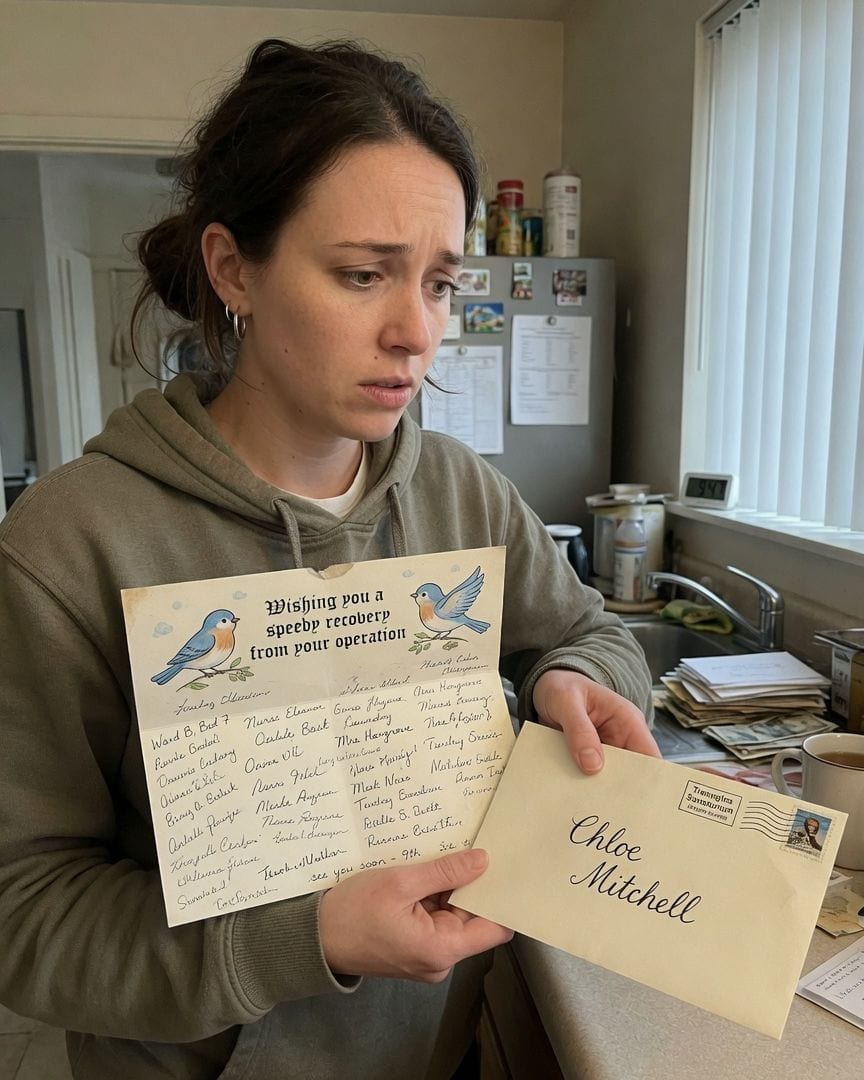
A get-well card wished me a speedy recovery from an operation I never had. It was postmarked from a sanatorium that burned down in 1963.
My quiet Tuesday morning was interrupted by an elegant get-well card, addressed to me. It wished me a speedy recovery from an operation I'd never had. But the postmark read 'Treneglos Sanatorium,' a hospital that vanished in a fire back in 1963.
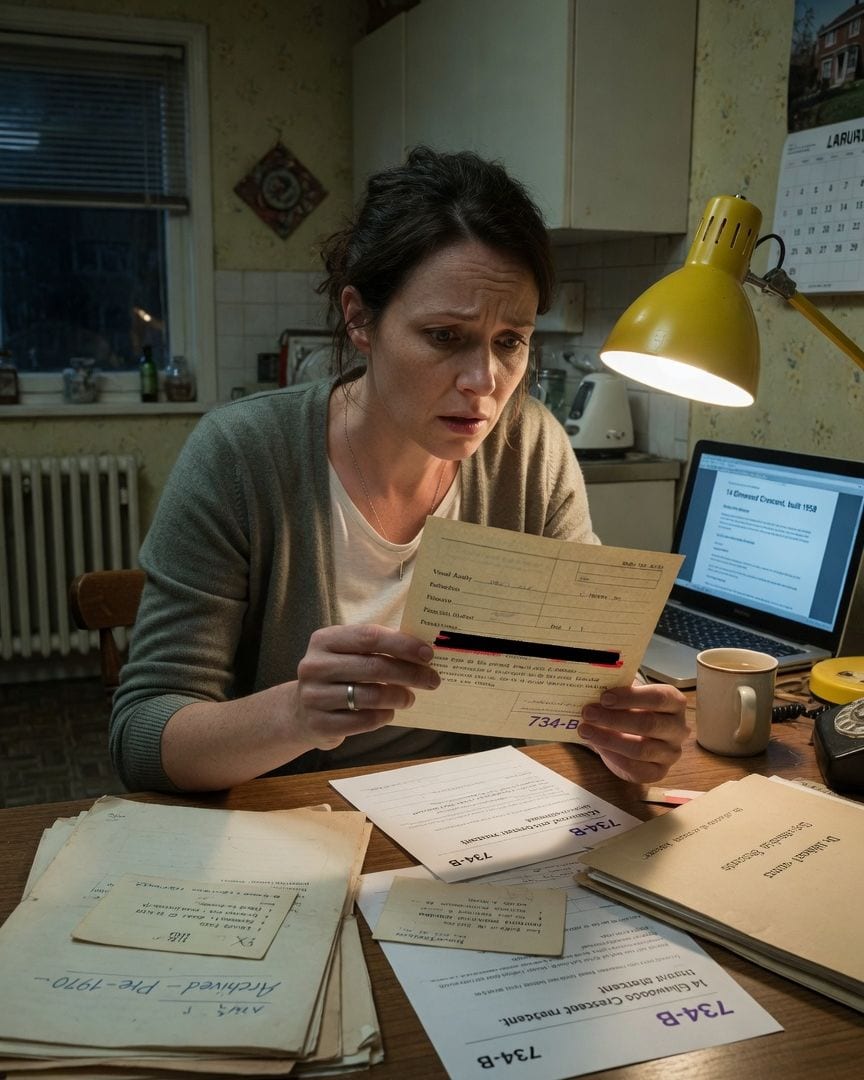
An old eye test card had my patient ID, 734-B, dated 1966. I found another, from 1948, for my house.
Transferring my old eye records should have been routine, but a strange, redacted card from 1966 raised a cold knot of dread. It mentioned my surname and street, along with a chilling instruction: 'tell the patient nothing.' Then I found my unique patient ID, assigned to me, on records dated 1948.
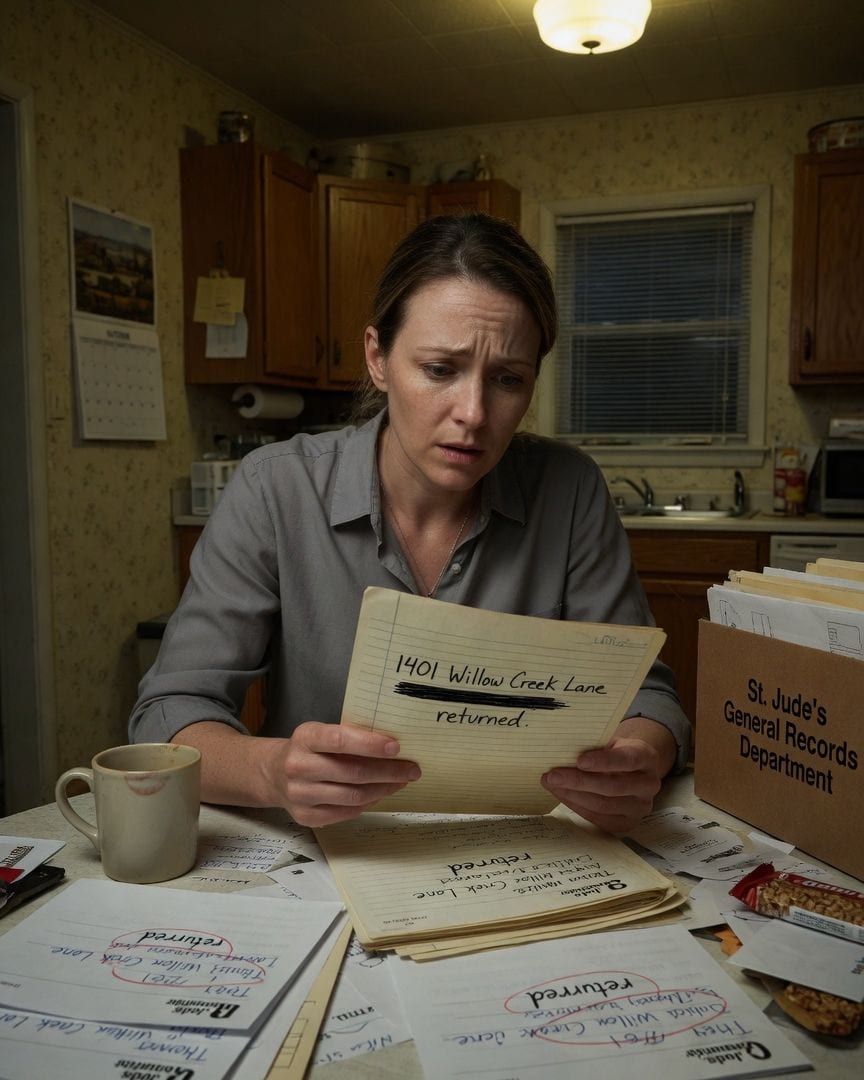
My medical file shows my street address on a struck-through line from 1988, a year I lived two counties away. It just says 'returned'.
A routine insurance audit led me to my childhood medical file from 1988. But among the expected notes, a deliberately struck-through line listed my current house address, followed by the stark word 'returned.' In 1988, I lived two counties away, making this entry an impossible and unsettling mystery.
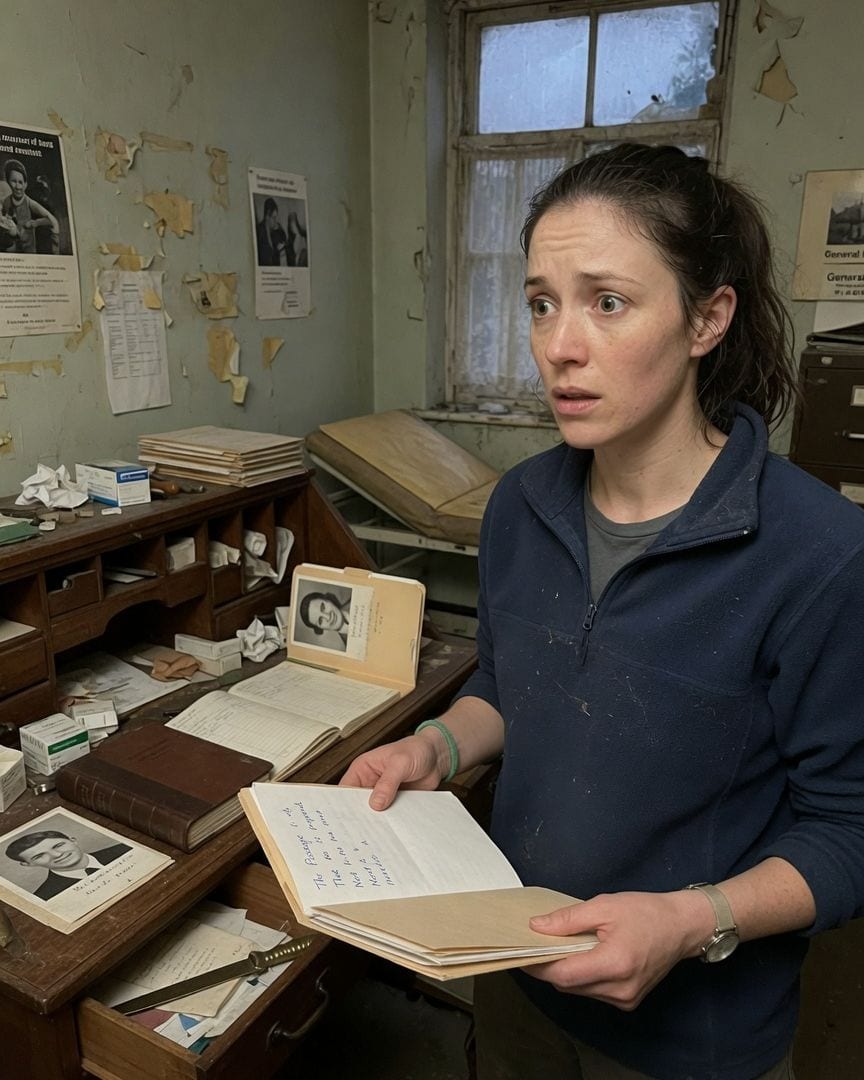
My new clinic's appointment book shows entries for this coming Monday, decades after the doctor retired and died.
Chloe Lawson bought an old, abandoned surgery in Nettlebed, ready to open her new vet clinic. Locals insisted Dr. Almott retired in '79 and the practice shut down for good. But then Chloe found his dusty appointment book filled with meticulous entries, continuing unbroken from 1979 through the decades, right up to this coming Monday.