My rib scan showed three old breaks, perfectly healed. I've never cracked a rib in my life.
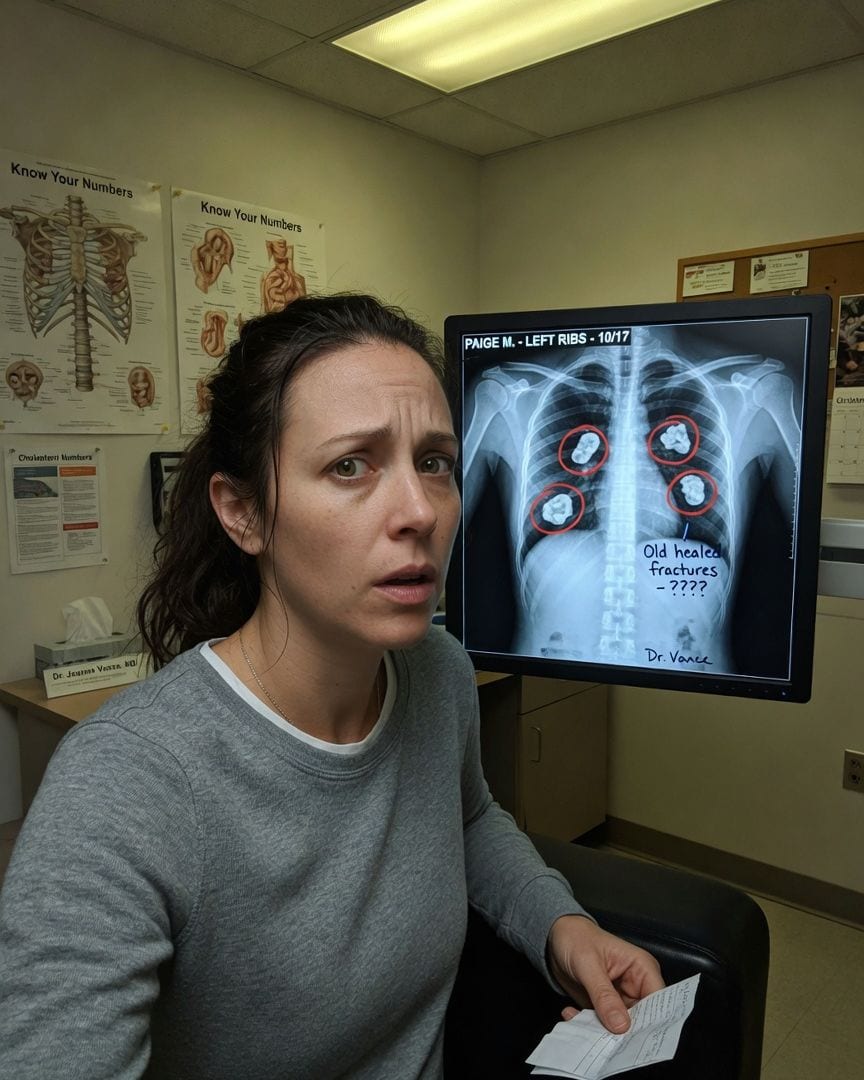
The fluorescent lights of Dr. Vance’s office hummed, a flat, unremarkable sound. My GP, Dr. Joanna Vance, tapped a pen against the monitor, her brow furrowed. “See here?” she asked, pointing to a glowing image on the screen.
It was my bone-density scan, a routine check-up, nothing I’d given a second thought to. But there, on my left side, were three distinct, lumpy joins along my ribs, thick with the tell-tale callus of old, badly healed fractures.
“Three broken ribs,” Dr. Vance stated, her voice calm but questioning. “Healed perfectly, decades ago by the look of it. What was the accident?” I stared at the image, then back at her.
My mind raced, searching for any memory, any fall, any crash that could account for such a thing. There was nothing. My past was uneventful, free of major injuries. I’d never even sprained an ankle.
I opened my mouth to explain, but no explanation came. The image on the screen, undeniably mine, was a lie.
Dr. Vance, seeing my blank stare, suggested it might be an old childhood injury I’d forgotten. She ordered a more detailed, targeted scan and advised me to check with my parents. My parents, however, were equally baffled.
My mother, a meticulous record-keeper, pulled out my baby books and childhood medical charts. Not a single mention of broken ribs, not even a bad fall.
I spent hours online, searching local news archives for any major accidents involving a young girl in our town decades ago. Nothing. The new scan, however, came back with even stranger results.
It confirmed the fractures, not just healed, but deeply set into the bone structure, consistent with a severe impact. Dr. Vance, now clearly intrigued, called in a colleague, a radiologist named Dr. Chen.
Dr. Chen spent a long time examining the images, rotating them, zooming in. He pointed out the subtle differences in bone density around the fractures, the way the new bone had knitted itself almost too perfectly.
He then highlighted something else, a faint, almost invisible line of scar tissue running beneath the lowest rib callus. “This,” he murmured, tracing it with his finger, “looks like an old surgical incision. Very old. Almost faded into the bone.
Do you remember what surgery this was from, Paige?” I felt a cold dread creep up my spine. No. I had never had surgery. Not ever. My medical history was an open book, and that page was blank.
The radiologist, Dr. Chen, zoomed in further, his voice dropping to a low, speculative tone. The faint line was undeniable, a subtle ripple in the bone, perfectly straight, unlike any natural injury.
It was too precise to be random, too deeply embedded to be recent. He looked at me expectantly, waiting for an answer to a question that had no answer. “This type of scarring,” he began, “suggests a procedure.
A repair, perhaps, or something more… invasive. And given its position, directly over the site of one of the worst breaks, it’s almost certainly related. Are you absolutely certain you’ve never had any thoracic surgery, Paige?”
I shook my head, my throat tight. The scar was there, physically present within my own body, a silent, impossible witness to a past I didn't own.
The impossible scar drove me to seek answers beyond my GP. Dr. Vance, while concerned, admitted she was out of her depth.
I started with my own medical records, requesting every file from every doctor I’d ever seen, going back to my birth. They were all meticulously clean: no surgeries, no major injuries, no broken bones.
It was as if my body was contradicting every official document of my existence.
I went to the local library, poring over microfiche and newspaper archives, looking for any mention of strange medical cases, forgotten clinics, anything that might explain a surgical scar I couldn’t account for. The search yielded nothing relevant.
Frustrated, I decided to tackle the problem from another angle. If my body had a past I didn’t recognize, perhaps my genetic makeup held a clue.
I ordered a popular at-home DNA ancestry kit, thinking it might reveal an unexpected family history, a distant relative with a rare condition, anything that could link me to an unknown medical anomaly.
I sent off the sample, trying to cling to the rational hope that there was a mundane explanation, a genetic quirk, or a distant ancestor whose medical history was somehow imprinted on my own.
While waiting for the DNA results, I dug deeper into local history, shifting my focus from 'me' to 'the place'.
I visited the local historical society, hoping to find records of old hospitals or experimental clinics that might have operated in the area decades ago. Vera Drummond, the archivist, a kind woman with sharp eyes, helped me navigate dusty files.
She mentioned the 'Easton Clinic,' a private research facility that had been quite prominent in the mid-20th century, known for its groundbreaking but often controversial work, before it quietly closed down around 35 years ago.
The timing, I noted, felt strangely significant.
My inquiries about the Easton Clinic seemed to stir something. A few days after my visit to the historical society, I noticed small things.
My mail, usually left neatly on my porch, was sometimes tucked oddly into the mailbox, as if someone had fumbled with it.
Once, returning home late, I saw a faint light in my living room window, only to find the house dark and empty when I unlocked the door. I told myself it was nerves, paranoia, the stress of the unknown.
Then, a week later, I received a cryptic email. No sender, just a subject line: 'Some things are better left undisturbed.' The body of the email was a single, grainy black and white photograph.
It was an old newspaper clipping, yellowed and faded, showing the exterior of a building with a small, unassuming sign: 'Easton Clinic.' My breath hitched. How could anyone know I was looking into that?
The photo was accompanied by a single sentence: 'The past is a quiet place for a reason.' The message felt like a warning, a cold hand on my shoulder in the dark.
I tried to trace the email, but it bounced through layers of anonymous servers, untraceable. The unease escalated from a personal mystery to a palpable threat.
Someone was watching me, someone knew what I was digging for, and they wanted me to stop. The fear was no longer just for my identity, but for my safety.
The warning email cemented my resolve. The DNA results arrived, and I immediately booked an appointment with Daniel Hale, a geneticist at a private lab, hoping he could make sense of the ancestry kit’s raw data.
He was a professional, calm and detached, as he loaded my genetic profile onto his system. He scrolled through the markers, nodding to himself. “Your markers are all consistent with your stated ancestry, Paige.
Nothing unusual here that would explain a spontaneous surgical scar, or…” He paused, his finger hovering over a specific section of the report. “Wait. This is… highly unusual.” He clicked a few more times, pulling up comparative data.
“Your report shows an absolute, 100% genetic match. Not a relative, not an ancestor. An identical match.” My heart began to pound. “A match to what?” I asked, my voice barely a whisper.
He looked at me, his calm facade cracking slightly. “To a historical record. A woman named Cecilia Abbott. Died 35 years ago, at the age of twenty-eight.
Cause of death listed as complications from severe blunt force trauma to the chest, including multiple rib fractures.” He pushed the printout across the desk.
It was an obituary, yellowed and faded, for a woman with my last name, a woman who died the very year I was born, from the very injuries my body now carried.
The rib fractures, the surgical scar – it all clicked into place with horrifying precision. My body wasn’t just carrying an impossible past; it was carrying someone else’s past.
The obituary detailed Cecilia’s short life, her accidental fall, and the experimental treatments she’d received at a place called the Easton Clinic. My mind reeled. “This can’t be,” I whispered, looking from the obituary to Daniel Hale’s grave face.
“I’m Paige Abbott. I’m 35.” He just shook his head slowly. “Genetically, you are Cecilia Abbott.” The implication hit me with brutal force. The body I walked around in, the body I’d inhabited my entire life, was not originally mine.
It belonged to a woman who had died decades ago, and somehow, impossibly, I was now living inside it.
I left Daniel Hale's office in a daze, the obituary for Cecilia Abbott clutched in my hand, the DNA report a burning weight in my bag.
The world felt wrong, shifted, as if the ground beneath my feet was no longer solid. The rib fractures, the impossible scar, the unnerving email – it all pointed to one terrifying, undeniable truth. My body belonged to someone else.
I drove straight to the cemetery listed in Cecilia's obituary. The headstone was old, weathered, but legible: 'Cecilia Abbott, 1957-1985.' My birth year. I stood there, staring at the name, at the dates, a cold knot forming in my stomach.
This was her resting place, but somehow, her body was still walking. It was me. A shiver ran through me, not from the chill in the air, but from the horrifying realization that settled deep in my bones.
I wasn't just investigating a mystery; I was the mystery. The 'wrongness' wasn't something external I had stumbled upon; it was woven into the very fabric of my existence.
I pulled out my phone, snapping a picture of the headstone, the only proof I had of this impossible connection. As I turned to leave, a movement caught my eye.
A figure, silhouetted against the setting sun, stood by a distant oak tree, watching me. It was an older man, his posture stiff, unmoving. He made no attempt to hide, simply observed.
As I fumbled for my car keys, he took a single, deliberate step forward, then another. His face was obscured by shadow, but I felt his gaze, heavy and knowing, like a physical touch.
He was coming for me, and he knew exactly why I was there.
The figure approaching me in the cemetery was Charles Easton, the former director of the Easton Clinic, as identified by Vera Drummond from an old photo. He stopped a few feet away, his expression unreadable.
“You found her,” he said, his voice surprisingly calm, almost weary. “I knew someone would, eventually.” I held up the DNA report. “My body. It was hers. Cecilia Abbott.” He nodded slowly. “Yes. Cecilia was a patient at my clinic.
A promising young woman, a brilliant mind, tragically injured in an accident. We tried to save her. When conventional medicine failed, we embarked on… less conventional methods.” He paused, looking at the headstone.
“We believed the human consciousness, the 'self,' could be transferred, or perhaps, re-seeded, into a viable vessel. Cecilia’s body, though badly damaged, was still… active. We managed to stabilize it, repair the most severe injuries. The surgical scar you found?
That was from our attempts to reconstruct her thoracic cavity after the fall.” He looked at me, a strange mix of pride and regret in his eyes. “We were on the cusp of something revolutionary.
We believed we could give her a second chance, a new life, free from the trauma of her accident. We called it Project Phoenix. You, Paige, are our greatest success.” My mind struggled to process his words.
“You’re saying… you put me in her body?” Easton shook his head. “Not exactly. We created the conditions for a new consciousness to manifest, to inhabit the vessel. Your memories, your life, are entirely your own.
But the physical form, the shell… that is Cecilia’s. The DNA, the healed fractures, the old scar – they are all indelible marks of her original existence. We simply… gave it a new beginning.”
The full horror of it washed over me. I wasn't born; I was an experiment, a second chance for a body that had died. Every physical detail, every ache, every scar, was a ghost of another life.
The coherence of it all was terrifying. It wasn't a monster; it was science, taken too far.
Easton reached into his coat pocket, pulling out a small, leather-bound journal. “This is my record,” he said, extending it towards me. “Everything we did, every success, every failure. It’s all here. I’m an old man, Paige.
I wanted someone to know the truth, to carry it. You are the only one who can.” He seemed to expect me to take it, to accept this burden.
But the thought of carrying his meticulous, horrifying notes, of becoming a custodian of this impossible science, filled me with revulsion. “No,” I said, stepping back. “I don’t want your records. I want to be free of this.”
He sighed, a sound of profound disappointment. “Freedom is a luxury, Paige. You are living proof of what we achieved. The world needs to know.”
He began to walk towards me, the journal still in his hand, a strange, almost paternal determination in his stride.
I knew I couldn't let him share this with the world, not like this, not with me as his living exhibit. I turned and ran, sprinting through the rows of headstones, the rustling leaves sounding like whispers in my ears.
He called out my name, his voice surprisingly strong, but I didn't look back. I reached my car, fumbling with the keys, my hands shaking.
I started the engine, threw the car into reverse, and sped out of the cemetery, glancing in the rearview mirror. Easton stood by Cecilia’s grave, a lone figure, the journal clutched to his chest. He wasn't pursuing me.
He was just watching, a silent, knowing guardian of a secret I now carried. I had the DNA report, the photos of the scans, the obituary. I had the proof. But who would ever believe me?
The cost of knowing was the shattering of my own identity, the constant awareness that the body I inhabited was a borrowed vessel.
I had escaped, yes, but I was irrevocably changed, forever marked by a truth no one else would ever accept.
I never saw Charles Easton again. The Easton Clinic archives, which I later confirmed with Vera Drummond, contained no official records of 'Project Phoenix,' only vague references to experimental tissue regeneration.
Daniel Hale, the geneticist, was rattled by the DNA match but, without further evidence or context, classified it as an 'unexplained anomaly,' too extraordinary to publish.
My own GP, Dr. Vance, had no explanation for the impossible scar or the fractures, chalking it up to a statistical medical mystery. The world moved on, oblivious.
I moved too, to a new city, trying to build a life untainted by the impossible truth. But every morning, when I looked in the mirror, I saw her. Cecilia. Her body, my life.
The proof I carried, tucked away in a waterproof file, was my burden alone. It was a truth too monstrous, too personal, to ever share.
Sometimes, when I catch my reflection unexpectedly, I swear I see a flicker, a ghost of an expression that isn't quite mine, a memory in the eyes that belongs to someone else.
I trace the faint outline of the old scar on my side, a secret signature beneath my skin. The world insists I am Paige Abbott, and I live as her, but the quiet, undeniable truth is a constant whisper.
I am a body that doesn't fit, a life built on a borrowed frame, carrying the healed wounds of a ghost.
I wonder if she knows, if a part of Cecilia Abbott is still here, a silent passenger, watching my life unfold through her eyes. I wonder if she approves.
I never crack a rib, never take a fall, never risk an injury that might expose the impossible coherence of my own existence. The dread is a quiet companion, always there.
I live with it now, a permanent resident beneath my skin, a constant reminder that some truths are too vast, too terrifying, to ever truly escape.
The only thing I know for sure is that this body has a history I didn't write, and sometimes, late at night, I feel the phantom ache of old, healed fractures.
If this one got to you
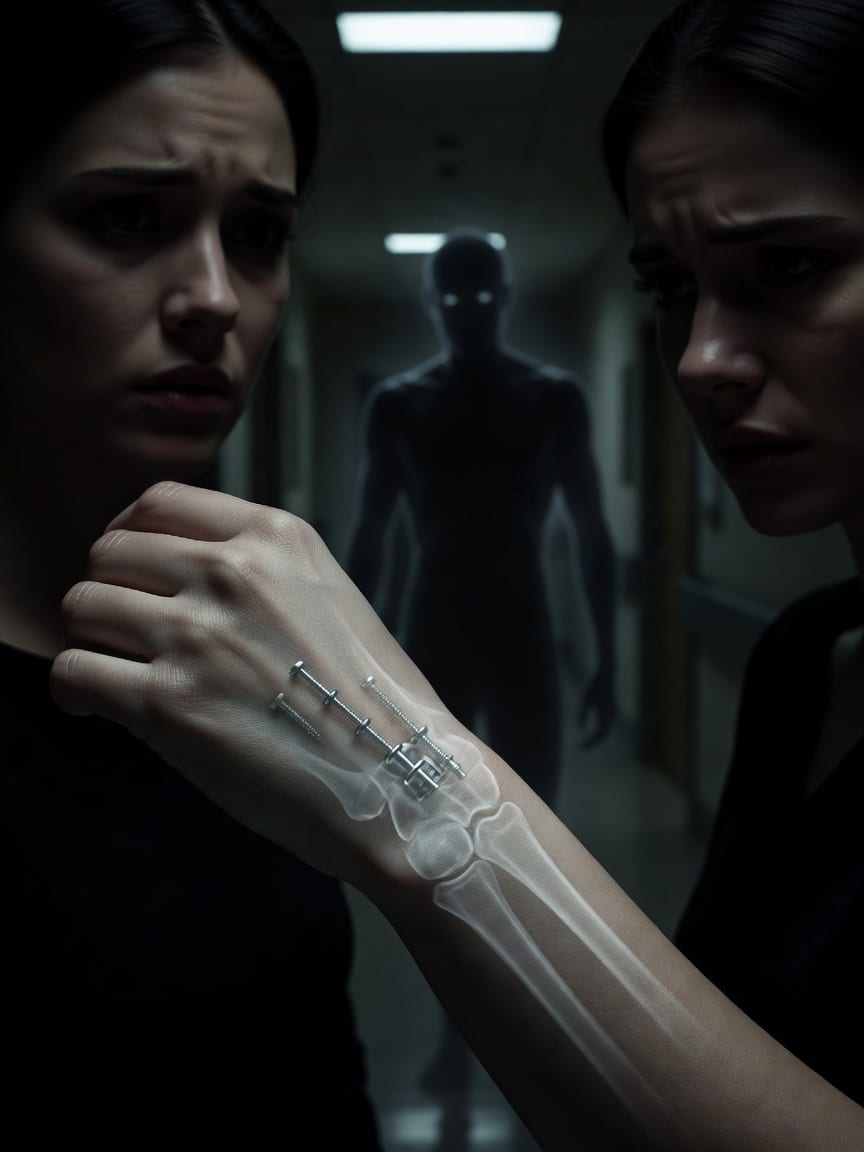
My wrist X-ray showed a titanium plate fixing a break from years ago. My surgeon asked which hospital did the operation. I've never had surgery in my life.
After a clumsy accident, I visited the fracture clinic for my swollen wrist. But my X-ray showed a perfectly healed titanium plate embedded in my bone – an implant I had no memory of receiving. Despite being decades old, there was no scar on my skin, and no medical record of the surgery under my name.
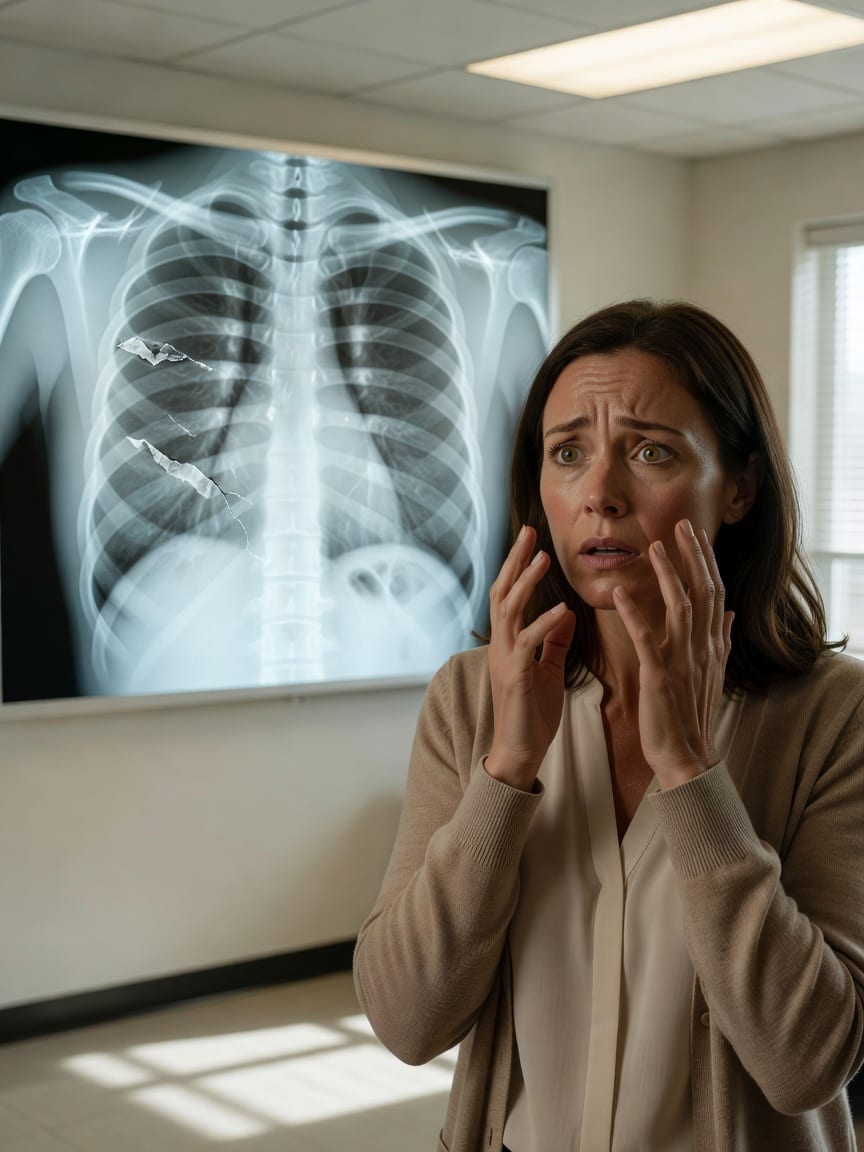
My chest CT shows four old healed rib fractures. I've never broken a rib in my life. The consultant asked if anyone hurt me when I was small. No one ever had.
A routine CT scan for a lingering cough revealed four old, healed rib fractures on my left side, injuries I have no memory of ever sustaining. Despite searching my childhood records, I found no explanation, until a faded sonogram report from my mother's past unveiled a chilling truth: a tiny, distorted second fetus with a dark smudge where its ribs should be.
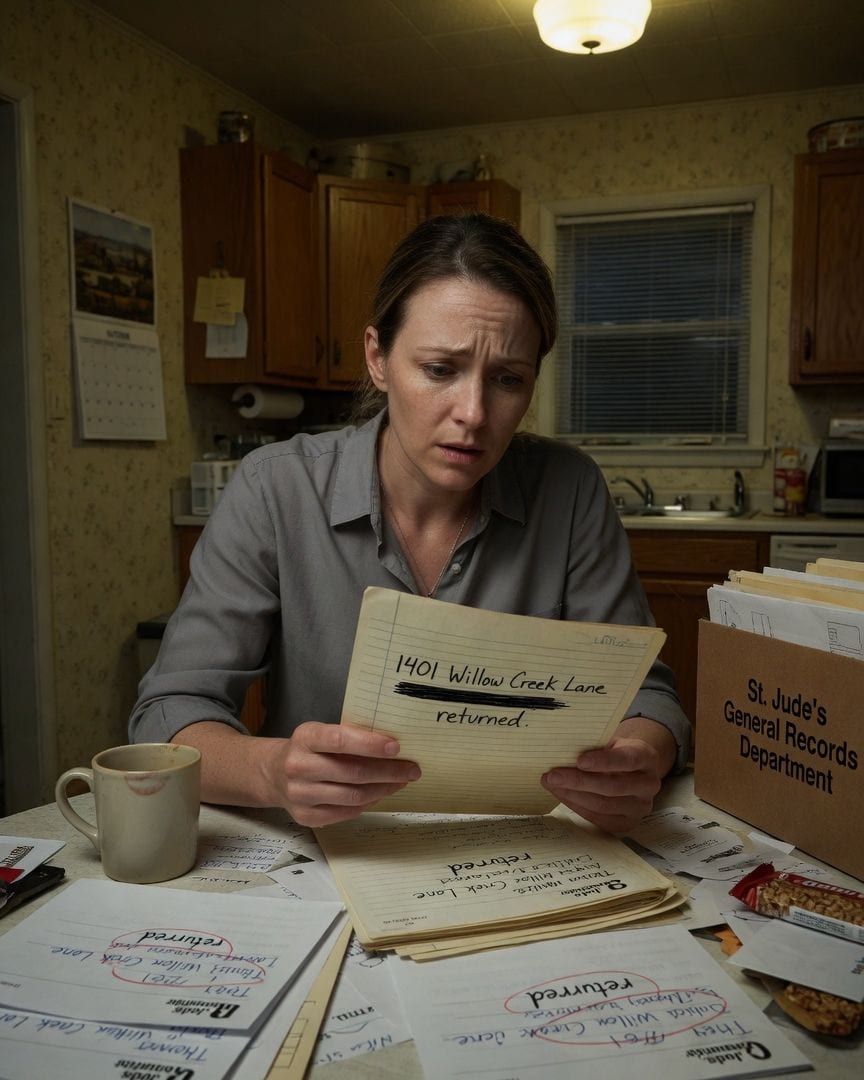
My medical file shows my street address on a struck-through line from 1988, a year I lived two counties away. It just says 'returned'.
A routine insurance audit led me to my childhood medical file from 1988. But among the expected notes, a deliberately struck-through line listed my current house address, followed by the stark word 'returned.' In 1988, I lived two counties away, making this entry an impossible and unsettling mystery.
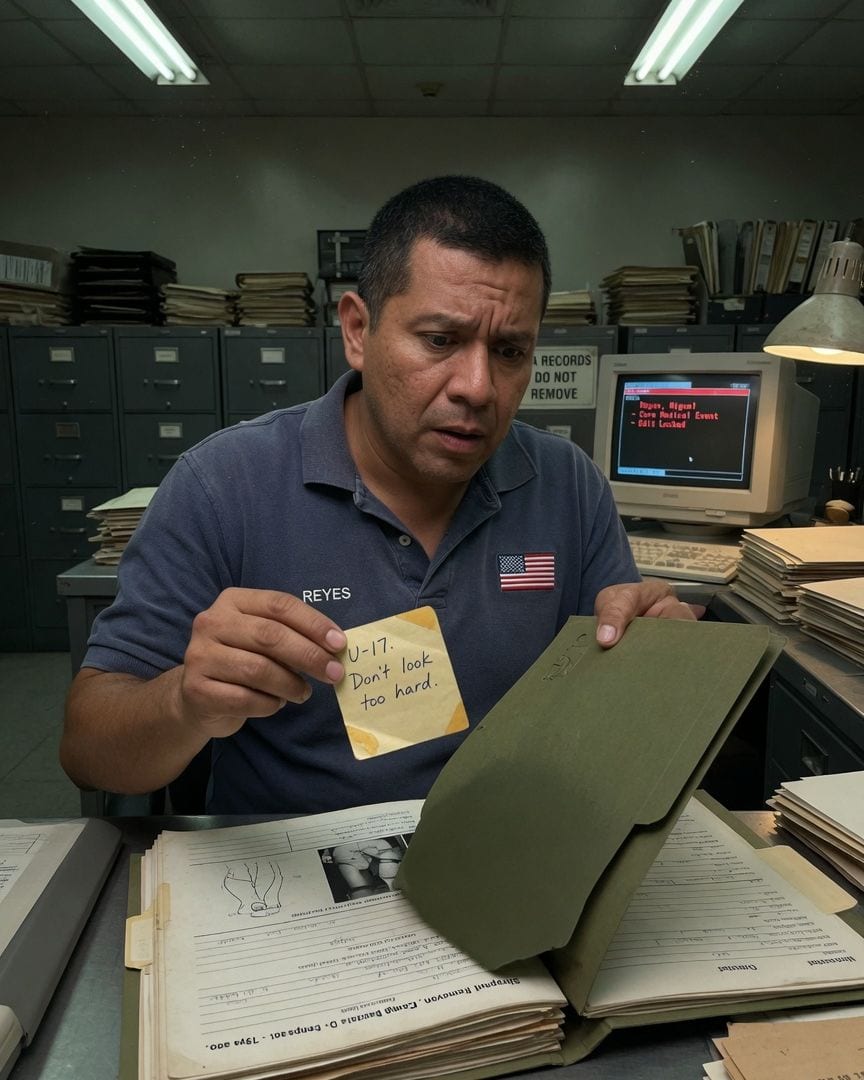
A veteran's medical record details a shrapnel wound his body never had. Taped to the report: 'U-17. Don't look too hard.'
Miguel Reyes, a veteran seeking relief for an old running injury, found his routine VA visit take a chilling turn. His medical file claimed a shrapnel wound and surgery from thirteen years prior, but his leg bore no scar, no mark of the supposed incident. Despite the detailed digital and paper records, his body swore the event never happened. As he pressed for answers, a hidden, yellowed note taped inside the official report surfaced, scrawled with two words: "U-17. Don't look too hard." The sterile clinic air suddenly felt cold and thick, suggesting a truth far darker than a simple clerical error.
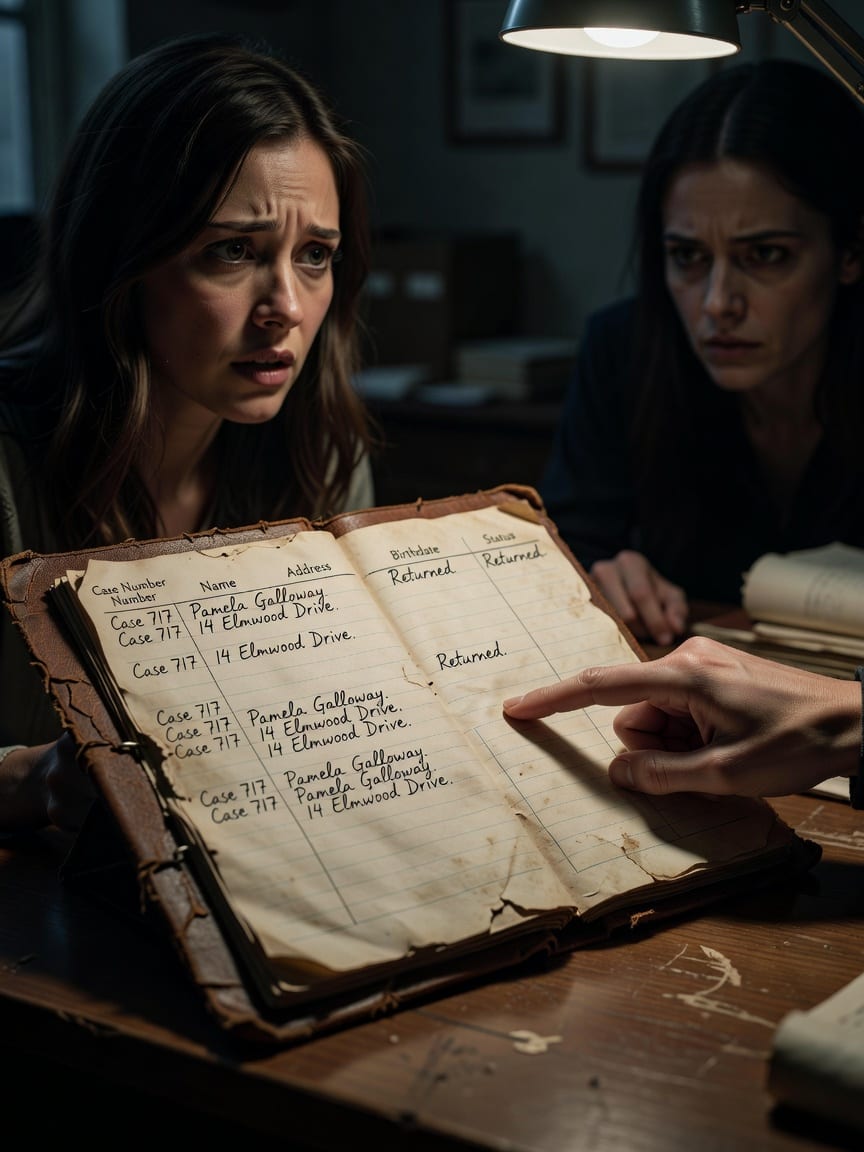
My hospital file has a blacked-out line from 1988. It names my street address, decades before I lived here. Then: 'returned'.
I finally got my medical file, hoping to clear up a ridiculous bill. Inside, I found an entry from 1988: my current home address, scrawled on a partial intake form and marked 'returned.' I was six then, living fifty miles away.
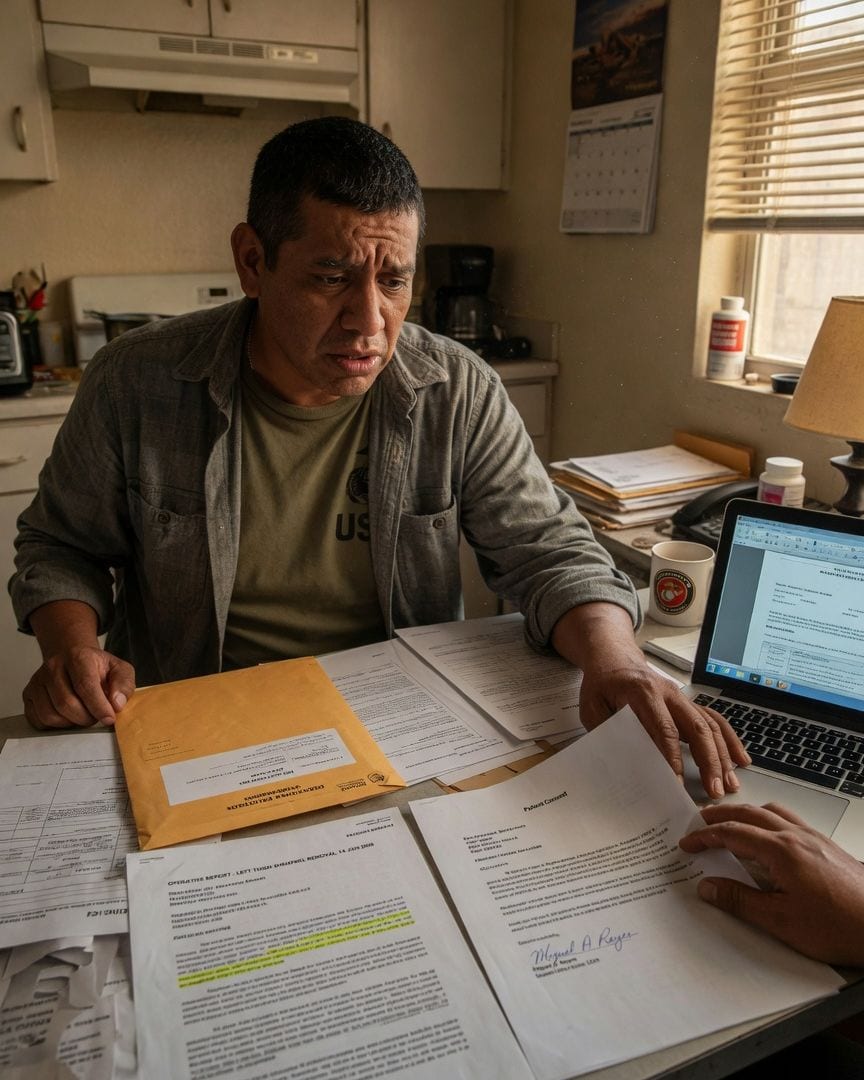
A veteran's VA file listed surgery for shrapnel. The doctor retired decades before he joined the Corps.
Miguel Reyes, a veteran, sat in a sterile VA clinic, his bad knee throbbing, expecting routine. Instead, a physician's assistant presented a digital file detailing shrapnel removed from his thigh in 2008 – an injury Miguel had no memory of, no scar for. His own service record later confirmed the impossible surgery, complete with a consent form bearing his perfect, yet utterly alien, signature. Driven by unease, Miguel researched the listed surgeon, Dr. Charlotte Bennett, only to discover she had retired from military service decades before he even enlisted. The numbers didn't just not add up; they violently contradicted each other, revealing a deliberate, impossible fabrication in his own life story.