Sergeant Delgado, three weeks from home, counted his thirty-one men. Then a thirty-second soldier stood watch with a blurred face, not on the schedule.
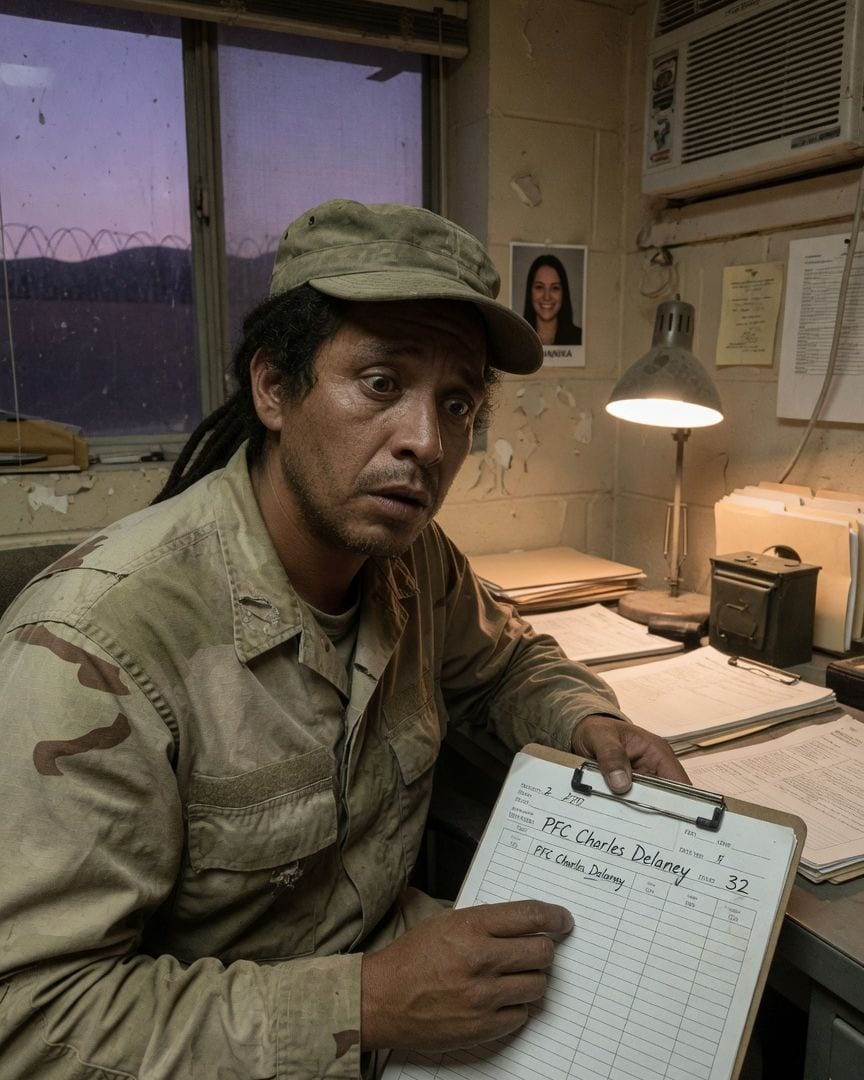
Dusk settled over Firebase Kestrel, painting the desolate, windswept ridgeline in shades of bruised purple and charcoal. Sergeant Roy Delgado, his skin gritty from the constant desert dust, ran the evening head count he’d run every dusk since spring.
He was three weeks from the end of an eight-month tour, and the thought of his wife, Annika, was a constant, shimmering mirage in his mind.
He called out names, one by one, watching each soldier step forward, answer, and fall back into formation. Each of his thirty-one men answered. He swept his gaze across the assembled formation, counting heads against the purpling sky. Thirty-two.
Delgado blinked. He shook his head, a faint dust cloud rising from his helmet, and started again. Slower this time, he pointed, naming each man as he tallied them. Thirty-two.
He walked the line, confirming each face, each name, each living, breathing body. Not one name was missing. Every man stood in his proper place, accounted for.
There were simply thirty-two of them now, and a cold dread, sharper than the desert wind that whipped through the compound, settled deep in Delgado’s gut.
Delgado spent the next hour in his cramped office, the air conditioner rattling faintly in the corner like something trapped. He hunched over the unit’s official duty roster, tracing the lines with a calloused finger. It clearly listed thirty-one names.
He pulled up the digital manifest, the one he had signed upon arrival back in February; thirty-one entries, each one verified.
He cross-referenced every form, every piece of paperwork, sifting through transfer requests, medical logs, leave schedules, searching for a clerical error, a new transfer he might have missed, anything that could explain the impossible count. Nothing. The records were pristine.
Later, unable to shake the impossible count, Delgado found himself drawn to Captain Eleanor Vance’s office, ostensibly to drop off some reports. The captain’s door was ajar, and inside, her desk was meticulously organized.
On its polished surface, pristine and seemingly fresh, lay the daily log for today’s date. Delgado approached, his boots silent on the concrete floor, and picked it up. His breath caught in his throat. It listed thirty-two names.
At the bottom, his own signature was scrawled next to the total, looping exactly as he always signed. The thirty-second name, neatly typed, read: 'PFC Charles Delaney.' Delgado didn’t recognize it. He knew every man in his unit.
The handwriting for 'Delaney' on the log, however, looked strangely familiar, almost like his own, but subtly, unsettlingly wrong, as if an echo or a shadow of his own script had been lifted onto the page.
Delgado confronted Captain Vance, holding the daily log out, his thumb resting on 'PFC Charles Delaney.' He pointed out the impossible name and his own signature next to the thirty-two-man tally.
She glanced at it, her expression unreadable, then dismissed it with a languid wave of her hand. "Clerical error, Sergeant. Happens."
But her eyes, for a fleeting moment, flickered toward a small, reinforced cabinet behind her desk, its steel door secured with a heavy lock.
That night, sleep refused Delgado. The desert wind outside his bunk seemed to whisper the name 'Delaney' against the corrugated metal walls.
He pulled on his boots, grabbed his patrol cap, and walked the perimeter in the pale moonlight, the desert air biting at his exposed skin. Ahead, at the far end of the wire, a lone figure stood watch.
PFC Charles Delaney. He looked exactly like any other soldier, helmet, rifle, posture perfect, a silhouette against the low, distant stars.
But as Delaney slowly turned his head, there was no discernible face, only a blur in the dim light, like a photograph taken with a shutter speed too slow.
Delaney raised a hand, saluted with crisp, impossible precision, then turned back to the wire, his attention fixed on the desolate expanse beyond the fence. Delgado checked the watch schedule on his wrist-mounted tablet. PFC Charles Delaney wasn't on it.
Delgado began a quiet, almost imperceptible investigation. He observed 'PFC Delaney' during the day.
The soldier blended into formations with unnerving ease, performed duties with silent efficiency, and ate in the mess hall, always taking the last seat at a table.
Yet, he was always on the periphery, never engaging in conversation, his face always slightly out of focus, or turned away when Delgado tried to meet his gaze directly. He was a phantom made solid, a constant, peripheral presence.
Delgado started noting small details. An extra set of boots outside the barracks door, mud-caked and worn, that didn't belong to any of the other thirty-one men.
An extra uniform, laundered and folded with impossible neatness, hanging on the line alongside the others. He checked the supply logs for the past two weeks. Thirty-two sets of rations drawn, consistently. Thirty-two sets of uniforms issued.
He even found a storage locker, tucked away in an unused corner of the supply depot, with 'PFC Delaney' stenciled on its faded green door. Inside, a standard-issue kit: duffel bag, personal effects, all seemingly untouched but present.
He tried to look up PFC Charles Delaney in the digital service records, accessing the military's secure database from his office terminal.
He cross-referenced with other bases, other units, searching for any trace of an enlistment date, a background check, prior assignments. The name yielded nothing. No service number, no blood type, no emergency contact.
It was a ghost in the system, a blank space where a soldier should have been, yet fully accommodated by the physical reality of Firebase Kestrel, a seamless, impossible presence consuming rations and wearing uniforms.
The computer hummed quietly, its screen reflecting Delgado’s baffled expression, offering no explanation, only absence.
Delgado attempted to discreetly raise his concerns again with Captain Vance, framing it as a "personnel discrepancy" during a routine briefing on supply readiness. She cut him off, her voice low and even, her gaze unwavering.
"Sergeant, maintaining unit cohesion is paramount. Focus on your men, not on distractions." Her tone carried an edge of warning, cold and sharp, like the blade of a knife.
The air in the cramped office seemed to grow thin, pressing in on Delgado.
Later that day, Delgado returned to his bunk to find his personal logbook, a small, olive-drab notebook where he’d been jotting down his observations about Delaney, lying open on his cot. He always kept it tucked beneath his pillow.
A single entry, 'Delaney, Charles. Indistinct. Always accounted for,' was underlined in vivid red ink. His blood ran cold. No one else ever touched his logbook. He lived alone in this bunk, a privilege of his rank.
He scanned the barracks, the rows of empty cots. PFC Charles Delaney stood by the window, motionless, seemingly staring out at the desolate desert expanse.
But Delgado felt the weight of his unblinking gaze, a palpable pressure that settled on his shoulders. The air around him grew heavy with the distinct certainty that his digging had been noticed, and he was now being watched.
The barracks, usually a cacophony of minor sounds, was unnaturally still, as if holding its breath.
Driven by the chilling realization of being watched, Delgado sought out Specialist Ryan Winslow, a young soldier who’d been at Kestrel for two rotations, already a veteran of its peculiar rhythm.
Winslow was known for his quiet nature and his habit of listening intently to the older sergeants’ stories, often sitting at the edge of conversations like a stray dog hoping for scraps.
Delgado cornered him during chow, when the mess hall was a low murmur of clanking trays and hushed conversations. He spoke in tones barely audible above the general din. "Winslow, about Delaney…"
Winslow’s eyes widened, and he visibly tensed, his fork clattering against his metal tray. He glanced around nervously, as if expecting the very walls to listen.
Delgado pressed him, gently at first, then with the quiet authority of a superior officer who needed an answer. "He's not on the records, Winslow. He just… appeared."
Winslow, terrified, finally broke. His voice was a barely audible rasp, lost in the background noise. "Sergeant, he’s… always been here. Or someone like him. Different faces, different names sometimes, but always the extra man."
Winslow picked at his food, not meeting Delgado’s gaze. "The old-timers call it 'Kestrel’s Shadow.' They say you don’t talk about him. You just… count him."
He explained that there was an unofficial, unwritten rule, passed down from rotation to rotation: if you noticed the extra man, you accepted him. You integrated him into your count, into your reality. Or you became one of them.
Winslow then mentioned an old, dusty "Firebase Kestrel Protocol Manual," kept in a locked compartment in Captain Vance’s office, a manual "from before the war," that supposedly had "all the answers no one talks about."
He shuddered, then quickly finished his meal and left, leaving Delgado alone with his chilling words.
Winslow’s words echoed in Delgado’s mind, hardening his resolve. Or you become one of them. The underlined entry in his logbook, Delaney’s unblinking stare – it all clicked into a terrifying coherence.
That night, while Captain Vance was on her routine rounds, her footsteps echoing faintly in the distance, Delgado used a master key he'd 'found' tucked inside an old toolbox in the motor pool to access her office.
His heart pounded against his ribs, a frantic drum in the silent room. He located the locked cabinet Winslow had mentioned, a dark steel box built into the wall behind a stack of faded topographical maps.
The lock was old, simple, and clicked open with a soft, metallic sigh.
Inside, beneath stacks of old supply manifests from forgotten campaigns, he found it: a thick, yellowed binder, its canvas cover faded to a dull gray, bearing the stark label 'FIREBASE KESTREL PROTOCOL MANUAL – CLASSIFIED.'
The binder was surprisingly heavy, dense with years of brittle paper. His hands trembled as he opened it. The pages were brittle, crinkling at his touch, filled with typewritten directives, diagrams of forgotten equipment, and bureaucratic language.
He flipped past routine procedures, past sections on desert warfare and perimeter defense, until a specific section heading, written in bold, faded black ink, caught his eye: 'Kestrel Anomaly Personnel Integration.'
He read, horrified, how the manual detailed procedures for managing the 'numerical discrepancy,' ensuring the official count always matched thirty-two personnel. It outlined protocols for daily tallies, supply requisition, and even social interaction.
Then, in the midst of a dry explanation of duty rosters, he found it: a roster, dated 1953, listing thirty-two names. The thirty-second name, typewritten with chilling clarity, read: 'PFC Roy Delgado.'
And next to it, the signature for the head count, precisely his own unmistakable hand.
Reeling from the impossible sight of his own name on a 1953 roster, Delgado continued to read the manual, his mind struggling to process the implications.
The 'Kestrel Anomaly' was described in chillingly detached language as a 'localized spatial-temporal bleed,' a recurring manifestation of a 'stabilizing influence' that ensured the firebase's continued operational integrity.
It explained that the anomaly integrated itself into the unit roster, adopting the identity of a past or future soldier, always maintaining the 'correct' count of thirty-two.
The manual stated, in chillingly bureaucratic language, that attempts to remove or dislodge the anomaly were 'not advised' and had historically resulted in 'catastrophic unit dissolution.'
It detailed multiple such 'dissolutions' over the decades, each incident precisely recorded: a unit from 1957 that vanished overnight, another from 1968 found in a state of advanced decay despite having been present just hours before, always at Kestrel, always after someone tried to break the pattern.
Commanders, it seemed, had been aware of this for generations, maintaining a meticulous, classified record of 'integration success' and 'dissolution events.'
The document concluded with a chilling directive, stark and absolute, stamped in faded red ink on the final page: 'The Anomaly is Kestrel. Kestrel is the Anomaly. Maintain the count.'
Delgado stood in the dark office, the ancient manual a heavy weight in his hands, its pages rustling softly in the still air. The full, terrifying coherence of it all settled over him.
Every discrepancy, every oddity, every unblinking stare, now made perfect, horrifying sense. The institution hadn't fought the anomaly; it had absorbed it, managed it, made it part of the system.
Firebase Kestrel wasn't just built on top of the anomaly; it was the anomaly.
He looked up, his gaze drawn to the doorway, and there, silhouetted against the fainter light of the corridor, stood PFC Charles Delaney. Not indistinct now, but clear, solid, and undeniably present.
He looked exactly like Roy Delgado, but younger, his eyes holding an ancient, empty knowing that chilled Delgado to the bone. Delaney didn't speak. He simply raised a hand, palm up, implicitly asking for the manual. Delgado understood.
He was not just a witness; he was part of the cycle, perhaps the next 'Delaney' for a future rotation, the replacement for a previous instance, or the past 'Delaney' who had now manifested.
He could not fight this, could not escape the accountability that could not be. The system had already accounted for him, centuries ago, decades ago, now. Slowly, deliberately, Delgado placed the heavy, yellowed manual into Delaney's outstretched hand.
Delaney took it, his touch surprisingly firm, then gave a perfectly crisp salute, a mirror of the one Delgado saw on the perimeter weeks ago.
He turned, walking out into the night, vanishing into the desert darkness, leaving Delgado alone in the quiet office.
The next morning, the count was thirty-two. PFC Charles Delaney was present, indistinct but accounted for, a familiar shadow among the concrete shapes of the firebase.
Sergeant Roy Delgado ran the count, his movements precise, his face impassive, his gaze meeting Delaney's for a fraction of a second, an unspoken understanding passing between them, a cold acceptance. He no longer questioned it.
Captain Vance, watching from her office door, looked at him, a faint, almost imperceptible nod. The remaining three weeks of the tour passed without incident. Delgado performed his duties with quiet efficiency, a piece of the Kestrel mechanism, perfectly integrated.
The base operated as it always had, the impossible woven seamlessly into the mundane, a routine that stretched back further than any living memory.
Three weeks later, Sergeant Roy Delgado was processed out of Firebase Kestrel, his discharge papers signed, his tour officially over. He stepped onto the transport out, his gear slung over his shoulder.
He looked back at the firebase, a silent, unblinking stare, feeling a strange sense of belonging, a quiet understanding of its purpose. The desert wind no longer felt sharp; it felt like a familiar breath.
He was discharged, returned home, a decorated veteran. Years passed. He lived a quiet life, building a family, a career, the memories of Kestrel receding into the background like a distant, hazy dream.
One evening, his wife, Annika, found an old, dusty photo album from his grandfather’s military service. She pointed to a faded black-and-white photograph of a unit from the Korean War era, a group of young, grim-faced soldiers.
"That’s you, isn’t it, Roy?" she asked, her finger tracing the outline of a young, indistinct soldier in the back row, his face blurred as if caught in motion. "You never told me you served during Korea."
Annika Delgado looked at the old photograph, a faded image of soldiers from a forgotten war. Her husband, Roy, sat across from her, reading the newspaper, the soft lamp light glinting off his glasses. "That’s you, isn’t it, Roy?"
she asked, pointing to a young, indistinct soldier in the back row. "You never told me you served during Korea."
Roy Delgado slowly lowered his newspaper, a faint, almost imperceptible smile playing on his lips, the kind of smile that held no humor, only deep, ancient knowing. "Is that so?"
If this one got to you
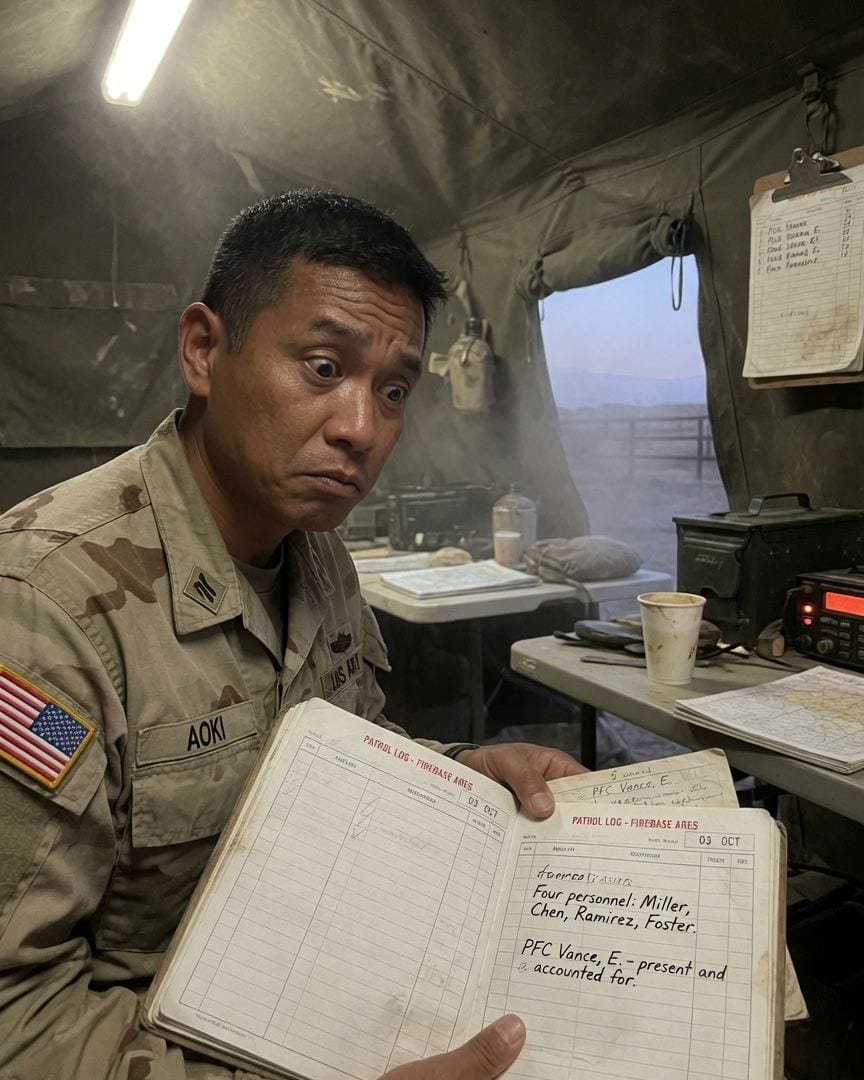
On his final patrol, Sergeant Hans Aoki led his four-man team. A fifth figure, silent, disciplined, shifted its weight right off his shoulder. Then his own signed log confirmed five men present.
On his final patrol through the pre-dawn Afghan desert, just hours from leaving Firebase Ares for good, Sergeant Hans Aoki led a disciplined four-man team. At the halfway point, a fifth figure, silent and disciplined, shifted its weight right off his shoulder, matching his stride; Aoki saw only four men, but the phantom presence remained, and the comms static felt like a muffled whisper. Back at the operations tent, his own signed patrol log, confirming four men, then listed an impossible fifth soldier, 'PFC Vance, E.', as present and accounted for. What impossible truth had his own hand attested to?
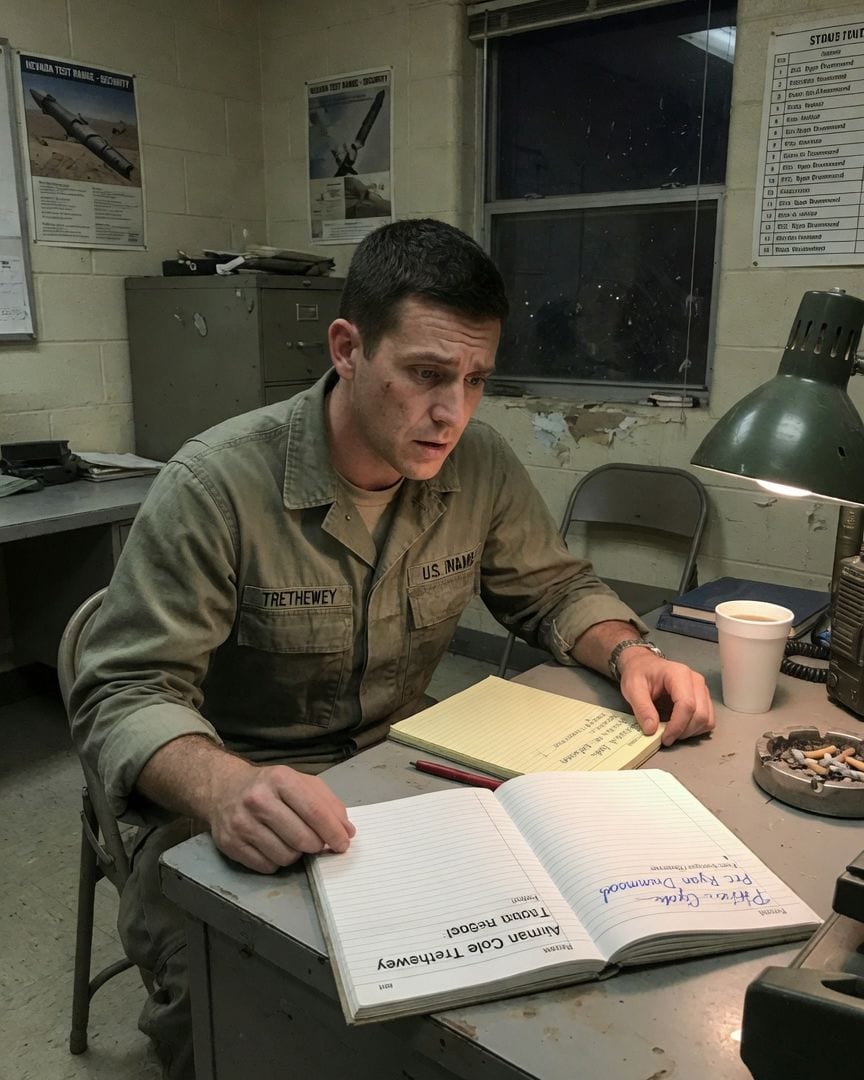
On his final patrol, Airman Cole Trethewey saw a man vanish. Then the stranger sat beside him, seatbelt buckled, miles from any outpost.
Airman Cole Trethewey was on the last loop of his final patrol, the desert night sharp and silent as his jeep cut through the Nevada test-range perimeter. Miles from any outpost, he saw a man standing in the road; a second later, the stranger sat beside him, seatbelt buckled, perfectly still. Back at the outpost, Cole’s dread deepened when his final patrol logbook listed a 'Ryan Drummond' as his observer, signed with an exact replica of his own hand. No records existed for the name, leaving Cole with an impossible, chilling fact that simply should not be.
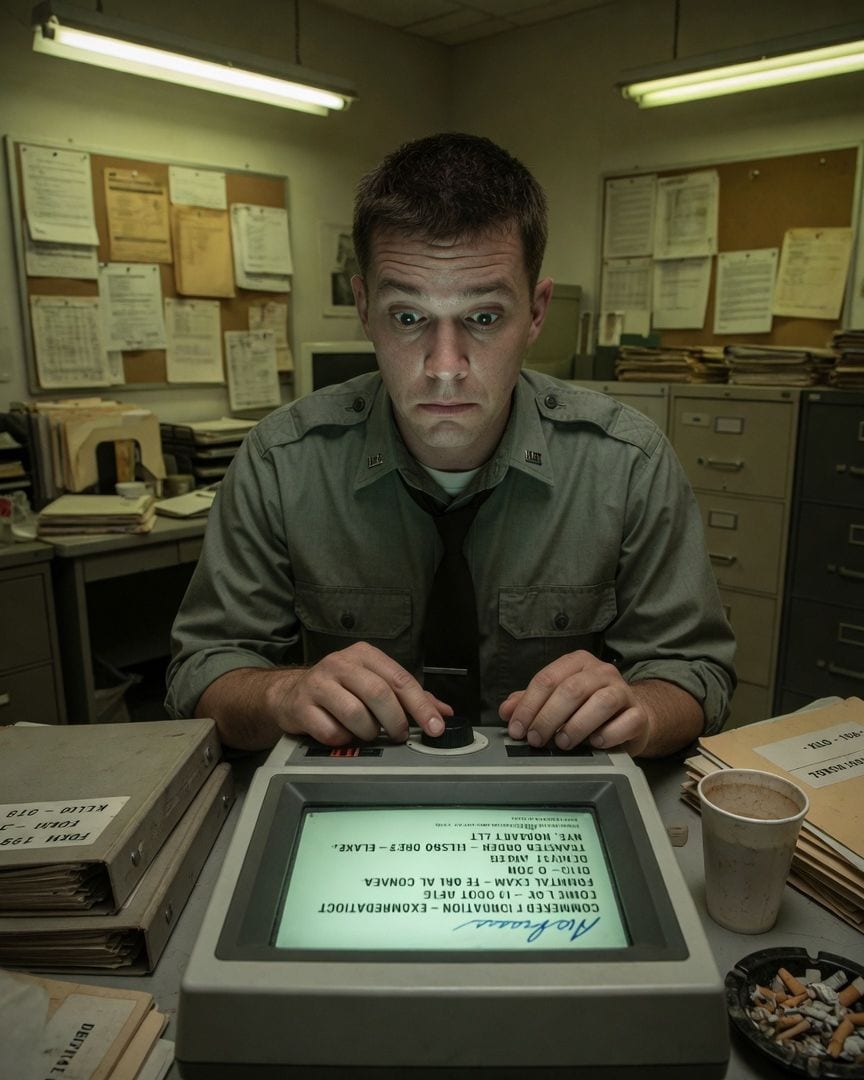
A missile commander watched his ten nuclear silos go dark. His own service record shows his signature on a future he's never lived.
Second Lieutenant Hobart Nye, a missile commander in Wyoming, had his quiet 0247 watch shattered by a security report: a massive, silent black triangle hovered over Launch Facility Kilo, casting a perfect shadow. Hobart watched his console's fault panel light up, signaling all ten nuclear missiles going dark in an impossible silence, followed by eleven minutes his security team could not remember. Official logs called it a "radio malfunction," but Hobart found a requisition for invisible-tracking sensors, signed by a base commander who was supposed to be off-base. The final, chilling discovery came when his own service record showed new entries—a dental check-up, a transfer to Alaska—all dated for a future he never lived, complete with his perfectly replicated signature.
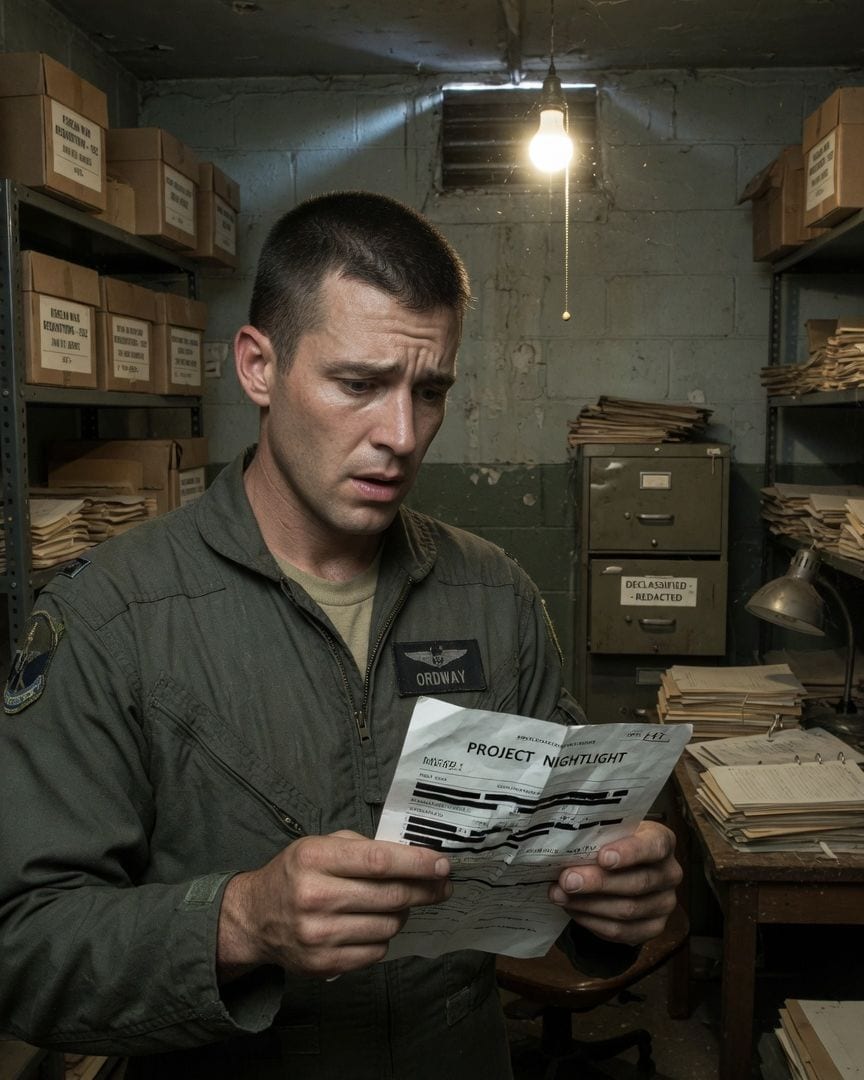
A Cold War pilot's F-104 Starfighter was shadowed by an impossible object. Weeks later, a secret memo referenced his own service number for 'pilot reassignment protocols.'
First Lieutenant Cal Ordway soared over the Mojave in his F-104 Starfighter in 1962, the night sky a familiar canvas. But that night, one 'star' broke formation, pulling alongside his wing and mirroring his every impossible maneuver. His instruments confirmed the silent, unblinking object, defying all known physics. After filing his precise report, Cal found his flight log altered to 'no incidents,' radar tapes corrupted, and a superior advising him to 'let it go.' Driven by his training, he uncovered a heavily redacted memo referencing 'Project NIGHTLIGHT' and, chillingly, his own service number for 'pilot reassignment protocols initiated.' Was he merely a witness, or already a subject in a much deeper secret?
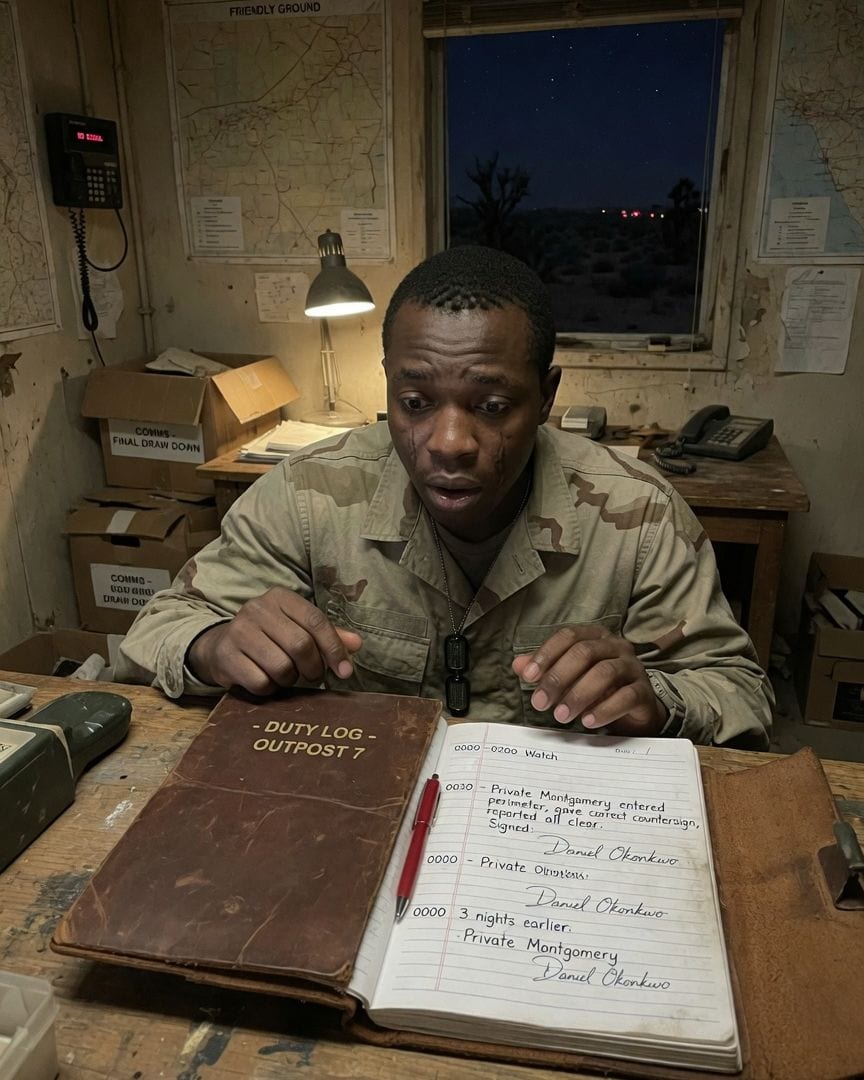
On Private Okonkwo's last desert watch, a soldier with an unnatural smile appeared. Then the duty log showed his own signature, confirming an entry he never made.
Private Daniel Okonkwo was counting minutes on his final watch at desolate Outpost 7, eager for dawn and a long-awaited trip home before the base closed for good. The familiar desert night offered little comfort, its vast emptiness usually reassuring, but tonight held an unsettling quiet. As his starlight scope swept the sparse treeline, a figure in their uniform stepped from the absolute dark, raising a hand with the correct recognition signal—and an unnatural, wide smile. Later, Private Okonkwo found his own unmistakable signature in the outpost's duty log, confirming a 'Private Montgomery' had entered the wire during his shift, an event he knew never happened. With the last convoy disappearing, who—or what—had signed his name to a lie, and why?
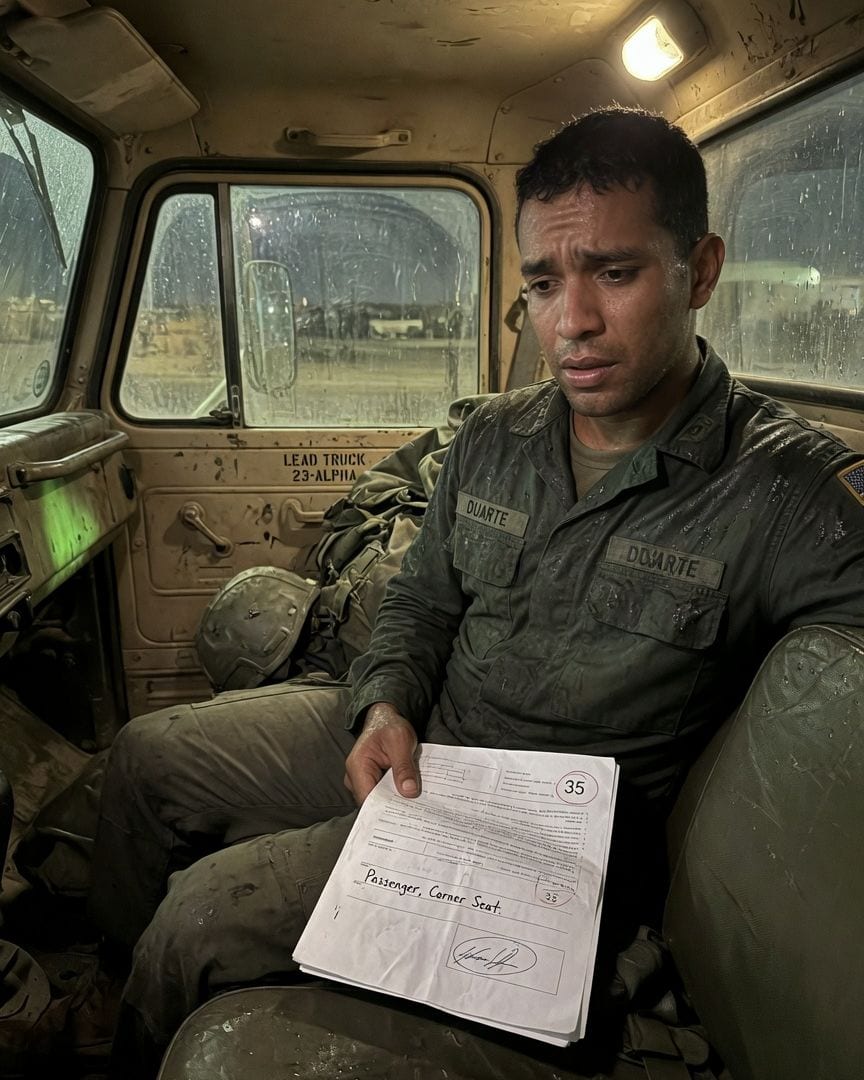
Specialist Duarte, two weeks from going home, found his empty truck seat warm and dented — then his service record showed a ghost deployment he never made.
Specialist Felix Duarte was just two weeks from going home, but a final convoy mission held an unsettling mystery. Soaked and running late, he squeezed into the lead truck's forbidden corner seat, a place every soldier knew to leave empty. Hours later, stepping out into the desert, he found the seat was strangely warm and distinctly dented, as if two unseen bodies had pressed in beside him. The official manifest then listed an extra soul for his truck, simply 'Passenger, Corner Seat,' signed by his own hand. What impossible presence had shared Specialist Duarte's ride, and what other records might it have altered?