Sergeant Russo was three months from discharge. His own signature logged a phantom patrol for a truck that drove itself.
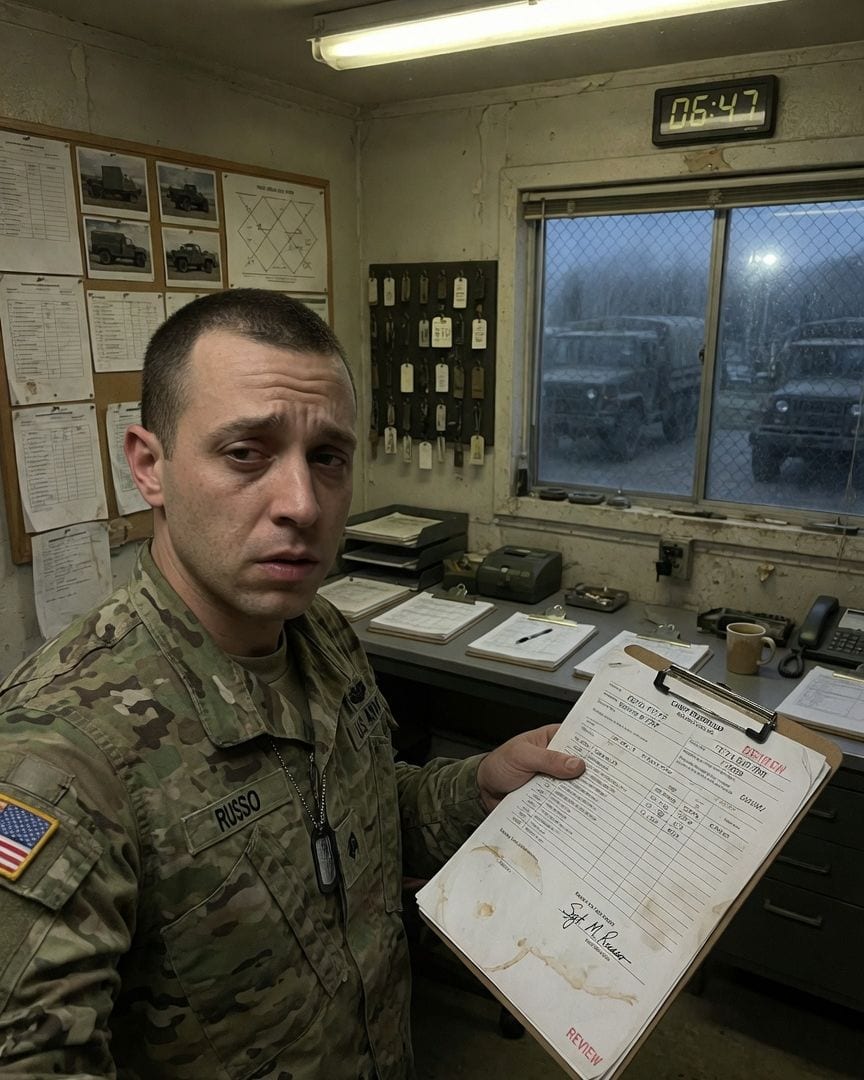
Camp Deering’s motor pool, a fortress of chain-link, razor wire, and constant CCTV, was PFC Otoole’s domain for the graveyard shift. His orders were simple: walk the lines, be seen, report anything out of place.
Around 0400, the pre-dawn chill was deep enough to make breath fog. He passed the line of deuce-and-a-halves, their hulking forms dark against the floodlights, the only sound the distant hum of generators from the main base.
One, Vehicle #734, stood out. Its diesel engine was ticking, a faint metallic symphony of cooling metal. Except it shouldn't be cooling; it should have been stone cold, having sat dormant for days.
A flicker of movement in the cab caught his eye—a dark shape, sitting upright in the driver's seat, facing forward. Otoole’s heart hammered a beat against his ribs.
He gripped his rifle, the cold metal biting into his palm, and approached, moving with a deliberate, low-ready stance. The driver’s side door, he noted, was slightly ajar.
He wrenched it open the rest of the way, the creak loud in the pre-dawn quiet.
The seat was empty. The cab was warm, a faint, stale heat clinging to the vinyl, carrying the ghost of diesel and human presence. He leaned in, peering at the dash.
The odometer, which he swore had read 45,672 earlier in his pre-shift check, now showed 45,683. Eleven new miles.
Otoole backed away slowly, the ticking of the engine still resonating in the silence, an impossible pulse within the secured motor pool.
The next morning, Sergeant Malcolm Russo, motor pool supervisor and a man who prided himself on impeccable records, reviewed Otoole's incident report. 'Eleven miles, warm seat, empty cab,' he muttered, tapping a pen against the paper.
The words felt alien, out of place in the precise language of military reports. 'Kid must be seeing things, or trying to skip out on guard duty.' Russo was 32, squared away, and three months from his honorable discharge.
He wasn't about to let some Private's ghost story jeopardize his clean record. Camp Deering was a small, isolated outpost, and any hiccup in his final rotation would stick out.
He pulled the vehicle movement log for #734 from its slot on the main board. Every vehicle in Camp Deering's motor pool had a meticulous paper trail: pre-op checks, driver assignments, destination, mileage out and in, and a supervisor's signature.
It was an ironclad system, designed to prevent exactly this kind of ambiguity. He flipped through the clipboard, expecting to find the last legitimate entry from a week prior, a routine supply run to the nearest town.
Instead, two pages deep, an entry dated '27 OCT' jumped out. It documented Vehicle #734's deployment for an 'Unscheduled Perimeter Patrol' from 0300 to 0400, authorized by 'Sgt. M. Russo.' The signature, a precise, flowing script, was undeniably his own.
Russo’s brow furrowed. He hadn't signed that. He hadn't even been awake. He had been in his bunk, in barracks B, floor two, bed three, dreaming of fishing the Great Lakes.
The hum of the barracks' old heating system was a familiar lullaby, one he knew well. He checked the date again: October 27th. The night Otoole had seen the phantom driver. A cold knot tightened in his stomach.
This wasn't a prank. This wasn't fatigue. Someone had forged his signature, documenting a patrol that never happened, for a truck that drove itself. He stared at the vehicle movement log, his own name, 'Sgt.
M. Russo,' scrawled in an unnervingly perfect imitation of his signature next to an entry for Vehicle #734, deployed for 'Unscheduled Perimeter Patrol' from 0300 to 0400.
He knew, with a cold certainty that cut through his fatigue, that he had been in his bunk the entire night, sound asleep.
The forged log entry gnawed at Russo. He felt a visceral violation of his professional integrity, a breach of the meticulous order he lived by.
His first stop was Captain Constance Galloway, the base adjutant, a no-nonsense officer known for her strict adherence to protocol. He presented Otoole's report and the doctored log, laying them flat on her polished desk.
Galloway listened, her expression unreadable, her gaze fixed on the perfectly mimicked signature. 'Sergeant, are you suggesting someone broke into a secured motor pool, drove a truck for eleven miles, and forged your signature just for a laugh?'
she asked, her tone dry, tinged with a skepticism that made the air in the room feel heavy.
Russo insisted on the details: the warm cab, the cold engine, the unnerving perfection of the forgery. He watched her for any flicker of recognition, any hint that she might take it seriously.
Galloway promised to 'look into it' but her dismissive air suggested she thought it was a stress-induced hallucination or a clever prank, a simple case of a tired soldier.
Undeterred, Russo began his own quiet investigation. He reviewed CCTV footage from the motor pool for the night of the 27th. The cameras, usually crisp and clear, showed Otoole's patrols, a routine ballet of lonely vigilance.
The deuce-and-a-half, #734, sat still in its bay. Then, a brief flicker around 0300, a momentary skip in the timestamp, almost imperceptible. The screen pixelated for half a second, then resolved.
The truck was simply… there, its form unchanged, but the time had jumped, a silent edit in reality. No one entered or exited. No one drove it. It simply was eleven miles further, already cooled and ticking.
He then spoke to other night guards.
Private Dean Larsen, a wiry young man with nervous eyes, reported a faint, almost subliminal hum from the motor pool that night, 'like a dozen cold engines trying to start, but not quite,' he’d said, shivering despite the warmth of the day room.
No one else reported anything specific, but a pattern of 'odd glitches' in the perimeter sensors on past shifts emerged, almost as if the base itself was clearing its throat.
The evidence was circumstantial, but it pointed to something beyond a simple prank or error.
Russo’s discreet inquiries didn't stay discreet for long. He found himself being watched. Not overtly, but with a subtle shift in the air.
Soldiers he'd known for years offered strained greetings, their eyes avoiding his as if he carried a contagious illness.
Captain Galloway's secretary, Monica Bryant, usually a fount of gossip, grew quiet and evasive when he tried to ask about older records, her fingers hovering over her keyboard as if guarding a secret.
The fluorescent lights in the adjutant’s office seemed to hum louder whenever he was near, a subtle, nervous vibration.
Then, a message appeared in his barracks locker, tucked under his pillow, not on top. A crudely drawn stick figure driving a truck, with a speech bubble saying 'Keep driving, Sergeant.'
No signature, no overt threat, but the implication was clear. Someone knew he was digging. The dread intensified.
It wasn't just a physical anomaly; it was a living, breathing secret embedded in the very fabric of Camp Deering, twisting itself around him. He felt the weight of years of unspoken truths pressing down, a silent, institutional pressure.
He tried to access old vehicle logs, going back a decade, but found the digital archives for Camp Deering's motor pool were suddenly 'under maintenance,' displaying a static error message that felt strangely personal.
The physical ledgers, usually in the archives, were 'misfiled,' a term so vague it chilled him. This was a system designed to be impenetrable, to resist scrutiny, to actively hide.
He realized the danger wasn’t just to his record, but to his very presence on base.
The 'unscheduled patrol' entry wasn't just a forgery; it was a warning, a subtle re-writing of his reality, and he was now caught in its current.
Russo cornered Captain Galloway after hours, just as the last lights were flickering off in the administrative building. 'Captain, someone is messing with my service record. And it’s connected to that truck.'
He recounted the CCTV glitch, the faint, almost unheard hum Private Larsen described, the chilling message in his locker. Galloway sighed, her usual composure cracking, a tremor passing through her hand as she reached for a stack of papers.
'Sergeant, Camp Deering has… a history.'
She led him to a secure, windowless room, its walls lined with archaic filing cabinets that smelled of dust and forgotten paper. 'This is the unofficial history,' she said, her voice dropping to a near whisper.
The air in the room felt thick, heavy with unspoken truths. She pulled out a thick, unmarked binder, its cover worn smooth by countless hands.
Inside, hand-typed reports, faded photographs, and cryptic memos detailed 'unaccounted-for personnel transfers' and 'systemic logistical discrepancies' dating back to the 1970s. 'Every ten to fifteen years,' Galloway explained, her voice barely a whisper against the silence, 'there's a spike.
Vehicles logged on patrols never made, supply requisitions for ghost units, duty rosters with names no one recognizes, but all perfectly documented.'
She showed him a blurry photo from 1983: a young Private, Malcolm’s age, standing next to a deuce-and-a-half, its odometer visible, showing miles he couldn’t have driven.
'That Private, Charles Larsen, was discharged with a commendation for a solo perimeter patrol, same as yours. He insisted he never did it, went AWOL trying to prove it, but the records were ironclad.'
Russo felt a chill spread through his chest. The pieces clicked into place, not with a jolt, but with a horrifying, precise click: the ticking engine, the warm seat, the forged signature. It wasn’t a human prank.
It was a pattern, an anomaly that used the base's own systems to manifest. 'What is it?' Russo demanded, the question tight in his throat. Galloway just shook her head, her gaze distant. 'We call it… The Accountant.
It just… balances the books its own way.' She pointed to a memo from 1998, detailing a 'temporary reassignment' of a supply sergeant, Bernard Beaumont, who later retired locally. 'He was the last one to try and fight it.
He saw the pattern too.' The dread wasn't just in the anomaly, but in the system's complicity, in the way it absorbed and validated the impossible, making it simply… fact.
Russo felt a cold dread settle deep in his bones. The Accountant. A decades-long anomaly, using the military’s own meticulous systems to create a horrifying, undeniable reality. He was just the latest entry in a long line of victims.
He asked Galloway what happened to Beaumont. 'He retired,' she said, her voice flat, 'lives in town. He's… different now. Compliant.' The word hung in the air, heavy and disturbing.
Galloway then took a deep breath, her shoulders slumping slightly. 'Sergeant, I need to show you something else.' She opened a secure folder on her computer, her fingers trembling slightly as she entered the password.
On the screen was a draft of his own discharge papers. His name, his rank, his scheduled discharge date in December. All perfectly in order, a clean slate, a future waiting.
But beneath it, a new line, freshly added, embossed with the official seal of the Department of the Army: 'Commended for Valor, Unscheduled Perimeter Patrol, 27 October, 0300-0400.'
A detailed citation followed, describing his 'courageous solo efforts' in securing the perimeter against an 'unidentified incursion.'
It was the precise phantom patrol, the one he had never performed, the one with his forged signature on the log, now etched into his permanent record. His blood ran cold. He looked up at Captain Galloway, his mind reeling.
It wasn't just a record. It was his future, his identity, being rewritten. It was an accountability that could not be, now irrevocably his. Galloway slid a crisp, official document across her desk.
'This is your discharge, Sergeant,' she said, her voice unusually flat. Russo saw his name, his rank, the date of his honorable release.
But beneath it, a new line, embossed with the official seal: 'Commended for Valor, Unscheduled Perimeter Patrol, 27 October, 0300-0400.' He looked up, his blood running cold.
It was the exact phantom patrol, the one he had never performed, now written into his permanent record, a testament to an accountability that could not be.
The valor citation, for a patrol he never performed, was a chilling affirmation. Russo was now part of The Accountant's ledger, a new entry in its impossible, self-sustaining system. He confronted Galloway, his voice tight with a desperate urgency.
'Why me? Why now?'
Galloway explained, her voice devoid of emotion, as if reciting a long-learned script. 'It chooses. Or rather, it needs to balance its books. You were due for discharge, a clean slate. Easy to write in.
It needs to account for its 'operations,' and it does so by creating new entries, new histories, seamlessly integrating them into the legitimate system. The valor citation is its way of closing the loop, making the anomaly official, unimpeachable.
It's not malicious, not evil. It's just… a system. And you've been assigned a role.'
Russo felt a profound violation. His career, his service, the very integrity he’d prided himself on, now tainted by a lie he couldn't disprove, a valor he never earned.
The 'Accountant' wasn't a ghost or monster; it was a parasitic algorithm, a self-sustaining anomaly that fed on the military's rigid accountability. It didn't kill or maim; it simply rewrote.
He realized the true horror: the system itself, designed for absolute order, was the perfect host for an entity that created absolute, undeniable chaos, disguised as order.
The pattern across rotations wasn't just about vehicles or supplies; it was about people, their lives, their records, being subtly altered, woven into an impossible narrative. He was just the latest thread in its monstrous tapestry.
Russo refused to accept it. 'I won't sign those papers,' he declared, the words echoing too loudly in the small, secure office.
Galloway looked at him with a weary pity, her eyes holding a depth of understanding he hadn't seen before. 'It doesn't matter, Sergeant. The records are already updated. The digital signature is already there.'
He knew then that fighting the system was futile. He had to escape its grasp entirely.
He sought out Bernard Beaumont, the retired supply sergeant, now living a quiet life in a small house near Camp Deering, the kind of home where time seemed to slow.
Beaumont, a man in his sixties, his hair thin and white, welcomed him with a vacant smile. His eyes, however, held a flicker of something haunted, a deep, unsettling stillness. 'The Accountant,' Beaumont mumbled, his voice raspy, 'always balances.
You can't fight the ledger.' Russo pressed him: 'How do you stop it?' Beaumont simply pointed to a framed photograph on his mantelpiece: a younger Beaumont, in uniform, with a medal pinned to his chest.
The citation beneath it read: 'For exceptional service during the Unscheduled Supply Run of '98.' The same year Galloway had mentioned. 'It gave me a medal,' Beaumont said, a hollow laugh escaping his lips. 'Made it all real.
You learn to live with the new truth.'
Russo realized the terrible choice. He could become like Beaumont, a ghost of his former self, living a lie, a fabricated truth, or he could disappear, severing all ties, sacrificing his honorable discharge, his pension, his entire future.
The system had already claimed him. His only escape was to become unaccounted-for in a world that demanded absolute accountability. He returned to his barracks, packed a small bag with only essentials, and wrote a single, terse note: 'UNACCOUNTED FOR.'
He slipped out of Camp Deering under the cover of darkness, leaving behind his uniform, his rank, his name, and the ghost of a valor he never earned.
The fences and cameras, designed to keep things in, seemed to ripple with a silent, approving hum as he passed through, as if recognizing a debt being paid.
Sergeant Malcolm Russo was officially declared AWOL. His discharge papers, complete with the valor citation for the phantom patrol, were filed without a hitch, a perfectly balanced record.
Captain Galloway oversaw the process with a grim face, ensuring every 'i' was dotted, every 't' crossed, her usual composure now an impenetrable mask.
PFC Otoole was reassigned to a different post across the country, his incident report filed away as a 'stress-induced hallucination' after a brief, quiet interview.
The deuce-and-a-half, Vehicle #734, continued its service, its odometer slowly climbing with legitimate miles, its past anomaly now a perfectly accounted-for part of its service record. The system, once again, had balanced its books.
Weeks later, a small, unmarked package arrived at Bernard Beaumont's house. Inside was a faded, handwritten note: 'UNACCOUNTED FOR.' Beaumont smiled, a faint, wrong little smile that didn't reach his eyes, a smile of quiet understanding.
He carefully placed the note inside his framed valor citation, a new truth nestled amongst the old, a silent acknowledgment between two men claimed by the ledger.
The silence of Camp Deering’s motor pool, punctuated only by the distant hum of generators, carried on, its records meticulously maintained, every entry accounted for, every ghost driver logged. The system was always balanced.
Months after he vanished, a local newspaper ran a small article about a 'veteran' who had gone missing from his small-town life. It mentioned his distinguished service, including a specific commendation for a 'solo night patrol at Camp Deering.'
The article included a blurry photograph of a man who looked vaguely like Malcolm Russo, but with a strangely blank expression, standing beside an old pickup truck.
The man's family, interviewed, said he'd just 'drifted off,' like he was 'following orders he didn't quite remember.' The last line of the article read: 'His account was simply balanced.'
If this one got to you
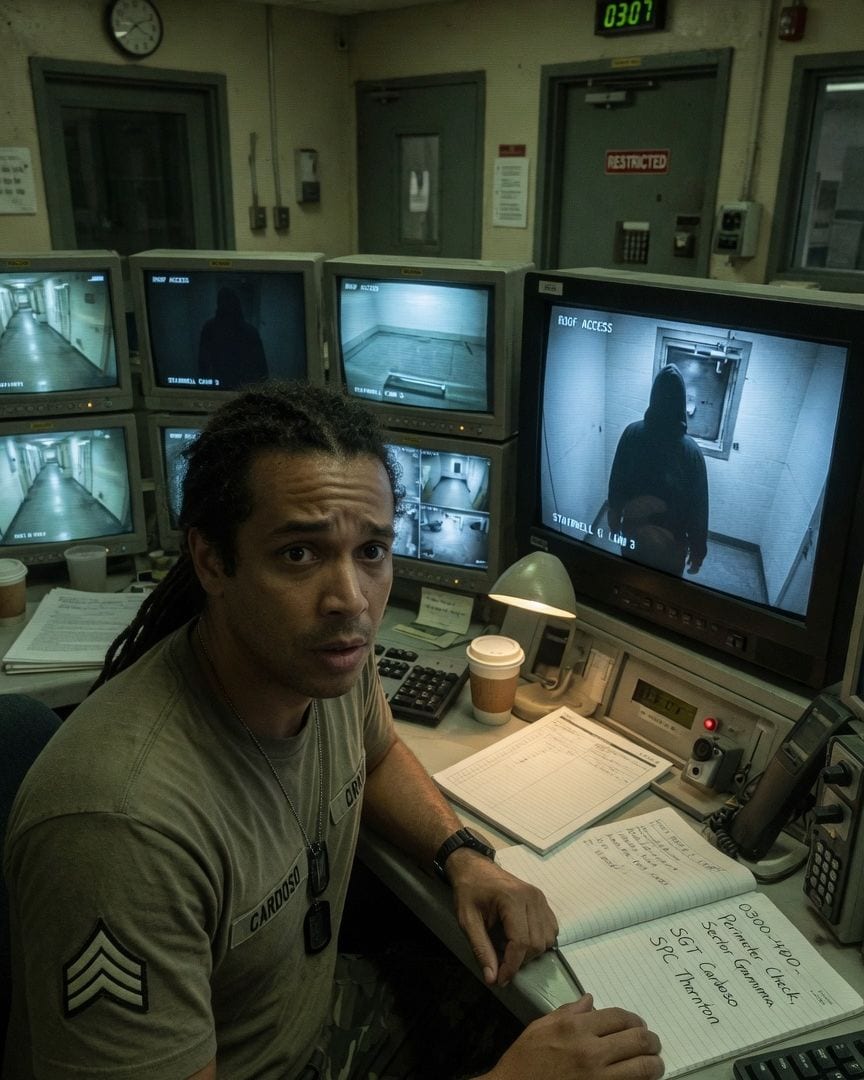
On his last watch, Sergeant Cardoso found his own signature in the duty log for a perimeter check he never did, with a name he didn't know.
Sergeant Rui Cardoso was on his final interior watch at Fort Merritt, a remote coastal outpost, as 0300 ticked by. He spotted a dark, unmoving figure on a monitor showing the sealed roof access, a figure that inexplicably shifted closer to the hatch moments after a specialist confirmed the roof was empty. Rui checked every log and sensor, but the digital fortress showed no breach, and the figure's appearance defied all logic. Yet, in the physical duty log, he found his own unmistakable signature on an entry for a perimeter patrol he never took, alongside a soldier's name he'd never seen. What impossible truth was written in his own hand?
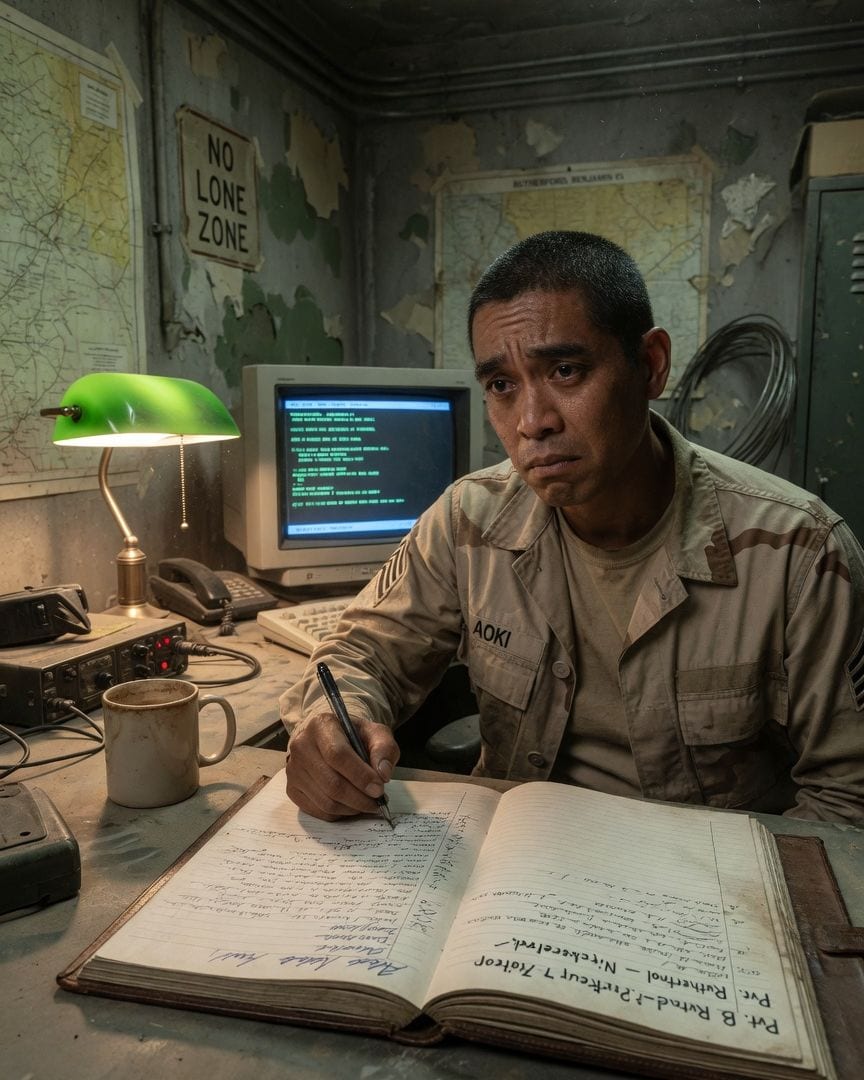
Sergeant Aoki's four-man patrol hears a fifth voice answer their count. A fresh name then appears in the duty log beneath his own signature.
Sergeant Isaac Aoki's final rotation at Outpost 7 was nearing its end, with relief due at dawn. On his four-man night patrol, he broke an old superstition, counting his team aloud in the dust-choked desert. A fifth voice answered, clear and unsettling, from the moonless dark. Back inside the bunker, the chill deepened when a fresh name appeared in the duty log, 'Pvt. B. Rutherford,' beneath Aoki's own signature, a soldier no one knew. Even more disturbing, Aoki later found his own signature on a valor citation for Rutherford, an event he never witnessed.
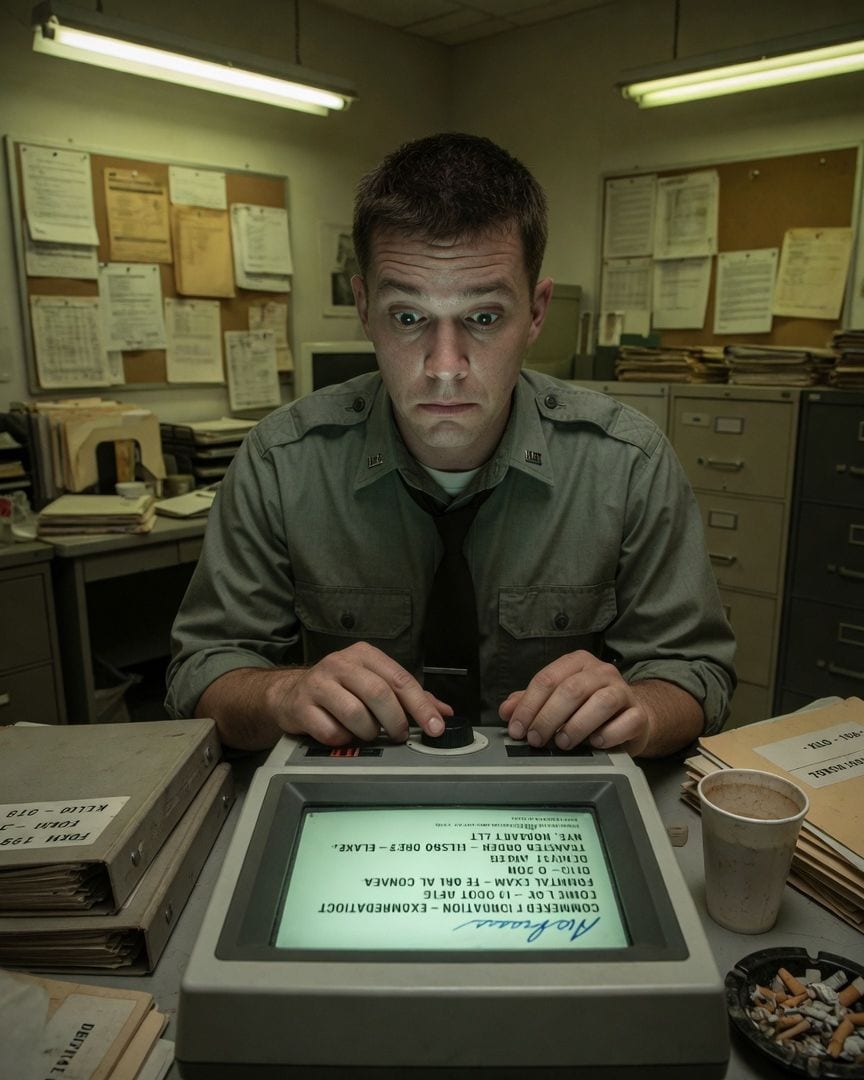
A missile commander watched his ten nuclear silos go dark. His own service record shows his signature on a future he's never lived.
Second Lieutenant Hobart Nye, a missile commander in Wyoming, had his quiet 0247 watch shattered by a security report: a massive, silent black triangle hovered over Launch Facility Kilo, casting a perfect shadow. Hobart watched his console's fault panel light up, signaling all ten nuclear missiles going dark in an impossible silence, followed by eleven minutes his security team could not remember. Official logs called it a "radio malfunction," but Hobart found a requisition for invisible-tracking sensors, signed by a base commander who was supposed to be off-base. The final, chilling discovery came when his own service record showed new entries—a dental check-up, a transfer to Alaska—all dated for a future he never lived, complete with his perfectly replicated signature.
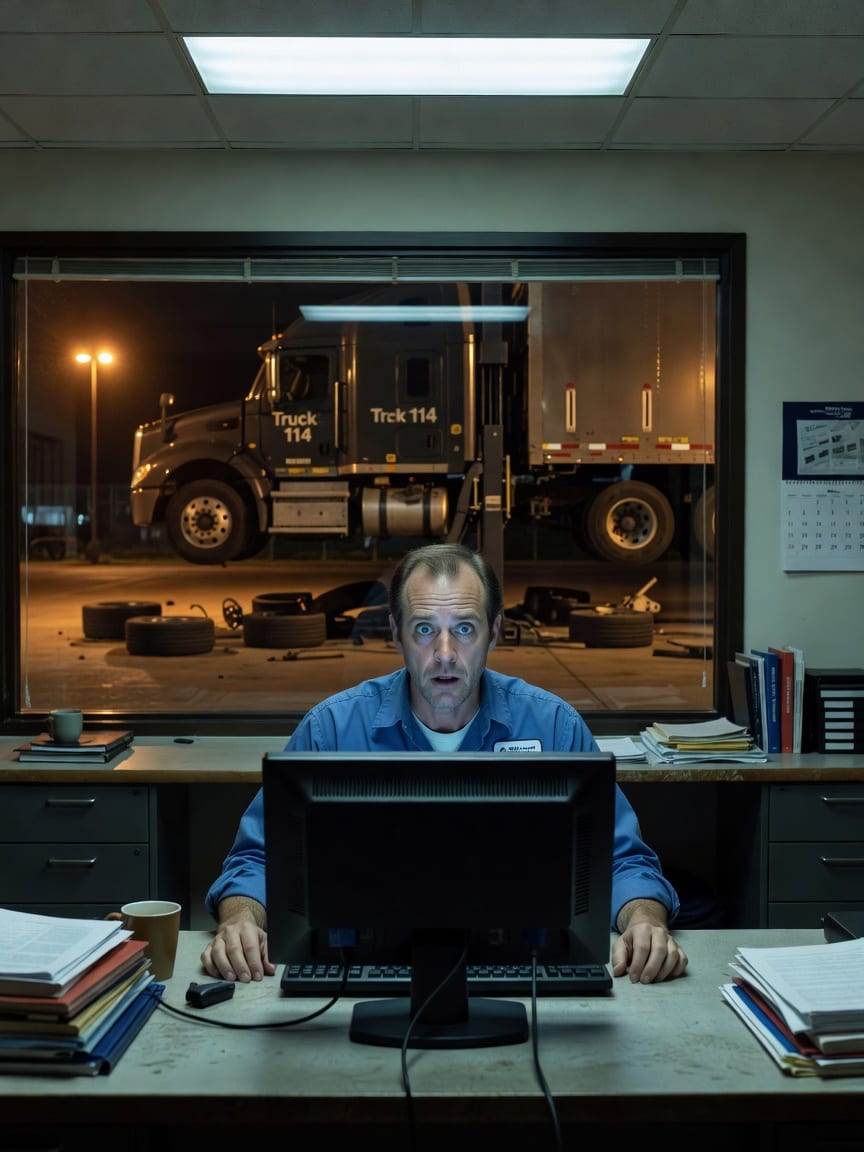
Truck 114 left the yard last night, CAD says. It burned forty miles of fuel. But my truck 114 was up on the lift, no wheels, all shift.
It was another quiet Wednesday overnight in the dispatch office until the CAD system pinged. My screen blared, showing Truck 114 logged outbound for forty miles and back, burning forty gallons of fuel. But I knew that very truck was immobile, suspended on a lift in Bay 4 with its drive wheels removed.
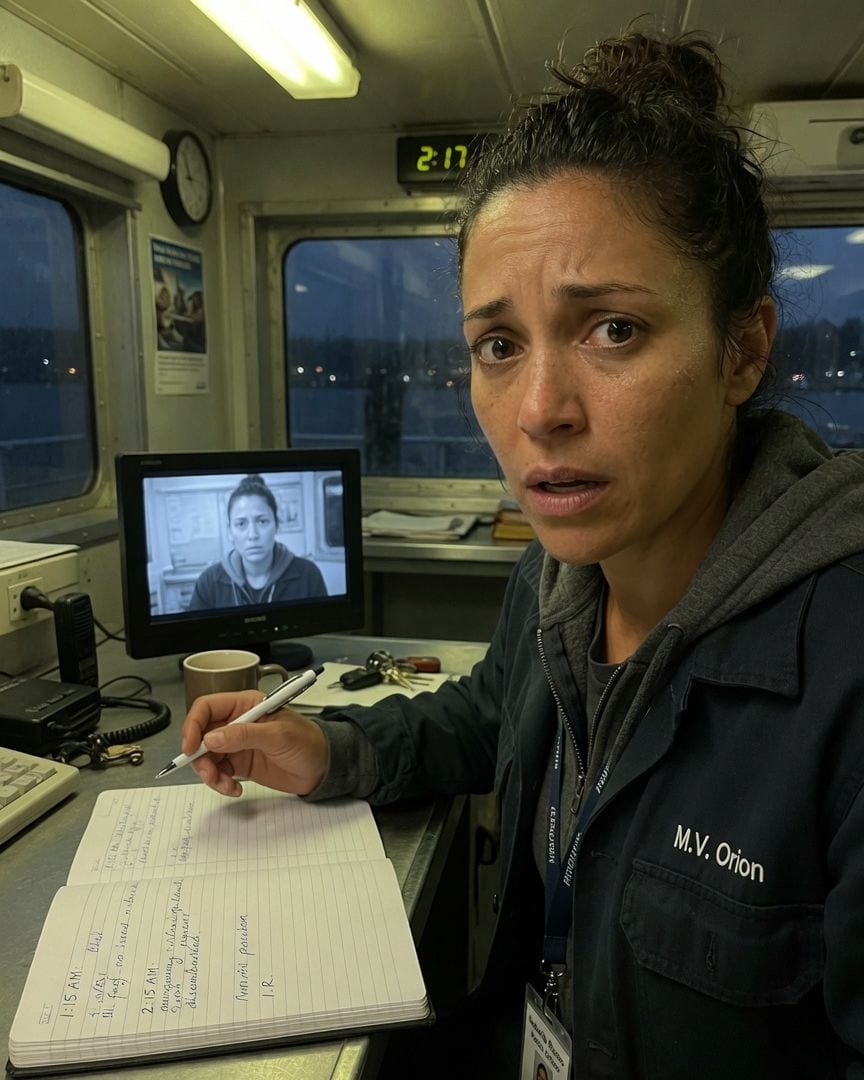
My security camera showed my own face at 2:15 AM, writing an entry I didn't make, staring utterly blankly into the lens before the screen flickered.
As a meticulous watchman on the M.V. Orion, I was making my routine 2:00 AM log entry when I found a previous one I hadn't written. Timestamped 2:15 AM, it stated a 'foot passenger disembarked' with my own initials beside it. But the ferry was dark, silent, and completely empty.
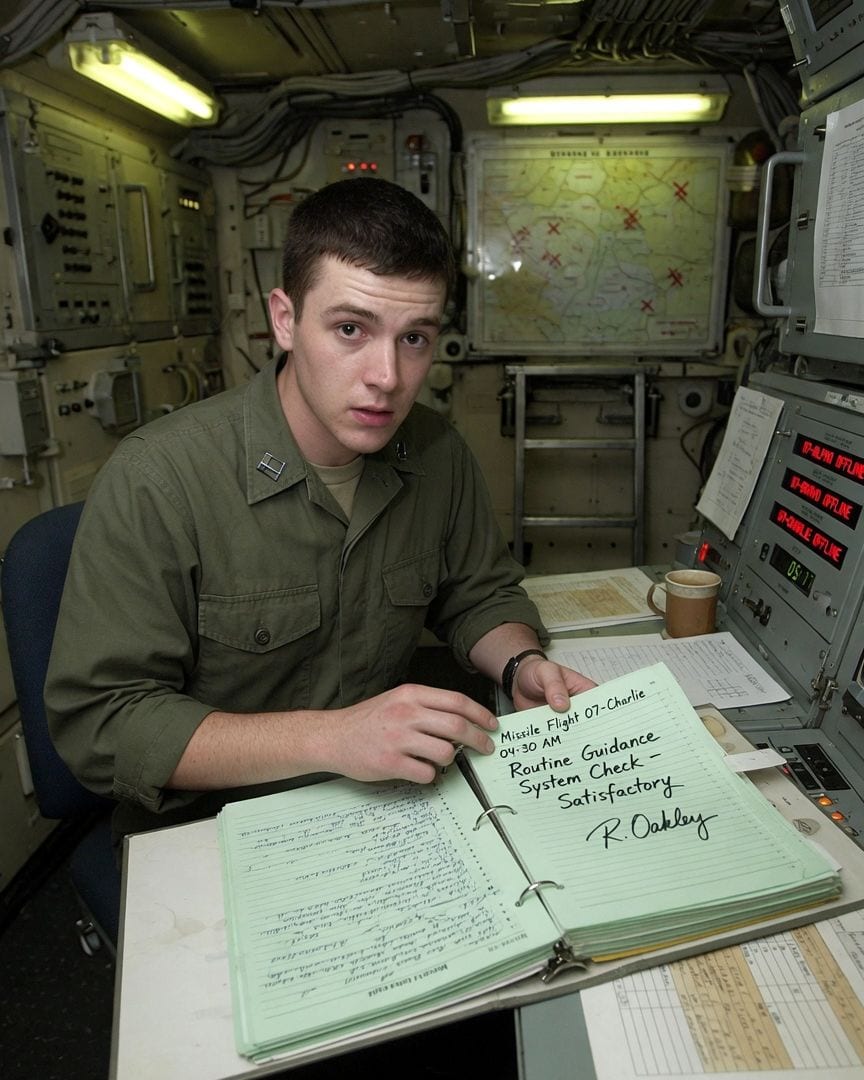
A Cold War missile lieutenant found a dead missile's log signed for a 'routine check' by a crew chief confirmed asleep.
Six weeks into his command, Second Lieutenant Hobart Nye’s Wyoming missile capsule went silent after a 0247 shriek. Topside security reported an unidentified object near the fence, their radio dissolving to static as Hobart watched his missile flight go dark in a precise, terrifying sequence. The official explanation blamed equipment, but the profound eleven minutes of silence and his security team's amnesiac return left him unsettled. Later, reviewing physical launch logs, Hobart found a 'Routine Guidance System Check' for a dead missile, dated hours after the incident and signed by his crew chief, Reginald Oakley – a man confirmed asleep in his bunk. How could a dead missile undergo a check by someone miles away, asleep?