My tearoom table reservation replaced three initials booked daily since 1926. Today, I sat in their seat.
The Quiet Corner tearoom in Oakhaven was everything I’d hoped for when I moved here. Quaint, quiet, and that soft, warm smell of Earl Grey mixing with old wood.
I’m an art restorer, used to quiet places, used to seeing the texture of history. This place felt right.
I walked past the lace-curtained windows, a bell above the door chiming a soft welcome, and spotted it: an empty corner table, perfectly set for three, bathed in the afternoon sun. It looked inviting, private.
“Oh, not that one, dear. It’s reserved.”
Gloria Bishop, the owner, intercepted me with a polite but unyielding smile. Her eyes were kind, but her jaw was firm. I'm stubborn, always have been.
I found another seat, a smaller one by the fireplace, but my gaze kept drifting back to the corner table. It remained empty, hour after hour. Teacups, saucers, napkins—all pristine, undisturbed.
Later that week, after Gloria had steered me away from it twice more with the same polite firmness, a prickle of defiance got the better of me. The tearoom was nearly empty.
I walked over, pulled out a chair, and simply sat down. The wood felt cool beneath my hands. The air around me felt oddly still, heavy, like a breath held. No one else was there to protest.
When I left, Gloria gave me a look I couldn't quite decipher—a flicker of something that wasn't anger, but a deep, cold fear that made the hairs on my arms prickle.
That night, the image of the empty table wouldn't leave me. The stillness, Gloria’s face. I found myself thinking about it when I drove past the tearoom, its windows dark.
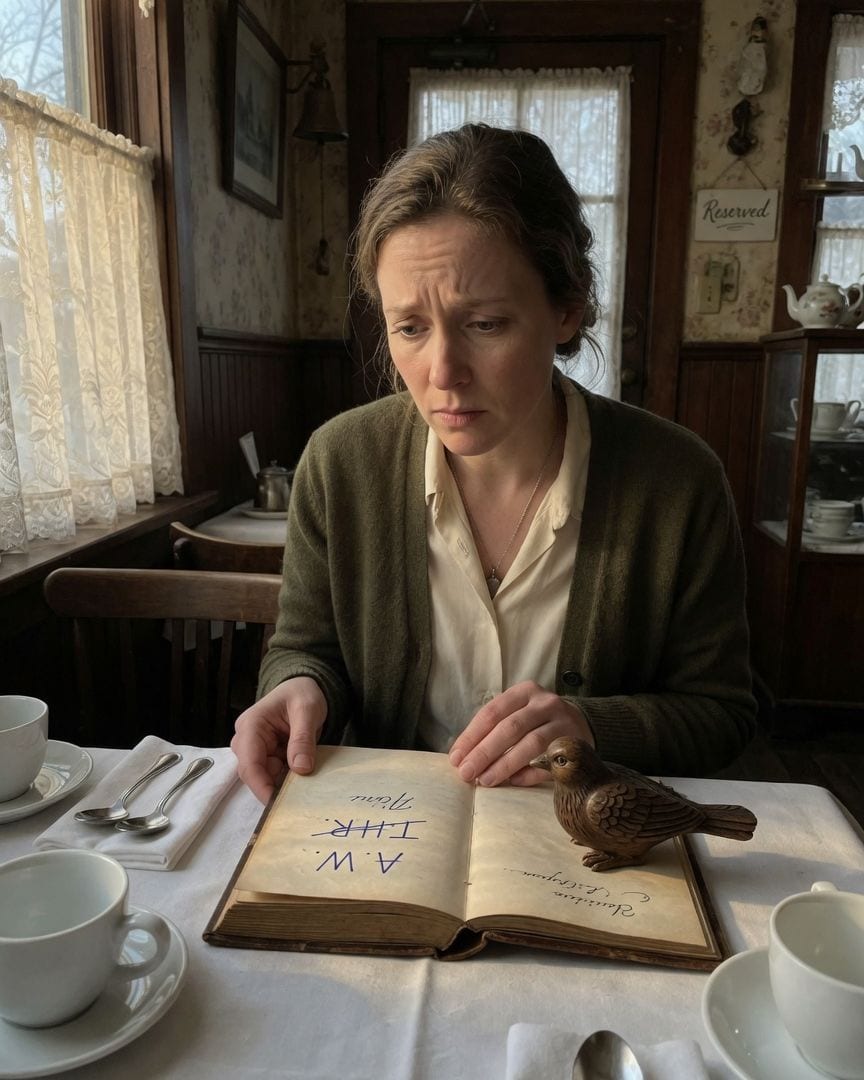
Later, back in my apartment, I pulled out the tearoom's faded, leather-bound reservations book. Gloria usually left it on the counter, a simple courtesy for regulars checking availability. I scanned the page for tomorrow's date, September 18th.
The corner table, as always, was booked for 'T.H.R.' at two o’clock. The initials were familiar now, a constant presence. But beneath them, a fresh line of ink, unmistakably Gloria’s neat script, had crossed them out.
And beneath that, written clearly for the same time, were my own initials: 'A.W.'
The next morning, the reservations book felt heavy in my hand as I walked back into The Quiet Corner. The air was cool, despite the morning sun.
The corner table, of course, was once again meticulously set for three, empty and waiting. I opened the book to yesterday’s entry, confirming the crossed-out 'T.H.R.' and my 'A.W.' in Gloria’s precise script.
Then I flipped back, day after day, week after week. Each entry for that corner table, without fail, was 'T.H.R.' at two o’clock.
I went further back, past months, past years, until I reached the very first page, stamped '1926' in faded ink. The same initials, the same time. Never cancelled, never arrived.
It was too precise, too consistent to be a quirk, a forgotten tradition, or even a running joke.
My mind raced, trying to find a mundane explanation. Maybe it was some kind of inventory code? But why in a reservation book? I ran my hand along the underside of the table, half-expecting a hidden compartment, a secret drawer.
My fingers brushed against something small, hard, and smooth. Tucked deep into a crevice, where it would be almost impossible to find by accident, was a tiny, intricately carved wooden bird.
It felt ancient, its surface worn smooth by countless touches, and strangely, unnaturally warm against my skin. I pulled it out, examining the delicate craftsmanship – feathers etched with meticulous detail, tiny eyes.
It was beautiful, but felt utterly out of place, an object from another time.
I tried to rationalize it again: a long-forgotten toy, a strange tradition, a customer’s misplaced trinket. But the warmth was persistent, almost alive. I approached Gloria, who was polishing silverware behind the counter, humming a tuneless melody.
'Gloria,' I began, my voice carefully neutral, 'I was looking through the reservations book. And I found this.' I held up the bird, then pointed to the crossed-out 'T.H.R.' and my 'A.W.' in the open book.
Gloria’s humming stopped. Her face went utterly blank, then a shadow of pure dread passed through her eyes, a look that made my stomach clench. It wasn't just fear; it was recognition.
She snatched the bird from my hand, her fingers surprisingly cold despite the object’s warmth.
'It's nothing,' Gloria said, her voice tight, strained. 'An old customer's misplaced trinket. And the booking… a mistake. Just a mistake.' But her eyes, wide and fixed on me, screamed otherwise.
Her gaze wasn't on the book, or even on the bird she clutched, but on me.
I left the tearoom that day with a chill that had nothing to do with the autumn air. Gloria's fear had been palpable, a raw, exposed nerve.
The word 'mistake' felt like a lie, a thin veil over something much darker. I was halfway home, walking past the old clock tower, when I realized Gloria hadn't returned the little carved bird.
I checked my purse, then my coat pockets. Nothing. A cold dread seeped into me, replacing the chill. I pictured Gloria, clutching the bird, her face a mask of terror.
I knew, with a certainty that made my heart pound, that it wasn't a mistake. I pulled out my phone, scrolling through local news for Oakhaven. No, nothing out of the ordinary. No missing persons, no strange incidents.
I closed my eyes, trying to make sense of the impossible. Then, a faint warmth against my palm. I opened my hand. The small, intricately carved wooden bird lay there, its surface radiating a soft, steady heat. It was back.
The carved bird, now a constant, unsettling companion in my pocket, propelled my investigation. Its warmth was a pulsed presence against my thigh, a reminder that this wasn't just my imagination.
I confronted Gloria again the next day, not with accusations, but with a more direct question. 'Gloria,' I said, leaning across the counter, keeping my voice low, 'What happens to people who sit at that table?'
She simply wrung her hands, polishing the same spot on the counter with her cloth, refusing to meet my gaze. 'Nothing, dear. It's just a table.' Her voice was thin, reedy.
I knew she was lying. Her eyes darted away, fixed on some point in the middle distance. There was a story here, and Gloria wasn't telling it. So I shifted my focus to the town's history.
The local library was small, tucked away behind the main street, but its archives were meticulously kept by Samuel Hale, a man whose tweed jackets smelled faintly of parchment and pipe tobacco.
He was exactly what you’d expect from a town archivist – meticulous, quiet, and initially, very helpful.
I began by researching The Quiet Corner tearoom's founding in 1926. I found old newspaper clippings, town council minutes, and property deeds. Nothing immediately jumped out regarding the corner table, but I started cross-referencing names and dates.
I noticed a pattern, subtle at first, then undeniable: every few decades, a local resident, often a newcomer like me, or someone without deep roots, would simply vanish.
Not a dramatic disappearance reported on national news, but a quiet, almost accepted 'departure.' They just… moved on, the local papers would say, or 'left town suddenly.'
The dates of these departures, while not exact to the day, seemed to cluster around late autumn, coinciding with the 'T.H.R.' entries in the reservation book.
I found a faded article from 1957 about a young woman, a visiting artist named Claire Montgomery, who had 'left town suddenly' after only a few months.
A small, almost imperceptible detail in the accompanying photo caught my eye: a blurred background shot of 'The Quiet Corner,' and through the tearoom window, the corner table, empty, yet seeming to glow with an unnerving significance.
Samuel Hale, initially helpful and chatty, grew increasingly wary as I requested more obscure records, digging deeper into these 'departures.'
'Old bones, Miss Whitfield,' he'd said, his voice flat, his pipe smoke curling around him like a warning. 'Best left undisturbed.'
He seemed to watch me with a new intensity after that, a quiet, knowing look that made my skin crawl. He wasn't just an archivist anymore; he was a guardian.
I felt the town's subtle shift. It was like a silent agreement had been made. Conversations would suddenly hush when I entered a room. The cashier at the general store, usually chatty, would simply nod, her eyes avoiding mine.
Gloria’s usual pleasantries at the tearoom became strained, her eyes darting away whenever I tried to engage her. Samuel Hale’s 'old bones' warning echoed in my mind, a low thrum beneath the everyday sounds of Oakhaven.
One evening, as I left the archives, the autumn dusk settling around me, I saw Samuel standing across the street, ostensibly watering his petunias. But his gaze was fixed on me, a solemn, almost mournful expression on his face.
He didn't wave, didn't offer a polite smile. He just watched until I was out of sight, a still, dark silhouette against the fading light.
The next day, I found a small, unsigned note tucked under my car's windshield wiper. It read: 'Some questions are best left unasked. The answers come at a cost.'
The words were printed, not handwritten, but the paper felt old, like library stock, with that faint, musty smell I'd come to associate with Samuel’s archives. I knew it was from him.
I also knew it wasn't a threat, but a genuine warning, heavy with resignation.
That night, I lay awake, the carved bird in my hand, its warmth a pulsing presence. The air in my apartment felt heavy, not with silence, but with an unseen presence.
I felt eyes on me, not just from the townspeople, but from something deeper, older, that had settled into the very foundations of Oakhaven.
When I looked out my window, down the street towards the tearoom, I saw Gloria standing on her porch. She was a silhouette against the streetlights, looking directly at my window. Gloria didn't move, didn't wave.
She just stood there, watching, a silent, unblinking sentinel. It was clear: my digging had been noticed, and the town, or something within it, was now watching me.
The next morning, the warning note crumpled in my pocket, I returned to the archives. Samuel Hale was already there, his usual calm demeanor replaced by a visible tension. He didn't offer me a seat.
I laid out my findings: the clustered dates of disappearances, the name Claire Montgomery, the vague mentions of 'sudden departures' linked to the tearoom.
'Mr. Hale,' I said, my voice firm, trying to cut through his reticence. 'This isn't just a coincidence. These people didn't just leave. What happened to them?'
Samuel sighed, running a hand over his tired face. The smell of pipe tobacco was stronger today, tinged with something else, like old dust and fear. 'The town has its ways of protecting itself, Miss Whitfield.
And some truths… they're best kept quiet.'
I pushed harder. 'Protecting itself from what? And who is T.H.R.? I've seen it in the tearoom's book for almost a century.'
Samuel looked at me, a flicker of raw fear in his eyes, quickly masked by a profound weariness. 'T.H.R. is not a 'who,' Miss Whitfield. It's a 'what.' A presence.
And the reservations… they were meant to keep it at bay.' He finally relented, pushing a stack of ledgers aside on his desk and pulling out a dusty, leather-bound book from a hidden shelf.
It wasn’t a town record, but a private journal, its pages filled with elegant, looping script.
'This belonged to my great-aunt,' Samuel explained, his voice barely a whisper. 'She was the first owner of The Quiet Corner.
She wrote about the 'Quiet Visitor,' and how it would sometimes… 'claim' a new resident, particularly those who felt adrift. The table was meant as a barrier.
A 'place setting' for something that would never arrive, to ensure no one else would sit there.' The journal entries detailed a cycle, recurring every few decades, always in autumn.
My mind raced, connecting the dots: the 'departures,' the dates, the perpetually reserved table. It all clicked into place. The ordinary explanation of an eccentric owner or a quirky tradition died for good, replaced by something far more chilling.
I left the archives and went straight to the tearoom. Gloria was behind the counter, her face pale, her hands resting on the cool marble.
She looked up as I entered, her eyes full of the same weary sorrow I’d seen in Samuel’s.
'You knew,' I stated, not a question.
Gloria nodded slowly, tears welling in her eyes, catching the faint light from the windows. 'My family has watched this place for generations. My great-aunt… she tried to warn everyone. But the town decided to manage it quietly.
To keep it contained. The reservations were a ritual. A way to tell it: 'Stay put. Your place is here, empty.'' Gloria’s voice broke, catching on a sob. 'Until you sat there, Annika. You broke the rule.
And now… now it has a new booking.'
Gloria led me to a small, hidden compartment behind the tearoom's old fireplace, a space so secret, concealed by a loose brick and decades of undisturbed dust, I never would have found it.
Inside, nestled amongst dried herbs and yellowed papers that crumbled at the edges, was a small wooden box.
Gloria opened it, revealing a collection of trinkets: a tarnished silver locket, a pressed flower that had long lost its color, and a stack of faded, sepia-toned photographs. She picked up one, her hand trembling.
It showed a young woman from the 1950s, dressed in a floral dress, her hair swept up, sitting in my exact seat at the tearoom's corner table.
Her hand was resting on the table, and clutched within it was a small carved bird, identical to the one I now carried in my pocket. But it was her face that stole my breath.
The woman's eyes, her jawline, the curve of her smile — they were undeniably, impossibly Annika's. My face.
I stared, a cold wave washing over me, the floor seeming to tilt beneath my feet. The woman in the photo wasn't just similar; she was a doppelgänger, a ghost of my own reflection from another era.
Gloria pointed to another photo, from the 1930s. Then another from the 1970s. Each one, a different woman, a different era, but with the same uncanny resemblance, the same pose, the same carved bird clutched tight.
Gloria’s voice was a barely audible whisper, thin as old paper. 'You're not the first to sit there, Annika. You're the next host.'
Gloria finally laid bare the full, horrifying truth. 'The entity… we don't know what it is. My great-aunt called it the 'Quiet Visitor.' It's ancient, tied to this land, to this very spot where the tearoom now stands.
It needs a vessel, a 'host,' to manifest, to 'return.' The 'T.H.R.' in the book isn't a booking, Annika. It's a prayer. 'The Host Returns.' The table is its anchor, the point of its manifestation.'
She explained that her great-aunt, the tearoom's founder, had discovered the cycle – the entity’s periodic need for a host, occurring every few decades – and, in desperation, devised the ritual of the perpetually reserved table.
It was a containment spell, a way to keep the entity anchored, satisfied with its empty seat, to prevent it from claiming a new host.
The town, fearful and superstitious, had quietly maintained the ritual for generations, the Bishops guarding the secret, ensuring the table was always set, always reserved, always empty.
'When you sat there, Annika,' Gloria continued, her voice heavy with regret, 'you offered yourself. You broke the fragile balance. The 'A.W.' in the book… that was the entity accepting its new booking, taking its claim.
The carved bird… it's a marker. It appears to those chosen, a sign that the claiming has begun. It binds you.'
Gloria then revealed a deeper, more chilling connection. She showed Annika a faded family tree from the private ledger, tracing Annika's own Whitfield surname back through generations.
Several names, including a 'Rose Whitfield' from the 1930s and a 'Cynthia Whitfield' from the 1970s, were marked with a small, hand-drawn bird symbol next to them. These were the women in the photographs, the previous 'hosts.'
I wasn't just a random newcomer; my lineage made me a susceptible, perhaps even predestined, vessel.
My arrival in Oakhaven hadn't been by chance, but a terrifying echo of a pattern I was now caught within, a name called from a long-forgotten list.
The revelation hit me with the force of a physical blow. I wasn't just a victim; I was a participant, perhaps even an heir to a dreadful legacy. There was no escape.
I tried, of course. I packed my car, my hands shaking so hard I dropped my duffel bag twice. I threw clothes and essentials into it, anything I could grab.
The carved bird, which I’d tried to discard multiple times – once in a river, once flung into a dumpster – reappeared on my passenger seat, its warmth a constant, unsettling pulse against the fabric.
I cursed, flung it into the dense woods beside the road as I drove out of town, watching it disappear into the undergrowth. I sped, leaving Oakhaven in my rearview mirror, the scent of Earl Grey and old wood fading.
But the further I went, the stronger the compulsion grew. It wasn't a voice, or a command, but a deep, resonant pull, a sense of belonging that was both terrifying and strangely comforting.
The dread began to give way to a chilling familiarity, like coming home to a house you never knew you lived in.
The road, no matter which turn I took, no matter how many miles I put between myself and Oakhaven, seemed to curve back. The GPS on my phone glitched, then settled, showing a route that led directly back.
I saw Gloria standing on her porch, watering the wilting hydrangeas, her face etched with the same knowing sorrow. Samuel Hale was tending his petunias across the street, his gaze meeting mine, mournful and resigned.
They watched me, not with menace, but with a quiet, resigned acceptance.
I pulled my car to a stop outside 'The Quiet Corner.' The tearoom was dark, but a faint light emanated from the corner table, as if waiting.
I stepped out, the carved bird now resting in my open palm, its warmth spreading through my arm, up to my chest, settling in my core.
I walked towards the tearoom, my steps no longer hurried by fear, but guided by an unseen current, a silent, ancient imperative. The town held its breath, its eyes on me, or on what was happening through me.
I pushed open the door, the bell above chiming softly, a final, chilling welcome.
Days later, 'The Quiet Corner' tearoom was open as usual. The aroma of Earl Grey and freshly baked scones filled the air.
Gloria Bishop, looking years older, her movements slow and heavy, stood behind the counter, polishing a teapot, her eyes hollow. The corner table, as always, was laid for three, impeccably set, and empty.
In the reservations book, for the following day, the entry for that table had been carefully updated.
The initials 'A.W.' had been struck through, and beneath them, in a hand that was not Gloria’s, but somehow familiar and precise, read 'T.H.R.' The cycle continued, unbroken, unseen by outsiders, but deeply understood by the quiet town of Oakhaven.
Annika Whitfield, or the woman who looked exactly like her, moved with a serene, almost detached grace behind the counter. Her hair was pulled back in a neat bun, her apron spotless.
Her eyes, once bright with curiosity, now held a deep, ancient knowing. A faint, almost imperceptible smile played on her lips as she served tea, her movements precise, her gaze distant, seeing things Gloria no longer could.
She was now the new 'Gloria,' a silent guardian of the table, a part of the town's enduring secret. The town went back to normal, quiet and watchful, knowing its fragile peace was once again maintained.
At 'The Quiet Corner,' a woman with Annika's face now served tea, her movements precise, her gaze distant. One afternoon, a young couple, new to town, tried to sit at the reserved corner table.
"Oh, no dear," she said, a faint, wrong smile touching her lips, "That one's taken."
If this one got to you
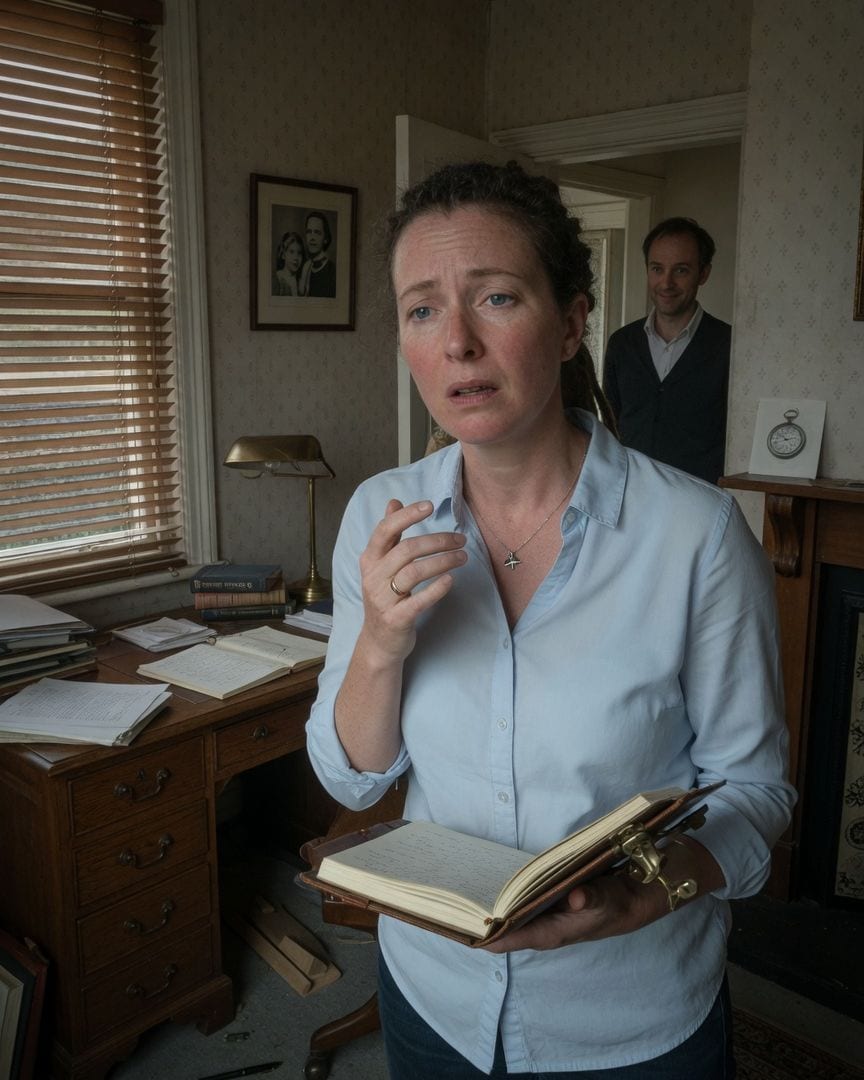
My father-in-law turns his right cheek now, and when I laughed about it he didn't laugh, he just watched me and asked who taught me the other way.
Theodore, my father-in-law, had just returned, and everything felt subtly off. Later, I found his old leather journal, its clasp broken and ajar. Inside, an entry described my hidden carved bird collection—a secret I'd kept from everyone, even my own family.
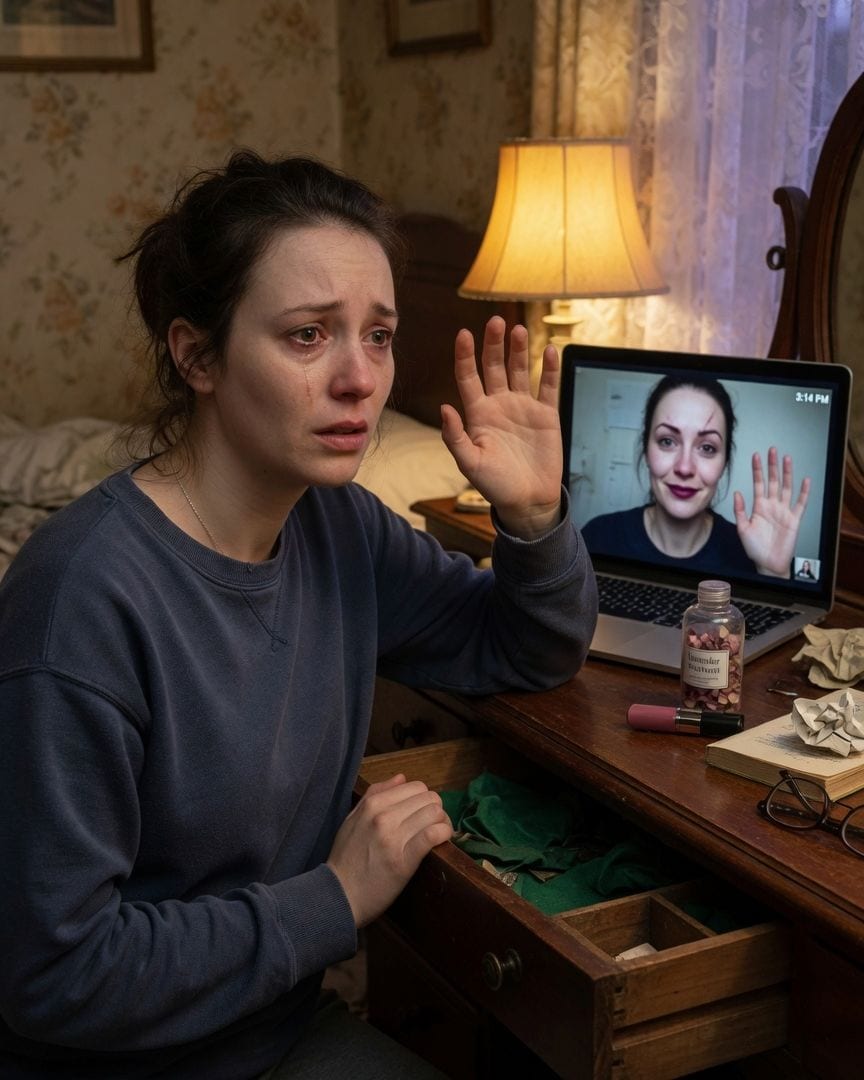
My mother waved with her right hand, both times, on our first call after she came home. She always waved left.
My mother vanished three months ago, then came back. On our first video call, she waved goodbye, but not with her usual left hand. It was her right, a small gesture that twisted something cold in my stomach.
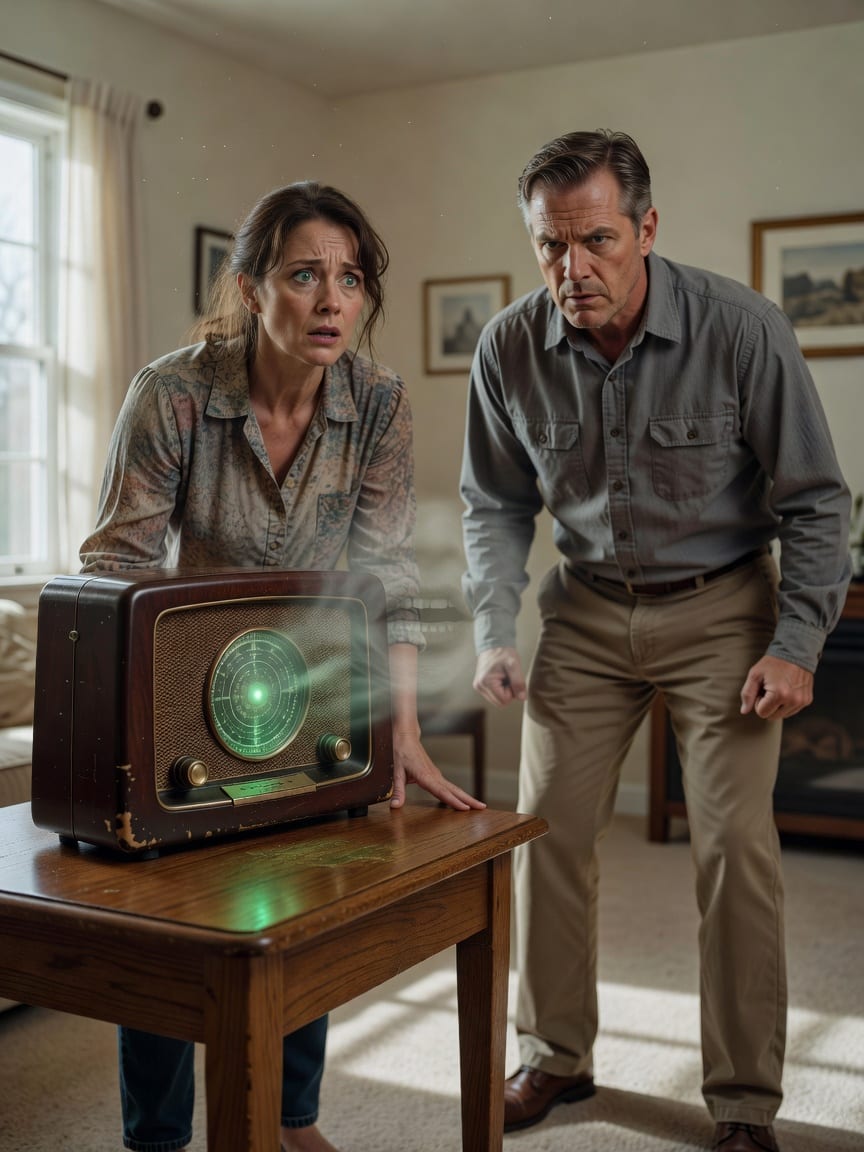
My neighbor apologized for Biscuit's death. My terrier was asleep on the landing, perfectly fine.
My neighbor Tom arrived on Sunday, distraught and apologizing for my dog Biscuit, who was perfectly fine. Days later, a condolence card arrived for a loss I hadn't suffered, postmarked from an empty lot where a house once stood. Then I found another, dated days before Tom's strange apology.
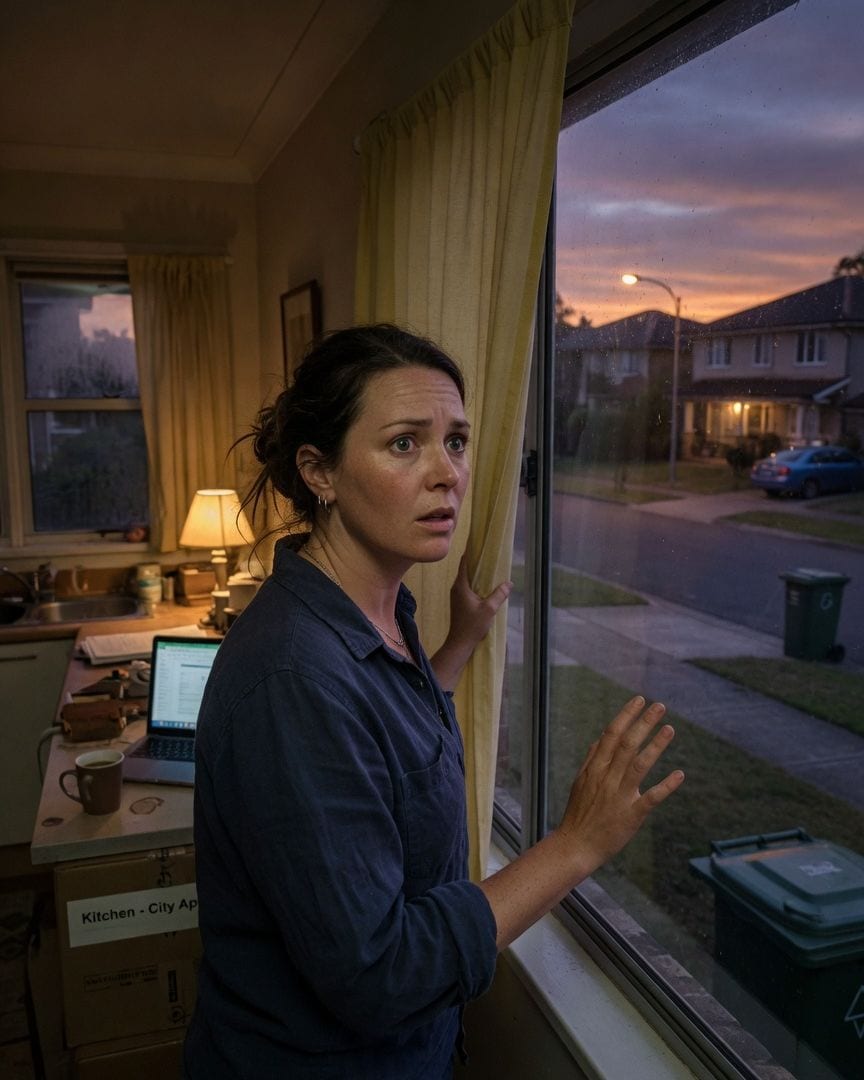
My bin was turned the wrong way Tuesday. The man three doors down hasn't been seen since, though his curtains still open.
New to Oakhaven, I dismissed the local warnings as charming quirks. But after I put my bin out first, my neighbor Joel Whitmore vanished, leaving only a cryptic 'My turn' note. The same strange symbol from his note was chalked on my bin, facing the street.
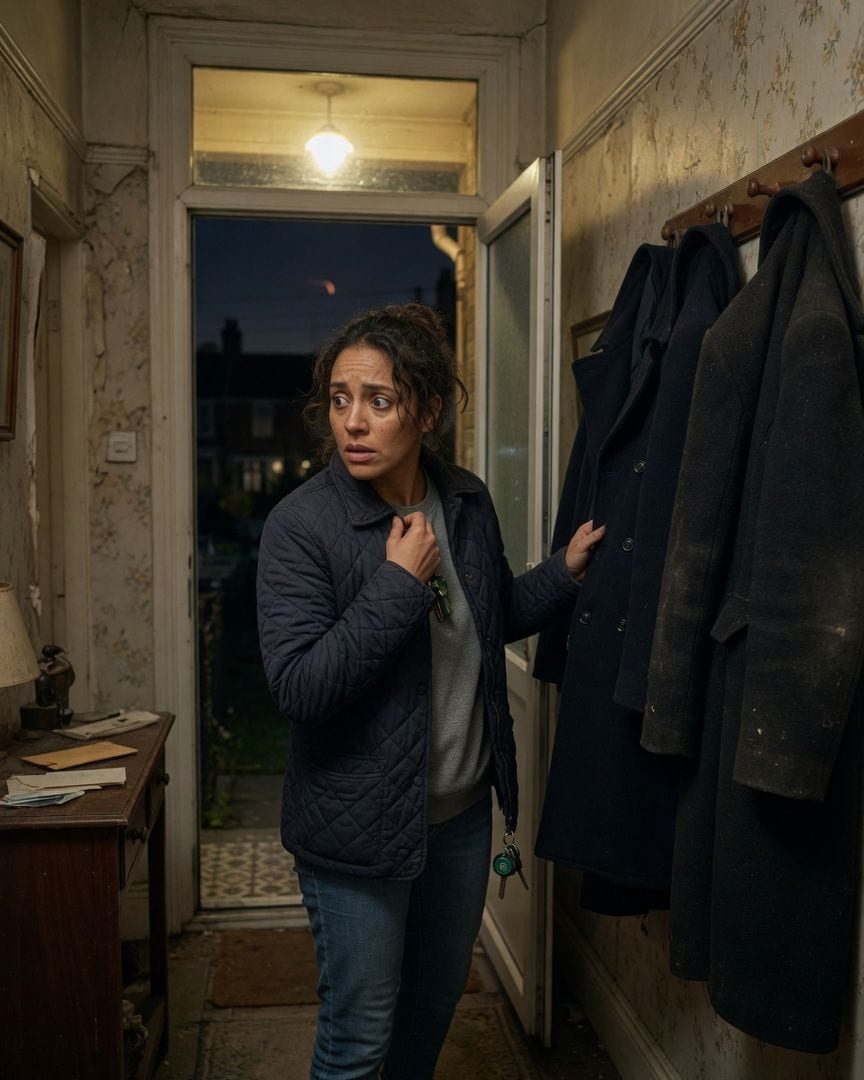
My tiled path was new, my front door green. Then three dark coats hung in my hallway.
After a late night watching the lunar eclipse, I returned to my Victorian house, only to find the path and front door inexplicably changed. Though the house seemed to revert to normal, strange things started appearing: a kettle warm from boiling, a distinct impression on my armchair. Then, an antique, lavender-scented handkerchief appeared on my bedside table, an undeniable presence in my private space.
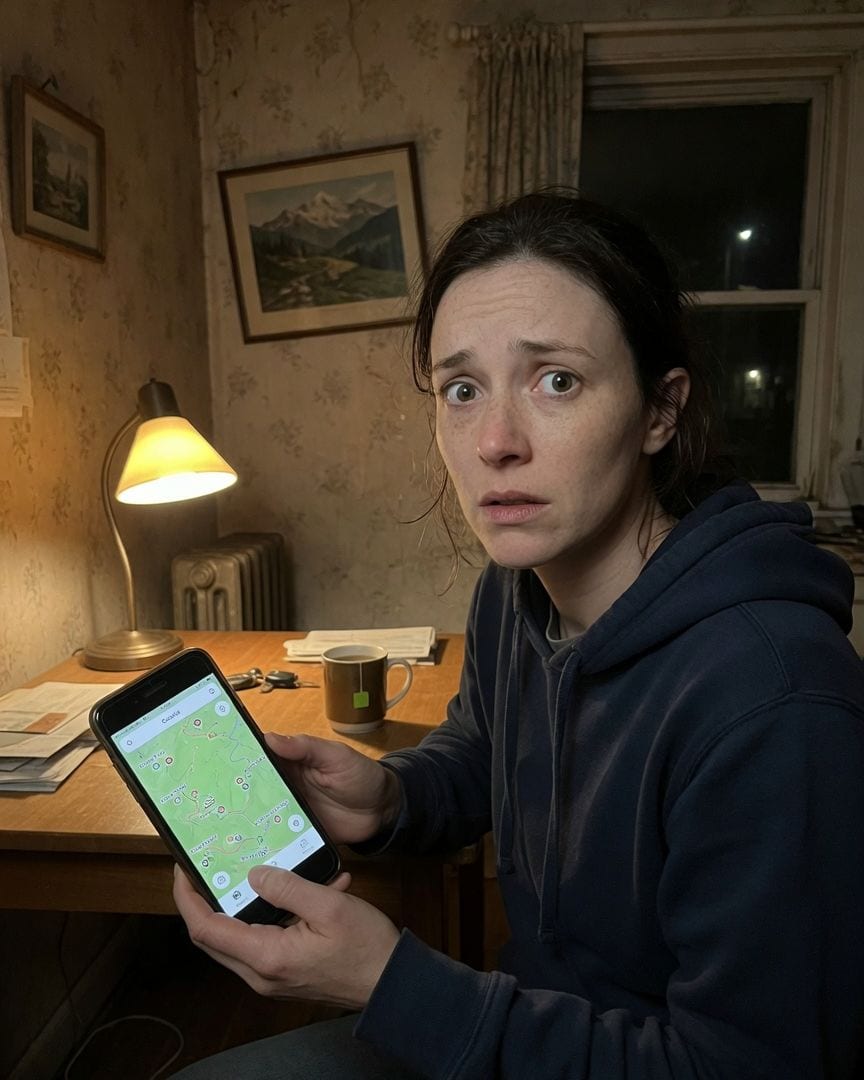
My hiking app scrubbed the hill's name from the map, on a phone that's been in airplane mode for two days.
I just moved to town and hiked a local hill, 'Cathan Tor,' according to my phone's app. But when I mentioned the name to the mechanic, he froze, dropped his wrench, and whispered, 'Don't say that name, Colette.'