Two weeks from discharge, Sergeant Dean Ackers found a hidden bunker where a phone rang, and a voice named his home address.
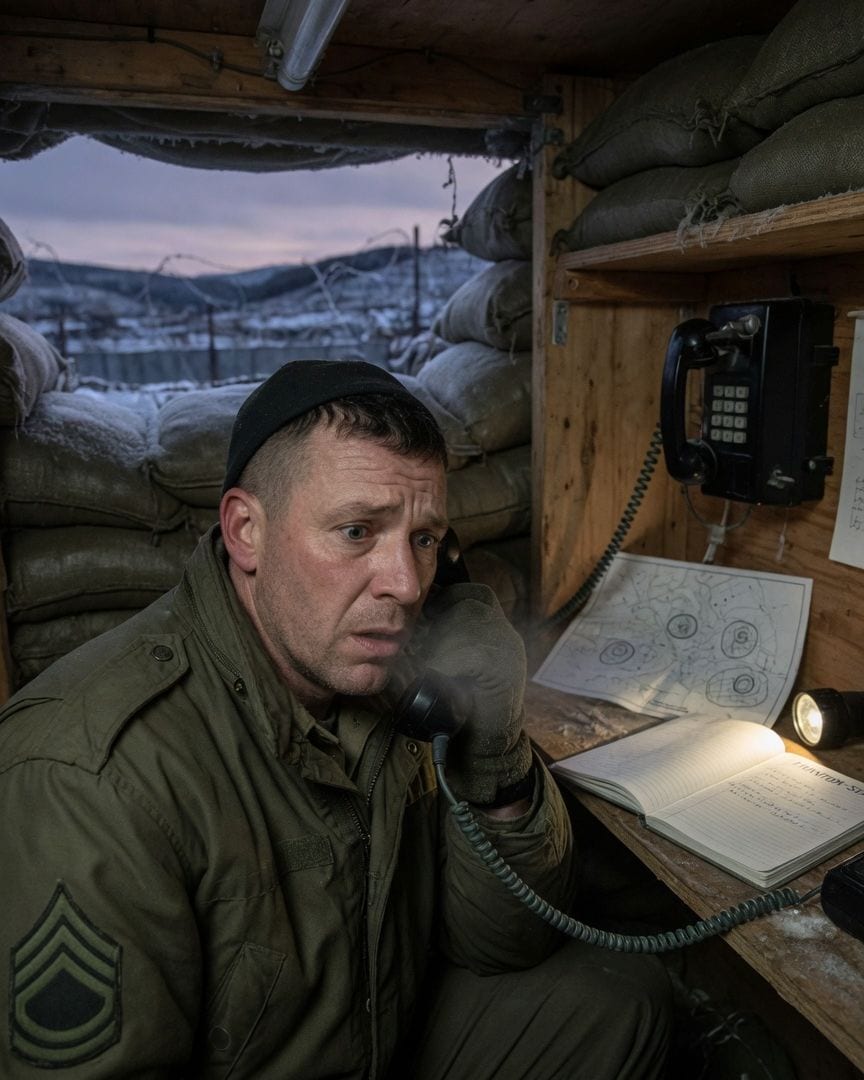
Sergeant Dean Ackers shivered in the Korean DMZ's biting wind, his breath pluming white. He moved along the perimeter wire, counting the bunkers, each a familiar, sandbagged hump against the stark, frozen ridges. One, two, three… then a fourth.
Ackers stopped, a frown creasing his brow. It wasn't on the position sketch. Captain Sutton hadn't mentioned it in the morning brief. This bunker, perfectly camouflaged with fresh sandbags, had a field phone wired neatly to the wall.
Inside, tucked onto a small wooden shelf, sat a logbook.
He pulled it open. The entries were precise, continuous, going back years. Each shift was signed by soldiers, listing their names and ranks.
But the unit designation, scrawled repeatedly at the top of each page, was a call sign Ackers had never seen: 'PHANTOM-SIX'. No battalion roster had ever assigned a unit by that name.
As his gloved fingers traced the last impossible entry, the sound-powered field phone on the wall began to ring, a sharp, insistent burr in the silent, frigid air.
Ackers hesitated, his hand hovering over the heavy Bakelite receiver. A prank, he thought, a new recruit's misguided attempt at humor. But the ringing was too deliberate, too unhurried.
It vibrated through the cold metal of the phone, a persistent drone against the bunker's thick walls. He lifted the receiver. Static hissed, a low, steady hum following it. No voice, just the bare-bones thrum of an open line.
He pressed it to his ear for a full minute, listening to the unchanging electronic breath, before hanging up.
The silence that followed was heavier than before, somehow more profound. He flipped back through the logbook. The meticulous handwriting, the precise timestamps, the continuous guard shifts – it was all too real, too consistent for a prank.
He checked his own patrol route, confirming he hadn't veered off course, hadn't imagined the extra hundred meters of wire.
He pulled out his issued position sketch, a laminated sheet he knew by heart, tracing the line with a gloved finger. Three bunkers. Not four. He double-checked the coordinates on his GPS, comparing them to the map.
The coordinates of this extra bunker, if it were real, would place it squarely within the perimeter, yet entirely outside the official survey.
He tried to rationalize it: an abandoned listening post, a forgotten relic. But the sandbags were fresh, the wire recently strung, the phone clearly active, humming with a latent power.
It felt less like a forgotten place and more like an invisible one, suddenly made visible, revealed just to him. He felt a prickle of unease, a cold sensation that had nothing to do with the wind whipping outside.
The silence in the bunker pressed in around him, thick and expectant, and he found himself glancing at the phone again, half-expecting it to ring.
Ackers, his mind racing with possibilities he couldn't quite grasp, decided to report the anomaly immediately. As he turned to leave the bunker, the sound-powered phone rang again.
This time, he answered immediately, a surge of frustration mixing with his growing dread.
"Sergeant Ackers," he snapped into the mouthpiece, "who is this?"
The static cleared, replaced by a calm, male voice. "Sergeant Dean Ackers, US Army, Service Number 877-34-4567. Scheduled for discharge in two weeks. Home address: 421 Elm Street, Fairview, Ohio. Drives a 1999 Ford F-150. Correct?"
Ackers froze, every muscle tensing, the cold metal of the field phone pressed to his ear. The voice continued, even and unhurried, "Are you ready for your new assignment, Sergeant?"
Ackers hung up, his heart hammering against his ribs, a cold sweat breaking across his back despite the frigid air.
He burst out of the bunker, scanning the perimeter with frantic eyes, but saw nothing beyond the stark, familiar landscape and the endless, frozen ridges.
Back at the main outpost, he immediately sought out Captain Naomi Sutton. Her face, usually stern, softened slightly at his disheveled appearance.
He recounted everything, from the extra bunker and its impossible logbook to the phone call that had listed his personal life with chilling accuracy. Captain Sutton listened, her expression slowly hardening.
"Sergeant, I appreciate your vigilance, but there’s no fourth bunker on that wire. Our position sketches are up-to-date, and I personally walked that perimeter last month." She pulled up digital manifests, cross-referencing every asset and personnel record for the sector.
Nothing. Not a single discrepancy. "Fatigue, Ackers? Final tour jitters?" she suggested, though her gaze was assessing, searching his eyes for any sign of a lie.
Ackers insisted. "The logbook, Captain. The call sign. And the voice knew my details – my address, my truck, my discharge date. No one on this base, outside of command, has access to that."
Sutton, seeing his conviction, relented slightly. "Alright. I'll have Specialist Ellsworth run a sweep for unauthorized signals, and we'll check the old physical archives. But I'm telling you, the paperwork doesn't lie."
Later that night, Ackers approached Specialist Chloe Ellsworth, the outpost’s comms expert. Chloe, a quiet woman with sharp eyes often hidden behind her headset, listened patiently as he described the sound-powered phone and the call. "Ghost signals?"
she mused, adjusting her headset. "I've picked up odd static patterns before, faint, almost below the threshold, always around this sector. Never anything coherent, though. Just… noise that doesn't fit the spectrum."
She agreed to conduct a thorough sweep, noting the exact frequencies and potential locations for a hard-wired field phone.
As she worked, Ackers felt a growing sense of isolation; the official system, designed for precision, was actively denying what he knew to be true. The cold outside felt like it was seeping into his bones.
Days passed, each one tightening the knot in Ackers' gut. Chloe's sweeps yielded nothing concrete, just the same 'ghost static' she couldn't pinpoint, signals too ephemeral to track to a source.
Captain Sutton, frustrated by the lack of evidence, warned him to drop it, reminding him of his impending discharge and the need for a clean record. "Don't go chasing shadows, Sergeant. You're almost home. Keep your head down."
But the shadows were chasing him. During a routine night watch, Ackers felt an unsettling awareness, a prickle on the back of his neck, a sense of being observed.
He scanned the perimeter with his night vision, the world a sea of green, but saw nothing. Yet, the feeling persisted.
He swore he saw a faint heat signature, just beyond the wire where the extra bunker should be, a momentary flicker that vanished before he could focus his optics.
The next morning, he found a small, neatly folded piece of paper tucked into his bunk, beneath his pillow. On it, in precise, military script, was a single word: 'PHANTOM-SIX.' No threat, no explanation, just the call sign.
He showed it to no one, folding it carefully into his uniform pocket. The message was clear: someone knew he was digging, and they were letting him know.
Later that day, Private Leonard Hughes, one of Ackers’ subordinates, approached him nervously, his eyes wide. "Sergeant, I… I think I saw something. Last night, near your bunk. Someone was there, just standing in the shadows, then they were gone.
Didn't look like anyone from our rotation. I thought maybe I was just tired." Hughes, usually stoic and unflappable, looked genuinely shaken. Ackers felt a chill. The system wasn't just denying him; it was watching him.
He was no longer hunting; he was being observed, his every move noted. The possibility that the 'phantom' was already inside the outpost, walking among them, tightened its grip on his dread.
The outpost air, usually bustling with familiar sounds, now seemed to hum with an unheard frequency.
Ackers cornered Chloe later that evening, his face grim. He pulled out the 'PHANTOM-SIX' note. Her eyes widened as she read the single word. "That's… specific," she whispered, her voice low. "I've been going through old archives, Sergeant.
Captain Sutton finally gave me limited access to the really old stuff. The oldest signal logs. There's a recurring signature. Not just static. A pulse. Always at 0400 hours. Always the same frequency, just below our standard military band.
It's too consistent to be random noise, too precise to be a glitch."
Chloe pulled up an archaic, microfiched battalion roster from the 1970s. She pointed to a section. "Look. This unit, 'Charlie Company, 2nd Battalion,' was deployed to this sector. See these names?" She highlighted several faded entries on the screen.
"Officially MIA after a patrol went missing in the mountains."
Ackers leaned closer, his breath catching. He recognized one of the names – Private Leonard Hughes. "That's impossible. Hughes is in my unit now. My private Leonard Hughes."
Chloe shook her head slowly. "Not our Hughes, Sergeant. A different Private Leonard Hughes. Same name. But look at this…" She pulled up another manifest, this one from the 1990s. More MIA names. More familiar surnames.
"It's a pattern," she breathed, tracing the entries with a shaky finger. "Every few years, a unit here loses personnel. And then, in the phantom signal logs, there's a spike. A 'new registration.'
It's like… they're being absorbed into something else."
Ackers felt a cold dread spread through him, solidifying in his chest. The extra bunker, the unassigned call sign, the voice that knew his details – it was all part of a horrifying, decades-long process.
The 'ghost static' wasn't just noise; it was the hum of a parallel, impossible system, meticulously accounting for the disappeared.
The names in the bunker's logbook, which he'd dismissed as random or fabricated, now clicked into place: they were the names of the 'disappeared,' meticulously recorded by their new 'unit.'
The accountability wasn't missing; it was just in the wrong place, written in a different ledger. The silence of the comms room seemed to deepen, heavy with the weight of generations of lost men.
Ackers brought Chloe’s findings to Captain Sutton, ignoring her earlier warnings. He laid out the microfiche, the old manifests, the signal logs. Sutton, her face pale, cross-referenced the names, her finger trembling slightly as it moved across the screens.
She found the entry for the 'original' Private Leonard Hughes, MIA, 1973. Then she pulled up the current roster for their unit, confirming the active Private Leonard Hughes.
The same name, different service numbers, different dates of birth, but an uncanny resemblance in their official photos.
"This is a clerical error, a bizarre coincidence," Sutton insisted, but her voice lacked conviction, a desperate attempt to cling to the mundane. The words felt thin, transparent.
Ackers then produced the logbook from the extra bunker, the one he had meticulously photographed with his phone before the evidence might vanish. "Look at the names, Captain.
Every single one matches an MIA or KIA from this sector, going back to the Korean War. And look at the last entry."
Sutton’s eyes scanned the page, stopping at the most recent entry, her face draining of color. Her breath hitched, a faint gasp escaping her lips. The precise, military script read:
'SGT ACKERS, DEAN. Transfer to PHANTOM-SIX. Effective: Today's date.'
Captain Sutton stared at the logbook, then at Ackers, her face a mask of horror. The flickering overhead light in the office seemed to dim, casting long, unsettling shadows.
"This… this isn't a transfer," she whispered, her voice barely audible, the words themselves a violation. "This is a replacement."
The implications crashed down on them, heavy and suffocating. The 'extra' bunker wasn't just a hidden post; it was a processing center.
The phantom unit, PHANTOM-SIX, wasn't just unassigned; it was a ghost unit, continuously staffed by soldiers who had been removed from the official rolls but were still 'serving' in this impossible, parallel system.
The meticulous logbook, the precise entries, the sound-powered phone – it was all part of an elaborate, self-sustaining mechanism of 'accountability that cannot be.'
The names in the logbook were not just MIA/KIA soldiers; they were the new recruits for PHANTOM-SIX, their identities subtly shifted, their service records rewritten into this hidden ledger.
The 'ghost signals' Chloe detected were the phantom unit's communications, maintaining its own operational integrity. The voice on the phone was the system's invitation, its attempt to integrate Ackers into its ranks.
The note in his bunk, the heat signature, Hughes's sighting – they were all manifestations of a presence that was both everywhere and nowhere, meticulously maintaining its numbers.
The puzzle pieces clicked, forming a picture of an insidious, decades-old operation, perfectly hidden in plain sight.
Captain Sutton, her face grim, ordered an immediate, unofficial sweep of the perimeter, focusing on the coordinates Ackers provided for the extra bunker.
They moved under the cover of a pre-dawn whiteout, the wind howling around them, erasing their tracks almost as soon as they made them. As they approached the designated spot, the bunker was gone.
No sandbags, no wire, no field phone. The ground was undisturbed, covered in a fresh layer of snow, as if nothing had ever been there. Ackers and Sutton exchanged a look of profound, chilling understanding.
The system wasn't just hidden; it was fluid, capable of erasing its own traces, of existing only when it chose to be seen.
They returned to the outpost, the weight of their knowledge pressing down, heavier than any pack they had ever carried. Sutton immediately tried to access the archived manifests for the 'original' Private Leonard Hughes again. The files were corrupted.
Every trace of the 'pattern across rotations or dates' they had uncovered was now inaccessible, wiped clean. Chloe's signal logs, too, showed only blank static for the relevant dates, the phantom pulse scrubbed from existence.
The phantom system had not only moved its physical presence but had also purged the evidence of its historical activity, leaving no trace behind but the chilling memory of what they had seen.
Ackers felt a profound sense of helplessness. They had understood the full truth, but it was a truth that could not be proven, could not be acted upon. The system was too pervasive, too integrated, too capable of self-preservation.
It didn't need to confront them; it simply erased its tracks and continued its impossible operations. Their knowledge was their burden, a secret that would forever bind them to the outpost's chilling history.
They had seen behind the curtain, and the world had simply folded back over, leaving them to bear the impossible weight of what they knew.
The cold, silent ridges held their secret, and now, part of Ackers and Sutton's souls would forever be held there too.
Captain Sutton filed a report citing 'equipment malfunction' and 'personnel fatigue' for the anomalous activity, a lie that felt like a permanent stain on her conscience.
Ackers completed his final two weeks of service in a daze, every face on the outpost now suspect, every familiar routine tinged with a horrifying potential. He watched Hughes, wondering.
Chloe Ellsworth, after several unexplained 'system crashes' and a subsequent psychological evaluation, was quietly transferred to a remote data analysis unit, far from any active field operations or open airwaves.
Private Hughes, oblivious, continued his duties, his laughter echoing across the parade ground, a sound that now grated on Ackers' nerves. The outpost continued its patrols, its headcounts, its meticulous accounting, all perfectly normal, all perfectly false.
Sergeant Dean Ackers stood on the tarmac, the roar of the transport plane deafening, a cold civilian jacket replacing his uniform. He looked back at the receding outpost, a tiny speck against the vast, indifferent Korean landscape.
He had made it out. He was going home. He carried his discharge papers, his packed duffel bag, and the impossible knowledge that gnawed at him.
He knew the truth about the phantom unit, its decades of silent recruitment, its perfect, horrifying accountability. He knew it was still operating, somewhere, unseen, unheard, continuing its work in the meticulous, bureaucratic precision of military life.
He would never speak of it, could never prove it. The system had simply absorbed the evidence, leaving him with the chilling clarity of what he now understood.
He sat on the plane, staring out the window, the frozen ridges fading from view. He was free, but the phantom unit had left its mark. He knew. And the knowing was everything.
Months later, Dean Ackers sat in his quiet Ohio home, staring at the mail on his kitchen counter. Among the bills and junk mail was an official-looking envelope, bearing a military seal. He opened it, his heart sinking.
Inside was a single, crisp form: a 'Request for Re-assignment' order, pre-filled with his name, rank, and service number. Below it, in the 'Unit' field, was a single, precise entry: PHANTOM-SIX.
He crumpled the paper, but the quiet hum he now sometimes heard in the dead of night, like a faint, distant field phone ringing, seemed to grow louder. He knew he was still accounted for.
If this one got to you
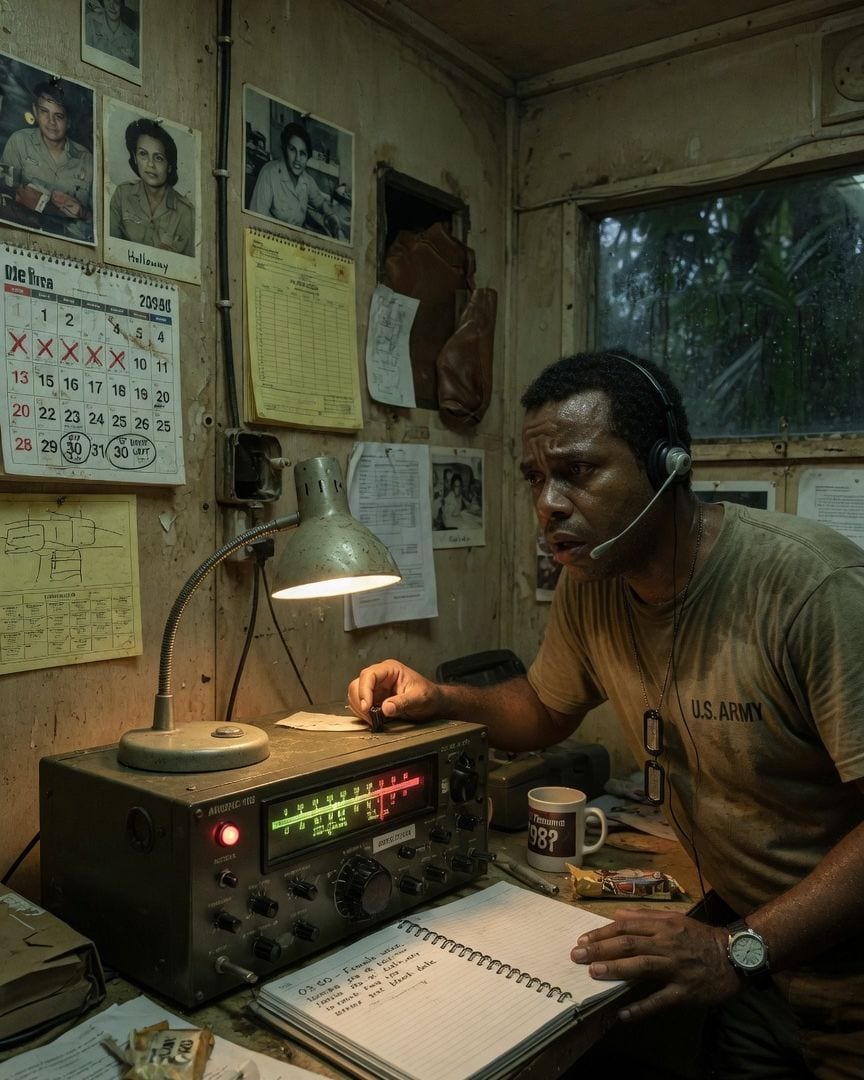
Three months from his tour ending, a sergeant's Cold War radio lists his name with a blank 'ceased answering' date. A hidden logbook warns: 'It knows my name.'
Sergeant Kevin Brooks was three months from finishing his year-long tour at a remote Panamanian jungle station. He meticulously marked each passing day, eager to escape the humid nights and unseen blossoms pressing against the comms shack walls. But at 0300, his old radio crackled to life with a woman's calm voice, listing names of past operators who 'ceased answering.' Then the voice spoke his own name, leaving a chilling blank space where his date should have been. What grim roll call had Sergeant Brooks stumbled upon?
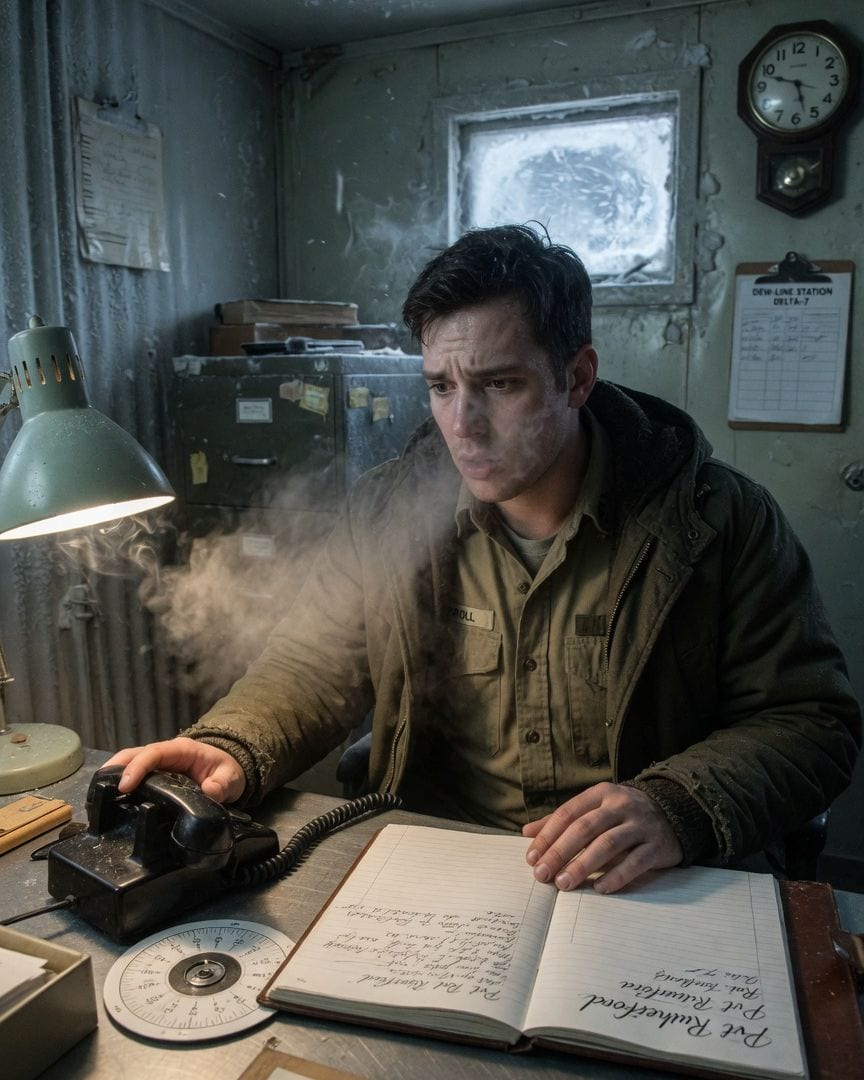
A communications specialist saw his last line go dead. Then the old Cold War field phone rang with a voice from 1966, naming a man freshly signed into his current shift log.
Specialist Walter Kroll shivered in the frigid communications room of DEW-line Station Delta-7, completely cut off by a historic Arctic blizzard. He had personally watched the last hard-wired connection to the outside world snap earlier that day. Now, past midnight, the old field phone at his position began to buzz, impossible from a line he knew was dead. A calm, unfamiliar voice spoke, reading a crew roster Kroll didn't recognize, including Private Rutherford. His search through decades of dusty logbooks revealed Rutherford was assigned to this exact watch in 1966, but then Kroll found the same name freshly inked into his *current* shift's sign-in sheet.
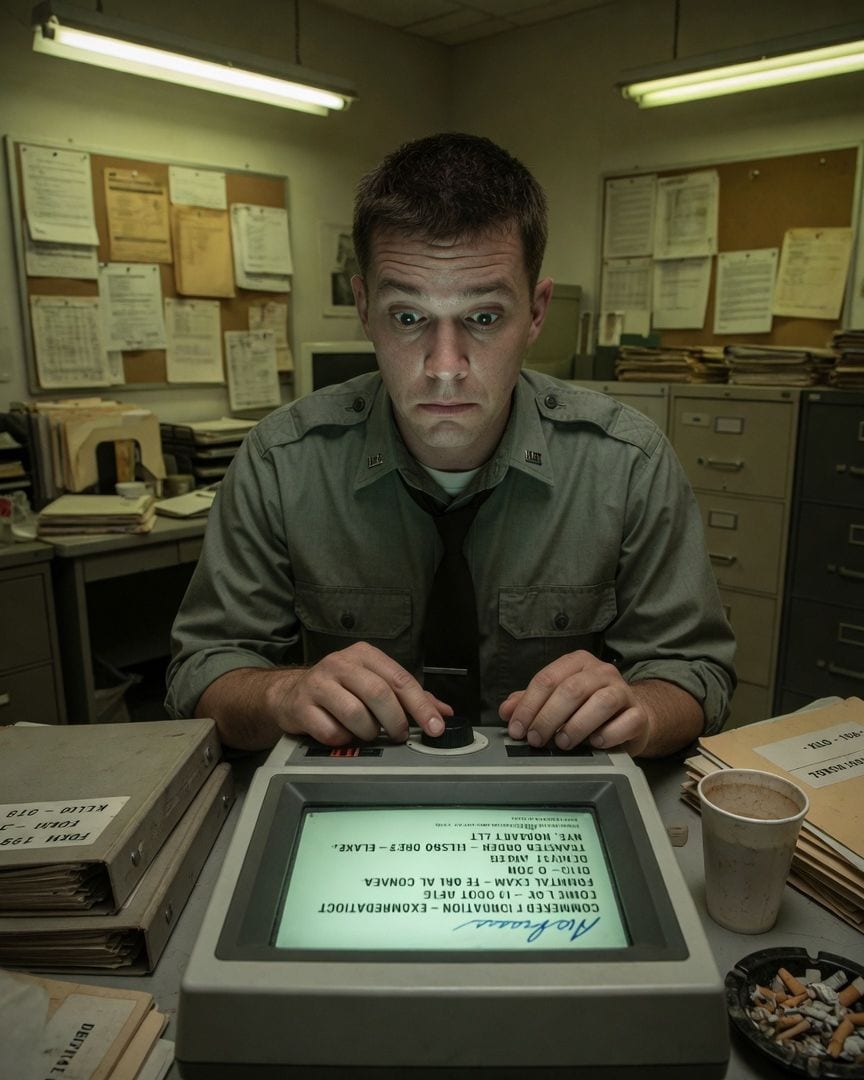
A missile commander watched his ten nuclear silos go dark. His own service record shows his signature on a future he's never lived.
Second Lieutenant Hobart Nye, a missile commander in Wyoming, had his quiet 0247 watch shattered by a security report: a massive, silent black triangle hovered over Launch Facility Kilo, casting a perfect shadow. Hobart watched his console's fault panel light up, signaling all ten nuclear missiles going dark in an impossible silence, followed by eleven minutes his security team could not remember. Official logs called it a "radio malfunction," but Hobart found a requisition for invisible-tracking sensors, signed by a base commander who was supposed to be off-base. The final, chilling discovery came when his own service record showed new entries—a dental check-up, a transfer to Alaska—all dated for a future he never lived, complete with his perfectly replicated signature.
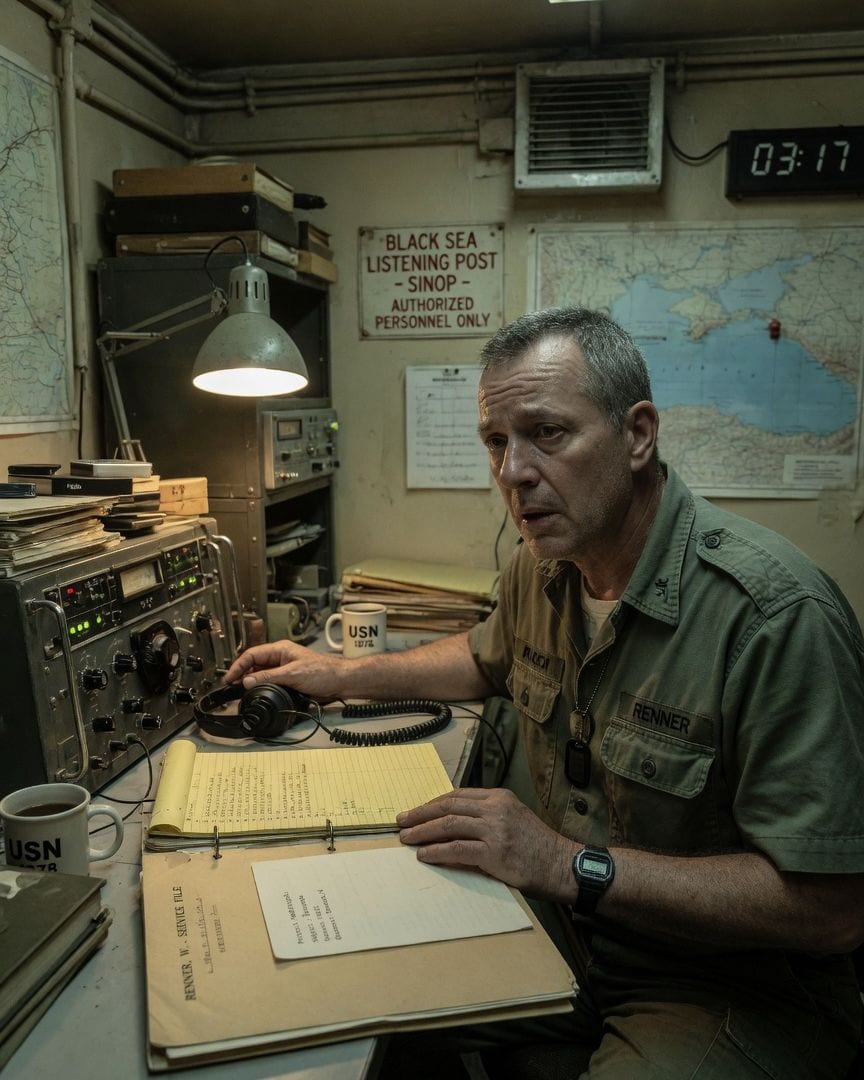
Specialist Walt Renner had six weeks left at Sinop when his Cold War numbers station stopped counting and spoke his mother's name: 'Walter.'
Specialist Walt Renner had just six weeks left at the Sinop station, anticipating the close of his thirty-year career. For almost two decades, he had tracked a mysterious numbers station, broadcasting from an impossible point in the Black Sea. Tonight, the woman's flat voice stopped counting, and the static cleared, replaced by a single, perfectly clear word: 'Walter.' It was the intimate name his mother had used, a name he hadn't answered to in decades. Yet, it emanated from the same empty water, a deeply personal address from the void itself.
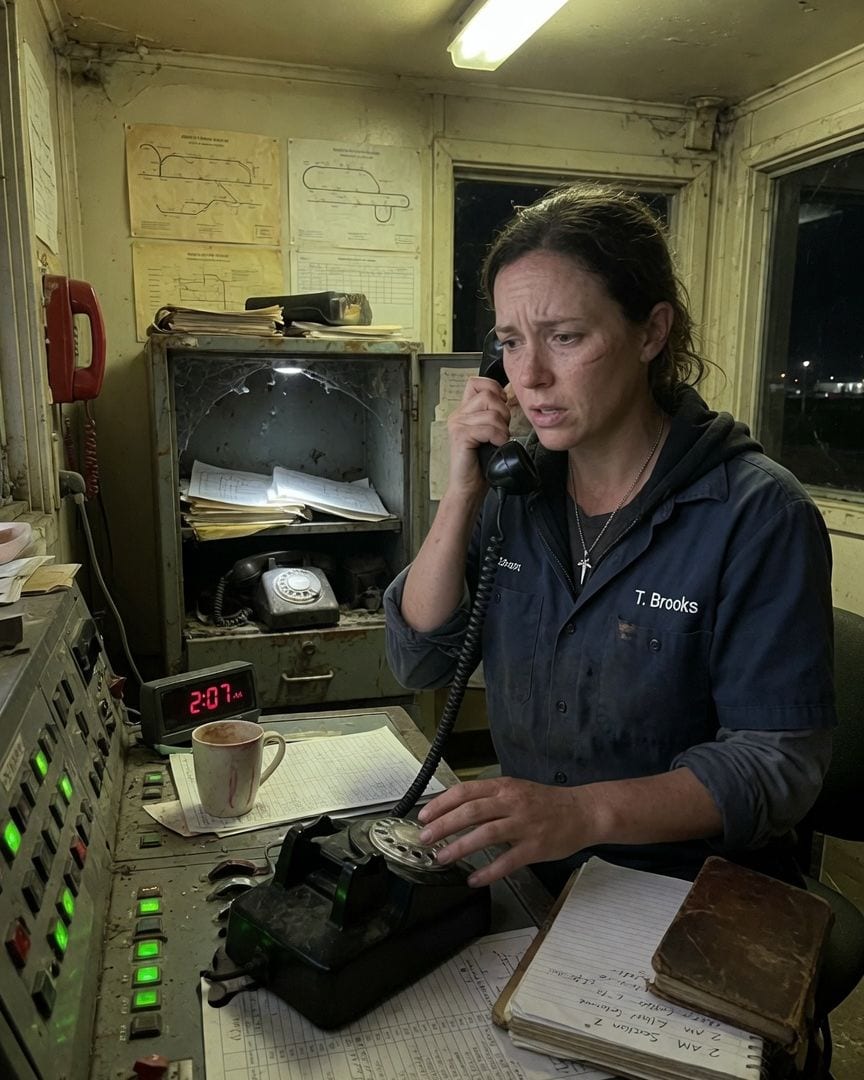
My signal box gets a 2 AM call every night from a man whose section was demolished eleven years ago. Now I found his logbook with today's date.
My night shift at the signal box is quiet and precise, defined by the routine 2 AM call from Ellis confirming Section 7 is clear. But when I asked my duty manager to log it, he said Section 7 hasn't had a track walker in eleven years, not since its cabin and phone were demolished.
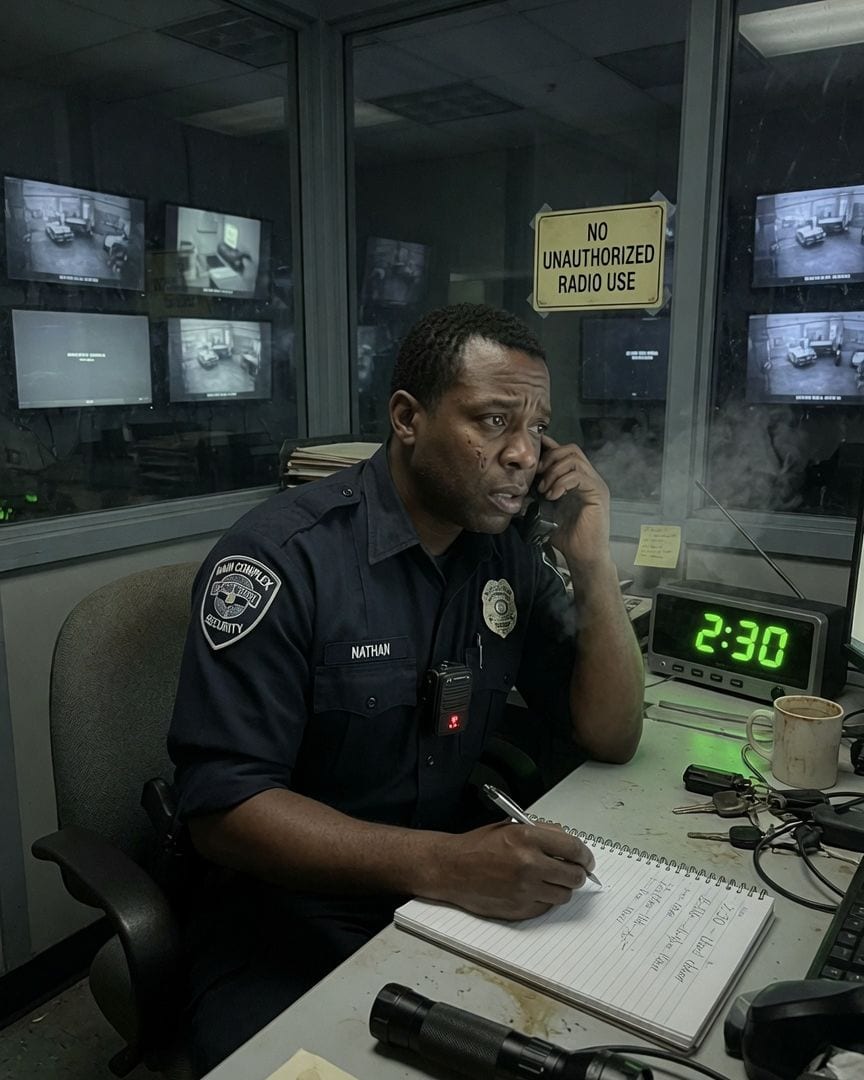
I radio Cole every night. My supervisor says his dock post was cut two years ago, and no Cole exists. But I just found Cole’s old logbook.
My graveyard shift usually consists of monotonous hourly check-ins with Cole, the guard at the loading dock. But my supervisor just revealed that the dock post was cut two years ago, and no one named Cole has ever worked for the company. I've been talking to someone who simply isn't there.