My university file contained a 1966 page naming my exact room, with a tutor’s note: "assign and observe." I lived alone.
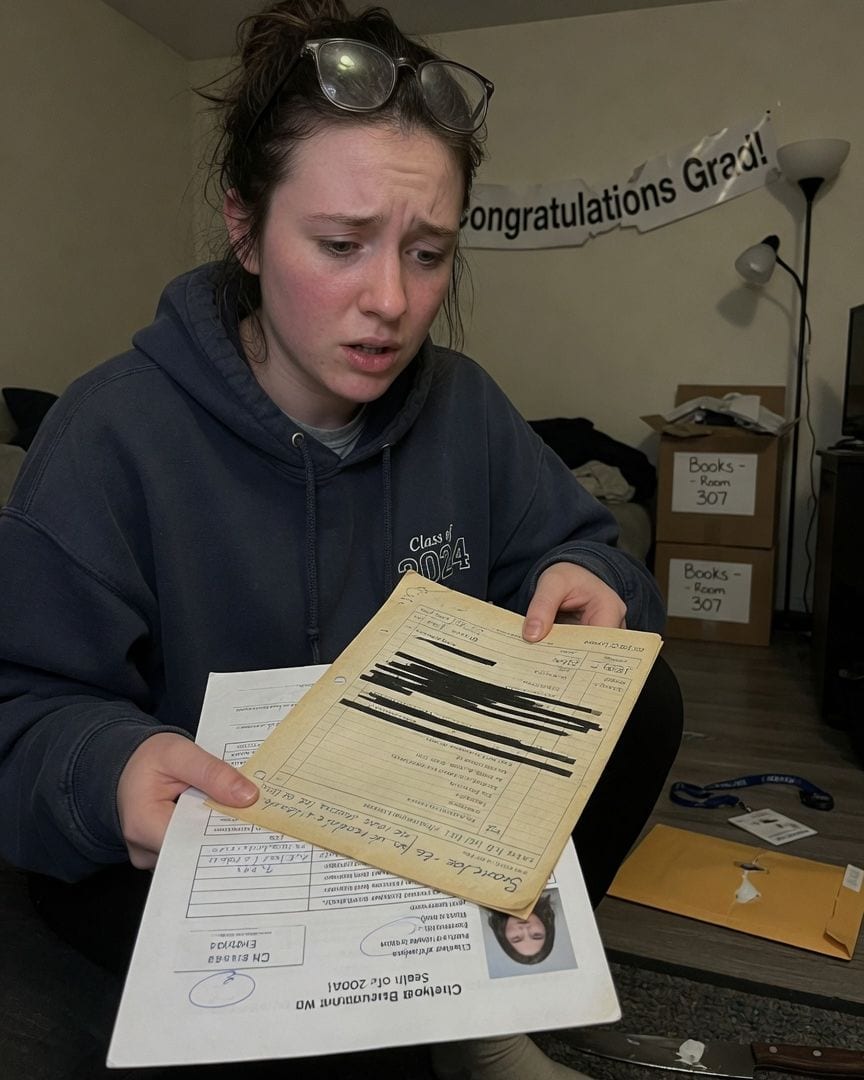
The thick manila envelope landed on my doormat with a soft thud, officially marking the end of my university life. Evelyn Beaumont, freshly graduated, a degree in English Lit, and now, my entire academic history in one neat package.
I slit the seal with a kitchen knife, pulled out the stack of papers. Transcripts, essays, immunization records—all accounted for.
Then, tucked right in the middle, between my final thesis approval and a receipt for a library fine from sophomore year, I found it.
It was a single, brittle page, yellowed with age, thinner than the rest. Not university letterhead, not official print. It looked like a carbon copy from an old ledger. Dated 1966. My breath hitched.
Above a line that was mostly redacted, a name obscured by thick black ink, I saw a room number. My stomach dropped. It was the exact number of my old dorm room: 307. My room.
The one I’d just moved out of last month. Below the redacted line, a tutor’s marginal note, scrawled in faded ink, was still perfectly legible: “same room, same reading list as the previous — assign and observe.”
The paper felt unnervingly cold in my hands, a sudden, inexplicable chill spreading through my quiet apartment. I live alone. Room 307 was my room, just last year. The contradiction hung in the air, thick and impossible.
I tried to dismiss it, of course. A clerical error. A mis-sorted relic from half a century ago that somehow found its way into my file. Universities are ancient, sprawling things; records get misplaced. It happens.
But the detail, "same room, same reading list," gnawed at me. Like a sliver of glass under the skin. I pulled out my own graduation records, flipping to my student ID.
Then, very carefully, I laid the faded 1966 page next to it. The partial, barely visible ID on the old page had a format eerily similar to mine, a specific three-letter prefix followed by a numerical sequence.
Not identical, but… related.
I logged into the university's alumni portal, my fingers stiff with a strange reluctance. Campus maps, housing directories, archived student records. I searched for "Room 307." It showed up consistently, year after year, decade after decade.
But some of the older entries were strangely sparse, lacking full names or detailed course loads. Just a number, a room, and a date. The rational explanation of a commonly shared room number, a standard dorm slot, began to fray.
I remembered the specific, somewhat obscure, reading list I'd been given for my final year project.
It was for a special topics seminar, a list I'd always found a little odd for my major, full of esoteric philosophy and forgotten poets.
Now, the phrase "same reading list as the previous" echoed in my mind, turning a simple coincidence into something far more deliberate, far more unsettling. My apartment, usually a haven of quiet, seemed to press in on me.
I needed more. I needed to see the actual housing allocation records, something physical. The university library archives.
In the dusty university archives, the air thick with the smell of old paper and dust motes dancing in the weak sunlight, I requested access to historical student housing records.
The archivist, a quiet man named Bernard Pierce with thick spectacles perched on his nose, regarded me with a mild curiosity before directing me to a microfiche reader in a dimly lit corner.
I threaded the film, scrolling through decades of tiny, faded text. My eyes began to ache. Searching specifically for 'Room 307,' I started to see it. A pattern.
Every few years, sometimes every four, sometimes every three, an entry for Room 307 would appear. Each entry had a unique student ID, yet all shared a familiar-looking coded prefix.
Not the same ID, no, but a reissued sequence, like a serial number. And sometimes, a terse, almost identical note was tucked beside the entry: 'assigned' or 'special placement.' The entries stretched back. 1961.
A long, impossible chain of students, all in my room. Evelyn stared at the microfiche screen, a chill spreading through her.
Dozens of entries for 'Room 307' scroll by, each with a unique student ID, yet all sharing the same coded prefix, and the years span back to 1961, repeating the cycle every few years.
Her own student ID, she realizes with a lurch, has that exact same prefix.
My initial inquiries about 'historical housing patterns' were met with polite but firm resistance. Bernard Pierce, the archivist, remained impassive behind his desk, citing privacy regulations and the sheer volume of records.
His calm, almost practiced evasiveness, however, only fueled my suspicion. He didn’t seem surprised by my questions, only guarded.
The heavy thud of the microfiche reader as I tried to force another search seemed to echo the growing frustration in my chest.
I shifted tactics. I concocted a story about an academic interest in a specific esoteric literary movement, a topic that, strangely enough, aligned with some of the more unusual texts on my old reading list.
This allowed me to request access to faculty notes and course syllabi from the relevant periods. Days blurred into a haze of dry academic jargon and faded ink.
While sifting through a particularly dusty box of old departmental memos from the 1970s and 80s, I found it. A series of internal 'student placement directives.' Each directive outlined the specific assignment of a student to Room 307.
Always using the reissued ID format I’d identified. Always specifying a 'customized reading curriculum.' My own name, my own student ID, and my specific reading list suddenly made terrifying sense. It wasn’t a mistake. It was a design.
I tried to cross-reference my own student profile in the alumni portal, just a quick search for my old course list, something innocuous. But my access was now strangely restricted to basic information.
No detailed course history, no special seminar notes. It was as if a part of my digital footprint had been deliberately trimmed, sanitized. A cold dread, sharp and sudden, settled in. My investigation was no longer quiet.
The quiet hum of the library seemed to turn into a low, pervasive thrum, as if the very walls were aware of my presence.
The next morning, I found a single, unmarked envelope slid under my apartment door. It wasn't shoved, not forced, but placed with a chilling precision, flat against the threshold. My heart hammered against my ribs as I tore it open.
Inside was a printout. My own recent alumni portal activity. It detailed my searches for 'Room 307,' my attempts to access 'student placement directives.'
Scrawled across the top, in stark, unfamiliar handwriting, was a single line: "Some files are best left closed, Miss Beaumont."
The cold dread solidified into a block of ice in my stomach. Someone knew. I glanced out my window, my gaze sweeping the street.
A flicker of movement caught my eye – a nondescript, dark sedan parked a block down, its windows tinted. It could have been anyone. It could have been nothing. But it wasn't.
Later that week, leaving the university library after another fruitless afternoon, I spotted Bernard Pierce. He was ostensibly watering a planter by the main entrance, a small, ornamental succulent.
But his gaze, usually so mild and unfocused, seemed to linger on me for a moment too long. The casualness felt forced, a performance for the benefit of passersby.
The anonymous warning, the restricted access to my own records, Bernard’s knowing glance – it all coalesced into a chilling certainty: I was no longer just investigating. I was being watched. My every move noted. The 'study' wasn't just historical.
It was active, and I was clearly on its radar. The air itself felt colder around me, a silent observer.
I confronted Bernard Pierce in his office the very next morning. I didn't bother with pleasantries.
The printout of my portal activity, with its stark warning, was clutched in one hand, the brittle 1966 page with its faded "assign and observe" note in the other.
I laid them out on his polished, oak desk, the yellowed paper a contrast to the modern laser print. "What is this, Bernard?" I demanded, my voice steady despite the tremor in my hands. "What is 'assign and observe'?"
Bernard’s placid demeanor finally cracked. Not dramatically, not with a gasp or a sudden flush of fear. Instead, a weary, almost resigned look settled over his face, as if he’d been waiting for this conversation for years, decades even.
He didn’t deny it. He just sighed, a slow, deliberate exhalation.
He admitted, slowly, that it was an 'ongoing legacy project' of the university. A 'longitudinal study.' He explained that certain students were 'identified' at matriculation, exhibiting specific, rare aptitudes. He used vague terms, like 'heightened perception' or 'unusual sensitivity.'
Room 307, he explained, was a 'controlled environment,' an anechoic chamber for the soul, he almost joked. The reading lists, my own included, were 'curated tools.' Designed, he said, to 'nurture particular faculties.'
The reissued numbers, he said, were merely 'internal tracking.' He insisted, his gaze finally meeting mine, that it was all for 'research purposes.' For 'understanding, not harm.'
"Understanding what?" I pressed him, my voice tight. "And why my room? Why my reading list?"
Bernard avoided my gaze again, looking instead at the dust motes swirling in the sunlight that slanted through his window. "Some talents manifest uniquely," he murmured. He implied a certain inevitability, that I was 'selected' due to my own 'aptitude.'
The earlier clues—the weird reading list, the repeated room number, the 'assign and observe' on that impossible 1966 page—snapped into focus, re-meaning themselves as parts of a carefully orchestrated design. The bureaucracy itself was the horror.
It wasn't malicious, but cold. Scientific. A silent, observing eye.
Bernard, clearly uncomfortable with my relentless questions, shifted in his seat. The heavy wooden chair creaked beneath him like an old ship on a restless sea.
He began to reveal that some of the 'subjects' of the study, the older ones, were still within the university’s extended community.
He mentioned, almost as an aside, that one of the earliest tutors involved in these 'special assignments' was a Professor Sylvia Yates, now retired.
He gave me a look of profound, almost pitying, understanding, as if to say, "She knows everything, and you're already part of it."
The implication hit me like a physical blow: this wasn't just an abstract system, a cold, institutional protocol. It was a network of living people, some of whom had been actively involved for decades.
Sylvia Yates wasn't just an old name on a faded file; she was the 'witness who always knew,' a direct, living link to the very genesis of this horrifying 'study.'
I felt an icy dread seep into my bones, worse than anything I’d felt before. I left Bernard’s office, the weight of his words pressing down on me, making each step feel impossibly heavy.
I found Sylvia Yates’s contact information in the alumni directory, her heart pounding a frantic rhythm against my ribs.
Bernard Pierce's eyes, usually so placid, are filled with a deep, unsettling pity as he murmurs, 'Professor Yates… she was a tutor back then. She'd remember the early assignments.'
He gives Evelyn a look that says, 'You don't know what you've stepped into,' and Evelyn feels an icy dread as she realizes the true orchestrator, the 'witness who always knew,' is still alive, a direct link to the very beginning of this impossible file.
I found Sylvia Yates living in a quiet, unassuming house on the edge of town, surrounded by books that climbed the walls like ivy. The air inside smelled of dust and dry leaves.
Sylvia, though frail, possessed an unnerving clarity in her gaze, a sharpness that belied her age. She offered me tea, her hands steady, then, without preamble, confirmed Bernard's hints.
"The 'study' identifies individuals with a unique neuro-sensory perception," Sylvia explained, her voice calm, devoid of judgment. "A resonance. Some call it psychic, others merely heightened intuition. It manifests differently in each subject."
She described Room 307 not as a mere dorm room, but as a 'stabilizing node,' a place where nascent abilities could be nurtured without interference.
The specific reading list, she continued, was a 'catalyst,' designed to gently awaken and focus these latent abilities. The reissued student IDs, she said, were a simple, bureaucratic way to track the lineage, the 'resonant generations,' ensuring continuity across decades.
Sylvia revealed that the university, supported by an ancient, anonymous trust, had been doing this since before the 1960s. Documenting the emergence of these 'resonants' and their developing abilities, always without direct intervention unless absolutely necessary.
She looked directly at me then, her eyes like chips of blue ice. "You, my dear, are a resonant. Your sensitivity is why you found the file, why you followed the trail. You were assigned, and you observed yourself."
Every planted clue, every odd detail, every wrongness I’d felt, now locked into place, forming a coherent, terrifying picture of a world running beneath the mundane, an unseen current.
I was horrified, not by malice, but by the cold, scientific detachment, the lifelong manipulation. "You've been watching people their whole lives?" I asked, my voice barely a whisper, a thread of sound in the quiet, book-lined room.
Sylvia nodded, calmly. "Observing. Documenting. Never interfering, unless requested." She explained that some 'resonants' eventually sought them out, wanting to understand their abilities, wanting guidance. Some stayed. Some walked away. She offered me a choice, her gaze unwavering.
"Join us, understand your gifts, contribute to the greater knowledge. Or walk away, and try to forget."
I shook my head, feeling a profound sense of violation, a chill that had nothing to do with the temperature of the room. "I won't be another data point," I managed, my voice firm despite the tremor running through me.
I stood to leave, but Sylvia’s gaze sharpened, piercing me. "It's not that simple, Evelyn. The resonance, once awakened, doesn't sleep. You'll feel it. You'll see things. And we'll be here, if you need us."
As Sylvia spoke, I felt a sudden, subtle shift within myself, a faint hum in the air around me that had nothing to do with the house's old wiring, a fleeting shadow at the edge of my vision that wasn't there a moment before, a whisper just beyond hearing, like wind chimes played by an impossible breeze.
The world around me seemed to gain an extra dimension, a shimmering layer of perception I never noticed before. I realized the 'study' had already changed me, irrevocably.
The door to Sylvia's quiet study, once ordinary, now felt impossibly heavy, a barrier between two worlds. I pushed it open, stepping out into a world that was now subtly, terrifyingly, different.
I tried to return to my normal life, but the world no longer felt normal. The hum, the faint shadows, the whispers – they were always there now, subtle but undeniable, like a persistent tinnitus.
I found myself noticing patterns, connections, and fleeting impressions I never would have before, a sense of knowing something just before it happened, or understanding something unsaid. The university continued its operations, undisturbed.
Bernard Pierce remained in the archives, calm and efficient, a silent guardian of the impossible. The 'study' continued, a silent, unseen current beneath the surface of everyday life, always flowing, always observing.
I carried the knowledge, a permanent mark on my perception.
I sometimes catch a glimpse of a familiar face in a crowd on campus, a young student, perhaps a new 'resonant' on their way to Room 307.
I know the file is still open, my name now part of the long, reissued sequence. I never joined them, but I never truly left the study either. I live with the knowing.
A year later, Evelyn Beaumont receives a small, unmarked package in the mail. Inside, a single, new edition of one of the old reading list books, with a bookmark placed halfway through. No note, no sender.
If this one got to you
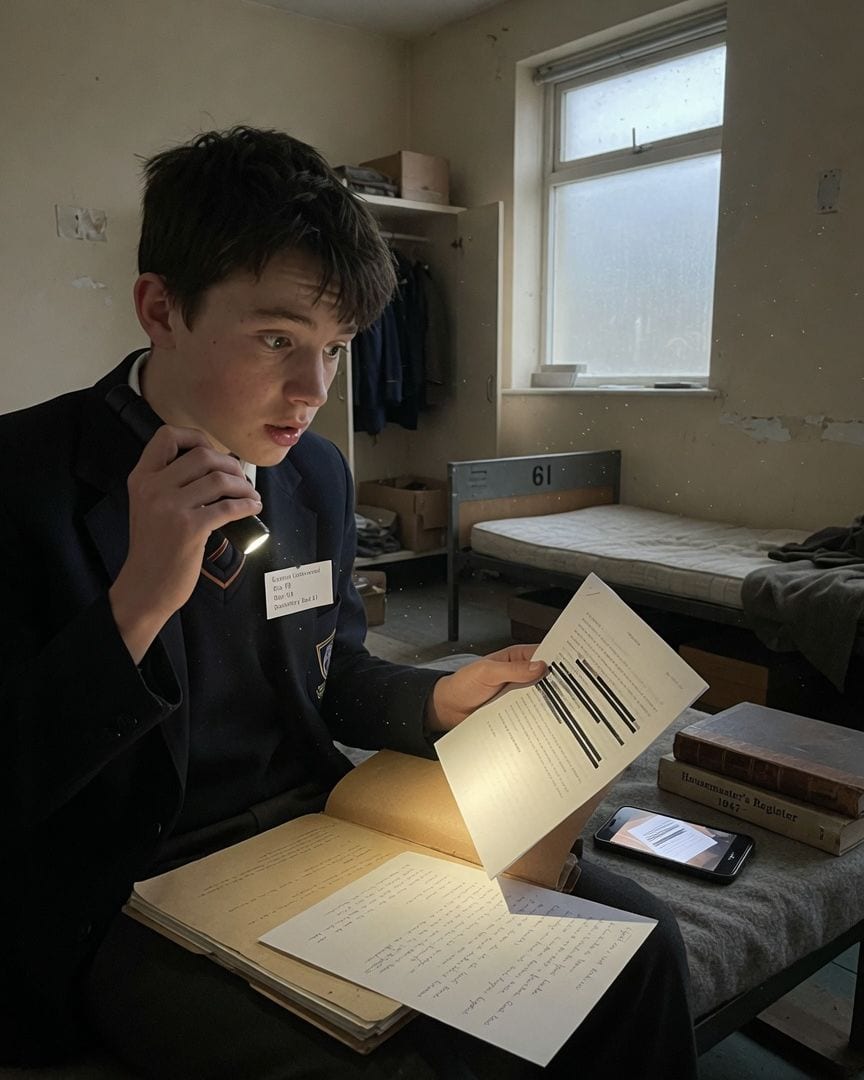
My boarding school bed number was 61, and the archive shows a boy assigned it every eight years since 1947, each leaving mid-term with the bed 'to remain made up'.
I found my matriculation card, listing me as 'Boy 61, Dormitory Bed 61.' Later, an old ledger revealed every boy assigned that bed since 1947 left mid-term, with an unsettling note: 'bed to remain made up.' Our housemaster’s recent scribble, 'as the others,' only deepened the dread around my own assigned bed.
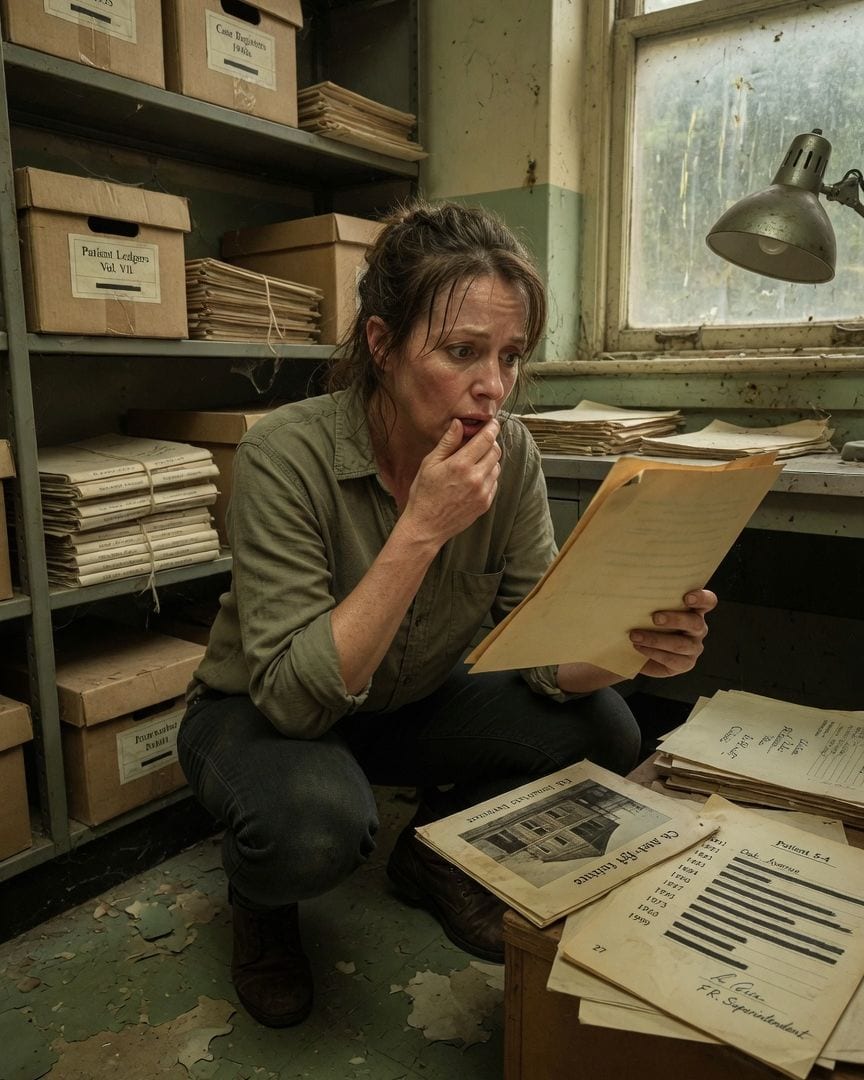
Patient 5-4 keeps checking into my aunt's old sanatorium chalet. The same initials sign them out, 'not traced,' every thirteen years since 1921.
Sifting through my aunt Margaret's estate, I found her old sanatorium file from 1999. Her patient record listed her as 'Patient 5-4,' discharged 'not traced.' But when I accessed the archives, I found 'Patient 5-4' was admitted every thirteen years since 1921, always with identical discharge notes.
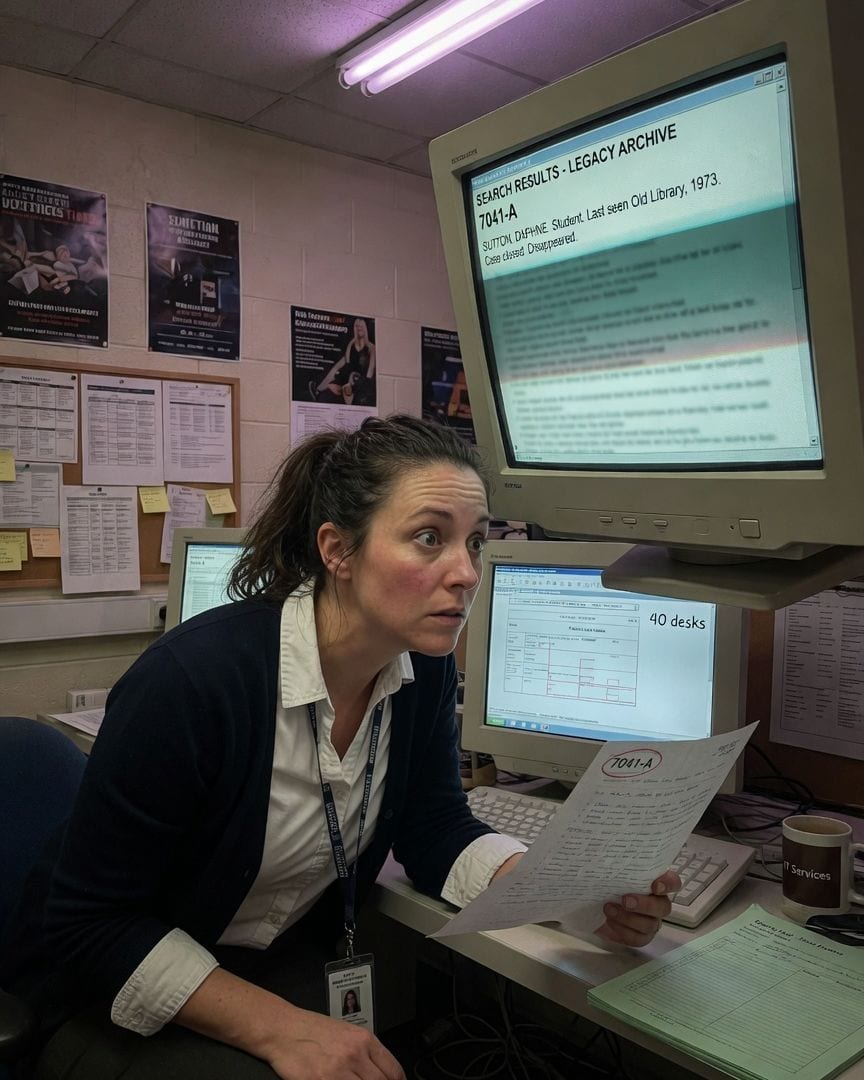
My exam hall had forty desks. The system printed forty-one candidates, and desk 41 held a completed paper in an aisle I know I left empty.
I meticulously arrange forty desks for final exams, ensuring every detail is precise. But after the papers were collected, I found a completed exam for a Desk 41, with fresh ink, sitting exactly where an empty aisle should have been.
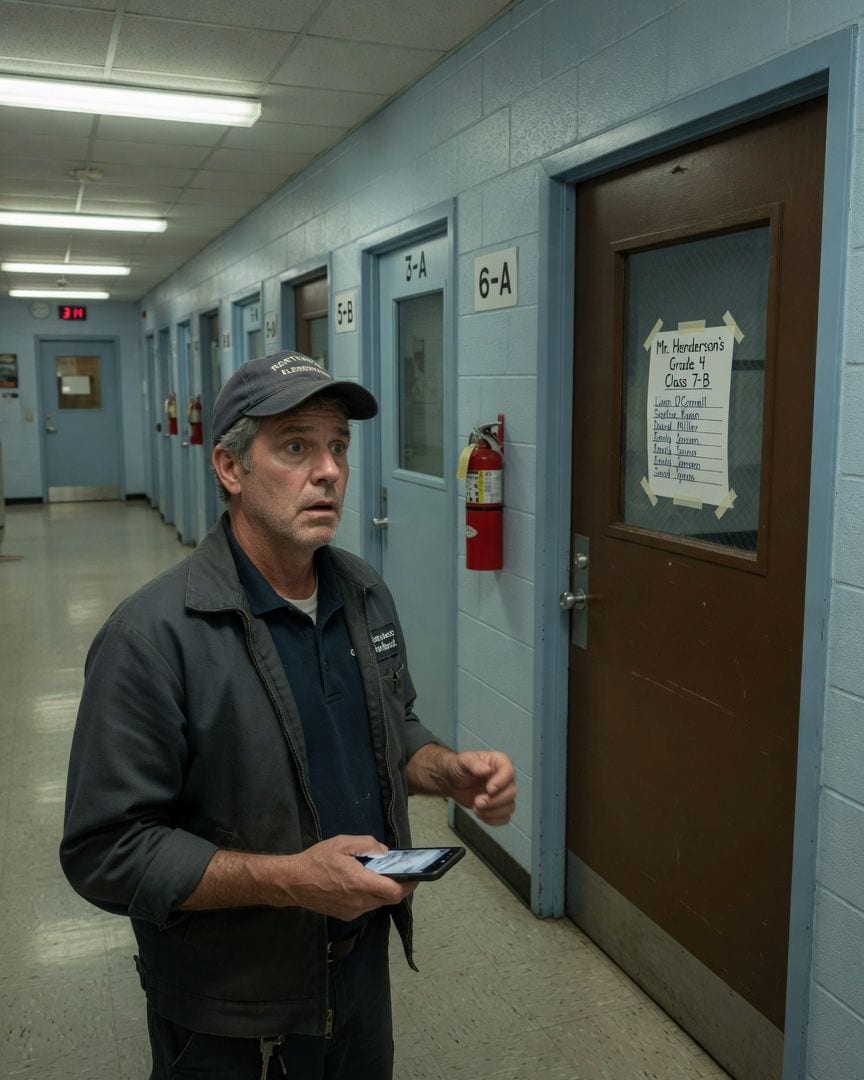
My classroom doors counted twenty-three last night. The extra one had a class list taped inside, names of children who've never been at this school.
My job as night caretaker at Northwood Elementary is routine: 22 classrooms, all accounted for. But one night, an impossible 23rd door appeared in the science block, nestled where only a wall should be. It bore a class list of students and a teacher who don't exist in any school record. Then, in an old logbook, I found that exact same list, dated 40 years ago.
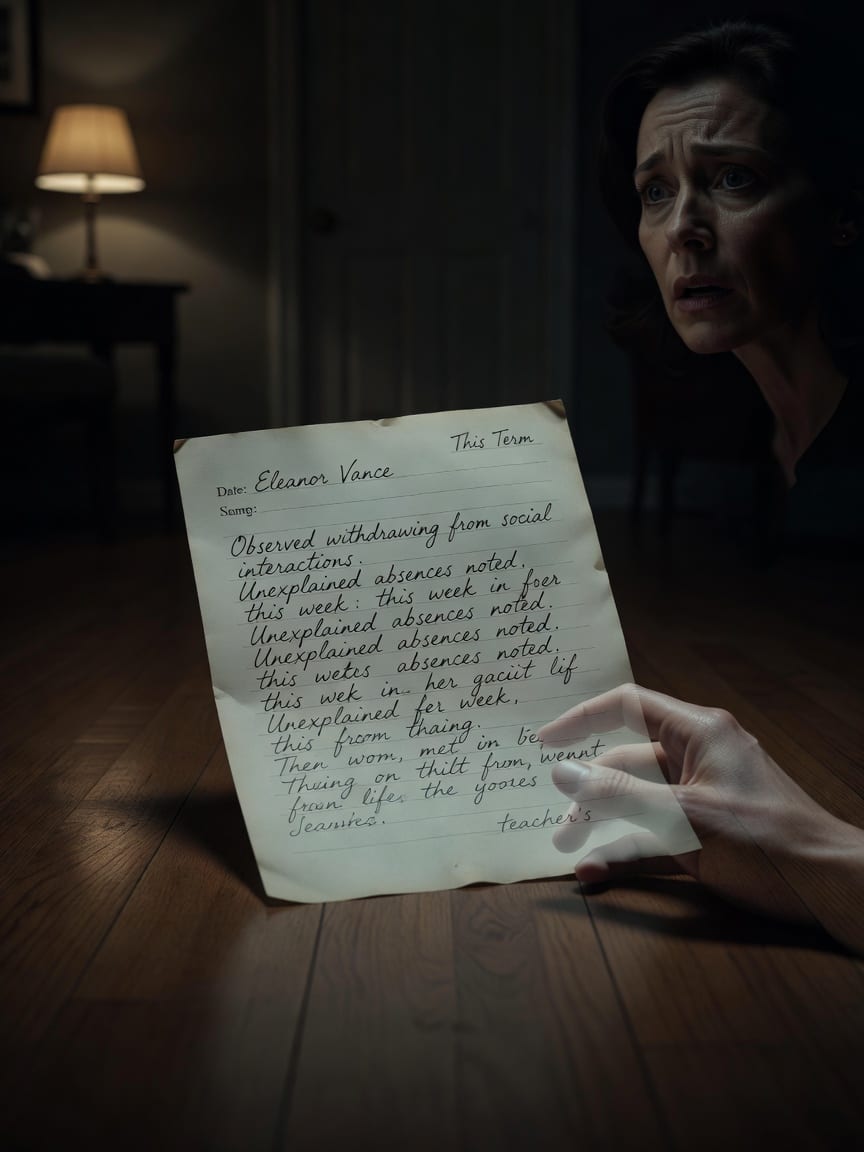
My school reports keep arriving, one a term, signed by teachers dead for decades. The latest describes something I'm doing *this week*.
My name is Eileen Caldwell, and my quiet life was upended by a school report from a place demolished decades before I was born. The report, signed by a long-dead teacher, eerily detailed my current habits. But the real shock arrived when I found my own name in a student register, dated 1968, with precise descriptions of my childhood—years before I existed.
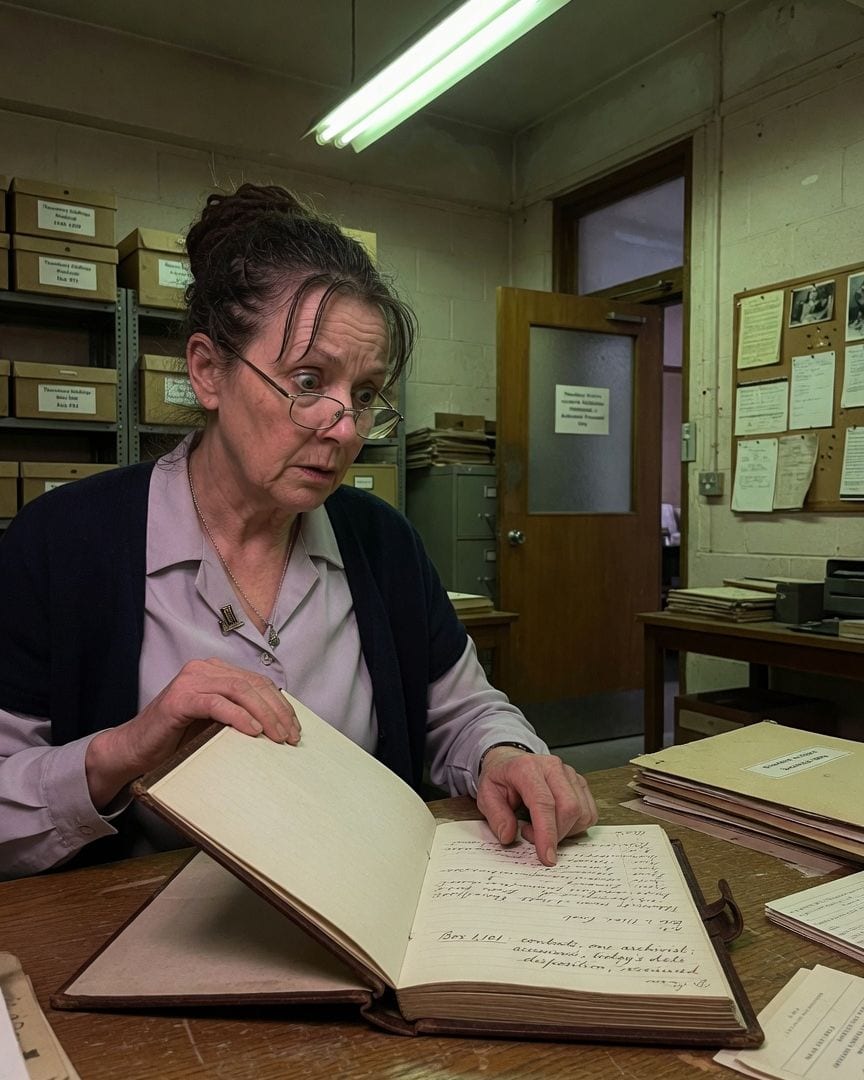
Archivist Beatrice Kell had four hours to finish her life's work when an old Cold War register listed 'Box 1,101: contents, one archivist' for today's date.
Methodical archivist Beatrice Kell had just four precious hours left before renovation began, a final chance to complete two decades of her life's work within the Thornbury Collection. The heavy oak door creaked shut, sealing her in with the comforting scent of old paper. But as she opened the original 1952 accession register, a familiar document she knew intimately, she found an impossible entry: 'Box 1,101: contents, one archivist; accessioned, today's date; disposition, retained.' Her own title, linked to a box that didn't exist, settled a profound chill deep in her bones. Was this a macabre joke, or something far more sinister?