A wreck-hunter unearths a 1944 B-17, but its oxygen bottle still hisses, fully charged, beside a sealed Cold War cylinder.
Anselm Roeder, 56, gripped the steering wheel of his custom-built truck, guiding it carefully through the frozen, muddy fields of a rural Pennsylvania valley. For a week, he had been following up on a farmer’s half-joking remark about 'bad ground.'
The farmer had plowed these same acres since he was a boy, never hitting so much as a fence post, but his plow kept snagging deep, twelve feet down, on something immense and metallic.
Anselm, a methodical wreck-hunter with a reputation for impossible finds, had brought his ground-penetrating radar. It confirmed it: a large, intact object lay beneath the soil.
Today, in the sharp winter air, his small team had finally reached it. Twelve feet down, amidst the clinging mud and glacial clay, the rusted, mud-caked wing of a B-17 bomber emerged from the earth, remarkably preserved.
The sheer scale of it was breathtaking, a phantom of war unearthed. As Anselm brushed away the last of the tenacious soil, a dark, cylindrical shape caught his eye: an oxygen bottle, still strapped to a corroded bulkhead.
Its regulator, impossibly, was still charged to fifteen hundred pounds.
He knelt in the cold, damp earth, the biting wind irrelevant as he listened to a faint, steady hiss that should not have been possible from a piece of metal buried since 1944.
Anselm spent hours carefully extracting the oxygen bottle, its impossible hiss a constant, unnerving counterpoint to the quiet of the valley. He double-checked the pressure gauge with his own calibrated instruments, a series of quick, practiced movements.
The gauge was accurate. The bottle was fully charged. This wasn't a faulty reading, nor a trapped pocket of residual gas. It was a physical impossibility, a defiance of eighty years of corrosion and the immense pressure of the earth.
As he worked, meticulously documenting every piece of debris with his camera and notebook, his gloved hand brushed against something small, dense, and unnaturally smooth embedded in the mud near the bottle’s base.
He carefully dug it out, prying it free from the compacted soil. It was a metallic cylinder, no larger than his thumb, sealed tight. It wasn't aircraft aluminum, nor any alloy he recognized.
It bore no visible markings, no manufacturer's stamp, no serial number that made sense in the context of a 1944 bomber.
It felt cool to the touch, almost inert, yet its presence felt profoundly wrong, a discordant note in the symphony of historical wreckage.
He tried to pry it open, gently at first with a small pick, then with more calculated force using a specialized tool, but it remained stubbornly sealed, as if forged from a single, seamless piece of metal.
Its surface was too perfect, too smooth to have spent eighty years in the ground, completely untouched by time.
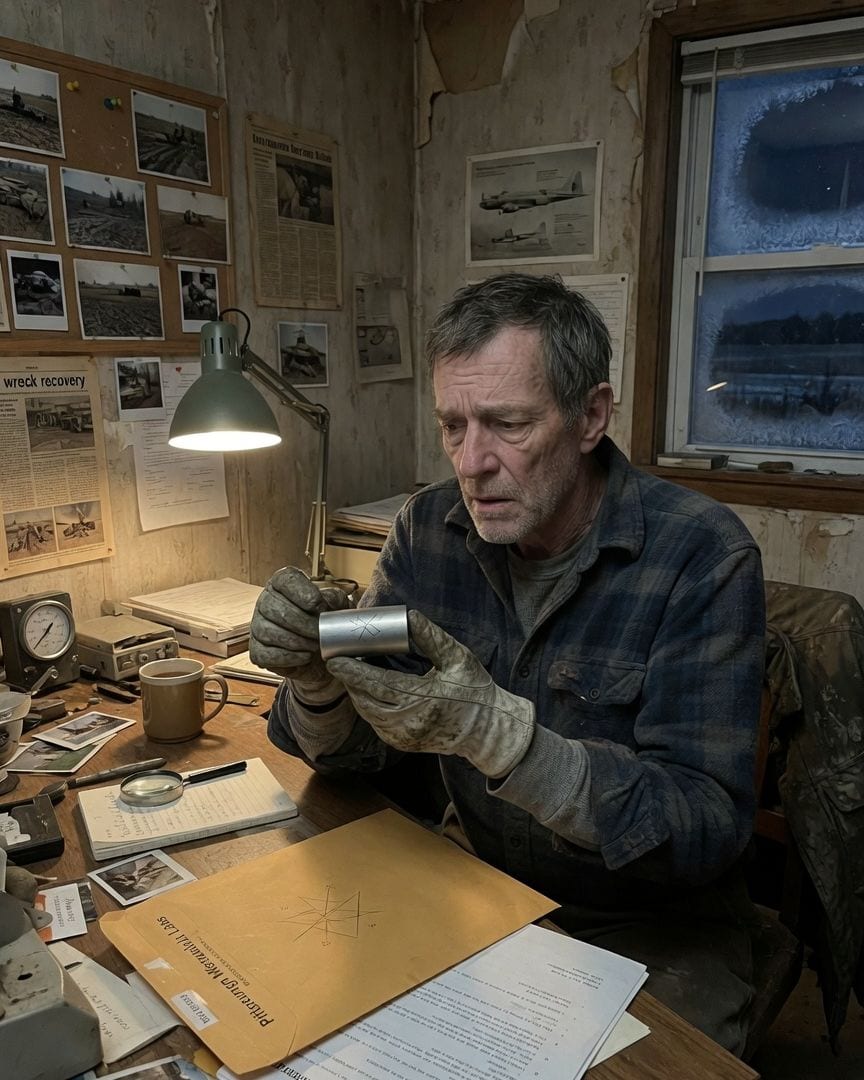
Anselm took the cylinder to a trusted metallurgical lab in Pittsburgh, more for validation than any real expectation. Days later, the report came back, stapled and tucked into a brown envelope. He smoothed it on his desk.
The cylinder, the report stated, was composed of an unknown, non-ferrous alloy, impervious to their cutting tools, including diamond-tipped drills and industrial lasers. They simply couldn't open it.
More unsettling, a faint, almost invisible etching on its side, only visible under extreme magnification, revealed a complex, geometric symbol, unlike any military insignia.
The lab report also included a 'ghost' serial number they’d managed to extract from its molecular structure, a sequence of digits that traced back to a procurement code that technically didn't exist in any official military database.
Anselm, a meticulous researcher who prided himself on comprehensive knowledge of classified hardware, realized he had seen that symbol before, in a heavily redacted Cold War incident file he’d once briefly glimpsed during a declassification review years ago.
He stared at the metallic cylinder in his hand, the lab's report confirming its anomalous nature, its impossible serial number, and the faint, recurring symbol that prickled at the edge of his memory, linking it to a file that should not exist.
Driven by the impossible cylinder, Anselm began to chase the ghost procurement code and the geometric symbol.
His initial inquiries led him down forgotten bureaucratic rabbit holes, but his veteran status and a few well-placed phone calls eventually granted him access to the more obscure sections of the National Archives in College Park.
This labyrinthine journey led him to Pamela Novak, 42, a records clerk whose reputation for meticulousness bordered on obsession.
She was initially wary, her gaze sharp and assessing, but Anselm’s precise, rational questions about anomalous procurement codes and unusual redaction patterns seemed to pique her interest.
He eventually found the file he dimly remembered, a dossier on 'Project Chimera,' ostensibly a weather balloon incident from 1968. It was heavily redacted.
But as he looked closer, the blacked-out lines weren't straight; they curved subtly, forming an almost organic, repeating shape across multiple pages, like some unsettling, abstract watermark.
The cover sheet stated '20 pages total,' but the physical folder only contained 12. He checked the document control number, then the page count again. Eight pages were simply gone.
The downgrade schedule, printed clearly on the inside flap, read: 'DECLASSIFY: NEVER.'
What remained unblacked out—fragments of weather reports, a few disjointed flight coordinates, and a single, grainy photograph of a cloud formation that looked too solid, too geometric to be natural—made no sense.
It was a record designed to obscure, not inform, and the shape of the redactions felt less like censorship and more like a signature, a deliberate, unsettling mark.
Anselm’s inquiries intensified. He requested more files, cross-referencing dates and locations from 'Project Chimera' with other, seemingly unrelated incidents – reports of impossible atmospheric phenomena, unexplained signal intercepts, even a few missing cargo ship manifests.
His access, initially granted with a dismissive wave, grew increasingly difficult.
Forms were lost, appointments were inexplicably canceled at the last minute, and digital files became corrupted just as he tried to download them, replaced by static or an unhelpful error message.
Pamela, who had been quietly, almost invisibly, assisting him by pointing him to obscure cross-references within the sprawling archive system, suddenly became withdrawn. She started avoiding his calls, her emails terse and impersonal, signing off abruptly.
Then, one evening, as Anselm sat poring over a faded microfiche, his phone buzzed. It was an anonymous text message, from an untraceable burner phone. It contained only five words: 'Some records are meant to stay buried.
You’re making a new one.'
The message sent a cold dread through him, a physical clench in his gut. The silence of his office seemed to deepen, the air growing heavy.
He knew he wasn't just digging into old government secrets anymore; someone, or something, was actively aware of his investigation, and they had just delivered a chillingly personal warning.
He felt a sudden, visceral understanding that his role had shifted from hunter to prey, his every move now observed and logged, becoming part of an invisible, unfolding narrative.
Anselm drove directly to Pamela’s apartment, the chilling text burning a hole in his pocket. He ignored her attempts to deflect him through a quick, terse phone call; he just kept driving.
He found her packing, her face pale and drawn, a half-filled box of books on the floor next to a stripped bed. When he held up his phone, showing her the anonymous text, she flinched, visibly, as if struck.
Then, finally, she broke.
She admitted that the 'ghost' procurement codes weren't a glitch in some archaic military system; they were a systemic designation for items that passed through 'unregistered channels,' a phrase her grandfather had used.
Her own grandfather, Albert Crane, a retired historian she described as eccentric but brilliant, had spent decades obsessively tracking similar anomalies, convinced there was an 'invisible archive' at work.
He had warned her about 'the filing system' since she was a girl, telling her to 'never look too closely, or you’ll become part of the file.'
Pamela confessed that she had been subtly feeding Anselm clues, hoping he might make sense of her grandfather’s fragmented research, hoping he could finish what Albert had started.
She produced a dusty, heavy box from under her bed, its cardboard yellowed with age, labeled in faded handwriting: 'Albert Crane – Unofficial Records.'
Inside were decades of meticulously handwritten notes, photocopies of obscure documents with the same curved redactions, and a series of cross-referenced lists, all bound with brittle rubber bands.
'He tried to publish it, years ago,' Pamela whispered, her voice barely audible, her eyes scanning the empty room as if something watched from the shadows. 'But every time, something… interfered. Journals lost his submissions, publishers just stopped responding.
He just faded away, became irrelevant. He said it wasn’t malice; it was just… order.' The box felt unexpectedly warm in Anselm's hands, as if it had just been pulled from the ground, still retaining some ancient, subterranean heat.
Anselm spent the next two days sealed in his office, poring over Albert Crane’s notes. The sheer volume of cross-referenced data was overwhelming, a lifetime of quiet obsession laid bare.
Albert had meticulously documented hundreds of incidents: 'ghost' procurement codes, impossibly preserved artifacts like Anselm's oxygen bottle, dates of disappearances across military, civilian, and even scientific sectors, spanning from post-WWII to recent satellite anomalies.
The pattern across decades and classifications began to resolve itself, forming a monstrous, coherent shape that transcended mere human conspiracy. The bomber wasn’t an isolated incident; it was one entry in an ongoing, vast, and systematic process.
He found the section labeled 'Witness Designations,' a chilling list of names and dates associated with specific 'ghost' codes. His finger, trembling slightly, traced the faint, handwritten entry in Albert Crane's decades-old ledger: ROEDER.
Then, two lines below it, his own first name: ANSELM.
The date next to it marked a year after he’d first incorporated his wreck-hunting business, years before he’d ever heard of a 'ghost' code or a plane buried in a farmer's field, and he felt a cold, absolute certainty that he isn't just investigating a file; he is already an entry within it.
The full, monstrous truth snapped into place.
Albert Crane’s notes, combined with Anselm’s own discoveries, revealed that the 'secrecy machine' was not an institution of people but a mechanism, an immense, non-human intelligence that 'filed' anything that deviated from its perceived norm.
The bomber, the metallic cylinder, the impossible oxygen bottle—they weren't lost or destroyed. They were 'collected' and preserved, rendered inert but not erased, their existence subtly re-categorized within a vast, invisible archive.
The 'ghost' codes were its internal classification system, and the oddly shaped redactions were its signature, denoting the type of anomaly.
The names on Albert’s 'Witness Designations' list, including Anselm’s own, weren't victims of a cover-up, but 'discoverers'—individuals whose investigations led them too close to a 'filed' item, causing them to be absorbed into the system as new entries.
The anonymous text message wasn't a warning; it was a notification. The system wasn't malicious; it was merely an immense, patient archivist of the uncanny, operating beyond human comprehension.
The oxygen bottle hissed because the 'filing' preserved the object, even its impossible state of charge, perfectly as it was found, frozen in an unexplainable moment. The horror wasn't in what it did, but in its indifferent, systematic coherence.
Anselm knew he was already in the file, yet a deep, methodical part of him couldn't simply accept it. He had to try. He tried to publish Albert’s research, to expose the pattern, to break the silence.
He meticulously compiled a manuscript, cross-referencing every source, every 'ghost' code, every impossible detail he and Albert had uncovered. He sent it to academic journals, independent publishers, even a few investigative journalists he knew personally.
Each attempt met with a quiet, bureaucratic wall. Editors declined without specific feedback, citing 'lack of general interest' or 'insufficient peer-reviewed data.'
Websites he uploaded sections to mysteriously crashed, files corrupted beyond recovery, or simply vanished overnight, replaced by unrelated content. There were no threats, no overt censorship, just a gentle, insistent pressure, a systemic erosion of his efforts.
It was like trying to argue with a tide.
He tried to contact Pamela, but her phone was disconnected, the number no longer in service. He drove back to her apartment building.
The landlord, a gruff man who barely remembered Anselm from his last visit, claimed she'd 'moved out quietly, didn't leave a forwarding address.' She was gone, a ghost in the records he was trying to expose.
Then, compelled by an instinct he couldn’t ignore, he returned to the Pennsylvania valley field, the site of the bomber. The excavation was gone, the gaping hole filled in.
The ground was perfectly graded and covered with fresh sod, indistinguishable from the surrounding farmland. There was no trace of his work, no sign of the bomber, no evidence he had ever been there.
The system didn't destroy; it simply re-filed, making the evidence, and the witness, disappear into an inaccessible record.
Anselm retreated to his home office, surrounded by the remnants of his research – Albert's notes, his own meticulously collected data, all now unpublishable, unshareable.
He tried to resume his wreck-hunting business, but clients called less often, their requests turning strangely vague or getting abruptly canceled.
His bank statements began to show minor, inexplicable discrepancies, small errors that gradually accumulated, eroding his credit, making him less credible, less visible in the financial system.
Pamela Novak remained untraceable, a ghost in the records, as if she had never existed. The world moved on, indifferent to the quiet erasure of a few names and an impossible bomber.
Anselm sat alone in his office late one night, the only light coming from his desk lamp, casting long shadows across the stacks of paper.
He picked up a random, declassified document from a stack he'd been reviewing for a now-abandoned project. It was an innocuous report on Cold War weather patterns.
On the top sheet, barely visible, a newly added stamp appeared in the corner, a faint, almost transparent impression. It read: FILED.
He pressed his thumb over it, feeling a faint, unsettling warmth emanating from the paper, as if the ink was still drying.
He tried to call a colleague, a man he'd worked with for twenty years, but the line rang endlessly, then clicked to a disconnected tone.
He held the document, feeling its warmth spread through his fingers, a quiet, inexorable certainty settling over him. He was no longer just an entry. He was filed.
His neighbor, Gloria Porter, saw his office light on late into the night for weeks after that. One morning, Anselm’s truck was gone from his driveway. She called him, but the line was disconnected.
A new wreck-hunter eventually bought his property, inheriting the old files, but never found anything interesting in them.
If this one got to you
A contract archaeologist has nine days left when her trowel hits a Cold War something vast, dark, and utterly alien in the Utah desert.
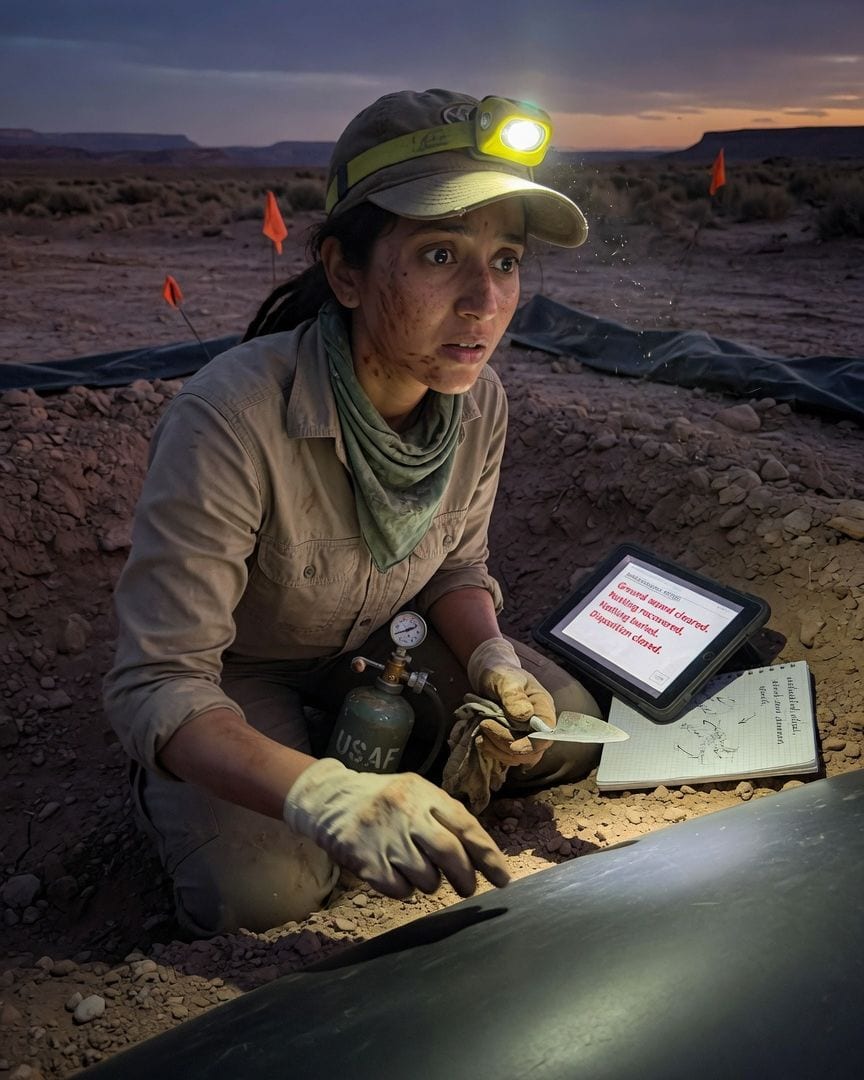
Contract archaeologist Priya Raval raced against a ticking clock in the Utah desert, her permit set to expire in just nine days. The scorching sun beat down as she surveyed an Air Force site, officially 'cleared' decades ago, where nothing was supposed to be buried. Her first find was an 80-year-old oxygen bottle, still pressurized, unearthed from a cavity deliberately backfilled, a quiet mockery of official records. But the true anomaly emerged when her trowel struck something vast, dark, and perfectly smooth, unlike any known terrestrial construction. This seamless, featureless hull absorbed light, stretching into the earth below. Embedded on its surface was a metallic box etched with an intricate symbol identical to a pattern she'd dismissed as natural. What impossible history lay hidden beneath the Utah sands?
A curator found a guidon dated 1989. The museum took it in 1988, but the Cold War airman on its tag vanished in 1954.
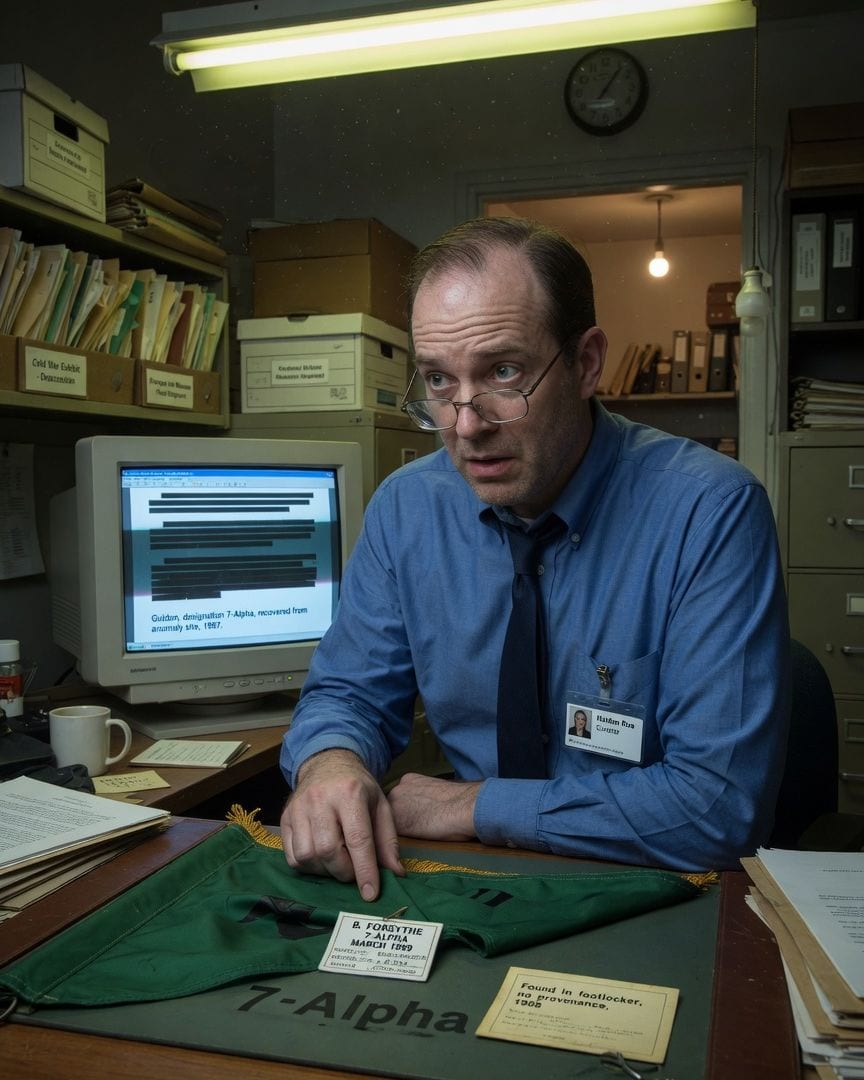
Halden Roe, a meticulous curator, worked against a pressing deadline as the Presque Isle Museum's Cold War exhibit closed for good. In the dusty storage unit, under a single bare bulb, he discovered a small laundry tag sewn into an antique green silk guidon. Its crisp black stitching clearly read 'MARCH 1989' — a date a full year *after* the museum’s intake record for the artifact. As Halden's unease grew, he found the service number on the tag belonged to Benjamin Forsythe, an airman who vanished off Greenland in 1954. How could a museum piece found in 1988 bear a future date and belong to a ghost from decades past?
An inventory officer found a bunker's log of soldiers, then found one of their dog tags marked 'KIA, 1970'.
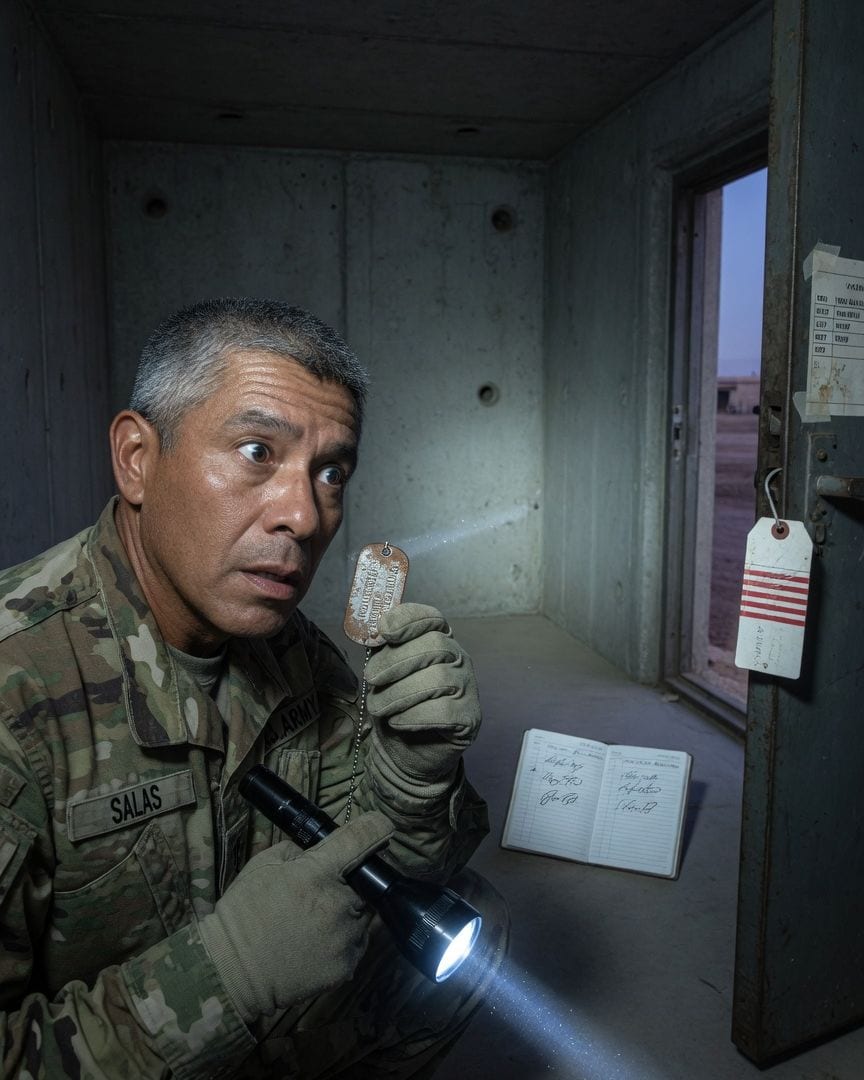
Chief Warrant Officer Gideon Salas meticulously oversaw the Hawthorne Ammunition Depot's inventory, racing against its final closure in two weeks. The high desert winds whipped dust across the familiar igloos as he worked, each bunker accounted for, until he reached the eastern perimeter. There, an extra igloo, Bunker 40, stood with a current lock and seal, though it wasn't on any map. A duty log propped open nearby listed inspections signed by men the Army swore didn't exist. His gut, honed by decades of service, churned with unease; inside the empty bunker, his flashlight found a corroded dog tag bearing one of those names, marked 'KIA, 1970'.
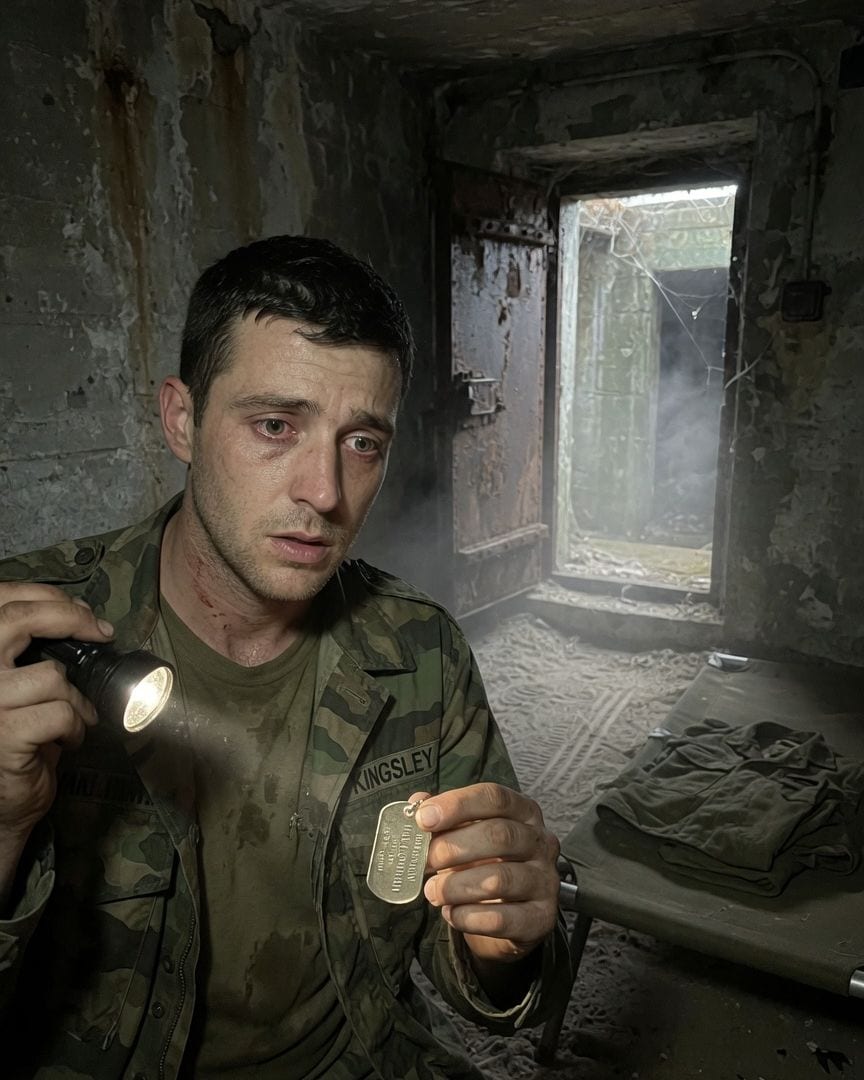
On his final rotation, a Private finds a WWII dog tag for 'Halloran' in a bunker sealed for eighty years.
Private Roland Kingsley endured the bone-deep weariness of his final graveyard watch at a reactivated WWII bunker on the Northern California coast, just hours from dawn and the end of his deployment. His searchlight cut through thick fog, revealing impossible figures: men in archaic WWII uniforms, assembling on the deserted beach, only to vanish moments later. As dawn broke, Kingsley discovered the bunker's rear hatch, sealed for decades, now stood mysteriously ajar. Inside, on an empty cot, lay a WWII-era field jacket, and in its pocket, a dog tag for 'Halloran' — a name impossible to the bunker's eighty-year history. What unseen presence had disturbed the long-sealed past?
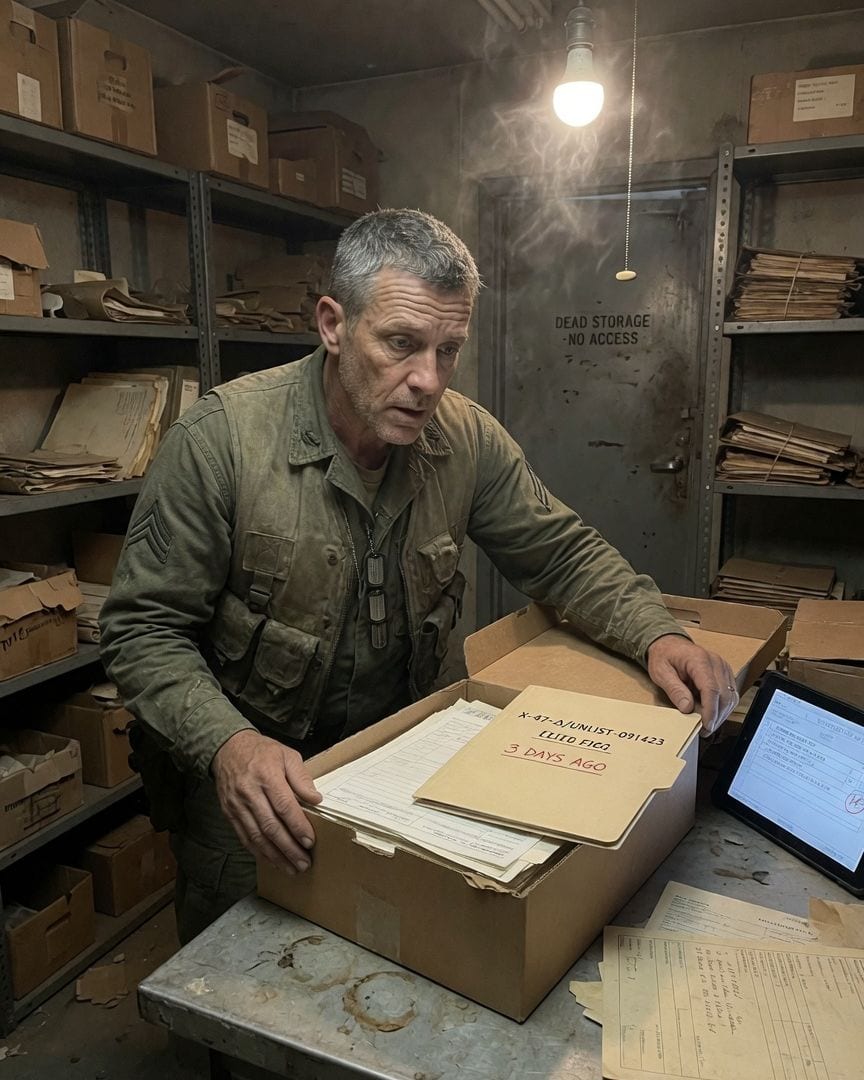
Sergeant Pryor, days from retirement, finds a four-hundred-foot crater. The desert floor is still warm, but no one remembers the blast.
Sergeant Alden Pryor, forty years old and just eleven days from retirement, drove the familiar Ranier Flats fence line for one of his final patrols. The desert stretched out, silent and vast, until he discovered a four-hundred-foot crater, dark and impossibly vast, where the sand had fused into slick glass. The ground within the crater was still faintly warm, a subtle heat defying the cool desert air. Yet, every official log confirmed the blast, while no one recalled a tremor or flash across three states.
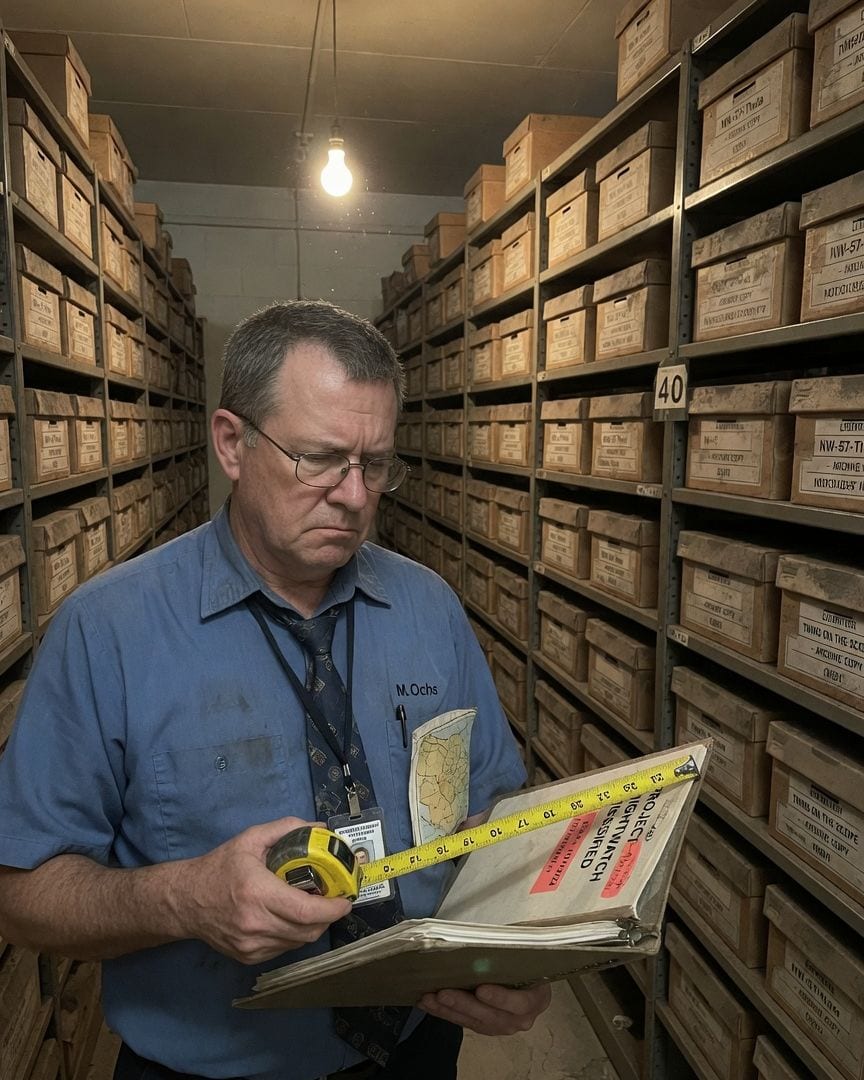
A Cold War records clerk on his final patrol found Aisle 40 stretched 61 feet longer, lined with unknown boxes. Inside one: 'PROJECT NIGHTWATCH - CLASSIFIED' with a fresh timestamp.
Marlin Ochs, a creature of habit after nineteen years at the St. Louis federal records depot, faced his final patrol through Aisle 40 before its scheduled pulping. His routine walk, usually 92 precise strides, suddenly stretched to an impossible 119, making the aisle 61 feet longer than its blueprint. The extra section felt colder, lined with dust-laden boxes bearing alien classification codes and no manifest. Inside one, he found a metal-bound file: 'PROJECT NIGHTWATCH - CLASSIFIED,' dated 1957, but with a timestamp just hours old.