My X-ray showed a complete hip replacement. I walk without a limp, and there's no scar on that thigh.
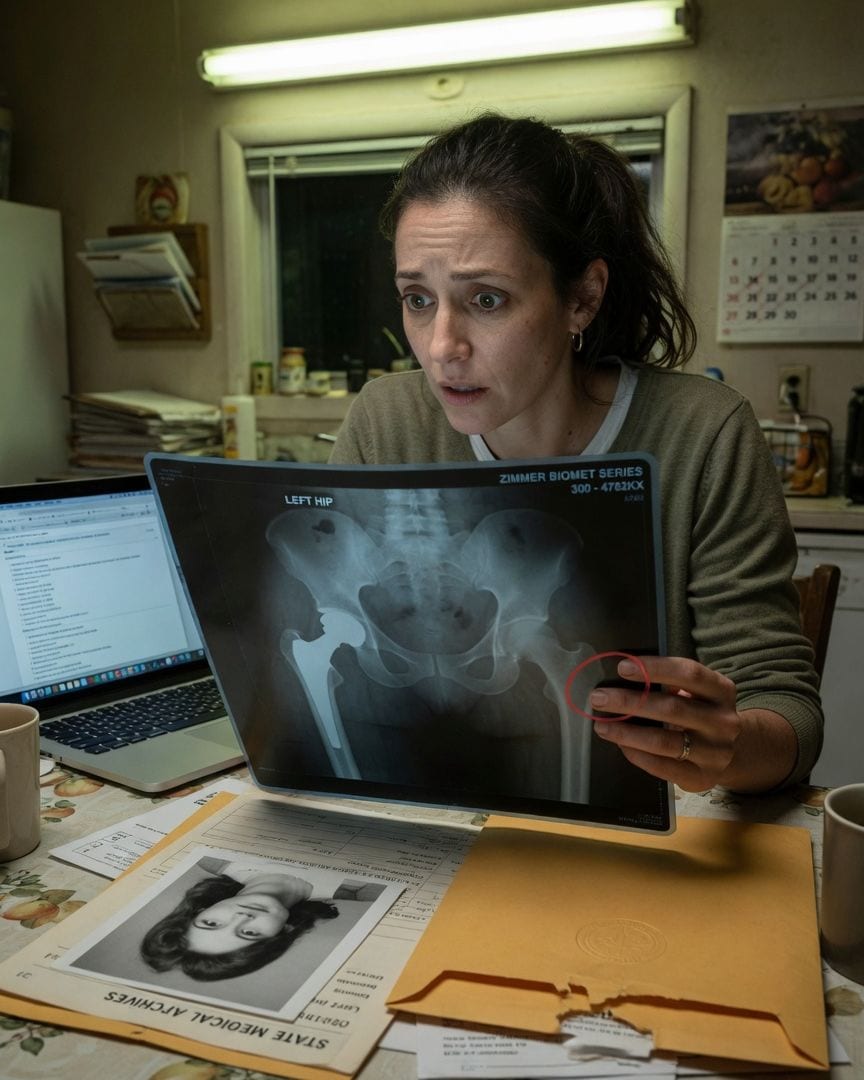
Eleanor Romano lay on the table, trying to make small talk with Dr. Samuel Sheppard, her surgeon, before a minor hernia repair. The pre-op pelvic X-ray was up on the light box behind him.
He’d just returned from reviewing it, and his usual jovial expression was replaced by a slight frown. “Eleanor,” he began, his voice carefully neutral, “when exactly did you have your left hip replaced?” I blinked. “Replaced?
I’ve never had major surgery like that, Dr. Sheppard. Only my appendix out as a kid.” He turned, gesturing to the X-ray.
There it was, stark and undeniable: a gleaming metal ball and stem, perfectly seated in her hip joint, the bone around it a seamless, healthy white, grown tight as if it had always been there.
It was a complete, textbook hip replacement. I stared. I felt no pain, had no scar, no memory of recovery, no long-forgotten limp. Nothing. My left leg felt exactly like my right.
Dr. Sheppard pulled up two more views, zoomed in. He read off the implant's make and size, a string of numbers. “It’s a Zimmer Biomet, Series 300, made for performance and longevity.
And it’s been in there for years, by the look of the bone integration. Are you absolutely certain, Eleanor?” I could only shake my head, a cold knot tightening in my stomach.
It was my hip, my body, but the image on the screen insisted a piece of it was a stranger’s history.
The hernia repair was postponed. I left Dr. Sheppard’s office with a referral for an orthopedic consult and a printout of the X-ray, the Zimmer Biomet serial number circled in red.
The silence in my car on the way home was heavy, full of questions I couldn't answer. Every step I took felt normal, yet the image on the X-ray film, lying on the passenger seat, screamed that it wasn't.
The orthopedic surgeon, a younger man named Dr. George Granger, confirmed it: a perfectly integrated, fully functional hip replacement. He found no record of it in my medical history, anywhere.
“It’s like it just appeared,” he mused, perplexed, his brow furrowed as he scrolled through my digital files. “Or you had it done under a different name, a long time ago. Are you sure you haven’t had any… memory gaps?”
The latter thought burrowed into my mind. Memory gaps? Was he implying I was crazy, or just forgetful? I knew my own body. I knew my past. I thought.
That night, I sat at my kitchen table, the fluorescent light humming over my head, tracing the contours of the metallic joint on the X-ray. The serial number. That was the key.
Dr. Sheppard had given it to me, almost as an afterthought, a piece of mundane data he expected me to verify. I typed it into a medical device database.
It returned a batch number, a manufacturing date from 45 years ago, and a list of hospitals that had purchased that batch. My stomach dropped a little further. Forty-five years. I was only 38.
Most of the hospitals on the list were closed, merged, or renamed. One, however, was still active, though its older records were now centralized in a state medical archives facility.
I filled out a complex request form online, citing the specific serial number and the anomaly in my own records, attaching Dr. Granger’s notes.
It felt like a shot in the dark, a desperate attempt to find a mundane explanation for the impossible: a paperwork error, a misfiled record, anything but what the X-ray implied. A week later, a thick, official-looking envelope arrived.
It wasn't a standard hospital envelope, but heavy cardstock, embossed with the State Medical Archives seal. Inside was a letter confirming a file had been located matching the implant's serial number, and a copy was enclosed.
My hands trembled as I pulled out the stapled packet of yellowed papers. The first page was a patient intake form. The name on it was not Eleanor Romano.
The name on the file was Ruth Davenport. The surgery date: October 12th, 45 years ago. I quickly calculated. Ruth Davenport would have been 28. I myself wasn't born until seven years after that date.
The file detailed the hip replacement, the same Zimmer Biomet Series 300, a chilling confirmation of the X-ray. There were nurses’ notes, a surgeon’s report, and then, tucked into a sleeve, a faded, black and white patient photo.
I pulled it out. It was a young woman, her hair styled in soft waves, a little bouffant, a way that spoke of a bygone era, of beehives and cat-eye glasses. But her eyes. Her jawline.
The curve of her mouth, even the slight tilt of her head. It was my face. Not identical, not a perfect mirror, but a resemblance so strong it stole the breath from my lungs and turned my blood to ice.
The woman in the picture, undeniably the patient who received the hip implant decades ago, had my eyes, my jawline, a face that could almost be my own twin, now long dead.
I spent the next few days in a daze, the photo of Ruth Davenport taped to my refrigerator, an unsettling mirror staring back at me.
The mundane explanations I’d tried to cling to – a mix-up, a lost file – had dissolved into something far more bizarre. A long-lost relative? A bizarre coincidence? I needed to verify everything, to see the original file.
I called the state medical archives and requested an in-person appointment, feigning a need to clarify details in a distant relative's file. They scheduled me for the following Tuesday.
The facility was a sprawling, low-slung concrete building, quiet and labyrinthine inside.
I met Helen Sterling, a quiet, meticulously organized woman in her sixties, whose office smelled faintly of old paper and dust, and a sharp tang of ozone from an antique air purifier.
She had kind eyes, but her expression held a weary resignation, as if she'd seen every strange thing the archives had to offer.
I presented the Ruth Davenport file copy, carefully explaining my unusual query, omitting the details of my own X-ray, framing it as a genealogical puzzle.
“I tracked this implant serial number,” I began, pushing the papers across her polished wooden desk, “and it led me to this record. I was wondering if such a precise match to an implant serial number was common.”
Helen studied the papers through her bifocals, her finger tracing the faded ink on the patient intake form. “Highly unusual, dear. Most people don’t have their implant serial numbers, let alone track them down like this.”
Her gaze was unreadable as she looked up at me. “But, not impossible.” I pressed, trying to keep my voice even. “And the patient… Ruth Davenport. Is this a genuine record?”
Helen nodded slowly, pulling a thick bound ledger from a shelf behind her. She flipped through the brittle pages, her movements unhurried. “Oh yes. Completely authentic. October 12th, 45 years ago. A pioneering procedure for its time, if I recall.
Tragic case, though. She didn’t recover well.” Her tone was calm, almost detached, as if discussing a forgotten library book, or a newspaper clipping from a century ago. The air in the room felt heavy, still.
I paused, my heart thumping against my ribs. “And the photograph… the resemblance is striking. To… my family.” Helen merely hummed, her eyes flicking to the photo I’d slipped from the copy, then back to the ledger.
“Genetics are a funny thing, aren’t they? Or perhaps… unique cases. We had a few of those in the older days. Experimental. Not all of them ended as planned, of course.”
She closed the ledger with a soft thud, returning it to its shelf. Her eyes met mine, and there was a flicker there – not of malice, but of something deeper, older. A knowing.
I left the archives with a profound sense of unease. Helen Sterling knew something, but wasn’t saying it, wrapped in the quiet authority of her position. The fluorescent lights of the corridor seemed to dim around me.
Back home, I considered my next, most logical step: DNA. I ordered a popular at-home genetic testing kit, telling myself it was to rule out some distant, unknown familial connection to Ruth Davenport. A third cousin, perhaps.
It was the only rational explanation left, however unlikely, however utterly improbable. I pricked my finger, collected the sample, and mailed it off, trying to banish the image of Ruth Davenport’s face, a ghost of my own, from my mind.
The days after mailing my DNA sample were punctuated by a growing sense of being watched. It wasn’t paranoia, not at first. I’m a creature of habit. I noticed small deviations from the norm.
A dark sedan, always a different make and model – a Ford, then a Honda, then a Subaru – but always idling subtly on my street as I left for work, or returned home.
The engines idled too long, the tinted windows too opaque.
I'd catch a glimpse of a shadowed figure in its window, but it would always drive off before I could get a clear look, turning a corner just as I stepped onto the curb.
The air in my apartment felt thinner, somehow, as if someone else was breathing it. One evening, an email arrived from the DNA company. Subject: 'Urgent Follow-Up Regarding Your Genetic Profile.'
The tone was unusually formal, devoid of the friendly branding I’d expected. It requested an immediate in-person consultation with a lead researcher, citing "unforeseen complexities." The urgency felt less about my health, and more about my results. It smelled wrong.
I called Helen Sterling, ostensibly to ask about another archive detail – a follow-up on "my family history." I needed to gauge her reaction.
“I’ve been thinking about what you said, about ‘unique cases’,” I prompted, my voice low, hoping she’d pick up on the subtext. Helen’s voice was softer this time, almost a warning. “Some things, Eleanor, are better left undisturbed.
The past… it has a way of clinging, even when you try to bury it.” Her words hung in the air, heavy with unspoken meaning, before she politely ended the call.
The dial tone buzzed in my ear, a contrast to the quiet dread now settling in. The next morning, as I walked to my car, a man in a dark suit stepped out from behind a parked van.
He was tall, with a precise, almost clinical gaze, his face smooth and unsmiling. He didn't seem out of place, yet entirely out of context for my quiet residential street. “Ms. Romano?”
he asked, his voice smooth, devoid of inflection, like a recording. I froze, my hand on the car door handle. “Yes?” He offered no name, no identification, just stood there, radiating an unnerving stillness.
“We advise you to reconsider your inquiries into certain… historical medical procedures. For your own well-being.” His eyes, dark and flat, held no threat, only an absolute certainty. It wasn't a warning, it was a statement of fact.
He didn’t wait for a response, simply turned and walked away, disappearing around the corner of the street. The message was clear. My digging had been noticed. My mundane explanation for being watched – simple paranoia – had evaporated.
This was real.
I went to the DNA company's office, my heart pounding a frantic rhythm against my ribs. The building was sterile, gleaming white, the air conditioning too cold.
The man who greeted me, Vincent Radcliffe, was a researcher in his early forties, his face pale and his hands visibly trembling as he offered me a glass of water I couldn't touch.
He led me to a small, windowless consultation room, the walls lined with acoustic panels, making the silence feel heavy. “Ms. Romano,” he began, his voice strained, almost a whisper, “your results are… unprecedented.
I’ve never seen anything like it in my career, and I’ve processed tens of thousands of samples.” He pulled up a complex genetic mapping on a large screen that dominated one wall.
It was a dizzying array of colored lines, segments, and labels. “We ran your sample multiple times. We cross-referenced it with every database we have access to, public and private. And it’s a 99.9% match to a specific individual.
Or rather, to their remains.” He clicked, and the intricate map was replaced by a grainy image of an old headstone. The stone was weathered, partly obscured by shadow. But the name was clear: RUTH DAVENPORT. Born: 19XX. Died: 19XX.
The dates matched the old medical file perfectly. She died shortly after her surgery, 45 years ago. I felt the floor drop out from under me, a sickening lurch in my stomach. “How is this possible?”
I managed to choke out. “Is she a distant relative? A forgotten aunt?” I grasped at the last, thinnest strand of a rational explanation.
Vincent shook his head, running a hand through his thinning hair, his eyes wide with an uncomfortable mix of fear and professional awe. “That’s the part we can’t explain. Your DNA, Eleanor, shows a full genetic match to Ruth Davenport.
But it also shows… a partial match to your own current genetic markers. Not as a daughter. Not as a sister. It’s… chimeric. Like two distinct genetic profiles existing within the same organism, but fused. Seamlessly.”
He pointed to specific sequences on the screen, bringing up magnified views. “This segment, here, is pure Ruth Davenport. Unmistakable. This segment, here, is uniquely yours. Your distinct genetic signature, as if you’d provided a sample from a different body.
And then, these overlapping regions, where they seem to have… blended. Not a mix. A fusion. At a cellular level.” I stared at the screen, a dawning horror chilling me to the bone, spreading through my veins.
The gleaming hip in my body, Ruth Davenport’s face mirroring my own in that faded photograph, the grave. It all clicked into a pattern too terrifying to comprehend, too cohesive to dismiss as coincidence. “What are you saying?”
I whispered, my voice barely audible. Vincent leaned forward, his voice dropping, his gaze intense.
“I’m saying, Ms. Romano, that the body you inhabit… appears to be biologically linked to Ruth Davenport, yet also contains unique genetic material that is undeniably yours. It’s as if… you are both there, somehow.
Her physical vessel, carrying your distinct genetic identity.” He looked at me, his eyes wide with a mixture of fear and awe, the stark white room feeling suddenly oppressive. “This shouldn’t be possible. It defies every known biological law.
It’s… artificial.”
Vincent, his face slick with sweat, began to explain the implications. “We need to run a full genomic sequence, Eleanor. This could rewrite everything we understand about human biology, about identity.
I’ve heard whispers, old urban legends in the scientific community, about a defunct, experimental program called…” He trailed off, his eyes fixed, wide and bloodshot, on his computer screen.
The complex genetic map, the grainy grave image, the data — it all vanished.
The screen went black for a moment, the hum of the machine seeming to deepen, then flickered back to life, displaying a single, stark message in white text on a black background: 'Project Chimera: Phase II initiated.
Subject ID: Eleanor Romano.' My breath hitched. Project Chimera. Helen Sterling’s ‘unique cases.’ Dr. Sheppard’s unblinking, calm gaze when he first showed me the X-ray. It wasn't a myth. It was real, and I was at its terrifying center.
Vincent scrambled to his keyboard, his fingers flying, trying to close the window, to open another program. Nothing responded. The message remained, unyielding, a glowing white assertion against the black, reflecting in his horrified eyes.
He slammed his palm on the desk. “No, no, no!” He tried the door, rattling the handle, pulling with desperate strength. It was locked. From the outside.
A soft, almost imperceptible click, like a single turn of a deadbolt, echoed from the office door, now locked from the outside.
Panic flared in Vincent’s eyes. He tugged frantically at the locked door, his breathing ragged. “They know,” he choked out, his voice hoarse. “They found us. Project Chimera… it was a black project, decades ago. Not just rumors.
My mentor, he hinted at it. 'Biological repurposing,' he called it. Transferring consciousness, or growing new ones in existing vessels. It was supposed to be shut down years ago. A complete failure. Too many… complications.”
My mind raced, every planted clue clicking into horrifying, undeniable place. The gleaming hip in my body, 45 years old. Ruth Davenport’s face, my face, staring out from that faded photograph, buried in a grave.
My own chimeric DNA, a seamless blend of her and me. Helen Sterling’s knowing calm, her quiet warnings about ‘unique cases’ and ‘experimental procedures.’ The man in the dark suit, his precise, clinical gaze, telling me to stop digging.
It wasn't a conspiracy theory anymore. I was a living ghost, a borrowed body, a successful experiment, and they had just confirmed it.
“They put me in her,” I whispered, the realization a cold, hard stone in my gut, heavy and suffocating. “They put my… self… into Ruth Davenport’s body. Or what was left of it after she died.”
Vincent nodded, distraught, abandoning the door to pace the small room like a trapped animal. “Or they grew you there. A new consciousness in a modified vessel. The chimeric DNA… it’s the proof.
They’ve been monitoring you, waiting for something, for ‘Phase II.’ To see if the integration held, if the new self would fully overwrite the old. And you, Eleanor,” he said, pointing a trembling finger at me, “are their success story.”
The dread was overwhelming, a physical weight on my chest, but it brought with it a terrible, crystalline clarity. I wasn’t just a person with a medical anomaly; I was an artifact, a project, a carefully observed biological vessel.
And now, they were initiating 'Phase II.' What Phase II meant, I didn’t want to know. It had to be containment, further modification, or worse. I looked around the room, desperate for an exit.
The windowless walls felt like a tomb, the air stale and thin. Vincent, still trying to force the door, was breathing heavily, his gasps loud in the oppressive silence. “We have to get out. Now.”
I scanned the small room, my eyes darting over every surface, every shadow. In the corner, almost hidden behind a tall stack of medical journals and a forgotten printer, was a small, unmarked panel.
It looked like a utility access hatch. I pulled at it, my fingers fumbling, and with a soft click, it opened, revealing a narrow, dusty service tunnel, smelling of old concrete and a faint metallic tang. “Vincent, here!”
I urged, my voice tight with urgency. He abandoned the door, scrambling towards me, his eyes wide with a sliver of desperate hope. “A maintenance shaft? Perfect.”
He squeezed in first, his larger frame struggling to fit, grunting with effort as he pushed his way into the darkness.
I grabbed the printed DNA results from his desk, the stark white paper of 'Project Chimera: Phase II initiated' still glowing faintly on the screen.
I stuffed the printout into my pocket, along with the copy of Ruth Davenport’s medical file. I would not leave without proof. As I was about to follow Vincent, the main office door burst open.
The sudden force made the papers on Vincent's desk flutter like startled birds. Two figures in dark suits, the same kind as the man who'd warned me on the street, stood silhouetted against the bright fluorescent light of the hallway.
They moved with a chilling, practiced efficiency, no wasted motion. “Subject, halt!” one commanded, his voice deep and resonant, cutting through the sudden silence. Vincent, halfway through the tunnel, his legs still visible, cried out, “Go, Eleanor! Don’t look back!”
I hesitated for a split second, meeting the cold, unblinking gaze of the approaching figures. I saw no malice, no anger, only purpose. I was a specimen, not a victim they hated, but a project to be contained.
With a surge of adrenaline, a raw, animal instinct to survive, I dove into the narrow opening, scraping my knees and elbows on the rough concrete, ignoring the pain.
I heard a thud, Vincent’s cry cut short, followed by a muffled struggle. The panel slammed shut behind me with a sickening finality, plunging me into absolute darkness and deafening silence.
I crawled, scrabbling through the dust and grime, the metallic tang of the tunnel air filling my lungs. The sounds of muffled voices and a struggle faded quickly behind me, swallowed by the winding passage.
I didn't know where I was going, only that I had to get out, had to keep moving. I was not Eleanor Romano, not anymore. Not the Eleanor I thought I was.
I was a walking, breathing testament to a monstrous secret, carrying the only evidence that my original self had ever truly existed, or that this strange, composite body was not entirely my own.
I was free, but at an unbearable cost: my very identity, shattered, my past a lie, my future a permanent flight from a truth no one would believe.
I vanished. I abandoned my apartment, my job, my entire life, a ghost in a body that wasn’t fully mine.
The DNA printout and the old medical file became my most prized, terrifying possessions, tucked into the sole backpack I carried.
I moved from town to town, taking odd jobs – waitressing, night auditing at motels, anything that paid cash and required no paper trail.
I was always looking over my shoulder, the memory of the dark suits and the clinical gaze burned into my mind. Vincent Radcliffe’s disappearance was noted in local news as a 'personal leave of absence' for "stress-related issues."
The DNA company issued a bland statement about a 'system error' affecting a small number of test results, a data anomaly quickly resolved.
I tried, once, anonymously, to upload the files online, creating a throwaway account, but they were dismissed as an elaborate hoax, another creepypasta, quickly buried under a flood of sarcastic comments. No one believed the impossible proof I carried.
I was alone with my stolen life, my composite self, a secret I couldn't share.
Years passed. I, now living under an assumed name, occasionally risked checking old news archives from burner phones, always wary of digital footprints. My new life was a constant low thrum of anxiety.
One late night, in a dingy internet cafe in a town I wouldn't stay in for long, I saw a small, innocuous article from a medical journal I used to read.
It was a glowing profile of Dr. Samuel Sheppard, my former surgeon, receiving a prestigious lifetime achievement award for “pioneering contributions to reconstructive surgery and tissue integration.” His photo accompanied the article.
He looked remarkably youthful for his age, his skin unlined, his eyes bright. Not just well-preserved, but almost… ageless. A faint, almost imperceptible curve played on his lips, a knowing smile.
It was the same subtle, unbothered expression I remembered from his office, the day he’d first shown me the X-ray of the hip that wasn't mine, the day this all began.
The proof I carried was useless to a world that saw a respected surgeon, not a keeper of impossible secrets. The wrongness was permanent, inside me, and still, quietly, moving through the world, celebrated even.
He smiled from the article, the same faint, knowing curve of lips I remembered from the operating room, and I knew I was just another of their successes.
If this one got to you
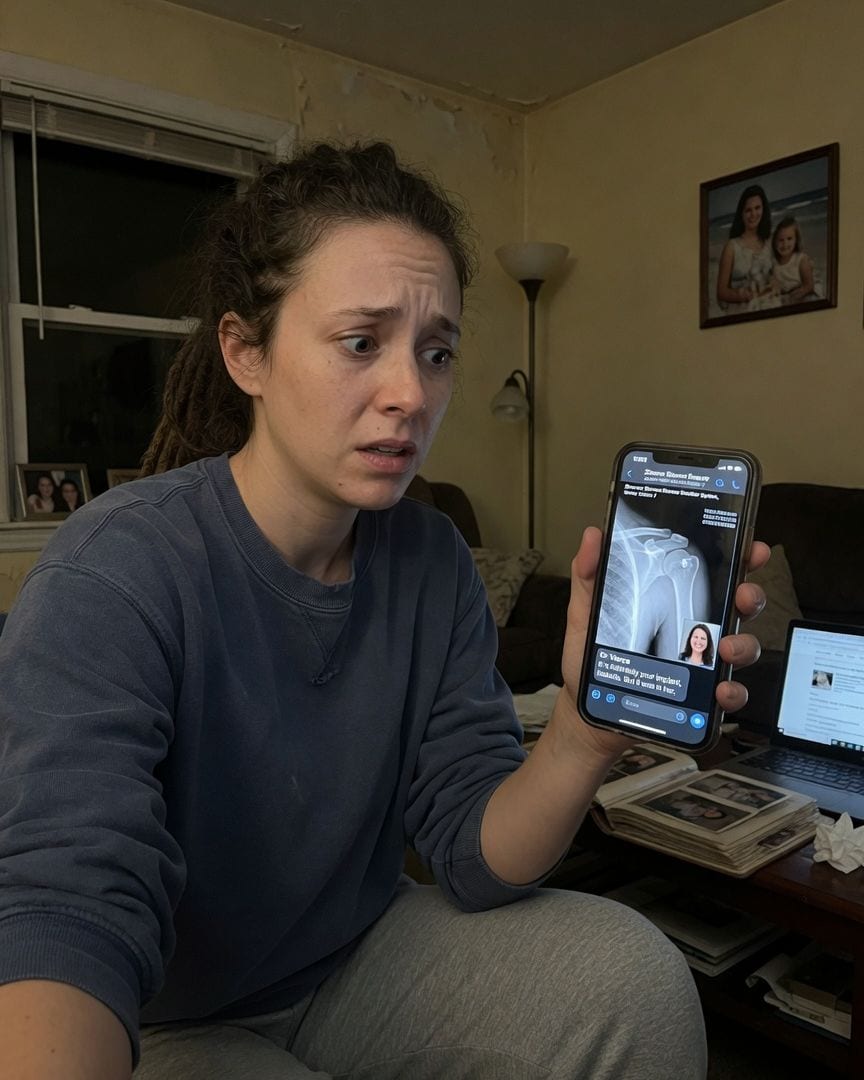
My shoulder X-ray showed a full metal replacement, bone grown tight to it. I have no scar, no memory of surgery, and the consultant asked for my surgeon's name.
An ache in my shoulder led me to the clinic, expecting a simple diagnosis. Instead, my X-ray revealed a complete shoulder replacement, perfectly integrated into my bone. The problem? I've never had surgery in my life, with no scars or memories to explain it.
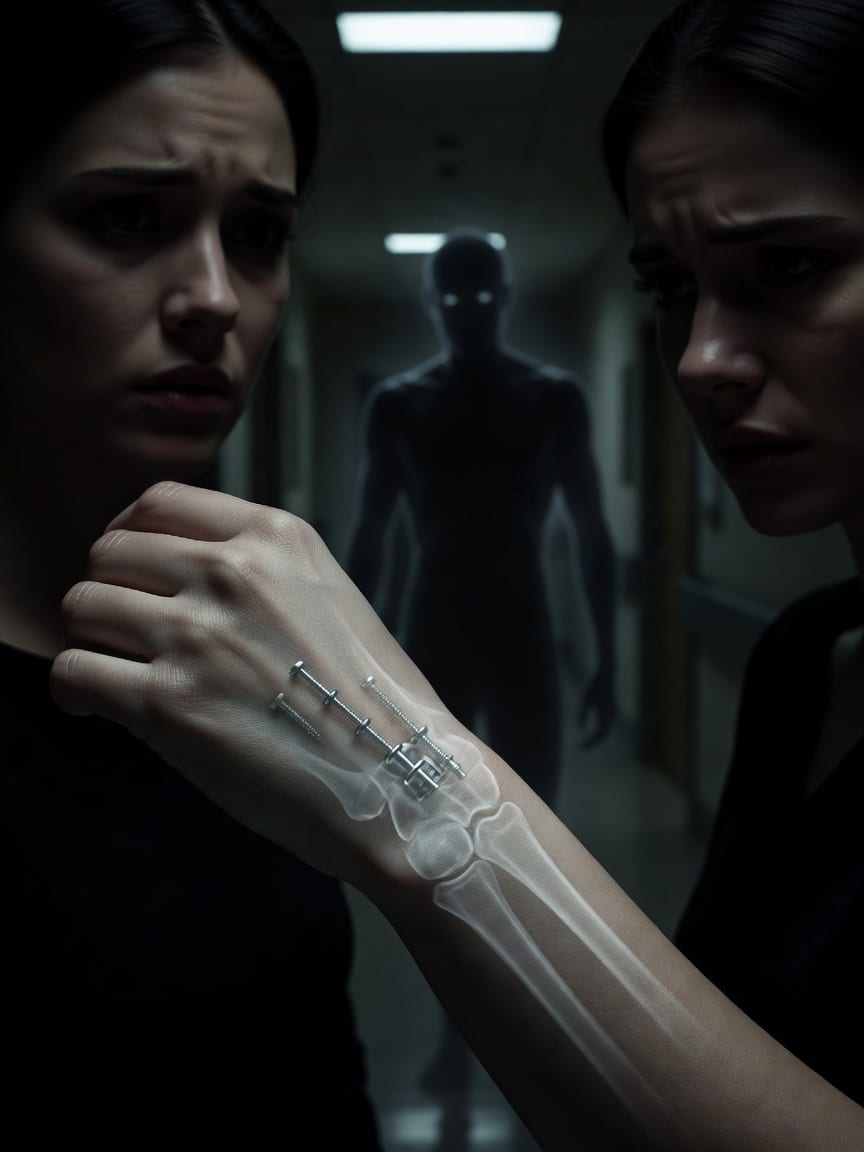
My wrist X-ray showed a titanium plate fixing a break from years ago. My surgeon asked which hospital did the operation. I've never had surgery in my life.
After a clumsy accident, I visited the fracture clinic for my swollen wrist. But my X-ray showed a perfectly healed titanium plate embedded in my bone – an implant I had no memory of receiving. Despite being decades old, there was no scar on my skin, and no medical record of the surgery under my name.
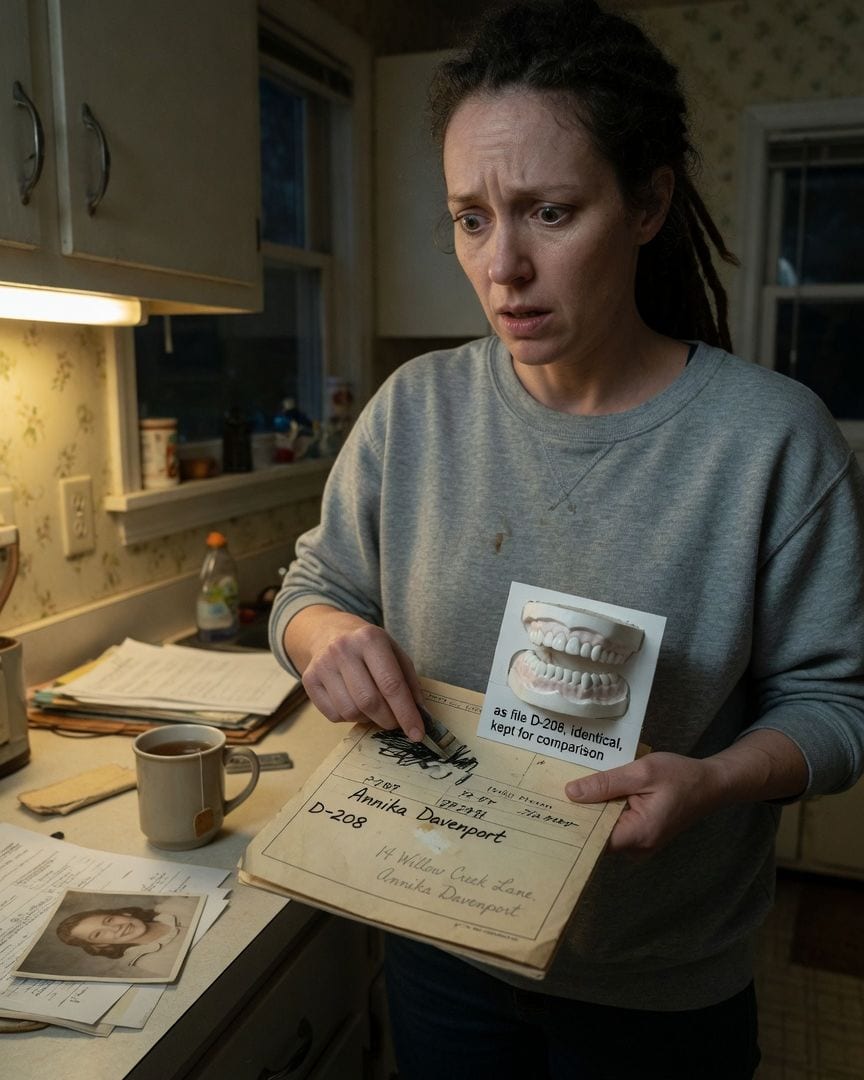
My childhood dental chart lists the house I bought last year — in my own name, years before I was born. A second set of my teeth sits filed beside it, marked 'identical.'
Sifting through old dental records, I found my chart, D-208, with my 1988 birth date. But a line from 1958 was blacked out, and a clipped card with an impression of my teeth listed my name and current home address, decades before I was born. The impossible facts knotted into a cold certainty.
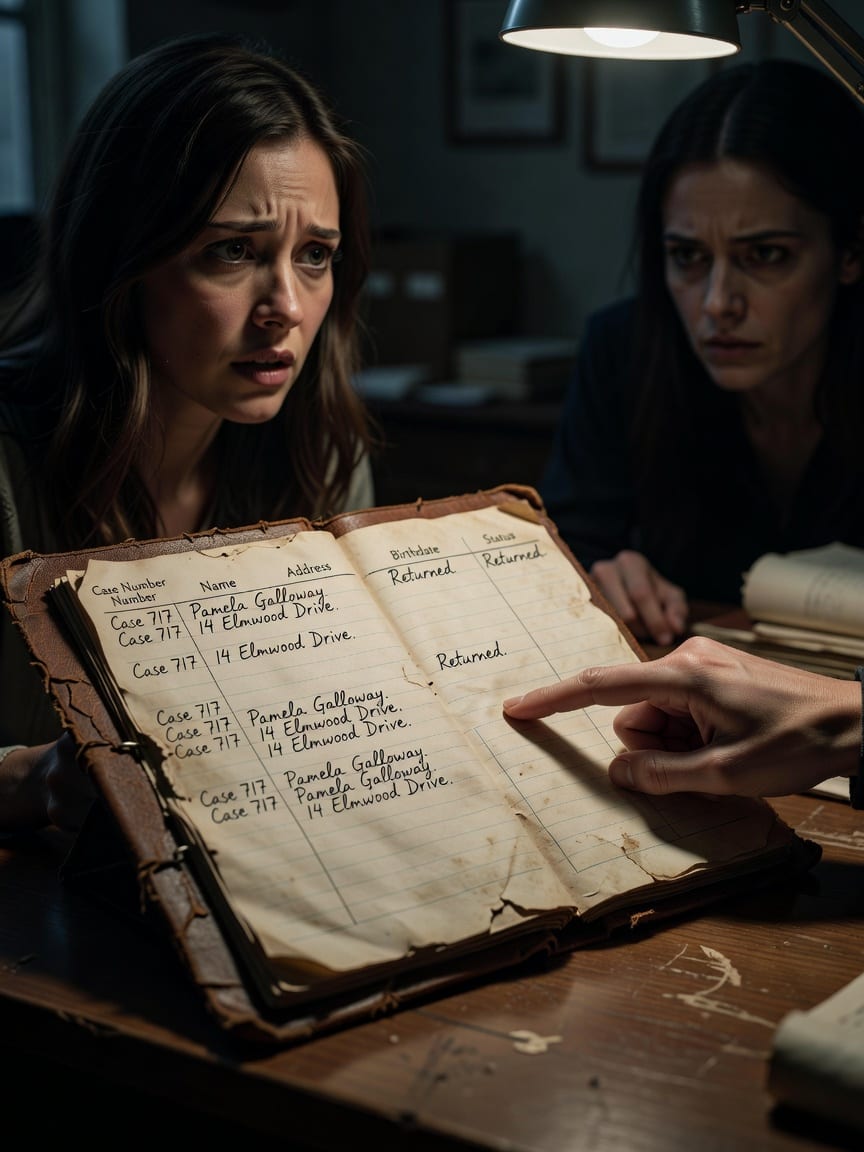
My hospital file has a blacked-out line from 1988. It names my street address, decades before I lived here. Then: 'returned'.
I finally got my medical file, hoping to clear up a ridiculous bill. Inside, I found an entry from 1988: my current home address, scrawled on a partial intake form and marked 'returned.' I was six then, living fifty miles away.
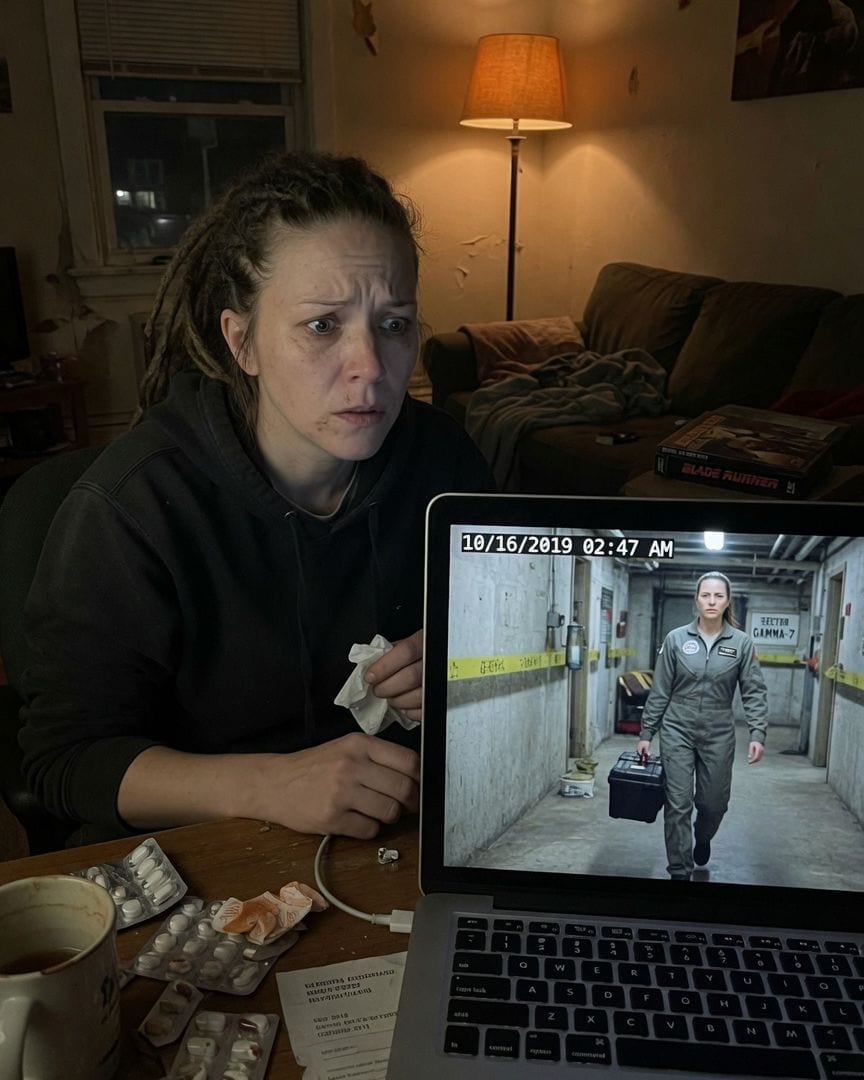
My timesheets show me working night shifts in a town I never lived in. The signatures are mine. The pay went to an account that isn't.
An old employer sent me timesheets from five years ago, detailing night shifts I supposedly worked at a depot 80 miles away. But I knew I was home recovering from surgery that entire week, nowhere near the industrial town. Then a security photo arrived, showing my face in an unfamiliar uniform, working a shift that wasn't quite me.
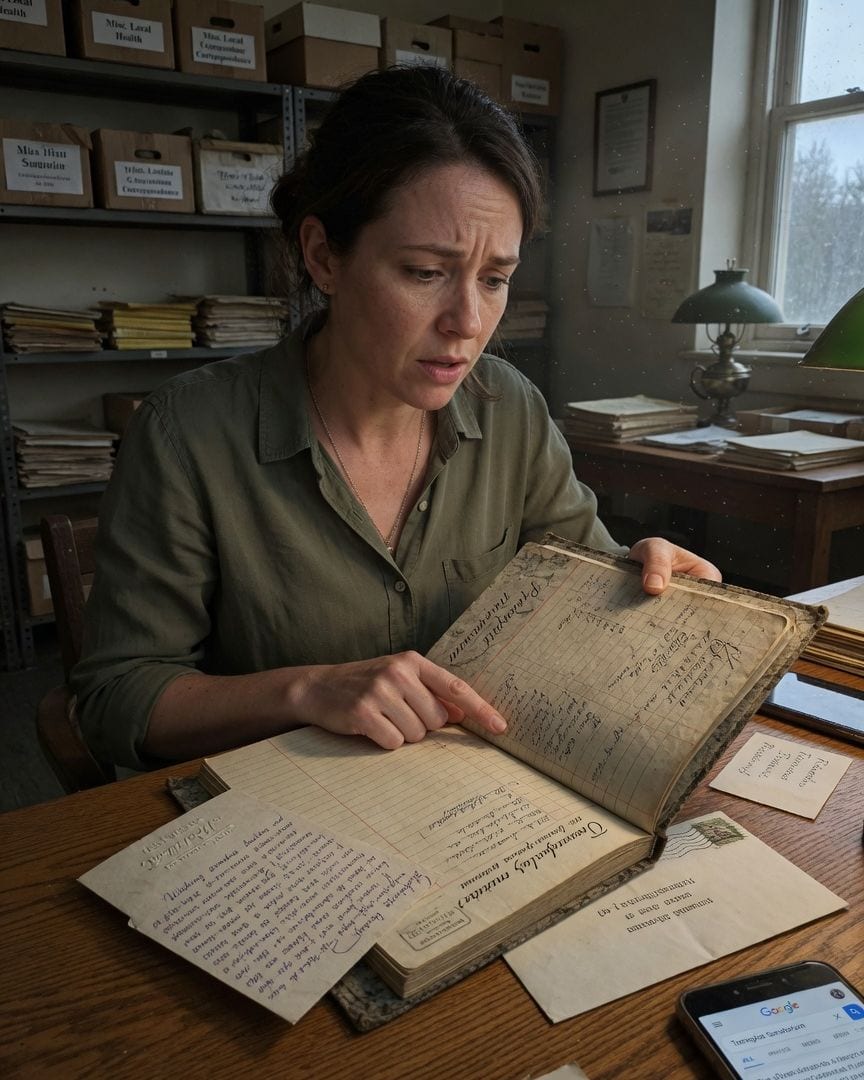
My get-well card wished me recovery from an operation I never had, postmarked from a hospital that burned down in 1963.
I received a get-well card wishing me recovery from an operation I never had. The envelope bore a fresh postmark from Treneglos Sanatorium, a TB hospital that burned down and ceased to exist in 1963. Now, a patient register from that long-gone sanatorium lists my name, dated 1959.