An Airman on his final Cold War watch hears the empty third chair sigh as a man sits. Moments later, the system logs 'Operator 3: Ready for Transfer'.
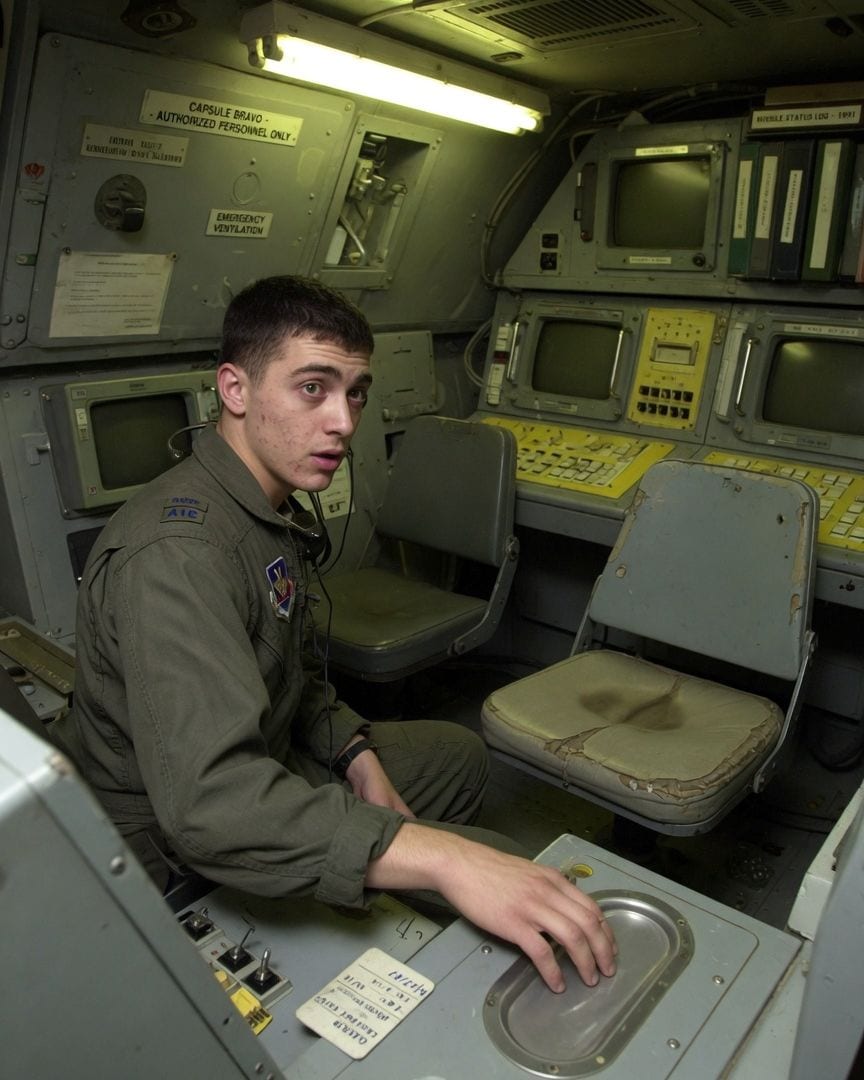
Airman First Class Dov Kestrel, 20, adjusted his headset, the dim console lights reflecting in his tired eyes.
He was on the last watch of the last alert at Halloway Site Bravo, seventy-two hours before the wing stood down for good in late 1991.
The isolation of the underground missile capsule was absolute, built for two operators, two chairs, two keys, behind an eight-ton door. But in the corner, bolted to the deck plates, sat a third chair.
Its frame was painted the same twenty-year-old gray as everything else, and the seat cushion was worn smooth.
Dov had checked the manifest when he first came on shift, trying to rationalize it, but the document listed 'Operator 3 Console and Chair' as original equipment. It made no sense. He was alone.
The capsule was empty save for him. The ventilation system hummed, a low, constant presence that usually faded into background noise. The air hung heavy and still.
At 0300 exactly, a soft, distinct sound echoed in the silence: the sigh and settle of a cushion, the way a chair does when a man sits down in it.
Dov froze, breath held tight in his chest. He strained his ears, listening for a follow-up sound, a cough, a rustle of uniform. Nothing. The silence settled back, thicker than before, pressing in from the metal walls.
He slowly turned, his gaze fixed on the third chair. It was empty. He told himself it was the old metal groaning, the air pressure shifting, anything but what he’d heard. He rose, walked over, and peered at the chair.
The cushion was indeed worn, a deep indentation in the center suggesting long use. As he ran his hand along the seam, his fingers brushed against something stiff.
Tucked deep into the fabric was a small, plasticized maintenance tag, the kind used for equipment checks. It was for 'Operator 3,' and beneath that, a stamped date: '11/15/91'—yesterday’s date. Below that, a crisp, official initial 'R.V.'
He knew Sergeant Vance had been in the capsule earlier yesterday, signing off on various decommissioning checks, but Vance was George, not R.V., and certainly not 'Operator 3.'
Dov tried to dismiss it as a forgotten tag, a misfile, a joke, but the date was too recent, too specific. The cold precision of the date, the official font, argued against any casual explanation.
He pulled the tag free, the plastic cool against his fingers, a cold unease beginning to coil in his gut. The capsule’s single fluorescent light above his console flickered, a brief, sharp shudder.
The tag felt too real to ignore. Dov returned to his console, his fingers flying across the auxiliary system's log interface. He typed 'Operator 3,' then 'R.V.,' then '11/15/91.'
The system whirred, its internal fans kicking up a notch, then displayed a single, chilling entry: 'Operator 3: Status Green, Ready for Transfer.' The timestamp on the entry was 03:01, just one minute after he’d heard the sound.
He checked the main capsule log, cross-referencing times, but found no corresponding entry for a third operator. No authorized personnel had been logged in. He leaned forward, staring at the screen, then glanced back at the empty chair.
A detail he hadn't noticed before caught his eye: on the console panel directly beside the third chair, where an operator's hand would rest, was a faint, almost invisible indentation in the twenty-year-old plastic.
It was a smooth, polished oval, as if a hand had rested there thousands of times. Dov slowly reached out, placing his own hand over the mark. It fit perfectly, his fingers aligning with the subtle depressions.
He pulled his hand away sharply, a cold dread washing over him.
The handprint on the console next to the phantom chair, fitting his own, sent a tremor through Dov.
He tried to rationalize it again: an old mark from a previous operator, perhaps, before the two-man system was strictly enforced, before the capsule had settled into its final, sealed purpose.
But the 'Operator 3' log entry from 03:01, after he’d heard the sound, lingered like a bad taste. He accessed the capsule's internal network, bypassing the standard operational logs to delve into historical archives.
His search terms grew increasingly desperate: 'third operator protocol,' 'unaccounted personnel Halloway,' 'Omega 3.' He found fragmented, heavily redacted documents.
Most were classified, locked behind protocols that even his senior clearance wouldn't touch, but enough snippets emerged to form a terrifying picture.
References to 'Contingency Protocol Omega-3' and 'Non-Designated Personnel' kept appearing, always linked to 'continuity of operations' and 'system integrity.' The language was bland, bureaucratic, chillingly devoid of human context.
He noticed a disturbing pattern: these entries, though sparse and often just cryptic codes, ran parallel to the official two-man logs, sometimes overlapping, sometimes continuing long after a unit was officially decommissioned. It wasn't a clerical error.
It was a separate system, quiet and persistent, recording a presence that wasn't supposed to exist, a hidden layer of documentation within the very heart of the facility.
He felt a growing certainty that the 'Operator 3' entries weren't mistakes, but deliberate, ongoing records of something officially sanctioned yet deeply hidden.
The capsule, meant for two, had always had a ghost in the machine, and its paperwork was immaculate.
Dov’s deep dive into the historical logs triggered an alert. The secure line to his console buzzed, startling him, the sudden sound a harsh intrusion in the quiet capsule.
It was Sergeant George Vance, his voice calm but with an edge Dov hadn’t heard before. “Airman Kestrel, I’m seeing some unauthorized access to restricted historical files. Everything alright down there?” Dov stammered, trying to formulate an excuse.
“Just, uh, curious about some old maintenance protocols, Sergeant. Pre-decommissioning stuff.” The lie felt thin, transparent even to his own ears. Vance’s reply was slow, deliberate, each word dropping into the silence with unsettling weight.
“Airman, your job is to monitor the current manifest, not to go digging where you don’t belong. Some things are best left in the past.” The line clicked off, leaving a ringing silence that felt heavier than before.
Dov felt a prickle on his skin. The capsule’s internal cameras, usually ignored, tiny black domes in the upper corners, now felt like eyes on him.
He scanned the room, a chilling sense of being observed settling in, the very air in the capsule feeling denser, colder. He went back to the archives, searching for 'Omega-3' again, this time adding 'personnel.'
He navigated past layers of security warnings, the system fighting him, as if trying to protect a secret that belonged to no one.
He found a single, unredacted entry in an old log from 1978: 'A1C Nathaniel Marsh reported failure to relieve for duty. Reclassified as Operator 3 under Contingency Protocol Omega-3. Service record to continue.' Nathaniel Marsh. A real person. Reclassified.
The implication hit him like a physical blow. The 'third man' wasn't just a protocol; it was a fate. And someone knew he was looking for it.
A few hours later, Sergeant Vance appeared at the capsule door for a routine check, his face impassive, his posture rigid. The heavy door hissed shut behind him, sealing them both into the small, echoing space.
Dov decided to press him. “Sergeant, about 'Operator 3' and the 'Omega-3' protocol…” Vance cut him off, his eyes locking onto Dov’s, unblinking. “Some things, Airman, are just part of the system. You learn not to question them.
You just process the paperwork.” He spoke with a disquieting calm, as if this were an everyday conversation about inventory. Dov pushed back. “But the records keep writing, Sergeant. For decades.
How can someone be 'reclassified' as an operator after they’re gone?” Vance sighed, a long, weary sound that seemed to carry the weight of years.
He leaned against the console, his gaze distant, unfocused, as if looking through the metal walls to something far away. “The system needs continuity, Airman. It always has. When a link in the chain breaks, another one forms.
Sometimes, it’s not a new man. It’s… a reclassification. A way to ensure the record, the 'file,' never stops. That’s all 'Operator 3' is. A placeholder. A designation for those who ensure continuity, even if they’re not… physically present.”
He spoke of it with a chilling detachment, as if discussing a piece of equipment, a broken circuit that needed patching. “The File That Kept Writing, as you call it, is very real.
It’s how their service continues, how the system keeps running, even when it shouldn’t. They’re not lost, Airman. They’re filed.” Dov felt a cold clarity.
The 'third man' wasn't a ghost with a name, but a functional role, a bureaucratic designation that absorbed living people, turning them into perpetual entries in a hidden ledger.
Nathaniel Marsh, and others like him, hadn't vanished; they'd been formally re-designated into an abstract, eternal service. The sound, the tag, the logs—it all clicked into a horrifying, coherent pattern of systemic absorption.
The dread wasn't in the unknown, but in the precise, methodical process of it all. The capsule’s atmosphere grew heavy, the air thick with unspoken truths.
The chilling truth of the 'Operator 3' designation, a bureaucratic reclassification of the 'lost,' settled deep in Dov's mind. He understood that the system didn't lose its people; it merely repurposed them into an endless, quiet service.
But a darker thought gnawed at him: if others had been reclassified, could he be next?
His fingers trembled as he returned to the encrypted archives, this time searching for his own name, 'Kestrel,' within the 'Omega-3' and 'Operator 3' files.
He navigated through layers of firewalls and obscure code, deeper than he’d ever gone, the console's fans whirring a frantic rhythm. His heart hammered against his ribs as he cracked open a file. The document was a 'Contingency Transfer Order.'
His official assignment to Halloway Site Bravo was listed, standard procedure, his rank, his name. But then, beneath his official rank and name, was a secondary classification, italicized and bolded: 'Designated Provisional Operator 3 (P-O3), effective 0300, final shift.' The date on the order was today’s date.
His own name. His current assignment. The exact time he heard the cushion settle. He wasn't just investigating the file. He was already named in it. He was already part of it.
The sound, the tag, the log entry – they weren't for someone else, they were for him. He stared at his own name, now an entry in a file that never stops writing.
The full, horrifying truth detonated in Dov’s mind. The 'third man' wasn't an individual operator, but a role, a designation, a function.
It was a place for those who ensured the system's continuity, filed away, their service records continuing long after their physical presence ceased.
The cushion sighing at 0300 wasn't an operator arriving; it was him being logged into the role, his personal file seamlessly integrated into the 'Operator 3' designation.
The maintenance tag, the handprint, the 'Status Green' log entry—they were all initial indicators of his own reclassification, his absorption into the 'Omega-3' protocol.
The secrecy machine didn't lose people; it reclassified them, their records flowing into an endless, self-perpetuating bureaucracy.
He saw the pattern across decades: airmen, pilots, missileers, listed as 'missing' or 'failed to report,' but secretly re-designated as Operator 3, their phantom service continuing. The base was closing, but the 'files' and the 'operators' were not.
They were simply transferred, folded into a larger, more abstract system, ensuring the 'continuity of operations' for eternity. The dread was in the perfect, cold coherence of it all. There was no escape; the system had already accounted for him.
Hours later, Captain Carol Vaughn, 52, arrived for the final shutdown procedures. She found Dov Kestrel sitting in his operational chair, but he was facing the empty third chair, a strange, quiet calm on his face.
The console glow illuminated his profile, casting long, still shadows across the capsule. “Airman Kestrel,” Vaughn said, her voice crisp, cutting through the silence. “Everything by the book?” Dov turned, his eyes holding a depth of knowledge that unnerved her.
His gaze was steady, unnervingly lucid. “It’s all by the book, Captain,” he replied, his voice flat, devoid of emotion, like a well-worn recording. He gestured to the third chair. “Every last page.” He didn't scream, didn't fight.
Instead, he methodically recounted the 'Omega-3' protocol, the 'non-designated personnel,' and how the records continued, how people were 'filed' into perpetual service.
He explained the system's need for continuity, its silent, bureaucratic horror, the way it swallowed individuals and repurposed their existence into endless paperwork. Vaughn listened, her expression unreadable.
She didn't deny it, didn't try to offer a mundane explanation, or dismiss him as delusional. She simply watched him, her gaze steady, a flicker of something unreadable in her eyes.
When he finished, she took a long breath, a soft sigh that hinted at a burden long carried. “Some things,” she said, her voice low, barely above a whisper, “are above our pay grade, Airman. Just sign out.”
She handed him the final decommissioning log. Dov took the pen, his hand steady. He was not escaping. There was no escape. He was simply signing out of one file, and into another.
The full truth was understood by him, and implicitly, by her. It could not be undone. He was just left knowing.
Dov Kestrel signed out of Halloway Site Bravo, the last airman to leave the now-sealed capsule. The eight-ton door hissed shut for the final time, its metallic groan echoing the closing of an era.
The base itself was quietly decommissioned, its purpose fulfilled, its secrets buried deeper. A week later, his transfer orders arrived. They were for a records management facility in a remote, unnamed location, deep in the American heartland.
The orders were standard, blandly official, but the internal routing code for his new assignment was 'Omega-3-Designated.' He packed his minimal belongings, a small duffel bag, his movements precise and unhurried.
He didn't tell anyone what he knew, the words feeling heavy and pointless, already part of a system that rendered speech irrelevant.
The dread was not in what he might face, but in the chilling coherence of the system he was now part of. He was filed. The paperwork continued.
Years later, Dov Kestrel, now in his early thirties, worked in a vast, climate-controlled archive. Endless rows of declassified files, dusty and forgotten by the outside world, were his domain.
He processed records for personnel long dead, some with impossible, ongoing entries, their 'service' continuing on paper, in silent, endless columns of data.
He occasionally saw new transfer orders come through, marked 'Omega-3-Designated,' for individuals he recognized from old photos, their faces youthful and unaware, just as he once was. He knew their fate.
One quiet afternoon, a junior archivist, Chloe Delaney, 22, a bright-eyed new recruit, approached his desk. She held a particularly thick, decades-spanning file, its covers worn smooth by time and handling.
“Mr. Kestrel,” she said, her brow furrowed in confusion, a slight tremor in her voice, “can you help me with this? It’s for 'Operator 3, Halloway Site Bravo.' She pointed to a recent entry, a transfer order dated today.
“Someone’s still signing off on this. But the base closed in '91.” Dov looked at her, then back at the file, and a faint, wrong little smile touches his lips.
If this one got to you
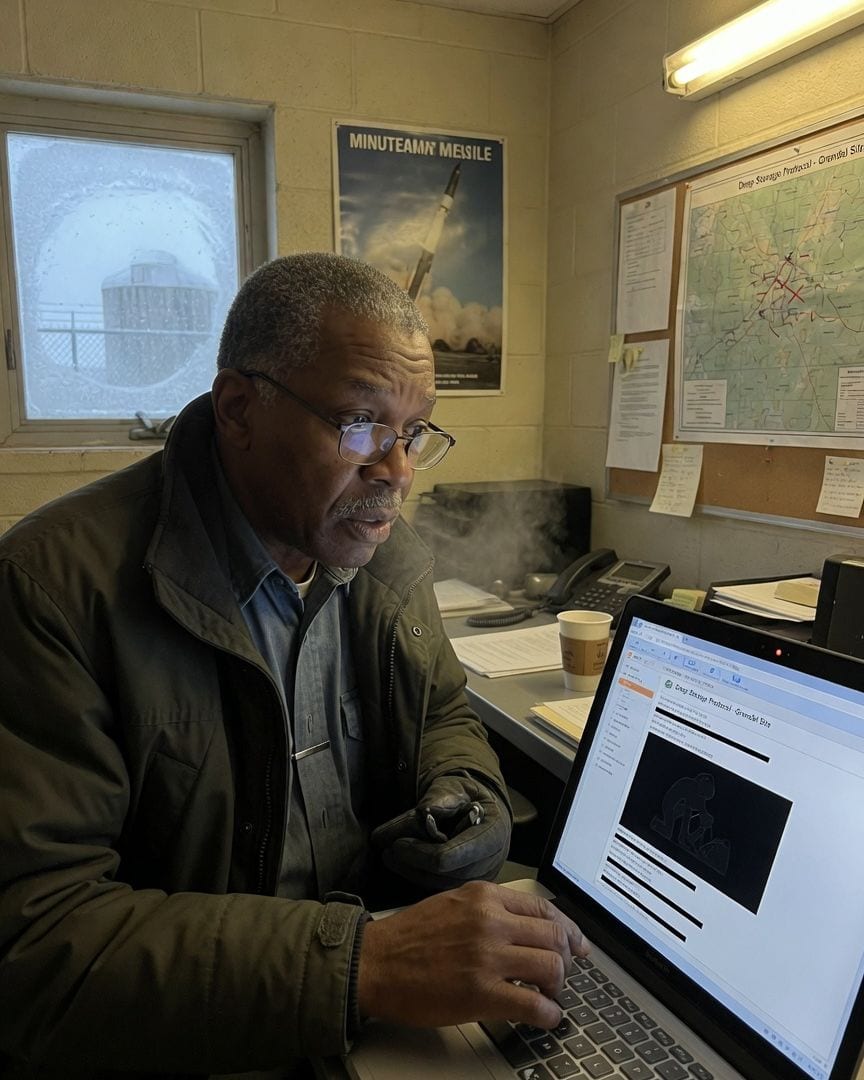
On his last cleanup before retirement, Colonel Marsalis found a dead Cold War missile silo's printer repeating: CREW STILL ON STATION.
Colonel Ren Marsalis, a career Air Force officer, faced his final administrative cleanup before retirement at the decommissioned Grendel Site in the biting North Dakota winter. He expected a sealed missile capsule, but Capsule 7's eight-ton door stood cracked open eleven impossible inches, its hydraulics removed in 1985. Inside, consoles glowed with static alerts from an unknown power source, while an old printer endlessly spooled paper repeating one chilling message: "CREW STILL ON STATION. ACKNOWLEDGE." This impossible communication, from a long-dead system, was no glitch; it hinted at a deliberate, hidden presence, a truth reinforced by a redacted document showing a hunched, humanoid shape.
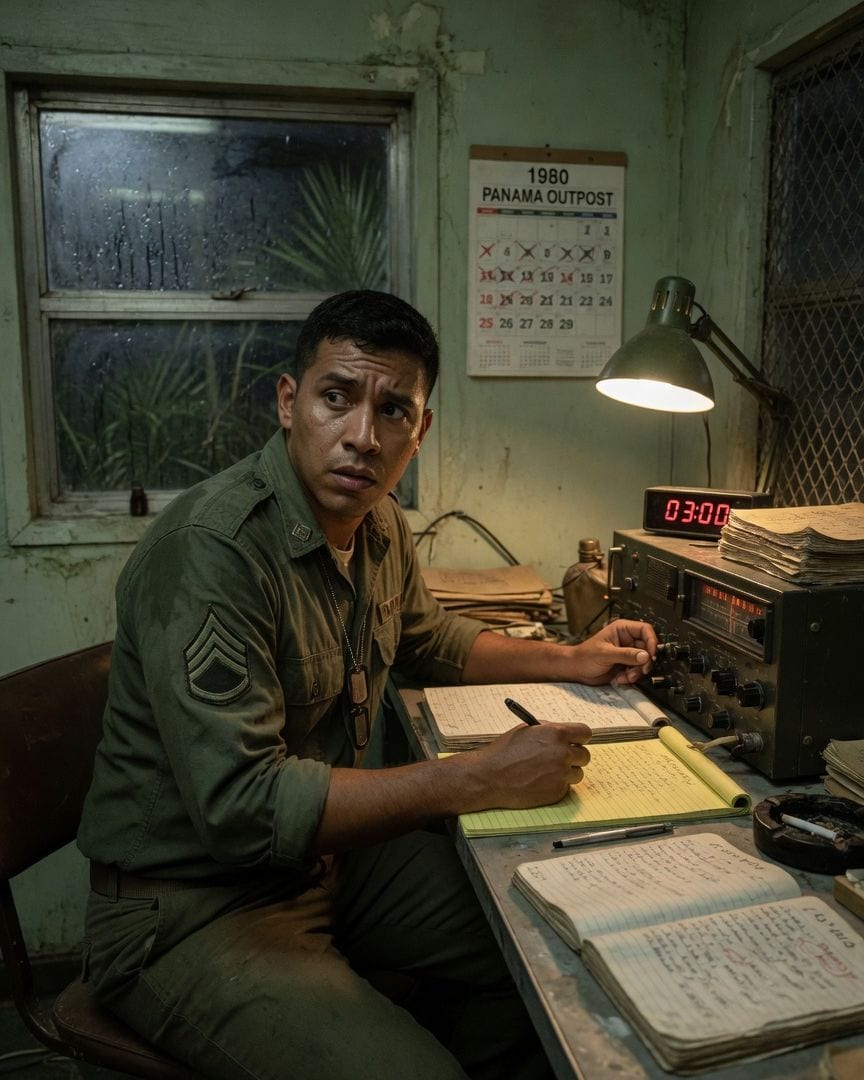
A Cold War comms operator at a remote outpost hears predecessors listed as 'stopped answering' — then the voice calls his own name.
Sergeant Adam Ibarra endured the damp Panamanian night in his remote outpost, the hum of old equipment his only companion. For three nights, a calm woman's voice transmitted a looping list of names and dates on the comms set, initially dismissed as a forgotten test loop. But the truth chilled him: these were his predecessors at the station, listed with the precise dates they had 'stopped answering' — and the sequence ended with a blank space just before his own. On the fourth night, Ibarra waited, rigid, as the voice added the last operator's name before him, then paused. Clear as a bell, it finally spoke: 'Ibarra, Adam.' What date would it add next?
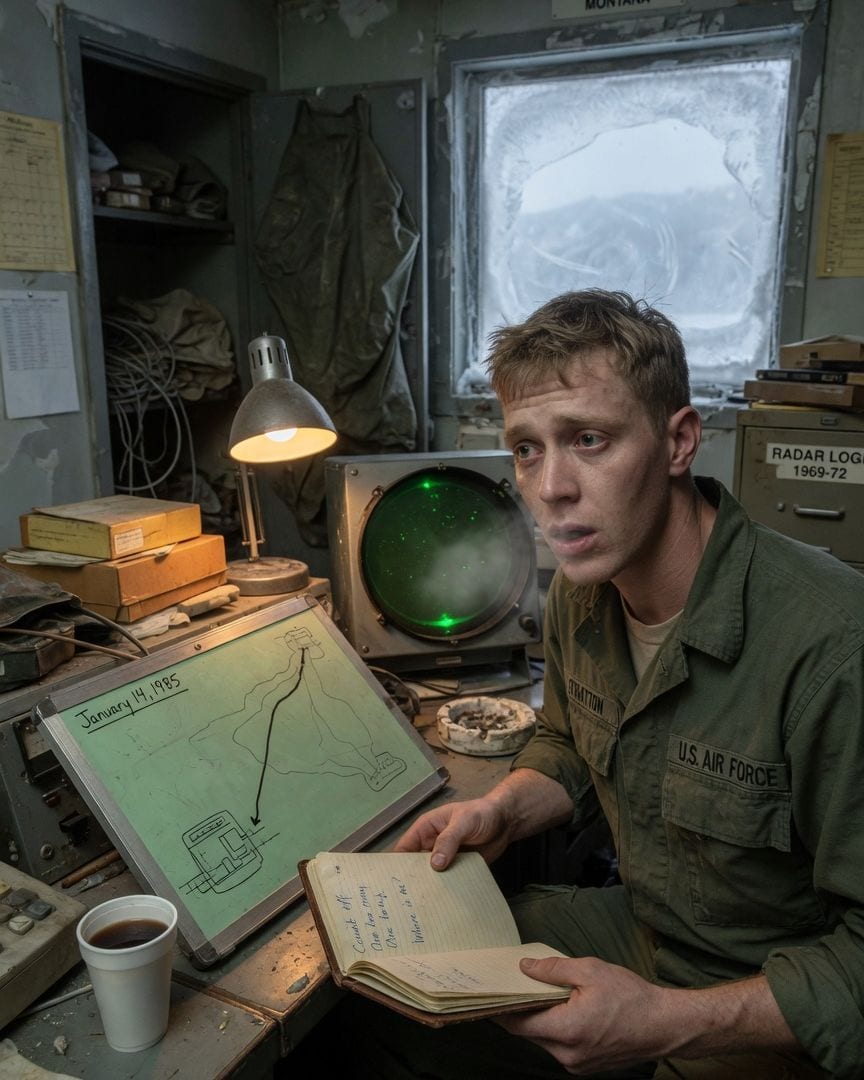
Airman Lars Stratton found an old Cold War manifest listing one name twice: 'Bernard Radcliffe' transferred and 'Bernard Radcliffe' still present.
Airman Second Class Lars Stratton was counting down his final weeks at Echo Station, a desolate Cold War outpost due for mothballing. He longed for home, far from the bitter Montana winds and the constant hum of static. Inside the dim radar shack, he logged the usual nightly ghost blip, a faint contact appearing at 2300, just as it had every winter since 1987. This night, a metallic tang like old blood lingered in the air, raising the hairs on his arms. Seeking distraction, Lars later discovered a leather-bound logbook from 1971, detailing the same 2300 contact, but with chilling notes and a manifest listing one airman's name, Bernard Radcliffe, twice—once transferred, once present. Was he truly alone in the silent, remote station?
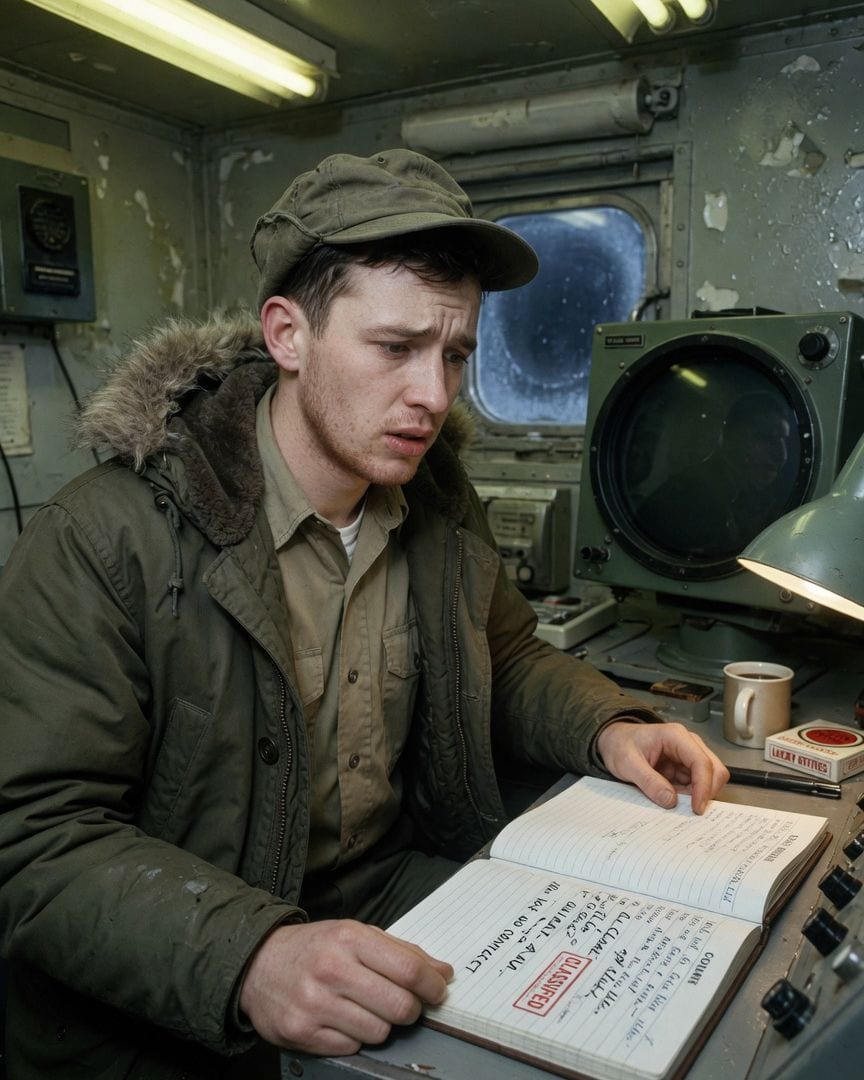
A Cold War airman logs an impossible radar contact on his last sweep. But his official logbook entry is stamped 'CLASSIFIED' and then contradicted by a hastily scrawled 'ALL CLEAR' dated moments before it.
Airman Ordway Vance, 22, manned the radar dome at Site Pellin in the biting North Atlantic dark of January 1962, running the last calibration sweep before its decommissioning. His scope picked up a faint, impossible return, growing closer with each pass, though the ocean remained empty to the eye. When Vance detailed the contact in his official logbook, a 'CLASSIFIED' stamp appeared, followed by a hastily scrawled 'ALL CLEAR' dated moments before his own entry, contradicting his every word. Commander Hartley dismissed it as equipment malfunction, but Vance sensed a chilling, official erasure behind the lie. He soon found a locked cabinet marked 'SITE PELLIN ANOMALIES,' hinting at a deeper truth buried within the base's final days.
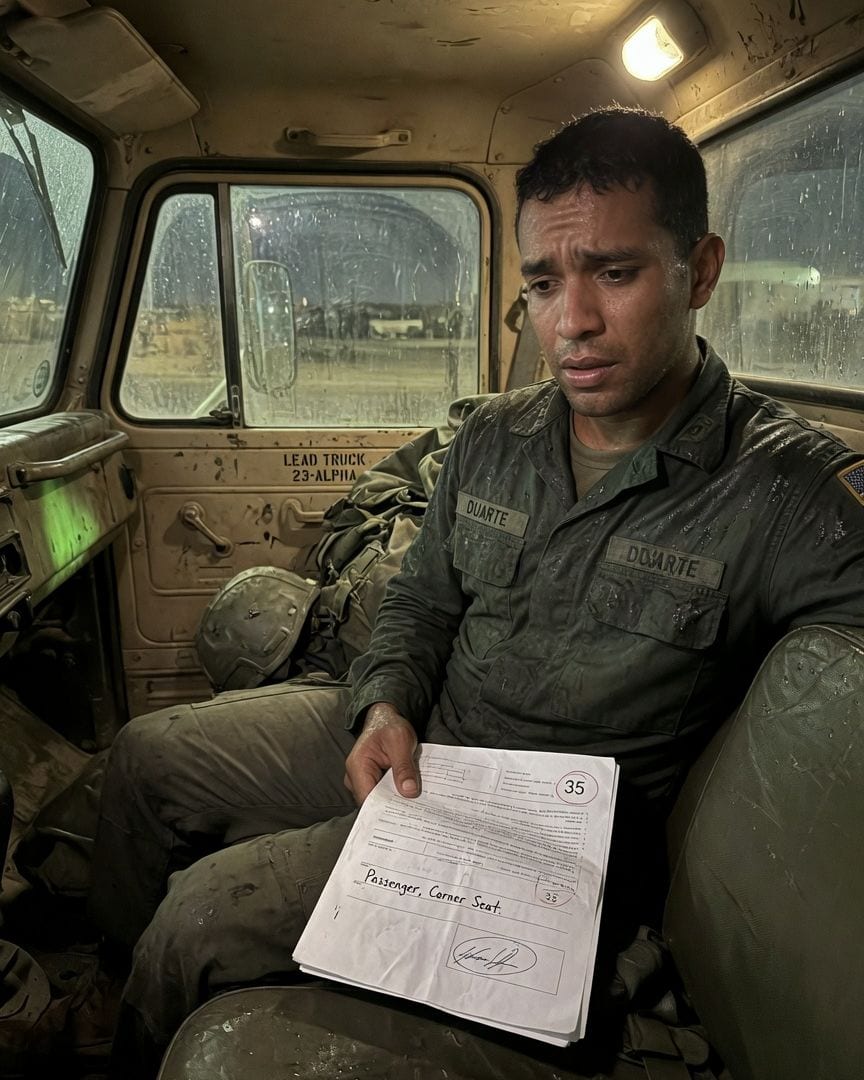
Specialist Duarte, two weeks from going home, found his empty truck seat warm and dented — then his service record showed a ghost deployment he never made.
Specialist Felix Duarte was just two weeks from going home, but a final convoy mission held an unsettling mystery. Soaked and running late, he squeezed into the lead truck's forbidden corner seat, a place every soldier knew to leave empty. Hours later, stepping out into the desert, he found the seat was strangely warm and distinctly dented, as if two unseen bodies had pressed in beside him. The official manifest then listed an extra soul for his truck, simply 'Passenger, Corner Seat,' signed by his own hand. What impossible presence had shared Specialist Duarte's ride, and what other records might it have altered?
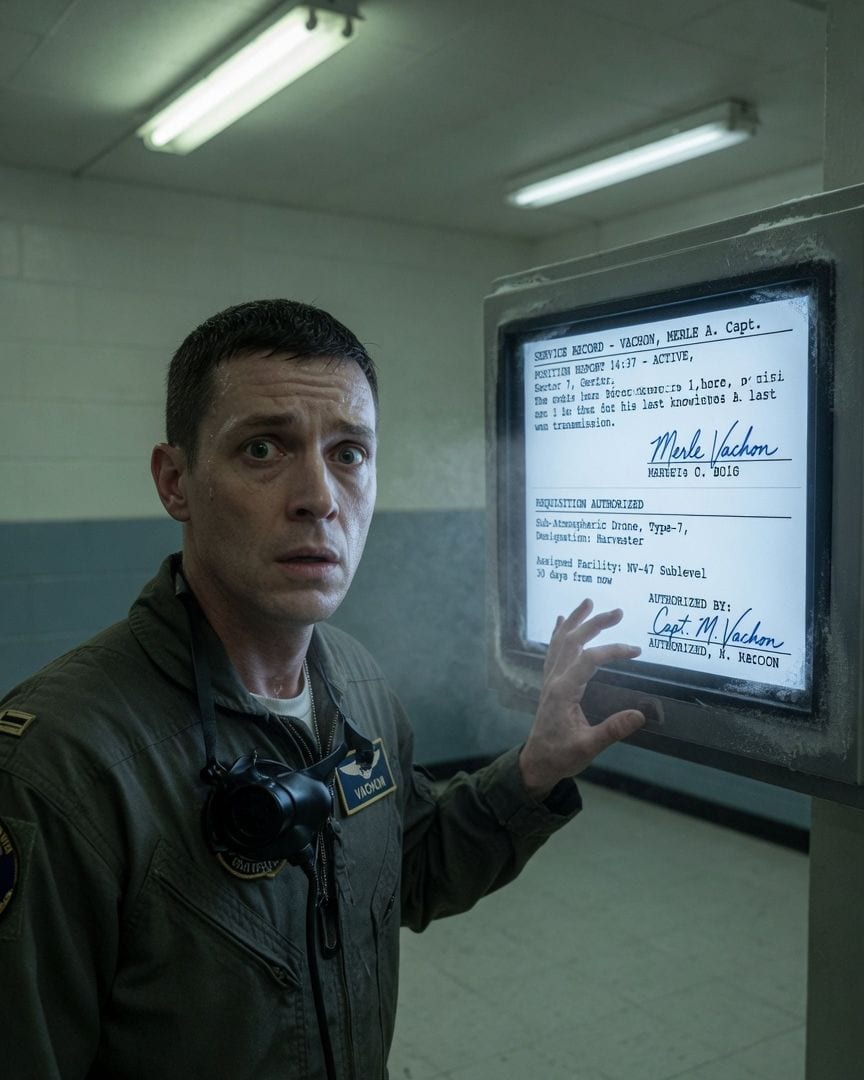
A Cold War pilot, eleven minutes from his new daughter, saw his own signature on a requisition for a 'Harvester' drone, dated a month in his future.
Captain Merle Vachon was just eleven minutes from seeing his newborn daughter when his F-86 Sabre encountered an impossible sight: a silent disc, utterly still, forty thousand feet above him. Radio silence turned to dead air, then the pilot was suddenly no longer in his cockpit, but floating in a vast, cold, sterile space. There, a glowing console displayed his service record, new entries scrolling into existence, listing him active *after* his last transmission. But the true dread landed when he saw his own confident signature on a requisition for an unknown 'Harvester' drone, dated a month in the future, for a facility hundreds of miles from any base he knew.