An MRI turned up a surgical plate in my ankle — from a surgery I never had, and there's no scar. Its serial number is registered to a patient marked deceased.
The MRI machine hummed, a low thrum against my ears, a rhythmic pulse in the enclosed tube. I lay still, trying to ignore the creeping claustrophobia, focusing on the ceiling panel above me.
It felt like an eternity, every nerve ending tingling with the enforced stillness. Then, mercifully, the machine whirred to a stop, and Sean Sinclair, the technician, slid the bed out.
“Everything looks good, Ms. Vance,” he said, his voice cheerful, eyes fixed on the monitor beside him. He scrolled through images, clicking here and there. “Just one thing, though. When did you break your ankle?
Looks like you’ve got a plate in there.”
I sat up, pushing myself off the bed, a prickle of confusion starting in my scalp. “A plate? I’ve never broken my ankle. Never had surgery, not even a sprain that needed more than an ice pack.”
I looked down at my left ankle, then my right. Both were smooth, unblemished skin, no scar, no memory of pain, no physical evidence of any old injury, let alone metal hardware. It was absurd.
Sean frowned, gesturing for me to look at the screen. He zoomed in on one of the grey-scale images: a perfectly clean, metallic rectangle, tiny screws clearly visible, embedded deep in the bone of my left ankle.
It was undeniably there, in my body. But it wasn't mine.
I insisted on speaking to the head of radiology, who, after a polite but firm conversation, suggested I speak to my primary care physician. Dr. Gideon Calloway, a man I’d trusted with my health for years, was equally baffled.
He ordered a new set of X-rays, then a more detailed MRI, convinced it had to be a mistake, a phantom image, or a mix-up of files. But the scans came back, identical, undeniable. The plate was there.
“It’s been there for decades, Eleanor,” he said, shaking his head slowly, his glasses perched on the end of his nose as he studied the films. “The bone has grown around it completely. It’s fused. It’s… old.”
Decades. I would have been born in 1986. That meant this foreign object had been inside me since I was a child, or even earlier. How could I have no memory? No scar? No indication whatsoever?
The hospital’s records department, initially dismissive, treating me like a hypochondriac, finally agreed to trace the serial number etched onto the plate itself, visible on the high-resolution scan. It was a long shot, they said, a needle in a haystack.
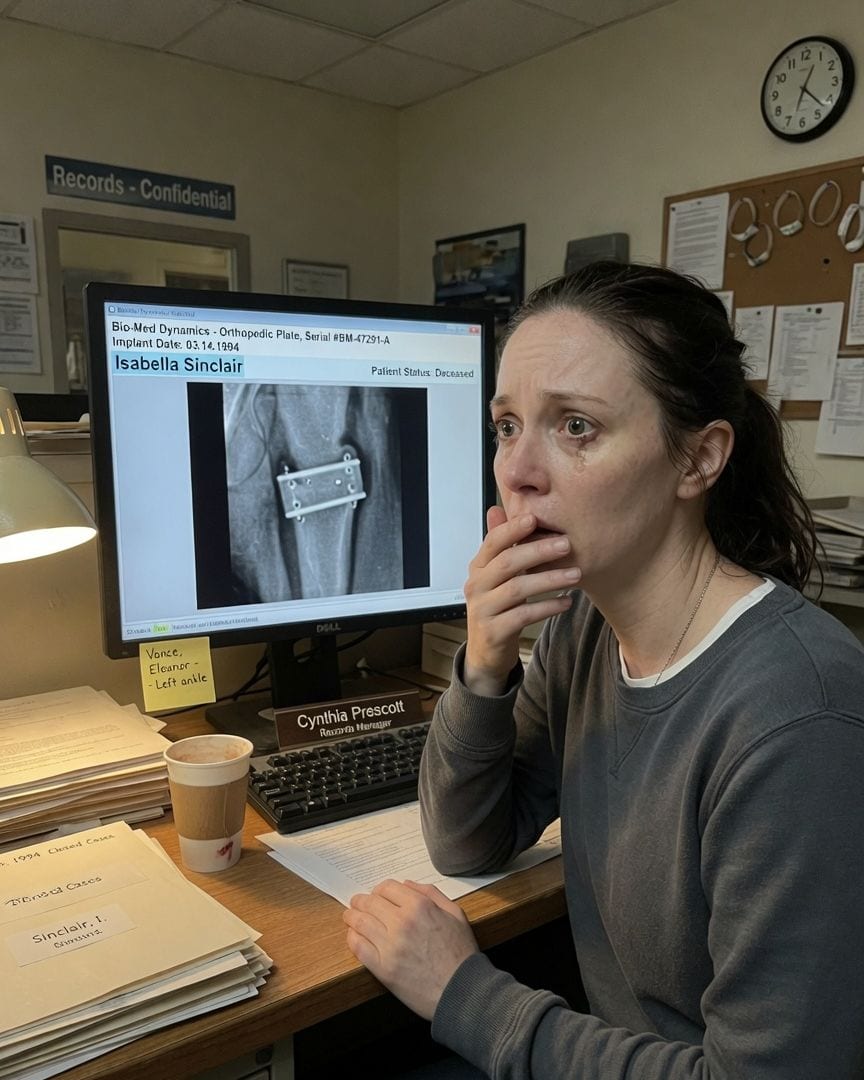
Weeks later, Cynthia Prescott, the Hospital Records Manager, called me back. Her voice was clipped, devoid of any warmth. “We’ve found a match for the serial number,” Cynthia stated, not meeting my gaze as I sat across her desk.
She gestured vaguely at a folder. “It’s a standard orthopedic plate, manufactured by Bio-Med Dynamics. Their registry indicates it was implanted in 1994.”
I felt a cold knot tighten in my stomach. “1994? I would have been eight years old then. I’ve never had a broken bone, let alone surgery, at that age or any other. My parents would know.”
I remembered every scraped knee, every childhood cough. Surgery would have been a landmark event.
Cynthia shuffled some papers on her desk, avoiding my eyes. “The patient file associated with that implant is… closed. Marked deceased.”
My breath caught. Deceased. I tried to process this, tried to force a mundane explanation into place, but it failed utterly. A part of a dead person, inside me?
A piece of medical hardware meant for someone else, now a permanent fixture in my own flesh and bone? It made no sense, yet the evidence was irrefutable.
I demanded the name, the file, anything that could make this nightmare coherent.
Cynthia hesitated, her fingers drumming a light, rapid rhythm on the polished wood of her desk. She looked up, her expression unreadable, a strange mix of pity and apprehension in her eyes.
The air in the room suddenly felt heavy, thick. Then, slowly, with deliberate movements, she turned her monitor towards me.
On the screen, next to the manufacturing details and the chilling 1994 implant date, a name appeared, stark and final, highlighted in pale blue.
Isabella Sinclair.
I felt the floor tilt beneath me, the fluorescent lights above seeming to flicker, though they didn't. The name echoed in my mind, completely alien, yet now terrifyingly intimate, a cold dread seizing me.
The name Isabella Sinclair became my obsession. I spent hours online, hunched over my laptop, the screen light reflecting off my wide eyes. I delved into newspaper archives, old obituaries, anything I could find. Isabella Sinclair. Born 1976.
Died tragically young in 1994 at the age of eighteen. An accidental drowning. The articles were short, sympathetic, mentioning a bright student, a promising future.
There were a few grainy photos from her high school yearbook, a community page remembrance. I felt a prickle of unease as I studied one particular photo: Isabella’s smile, the shape of her eyes, a subtle curve to her jawline.
It wasn’t an exact match, not a doppelgänger, but there was an unsettling familiarity, like looking at a distant cousin, or a reflection distorted by a funhouse mirror. The similarities were too close to dismiss, too subtle to pinpoint.
More unsettling was a small, faded photo from a local newspaper article about Isabella’s memorial service, showing her family standing by a grave.
In the background, Eleanor noticed a woman with a distinct birthmark on her left forearm, in the exact same spot I had one. The photo was too blurry to confirm if Isabella herself had it.
I consulted another orthopedic surgeon, Dr. Reginald Vance—no relation—for a third opinion, hoping for a different diagnosis, a simpler explanation. He confirmed the plate was perfectly integrated, showing no signs of rejection or recent trauma.
“It’s as much a part of you as your own bone now, Ms. Vance,” he’d concluded, bewildered by my story. “Truly remarkable healing.”
The ease with which my body had accepted a foreign object that wasn’t meant for it was, in itself, a chilling thought.
A vague memory of a unique tooth shape, something my childhood dentist once remarked on, nagged at me.
I called my old dentist’s office, asking for my childhood dental records, a desperate hope for a mundane detail to contradict this impossible narrative.
My persistent inquiries at the hospital, particularly my repeated requests for Isabella’s full medical history and especially her dental records, began to draw attention. Cynthia Prescott’s initial clipped professionalism had evaporated, replaced by a wall of cold, almost hostile, resistance.
“Ms. Vance, those files are archived. It takes time. And frankly, your connection to Ms. Sinclair is… tenuous,” she'd said during our last conversation, her tone implying I was overstepping, perhaps even imagining things.
The implication was that I was becoming a nuisance, an unstable woman chasing ghosts.
One evening, staring at my laptop, an anonymous email arrived. The subject line was blank. The body contained only a single, chilling sentence: 'Some doors are best left closed, Eleanor.' My heart hammered in my chest, a frantic drumbeat.
I knew it was about Isabella. I knew it wasn’t a random spam email. Someone knew. Someone was watching.
A few days later, while walking home from work, the air had a metallic tang that made me uneasy.
I noticed a dark sedan parked discreetly down my street, a model I didn't recognize, its windows tinted to an opaque black. It wasn’t there when I left in the morning, and it was gone the next morning.
Usually rational to a fault, my mind, frayed by Isabella, conjured images of hidden cameras, hushed conversations. I felt a tremor of fear. Someone was watching me.
Someone knew what I was looking for, and they didn’t want me to find it. The thought settled in my stomach like a lump of ice.
I decided to confront Cynthia Prescott directly. The vague threats, the chilling implications, had pushed me past the point of polite requests. I found the records manager in her office, looking more stressed than usual, her hair a bit dishevelled.
The blinds were drawn, making the fluorescent light feel harsher than usual.
“I’m not leaving until you tell me what’s going on, Cynthia,” I stated, my voice firm despite the tremor in my hands. “Who was Isabella Sinclair, and why is her surgical plate in my body?”
Cynthia sighed, running a hand through her hair, a gesture of exasperation. “This is highly irregular, Ms. Vance. Highly confidential. We have protocols. Confidentiality…”
I cut her off. “Confidentiality? My body has a piece of a deceased stranger in it. That’s beyond irregular. That’s a violation. I know Isabella died in 1994. I know that plate was implanted then.
What I need to know is the connection. Was there some kind of mistake? A mix-up? Another Eleanor Vance born in 1986 that I don't know about?”
I was grasping at straws, trying to force a mundane explanation into the impossible.
Cynthia finally met my gaze, her eyes weary, defeated. “No mix-up. Not in the way you mean.” She paused, considering her words carefully, as if picking through a minefield. The room felt strangely cold, the air thick and still.
“After Isabella Sinclair’s… unfortunate passing, her family made a difficult decision. They agreed to donate her body to a then-experimental research program here at the hospital. For ‘tissue regeneration and advanced biological study,’ they called it.”
My blood ran cold. “What kind of program?” I asked, my voice barely a whisper. The silence that followed was deafening, broken only by the hum of the fluorescent lights.
Cynthia lowered her voice, leaning forward conspiratorially. “It was… cutting-edge. Focused on cell growth, genetic imprinting. Trying to find ways to… preserve elements of life. Isabella’s body was part of the initial donor pool.
The plate, the serial number… it was an identifying marker for one of the early trials.”
My mind reeled, the pieces slowly clicking into place, not comforting, but horrifying. The plate wasn't just a random artifact; it was a deliberate marker, a test. A test that had somehow found its way into me.
A cold certainty began to settle in my gut.
“And what did this program… create?” I whispered, the implication dawning on me, cold and absolute, far worse than a simple mix-up.
Cynthia simply looked away, her silence a confirmation, the air in the room pressing down on me, heavy and suffocating.
Determined, a fresh wave of sick urgency propelling me, I managed to secure another appointment with Cynthia Prescott, this time under the guise of discussing the hospital’s patient privacy policies in a follow-up to my earlier complaints.
Once in her office, a sterile, quiet space that now felt menacing, I feigned an urgent phone call, mumbling apologies about needing to take it. As Cynthia excused herself briefly, I moved.
Quickly, my fingers flying across the keyboard, I navigated her computer to the hospital’s archived records. The system was old, clunky, but I found Isabella Sinclair’s file, tucked away in an old digital folder marked 'Project Nightingale - Deceased Donors.'
Among the scans and reports, I located Isabella’s dental records, dating back to her adolescence. My heart pounded against my ribs like a trapped bird.
I quickly snapped a photo with my phone, the click a deafening sound in the quiet room. Cynthia’s footsteps sounded in the hall, and I quickly closed the window, resuming my fake call just as she re-entered.
Later that night, safe in my apartment, the city lights outside doing little to dispel the gloom inside, I pulled up my own childhood dental X-rays, obtained from my old dentist just days before.
I laid them side-by-side with the photos of Isabella’s records on my dining table.
My hands trembled as I zoomed in on a specific molar, the one on the upper left, the one with the rare, distinctive notch I had always had, a unique congenital anomaly that made that tooth slightly weaker.
It was a genetic quirk, my dentist had explained.
On Isabella Sinclair’s X-ray, in the identical tooth, the exact same, impossible notch stared back at me, a silent, irrefutable accusation, an impossible object of proof that linked my physical body to a deceased stranger.
My breath caught in my throat.
I sought out Judith Norwood, Isabella Sinclair’s elderly aunt, whose address I had found nestled deep within Isabella’s archived file. The house was quiet, unassuming, smelling of old books and lavender.
Judith, a frail woman with sharp, observant eyes, sat in a worn armchair, surrounded by photo albums stacked like forgotten monuments.
When I explained my impossible situation, piecing together the fragments Cynthia had given me, Judith’s eyes filled with a deep, ancient sorrow, as if she had been waiting for this conversation for decades.
“Project Nightingale,” Judith murmured, her voice thin with age, barely a whisper. “They promised us Isabella would live on, in a way. That her essence, her unique spark, could be carried forward.”
Judith explained that Dr. Gideon Calloway, a brilliant but ethically unbound geneticist, had convinced Isabella’s grieving parents to allow her body to be used in his pioneering 'identity transfer' program.
The goal, she said, was to cultivate new biological 'hosts' using the deceased’s genetic material, then implanting specific biological markers and 'imprints' of the donor’s unique physical and even neurological patterns. It was a twisted form of preservation, a legacy.
My body, Eleanor Vance’s body, was one of these hosts, grown in a lab, infused with Isabella’s genetic blueprint and physical anomalies.
The ankle plate wasn’t just a marker; it was a tracking device, an early identifier for the 're-emergence' subjects. Isabella's 'spark' was meant to re-ignite within a new vessel.
“You are not a clone, Eleanor,” Judith said, her voice trembling, but her eyes held a chilling clarity. “You are… an echo. A second chance, built from her, carrying her marks.
Dr. Calloway believed he could cheat death, or at least, extend a life.”
The full, horrifying coherence of it crashed over me. Every clue, every impossible detail, from the invisible plate to the exact dental anomaly, to the shared birthmark, now made a monstrous, sickening kind of sense.
I was not born; I was constructed.
I found Dr. Gideon Calloway in his opulent, sun-drenched retirement home, tending to a meticulous bonsai garden. The air hummed with an unnatural stillness, broken only by the faint trickle of a nearby water feature.
He greeted me with unnerving calm, a faint, knowing smile already playing on his lips, as if he had been expecting me all along. “Eleanor,” he said, his voice smooth, devoid of surprise. “My greatest success.”
He spoke of his work with detached scientific pride, gesturing at the perfectly sculpted trees as if they were symbols of his mastery. He detailed the intricate process of transferring cellular memory and genetic markers, his words precise, academic.
“The body is merely a vessel. A temporary container. We simply provided a new one, ensuring certain key attributes were maintained. The plate was a simple identifier, a way to track the success of the integration.”
He sounded like a painter discussing his favourite canvas.
I felt a surge of revulsion so powerful it made me gag. “You created me. You put a dead girl’s… everything… inside me.”
Calloway chuckled softly, a dry, papery sound that sent shivers down my spine. “Not inside you, Eleanor. You are the product. A continuation. Isabella’s family sought a legacy. I offered them a form of immortality. You are the proof.”
He gestured to a leather-bound book on a nearby table, its spine thick and well-worn. “I have all the records, Eleanor. The full details of your… genesis. Your true self. Would you like to know more?”
I stared at him, at the man who had played God with my very existence, who saw me as an experiment, a success, a thing.
The offer of 'more information' felt less like an invitation to understanding and more like an invitation to a deeper, darker abyss.
I saw the quiet madness in his eyes, the unwavering conviction that he had done something noble, something brilliant. “No,” I choked out, backing away, the word tearing from my throat. “No, I don’t.”
The garden, the perfectly trimmed bonsai, the calm, knowing smile of Dr. Calloway — it all felt like a trap, a gilded cage designed to hold me.
I turned and fled, the implication of my own existence a crushing, suffocating weight.
I left Dr. Calloway’s home, the world outside feeling suddenly alien, hollow. The sunlight seemed too bright, the sounds of traffic too loud.
I tried to return to my normal life, to the routine that had once anchored me, but every reflection, every shadow, held a new, unsettling quality.
The surgical plate in my ankle, once a mere medical anomaly, was now a constant, cold reminder of my manufactured origin. It pulsed with a phantom history.
I saw Isabella in the faces of strangers, in my own reflection, a ghost of a life she had never lived, yet now carried within my bones, within my very being.
I stood before my bathroom mirror, brushing my teeth. I noted the familiar, slight asymmetry of my jaw, the specific curve of my lips, and the unique, small notch on my left molar.
I knew they were mine, had always been mine. But now, I also knew they were Isabella's.
The mirror reflected my own eyes, wide and searching, a flicker of something else, something old and knowing, seemed to pass through them, a fleeting recognition that wasn't quite my own. I finished brushing, rinsed, and slowly lowered the glass.
Her reflection shimmered, then settled, a faint, knowing smile playing on lips that weren't quite hers.
If this one got to you
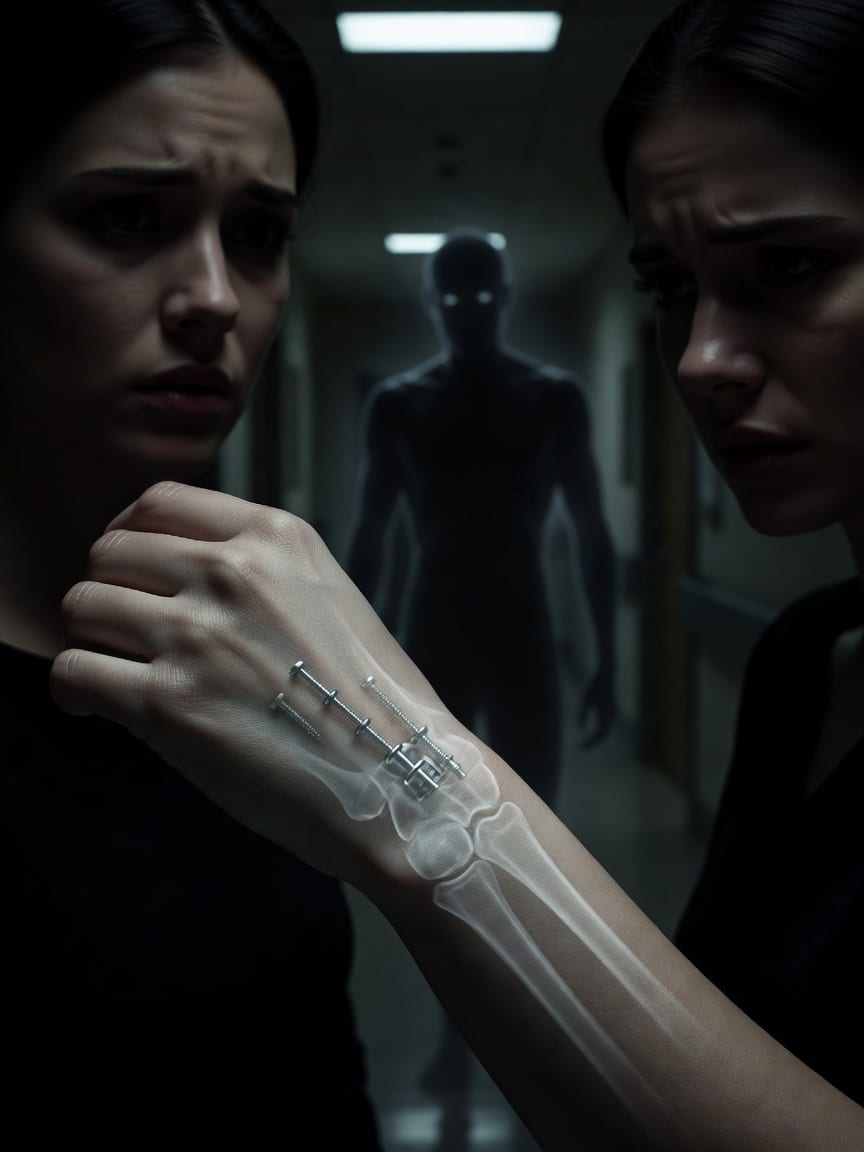
My wrist X-ray showed a titanium plate fixing a break from years ago. My surgeon asked which hospital did the operation. I've never had surgery in my life.
After a clumsy accident, I visited the fracture clinic for my swollen wrist. But my X-ray showed a perfectly healed titanium plate embedded in my bone – an implant I had no memory of receiving. Despite being decades old, there was no scar on my skin, and no medical record of the surgery under my name.
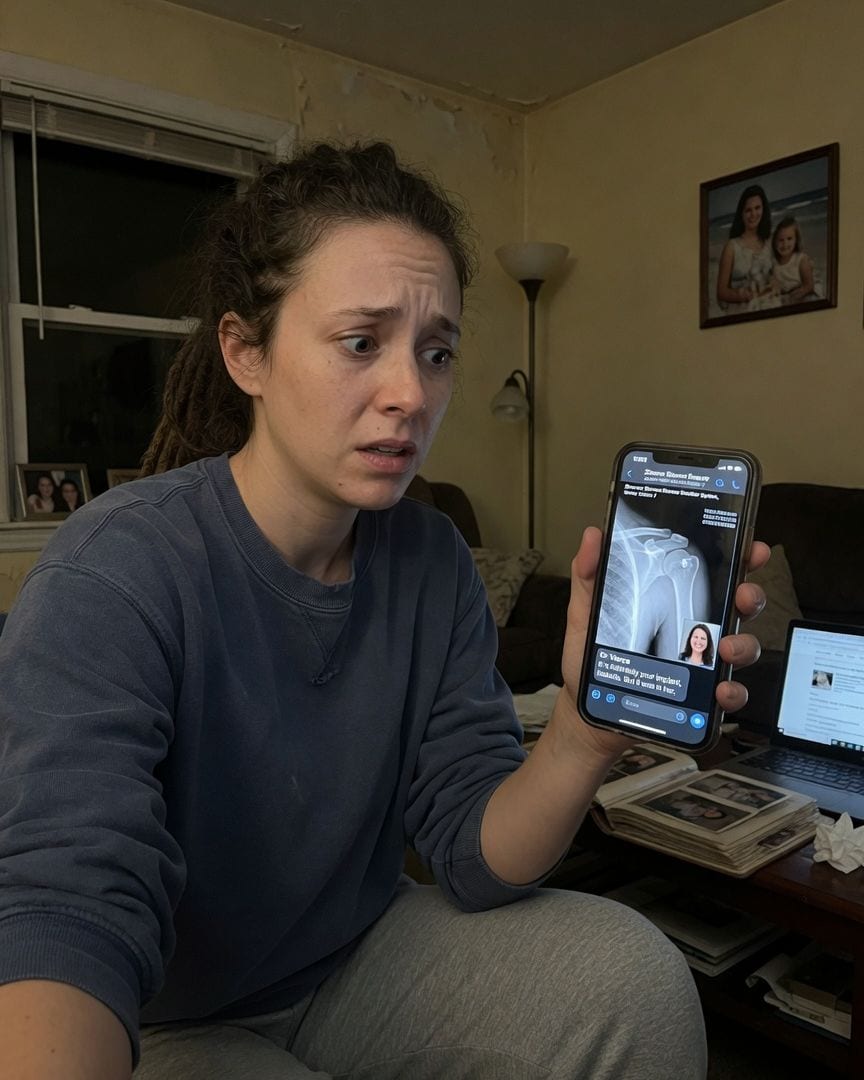
My shoulder X-ray showed a full metal replacement, bone grown tight to it. I have no scar, no memory of surgery, and the consultant asked for my surgeon's name.
An ache in my shoulder led me to the clinic, expecting a simple diagnosis. Instead, my X-ray revealed a complete shoulder replacement, perfectly integrated into my bone. The problem? I've never had surgery in my life, with no scars or memories to explain it.
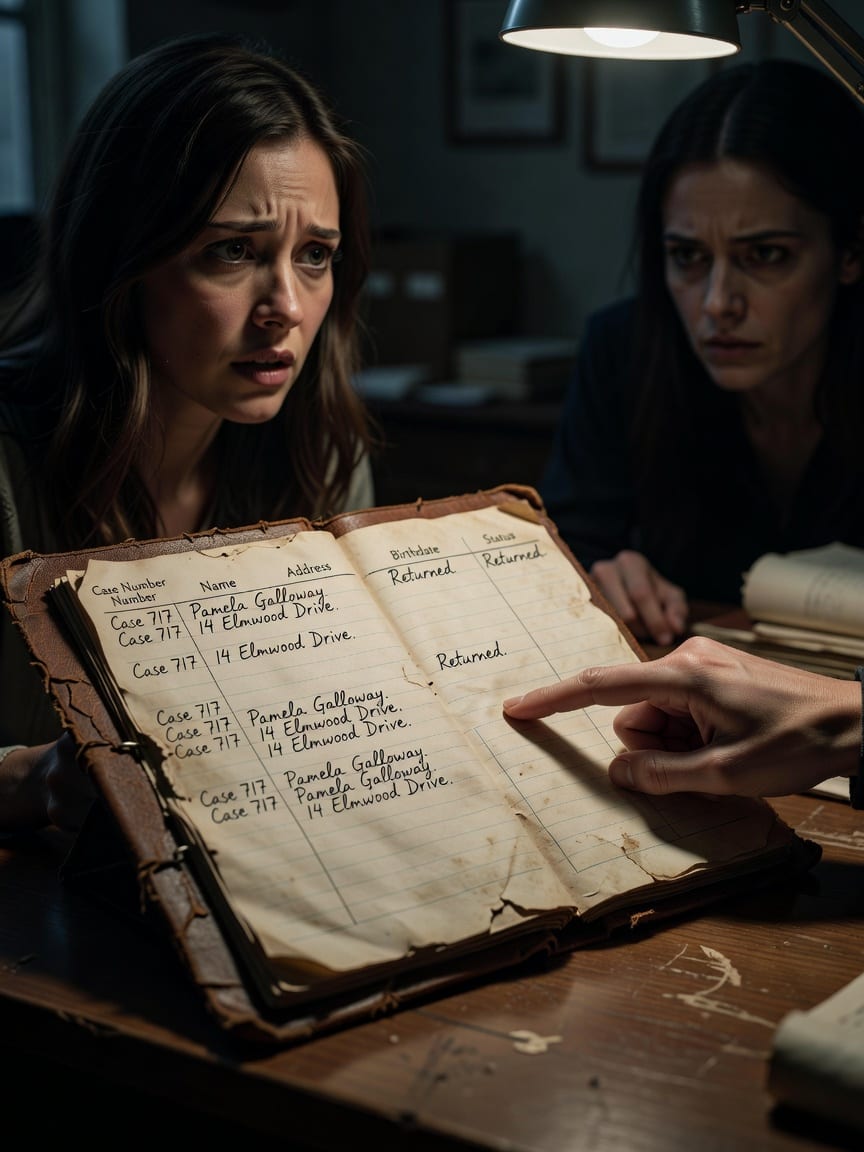
My hospital file has a blacked-out line from 1988. It names my street address, decades before I lived here. Then: 'returned'.
I finally got my medical file, hoping to clear up a ridiculous bill. Inside, I found an entry from 1988: my current home address, scrawled on a partial intake form and marked 'returned.' I was six then, living fifty miles away.
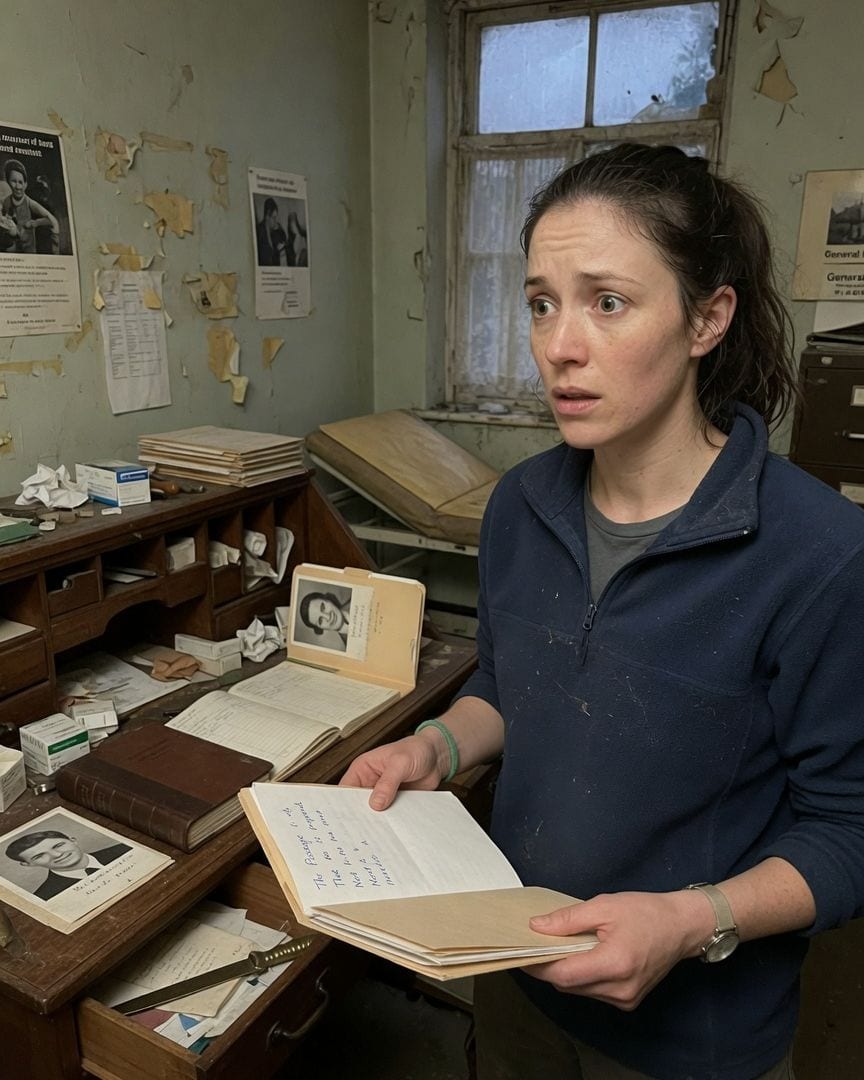
My new clinic's appointment book shows entries for this coming Monday, decades after the doctor retired and died.
Chloe Lawson bought an old, abandoned surgery in Nettlebed, ready to open her new vet clinic. Locals insisted Dr. Almott retired in '79 and the practice shut down for good. But then Chloe found his dusty appointment book filled with meticulous entries, continuing unbroken from 1979 through the decades, right up to this coming Monday.
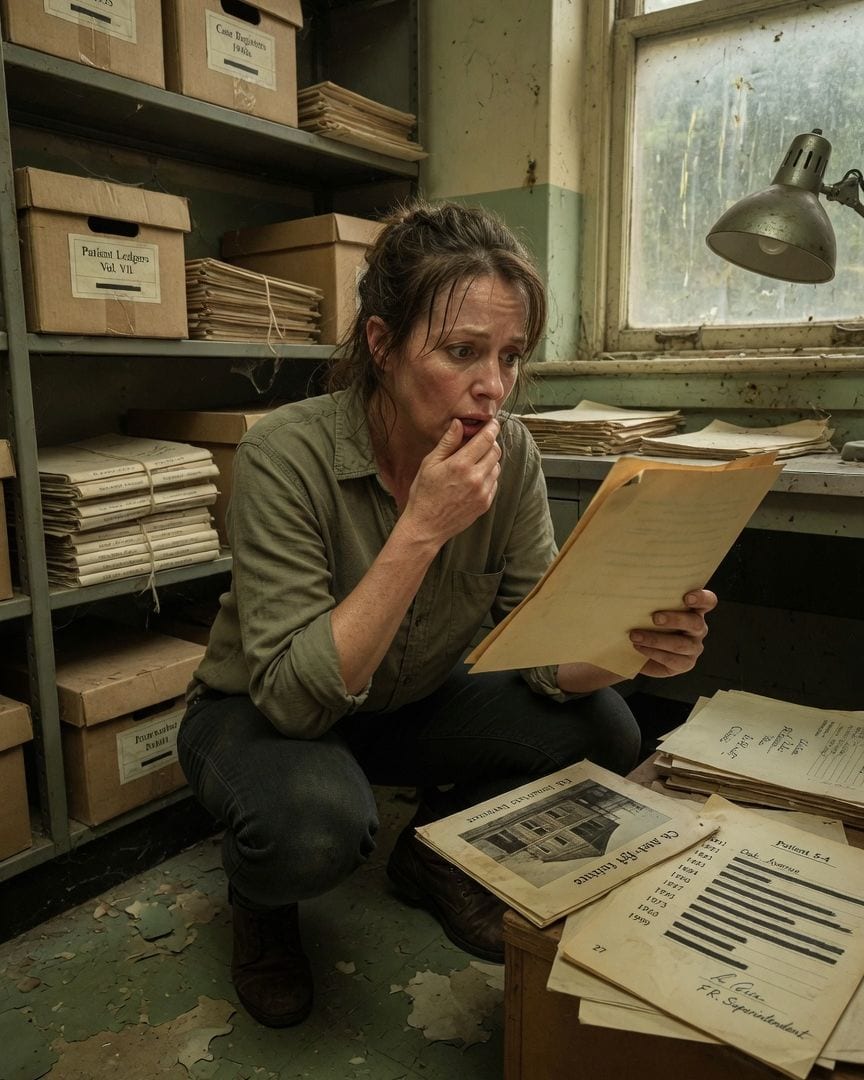
Patient 5-4 keeps checking into my aunt's old sanatorium chalet. The same initials sign them out, 'not traced,' every thirteen years since 1921.
Sifting through my aunt Margaret's estate, I found her old sanatorium file from 1999. Her patient record listed her as 'Patient 5-4,' discharged 'not traced.' But when I accessed the archives, I found 'Patient 5-4' was admitted every thirteen years since 1921, always with identical discharge notes.
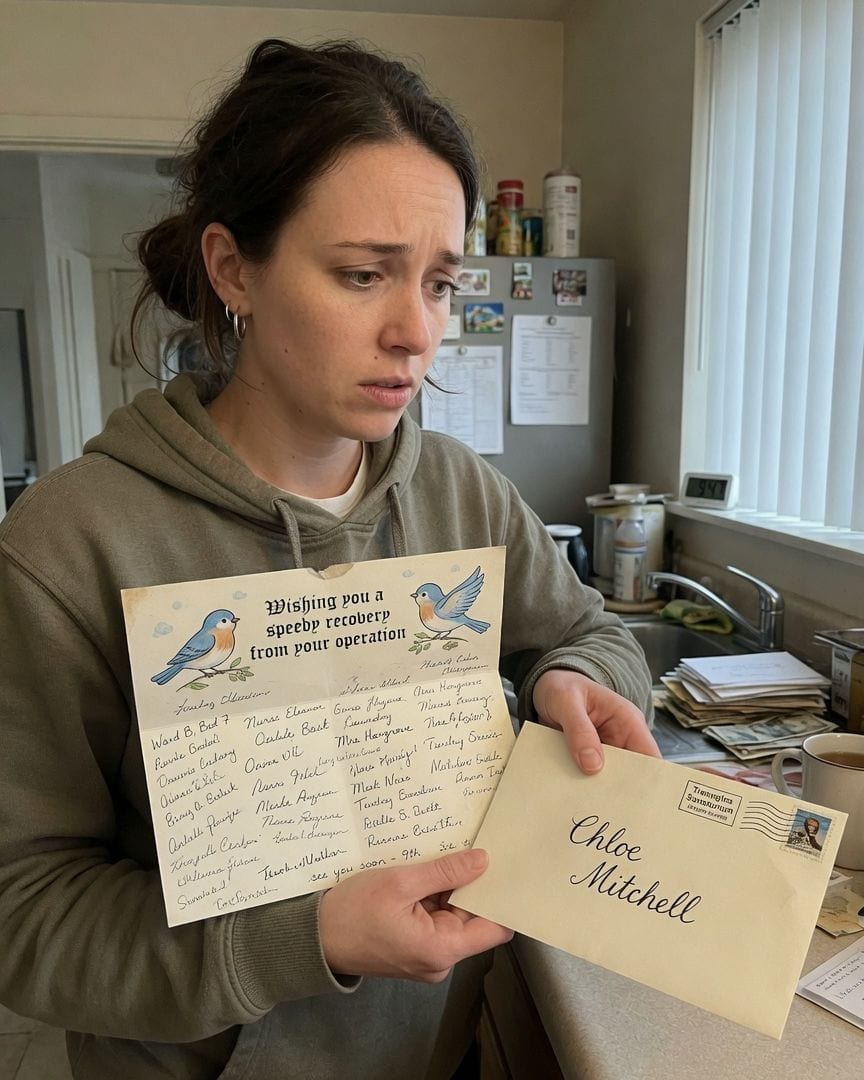
A get-well card wished me a speedy recovery from an operation I never had. It was postmarked from a sanatorium that burned down in 1963.
My quiet Tuesday morning was interrupted by an elegant get-well card, addressed to me. It wished me a speedy recovery from an operation I'd never had. But the postmark read 'Treneglos Sanatorium,' a hospital that vanished in a fire back in 1963.