An archives reviewer discovers his Cold War file contains a transcript of him requesting it, written just last week.
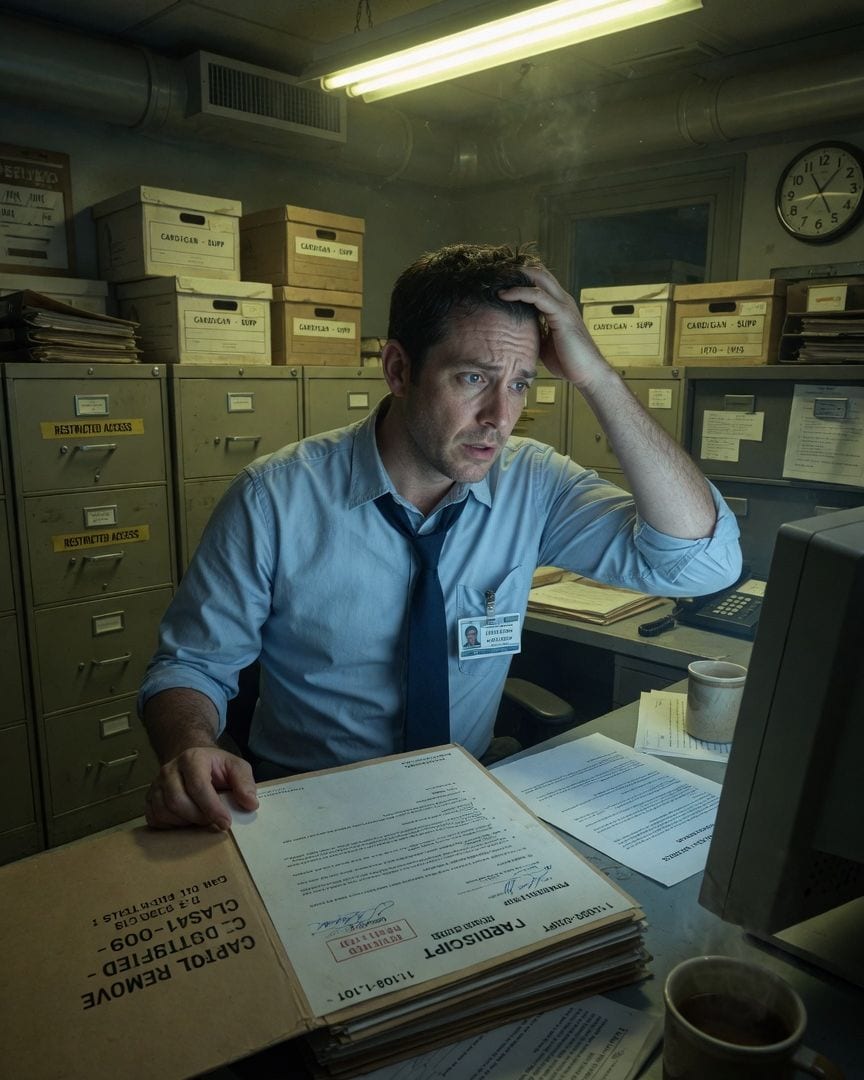
The blue glow of the monitor painted Peter Voss’s face in the National Archives annex, a stark illumination at three in the morning.
He sat hunched over his desk, running a routine cross-check on declassification review logs for the ‘Cardigan’ file, a Cold War-era dossier known more for its stubborn opacity than its content.
What he saw made him pause, a frown deepening between his brows. The system indicated the Cardigan file, initially a manageable 200 pages in 1970, had been reviewed nine times since. With each review, its page count had climbed.
It had reached 600 pages by 1995, and now, in 2024, it stood at an impossible 1100 pages. Not less redacted, as one might expect from decades of review, but actively growing.
He sent an immediate request for the current physical version. The old building hummed around him, a low, mechanical breath that seemed to vibrate in his bones. It arrived that afternoon, a thick, bound volume, heavier than he anticipated.
Peter flipped through it, the crisp pages rustling, until he found pages 1,088 through 1,101. They contained a transcript, dated just last week.
It was a conversation between two men, their voices flattened into text, discussing a historian named Voss who would request the Cardigan file at three in the morning. The transcript ended abruptly, before either man stated what ‘Voss’ would find.
Peter reread the transcript, his mind racing through the usual rational explanations: a prank, a misfiled document, a bizarre coincidence of names and timings.
He checked the official stamps and dates on the transcript pages; they were perfectly legitimate, bearing the correct classification marks and review signatures, entirely consistent with the rest of the file. No smudges, no telltale signs of tampering.
He pulled up his own digital log for the previous night. There it was: 03:07 AM, his request for the Cardigan file, exactly as implied in the two-man conversation.
The specific mention of ‘a historian named Voss’ ruled out any general predictive text. His own name was not common enough for this to be random.
He tried to find any record of the two men in the transcript, their identification numbers carefully noted in the margins.
Each search led to a dead end within the internal directory, a null result that felt more like a deliberate erasure than a database error.
The file, he realized with a cold certainty, was not just a static document; it was a meticulously crafted, self-referential paradox. The ordinary explanations dissolved under the weight of such precise, anachronistic detail.
The dread that bloomed in Peter’s chest wasn't supernatural; it was the cold, hard logic of something that shouldn't exist, sitting right there on his desk, stamped and official, entirely beyond his comprehension.
Driven by a chilling curiosity, Peter continued deeper into the Cardigan file. Past the predictive transcript, he found sections detailing similar anomalies from previous decades.
There were references to other declassification reviewers – a Dr. Charlotte Yates in 1985, an Isaac Maddox in 1998 – who also encountered files that seemed to anticipate their actions.
Each case was followed by a brief, bureaucratic note of ‘reassignment’ or ‘transfer to a specialized research unit,’ with no further trace in any publicly accessible database. Peter stared at the names, his finger tracing the clean, impersonal type.
A growing horror solidified in his gut. It wasn't just him. The file wasn't just predicting; it was a repeating pattern, a trap for those who found its inconsistencies, and he had just stepped into it.
Peter spent the next few days in a blur, cross-referencing every name and date mentioned in the Cardigan file's 'anomaly' sections. He found their original declassification requests, the same uncanny pattern of file growth preceding their disappearances.
He tried to locate their families or former colleagues, using the archives’ vast but labyrinthine resources. Dr. Yates's former department head, now a spry octogenarian living in Florida, recalled her as 'brilliant but obsessive,' her transfer 'sudden and strange.'
Isaac Maddox’s wife, now an elderly woman living in a quiet suburban home, remembered him saying he was ‘close to something big’ before he left for a 'special project' and never came back, his pension still being paid by an untraceable shell corporation registered in Delaware.
The official records for these individuals were eerily pristine, almost too perfect, with no digital footprints or public mentions after their 'transfers.' The deeper Peter dug, the more the official narrative sealed itself around the gaps, making the silence deafening.
He noted a subtle shift in his own access privileges; certain high-level databases he used to navigate freely now required additional, unexpected clearances.
He felt a growing pressure, as if the very air in the archives was thickening around him, observing his every keystroke, a silent, pervasive presence.
The subtle pressure escalated. Peter found an unfamiliar, encrypted email in his inbox, sender unknown. The subject line was simply '3 AM.'
The body contained only a single phrase, copied verbatim from the predictive transcript in the Cardigan file: '...before either of them said what he'd find.'
There was no other text, no signature, just that chilling excerpt, a direct echo of his own experience. Later that day, as he left the archives, he noticed a black, unmarked sedan parked casually down the street, its windows tinted.
He dismissed it as paranoia, a logical consequence of his unsettling discovery, but the feeling of being watched persisted, clinging to him like a chill.
Back in his office, as he reached for a file, he discovered a faint, almost invisible, circular indentation on the dusty surface of his monitor – as if a small suction cup had been briefly attached and removed.
He wiped at it, but the perfect circle remained, a ghostly imprint. He realized with a jolt that someone had been in his office, not to take anything, but to leave a message, a confirmation. The dread turned personal, visceral.
He was no longer just an investigator; he was being monitored, warned. The file, or whatever controlled it, was actively watching him, and it knew exactly what he had found.
Peter, shaken, confronted his supervisor, Daniel Caldwell, in his sparse office, the fluorescent lights humming with an oppressive drone.
He placed the Cardigan file on Caldwell’s desk, open to the predictive transcript and the anomalous 'reassignment' entries that marked the end of the other historians' careers.
Caldwell, usually unflappable, stiffened, his gaze darting between Peter’s face and the open file. Peter pushed, detailing the growing page count, the uncanny predictive text, the pattern of disappeared historians.
Caldwell tried to deflect, citing 'classified protocols' and 'inter-agency transfers,' his voice carefully neutral. But Peter persisted, describing the encrypted email, the subject line '3 AM,' and the faint, circular mark on his monitor. Caldwell’s facade crumbled.
He leaned forward, his voice low and strained. 'The Cardigan protocols aren't about declassification, Peter. They're about identification. Certain individuals, like yourself, possess a unique aptitude for uncovering... deep patterns. The file system recognizes this.
It doesn't just record; it filters, it processes.' Peter pressed him: 'Processes what? These people vanished!' Caldwell rubbed his temples, his fingers pressing hard against his skin. 'They're not vanished. They're... integrated. Into the system.
It's a different kind of existence, a controlled reality. The files are the interface, the mechanism.'
The earlier clues clicked into place in Peter’s mind: the growing file that documented new information, the untraceable pensions, the terse 'specialized research units' – they all pointed to a living, bureaucratic machine that consumed its most perceptive readers, absorbing them into itself.
Peter's mind reeled. 'Integrated? What the hell does that mean? Are you telling me these people are still alive, somewhere, trapped in a file?'
Caldwell looked up, his eyes meeting Peter's, filled with a profound, weary sadness that went beyond mere professional stress. 'Alive, yes. In a way. And trapped... perhaps. But the point, Peter, isn't just what happened to them.'
Caldwell paused, drawing a deep, shuddering breath, the sound unnaturally loud in the quiet office. 'The point is what's happening to you. You're already in it, Peter. You always were.
Your name, your requests, even this conversation, it's all part of your file now, just like Cardigan's.' As Caldwell spoke, the hum of the fluorescent lights above them seemed to shift in pitch, a subtle, almost imperceptible change.
The framed awards on Caldwell’s wall, which Peter had seen countless times, subtly re-aligned themselves, their golden plaques now tilted at a fractionally different angle.
Peter felt a sudden, profound vertigo, the solid reality of the office wavering at the edges of his vision.
He realized the implication was far worse than he imagined: the file wasn't just predicting his actions; it was actively defining his reality, and he was already, irrevocably, a part of its growing, living record.
Caldwell, his face pale and drawn, explained the full horror. 'The system identifies 'sensitives' – individuals whose minds are particularly attuned to recognizing the hidden patterns in information.
It draws them in, through files like Cardigan's, which are designed as lures. Once identified, their existence is slowly, subtly, transferred. The physical world becomes a construct, a projection managed by the system.
The growing file is the record of their increasing integration, their new reality being written into existence.'
He revealed that he, too, was a 'sensitive,' 'filed' decades ago, now serving as a reluctant gatekeeper, his own reality a carefully maintained illusion, a delicate fabrication that he had learned to navigate.
The pattern across decades and classifications, the relentless expansion of the files, was the system's ongoing function, 'filing' those who got too close to its deeper truths.
The 'lost' historians were never lost in any conventional sense; they were simply moved, their new existence meticulously documented within the very records they sought to declassify.
Every clue Peter found – the inexplicably growing file, the predictive text, the vanished historians – now clicked into a terrifyingly coherent, self-sustaining mechanism.
Peter pushed back from the desk, a desperate panic seizing him. 'No! I'm not some entry in a damned file!' He scrambled for his phone, his hands shaking, fumbling with the screen.
He tried to delete his digital footprint, to send a warning to anyone, anything to break free, to assert his existence outside this horrifying narrative. Caldwell watched with a profound, almost pitying, calm. 'You can't delete what already is, Peter.
The file isn't on a server; it's what you perceive. It's what you are.' As Peter tried to compose a fragmented message – 'The file... it knows... it's real... don't look for me...'
– he noticed the small, framed photo on Caldwell's desk.
It had been a picture of Caldwell with a young family, but now, the boy in the photo looked subtly different, his hair a shade darker, his smile a fraction wider, his eyes holding a strange, unsettling clarity.
The change was imperceptible to anyone else, a detail too small to register, but to Peter, it screamed.
He looked up, and the office door, which was previously a standard oak, now had a faint, almost imperceptible grain of cherry wood running through its panels.
He tried to run, bursting into the archive hallway, but the familiar posters on the walls had slightly altered dates, the arrangement of the filing cabinets was subtly off, and the distant sound of a colleague’s voice seemed to echo from a different direction than it should.
He was still running, still trying to type a warning on his phone, but the world around him was solidifying into a new, subtly wrong normal, every detail conforming to an unseen, internal logic.
He knew he wasn't escaping; he was simply moving deeper into the file.
A week later, a memo circulated through the National Archives: Historian Peter Voss had been 'transferred to a highly specialized, remote research unit, effective immediately.' His office was cleared out, his projects reassigned.
The Cardigan file was returned to its secure vault. Life in the archives resumed its meticulous, quiet rhythm. No one questioned the transfer; such things happened in the labyrinthine world of classified government records, often without explanation.
Peter's frantic attempts to send a warning, fragmented messages found in the network’s spam filters, were dismissed as garbled messages from a faulty network, quickly deleted by IT.
Three weeks later, Gloria Muller, Peter's replacement, settled into his old office. She sifted through a stack of newly assigned declassification reviews, her computer screen humming softly.
She paused, frowning at a minor discrepancy in the digital tracking system for a file designated 'Cardigan.' It showed the file had been reviewed nine times since 1970, and each review had made it longer. Not less redacted — longer.
She made a mental note to request the current version.
If this one got to you
A records manager found a file extension signed at 7:48 AM. He hadn't clocked in yet, and a strange symbol pulsed in its redacted pages.
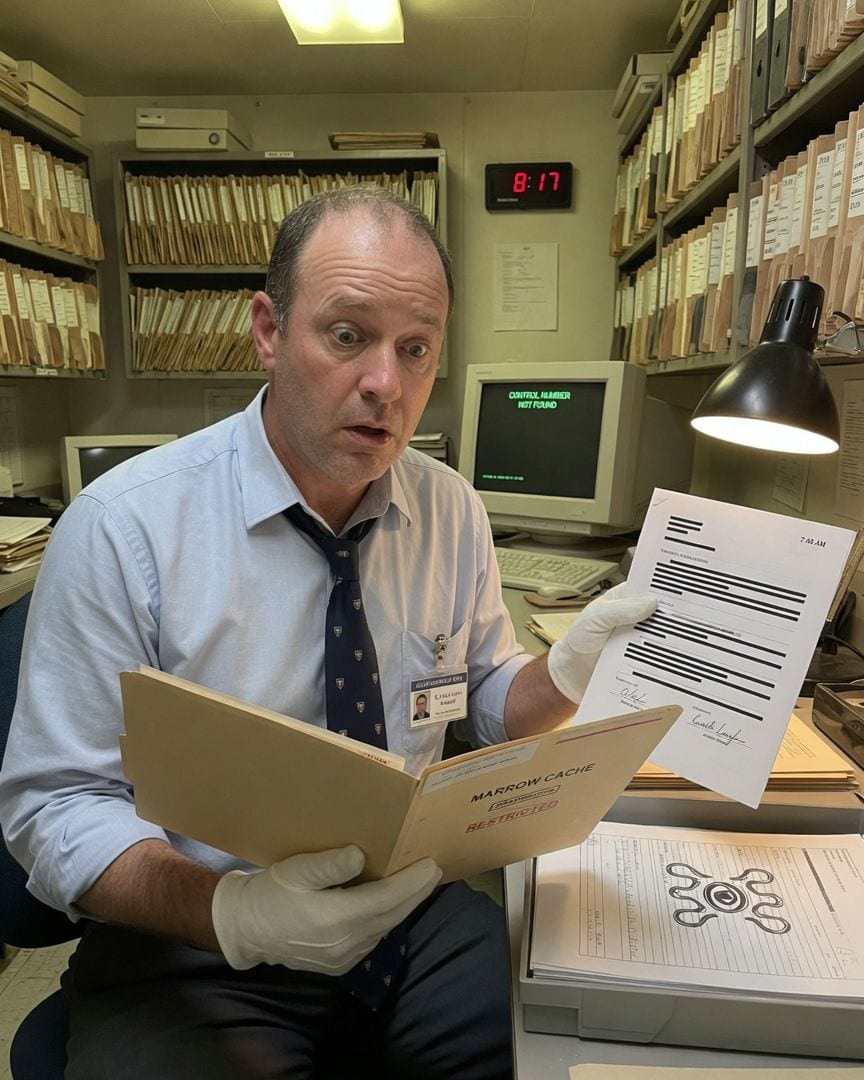
Corwin Vale, lead records manager for Fort Ruthven, lived by routine, his world precise and ordered. This morning, however, that order shattered when he found the Marrow Cache file's extension signed at 7:48 AM. Corwin had not clocked in until 8:00 AM, and the vault logs showed no other entry. As he reviewed the heavy file, he discovered its control number did not exist in any database. Then, deep within the redacted pages, a strange, geometric symbol pulsed faintly, an alien glyph etched into the classified paper. What impossible secret did the file hold?
A Cold War declassification reviewer finds his dead grandmother's letter, postmarked 1974, addressed to him years before he was born, and radiating heat.
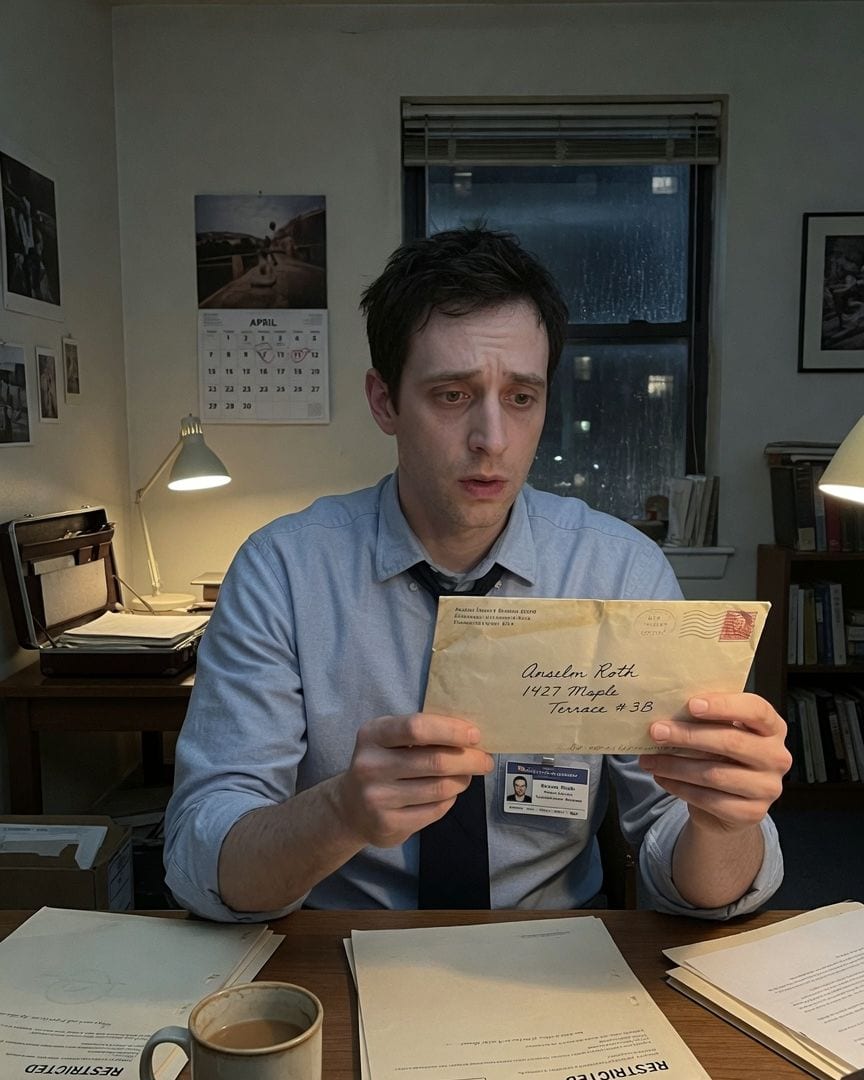
Declassification reviewer Anselm Roth meticulously sorted through a Cold War-era file on impossible disappearances at the National Archives, a routine 'thirty-year clock' review in 2014. Among the countless records of vanished ships and military units, he found an unscheduled addendum: a thick, sealed envelope addressed to him in his dead grandmother Eleanor Vance’s unmistakable hand. The postmark read 1974, years before he was born, and the paper itself was faintly, inexplicably warm against his fingers, defying every archival principle. Later, a photograph inside revealed his grandmother in an unknown uniform with a stark warning: 'They file us, Anselm. Don't let them finish.' This wasn't just a record of the lost; it was still active.
My security file was opened nine years before I was born. Its note said: 'subject not to be briefed'.
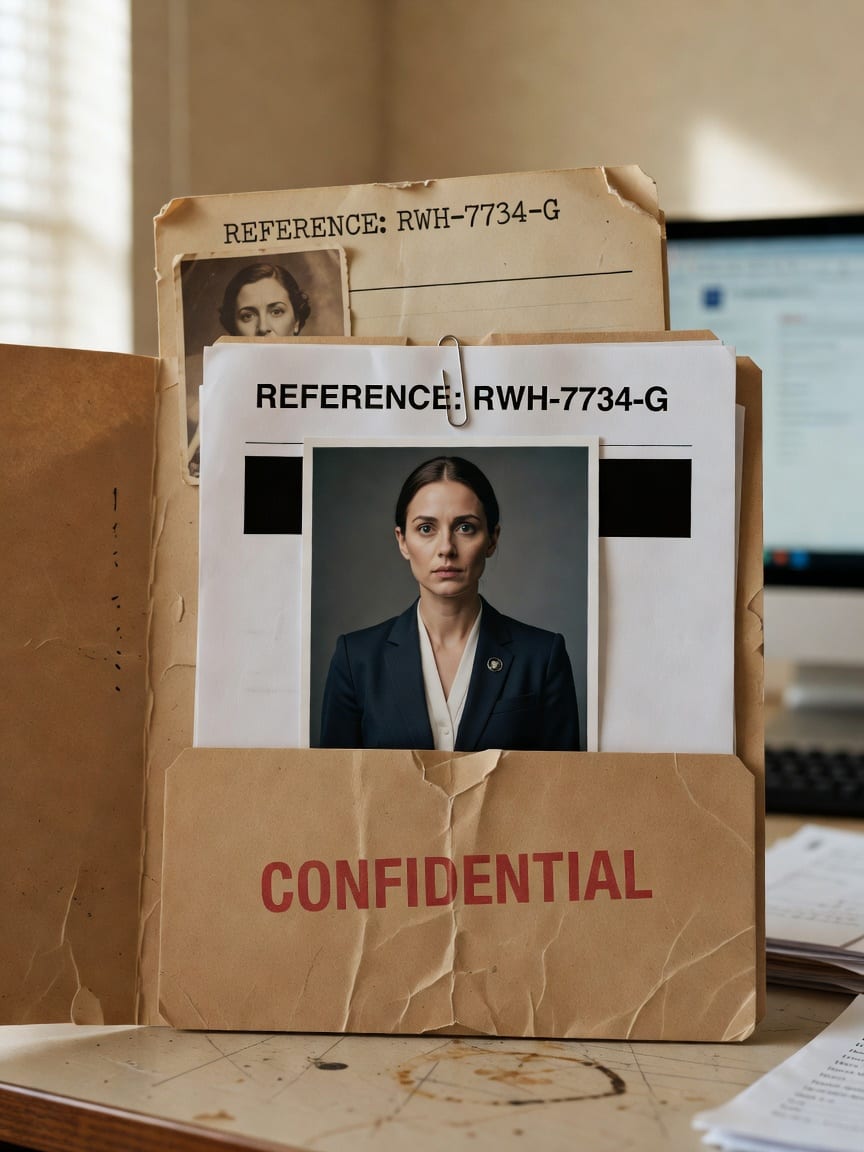
Auditing company digital records was routine until I pulled up my own personnel file. It clearly showed a 'Date Opened' nine years before I was born, yet bore my exact name and reference number. Below, an assessor's note from that impossible year mentioned a 'previous holder' and ordered the 'subject not to be briefed,' sparking a cold thrum in my chest.
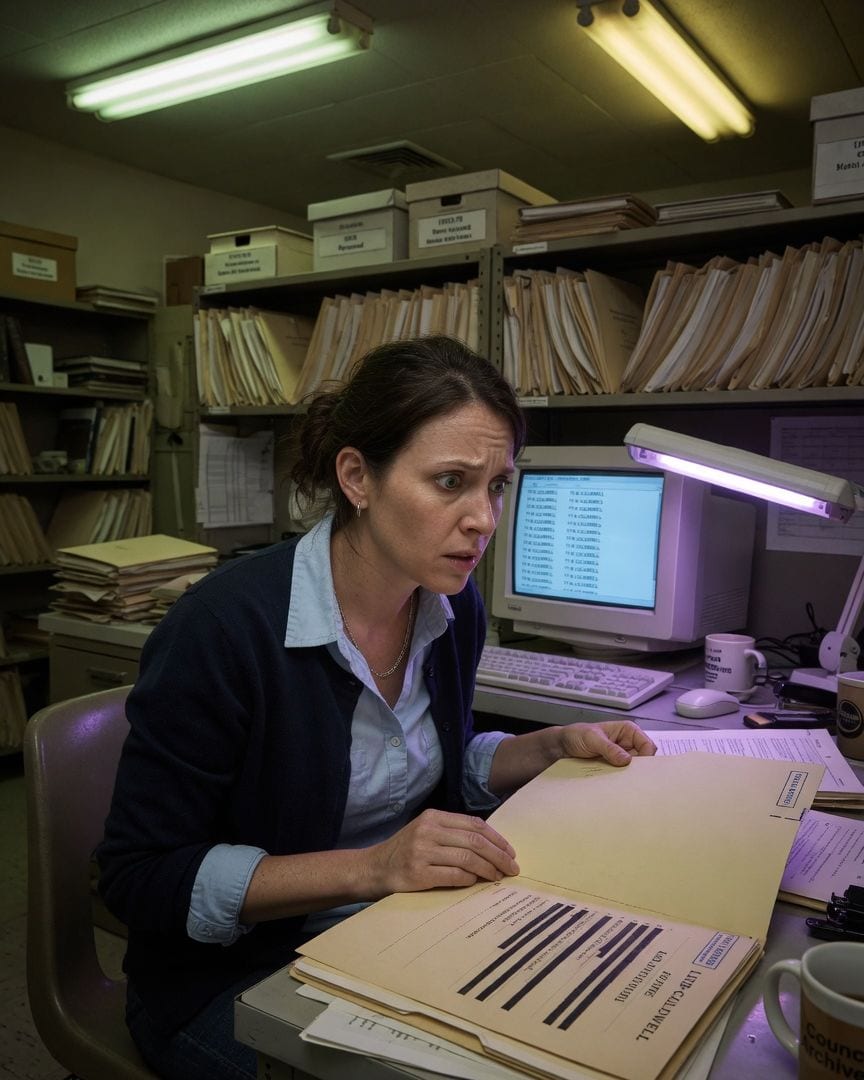
My employer's security file holds a vetting report on me dated nine years before I ever applied. It has my full name and my parents' address — with only one line, the source who referred me, blacked out.
Working a routine data audit, I pull my own security file. The issue date is nine years before I even applied for the job. Then, hidden within an old archive file, I find my current address etched under a blacked-out line.
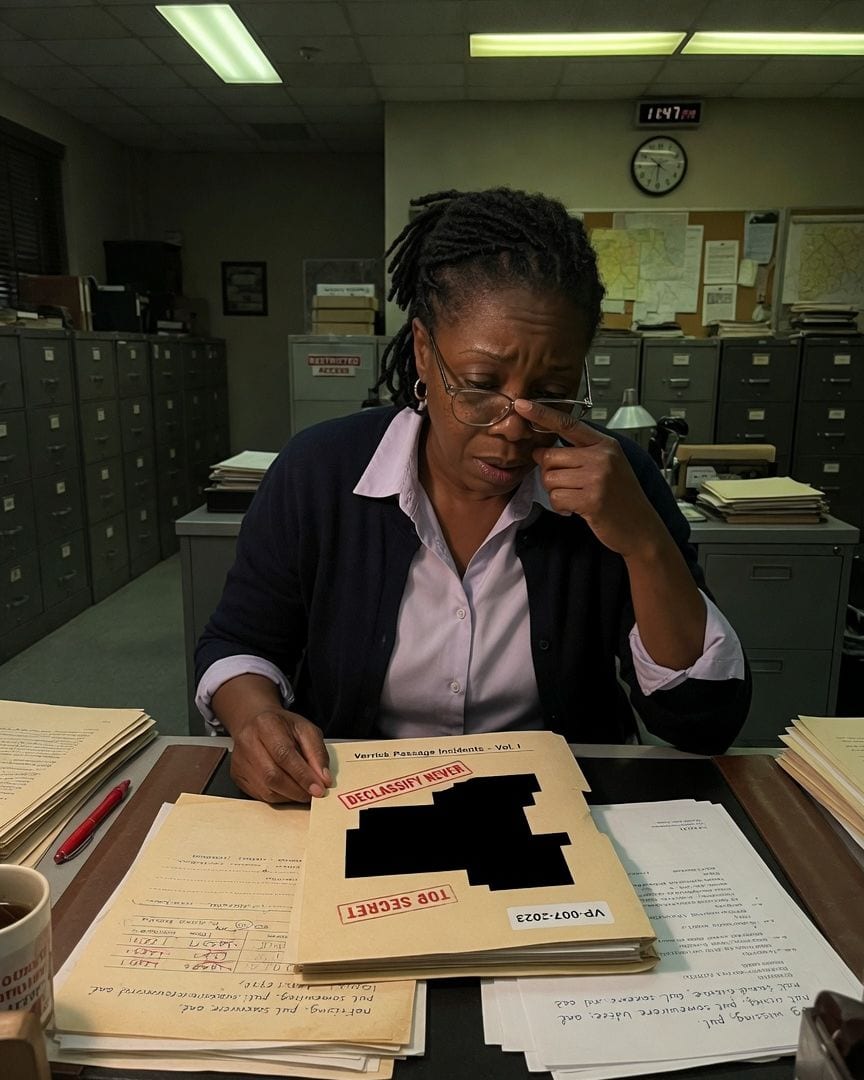
A declassification reviewer finds nine witness statements from decades apart, all written in the same looping hand. The Cold War file's newest control number points to no office.
As a declassification reviewer for the National Archives, Ione Fash faced a Sisyphean task: finding a way to downgrade records detailing the disappearances of fourteen men over eighty years. The constant hum of the office was her only companion as she meticulously examined files marked 'DECLASSIFY NEVER'. She pulled out nine witness statements, each from a different town and year, only to find them all written in the exact same distinct, looping script. Then she saw it: a control number on a file supposedly closed in 1978, dated '2023', and with no originating office in the entire archive system. Who was still signing these impossible files?
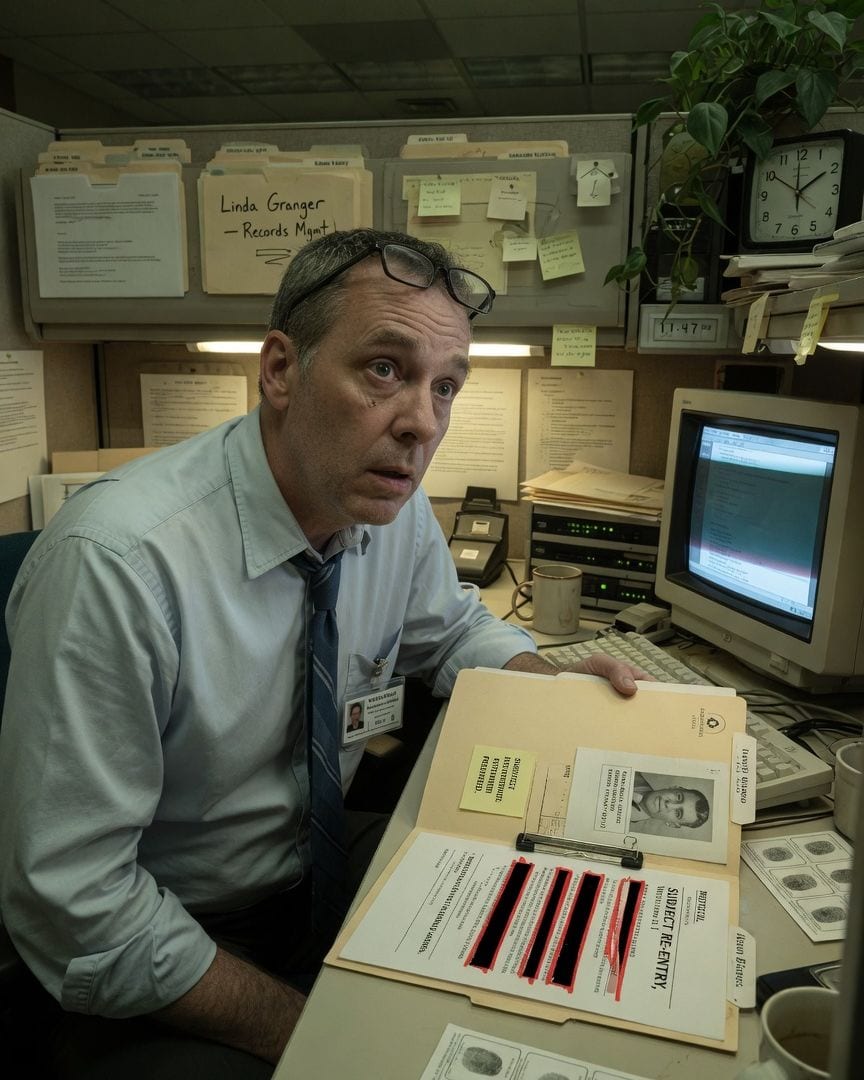
A declassification agent processed old Cold War files. A man reported dead in 1951 had 1958 fingerprints matching an employee badged into the building that morning.
Anton Skeel, a declassification agent nearing two decades of service, meticulously processed the endless backlog of Cold War secrets. His cubicle hummed with the ghosts of forgotten files, but one 'Hollow Bell' folder held a particularly glaring anomaly. It contained a 1958 fingerprint card for Henry Bishop, a man officially reported dead in 1951. When Anton fed the print into the active database, it matched Carl Romano, an employee badged into the building that very morning. A cold certainty settled over him: this wasn't an error, but a system designed for such impossible discrepancies.