My baby monitor shows David's nursery with floral wallpaper and a boarded-up window. My nursery has elephants. It's a room that doesn't exist.
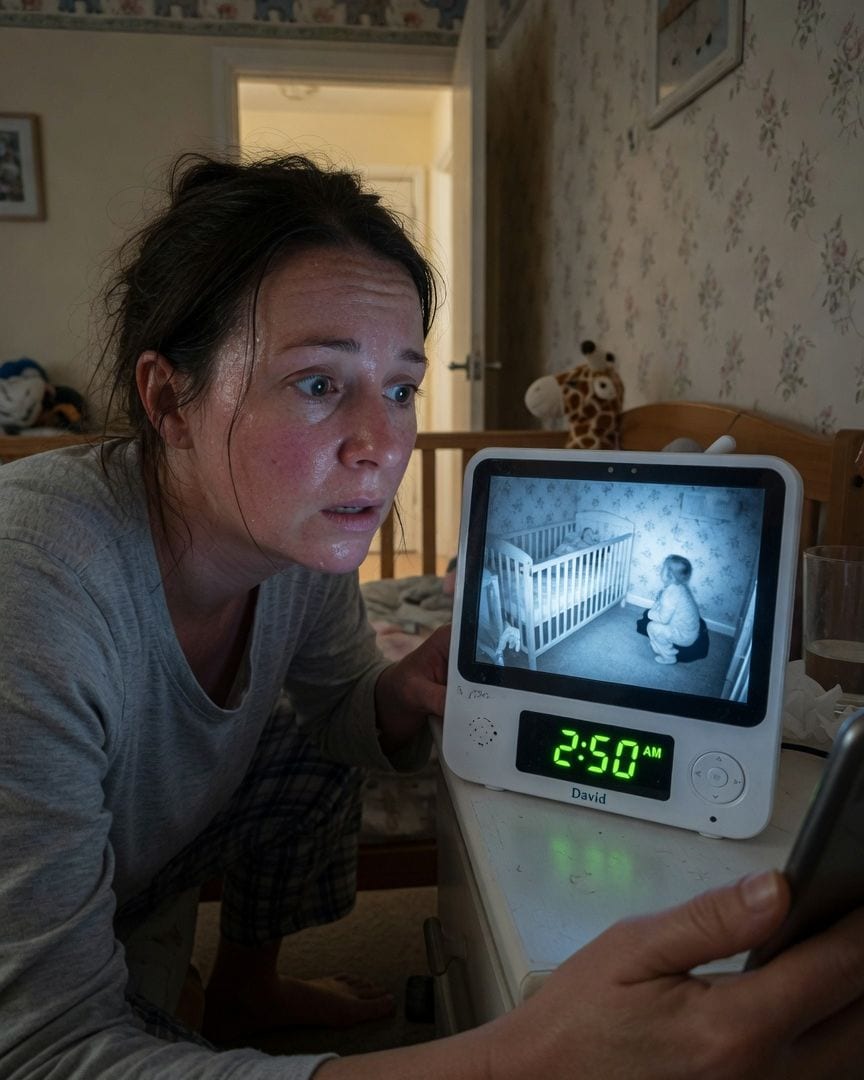
The glow of the baby monitor on my bedside table was what woke me, not David’s cry. It was 2:50 AM, the digital display stark against the dark. I blinked, reaching for my phone, thinking maybe the battery was low.
But the screen showed David, my one-year-old, sitting bolt upright in his cot. He wasn't crying. He wasn't even fidgeting. His head was turned, his gaze fixed on the far corner of his room, completely absorbed.
His eyes were wide open, a strange, focused intensity in them. My chest tightened.
And then I saw it.
It was a deeper shadow in the already grainy, monochrome night-vision feed. Low to the ground, crouched, almost folded in on itself in that corner. Not a pile of clothes, not a discarded toy.
It had a definite shape, a density to it that absorbed the faint infrared light. It was looking back at David. I couldn’t make out details, but it was there, an undeniable presence.
My breath caught, a cold knot forming in my stomach.
My heart hammered against my ribs, a frantic drum. I scrambled out of bed, the sudden motion jarring my husband, Leonard, awake beside me. “What is it?” he mumbled, half-asleep. I didn’t answer.
I fumbled for the bedroom door, my fingers numb against the handle. Twenty seconds, maybe less. That’s all it took to cross the hall. My bare feet hit the cold floor of David’s nursery.
He was lying down again, eyes wide open, staring at the ceiling. A faint smile played on his lips. The corner of the room was empty.
Just the familiar wall, painted soft cream, with the cheerful elephant wallpaper I’d picked out myself. Nothing there.
Leonard, bless his rational heart, tried to explain it away. “Night-vision artifact, babe. Shadows play tricks. You were half-asleep.” He said it with a shrug over his morning coffee, already halfway out the door for work. But I wasn't half-asleep.
I had seen it live. The memory of that crouched shape, the way David had stared, burned in my mind.
I spent the next day glued to the monitor’s recorded footage. I rewound the clip from 2:50 AM again and again, pausing, zooming in on the pixelated frame. The crouching shape was undeniable.
It wasn't human, not quite, but it wasn't a trick of light either. It was a blot, a distortion, almost like a hole in the fabric of the room, yet solid enough to block the faint infrared light.
My fingers trembled as I hit pause, my face inches from the tablet screen.
Then, as I zoomed in past the figure, my eyes snagged on something else. Something utterly impossible. The wallpaper directly behind David’s cot, visible in the grainy feed, wasn’t the familiar, playful elephants I’d carefully chosen.
It was a faded, intricate floral pattern, delicate and utterly distinct. Not a hint of my bright elephants. And just above where the figure had been crouched, partially obscured by its form, was a faint, rectangular outline.
A distinct indentation, as if a small window had been boarded up.
Impossible. My nursery had smooth, unblemished walls, painted a soft cream. No floral wallpaper, no boarded windows, certainly not in that corner. I walked into David’s room, a growing chill spreading through me.
I ran my hand over the spot where the monitor had shown the anomaly. Smooth plaster. Cool to the touch. I checked the monitor’s settings, the camera angle, the time stamp. Everything was normal. But the recording wasn't.
It wasn’t just a shadow. This was something else entirely.
I pulled out my phone, snapping a photo of the monitor screen, then another of the actual nursery wall. My hands were shaking as I laid them side-by-side on the kitchen counter. The discrepancy was stark, undeniable.
On the monitor, a different wallpaper. A different wall. It was David, it was his cot, but the room itself was wrong.
Not just a shadowy figure, but the very fabric of the space was altered, captured on a device I trusted to show me reality.
My own nursery stood just steps away, solid and familiar, yet the monitor had recorded a different truth. I stared at the image, a cold dread seeping into my bones. The room wasn't just 'wrong,' it was impossible.
It was a room that did not exist.
Leonard, ever the pragmatist, kept dismissing it. "Faulty camera sensor," he'd say. "Software glitch. You're just sleep-deprived, honey." But I couldn't shake the image of that impossible room.
I spent days meticulously documenting every detail of David's nursery, comparing it to the monitor’s past recordings. Most clips were perfectly normal, showing my elephant wallpaper and the smooth, cream walls.
But certain night-vision segments, always around the same early morning hours, always just after 2 AM, showed the subtle shifts: the faded floral wallpaper, the vague outline of the boarded-up window.
I started searching local property records online. Our house, built in the 70s, was relatively new for the area. I looked for older blueprints of houses that once stood on our lot.
It took hours, sifting through digitized city planning documents. I finally found an archived record for a small, two-story dwelling that had been demolished in the late 60s to make way for our current development.
The layout was different, but a small room on the second floor, roughly where David’s nursery was now, had a peculiar notation: 'Original window, bricked up 1928.'
And a faded, hand-drawn sketch of the interior showed a room with a distinct floral pattern, almost identical to what I saw on the monitor. The ground beneath my feet felt like it was dissolving.
The monitor wasn't just glitching; it was showing me a ghost of a room, a space that hadn't existed for decades, yet my son was in it.
Sometimes, when I watched David play, he would pause, tilt his head towards that corner, and offer a soft, unprompted giggle at nothing. It wasn't just a recording; it was a window.
Now consumed by this impossible puzzle, I extended my search to local historical societies and newspaper archives.
I was looking for anything related to the old house, anything that might explain the 'crouching thing,' or even the 'bricked-up window' detail that seemed so specific.
My visits to the dusty archives became frequent, my questions increasingly specific, the librarians starting to recognize my face.
One afternoon, as I was leaving the old town hall, a woman I vaguely recognized stopped me. Brooke Bennett, our elderly neighbor from two streets over, a quiet woman who rarely left her house.
Her eyes, ancient and sharp, held mine with an unnerving intensity. “Still looking for answers about the old house, dear?” Brooke’s voice was raspy, surprisingly firm for her age.
I stammered, caught completely off guard. “I… I was just researching local history,” I managed, feeling my face flush.
Brooke didn’t smile. Her gaze was unblinking. “Some things are best left buried, Frances. The past has a way of repeating itself, especially in places that remember too much.”
She paused, her eyes drifting past me, towards the direction of my house. “You have a little boy, don’t you? Keep him close.”
The warning, delivered with such calm certainty, sent a fresh shiver down my spine. Brooke had never shown any interest in me or my family before. How did she know what I was researching?
The implication was clear: someone knew I was digging, and they didn't like it. The dread shifted, becoming personal. I was no longer just an observer to some strange glitch; I was being watched, my frantic search noted.
Driven by Brooke's cryptic warning, by the unnerving quiet certainty in her voice, I returned to the archives, focusing my search on the period Brooke had implicitly mentioned: the 1920s.
I keyed in 'Bennett' and the street name of our old lot. Hours blurred. My fingers ached from scrolling through endless microfilm reels, the tiny text dancing before my eyes.
Then I found it. Buried deep in a reel of the local newspaper from 1923. The headline screamed, a jagged tear in the fabric of time: 'Bennett Toddler Vanishes from Nursery – Local Search Continues.' My blood ran cold.
The article detailed the disappearance of a one-year-old boy, David Bennett, from his nursery. The location was precise: a house matching the exact description and street number of the demolished dwelling on our lot.
The description of the room, including the floral wallpaper and the 'bricked-up window' – exactly as noted in the blueprints and on my monitor – was chillingly precise.
The article even included a grainy, sepia-toned photograph of the missing child.
I felt the world tilt on its axis, the air sucked from the dusty room. It was David. My David. The same wide, innocent eyes, the same curl of his fine hair around his forehead. An impossible mirror.
My son, David Carver, staring back at me from a century-old tragedy. The monitor wasn't just showing a ghost room; it was showing a ghost of a life, a tragedy, and now, a face that was undeniably my son's.
The crouching figure, the wrong room, David’s quiet giggles at the corner – it wasn't a glitch, it was a pattern. A terrifying, cyclical pattern. The first David Bennett, a century ago, vanished from that very room.
And now, my David was being seen in it, observed by whatever crouched in its corner.
I dropped the brittle newspaper clipping onto the old blueprint, my hand trembling violently. The blurry photo showed a child, unmistakable in his features, looking out from a room with the impossible floral wallpaper and boarded window.
The headline above read: "Bennett Toddler Vanishes from Nursery – Local Search Continues." The date was 1923. My son, David Carver, was staring back at me from a century-old tragedy that named a different family.
Brooke Bennett’s words echoed in my mind, a chilling whisper: 'The past has a way of repeating itself.' It wasn't just a record of a past event; it was a record of her son in that past event.
The monitor wasn't just a window to a forgotten room; it was a window to a stolen child.
And her own David, only a year old, was now appearing in that impossible, terrible footage, watched by something that had been waiting for a very long time. The implications were a suffocating weight.
This wasn't just history; it was happening again, and her son was the focal point.
I went straight to Brooke Bennett, the newspaper clipping clutched tight in my hand, as if it were a talisman. She was sitting in her dim living room, sunlight struggling to penetrate the heavy curtains.
She looked at the sepia photograph of David Bennett, his face a perfect echo of my own son, without surprise. "The land remembers," she rasped, her voice barely a whisper, thin as old paper.
"My great-grandfather, he built the first house on this land. He lost his first son, David. Vanished. They said he wandered off, into the woods. But the family, we knew. Something took him. And it comes back. Every few generations.
A boy, always a David, always a year old, growing in the nursery. Always the same corner."
Brooke explained that the 'crouching thing' was a 'watcher,' a remnant, she called it, of whatever dimension intersected with the land. It sought to draw the child in.
The monitor, she believed, was simply a modern device sensitive enough to register these temporal bleed-throughs, showing the 'other room' and the 'other David' as the rift opened, a window to a cyclical claim.
The house Leonard and I lived in was built on the exact spot where that original nursery had been.
The 'wrong' room on the monitor wasn't just a ghost; it was a living, breathing echo, a place that existed in a parallel time or dimension, and the watcher was there to guide the 'chosen' child across.
Brooke had tried to warn other families in the past, she told me, her eyes filled with an ancient, resigned sorrow. But no one had believed her. No one had proof.
I felt a cold certainty settle deep in my bones. Everything clicked into place with horrifying precision: the monitor’s impossible footage, David’s unprompted giggles at that empty corner, the crouching figure, the century-old newspaper clipping, Brooke’s quiet, knowing words.
My son wasn't just in danger; he was being called home to a place that wasn't ours, by a presence that had known his name for a hundred years.
That night, I watched the monitor with a terrifying new understanding. Leonard was asleep beside me, oblivious. I held my breath, the air in the room thick and cold, even though the window was closed.
At 2:50 AM, the screen flickered. David sat up. The room shifted, the floral wallpaper appearing, the boarded window. And the crouching figure was there, clearer than ever, a dark, hunched shape, its head slightly tilted as if listening.
David, my son, reached out a tiny hand towards it, a soft, trusting smile on his face. He was being lured.
I knew I had to act. I didn't try to reason with Leonard; there was no time for explanations he wouldn't grasp. I just shook him awake, my voice low and urgent. “Pack bags for David and yourself. Just essentials.
Meet me at the car. Now.” His eyes were wide with confusion, but the frantic urgency in my voice must have cut through his sleep-haze.
I grabbed David from his cot, still smiling at the corner, his small fingers wrapping around my hand. I ran. As I passed the nursery door, I glanced back at the monitor.
The crouching figure was no longer just watching David; it seemed to be looking directly into the camera, its form solidifying, its head turning, as if acknowledging my desperate escape.
I felt its gaze follow me down the stairs, a silent, ancient malevolence that promised consequences.
I strapped David into his car seat, my hands trembling but resolute. Leonard, pale and bewildered, was already in the driver's seat. He glanced at the monitor on my phone, which I had snatched in my haste.
It showed David's nursery, but the wall was the wrong floral, and the corner was empty. The figure was gone. But the dread remained, a cold certainty that we were leaving, but not truly escaping.
We were breaking a cycle, but the cost was permanent. We would never be able to go back, never truly feel safe.
Frances and Leonard left their house that night, never to return. They sold it quickly, at a loss, never mentioning the reason to the real estate agent.
The baby monitor, still containing its impossible recordings, was packed away in a cardboard box, hidden deep in their new attic, a relic of a truth no one would ever believe.
Leonard, though he never fully articulated what he saw, no longer questioned Frances. He had witnessed enough to know the mundane explanations had failed. The proof was there, on the monitor, dated and undeniable.
They rebuilt their lives, far from the old house, far from the land that remembered.
The monitor is off now, packed away in the attic, but sometimes, when David smiles at an empty corner, I wonder if he still sees the other room, waiting.
If this one got to you
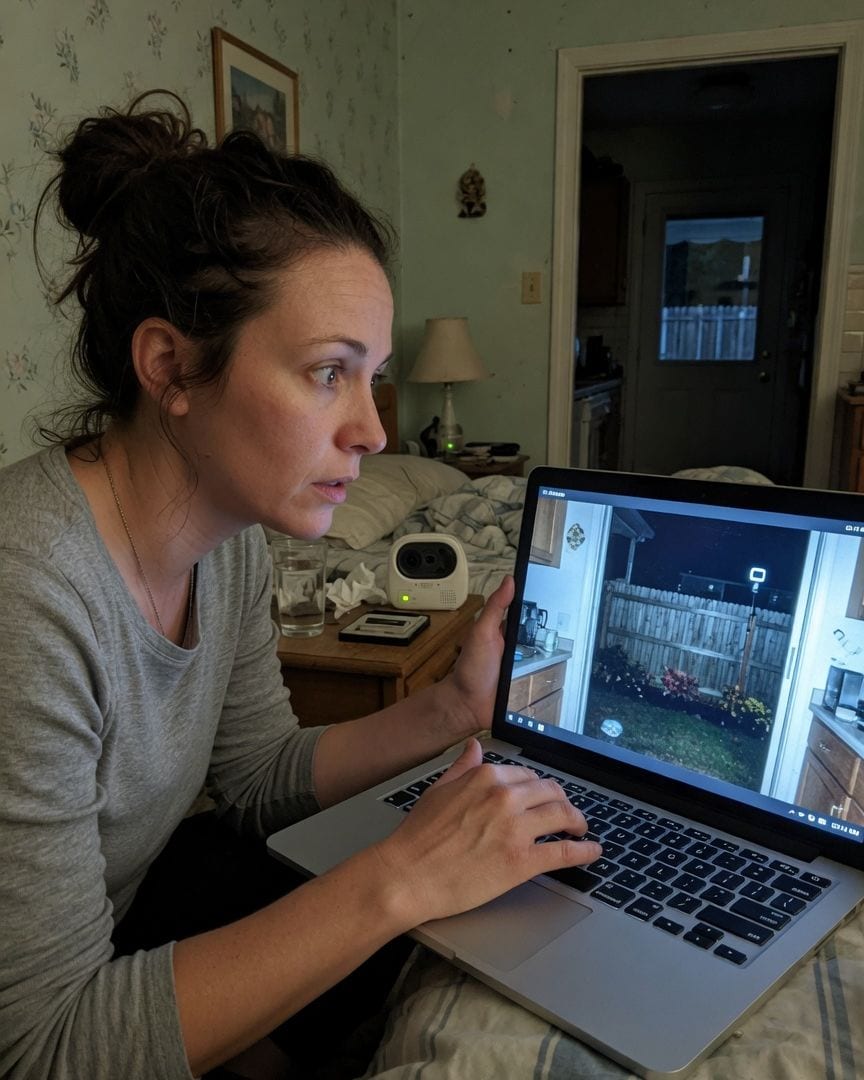
My game camera caught my back door from the inside. For three nights, it showed my door from the yard, getting closer. The last picture is from inside the glass, looking out at the fence.
I had set my game camera on the back fence, aimed at my house, to catch whatever I'd seen moving outside my kitchen window. But the last photo, taken after midnight, showed my kitchen from *inside* the locked back door, looking out.
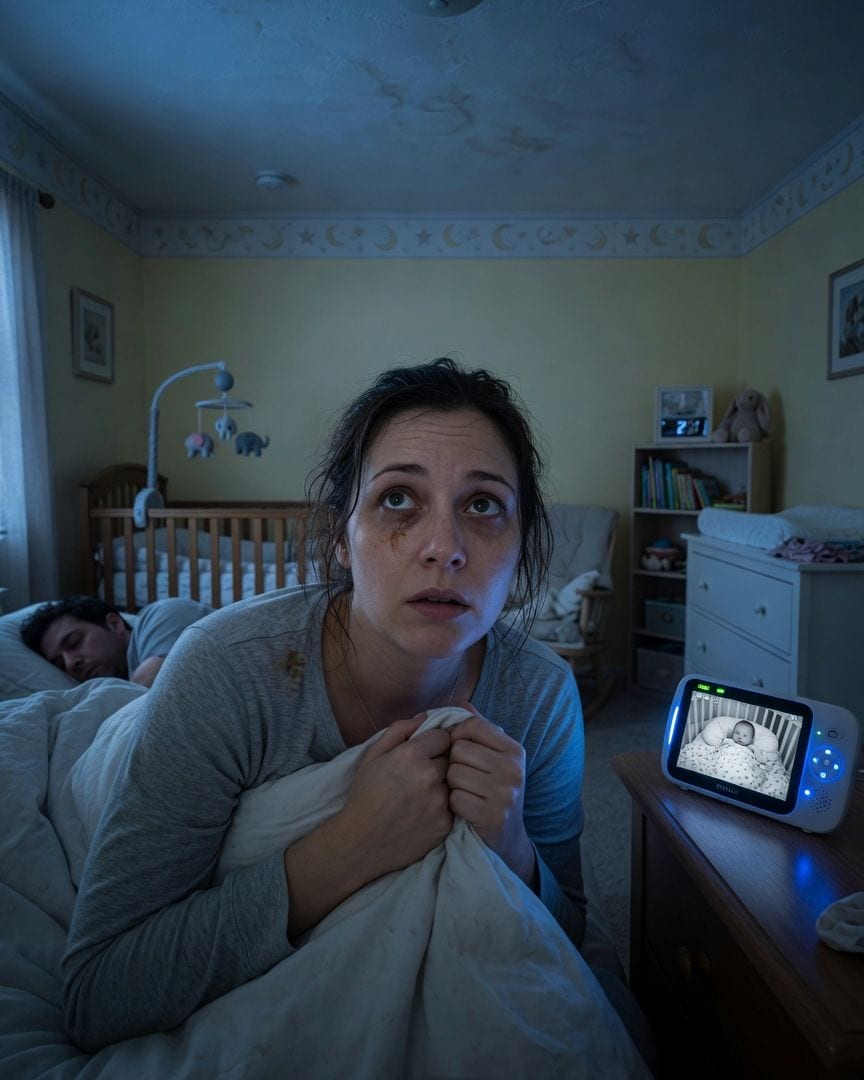
My baby monitor plays a lullaby from an empty room. But the floor holds a rocking chair's deep, decades-old track.
Every night, my baby monitor plays a lullaby and a rhythmic rocking chair creak from Emily's room. But the camera feed always shows her tucked in her crib, completely alone, in a silent, empty nursery. The sound is impossibly clear, as if the speaker were right there, even though nothing is.
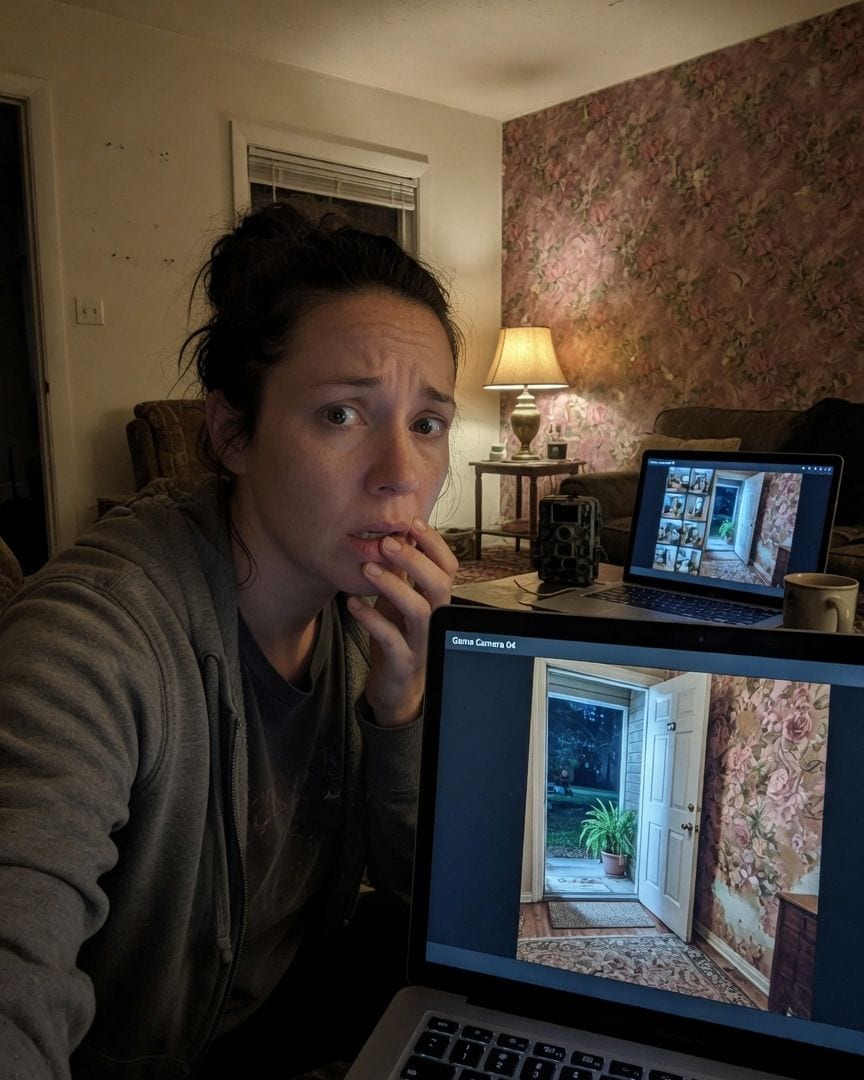
My game camera took photos of my back door, from inside the glass, looking out.
My routine check of the backyard game camera revealed an impossible photo: my back door, but taken from *inside* my locked house. What truly stopped my breath was the distinct floral wallpaper in the image – a pattern that hasn't covered my living room walls in over forty years.
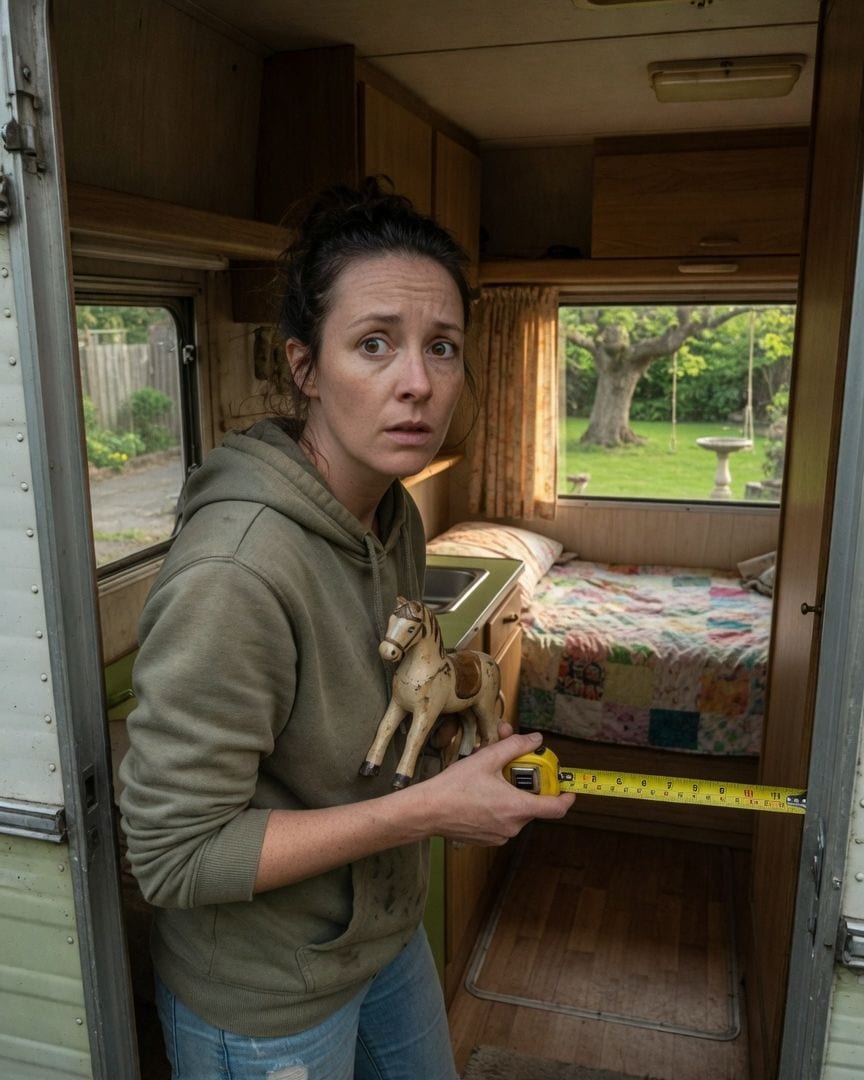
My new caravan's corridor runs longer than the caravan itself. Eleven feet of hallway past the end wall, to a room with a made bed and a window looking out on a garden it's never been parked in.
I finally bought my dream vintage caravan, a twelve-foot beauty. But when I measured inside for a mattress, the numbers didn't add up. Beyond where the wall should be, an impossible room with a window looked out onto a manicured garden I'd never seen before, a garden that couldn't possibly exist.
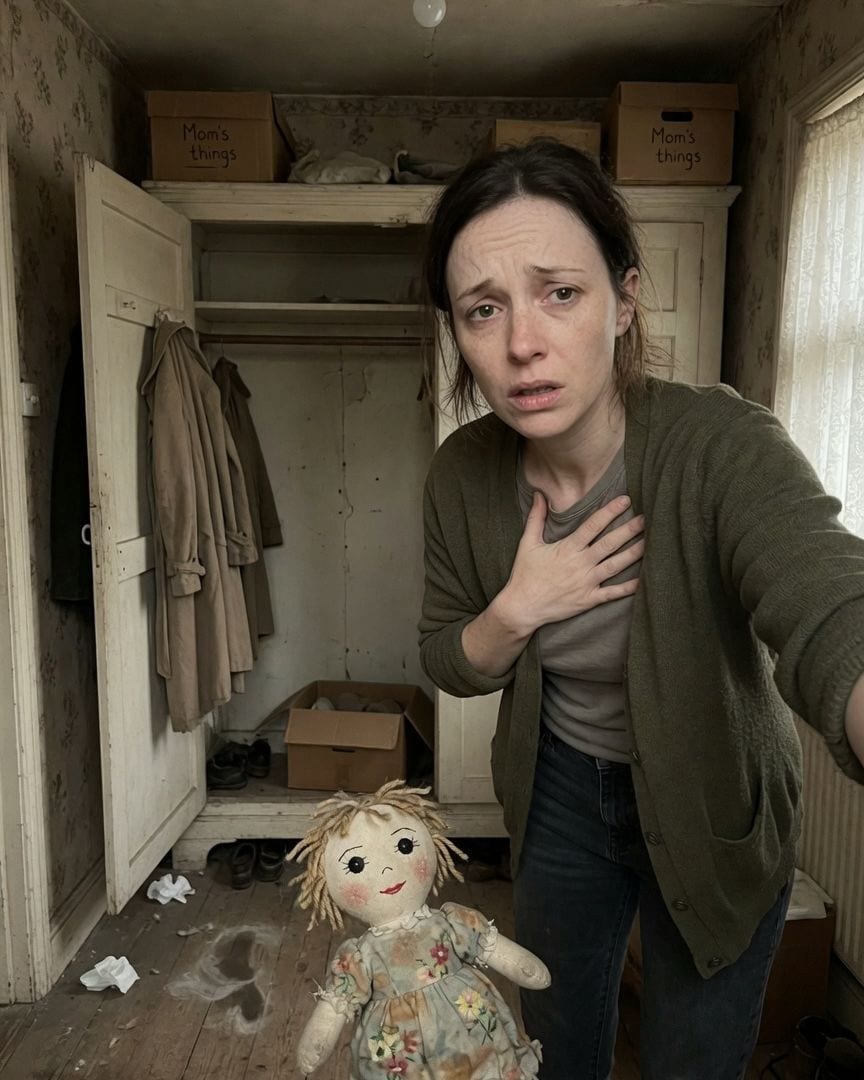
My shallow wardrobe opened into a child's bedroom. I'd knocked on its solid back wall for years. Now the doll from that room is on my floor.
My new house has a box room with a shallow wardrobe, barely a foot deep. But one day, reaching inside, the back wall vanished, opening into a child's bedroom with a cot and a burning nightlight. I slammed the door shut, only for it to be a normal closet again, leaving me with a cold, heavy stone of contradiction.
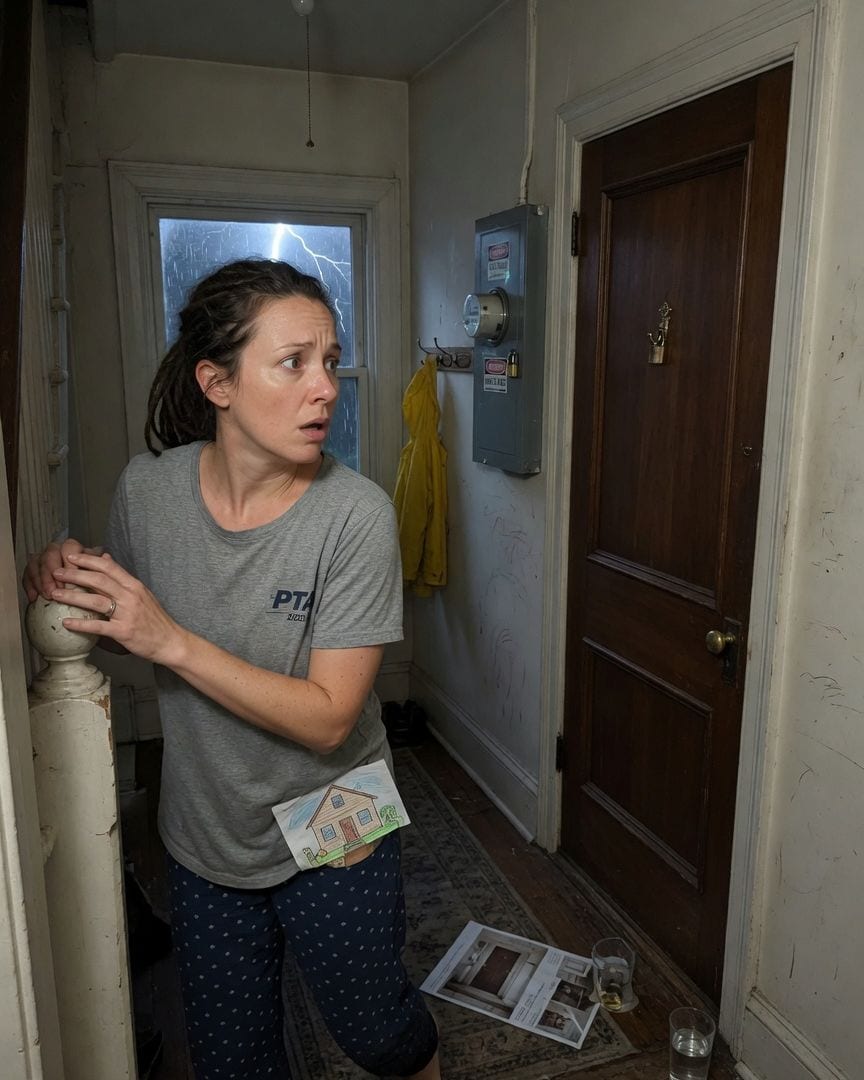
My son drew a door under our stairs. Tonight, I touched its cold brass handle.
My son Oliver drew our house with a small, panelled door under the main staircase, a detail I quickly dismissed because only a solid wall stood there. But an old real estate listing photograph revealed the exact door, perfectly placed, where no door could possibly exist.